|
|
|
PRINTING PROCESS |
|
|
|
|
Links for examples for early printing
processes. |
|
|
|
Definitions:
http://www.faqs.org/ologies-isms/Occ-Pot/Photography.html |
|
|
Collotype:
The collotype process was used by numerous
postcard printers at the
turn-of-the-century, particularly for their
monotone black orders. Some of the
publishers of Hamilton postcards who ordered
collotype cards were: B.C. Printing and
Litho. Ltd., Vancouver; Cloke & Sons,
Publishers, Hamilton; The International
Stationery Co., Picton; and Stanley Mills &
Co., Hamilton. The collotype process is
described in A Guide to Early
Photographic Processes as follows:
|
| |
Collotype Printing (early
1870's to date)
A photomechanical printing process
in which a metal or glass plate,
coated with bichromated gelatin, was
exposed under a negative. When the
moistened gelatin dried, it
reticulated, forming a fine-grained
mesh-like structure on the surface,
which took up greasy ink in
proportion to the hardening produced
by exposure. The ink was then
transferred from the plate to paper,
in a press. A number of processes
based on this principle were in use,
and is still operated for short run
quality printing. Collotype prints
show a well-defined, very
characteristic irregular grain
pattern when magnified.
|
| |
|
Photogravure:
A form of photoengraving in which the
photograph or illustration is reproduced on
an intaglio surface and then transferred to
paper. |
|
|
|
|
http://www.lahuffman.com/collotype.htm |
|
|
|
Example: |
 |
|
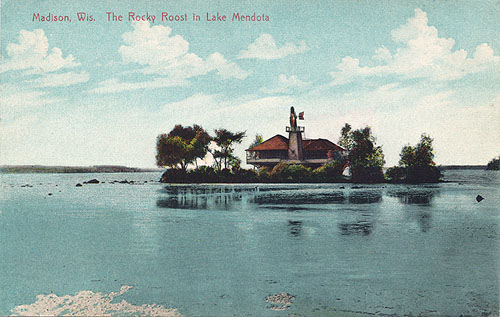
Rocky Roost Postcard. "Madison, Wis. The
Rocky Roost In Lake Mendota." Back: "The Hugh C. Leighton Co.,
Manufacturers, Portland, ME., U.S.A. (#) 15040. Made In Germany." PM
7/29/14. Circa 1909. There seems to be a mix of different processes. The sky
has a definite cyan (blue) halftone dot pattern, used in today’s printing
process. But this process appears only in the sky. The rest of the postcard,
including the water in the bottom half, is printed in color using a
cellotype,
photogravure or lithograph process, a
more uneven "dot" process. Under magnification, it appears that the magenta
(red), cyan (blue) and yellow plates most resemble the cellotype process.
The black plate is a very fine photogravure process printed over the three
other colors. Printed in Germany. The Hugh C. Leighton Co. manufactured
postcards from 1906-1909. They merged with Valentine & Sons in 1909. 5.4 x
3.4. See below. See
our Wright Study
of Rocky Roost. |
| |
 |
|
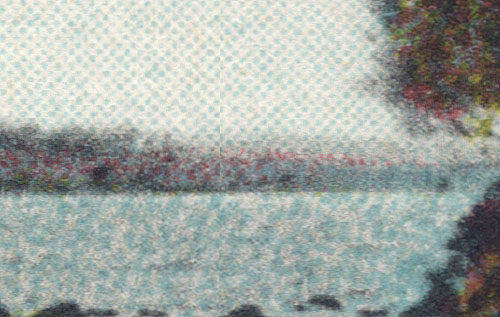
Rocky Roost Postcard.
Detail of image above. Circa 1909. There seems to be a mix of different processes. The sky
has a definite cyan (blue) halftone dot pattern, used in today’s printing
process. But this process appears only in the sky. The rest of the postcard,
including the water in the bottom half, is printed in color using a
cellotype,
photogravure or lithograph process, a
more uneven "dot" process. Under magnification, it appears that the magenta
(red), cyan (blue) and yellow plates most resemble the cellotype process.
The black plate is a very fine photogravure process printed over the three
other colors. Printed in Germany. See
our Wright Study
of Rocky Roost. |
|
|
|
|
|
|
|
|
|
|
|

CLICK TO ORDER












































































