|
|
| YEAR |
DESCRIPTION |
ST# |
|
1855 |
1855
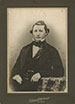 |
Harry C. Goodrich Residence, Oak Park,
Illinois, Portrait Circa 1855 (1896 - S.042). Portrait of Harry C.
Goodrich, taken about the time he was married, circa 1855. Frank Lloyd
Wright designed a house for Goodrich in 1895. Harry Clinton Goodrich was
born on March 22, 1832, died in 1926 at the age of 94. He was married to
Louisa M. Fowler on March 22, 1855. They had 11 children. The oldest was
Adelaide Eunice Goodrich, born in 1856. She became a famous actress. The
Adelaide Eunice Goodrich Collection of documents is located at the
University of Chicago Library. Harry C Goodrich also had a son by the
same name, Harry C. Goodrich, who was born on September 2, 1871. Harry
C. Goodrich (Sr.) had a brother, Herman Barnum Goodrich, who was also an
inventor. Herman B. Goodrich married Emily C. Dunkllee on November 8,
1855. They had seven children, one of which was named Harry Clinton
Goodrich, born on January 27, 1866. Text on face: "Gibson Art Galleries,
Chicago." Text hand written on verso: "H. C. Goodrich, taken about the
time he married. Father of Eunice Goodrich. #46." Stamped on verso:
"Harry Clinton Goodrich, 72 Wabash Ave., Chicago." Courtesy of the
University of Chicago Library. 7.25 x 10 B&W photograph. |
0000.47.0323 |
|
1879 |
C Pre 1879
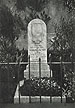 |
Tomb of John Keats, Circa pre-1879. Keats was born on October 31, 1795
and died on February 23, 1821 in Rome and was buried in the Protestant
Cemetery, Rome. His last request was to be placed under a tombstone
bearing no name or date, only the words, "Here lies One whose Name was
writ in Water." Joseph Severn and Charles Brown erected the tomb stone.
Under the relief of a lyre with broken strings, includes the epitaph,
"This Grave contains all that was Mortal of a Young English Poet Who on
his Death Bed, in the Bitterness of his Heart at the Malicious Power of
his Enemies Desired these Words to be engraven on his Tomb Stone: "Here
lies One Whose Name was writ in Water. 24 February 1821." Joseph Severn
was one of Keats closest friends. When he pasted away August 3, 1879, he
was buried next to Keats in the Protestant Cemetery, where they both
buried today. This photograph shows a concrete border tightly bordering
just the Keats grave, which may indicate this was photographed before
Severn's death. The concrete border was expanded to include Severn's
tomb stone. Caption: "2508. Cosmos Pictures Co. New York. Tomb of
Keats." After the turn of the century in 1900, Cosmos Pictures
advertised, "Reproductions...
Continue...
For more information on the
Eve of St. Agnes see our Wright Study.
|
0000.28.0613 |
|
1883 |
1883
 |
Wright at 16.
The Lloyd-Jones clan in 1883. Portrait of the Lloyd Jones family
photographed in the Spring Green area. The empty chair in the front row
was in memory of the wife of Richard Lloyd Jones. Front row (L-R):
Thomas, Mary, Jenkin, Charles, Richard, Frank Lloyd Wright (to the right
of the empty chair) holding his sister Maginel, Susan with Mary Lloyd at
her feet, and Jenkin with Richard at his feet. Middle row (L-R): Elinor
holding Agnes, Laura holding Maud, J. Richard holding Gwen, Orren,
Ellen, Edward, M. Helen, Jane (with her niece Jane standing behind her),
Elsie. Back row (L-R): Enos holding Chester, James holding Scott, John,
Nettie, Thomas B. Jones, Margaret, Thomas, Esther, William Carey Wright
and his wife Anna (Frank Lloyd Wright's parents), James Philip, and
Mary, three unidentified girls in front of them. Hand written on verso:
"The clan. (Frank, setting next to empty chair, is holding Maginel.)
Slipping pasted to verso: "The Lloyd-Jones clan in 1883: (Frank Lloyd
Wright, seated to the right of the empty chair, holds his sister,
Maginel in his lap." Original 10 x 8 B&W photograph. |
0000.36.0719 |
|
1885 |
1885
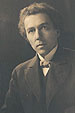 |
Wright at 18. Frank Lloyd Wright Portrait (circa 1885). Photographer
E.R. Curtiss, Wisconsin Historical Society. High-res digital
4 x 5 image. |
0001.01.0706 |
|
1886 |
Circa 1886
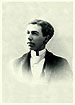 |
Wright
at 19. Frank Lloyd Wright Portrait (circa1886).
In January 1886, Wright was admitted to the University of Wisconsin. In
early 1887 Wright left Madison for Chicago. 5.75 x 7.1. Print, High res
digital image. |
0001.02.0310 |
|
1887 |
1887
 |
Unitarian
Chapel for Sioux City, Iowa. 1887 (FLLW #8702 - Project). Vintage 4" x
3.25" Magic Lantern Slide of the Unitarian Chapel for Sioux City, Iowa.
Copy slide of the perspective illustration by Frank Lloyd Wright,
published in the Inland Architect & News Record, June 1887 (Sweeney
3). Magic
lantern slides were used in the U.S. during the late 1800s through the
first half of the 1900s. Text: “Unitarian Chapel for Sioux City, Iowa.”
Signed: “Frank L. Wright, Arch. - Chicago, Ill.”
Bruce Brooks Pfeiffer wrote, “The Unitarian Chapel was Wright's first
independent commission and, although unbuilt, the drawing was published
in Inland Architect in 1887...” Frank
Lloyd Wright, Complete Works 1885-1916, 2011.
Text on face of slide: “Wright, Frank Lloyd, 1867-1959. 1887. Project
for Unitarian Chapel, Sioux City, Iowa. (From Inland Architect, June
1887). 62191. Art Dept Smith College.” Acquired from the Art Department
at Smith College. Magic lantern slide 4" x 3.25", Transparency: 3" x
2.25" |
0003.01.0725 |
1887
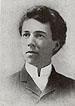 |
Wright at 20. Portrait of Wright shortly after he arrived in Chicago.
Published in "An Autobiography, Frank Lloyd Wright",
Wright, 1977, page 64f. Dated at age 20. Also published in "Frank
Lloyd Wright A
Biography, Secrest, 1992, page 80. Dated at age 20. 4.25 x 6 Print, High
res digital image. |
0004.01.0509 |
C 1887
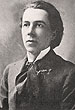 |
Wright at 20.
Circa1887. Wright is looking to the left of the camera. A pleasant, calm
look on his face. In January 1886, Wright was admitted to the University
of Wisconsin. In early 1887 Wright left Madison for Chicago. Almost
immediately he acquired an entry level job as a tracer with Joseph Lyman
Silsbee, an architect well known for Queen Anne and Shingle-Style homes.
He was soon promoted to draftsman. In 1888 he took a job as a draftsman
for Adler and Sullivan. Text on sleeve: "Wright-Portrait -7. American.
Wright during Oscar Wilde phase, ca. 1887. Full view. 1882-92. U of
Virginia FAIC." Acquired from the archives of the University of
Virginia. 35mm Color slide, sandwiched between glass, plastic mount. |
0004.06.0520 |
|
1888 |
1888
 |
Perspective
illustration of the Residence for J. L. Cochrane 1888. Vintage 4" x
3.25" Magic Lantern Slide of the Residence for J. L. Cochrane. Copy
slide of the perspective illustration by Frank Lloyd Wright, published
in the Inland Architect & News Record, March 1888 (Sweeney
9). Magic lantern slides were used in the U.S. during the late 1800s
through the first half of the 1900s. Text: “Residence for J. L.
Cochrane, Esq. J. L. Silsbee, Architect.” Signed: “Frank L. Wright.”
Text on face of slide: “Wright, Frank Lloyd, 1867-1959. 1887-88. Project
for Cochrane House. (From Inland Architect, 1887 or 1888). 62190. Art
Dept Smith College.” Acquired from the Art Department at Smith College.
Magic lantern slide 4" x 3.25", Transparency: 3" x 2" |
0009.13.0725 |
1888
 |
Victor Falkenau
Row House Element, Chicago, 1888. Adler & Sullivan, Architects, Chicago.
Terra-cotta Cherub, designed for the face of the three houses in 1888,
salvaged from the Victor Falkenau Row Houses during demolition. In 1887
Frank Lloyd Wright joined the firm of Adler & Sullivan where he worked
for six years. An illustration of the Falkenau Row Houses was published
in the Inland Architect
& News Record - V. XI No.7 - June 1888. "Houses for Victor Falkenau,
Chicago. Adler & Sullivan, Architects, Chicago." Signed: "Frank L.
Wright." A description was published in "The Daily Inter Ocean,"
December 16, 1888: "The Material Of The Fronts Is Blue Bedford Stone,
With Pressed Brick For The Other Walls. There Are Elegant Copper Bays At
The Second Storey And Much Beautiful Carving In Stone, Especially About
The Cornice And In The Open Lattice-Work Of The Basement. Two Cherub
Heads Are Introduced Very Effectively. The Houses Are Three-Storey And
Basement, With Hardwood Finish Throughout The First Floor, Very
Elaborate Gas-Fixtures, And The Most Liberal Provision Of Sanitary
Appliances" The Sidewalks Are Stone, And So Are The Steps Of The House,
And The Latter Are Protected By Wrought Iron Rails..." The three
row-houses were located at 3420-24 South Wabash avenue...
Continue... |
0005.01.0919 |
C 1888
 |
Wright at
21. Frank Lloyd Wright and Cecil Corwin in Chicago, circa 1888.In early
1887 Wright left Madison for Chicago. Almost immediately he acquired an
entry level job as a tracer with Joseph Lyman Silsbee, an architect well
known for Queen Anne and Shingle-Style homes. He was soon promoted to
draftsman. In 1888 he took a job as a draftsman for Adler and Sullivan.
It was during his employment with Silsbee that he met and developed his
relationship with Corwin. Wright wrote extensively about his friendship
with Corwin in An Autobiography,
Including a chapter about Corwin. "During these later months at
Silsbee's Cecil and I were inseparable. Discussed everything in the
heavens above, the earth beneath and the waters thereof. We would go to
Madame Galle's Italian table d'hdte and various other cozy restaurants.
Or, if we had a little money, to the Tip Top Inn in the Pullman
Building." 1932, P.75. Courtesy of the Frank Lloyd Wright Foundation. 8
x 7.75 B&W photograph. (S#09.09) |
0009.09.0820 |
|
1889 |
1889
 |
Wright at 22. Frank Lloyd
Wright Portrait (circa 1889). International Newsreel Photo - Received 9/20/29. Typed
caption on back: "Friends incorporate F.L. Wright, Architect. Chicago
Ill... Frank Lloyd Wright, internationally famous architect who is now an
institution under the charter of Frank Lloyd Wright, Inc., following the
establishment of the corporation by his friends. Wright may now give
his talent free play unhampered by domestic or financial matters. He
is said to have invented a method that will revolutionize skyscrapers."
Time line: Wright arrived in Chicago in 1887. Set up his own practice
in 1893. Original silver gelatin photo. 6 x 8. |
0009.01.0401 |
|
1890 |
C 1890
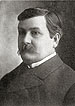 |
Dr. Allison W.
Harlan House, Chicago, Illinois, Portrait Circa 1890 (1892 - S.018).
Portrait of Dr. Allison Wright Harlan circa 1890. Dr. Harlan was a
successful Chicago Dentist. Born on November 15, 1851 and died on March
6, 1909 at the age of 57. He moved to Chicago in 1869. "Dr. Harlan was
one of the most active and best known dental practitioners in the United
States." The Bur, March 1909, p.35. In 1881, he was appointed a member
of the first Board of Dental Examiners. In 1881 he also assisted in
organizing the Chicago College of Dental Surgery and on of the first
Board Members. He wrote the first published article suggesting the
holding of of the Columbian Exposition in 1893. He belonged to numerous
dental and medical societies, attending conferences throughout the
world. He established The Dental Review, and was the Editor for years.
It was reported that his death was caused by a fall in his home. He
commissioned Frank Lloyd Wright to designed a house in 1892 while Wright
was still working for Louis Sullivan, it was considered one of Wright's
"bootlegged" houses. 8 x 10 B&W copy of photograph published in The Bur,
March 1909, p.36. |
0010.03.0420 |
1890
 |
Wright
at 23, Wright Family, Summer 1890. On June
1, 1889, Catherine and Frank were married in Chicago, Illinois. She was
17 years old. During the Summer of 1890, at one of the family
gatherings, this photograph was taken on the front steps of Wright's
newly completed home. Always aware of appearance, Wright placed an
oriental carpet on the stairs, and a tennis racket in his Aunt's hand.
(L to R) Uncle Jenkin Lloyd Jones and his wife Aunt Susan Lloyd
Jones; Wright's sister Jane; Catherine holding Frank Lloyd Wright, Jr.
(Lloyd); his mother Anna Wright; his sister Maginel; Wright; and Mary,
the daughter of Jenkin and Susan. Published in "Frank Lloyd Wright's
Monona Terrace", Mollenhoff; Hamilton, 1999, page 61, Dated late 1890.
6.75 x 5.5. Print, High res digital image. |
0011.01.0310 |
|
1891 |
1891

|
James
Charnley Residence 1891 (1891 - S.009). Presentation Drawing of the
James Charnley Residence, Adler and Sullivan Architects. Designed in
1891 by Frank Lloyd Wright. After arriving in Chicago, Frank Lloyd
Wright was hired as a draftsman with Joseph Lyman Silsbee who he had
collaborated with on Unity Chapel (1886 - S.000) in Spring Green. His
employment with Silsbee was short lived after accepting employment in
1887 as a draftsman for Adler and Sullivan, working closely with
Sullivan for six years. In his autobiography, Wright wrote: "With
Silsbee, I had gained considerable light on the practical needs of the
American dwelling. Adler and Sullivan refused to build residences during
all the time I was with them. The few that were imperative, owing to
social obligations to important clients, fell to my lot out of office
hours. They would, of course, check up on them in good time. Sullivan's
own home on Lake Avenue (now demolished) was one of these, as were his
southern house at Ocean Springs and the house next door for the
Charnleys. The city house on Astor Street for the Charnleys, like the
others, I did at home evenings and Sundays in the nice studio draughting
room upstairs at the front of the little Forest Avenue home... In this
Charnley city-house on Astor Street...
(Sweeney 11)... Continue... |
0011.00.0919 |
1891-92
 |
Wright's Oak Park Home 1891 to 1892 (1895 - S.002-4). Frank Lloyd Wright
purchased the lot in Oak Park in May 1889, drawings for the home are
dated 1889. Construction did not begin until late August and was
probably finished by the end of 1889 or the early part of 1890. The
original working drawings of the 1889 home still exist in the Taliesin
Archives. This photograph published in "The Frank Lloyd Wright Home and
Studio, The Plan for Restoration and Adaptive Use," 1978, page 20, and in
"In The Nature of Materials", Hitchcock, 1942, Plate 11. Caption:
"West
facade of home, facing Forest Avenue, about 1891 or 1892. Interlocked
windows have been modified, becoming a band of casement windows.
Diamond-pane art glass now appears in all the window sash. Awning used
to block the western sun." Two large vases sit atop the piers on either
side of the stairs. A decorative gate enclosed the porch, and begs to be
a Wright design. Label pasted to verso: "The Museum of Modern Art.
Wright, Frank Lloyd. House of the Architect, Oak Park, Illinois, Front
of the House, 1889." Original 10 x 8 B&W photograph. |
0011.10.0216 |
1891-92
 |
1) Frank Lloyd Wright Home & Studio, Oak Park, Illinois, 1891 to 1892
(1895 - S.002-4). Set of 2 - 35mm slides. Frank Lloyd Wright purchased
the lot in Oak Park in May 1889, drawings for the home are dated 1889.
Construction did not begin until late August and was probably finished
by the end of 1889 or the early part of 1890. Text on sleeve: "Wright,
F. L. Wright Home & Studio. 4-1. Wright Home & Studio. Ext., original
facade of house from street. Oak Park, IL. USA. 1889-1909. Wright, Frank
Lloyd. U of Virginia FAIC." Acquired from the archives of the University
of Virginia. 35mm Color slide, sandwiched between glass, plastic mount. |
0011.11.0720 |
1891-92
 |
2) Frank Lloyd Wright Home & Studio, Oak Park, Illinois, 1891 to 1892
(1895 - S.002-4). Set of 2 - 35mm slides. Frank Lloyd Wright purchased
the lot in Oak Park in May 1889, drawings for the home are dated 1889.
Construction did not begin until late August and was probably finished
by the end of 1889 or the early part of 1890. Text on sleeve: "Wright,
F. L. Wright Home & Studio. 4-3. Wright Home & Studio. Ext., original
facade of house from street. Oak Park, IL. USA. 1889-1909. Wright, Frank
Lloyd. U of Virginia FAIC." Acquired from the archives of the University
of Virginia. 35mm Color slide, sandwiched between glass, plastic mount. |
0011.12.0720 |
|
1892 |
C 1892

|
Dr. Allison W. Harlan House, Chicago, Illinois,
Circa 1892 (1892 - S.018). View of the Harlan House from the East. Note:
This photograph has not been dated. Our conclusion: It is very similar
to image published in The Inland Architect, 1897. The vegetation on the
left and right side of the Terrace is similar. The balcony planters do
not have plantings in them. This could have been taken just after
construction was complete, or a few years after. We lean toward this
being an earlier view.
According to Greg Brewer who supplied this more complete photograph
concluded: “I think it taken in summer 1892 around the time of first
occupancy. (The Harlans occupied the house in July 1892.) Notice what
appears to be excavation at right. I think the photo was taken
immediately before construction of the neighboring apartment buildings.
The building permit was issued September 24, 1892. Harlan and others
filed for an injunction to prevent construction in November 1892. The
State Supreme Court ruled against them in April 1893. The building later
burned in November 1894. The ruins of the north portion are shown on the
1897 Sanborn map. The apartment building shown in the more common later
photo of the house was built in 1901...
Continue... |
0013.29.0524 |
C
1892
|
Dr. Allison W. Harlan House, Chicago,
Illinois, Circa 1892 (1892 - S.018). View of the Harlan House from the East.
Note: This photograph has not been dated. It is very similar to image
published in The Inland Architect, 1897. The vegetation on the left and
right side of the Terrace is similar. The balcony planters do not have
plantings in them. The tree on the far right, 10-20 years old, does not
exist in the 1897 view, so this cou8ld have been taken just after
construction was complete, or a few years after, and the tree was cut down
before the 1897 view. We lean toward this being an earlier view. There are
three children standing to the left of the terrace. Designed in 1892 while
Frank Lloyd Wright still worked for Louis Sullivan, it is considered one of
Wright's "bootlegged" houses. There are two cantilevered balconies, one that
runs the length of the front of the house, and a shorter balcony on the
South elevation. The face, side and possibly the base of the balcony is
covered in Sullivanesque panels, and the front balcony is topped with
planters. Just below the roof line is another simplified cut-out design,
which is repeated in the dormer above. The entrance is reached on the left
side of the house. Stairs lead up to a hall that is open on the second
floor. The Library is straight ahead, Living Room to the right, Dining..
Continue... |
0041.38.0420 |
1892
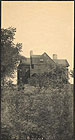 |
Hillside Home School I 1892 (1897 - S.001). Ellen (Nell) and Jane Lloyd
Jones, Frank Lloyd Wright's aunts, formed the Hillside Home School in
1887 and ran it until 1915 when it closed. The private school accepted
students between the ages of seven and seventeen. It espoused
non-conventional teaching methods, and was the first coeducational
school in the nation. After attending the University of Wisconsin,
Madison, Wright headed for Chicago in 1887 and accepted a position as
draftsman in the architectural firm of Joseph Lyman Silsbee. That year,
his Aunt's drafted him to design a school building for them, a large
Shingle styled building, reflected the designs of his mentor Silsbee,
and in the style of his first project, Unity Chapel, in Spring Green. It
was demolished in 1950. Photographed by Frank Lloyd Wright. Courtesy of
the Wisconsin Historical Society. 3.75 x 7 B&W photograph. |
0013.08.1213 |
1892
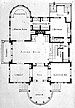 |
George Blossom
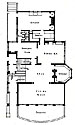
Residence, Chicago, Illinois, First Floor Plan 1892 (1892 - S.014).
First floor plan for the George Blossom Residence published in In The Nature Of
Materials, Wright, 1942, Plate 20. Frank Lloyd Wright designed
the George Blossom Residence in 1892. Text on sleeve: "A-20-Wr-100-1.
Wright. Blossom House. Plan: First floor." Acquired from the archives of
the University of Virginia. 35mm Color slide, sandwiched between glass,
plastic mount.
 |
0013.23.0720
0013.24.0720 |
C 1892
 |
George Blossom
Residence, Left (1892 - S.014) and the Warren McArthur Residence, Right
(1892 - S.011) Circa 1892. Both designed in 1892, both bootleg projects.
Note: this could be one of the earliest photographs of both houses. The
houses appear to be near completion, but debris appears to still be in
the yards. Sidewalks and curbs have been installed, but the streets
still appear to be dirt. The short wall, which is set between two sets
of stairs, that borders the sidewalk on the South (left) side of the
Blossom house has not yet been installed. The McArthur house on the
right, has the circular terrace, which was later squared off and
covered. 10 x 7.5 B&W photograph. |
0013.10.0517 |
1892
 |
Dr. Allison W.
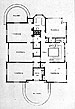
Harlan House, Chicago, Illinois, Floor Plan 1892 (1892 - S.018). First
floor plan for the Allison Harlan House. Designed in 1892 while Frank
Lloyd Wright still worked for Louis Sullivan, it is considered one of
Wright's "bootlegged" houses. The entrance is reached on the left side
of the house. Stairs lead up to a hall that is open on the second floor.
The Library is straight ahead, Living Room to the right, Dining and
Kitchen to the left. Five sets of floor to ceiling doors (and or
windows) in the Living Room open to an enclosed Terrace. Illustration
courtesy of In The Nature Of
Materials, Hitchcock, 1942, plate 22. Modified by Douglas M.
Steiner. 8 x 10 B&W photograph. |
0013.16.0420 |
1892
 |
Warren McArthur
Residence, Chicago, IL., Floor Plan Circa 1892 (1892 - S.011). Floor
plan for the Warren McArthur Residence. Copy of plan published in
Frank Lloyd Wright To 1910,
Manson, 1958, p.55. Designed by Frank Lloyd Wright in 1892. Text on
sleeve: "Wright, F. L. - McArthur House, 1-1. McArthur House. Plan,
ground floor. Chicago, IL., USA, 1892. Wright, Frank Lloyd. U of
Virginia FAIC." Acquired from the archives of the University of
Virginia. 35mm Color slide, sandwiched between glass, plastic mount. |
0013.22.0520 |
1892
 |
Robert P.
Parker House, Oak Park, Illinois, 1892 (1892 - S.017). First Floor Plan
for the Parker house. Designed by Frank Lloyd Wright in 1892. Text
bottom right: "First Floor Plan. Dwelling for Robert P. Parker." Stairs
lead up to an octagonal front porch. The entrance Hall is through the
front door. On the left is the octagonal Reception Room on the Northeast
corner. It leads to the Library (Living Room) with fireplace, and a door
that leads out to an octagonal Terrace. Continuing on, you enter the
octagonal Dining Room on the Southeast corner. Back at the entrance
Hall, straight ahead you pass the stairs that lead downstairs and the
Kitchen with a door that leads out to an exposed porch on the Southwest
corner. On the right side of the Hall, stairs lead to the second floor.
Robert P. Parker was an attorney in the Chicago area. The Chicago Legal
News reported on October 18, 1884, that Robert P. Parker and Frank A.
Parker were admitted to the bar. The Parker House is located about a
half-block west of Frank Lloyd Wright's home and Studio. Queen Ann in
style, it is similar in design to the
Robert G. Emmond
House, LaGrange, Illinois (1892 - S.015) and uses the same floor plan as
the
Thomas H. Gale
House (1892 - S.016). It is also one of Wright's earliest designs. Like
the Emmond and Gale... Continue... |
0013.17.0420 |
1892/1964
 |
Albert W. Sullivan Residence, Chicago, Illinois, 1892/1964 (1892 -
S.019). Reconstructed floor plan for the first and second floors of the
Albert Sullivan Residence. Delineated by John Vinci circa 1964. From the
Richard Nickel Archive. Designed in 1892 while Frank Lloyd Wright worked
for Louis Sullivan. Albert Sullivan, Louis" brother, commissioned him to
design a house for their mother. She past away before it was completed
and Louis Sullivan moved into the house when it was completed, and lived
there until 1896. Albert and his family then took up residence there
until 1914. The house was a collaboration between Sullivan and Wright,
but most scholars credit Wright with the design and Sullivan with the
floral designs. Sullivan was busy on commercial commissions and
delegated residential to Wright. The upper copper bay window was removed
in 1964. The house was demolished in 1970. Courtesy of The Art Institute
of Chicago. 10 x 8 B&W photograph. |
1596.113.0823 |
|
1893 |
C 1893
 |
Robert G. Emmond Residence, LaGrange, Illinois Circa 1893 (1892 -
S.015). Viewed from the Southwest. Designed and built in 1892 while
Frank Lloyd Wright still worked for Louis Sullivan, it is considered one
of Wright's "bootlegged" houses. It is similar in design to the
Thomas Gale Residence (1892 - S.016)
and the Robert Parker Residence (1892 - S.017). It is also one of
Wright's earliest designs. The stairs on the left lead up to a terrace,
and the main entrance. The front door opens to an entry hall with stairs
on the left that lead to the upper level. Straight ahead through a
doorway leads to the kitchen, or to the right, the octagonal reception
room. Between the two octagonal bays on the right is the "library"
(living room) which opens to a second terrace. Changes were made over
the years, but this photograph shows the house as Wright intended it. 10
x 7 B&W photograph. |
0013.11.0619 |
C 1893
 |
Peter Goan Residence, La Grange, Illinois, Front Elevation Circa 1893
(1893 - S.029). Considered one of Frank Lloyd Wright's last "Bootlegged"
Houses. Text: "Front Elevation. House For P. Goan, Esq. La Grange, Ills.
- Section." Running the full length of the front of the house was a
covered porch. Balustrades were in line with the sills of the upper
windows. Balustrades also enclosed the lower portion of the porch. The
two corner posts were decorative. Drawings indicated a carved wood base
"not included in this contract." They were capped in the drawings with
"turned wood balls." Two additional porch columns were capped with
"Carved Capitals." Missing from the drawing, but visible today are the
attic dormers. Courtesy of the Frank Lloyd Wright Foundation. Copy 8 x
10 photograph of the original drawing. |
0013.12.1019 |
C 1893
 |
Peter Goan Residence, La Grange, Illinois, North Elevation Circa 1893
(1893 - S.029). Considered one of Frank Lloyd Wright's last "Bootlegged"
Houses. Text: "North Elevation. House For P. Goan, Esq. La Grange,
Ills." Running the full length of the front of the house was a covered
porch. Balustrades were in line with the sills of the upper windows.
Balustrades also enclosed the lower portion of the porch. The two corner
posts were decorative. Drawings indicated a carved wood base. They were
capped in the drawings with wood balls. Above the side door on the North
Elevation is a tall window, allowing light to flood the stairwell.
Missing from the drawing, but visible today are the attic dormers. The
only dormer Wright indicated was on the back side of the house. Courtesy
of the Frank Lloyd Wright Foundation. Copy 8 x 10 photograph of the
original drawing. |
0013.13.1019 |
C 1893
 |
Peter Goan Residence, La Grange, Illinois, First Story Plan Circa 1893
(1893 - S.029). Considered one of Frank Lloyd Wright's last "Bootlegged"
Houses. Text: "First Story Plan. House For P. Goan, Esq. La Grange,
Ills." The floor plan of the Goan House is similar to the plan of
Wright's own home in Oak Park. The doorway on the right leads to a large
hall with an open stairway that leads to the upper four bedrooms and
bath. To the left is the living room with a central fireplace and
inglenook with built-in seating, much like Wright's own home. The bay
window in the living room does not continue to the second floor. The
dining room also has a bay window which does continue to the second
floor. The dining room was designed with built-in cabinets with "Glass
Panel Doors." Courtesy of the Frank Lloyd Wright Foundation. Copy 8 x 10
photograph of the original drawing. |
0013.14.1019 |
C 1893
 |
Peter Goan Residence, La Grange, Illinois, Second Story Plan Circa 1893
(1893 - S.029). Considered one of Frank Lloyd Wright's last "Bootlegged"
Houses. Text: "Second Story Plan. House For P. Goan, Esq. La Grange,
Ills." The floor plan of the Goan House is similar to the plan of
Wright's own home in Oak Park. The doorway on the right leads to a large
hall with an open stairway that leads to a large hall on the second
floor with four bedrooms and bath. The dining room's bay window
continues to the second floor. Courtesy of the Frank Lloyd Wright
Foundation. Copy 8 x 10 photograph of the original drawing. |
0013.15.1019 |
1893
 |
William Storrs MacHarg (McHarg), Chicago, Illinois, 1893 (1891 - S.10).
World's Columbian Exposition Senior Management Staff. Published in The
Inland Architect and News Record, (1893) Volume XXII, No. 5. Wm. Storrs
MacHarg is #35, Second row, fifth from the right. Daniel Hudson Burnham
is #44, First Row, fifth from the right. Frank Lloyd Wright designed the
MacHarg Residence in 1891 while working for Louis Sullivan. MacHarg was
the Chief Engineer in Chicago for water, sewage and fire-protection, and
oversaw much of the related construction in Chicago. He was also part of
the management team for the Chicago World's Columbian Exposition in
1893. Text: "The Director of Works and Staff of the World's Columbian
Exposition, Chicago." Courtesy of the Art Institute of Chicago. 10.5 x
7.25 B&W B&W photograph. |
0013.18.0620 |
1893
 |
Municipal Boathouse, Lake Mendota, Madison,
Wisconsin, Front Elevation 1893 (1893 - S.022). Front Elevation for the
Municipal Boathouse on Lake Mendota. The Municipal Boathouse on Lake
Mendota, in Madison, Wisconsin, a recreational building and storage
facility, was designed by Frank Lloyd Wright in 1893. He was 26 year old
at the time and a draftsman for the architectural firm of Adler and
Sullivan. In March 1893, the Madison Improvement Association announced a
competition for sketches of a boat house to be built by the association.
Frank Lloyd Wright submitted two designs, and both were excepted, one
for Lake Mendota and one for Lake Monona. The boat house for Lake
Mendota was completed by the Spring of 1894, but construction...
Continue...
|
0013.25.0823 0013.26.0823 0013.27.0823
0013.28.0823 |
C 1893
 |
Rookery Building Lobby circa 1893. View of the Lobby looking toward the
stairs. The Rookery building was designed by Burnham and Root in 1888.
Edward C. Waller, a client of Wright's, managed the Rookery Building in
1905 and retained Wright in 1905 to remodel the Entryway and Lobby.
Wright's offices were located in the building from 1898-1899.
Photographed before Wright remodeled the lobby. Published by the S. L.
Stein Publishing Co. 12 x 9.6. |
0013.03.0512 |
1893
 |
Francis James Woolley, Oak Park, Illinois Floor
Plan 1893 (1893 - S.023). Designed by Frank
Lloyd Wright in 1893, it is similar to those designed during his
"Bootlegged" houses, but there are hints of Prairie elements. Although
the house is designed with three octagonal bays, they are not as
prominent as the
Emmond (1892 - S.015),
Gale (1892 - S.016)
and
Parker (1892 - S.017)
houses. Text: "First Story Plan. House For Francis Wooley, Esq. Oak
Park, Illinois. F L Wright, Architect." Published in
Frank Lloyd Wright, Complete
Works 1885-1916, Pfeiffer, 2011, p.50. Courtesy of the Frank
Lloyd Wright Foundation. Copy 8 x 9.5 Color Photograph. |
0013.19.0620 |
1893
 |
Francis James Woolley, Oak Park, Illinois Front
Elevation 1893 (1893 - S.023). Designed by Frank Lloyd Wright in 1893,
it is similar to those designed during his "Bootlegged" houses, but
there are hints of Prairie elements. Wright specified 2 1/4 siding on
the first floor, running up to the window sills, finished off to the
soffit line in 6 inch shingle courses. In the 1980s, the house was
covered in vinyl siding, but since restored. Although the house is
designed with three octagonal bays, they are not as prominent as the
Emmond (1892 - S.015),
Gale (1892 - S.016)
and
Parker (1892 - S.017)
houses. Text: "Front Elevation." Published in
Frank
Lloyd Wright Monograph 1887-1901,
Pfeiffer, 1991, p.38. Courtesy of the Frank Lloyd Wright Foundation.
Copy 10 x 7 B&W Photograph. |
0013.20.0620 |
1893
 |
Francis James Woolley, Oak Park, Illinois Side
Elevation 1893 (1893 - S.023). Designed by Frank Lloyd Wright in 1893,
it is similar to those designed during his "Bootlegged" houses, but
there are hints of Prairie elements. Wright specified 2 1/4 siding on
the first floor, running up to the window sills, finished off to the
soffit line in 6 inch shingle courses. In the 1980s, the house was
covered in vinyl siding, but since restored. Although the house is
designed with three octagonal bays, they are not as prominent as the
Emmond (1892 - S.015),
Gale (1892 - S.016)
and
Parker (1892 - S.017)
houses. Text: "Side Elevation." Published in
Frank
Lloyd Wright Monograph 1887-1901,
Pfeiffer, 1991, p.38. Courtesy of the Frank Lloyd Wright Foundation.
Copy 10 x 7 B&W Photograph. |
0013.21.0620 |
|
1894 |
1894
 |
1) Dr. Howard W.
Bassett Residence Remodel, Oak Park, Illinois, East Elevation 1894 (1894 -
S.027). East elevation for the Dr. Howard W. Bassett Residence Remodel.
Designed in 1894 by Frank Lloyd Wright. He made "Additions To And
Alterations of A Residence, South Oak Park Avenue," turning the house into a
office and residence. Dr. Howard W. Bassett, was born Sacramento, California
on November 27, 1861. He received a medical degree at Chicago Homoeopathic
Medical College in 1889 and interned at the Cook County Hospital. He
practiced in Oak Park from 1891 - 1900. The ground level
was converted to an office which included a covered entrance, vestibule,
waiting room, operating room, and an entry to the private residence above. A
large room at the back remained unchanged. Stairs lead to the first floor
which had a large entry hall with built in seating, parlor, living room with
a fireplace, dining room and kitchen. The covered porch was reached from the
parlor. The second floor had three bedrooms with a porch off the larger of
the three bedrooms.
Additions to the ground floor included a covered entrance and exterior
surfaces covered in cement plaster. The diamond-pane windows were similar to
the windows in Wright's own house... Continue... |
0016.05.0823 |
1894
 |
2) Dr. Howard W.
Bassett Residence Remodel, Oak Park, Illinois, North Elevation 1894 (1894 -
S.027). North elevation for the Dr. Howard W. Bassett Residence Remodel.
Designed in 1894 by Frank Lloyd Wright. He made "Additions To And
Alterations of A Residence, South Oak Park Avenue," turning the house into a
office and residence. Dr. Howard W. Bassett, was born Sacramento, California
on November 27, 1861. He received a medical degree at Chicago Homoeopathic
Medical College in 1889 and interned at the Cook County Hospital. He
practiced in Oak Park from 1891 - 1900. The ground level was
converted to an office which included a covered entrance, vestibule, waiting
room, operating room, and an entry to the private residence above. A large
room at the back remained unchanged. Stairs lead to the first floor which
had a large entry hall with built in seating, parlor, living room with a
fireplace, dining room and kitchen. The covered porch was reached from the
parlor. The second floor had three bedrooms with a porch off the larger of
the three bedrooms.
Additions to the ground floor included a covered entrance and exterior
surfaces covered in cement plaster. The diamond-pane windows were similar to
the windows in Wright's own house. The first floor, up to the second ...
Continue... |
0016.06.0823 |
1894
 |
3) Dr. Howard W.
Bassett Residence Remodel, Oak Park, Illinois, South Elevation 1894 (1894 -
S.027). South elevation for the Dr. Howard W. Bassett Residence Remodel.
Designed in 1894 by Frank Lloyd Wright. He made "Additions To And
Alterations of A Residence, South Oak Park Avenue," turning the house into a
office and residence. Dr. Howard W. Bassett, was born Sacramento, California
on November 27, 1861. He received a medical degree at Chicago Homoeopathic
Medical College in 1889 and interned at the Cook County Hospital. He
practiced in Oak Park from 1891 - 1900. The ground level
was converted to an office which included a covered entrance, vestibule,
waiting room, operating room, and an entry to the private residence above. A
large room at the back remained unchanged. Stairs lead to the first floor
which had a large entry hall with built in seating, parlor, living room with
a fireplace, dining room and kitchen. The covered porch was reached from the
parlor. The second floor had three bedrooms with a porch off the larger of
the three bedrooms.
Additions to the ground floor included a covered entrance and exterior
surfaces covered in cement plaster. The diamond-pane windows were similar to
the windows in Wright's own house. The first floor, up to the second floor...
Continue... |
0016.07.0823 |
1894
 |
Municipal Boathouse,
Lake Mendota, Madison, Wisconsin, 1894 (1893 - S.022). The Municipal
Boathouse was built at the foot of North Carroll Street on Lake Mendota.
View of the Municipal Boathouse from the Southwest on June 10, 1894, shortly
after completion. Designed by Frank Lloyd Wright in 1893. He was 26 year old
at the time and a draftsman for the architectural firm of Adler and
Sullivan. In March 1893, the Madison Improvement Association announced a
competition for sketches of a boat house to be built by the association.
Frank Lloyd Wright submitted two designs, and both were excepted, one for
Lake Mendota and one for Lake Monona. The boat house for Lake Mendota was
completed by the Spring of 1894. From the lake side, the two towers
dominated the front elevation with a large arched opening that led to the
interior storage for boats. At the base of each towers, a single centered
arched doorway lead to the interior of the towers. Access was also gained by
walkways on either side of the arched opening in the center. The boathouse
was cut into the hillside and the back of the interior was semicircular. The
roof supported the semicircular loggia above. Boats could be loaded onto
storage racks via a "pivoted crane"ť that ran on a circular track overhead.
Two piers...
Continue... |
0016.08.0823 |
1894
 |
William H. Winslow
House, River Forest, IL, Reception Hall 1894 (1894 - S.024). Designed in
1894, this was Frank Lloyd Wright's first major commission after leaving
Sullivan's office. Photographed in 1894, printed in 1959. Chicago
Architectural Photographing Company, Chicago. This is the actual print that
was used for producing the image on page 117 in the June 1959 "Architectural
Record". Original gelatin silver photograph printed from the original
negative. Printed in 1959 by Henry Fuermann and
Sons. The original image was published
in June 1900 "The Architectural Review"
page 62. Also published in "In
The Nature of Materials" 1942 Henry-Russell Hitchcock plate 27;
"Frank
Lloyd Wright to 1910"
1958 Grant Carpenter Manson page 66; "Frank
Lloyd Wright: A study in
Architectural Content"
1966 Norris Kelly Smith page 70; "Frank
Lloyd Wright and Le
Corbusier"
1994 Richard A. Etlin page 42; "Frank
Lloyd Wright: Architect"
1994 Terence Riley page 115; "Frank Lloyd
Wright and The Meaning of Materials", 1994 Patterson page 34;
"The Decorative Designs of Frank Lloyd Wright",
1979, Hanks, pp 12. Original silver gelatin 8 x 10 B&W
photograph, Clarence Fuermann |
1275.07.0706 |
1894
 |
William H. Winslow
House, River Forest, IL, Reception Hall 1894 (1894 - S.024). Designed in
1894, this was Frank Lloyd Wright's first major commission after leaving
Sullivan's office. A friend of Winslow's, Wright worked with Winslow and
another client
Chauncey Williams
producing The Eve of St,
Agnes in 1896. Wright and Winslow produced
The House Beautiful
in 1898. Published in June 1900 "The Architectural Review"
page 62. Also published in "In
The Nature of Materials" 1942 Henry-Russell Hitchcock plate 27; "Frank
Lloyd Wright to 1910" 1958 Grant Carpenter Manson
page 66; "Frank
Lloyd Wright: A study in
Architectural Content" 1966 Norris Kelly
Smith page 70; "Frank
Lloyd Wright and Le
Corbusier" 1994 Richard A. Etlin page 42; "Frank
Lloyd Wright: Architect" 1994 Terence Riley
page 115; "Frank Lloyd
Wright and The Meaning of Materials", 1994
Patterson page 34;
"The Decorative Designs of Frank Lloyd Wright",
1979, Hanks, pp 12. Mounted to gray board. Label pasted to board: "W 20 US
Arch. Wright, Frank L:loyd. River Forest, Illinois. Winslow House, 1893.
Interior. Photo: Chicago Architectural Photo Co." Photographed by Clarence
Fuermann, Chicago Architectural Photographing Company, Chicago. Acquired
from the archives of the University of Minnesota. Original 9.5 x 7.75 B&W
photograph. |
0016.04.0420 |
|
1895 |
1895
 |
Adler, Dankmar (1844-1900) circa 1895. In 1879, Adler formed his own
firm. He invited Louis Sullivan to join him and soon after they became
partners. They hired Frank Lloyd Wright in 1887 Wright and worked there for six
years. Adler left the firm in 1895. Five years later he died of a stroke
at the age of 56. 7 x 10 B&W photograph.
|
0018.36.0814 |
1895
 |
Francis
Apartments Perspective 1895 (1895 - S.032). Perspective view of the
Francis Apartments. This illustration was published in
The Architectural Review,
June 1900, p.70. A variation was published as part of the
Ausgefuhrte Bauten und Entwurfe von
Frank Lloyd Wright, Plate V (5). Text on sleeve: "Wright, F. L.
- Francis Apts.3-1. Francis Apartments, render., Facade. Chicago, IL.,
USA. 1895. Wright, Frank Lloyd. U of Virginia FAIC." Acquired from the
archives of the University of Virginia. 35mm slide, sandwiched between
glass, plastic mount. |
0018.51.0420 |
1895
 |
Francis
Apartments Floor Plan 1895 (1895 - S.032). Typical Floor Plan for the
second and third floors of the Francis Apartments. A similar
illustration was published in
The Architectural Review,
June 1900, p.70. Text on sleeve: "Wright, F. L. - Francis Apts.1-1.
Francis Apartments, Plan, typical floor plan. Chicago, IL., USA. 1895.
Wright, Frank Lloyd. U of Virginia FAIC." Acquired from the archives of
the University of Virginia. 35mm slide, sandwiched between glass,
plastic mount. |
0018.52.0420 |
1895
 |
Francis
Apartments Ground Floor Plan 1895 (1895 - S.032). Ground Floor Plan for
the Francis Apartments. Copy of plan published as part of the
Ausgefuhrte Bauten und Entwurfe von
Frank Lloyd Wright, Plate V (5). A similar illustration was
published in The
Architectural Review, June 1900, p.70. Text on sleeve: "Wright,
F. L. - Francis Apts.1-2. Francis Apartments, Plan, typical floor plan.
Chicago, IL., USA. 1895. Wright, Frank Lloyd. U of Virginia FAIC."
Acquired from the archives of the University of Virginia. 35mm slide,
sandwiched between glass, plastic mount. |
0018.53.0420 |
1895
 |
Francis
Apartments Perspective 1895 (1895 - S.032). Perspective view of the
Francis Apartments. Copy of perspective published as part of the
Ausgefuhrte Bauten und Entwurfe von
Frank Lloyd Wright, Plate V (5). A similar illustration was
published in The
Architectural Review, June 1900, p.70. Text on sleeve: "Wright,
F. L. - Francis Apts.3-2. Francis Apartments, Render, east facade.
Chicago, IL., USA. 1895. Wright, Frank Lloyd. U of Virginia FAIC."
Acquired from the archives of the University of Virginia. 35mm slide,
sandwiched between glass, plastic mount. |
0018.54.0420 |
1895
 |
Francisco
Terrace Apartments Ground and First Floor Plan 1895 (1895 - S.030). Copy
photograph of ground and floor plan for the Francisco Terrace
Apartments. "First Story Plan. Flat Building For Mr. E. C. Waller.
Francisco Street Near Walnut. Frank L. Wright, Arch't. Oct. 1st, 1895."
This drawings appears to differ from the ground and floor plan published
in Architectural Review, June 1900, p.71. Where that plan laid out 22
units, this lays out 23. Each unit consisted of a Sitting Room, Kitchen,
two Bedrooms and a Bathroom. Of the 23 units, only five had bathtubs.
Larger units measured 23' 6" by 27', 637 square feet, minus square
footage for stairways that encroached on the space. Smaller units
measured 19' 4" by 26' 9", 517 square feet. Overall size of building,
206 feet by 104 feet. The top row of units are labeled "Flat N, No 1"
through "Flat N, No. 12." The lower row of units are "Flat S, No 1"
through "Flat S, No. 11" for a total of 23 units on the lover level.
There was a basement, and in Wright's description of the building
published in the Architectural Review, June 1900, p.71, there was a
water closet for each unit, and public baths for men and women. The rear
stairs led to the basement where the public baths were most likely
located. The center courtyard was to have railing enclosing two long
rows of grass... Continue... |
0018.43.0119 |
1895
 |
Francisco
Terrace Apartments Floor Plan 1895 (1895 - S.030). Lower illustration,
ground and lower level. 23 units, each consisted of a Sitting Room,
Kitchen, two Bedrooms and a Bathroom. Of the 23 units, only five had
bathtubs. Larger units measured 23' 6" by 27', 637 square feet, minus
square footage for stairways that encroached on the space. Smaller units
measured 19' 4" by 26' 9", 517 square feet. Overall size of building,
206 feet by 104 feet. The top row of units are labeled "Flat N, No 1"
through "Flat N, No. 12." The lower row of units are "Flat S, No 1"
through "Flat S, No. 11" for a total of 23 units on the lower level. The
upper level, 23 units, appears to follow the same plan. Of the 23 units,
six had private bathtubs. If these were the final plans, there would
have been a total of 46 units. There was a basement, and in Wright's
description of the building published in the Architectural Review, June
1900, p.71, there was a water closet for each unit, and public baths for
men and women. The rear stairs led to the basement where the public
baths were most likely located. The center courtyard was to have railing
enclosing two long rows of grass with circular flower beds on either
end. 8 x 8.5 B&W photograph. |
0018.44.0119 |
1895
 |
Francisco Terrace Apartments Floor Plan Detail
1895 (1895 - S.030). Detail of the first floor plan. Each consisted of a
Sitting Room, Kitchen, two Bedrooms and a Bathroom. Stairs from the
street lead to a small landing with three doors. The left and right
doors open to the two lower units. The center door leads up to the
corner unit on the second floor. Detail published in
Frank Lloyd Wright to 1910,
Manson, 1958, p.82. 8 x 10 B&W photograph. |
0018.45.0119 |
1895
 |
Francisco Terrace Apartments 1895 (1895 - S.030). Ground plan and detail
of the first floor plan for the Francisco Terrace Apartments. Designed
by Frank Lloyd Wright in 1895, demolished in 1974. Text on sleeve:
"Wright, F. L. - Francisco Terrace Apartments. 1-1. Francisco Terrace
Apartments. Plan. Chicago, IL, USA. 1895, 1971. Wright, Frank Lloyd. U
of Virginia FAIC." Published in
Frank Lloyd Wright to 1910,
Manson, 1958, p.82. Acquired from the archives of the University of
Virginia. 35mm Color slide, sandwiched between glass, plastic mount. |
0018.49.0420 |
1895
 |
Francisco Terrace Apartments Chicago, Illinois, Plan Details 1895 (FLLW
#9502.09) (1895 - S.030). Traverse Section and Terra Cotta Tower Detail
for the Francisco Terrace Apartment Building for Edward C. Waller. Text
lower left: “Test lower left: “Detail of Traverse Section.” Text Center:
“Flat Building For Mr. E. C. Waller. Francisco Street and Walnut. Frank
L:. Wright, Arch’t. Dec 1, 1895.” Text upper right: “Front Elevation,
Main Entrance.” Text lower right: “Detail of Terra Cotta of Tower.”
Traverse Section of the entrance side of the building from the
courtyard. Plan illustrates the stairway towers. Stairways were located
within four towers at the interior corners. The stairways opened onto an
upper balcony that framed the courtyard. Decorative terra cotta designs
were above the opening from the stairwell to the balcony on all four
corners, allowing additional light into the stairwell.
Terra
Cotta Tower Detail Plan illustrates the terra cotta detail of the
stairway towers. Stairways were located within four towers at the
interior corners. The stairways opened onto an upper balcony that framed
the courtyard. Decorative terra cotta designs were above the opening
from the stairwell to the balcony on all four corners, allowing
additional light...
Continue... |
0017.07.0326 |
1895
 |
Francisco Terrace Apartments Chicago, Illinois, Traverse Section Plan
1895 (FLLW #9502.09) (1895 - S.030). Traverse Section of the entrance
side of the building from the courtyard. Plan illustrates the stairway
towers. Stairways were located within four towers at the interior
corners. The stairways opened onto an upper balcony that framed the
courtyard.
Decorative terra cotta designs
were above the opening from the stairwell to the balcony on all four
corners, allowing additional light into the stairwell. Test lower left:
“Detail of Traverse Section.” Text lower right: “Flat Building For Mr.
E. C. Waller. Francisco Street and Walnut. Frank L:. Wright, Arch’t. Dec
1, 1895.” Published in Frank
Lloyd Wright Monograph 1887-1901, Volume 1, Pfeiffer, 1986/1991,
Plate 164. Courtesy of the Frank Lloyd Wright Archives, Avery Library,
Columbia University. 10 x 6.5 Color Photograph. |
0018.55.1120 |
1895
 |
Francisco Terrace Apartments Chicago, Illinois, Detail of Terra Cotta
Tower 1895 (FLLW #9502.09) (1895 - S.030).
Detail of Terra Cotta Tower.
Lower text: “Detail of
Terra Cotta of Tower.” Plan illustrates the terra cotta detail of the
stairway towers. Stairways were located within four towers at the
interior corners. The stairways opened onto an upper balcony that framed
the courtyard.
Decorative terra cotta designs
were above the opening from the stairwell to the balcony on all four
corners, allowing additional light into the stairwell. Frank Lloyd
Wright designed the Francisco Terrace Apartments Mr. E. C. Waller.
Published in Frank
Lloyd Wright Monograph 1887-1901, Volume 1, Pfeiffer,
1986/1991, Plate 164. Courtesy of the Frank Lloyd Wright Archives, Avery
Library, Columbia University. 8 x10 Color Photograph. |
0018.56.1120 |
1895
 |
Francisco Terrace Apartments Chicago, Illinois,
Anatomy of a Terra Cotta Tower 1895 (FLLW #9502.09) (1895 - S.030). Terra
Cotta Tower Detail Plan illustrates the terra cotta detail of the
stairway towers. Stairways were located within four towers at the
interior corners. The stairways opened onto an upper balcony that framed
the courtyard. Decorative terra cotta designs were above the opening
from the stairwell to the balcony on all four corners, allowing
additional light into the stairwell. Frank Lloyd Wright designed the
Francisco Terrace Apartments for Mr. E. C. Waller.
Photographs include: 1) Terra Cotta Cornice (S#0017.03). 2) Decorative
Outer Terra Cotta Block (S#0018.54). 3) Decorative Outer Terra Cotta
Block (S#0017.02). 4) Decorative Center Terra Cotta Block (S#0017.01).
5) Decorative Terra Cotta Center Arch (S#0017.09). 6) Decorative Terra
Cotta Column Capital (S#0017.06). Adaptation of original plan
by Douglas M. Steiner. 8 x10 Color Photograph. |
0017.08.0326 |
C 1895
 |
Rookery Building Lobby circa 1895. View of the Lobby looking toward the
Balcony. The Rookery building was designed by Burnham and Root in 1888.
Edward C. Waller, a client of Wright's, managed the Rookery Building in
1905 and retained Wright in 1905 to remodel the Entryway and Lobby.
Wright's offices were located in the building from 1898-1899.
Photographed before Wright remodeled the lobby. Courtesy Chicago
Historical Society. 10 x 8 B&W photograph. |
0018.26.0512 |
C 1895
 |
Chauncey L.
Williams Residence, River Forest, Illinois, Circa 1895 (1895 - S.033).
In 1895 Chauncey Williams hired Frank Lloyd Wright to design a home for
him in Oak Park (now River Forest). Chauncey L. Williams Residence
viewed from the East. The octagonal Library is on the left, entrance is
in Viewed from the Southeast shortly after completion. Photographed
before the dormers were remodeled in 1900 as well as before the
enclosure of a portion of the back terrace. The steepness of the roof is
similar to the Roloson Rowhouses, Moore and Young Houses. Massive brick
chimneys slice into the roof line on the North and South elevations. As
the chimney extends down on the South elevation the South plane cuts
through the roof and ties into the Roman brick that runs beneath the
window sills. The brick also extends past the rear of the house forming
a terrace. The wall of the terrace is patterned by rows of matching
diamond shapes. A unique "arts & crafts" element found only in the
Williams home was a mound of boulders embedded on either side of the
entryway and along the foundation, extending to the back of the house.
According to Grant Manson "The boulders were gathered on summer weekends
by the Wrights, the Williamses and the Wallers from the bed of the Des
Plaines River... Continue... |
0018.48.1019 |
1895
 |
Frank
Lloyd Wright Home & Studio, Octagonal Studio Library, Oak Park,
Illinois, 1895 (1895 - S.002-4). A large copper urn is on the left, a
large copper week holder is to it’s right, a lantern in the center. In
the background on the shelf is a sculpture of John Lloyd Wright,
“Goldenrod,” by Richard Bock.
John Lloyd
Wright wrote "Not satisfied with the bric-a-brac of the day, Father
designed his own. The copper weed-holders pictured to the right and left
of the chair are his early creations. Father liked weeds!" My Father Who
is on Earth, 1946, page 24.
David Hanks wrote: “The copper vase was probably
designed shortly after 1893, at the start of Wright's independent
practice. It appears in a photograph made around 1895 of the octagonal
library in Wright's studio and also as a pair in a photograph in the
1902 exhibition of the Chicago Architectural Club (The Art Institute of
Chicago, 1902, #441), captioned as the "Individual Flower Holder. Made
by James A. Miller." The Decorative Designs of Frank Lloyd Wright, 1979,
p.69.
This photograph was also published in "Architectural Review" June, 1900,
p.64. 9 x 8 B&W photograph. |
0017.12.0526 |
1895
|
Wright at 28. Portrait of Wright in 1895. Frank Lloyd Wright:
Wright was about 28 at the time this picture was taken, circa 1895.
Just two years earlier he had left the employment of Louis Sullivan and
begun his independent practice of architecture. Published in "Frank
Lloyd Wright, His Life and His Architecture", Twombly, 1979, page 23
but dated 1889. Courtesy National Library of
Australia. 3.25 x 5.6 Print, High res digital image. |
0018.01.0509 |
1895
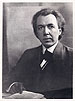 |
Wright at 28. 1895. "A self-photograph. No 'picture-taker' could
satisfy him. So he rigged up his camera with a long rubber tube, and at
the right moment, squeezed the bulb! It was the year 1895." John
Lloyd Wright, published in "My Father Who is on Earth", 1946, page 18.
Stamped on verso, "August 26, 86". Original 8 x 10 B&W Print. |
0018.02.1210 |
|
1896 |
1896
 |
Isidore Heller Residence, Chicago, Illinois, 1896
(1896 - S.038). Perspective of the Heller Residence, 1896. Designed by
Frank Lloyd Wright in 1896. Published in
The
Architectural Review. June, 1900,
Vol. VII., No. 6. Plate XXXV. Also published in
Ausgefuhrte
Bauten und Entwurfe von Frank Lloyd Wright,
Tafel IV (Plate 4), By Ernst Wasmuth A.-G., Berlin, 1910. Text on
sleeve: "Wright, F. L. - HellerHo. 3-1. Heller House. Render.,
Perspective drawing of Southwest facade. Chicago, IL, USA, 1897. Wright,
Frank Lloyd. U of Virginia FAIC." Acquired from the archives of the
University of Virginia. 35mm Color slide, sandwiched between glass,
plastic mount.
|
0026.06.0920 |
1896
 |
Charles E. Roberts Housing Project, Ridgeland, Oak Park, Illinois,
Perspective (FLLW #9608.010) (1896 Project). Adaptation to the original
perspective drawing for the Charles E. Roberts Housing Project.Designed
by Frank Lloyd Wright in 1896. Design was utilized for the Harry C.
Goodrich Residence, Oak Park, Illinois (1896 - S.042). Bruce Brooks
Pfeiffer indicated that there were no drawings that survived in the
Frank Lloyd Wright Archives for the Harry C. Goodrich Residence, Wright
1885-1916, P.73. But he also indicated that Wright resurrected earlier
unrealized plans, originally prepared for a Charles E. Roberts project,
Ridgeland Houses. Plans 9608.010-019 are nearly a perfect match with
minor changes... Continue...
|
0022.57.0223 (1-10) |
1896
 |
Architectural Review - June 1900 - Roberts Floor Plan. Vintage 4" x
3.25" Magic Lantern Slide of floor plans for Roberts block houses,
published in the Architectural Review, June, 1900. Copy photograph of
two floor plans published in the Architectural Review, June, 1900
(Sweeney 41). The floor plans are published on page 66, bottom left. The
description on page 72 reads: “Page 66... At the bottom are the germ
plans for a block of low cost houses for C. E. Roberts, Esq., at the
left.”
Magic lantern slides were
used in the U.S. during the late 1800s through the first half of the
1900s. Text: “Sectional View of the Dining Room. Sectional View of the
Living Room. Sectional View of Entry.”
Text on face of slide: “Wright, Frank Lloyd, 1867-1959. Ca 1896. Project
plan for block houses for S. E. Roberts. 43803. Art Dept Smith College.”
Acquired from the Art Department at Smith College. Magic lantern slide
4" x 3.25", Transparency: 1.4" x 2.5" |
0041.76.0725 |
1896
 |
George W. Smith Residence, Oak Park, Illinois,
Floor Plan 1896 (1896 - S.045). Floor plan for the George W. Smith
Residence, published in
The
Architectural Review, June, 1900. Although plans did not
survive for the George W. Smith Residence, it is generally accepted that
Wright used plans designed for the
Charles Roberts Ridgeland
Development, 1896, an unrealized project. Plans
do exist in the Archives for the Ridgeland Development, and Wright did
design a number of homes, but in scouring the archives, the George Smith
Residence has a few similarities, but nothing as conclusive as can be
said for the Goodrich Residence which is clearly one of the homes
designed for Ridgeland. There are many similarities to the Ridgeland
Development... Continue...
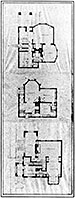 |
0022.58.0623 (1-2) |
|
1897 |
1897
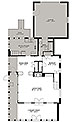 |
Thomas H. Gale Cottage, Whitehall, Michigan First Floor Plan 1897/2023
(1897 - S.088). Designed in 1897 by Frank Lloyd Wright. Plans for the
Thomas Gale Cottage have not survived in the Frank Lloyd Wright
Foundation archives. But the floor plan is similar to the plans of the
three Mrs. Thomas Gale cottages, with modifications and slightly larger
in size. 24' x 38' compared to 21' x 36', for a total square foot (both
floors) of 1,584 SF compared to 1,323 SF. The cottage was designed as a
summer cottage, and was not originally occupied year round. Designed by
Frank Lloyd Wright in 1897, five years after he designed the Gale house.
The house has been altered greatly and does not appear to retain many of
the original design elements of the original. The front of the cottages
faced the lake, so the main entrance was at the back of the cottage and
entered into the kitchen. To the left was a maid's room. Straight ahead
was the living room with a centrally located fireplace. To the left of
the fireplace, stairs led to the second level. From the living room
doors opened to a porch. Upstairs were four bedrooms. There was no
provision for a bathroom. The lower level was originally 912 square feet
including the front porch, the upper 672 for a total of 1584 square
feet. In 2023, the Thomas Gale Cottage...
Continue... |
0026.12.0923 |
1897
 |
Thomas H. Gale Cottage, Whitehall, Michigan Second Floor Plan 1897/2023
(1897 - S.088). Designed in 1897 by Frank Lloyd Wright. Plans for the
Thomas Gale Cottage have not survived in the Frank Lloyd Wright
Foundation archives. But the floor plan is similar to the plans of the
three Mrs. Thomas Gale cottages, with modifications and slightly larger
in size. 24' x 38' compared to 21' x 36', for a total square foot (both
floors) of 1,584 SF compared to 1,323 SF. The cottage was designed as a
summer cottage, and was not originally occupied year round. Designed by
Frank Lloyd Wright in 1897, five years after he designed the Gale house.
The house has been altered greatly and does not appear to retain many of
the original design elements of the original. The front of the cottages
faced the lake, so the main entrance was at the back of the cottage and
entered into the kitchen. To the left was a maid's room. Straight ahead
was the living room with a centrally located fireplace. To the left of
the fireplace, stairs led to the second level. A bathroom and firth
bedroom have been added to the second level. The lower level was
originally 912 square feet including the front porch, the upper 672 for
a total of 1584 square feet. In 2023, the Thomas Gale Cottage was placed
on the market and existing floor...
Continue... |
0026.13.0923 |
1897
 |
Dr. Allison W. Harlan House, Chicago, Illinois, View 1897 (1892 -
S.018). View of the Harlan House from the Southeast. Published in
The Inland Architect and News Record,
July, 1897, Volume XXIX, No. 6. Designed in 1892 while Frank Lloyd
Wright still worked for Louis Sullivan, it is considered one of Wright’s
"bootlegged" houses. There are two cantilevered balconies, one that runs
the length of the front of the house, and a shorter balcony on the South
elevation. The face, side and possibly the base of the balcony is
covered in sullivanesque panels, and the front balcony is topped with
planters. Just below the roof line is another simplified cut-out design,
which is repeated in the dormer above. The entrance is reached on the
left side of the house. Stairs lead up to a hall that is open on the
second floor. The Library is straight ahead, Living Room to the right,
Dining and Kitchen to the left. Five sets of floor to ceiling doors (and
or windows) in the Living Room open to an enclosed Terrace. A side
entrance is seen on the left. Over time, the front balcony was modified,
and the side balcony eliminated, exposing the large semi-circular window
in the stairwell. (Photograph) 8 x 10 color photograph. |
0023.01.0524 |
1897
 |
Dr. Allison W. Harlan House, Chicago, Illinois, View 1897 (1892 -
S.018). View of the Harlan House from the Southeast. Published in The
Inland Architect and News Record, July, 1897, Volume XXIX, No. 6. Text:
"A Chicago Residence. Frank L. Wright, Architect." Designed in 1892
while Frank Lloyd Wright still worked for Louis Sullivan, it is
considered one of Wright's "bootlegged" houses. There are two
cantilevered balconies, one that runs the length of the front of the
house, and a shorter balcony on the South elevation. The face, side and
possibly the base of the balcony is covered in Sullivanesque panels, and
the front balcony is topped with planters. Just below the roof line is
another simplified cut-out design, which is repeated in the dormer
above. The entrance is reached on the left side of the house. Stairs
lead up to a hall that is open on the second floor. The Library is
straight ahead, Living Room to the right, Dining and Kitchen to the
left. Five sets of floor to ceiling doors (and or windows) in the Living
Room open to an enclosed Terrace. A side entrance is seen on the left.
Over time, the front balcony was modified, and the side balcony
eliminated, exposing the large semi-circular window in the stairwell. 8
x 10 color photograph. (Sweeney 23) |
0023.00.0420 |
1897
 |
Vintage 4" x 3.25" Magic Lantern Slide of the Luxfer Prism Company
Corporate Office Building Circa 1897 (Project) (FLLW #9509.001). The
Frank Lloyd Wright Foundation dates this project 1895. Study for the
front elevation of the proposed Luxfer Prism Corporate Office Building.
In 1896 James Pennycuick formed the Radiating Light Company. In 1897,
with the help of five major investors, the name was changed to the
American Luxfer Prism Company. Two were Wright friends and clients,
William Winslow and Edward Waller. Other investor’s included Cyrus H.
McCormick, George A. Fuller (Skyscraper), Charles H. Wacker (Wacker
Drive), and Levi Z. Leiter (Marshall Field & Co.). John M. Ewen was the
company’s first President. Wright, Winslow and Luxfer all had offices in
the Rookery Building. Wright remodeled the Rookery Lobby in 1905. “The
company hired the young Chicago architect Frank Lloyd Wright as a
product designer, whose office at that time was on the same floor of the
Rookery Building in Chicago as that of the Luxfer Prism Company.”
Journal of the Society of Architectural Historians, March 1995. Label
affixed to face: “Wright, Frank Lloyd, 1867-1959. 1895. Project for
Luxier Prism Company Skyscraper: design I. 80638L. Second small label:
“Art. Dept. Smith College.” Acquired from the Art Department...
Continue... |
0026.15.1125 |
1897
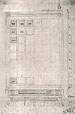 |
Luxfer Prism Company Corporate Office Building Circa 1897 (Project)
(FLLW #9509.001). Study for the front elevation of the proposed Luxfer
Prism Corporate Office Building. In 1896 James Pennycuick formed the
Radiating Light Company. In 1897, with the help of five major investors,
the name was changed to the American Luxfer Prism Company. Two were
Wright friends and clients, William
Winslow and Edward
Waller. Other investor's included Cyrus H. McCormick, George A.
Fuller (Skyscraper), Charles H. Wacker (Wacker Drive), and Levi Z.
Leiter (Marshall Field & Co.). John M. Ewen was the company's first
President. Wright, Winslow and Luxfer all had offices in the
Rookery Building. Wright remodeled the
Rookery Lobby in 1905. "The company hired the young Chicago architect
Frank Lloyd Wright as a product designer, whose office at that time was
on the same floor of the Rookery Building in Chicago as that of the
Luxfer Prism Company." v, March 1995. Text bottom left: "9509.01."
Bottom Right: "Study for Office Building Facade, employing Luxfer prism
- lighting. 1894-5." Courtesy of the Frank Lloyd Wright Foundation. 7 x
10.5 Color photograph. |
0026.04.0720 |
1897
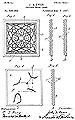 |
Luxfer Prism Glass Company, John Ewen Patent. In 1896 James Pennycuick
formed the Radiating Light Company. In 1897, with the help of five major
investors, the name was changed to the American Luxfer Prism Company.
Two were Wright friends and clients,
William Winslow and
Edward Waller.
Other investor's included Cyrus H. McCormick, George A. Fuller
(Skyscraper), Charles H. Wacker (Wacker Drive), and Levi Z. Leiter
(Marshall Field & Co.). John M. Ewen was the company's first President.
Wright, Winslow and Luxfer all had offices in the
Rookery Building. Wright
remodeled the Rookery Lobby in 1905. On December 7, 1897, John Ewen was
issued 21 patents related to Luxfer Prisms. Of note is Patent No.
595,264. At first glance, it appears to be the same design as Patent No.
27,977, issued on December 7, 1897, to Frank Lloyd Wright. Ewen's was a
patent for the overall design of the glass, Wright's was for the design
on the face of the glass. Even though Ewen patented face designs, he
chose to use Wright's design, which tends to add confusion to Frank
Lloyd Wright's patent. B&W photograph. |
0026.02.0620 |
1897
 |
1) Luxfer Prism Glass Company Design for a Prism Light. "Design. F. L.
Wright. Prism Light. No. 27,977. Patented Dec. 7, 1897. Inventor: Frank
L,. Wright." Specification: "My invention relates to designs for
prism-lights. The essential features of my design are found in a
prism-light comprising a body with prisms on one side and on the other a
series of concentrically-arranged ornamental lines which interlace or
overlap each other, so as to produce a grid-like appearance." United
States Patent Office. Published in The Official Gazette of The United
States Patent Office, December 7, 1897. B&W photograph.
2) Luxfer
Prism Glass Company Design for a Prism Light. "Design. F. L. Wright...
Continue...
|
0026.03.0620 (1-41) |
1897
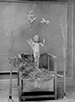 |
Frank Lloyd Wright Home & Studio, Oak
Park, Illinois, Chair, Sculpture and two Weed Holders, Circa 1897 (1895 -
S.002-4). The setting, photographed in Frank Lloyd Wright’s Home and Studio
included a chair hair, “Goldenrod” sculpture and two Weed Holders.
John Lloyd Wright wrote "Not satisfied with the bric-a-brac of the day,
Father designed his own. The copper weed-holders pictured to the right and
left of the chair are his early creations. Father liked weeds!" My Father
Who is on Earth, 1946, p.24.
David
Hanks wrote: “The copper vase was probably designed shortly after 1893, at
the start of Wright's independent practice. It appears in a photograph made
around 1895 of the octagonal library in Wright's studio and also as a pair
in a photograph in the 1902 exhibition of the Chicago Architectural Club
(The Art Institute of Chicago, 1902, #441), captioned as the "Individual
Flower Holder. Made by James A. Miller." The Decorative Designs of Frank
Lloyd Wright, 1979, p.69;
Richard
Bock wrote, “In 1897... Wright asked me to do a small job of a panel for a
house he was doing for a Mrs. Heller. This panel was a repetitive portion of
a frieze running all the way around the building. Wright was still strongly...
Continue... |
0026.16.0525 |
Circa 1897
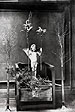 |
Wright's Oak Park Home and
Studio (1895 - S.003) circa 1897. Wright
Weed Holders, Studio Chair with Richard Bock Sculpture in Oak Park
Studio. Possibly staged by Wright. Published in
Architectural Review,
June 1900, page 65. Also published in
Frank
Lloyd Wright Ausgefuhrte Bauten, 1911, page 98. The chair was from Wright's Studio. According
to Richard Bock, Wright asked him to design a small panel for Mrs. Heller
(1896 - S.038). "As an inducement to do the freeze he asked me to model a
portrait statue of his son John, which was intended for the children's
playroom in the home he was building in Oak Park. The figure was about two
feet tall and was to represent a goldenrod. John Wright was then about four
years old and the most contentious model I have ever encountered... It
eventually turned out to be an attractive piece of sculpture of a very
angelic child." Memories of an American
Artist, Bock, 1989, page 67. Wright used this photograph in his
announcement of his first exhibition in 1902. Most likely photographed by
Frank Lloyd Wright. Original 6.7 x 10 B&W photograph. |
0041.08.0712 |
|
1898 |
1898
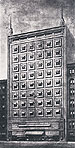 |
Luxfer Prism Company Corporate Office Building Circa 1897 (Project)
(FLLW #9509.001). Study for the front elevation of the proposed Luxfer
Prism Corporate Office Building, published in the
Architectural Forum,
January 1938, p.54. Caption: "An early design for a prism-glass office
building, Chicago... 1896... Notwithstandiong the Chicago World's Fair
of 1893... A Front only." Courtesy of the Frank Lloyd Wright Foundation.
5 x 9.5 B&W copy photograph. |
0026.05.0720 |
1898
 |
"Down The Valley" Spring Green, Wisconsin 1898. Photographed by Frank Lloyd Wright.
Wright printed a series of photographs for an album showing the Hillside
Home School (S.001 - 1887) run by his Aunts in Spring Green, Wisconsin.
The album included a number of horizontal panoramic prints. Five of
which are part of the CCA, Canadian Centre for Architecture collection.
Each print was titled in Wright's handwriting. When placed side-by-side,
three of the images; "N.W", "Down the Valley", and "Bryn Mawr" form a
panoramic view of the Jones Valley looking north. A number of these
photographs are also part of the Wisconsin Historical Society
collection. Clipping pasted on verso: " 'Down the Valley' (Spring Green,
Wis.) c. 1898, by Frank Lloyd Wright."
Acquired from the archives of the Chicago Tribune. Original 10 x 8 B&W
photograph, (cropped). |
0032.04.0911 |
1898
 |
Frank Lloyd Wright Designed Square Holder, Vase 2, Vases and
Flowerholders, 1898, FLLW#9806.09.
Side and top view of a vase combining square and
circular elements. Designed by Frank Lloyd Wright in 1898.
Wright's design interests extended well beyond
architecture, encompassing vases and flower holders. In 1898, he created
numerous designs, 13 of which are preserved in the Frank Lloyd Wright
Archives. Among these, two notable designs were executed in copper: the
renowned circular copper urn and the copper weed holder. In 1992,
Historic Arts & Crafting executed two unrealized flower holders in
bronze, based on Wright's designs. A fifth vase design, FLLW#9806.09,
remained dormant for 32 years. This particular design uniquely combined
square and circular elements and was titled "Vases and Flowerholders:
Square Holder, 2."
Frank Lloyd
Wright revived this fifth design in 1929 for the N.V. Glassfabrik
Leerdam in Holland. The term "Glassfabrik" translates to "Glass Factory"
in English. This Dutch glass manufacturing company was established in
1878 and became known as the NV Glasfabriek Leerdam in 1891. According
to Bruce Brooks Pfeiffer, “In 1928...
Continue... |
0032.26.1225 |
1898
 |
Wright's Oak Park Home and Studio, Drawing 1898 (1895 - S.002-4).
Illustration of Frank Lloyd Wright's Home and Studio published in
The House Beautiful,
December 1899, p.37. View from Chicago Avenue. The draughting room is on
the left, entrance hall in the center, and octagonal library on the
right. The home is in the background on the right. Text on face: "Frank
Lloyd Wright's own rendering of his home and studio in Oak Park,
Illinois. With Marlin, Architects' Mecca. The Christian Science
Monitor." Stamped on verso: Dec 8 1976." Acquired from the archives of
the Christian Science Monitor. Original 10 x 5 B&W photograph. |
0032.19.0421 |
1898
 |
Frank Lloyd Wright’s Oak Park Studio Entrance,
Circa 1898 (1895 - S.002-4). Perspective view of the entrance to Frank
Lloyd Wright Studio. Published in
The House Beautiful,
December 1899, p.41. “...One of the most radical of these opponents is
Mr. Frank L. Wright, whose house and studio I have the privilege of
describing. To do full justice to this subject in a short magazine
article is out of the question, and I shall have to depend very largely
upon the accompanying photographs to convey to the reader the charm of
this unique establishment...” p.36.
Large urns
set atop columns on either side of the stairs. A few steps up from the
sidewalk, stork columns appear at the entrance to the Studio. Below the
Tree of Life, storks stand on either side of a scroll with an
architectural plan. A plaque on the left reads "Frank Lloyd Wright
Architect." Above the entrance on either side rest two crouching figures
named The Boulders by Richard Bock, an artist who collaborated with
Wright. The statues depict old men attached to Earth but struggling to
rise. Hand written lower right: “10863.” Photographed by Henry Fuermann.
10 x 8 B&W photograph. |
0032.24.0925 |
1898
 |
Frank Lloyd Wright’s Oak Park Studio Entrance,
Circa 1898 (1895 - S.002-4). Perspective view of the entrance to Frank
Lloyd Wright Studio. Published in
The House Beautiful,
December 1899, p.41. “...One of the most radical of these opponents is
Mr. Frank L. Wright, whose house and studio I have the privilege of
describing. To do full justice to this subject in a short magazine
article is out of the question, and I shall have to depend very largely
upon the accompanying photographs to convey to the reader the charm of
this unique establishment...” p.36.
Large urns
set atop columns on either side of the stairs. A few steps up from the
sidewalk, stork columns appear at the entrance to the Studio. Below the
Tree of Life, storks stand on either side of a scroll with an
architectural plan. A plaque on the left reads "Frank Lloyd Wright
Architect." Above the entrance on either side rest two crouching figures
named The Boulders by Richard Bock, an artist who collaborated with
Wright. The statues depict old men attached to Earth but struggling to
rise.
Text upper left in photograph: “Frank Lloyd Wright Studio, Oak Park...
Continue... |
0032.25.0925 |
1898
 |
Wright's Oak Park Studio Fireplace (1895 - S.004) circa 1898. After
securing a commission with the Luxfer Prism Company, Wright built a new
Studio attached to his home in 1898. Possibly staged and photographed
just after completion. Brick fireplace with a circular opening. A brick
column balances out each side, possibly set at 45 degrees (?), base and
capped with stone. Cubed stones balance the opening and set on the
hearth. Tucked behind the large vase on the far left is a Sullivanesque
frieze, similar to the Winslow door panel or the panel that faces the
Roloson row houses. A Wright designed
studio arm chair is to the
left of the fireplace. A large floor matt with an Native American
pattern sets in front of the fireplace, a smaller runner is draped over
the chair. Wright commissioned Orlando Giannini to paint three American
Indian murals in his Oak Park home in in 1895. John Lloyd Wright wrote,
" 'Skinny' Giannini from Italy painted American Indians in brilliant
colors on the walls of Papa's bedroom... Papa liked Indians!"
"My Father
Who is on Earth," 1946, page 34. On the upper face of the
fireplace hangs four frieze panels sculptured by Richard Bock for the
Heller Residence in 1896. According to Richard Bock, Wright asked him to
design a small panel for Mrs. Heller (1896 - S.038)...
Continue...
See our Wright Study on the Heller Residence. |
0032.15.0514 |
1898
 |
Wright's Oak Park Studio Fireplace Detail of Heller Frieze (1895 -
S.004) circa 1898. On the upper face of the fireplace hangs four frieze
panels sculptured by Richard Bock for the Heller Residence in 1896.
Winged maiden set within a Sullivanesque design. According to Richard
Bock, Wright asked him to design a small panel for Mrs. Heller (1896 -
S.038). "As an inducement to do the freeze he asked me to model a
portrait statue of his son John, which was intended for the
children's playroom in the home he was building in Oak Park. The figure
was about two feet tall and was to represent a goldenrod. John Wright
was then about four years old and the most contentious model I have ever
encountered... It eventually turned out to be an attractive piece of
sculpture of a very angelic child."
"Memories of an American Artist,"
Bock, 1989, page 67. 10 x 6.5 B&W photograph. Courtesy of the Frank
Lloyd Wright Foundation. See our Wright Study
on the Heller Residence. |
0032.16.0514 |
|
1899 |
1899
 |
Municipal Boathouse, Lake Mendota, Madison, Wisconsin, Circa 1899 (1893
- S.022). The Municipal Boathouse was built at the foot of North Carroll
Street on Lake Mendota. View of the Municipal Boathouse from the
Northwest. Designed by Frank Lloyd Wright in 1893. He was 26 year old at
the time and a draftsman for the architectural firm of Adler and
Sullivan. In March 1893, the Madison Improvement Association announced a
competition for sketches of a boat house to be built by the association.
Frank Lloyd Wright submitted two designs, and both were excepted, one
for Lake Mendota and one for Lake Monona. The boat house for Lake
Mendota was completed by the Spring of 1894. From the lake side, the two
towers dominated the front elevation with a large arched opening that
led to the interior storage for boats. At the base of each towers, a
single centered arched doorway lead to the interior of the towers.
Access was also gained by walkways on either side of the arched opening
in the center. The boathouse was cut into the hillside and the back of
the interior was semicircular. The roof supported the semicircular
loggia above. Boats could be loaded onto storage racks via a "pivoted
crane" that ran on a circular track overhead. Two piers extending out
into the lake... Continue... |
0036.21.0823 |
1899
 |
Municipal Boathouse, Lake Mendota, Madison, Wisconsin, 1899 (1893
- S.022). The Municipal Boathouse was built at the foot of North Carroll
Street on Lake Mendota. Partial view of the Municipal Boathouse from the
walkway between the two towers. Madison can be seen in the background.
Designed by Frank Lloyd Wright in 1893. He was 26 year old at the time
and a draftsman for the architectural firm of Adler and Sullivan. In
March 1893, the Madison Improvement Association announced a competition
for sketches of a boat house to be built by the association. Frank Lloyd
Wright submitted two designs, and both were excepted, one for Lake
Mendota and one for Lake Monona. The boat house for Lake Mendota was
completed by the Spring of 1894. From the lake side, the two towers
dominated the front elevation with a large arched opening that led to
the interior storage for boats. Photographed on April 24, 1899 by
Charles N. Brown. Courtesy of the Wisconsin Historical Society. 10 x 8
B&W Photograph. |
0036.22.0823 |
1899
 |
Edward C. Waller Residence Remodeling,
River Forest, IL 1899 (1899 - S.047). South Elevation of Frank Lloyd
Wright's alterations to the Waller Residence in 1899. Edward C. Waller
was a successful Chicago Businessman, real estate developer and an early
client and patron of Frank Lloyd Wright. According to Thomas A Hines
(Frank Lloyd Wright Field Guide, 2005, p.277), in 1886 Waller purchased
a large tract of land in River Forest which bordered the Des Plaines
River on the west, and Edgewood Place on the East, three blocks wide. It
also ran from Lake street North for one block. According to Carla Lind,
Lost Wright,
1996, p.49, it was a 6 acre parcel. Architect Daniel Burnham, Burnham
and Root, designed the original Waller House. The estate was large
enough that Waller had barns for horses and cows, a green house for
growing fruits and vegetable, and the Wright designed Poultry House for
raising chickens. The house was located around the area where 520 - 528
River Oak Drive is today. River Oak Drive may not existed as a street in
1899. In 1893-4, Waller sold a lot on Auvergne Place, across the street
from his own house to William Winslow (1894 - S.24), who commissioned
Wright to design his home. In 1895, Waller commissioned Wright to design
the Francisco Terrace... Continue...
|
0036.13.0521 |
1899
 |
Edward C. Waller Residence Remodeling, River Forest, IL 1899 (1899 -
S.047). Two interior sections of the Entrance and upper hall of Frank
Lloyd Wright's alterations to the Waller Residence in 1899. Edward C.
Waller was a successful Chicago Businessman, real estate developer and
an early client and patron of Frank Lloyd Wright. In the In the entrance
hall stairway, Wright incorporates circular design elements into the
railing baluster. Similar in design to the Charles E. Roberts House, Oak
park (1896 - S.40). Robert's windows and skylight were published in
The Architectural Review,
June 1900, p.62, lower right, and in
Light Screens,
Sloan, 2001, p.124-125. Another important design element that was
designed by Wright was the
copper urn.
There were three in the Waller House, two in the dining room and one in
the entrance. Text lower right: "Alterations in the Residence of Mr. E.
C. Waller, River Forest. Frank Lloyd Wright, Architect. February, 1899."
Text hand written lower left: "9901.06." Courtesy of the Frank Lloyd
Wight Foundation Archives. 10.5 x 6 B&W photograph. |
0036.14.0521 |
1899
 |
Edward C. Waller Residence Remodeling, River Forest, IL 1899 (1899 -
S.047). South and East Elevations of the Waller Dining Room of Frank
Lloyd Wright's alterations to the Waller Residence in 1899. Edward C.
Waller was a successful Chicago Businessman, real estate developer and
an early client and patron of Frank Lloyd Wright. Upper illustration:
"South Elevation." The built-in "Window Seat" ran the full length of the
large window and allowed Wright to hide the Radiator. The Dining Room
floor plans (9902.08) include the built-in Window Seat. Lower
illustration: "Dining Room East Elevation." To the left of the South
Elevation is the East Elevation. Existing photographs indicate that the
art glass windows were never completed. Text lower right: "Alterations
in the Residence of Mr. E. C. Waller, River Forest. Frank Lloyd Wright,
Architect. March, 1899." Text hand written lower left: "9901.11."
Courtesy of the Frank Lloyd Wight Foundation Archives. 10.5 x 6.6 B&W
photograph. |
0036.15.0521 |
1899
 |
Edward C. Waller Residence Remodeling, River Forest, IL 1899 (1899 -
S.047). North and West Elevations of the Waller Dining Room of Frank
Lloyd Wright's alterations to the Waller Residence in 1899. Edward C.
Waller was a successful Chicago Businessman, real estate developer and
an early client and patron of Frank Lloyd Wright. Upper illustration:
"North Elevation." The North Elevation included the fireplace as well as
built-in shelves above the fireplace behind glass doors. Lower
illustration: "Dining Room West Elevation." To the left of the North
Elevation is the West Elevation. Existing photographs indicate that the
art glass windows were never completed. Text lower right: "Alterations
in the Residence of Mr. E. C. Waller, River Forest. Frank Lloyd Wright,
Architect. March, 1899." Text hand written lower left: "9901.12."
Courtesy of the Frank Lloyd Wight Foundation Archives. 10.5 x 6.6 B&W
photograph. |
0036.16.0521 |
1899
 |
Edward C. Waller Residence Remodeling, River Forest, IL
1899 (1899 - S.047). Table design for the E. C. Waller Residence in
1899. Possible for the library. Edward C. Waller was a successful
Chicago Businessman, real estate developer and an early client and
patron of Frank Lloyd Wright. Front and side elevations. Like the Dining
Room table, these legs are square and flared at the bottom. Wright also
designed the dining room table, and according to Carla Lind,
Lost Wright,
1996, p.49, Wright also designed the dining room chairs. This table
measures 56" long, 2' 2" wide, and 2' 2" high. Courtesy of the Frank
Lloyd Wight Foundation Archives. 10.5 x 6.6 B&W photograph. |
0036.17.0521 |
1899
 |
Wright's Oak Park Studio (1895 - S.004) circa 1899. Wright hung four
Heller frieze panels above fireplace on the left. After securing a
commission with the Luxfer Prism Company, Wright built a new Studio
attached to his home in 1898. Brick fireplace with a circular opening is
on the left. A brick column balances out each side, possibly set at 45
degrees (?), base and capped with stone. On the upper face of the
fireplace hangs four frieze panels sculptured by Richard Bock for the
Heller Residence in 1896. According to Richard Bock, Wright asked him to
design a small panel for Mrs. Heller (1896 - S.038). "As an inducement
to do the freeze he asked me to model a portrait
statue of his son John, which was intended for the children's playroom in the home he
was building in Oak Park. The figure was about two feet tall and was to
represent a goldenrod. John Wright was then about four years old and the
most contentious model I have ever encountered... It eventually turned
out to be an attractive piece of sculpture of a very angelic child."
"Memories of an American Artist," Bock, 1989, page 67. Studio is filled
with drawing boards, sculptures (3 visible), drawings and plants. An art
glass piece hangs in the window. 10 x 8 B&W photograph. Courtesy of the
Frank Lloyd Wright Foundation. See our Wright
Study on the Heller Residence. |
0036.03.0514 |
|
1900 |
1900
 |
B. Harley Bradley Residence, Kankakee,
Illinois, Barrel Chair, 1900 / 2025 (1900 - S.052). Barrel chair for the B.
Harley Bradley Residence. Designed by Frank Lloyd Wright in 1900, the chair
was executed by the John Ayres Co. A partial hexagon in plan, the vertical
board sides with triple rectangular banding about the base and square
continuous arm edging, all seated upon four turned, bulbous feet. The triple
banding is seen on the entryway banister and the dining room sideboard.
Two chairs were offered at Christie’s, New York, June 8, 1991 and listed as
28" High x 27.5" Wide x 28" Deep. The two lots passed. One of the chairs was
offered again at Toomey & Co., June 14, 2025. The result $20,160. Courtesy
of Toomey & Co., Chicago. 8 x 8 Color photograph. |
0041.77.0626 |
1900
 |
Abraham Lincoln Center 1900 (1903 - S.095).
Perspective drawing of the auditorium as Frank Lloyd Wright designed it.
What was built was a very simplified version of Wright's design. It has been
altered greatly over the years. Published in
Frank Lloyd Wright
Monograph 1887-1901, Pfeiffer, 1991, p.165. Also published in the
Journal of the
Society of Architectural Historians, September 1991, p.256. 8 x 3.5
Color photograph. |
0041.37.0320 |
1900
 |
William and Jesse Adams Residence, Chicago,
Foundation Plan 1900 (1900 - S.048). Basement and Foundation Plan, Attic
Plan and Detail of Construction. William Adams was a successful contractor
in the Chicago area. Adam's first collaboration with Frank Lloyd Wright was
on Wright's first major commission, the Winslow Residence. Although both the
Residence and Stable were designed in 1894, it is not clear who the
contractor was for the house, but it is clear that William Adams built the
Stables, his signature was on the plans, "Frank
Lloyd Wright Preliminary Studies
1889-1916," Volume 9,
Pfeiffer, 1991, Plate 23-24. Two other major collaborations were the Heller
Residences (1896 - S.038) built in 1897 and Husser (1899 - S.046). Text on
plans: "Detail of construction." "Attic Plan." "Basement and Foundation
plan. Note: Inside of wall flush with inside of studs." Attic appears to
have two large rooms with windows and a closet. Basement included laundry
and coal storage. Copy photograph of plans published in "Frank
Lloyd Wright Monograph 1887-1901," Volume 1, Pfeiffer, 1991, P.160. 10 x
6 B&W photograph. Courtesy of the Frank Lloyd Wright Foundation. |
0041.34.1119 |
1900
|
William and Jesse Adams Residence, Chicago,
Floor Plans 1900 (1900 - S.048). First and Second Floor plans, Dining Room
Sideboard Detail and Sections. William Adams was a successful contractor in
the Chicago area. Adam's first collaboration with Frank Lloyd Wright was on
Wright's first major commission, the Winslow Residence. Although both the
Residence and Stable were designed in 1894, it is not clear who the
contractor was for the house, but it is clear that William Adams built the
Stables, his signature was on the plans, "Frank
Lloyd Wright Preliminary Studies
1889-1916," Volume 9,
Pfeiffer, 1991, Plate 23-24. Two other major collaborations were the Heller
Residences (1896 - S.038) built in 1897 and Husser (1899 - S.046). Text on
plans: "First Floor Plan of a residence for Mrs. Jessie W. Adams to be built
at Longwood Illinois. Frank Lloyd Wright . . . Architect. November 1900.
Second Floor Plan." "Second Floor Plan." "Sideboard of Dining Room."
"Section..." First floor includes the Covered Porch, Vestibule, Reception
Room, Living and Dining Rooms, Kitchen, Bath and Rear Porch. The Dining
Room's built-in Sideboard was on the West wall, removed during the extensive
1913 remodel. The second floor includes four bedrooms and a full bath. Copy
photograph of plans published...
Continue... |
0041.35.1119 |
1900
 |
Architectural Review, June 1900 - Floor Plan
Detail. Vintage 4" x 3.25" Magic Lantern Slide of an unidentified floor plan
published in the
Architectural Review,
June, 1900. Copy photograph of the an unidentified floor plan published in
the Architectural Review, June, 1900 (Sweeney 41). The floor plan is
published on page 65, top left. The description on page 72 reads: “Page 65,
at the top, shows the Bagley house and plans. The remainder of the group is
from Mr. Wright’s own house and studio.” This floor plan does not appear to
be either.
Magic lantern slides
were used in the U.S. during the late 1800s through the first half of the
1900s. Text: “Sectional View of the Dining Room. Sectional View of the
Living Room. Sectional View of Entry.”
Text on face of slide:
“Wright, Frank Lloyd, 1867-1959. Plan for a house. 43802. Art Dept Smith
College.” Acquired from the Art Department at Smith College. Magic lantern
slide 4" x 3.25", Transparency: 3" x .6" |
0041.75.0725 |
1900
 |
Frederick Bagley Residence 1900
Illustration, Hinsdale, Illinois (1894 - S.028). Copy of the illustration of
the Bagley Residence published in an article on Wright's early work in
Architectural Review,
June 1900. "The polygonal libraries of the Bagley, Devin and McAfee houses
and of Mr. Wright's own studio, with their above-head or direct top light
and air of quiet seclusion for study and reflection, are noteworthy
features." p.67. Although early photographs reveal that the house was
covered in cedar shingles, it is illustrated in stucco similar to the Frank
Thomas Residence (1901 - S.067). The roof also is illustrated light in
color. It has since been covered in white siding. It also appears to show an
addition at the back of the house, not indicated on the floor plan. 10 x
3.75 color photograph. |
0041.32.0719 |
1900
 |
Frederick Bagley Residence Floor Plan 1900,
Hinsdale, Illinois (1894 - S.028). Copy of the floor plan for the Bagley
Residence published in an article on Wright's early work in
Architectural Review,
June 1900. "The polygonal libraries of the Bagley, Devin and McAfee houses
and of Mr. Wright's own studio, with their above-head or direct top light
and air of quiet seclusion for study and reflection, are noteworthy
features." p.67. From the veranda, the front door leads to a hall. To the
left, stairs lead to a landing that leads to the library and the second
floor, the hall that leads to the kitchen, o a doorway leading to the
living room. The dining room and back veranda are on the opposite corner of
the house. (Note: Text enhanced by Douglas M. Steiner.) 9 x 8 color
photograph. |
0041.33.0719 |
1900
 |
Dr. Howard W. Bassett Residence Remodel, Oak
Park, Illinois, Circa 1900 (Not Dated) (1894 - S.027). The Bassett Residence
was demolished in 1922 to make room for an expanding downtown, located just
a few steps from the Oak Park Elevated Station and .3 miles from Unity
Temple. A perfect spot for a doctor's office/home. According to Thomas
Heinz, "Previously the house was the boyhood home of Walter Burley Griffin,
from at least 1885 when the city directories began; Griffin, who was
apprenticed to Wright... His father, George Walter Griffin, sold the house
to Bassett." Field Guide, 2005. Dr. Howard W. Bassett, was born Sacramento,
California on November 27, 1861. He graduated from Sacramento High School in
1877, and a medical degree at Chicago Homoeopathic Medical College in 1889
and interned at the Cook County Hospital. He practiced in Oak Park from 1891
- 1900. He took a post graduate course at the Chicago Polyclinic in 1892. He
was a member of the staff at St. Anthony's Hospital in Chicago and a
clinical assistant chair of neurology at Chicago Homeopathic Medical
College. In 1900 he moved to Richmond, Virginia. In 1906 he completed a post
graduate course at the Medical College of Virginia continuing his practice
during his studies. He was among the... Continue... |
0041.63.0823 |
1900
 |
B. Harley Bradley Residence, Kankakee,
Illinois 1900 (1900 - S.052). First floor plan for the Bradley Residence.
Designed by Frank Lloyd Wright in 1900, completed in 1901. The Bradley
Residence is one of Wight's earliest Prairie Houses, and is considered by
most to be his first. The depth of Frank Lloyd Wright's design incorporated
interior furnishing, carpets, built-ins, art glass windows and landscaping,
creating a complete harmonious design. The Bradley House incorporated many
design elements that defined Prairie Styled houses. Low pitched gabled
roofs, broad overhangs, dominate horizontal lines, the exterior finished in
stucco and horizontal bands of art-glass windows. Wright utilized a
cruciform floor plan, the living room and kitchen being the main axis, the
dining room to the reception room being the cross axis. The entrance is not
at the front of the house, but on the side, under the Porte cochere, hidden
from view, stereotypical of many of Wright's designs. The first floor
includes the reception room, living and dining rooms, kitchen, sitting and
dressing rooms, two bathrooms and three terraces/porches. The two-story
stable, set behind the house, is connected by a covered walkway. Illustrated
by John Eifler. 9 x 8 B&W photograph. |
0041.47.0222 |
1900
 |
B. Harley Bradley Residence, Kankakee,
Illinois 1900 (1900 - S.052). Second floor plan for the Bradley Residence.
Designed by Frank Lloyd Wright in 1900, completed in 1901. The Bradley
Residence is one of Wight's earliest Prairie Houses, and is considered by
most to be his first. The depth of Frank Lloyd Wright's design incorporated
interior furnishing, carpets, built-ins, art glass windows and landscaping,
creating a complete harmonious design. The Bradley House incorporated many
design elements that defined Prairie Styled houses. Low pitched gabled
roofs, broad overhangs, dominate horizontal lines, the exterior finished in
stucco and horizontal bands of art-glass windows. The second floor has a
smaller footprint, but includes six bedrooms, two bath and a large covered
porch. Illustrated by John Eifler. 10 x 8 B&W photograph. |
0041.48.0222 |
C 1900
 |
James Charnley Residence (1890 -
S.009) Circa 1900. Viewed from the Northwest during the winter. The 16-room
home included six bedrooms, four baths, and six wood burning fireplaces.
James Charnley was a wealthy lumberman who was a personal friend of Louis
Sullivan. Frank Lloyd Wright was the chief draftsman at the time for the
architectural firm of Adler and Sullivan. Acquired from the Library of
Congress. Original 10 x 8 B&W Print. |
0041.05.1011 |
1900
 |
Dwelling For Oakland, California, Oakland,
California, Elevation and Plan, 1900 (Project 1900 - FLLW #0013). Photograph
of original drawing in the Frank Lloyd Wright Archives. Designed by Frank
Lloyd Wright in 1900. Elevation and plan for a dwelling in Oakland
California. Top illustration: North elevation. Lower left illustration: Site
and main floor plan. Right illustration: Basement plan. The dwelling is
prairie styled, but not the typical rectangular footprint. The floor plan is
shows two squares overlapping at 90 degrees. The lower left "square"
contains the entrance, kitchen, bath and two bedrooms. The upper right
"square contains the living and dining rooms, central fireplace and the
stairs to the lower level. The basement is only below the living room square
and contains two additional bedrooms. The exterior is board and batten
construction. Text: "North. Elevation." "Main Story." "Basement. Dwelling
For Oakland, California. Frank Lloyd Wright Architect. Chicago, Illinois."
FLLW #0013.01. Published in Frank Lloyd Wright
1885-1916, Pfeiffer, 2011, p.109. Original 10 x 8 B&W photograph. |
0041.36.1219 |
1900
 |
1) Stephen A. Foster Cottage & Stable, West
Pullman, Chicago, Illinois, Perspective (1900 - S.049-050) (FLLW #0003.01).
Designed by Frank Lloyd Wright in 1900, it was designed the same year as the
pre-Prairie Jessie Adams House, and the Bradley and Hickox Prairie houses,
and might be considered a transitions between the two. Text of the
perspective plans reads: "Foster Cottage and Barn at West Pullman, at a Cost
of Both Complete "" Thirty Five Hundred Dollars" Feb. 20th 1900. Frank Lloyd
Wright Architect." The drawing included a front elevation and floor plan for
the barn on the left, and perspective and floor plan for the house on the
right. Frank Lloyd Wright included this drawing of the house in the June
1900 issue of
The
Architectural Review. Courtesy of the Frank Lloyd
Wright Archives, Avery Library, Columbia University. 10 x 4 Color
photograph. |
0041.50.0622 |
1900
 |
2) Stephen A. Foster Cottage & Stable, West
Pullman, Chicago, Illinois, Perspective (1900 - S.049-050) (FLLW #0003.01).
Designed by Frank Lloyd Wright in 1900, it was designed the same year as the
pre-Prairie Jessie Adams House, and the Bradley and Hickox Prairie houses,
and might be considered a transitions between the two. Text of the
perspective plans reads: "Foster Cottage and Barn at West Pullman, at a Cost
of Both Complete "Thirty Five Hundred Dollars" Feb. 20th 1900. Frank Lloyd
Wright Architect." The drawing included a front elevation and floor plan for
the barn on the left, and perspective and floor plan for the house on the
right. Frank Lloyd Wright included this drawing of the house in the June
1900 issue of
The
Architectural Review. Courtesy of the Frank Lloyd
Wright Archives, Avery Library, Columbia University. 10 x 4 B&W photograph. |
0041.51.0622 |
1900
 |
3) Stephen A. Foster Cottage & Stable, West
Pullman, Chicago, Illinois, Floor Plan (1900 - S.049-050) (FLLW #0003.02).
Designed by Frank Lloyd Wright in 1900, it was designed the same year as the
pre-Prairie Jessie Adams House, and the Bradley and Hickox Prairie houses,
and might be considered a transitions between the two. Text: "First Floor
Plan. Summer Cottage for Mr. Stephen A. Foster. To Be Built at West Pullman.
Frank Lloyd Wright, Architect. January 1900." The entrance is not on the
front of the house, but the side facing the driveway. As you stepped into
the house, you entered the reception hall. Seating was built into the bay
window on the right. Stairs on the left lead you to the bedrooms and bath
upstairs. Past the stairway on the left was the kitchen and pantry. Straight
ahead was the living room and dining area which was one big area, and
covered half the lower level. Centrally located was the fireplace. Courtesy
of the Frank Lloyd Wright Archives, Avery Library, Columbia University. 10 x
6.5 B&W photograph. |
0041.52.0622 |
1900
 |
Stephen A. Foster Cottage & Stable, West
Pullman, Chicago, Illinois, Floor Plan (1900 - S.049-050). Adaptation of the
floor plan of the first and second floor plans. Designed by Frank Lloyd
Wright in 1900, it was designed the same year as the pre-Prairie Jessie
Adams House, and the Bradley and Hickox Prairie houses, and might be
considered a transitions between the two. The entrance is not at the front
of the house, but the side facing the driveway. As you stepped into the
house, you entered the reception hall. Seating was built into the bay window
on the right. Stairs on the left lead you to the bedrooms and bath upstairs.
Past the stairway on the left was the kitchen and pantry. Straight ahead was
the living room and dining area which was one big area, and covered half the
lower level. Centrally located was the fireplace. Although the terrace was
uncovered, Wright designed a Japanese styled trellis system which appears to
be partially visible. Adaptation from the first and second floor plans by
Douglas M. Steiner. 10 x 8 B&W photograph. |
0041.57.0622 |
1900
 |
4) Stephen A. Foster Cottage & Stable,
West Pullman, Chicago, Illinois, Front (West) Elevation (1900 - S.049-050)
(FLLW #0003.06). Front elevation facing Harvard Avenue. Designed by Frank
Lloyd Wright in 1900, it was designed the same year as the pre-Prairie
Jessie Adams House, and the Bradley and Hickox Prairie houses, and might be
considered a transitions between the two. Text far left: "0003.06." Right:
"Front Elevation." The entrance is not of the front of the house, but the
side facing the driveway (left). The entrance is secluded by a prairie
styled balustrade screen. To the right of the entrance is a bay window.
Seating was built into the bay window. The right set of windows is the
living room. A terrace ran the full width of the South elevation (right). A
short wall enclosed it on three sides. Balustrade screens decorated both
corners of the terrace. Originally the terrace was open, but was later
enclosed, and stairs added to the East side of the terrace. Courtesy of the
Frank Lloyd Wright Archives, Avery Library, Columbia University. 10 x 6 B&W
photograph. |
0041.53.0622 |
1900
 |
5) Stephen A. Foster Cottage & Stable, West
Pullman, Chicago, Illinois, South Elevation (1900 - S.049-050) (FLLW
#0003.07). South elevation facing West 122nd Street. Designed by Frank Lloyd
Wright in 1900, it was designed the same year as the pre-Prairie Jessie
Adams House, and the Bradley and Hickox Prairie houses, and might be
considered a transitions between the two. Text far left: "0003.07." Right:
"South Elevation." The entrance is not of the front of the house, but the
side facing the driveway (left). A terrace ran the full width of the South
elevation. A short wall enclosed it on three sides. Balustrade screens
decorated both corners of the terrace. Three sets of doors open outward from
the living room, in the center of the terrace. Originally the terrace was
open, but was later enclosed, and stairs added to the East side (right) of
the terrace. Courtesy of the Frank Lloyd Wright Archives, Avery Library,
Columbia University. 10 x 6 B&W photograph. |
0041.54.0622 |
1900
 |
6) Stephen A. Foster Cottage & Stable, West
Pullman, Chicago, Illinois, Rear (East) Elevation (1900 - S.049-050) (FLLW
#0003.08). East elevation facing the alley. Designed by Frank Lloyd Wright
in 1900, it was designed the same year as the pre-Prairie Jessie Adams
House, and the Bradley and Hickox Prairie houses, and might be considered a
transitions between the two. Text far left: "0003.08." Right: "Rear
Elevation." A terrace ran the full width of the South elevation (left). A
short wall enclosed it on three sides. Balustrade screens decorated both
corners of the terrace. Originally the terrace was open, but was later
enclosed, and stairs added to the East side of the terrace. The dining area
is behind the three sets of windows to the left. The stairs on the right
lead up to a small porch, the door lead to the kitchen. Courtesy of the
Frank Lloyd Wright Archives, Avery Library, Columbia University. 10 x 6 B&W
photograph. |
0041.55.0622 |
1900
 |
7) Stephen A. Foster Cottage & Stable, West
Pullman, Chicago, Illinois, North Elevation (1900 - S.049-050) (FLLW
#0003.09). North elevation facing the driveway. Designed by Frank Lloyd
Wright in 1900, it was designed the same year as the pre-Prairie Jessie
Adams House, and the Bradley and Hickox Prairie houses, and might be
considered a transitions between the two. Text far left: "0003.09." Right:
"North Elevation." Stairs on the left lead up to a small porch, a door lead
to the kitchen. The door in the center lead to the basement, but was removed
before Gilman Lane photographed the house around 1940. The stairs on the
right lead up to the main entrance. Balustrade screens on the left and right
sides of the porch secluded the main entrance. Courtesy of the Frank Lloyd
Wright Archives, Avery Library, Columbia University. 10 x 6 B&W photograph. |
0041.56.0622 |
C 1900-10
 |
Francis Apartments (Circa
1900-10). Francis Apartments,
4304 Forestville Ave. Chicago, Illinois
(1895 - S.032). Designed by Wright in 1895, for the Terre Haute Trust
Company, Chicago. Demolished in 1971. Looking west on East 43rd
Street, Forrestville Avenue is on the left. 8 x 10 B&W photograph. |
0094.16.0711 |
1900
 |
Harry C. Goodrich Residence, Oak Park,
Illinois, Circa 1900 (1896 - S.042). View of the Goodrich
Residence from the West. Copy photograph published in
The Architectural Review,
June 1900, p.63. Designed by Frank Lloyd Wright in 1896. The house has a
nearly square footprint, with an off-centered front and back porch. It is
two-stories, with a high-pitched roof which flares at the base of all four
sides. The roof is covered with shingles, as are the two sides above the
eves. Horizontal clapboard covers the lower two-thirds of the exterior and
extends upward to the sills of the second story windows which are just
beneath the eves. The second story windows are set within a horizontal band,
lighter colored, possibly stucco. The bay window which continues from the
first to second floor, is centered on the front elevation. Corners and
columns have a vertical rectangular design element with a diamond centered
in each. The roof flare is repeated in the exterior base trim. Bruce Brooks
Pfeiffer indicated that there were no drawings that survived in the Frank
Lloyd Wright Archives, Wright 1885-1916, P.73. But he also indicated that
Wright resurrected earlier unrealized plans, originally prepared for a
Charles E. Roberts project, Ridgeland Houses. Plans 9608.010-019 are nearly
a perfect match with minor changes. 8 x 7 B&W copy photograph. |
0041.61.0323 |
C
1900
 |
Arthur Heurtley Cottage Remodeling, Les
Cheneaux, Marquette Island, Michigan, Circa 1900 (1902 - S.075). View of the
Heurtley Cottage from the Northwest prior to Frank Lloyd Wright revisions.
This may be one of the earliest photographs of the Cottage. What is missing
in this photograph are the dining room windows Wright added to the basement
level, facing the lake, which would be the elevation on the far right. The
L-shaped porch has not yet been glassed in. This does confirm that there
were windows on the second floor, those on the right are facing the lake.
This view also accentuates the outer walls that slope inward. Frank Lloyd
Wright may have this original cottage around 1898, but this can not be
confirmed cecause original plans for the cottage have not been found. What
can be confirmed is that in 1902 Frank Lloyd Wright designed a house for
Arthur Heurtley in Oak Park. Concurrently he remodeled the cottage for
Heurtley on Marquette Island, in Michigan. The renovation included
alterations to the bedrooms and bath on the first floor, and reconfiguring
the basement to include a dining room, kitchen and servant's quarters. He
also designed a fireplace for the dining room. He also specified maple floor
throughout the basement. Written on the plans: "Maple Floor Throughout...
Continue... |
0041.62.0523 |
1900
 |
Warren R. Hickox Residence, Kankakee,
Illinois, First Floor Plan 1900 (FLLW #0004.01) (1900 - S.056). First floor
plan for the Warren R. Hickox Residence. Designed by Frank Lloyd Wright in
1900. Both the Hickox and Bradley houses are considered Wright’s first
prairie styled houses. Although the Hickox is smaller than the Bradley, it
has many of the same characteristics. Broad overhanging eaves, gabled roof,
upturned flanges, stucco and wood trim, dominate horizontal lines, and
horizontal bands of leaded glass windows. The angles in the windows mimic
the angles of the roof line. The entrance to the house is up a few stairs to
a covered porch. The front door opens to a small entry hall with a second
door that leads into the reception room... Continue...
|
0041.66.1223 |
1900
 |
Warren R. Hickox Residence, Kankakee,
Illinois, North Elevation 1900 (FLLW #0004.01) (1900 - S.056). North
elevation for the Warren R. Hickox Residence. Designed by Frank Lloyd Wright
in 1900. Both the Hickox and Bradley houses are considered Wright’s first
prairie styled houses. Although the Hickox is smaller than the Bradley, it
has many of the same characteristics. Broad overhanging eaves, gabled roof,
upturned flanges, stucco and wood trim, dominate horizontal lines, and
horizontal bands of leaded glass windows. The angles in the windows mimic
the angles of the roof line. The library/music room is on the left. The
entrance to the house is up a few stairs to a covered porch. The front door
opens to a small entry hall with a second door that...
Continue...
|
0041.70.1223 |
C 1900
 |
Hillside Home School I Circa 1900 (1887 -
S.001). View from the driveway. This is considered the first building
designed by Frank Lloyd Wright. Ellen (Nell) and Jane Lloyd Jones, Frank
Lloyd Wright's aunts, formed the Hillside Home School in 1887 and ran it
until 1915 when it closed. The private school accepted students between the
ages of seven and seventeen. It espoused non-conventional teaching methods,
and was the first coeducational school in the nation. After attending the
University of Wisconsin, Madison, Wright headed for Chicago in 1887 and
accepted a position as draftsman in the architectural firm of Joseph Lyman
Silsbee. That year, his Aunt's drafted him to design a school building for
them, Hillside Home School I, a large Shingle styled building, reflected the
designs of his mentor Silsbee, and in the style of his first project, Unity
Chapel, in Spring Green. As the school grew, so did the need for more space.
In 1902 Wright designed a second and larger building for his aunts, Hillside
Home School II (S.069) which later was incorporated into the Taliesin
Fellowship complex. This building was demolished in 1950. Text in lower left
hand corner: "H 22." Published in
The Valley of the God-Almighty Joneses, Barney, 1965, p.62e. Also
published in Frank Lloyd Wright
1885-1916, Pfeiffer, 2011..
Continue... |
0041.31.0619 |
1900
 |
Joseph & Helen Husser Residence Fireplace
Drawing 1900 (1899 - S.046). Copy photograph of drawing published in the
June 1900, Architectural Review. During the final stages of the completion
of the Husser Residence, Robert C. Spencer, Jr. describes the home in the
June 1900 issue of The
Architectural Review. "A very recent innovation not yet in place is the
facing of gold enamel and glass mosaic for one of the Husser fireplaces.
Quietly framed within broad bands of Caen stone, the combination of gold in
fusion with color on porcelain have been made to delineate vine trunks and a
weeping profusion of wisteria sprays and pendent blossoms upon a ground dull
gold below and bright gold above a suggested horizon. The white joints have
been employed with great skill to delineate dainty stems and leaves of
softer green and crackled gold. The sprays of blossoms are inlays of rosy
white and pearly glass which fall in the airiest, sweetest fashion from the
tangle of leaves above. Mr. Wright as architect, Miss Ostertag as artist,
and Mr. Giannini as craftsman and burner of remarkable enamels, have
co-operated to show what may be conceived and executed here above and beyond
precedent. They have more than succeeded. No monochrome can even...
Continue... See our study of the Husser
and Martin fireplaces... |
0041.22.1018 |
1900
 |
Joseph & Helen Husser
Residence Fireplace Drawing 1900 (1899 - S.046). Copy photograph of drawing
published in Frank
Lloyd Wright Monograph 1902-1906, Volume 2, Pfeiffer, 1987, p.109,
plate 188. Published as part of the Martin residence, not identified as the
Husser fireplace. Misleading placement of illustration. Plate 186 is the
plan for the Martin fireplace. Hand written on plan: "Gold Mosaic Wisteria,"
"Wisteria Fireplace" and "Mosaic Fire Place, D. D. Martin, Buffalo." The
only difference between this illustration and the Husser 1900 Architectural
Review is that this illustration is missing the square and text in the upper
right hand block, and also the text in the fireplace screen which is too
faded out to read. 10 x 6 B&W photograph.
See our study of the Husser and Martin
fireplaces... |
0041.27.1118 |
C
1900
 |
Joseph & Helen Husser Residence Fireplace
Circa 1899-1900 (1899 - S.046). Copy photograph of image published in
Frank Lloyd Wright To 1910, Manson,
1958, p.148. Appears to be completed, but not installed around the
fireplace. 10 x 8 B&W photograph. See
our study of the Husser and Martin fireplaces... |
0041.23.1018 |
1900
 |
Joseph & Helen Husser
Residence Fireplace Circa 1900 (1899 - S.046).
Husser Fireplace Discovered. Copy photograph of
image published in the Frank
Lloyd Wright Ausgefuhrte Bauten, Wright, 1911, p.110, and in
Frank Lloyd Wright
Chicago, Wright, 1911, p.44. Both are identified as the Martin
fireplace. AB: "Wohnhaus Martin, Buffalo, N. Y. Kaminwand in Gold-Glasmosaik"
translates "Martin House, Buffalo, N. Y. Fireplace Wall in Gold and Glass
Mosaic." Chicago: "Wohnhaus Martin, Buffalo, N. Y. Mantelverkleidung in
Glasmosaik" translates "Martin House, Buffalo, N. Y. Mantel Paneling in
Glass Mosaic." Thanks for the heads-up from Tim Ellison. Although identified
as the fireplace mosaic from the Martin Residence (1904), it is actually the
fireplace mosaic from the Husser Residence, demolished in 1924. In 1968,
The Early Work By
Frank Lloyd Wright, Wright, p.110, it was miss identified again as
the Martin Fireplace. 10 x 6.75 B&W photograph.
See our study of the Husser and Martin
fireplaces... |
0041.26.1018 |
1900
 |
Joseph & Helen Husser Residence Fireplace
1900 (1899 - S.046). Copy photograph of image published in the June 1900,
The Art-Interchange, P.130. "Two fireplaces
in mosaic have attractive much attention in Chicago. One is in true mosaic
such as the centuries have known: the other is different, and called
"mosaic" simply for convenience. It is a new invention, or a new application
-- which amounts to the same thing... Frank Lloyd Wright, architect, is
responsible for the creation of the innovation, and Orlando Giannnini
invented the new glass work... The motive use by Miss Ostertag is based on
the study of the wisteria vine in blossom. The thick trunks of the vine
climb up either jamb and, branching, lose themselves in a mass of well-drawn
foliage above a conventionalized wall. The bunches of flowers are not
formally arranged, but seem to grow as the accidents of nature allowed..."
James William Pattison. Although the article does not mention the Husser
Residence by name, the Martin Residence was not designed until 1904. 10 x 8
B&W photograph. See our study of the
Husser and Martin fireplaces... |
0041.24.1018 |
C 1900
 |
Nathan G. Moore Residence
(1895/1923 - S.034) Circa 1900. Original 1895 structure. Originally designed
in 1895, the home was destroyed by fire in 1922. It was redesigned by Wright
in 1923. 333 Forest Avenue, Oak Park. Viewed from the Northeast. Superior
Street is seen in the foreground. Courtesy of the Art Institute of Chicago.
Original 9 x 7.75 B&W photograph. |
0041.06.0112 |
C
1900
 |
Municipal Boathouse, Lake Mendota, Madison,
Wisconsin, Circa 1900 (1893 - S.022). The Municipal Boathouse was built at
the foot of North Carroll Street on Lake Mendota. View of the Municipal
Boathouse from the Northeast. Designed by Frank Lloyd Wright in 1893. He was
26 year old at the time and a draftsman for the architectural firm of Adler
and Sullivan. The boat house for Lake Mendota was completed by the Spring of
1894. From the street side the boathouse looks like a one-story building.
The boathouse was cut into the hillside. From the street a "T"ť footbridge
led to a covered semicircular loggia. At both ends of the loggia were
covered pavilions that were the top floors of identical towers. A bridge
connected the two towers. The roof and sides of the boathouse were covered
in shingles, with the top five feet of both towers covered in cream plaster.
On three sides of each tower, were three arched windows and doors. Courtesy
of the Wisconsin Historical Society. 10 x 8 B&W Photograph. |
0041.65.0823 |
C
1900
 |
Albert W. Sullivan Residence, Chicago,
Illinois, Circa 1900 (1892 - S.019). View of the front of the Albert
Sullivan Residence. Designed in 1892 while Frank Lloyd Wright worked for
Louis Sullivan. Albert Sullivan , Louis's brother, commissioned him to design
a house for their mother. She past away before it was completed and Louis
Sullivan moved into the house when it was completed, and lived there until
1896. Albert and his family then took up residence there until 1914. The
house was a collaboration between Sullivan and Wright, but most scholars
credit Wright with the design and Sullivan with the floral designs. Sullivan
was busy on commercial commissions and delegated residential to Wright. The
house was demolished in 1970. Test bottom left: "C349." Photographed by the
Chicago Architectural Photographing Company between 1892 - 1910. Courtesy of
The Art Institute of Chicago. 8 x 10 B&W photograph. |
0041.64.0823 |
C 1900
 |
Louis Sullivan at his Bungalow
(1890 - S.005) in Ocean Springs, MS, circa 1900. In 1887 Wright joined the
firm of Adler & Sullivan where he worked for six years. While employed by
Adler & Sullivan he designed the Sullivan Bungalow and Stables (1890 -
S.006), the Charnley Bungalow (1890 - S.007), Guesthouse and Stables (1890 -
S.008), Charnley Residence (1891 - S.009) and the Albert Sullivan Residence
(1892 - S.019). To earn extra income Wright also designed "bootleg" houses
while still working for Adler & Sullivan. The W. Irving Clark house was one
of Wright's first bootleg homes, commissioned in 1892 and completed in 1893.
A dispute grew out of his acceptance of independent commissions, and in 1893
Sullivan fired Wright and began his own firm. 7.75 x 10 B&W photograph. |
0041.16.0714 |
C
1900
 |
Edward C. Waller Residence Remodeling, River
Forest, IL Circa 1900 (1899 - S.047). View of the Entrance and upper hall of
Frank Lloyd Wright's alterations to the Waller Residence. Edward C. Waller
was a successful Chicago Businessman, real estate developer and an early
client and patron of Frank Lloyd Wright. In the entrance hall stairway,
Wright incorporates circular design elements into the railing baluster.
Similar in design to the Charles E. Roberts House, Oak park (1896 - S.40).
Robert's windows and skylight were published in
The Architectural Review,
June 1900, p.62, lower right, and in
Light Screens, Sloan, 2001,
p.124-125. Above the Entry Hall on the second floor is an art glass dome
which appears to have a forest scene, as if you are looking up from the
forest bed to the tops of the trees in the forest. Another important design
element that was designed by Wright was the
copper urn setting atop the newel
post. There were three in the Waller House, two in the dining room and one
in the entrance. Frank Lloyd Wright's original drawing for the urn is
published in Drawings for a
Living Architecture, 1959, p.238. 8 x 10 B&W photograph. |
0041.39.0621 |
C
1900
 |
Edward C. Waller Residence Remodeling, River
Forest, IL Circa 1900 (1899 - S.047). View of the Dining Room from the
North, of Frank Lloyd Wright's alterations to the Waller Residence. Edward
C. Waller was a successful Chicago Businessman, real estate developer and an
early client and patron of Frank Lloyd Wright. The built-in "Window Seat"
ran the full length of the large window and allowed Wright to hide the
Radiator. The dining room table was designed by Frank Lloyd Wright, and
according to Carla Lind, Lost
Wright, 1996, p.49, Wright also designed the dining room chairs.
Wright designed art glass windows for the dining room, but there is no
evidence that they were ever executed. Two copper Urns are placed
symmetrically in the Dining Room, one on either side of the large window. A
similar photograph was published in "Architectural Review" June 1900, p63.
There were three Urns in the Waller House, two in the dining room and one in
the entrance. Frank Lloyd Wright's original drawing for the urn is published
in Drawings for a Living
Architecture, 1959, p.238. 10 x 6.75 B&W photograph. |
0041.40.0621 |
C
1900
 |
Edward C. Waller Residence Remodeling, River
Forest, IL Circa 1900 (1899 - S.047). View of the Dining Room from the
South, of Frank Lloyd Wright's alterations to the Waller Residence. Edward
C. Waller was a successful Chicago Businessman, real estate developer and an
early client and patron of Frank Lloyd Wright. The dining room table was
designed by Frank Lloyd Wright, and according to Carla Lind,
Lost Wright, 1996, p.49,
Wright also designed the dining room chairs. The fireplace is in the
background on the North side of the dining room, with built-in shelves above
the fireplace behind glass doors. Text lower right: "218891." Copy
photograph of image published in Frank
Lloyd Wright Interiors and Furniture, Heinz, 1994, p.30. Courtesy of
the Frank Lloyd Wright Foundation. 10 x 8 B&W photograph. |
0041.41.0621 |
Circa 1900
 |
Romeo and Juliet Windmill circa 1900 (1896 - S.037). Designed in 1896
for Wright's two aunts Ellen and Jane Lloyd-Jones and the Hillside Home
School, it was completed in 1897. They requested it to stand in harmony
with Hillside Home School I, the building he had designed for them ten
years earlier. Wright's 60 foot tall structure functioned as a windmill
and a belvedere. The design combined a diamond-shaped column wedged into
an octagonal structure, symbolizing the embrace of Shakespeare's lovers.
Photographed by Frank Lloyd Wright. Courtesy of the Wisconsin Historical
Society. 3 x 7 B&W photograph. |
0041.14.1213 |
1900
 |
Wright at 33. Circa 1900. Wright
wearing a hat, looking to the left. 5 x 6.2 Print, High res digital image. |
0041.01.0609 |
C 1900-1910
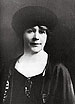 |
Miriam Noel Wright. Circa
1900-1910 (30-40 years old). Miriam wearing a hat, facing slightly to the
right. Courtesy of the Smithsonian Institute, Phil Fedderson collection.
(Note: AIA Monthly Bulletin, Michigan Society of Architects -
December 1959) (Phil H. Fedderson: A native of Clinton and a graduate of
Iowa State University in Ames, Phil Feddersen gained his work experience
with Alden Dow of Midland, Michigan before opening his own architectural
firm in Clinton 1959. Like Dow, Feddersen has been strongly influenced by
the later work of Frank Lloyd Wright.) Many of Feddersen's designs
exhibit the "organic" design philosophy of Wright. Published in "Many
Masks" Gill, 1987, page 235. 5 x 7 Print. High res
digital image. |
0041.02.0609 |
|
1901 |
1901
 |
B. Harley Bradley Residence, Kankakee,
Illinois 1901 (1900 - S.052). View of the Bradley Residence from the street.
Designed by Frank Lloyd Wright in 1900, completed in 1901. The Bradley
Residence is one of Wight's earliest Prairie Houses, and is considered by
most to be his first. The depth of Frank Lloyd Wright's design incorporated
interior furnishing, carpets, built-ins, art glass windows and landscaping,
creating a complete harmonious design. The Bradley House incorporated many
design elements that defined Prairie Styled houses. Low pitched gabled
roofs, broad overhangs, dominate horizontal lines, the exterior finished in
stucco and horizontal bands of art-glass windows. Published in
The Chicago
Architectural Annual, March 1902.
Although published in 1902, this photographs would have been taken after
completing in 1901. Caption: "The exterior is a cream-white plaster and
unsurfaced wood, stained a soft brown. The interior and furnishings are of
quartered oak throughout. The fittings and furnishings were designed by the
architect. The color of the interior walls, floor coverings and hangings of
the main floor is deep red, combined with yellow overhead. The plaster
walls, trim, and furniture are stained and waxed. The house stands in a
small glen on the banks of the... Continue... |
0049.26.0222 |
1901
 |
B. Harley Bradley Residence, Kankakee,
Illinois 1901 (1900 - S.052). View of the Bradley Residence from the street.
Designed by Frank Lloyd Wright in 1900, completed in 1901. The Bradley
Residence is one of Wight's earliest Prairie Houses, and is considered by
most to be his first. The depth of Frank Lloyd Wright's design incorporated
interior furnishing, carpets, built-ins, art glass windows and landscaping,
creating a complete harmonious design. The Bradley House incorporated many
design elements that defined Prairie Styled houses. Low pitched gabled
roofs, broad overhangs, dominate horizontal lines, the exterior finished in
stucco and horizontal bands of art-glass windows. An exact photograph, minus
the dog in the drive is published in
The Chicago Architectural Annual,
March 1902. Although published in 1902, this photographs would have been
taken after completing in 1901. Caption: "The exterior is a cream-white
plaster and unsurfaced wood, stained a soft brown. The interior and
furnishings are of quartered oak throughout. The fittings and furnishings
were designed by the architect. The color of the interior walls, floor
coverings and hangings of the main floor is deep red, combined with yellow
overhead. The plaster walls, trim, and furniture are stained and waxed. The
house... Continue... |
0049.27.0222 |
1901
 |
B. Harley Bradley Residence, Kankakee,
Illinois 1901 (1900 - S.052). View of the Bradley Residence living room.
Designed by Frank Lloyd Wright in 1900, completed in 1901. The Bradley
Residence is one of Wight's earliest Prairie Houses, and is considered by
most to be his first. The depth of Frank Lloyd Wright's design incorporated
interior furnishing, carpets, built-ins, art glass windows and landscaping,
creating a complete harmonious design. The Bradley House incorporated many
design elements that defined Prairie Styled houses. Low pitched gabled
roofs, broad overhangs, dominate horizontal lines, the exterior finished in
stucco and horizontal bands of art-glass windows. The living room space
spreads into subordinate spaces, and in some respects flows into the dining
room. The fireplace is centrally located. Benches originally set on either
side of the fireplace as did round
andirons
in the hearth. Across from the fireplace is a bay window with built in
seating. On either side are built -in bookcases. Two smaller rooms - spaces
- are on either side of the living room, each with built in bookcases and a
set of double doors that lead to the terrace. The top of the doors match the
angles of the roof line. Published in
The Chicago Architectural Annual,
March 1902. Although published...
Continue... |
0049.28.0222 |
1901
 |
B. Harley Bradley Residence, Kankakee,
Illinois 1901 (1900 - S.052). View of the Bradley Residence living room and
fireplace. Designed by Frank Lloyd Wright in 1900, completed in 1901. The
Bradley Residence is one of Wight's earliest Prairie Houses, and is
considered by most to be his first. The depth of Frank Lloyd Wright's design
incorporated interior furnishing, carpets, built-ins, art glass windows and
landscaping, creating a complete harmonious design. The Bradley House
incorporated many design elements that defined Prairie Styled houses. Low
pitched gabled roofs, broad overhangs, dominate horizontal lines, the
exterior finished in stucco and horizontal bands of art-glass windows. The
living room space spreads into subordinate spaces, and in some respects
flows into the dining room. The fireplace is centrally located. Benches
originally set on either side of the fireplace as did round
andirons in the hearth.
Across from the fireplace is a bay window with built in seating. On either
side are built -in bookcases. Two smaller rooms - spaces - are on either
side of the living room, each with built in bookcases and a set of double
doors that lead to the terrace. The top of the doors match the angles of the
roof line. Published in March 1908, Architectural record. Also published in
Frank Lloyd...
Continue... |
0049.29.0222 |
1901
 |
B. Harley Bradley Residence, Kankakee,
Illinois 1901 (1900 - S.052). View of the Bradley Residence living room.
Designed by Frank Lloyd Wright in 1900, completed in 1901. The Bradley
Residence is one of Wight's earliest Prairie Houses, and is considered by
most to be his first. The depth of Frank Lloyd Wright's design incorporated
interior furnishing, carpets, built-ins, art glass windows and landscaping,
creating a complete harmonious design. The Bradley House incorporated many
design elements that defined Prairie Styled houses. Low pitched gabled
roofs, broad overhangs, dominate horizontal lines, the exterior finished in
stucco and horizontal bands of art-glass windows. The living room space
spreads into subordinate spaces, and in some respects flows into the dining
room. The fireplace is centrally located. Benches originally set on either
side of the fireplace as did round
andirons
in the hearth. Across from the fireplace is a bay window with built in
seating. On either side are built -in bookcases. Two smaller rooms - spaces
- are on either side of the living room, each with built in bookcases and a
set of double doors that lead to the terrace. The top of the doors match the
angles of the roof line. Published in
Frank Lloyd Wright Ausgefuhrte
Bauten, Wright, 1911, p.25. Similar...
Continue... |
0049.30.0222 |
1901
 |
B. Harley Bradley Residence, Kankakee,
Illinois 1901 (1900 - S.052). View of the Bradley Residence dining room.
Designed by Frank Lloyd Wright in 1900, completed in 1901. The Bradley
Residence is one of Wight's earliest Prairie Houses, and is considered by
most to be his first. The depth of Frank Lloyd Wright's design incorporated
interior furnishing, carpets, built-ins, art glass windows and landscaping,
creating a complete harmonious design. The Bradley House incorporated many
design elements that defined Prairie Styled houses. Low pitched gabled
roofs, broad overhangs, dominate horizontal lines, the exterior finished in
stucco and horizontal bands of art-glass windows. A built-in china cabinet
covers one interior wall. Glass doors included art glass, but are an
entirely different design than the windows and skylight. Art glass windows
and doors throughout the house utilized a variation of the same design. The
angles in the windows mimic the angles of the roof line. The skylight in the
dining room is more elaborate in design and is considered the most
sophisticated and lavish art glass designed by Wright and do not relate to
the design of the windows in the house. According to Sloan, Light Screens,
2001, p.94, the skylights mirrored the size and placement of the dining room
table. Published...
Continue... |
0049.31.0222 |
1901
 |
Vintage 4" x 3.25" Magic Lantern Slide
of the Design for a Village Bank published in the August, 1901 of
The Brickbuilder. Copy
photograph of the perspective illustration of the Village Bank published in
the August 1901 of The Brickbuilder, constructed of Cast Concrete (Sweeney
44). Frank Lloyd Wright wrote: “While there is probably little romance about
a bank, - less poetry in the bray of Sancho Panza's substantial, positive
gray donkey than in the sound of Rosinante's spirited neighing, - yet the
community likes to feel that this same bank is there to stay. It is, in
fact, the town strong box...”
Wright published
this illustration again in 1910 as part of “Ausgefuhrte Bauten und Entwurfe
von Frank Lloyd Wright.” Study For a Concrete Bank Building. Plate XII.
Magic lantern
slides were used in the U.S. during the late 1800s through the first half of
the 1900s. Text: “Sectional View of the Dining Room. Sectional View of the
Living Room. Sectional View of Entry.”
Text on face of slide: “Wright, Frank Lloyd,
1867-1959. 1901... Continue... |
0044.02.0725 |
1901
 |
Vintage 4" x 3.25" Magic Lantern Slide
of the Design for a Village Bank published in the August 1901 of
The Brickbuilder. Copy
photograph of the cutaway illustration of the Village Bank published in the
August 1901 of The Brickbuilder, constructed of Cast Concrete (Sweeney 44).
Frank Lloyd Wright wrote: “While there is probably little romance about a
bank, - less poetry in the bray of Sancho Panza's substantial, positive gray
donkey than in the sound of Rosinante's spirited neighing, - yet the
community likes to feel that this same bank is there to stay. It is, in
fact, the town strong box...”
Wright published
this illustration again in 1910 as part of “Ausgefuhrte Bauten und Entwurfe
von Frank Lloyd Wright.” Study For a Concrete Bank Building. Plate XII.
Magic lantern
slides were used in the U.S. during the late 1800s through the first half of
the 1900s. Text: “Sectional View of the Dining Room. Sectional View of the
Living Room. Sectional View of Entry...
Continue... |
0044.03.0725 |
1901
 |
E. Arthur Davenport Residence, River
Forest, Illinois, First Floor Plan 1901 (1901 - S.068). A variation for the
first floor plan of the E. Arthur Davenport Residence. The plan is similar
to the completed house, with minor variations. The enclosure at the main
entrance is not included. The front porch bay was removed and a bay window
was added to the living room. Another change is the built-in seating in the
dining room. The house is approaches on the far left side of the property.
The front door faces the street, but is enclosed and obscured from the
street by a partial wall topped with square balusters. Once inside the
enclosure, a stone step leads into the main entry. To the right stairs lead
up to the main level. To the immediate left, stairs lead to the second
level. Past the stairway is the kitchen. Straight ahead is a partial wall
topped with square balusters obscuring the fireplace. To the right is the
living... Continue...
|
0049.32.1023
--
0049.38.1023 |
1901
 |
Fine Arts Building April 1901.
Browne's Bookstore (1907 - S.141), which opened for business during the last
few months of 1907, was located on the left side of the seventh floor as you
faced the building. The W. Scott Thurber Art Gallery (1909 - S.154) occupied
the fifth floor of the Annex adjacent on the right. The reader board above
the door on the left reads "The Studebaker, Castle Square Opera Co. Pirates
of Penzance". The May 1, 1901 issue of "The Dial" ran an ad, "The
Studebaker. Fine Arts Building... 3D Year. Castle Square Opera Company. Week
of April 29 - Pirates of Penzance." The "Pirates of Penzance" was performed
two times. Construction began in late 1887 on the Auditorium building (left)
and in late 1889 it held its grand opening. 8 x 10 Print. High res digital
image.
For more information see
our Wright Study on Browne's Bookstore. |
0048.01.0311 |
Circa 1901
 |
Henderson Residence (1901 -
S.057) circa 1901. View of the Living Room, Fireplace and Library from the
Dining Room. The Henderson Residence was one of Wright's earliest Prairie
styled homes and the only one in Elmhurst. In1900, with the
Bradley
Residence (S.052) and the Prairie style fully blossomed. In
1901 came the Willits Residence (S.054). There was a slight departure with the Hickox Residence (S.056). But
the Henderson Residence is authentic Prairie. In essence the Henderson
Residence was his fourth Prairie styled house. The massive twelve foot wide
brick fireplace centers the home. The deep beams span the width of the
Living Room. Two-light gas wall sconces and built-in cabinets line the
Library wall. The radiator were left exposed. Most likely photographed by
Henry Fuermann. Original 10 x 7.3 B&W photograph.
For more information see
our Wright Study on the Henderson Residence. |
0048.04.0712 |
1901
 |
1)
Warren R. Hickox Residence, Kankakee, Illinois, 1901 (1900 - S.056).
View of the Warren R. Hickox Residence from the East. Taken just after
completion of the house. This appears to be photographed at the same
time as S#49.39 and
S#49.40. Lack of landscaping and bushes, and the
small tree that was planted in front of the terrace. Shadows are also
similar. Designed by Frank Lloyd Wright in 1900. Both the Hickox and
Bradley houses are considered Wright’s first prairie styled houses.
Although the Hickox is smaller than the Bradley, it has many of the same
characteristics. Broad overhanging eaves, gabled roof, upturned flanges,
stucco and wood trim, dominate horizontal lines, and horizontal bands of
leaded glass windows. The angles in the windows mimic the angles of the
roof line. The terrace is on the far left. The Library/music room is on
the left, reception hall and entrance on the right, and covered front
porch of the far right. Published in
Frank Lloyd Wright, Ausgefuhrte Bauten
and
Frank
Lloyd Wright, Chicago, in 1911. Copy 10 x 8 B&W
photograph. |
0049.41.1223 |
1901
 |
2) Warren R. Hickox Residence, Kankakee, Illinois, 1901 (1900 - S.056).
View of the Warren R. Hickox Residence from the Southeast. Taken just
after completion of the house. This appears to be photographed at the
same time as S#49.40 and S#49.41. Lack
of landscaping and bushes, and the small tree that was planted in front
of the terrace. Shadows are also similar. The Dining room window is open
in the same position. Designed by Frank Lloyd Wright in 1900. Both the
Hickox and Bradley houses are considered Wright’s first prairie styled
houses. Although the Hickox is smaller than the Bradley, it has many of
the same characteristics. Broad overhanging eaves, gabled roof, upturned
flanges, stucco and wood trim, dominate horizontal lines, and horizontal
bands of leaded glass windows. The angles in the windows mimic the
angles of the roof line. The terrace on the left leads into the living
room. The dining room is on the far left, the library/music room is on
the right. Published in The
Chicago Architectural Annual, Chicago Architectural Club, 1902. Copy
10 x 8 B&W photograph. |
0049.39.1223 |
1901
 |
3) Warren R. Hickox Residence, Kankakee, Illinois, 1901 (1900 - S.056).
View of the Warren R. Hickox Residence from the South. Taken just after
completion of the house. This appears to be photographed at the same
time as S#49.39 and S#49.41.
Lack of landscaping and bushes, and the small tree that was planted in
front of the terrace. Shadows are also similar. The Dining room window
is open in the same position. Designed by Frank Lloyd Wright in 1900.
Both the Hickox and Bradley houses are considered Wright’s first prairie
styled houses. Although the Hickox is smaller than the Bradley, it has
many of the same characteristics. Broad overhanging eaves, gabled roof,
upturned flanges, stucco and wood trim, dominate horizontal lines, and
horizontal bands of leaded glass windows. The angles in the windows
mimic the angles of the roof line. The dining room is on the left, the
living room is in the center and leads out to the terrace in the
foreground. The library/music room is on the right. Published in
Frank Lloyd Wright, Ausgefuhrte Bauten
in 1911. Copy 10 x 8 B&W photograph. |
0049.40.1223 |
1901
 |
Project For Quadruple Block Plan for the Prairie. Vintage 4" x 3.25"
Magic Lantern Slide of Quadruple Block Plan published in the Ausgefuhrte
Bauten und Entwurfe von Frank Lloyd Wright, 1910,
Plate XIIIa. Frank Lloyd
Wright introduced the concept for the Quadruple Block Plan in the
February, 1901 issue of Ladies
Home Journal, as part of A Home in a Prairie Town.
When Frank Lloyd Wright published Ausgefuhrte Bauten und Entwurfe in
1910, Plate XIII repeated the 1901 single home illustration, Plate XIIIa
repeated the 1901 aerial view and elaborated his theory on the Block
Plan. This slide is a copy of Plate XIIIa.
In 1913, Wright expanded his theory including it in his plan for the
city in the Chicago City Club competition. He wrote of quadruple
re-subdivision by grouping four separate homes together in "sub-blocks".
He continued to developed the principle of the quadruple block plan.
Wright’s plan was published in
City Residential Land Development, 1916, pp. 96-102. Illustrations
were printed in color.
Magic lantern slides were used in the
U.S. during the late 1800s through the first half of the 1900s. Text:
“Sectional View of the Dining Room. Sectional View of the Living Room.
Sectional View of Entry...
Continue... |
0045.01.0725 |
1901
 |
Vintage 4" x 3.25" Magic Lantern Slide of a sectional view published in
the Ladies Home Journal - July 1901. Copy photograph of the an
illustration published in the Ladies
Home Journal - July 1901 (Sweeney
46). A Small House with ‘Lots of Room in It.’ A full page article of a
Prairie house designed by Frank Lloyd Wright. At the top of the page is
a sectional view of the Dining Room, Living Room and Entry. Magic
lantern slides were used in the U.S. during the late 1800s through the
first half of the 1900s. Text: “Sectional View of the Dining Room.
Sectional View of the Living Room. Sectional View of Entry.”
Text on face of slide: “Wright, Frank Lloyd, 1867-1959. 1900 (sic 1901).
Project for the Second Ladies Home Journal House: sectional views.
95918. Art Dept Smith College.” Acquired from the Art Department at
Smith College. Magic lantern slide 4" x 3.25", Transparency: 3" x .6" |
0046.01.0725 |
1901
 |
Vintage 4" x 3.25" Magic Lantern Slide of the Floor Plan for the Small
House with ‘Lots of Room in It,’ published in the Ladies Home Journal -
July 1901. Copy photograph of the floor plan for the Small House with
‘Lots of Room in It,’ published in the
Ladies
Home Journal - July 1901
(Sweeney 46). A Small House with ‘Lots of Room in It.’ A full page
article of a Prairie house designed by Frank Lloyd Wright. In the center
of the page, and and just below it are floor plans for the house.
These floor plans were published again in In
The Nature of Materials,
Hitchcock, 1942, Plates 62 and 63. This slide is a copy of plates 62 and
63. Magic lantern slides were used in the U.S. during the late 1800s
through the first half of the 1900s. Text: “Sectional View of the Dining
Room. Sectional View of the Living Room. Sectional View of Entry.”
Text on face of slide: “Wright, F. L. , 1867-1959. 1900 (sic 1901).
Project: A Small House with Lots of Room in it, for Curtis Pub. Co.
37413. Art Dept Smith College.” Acquired from the Art Department at
Smith College. Magic lantern slide 4" x 3.25", Transparency: 3" x 1.25" |
0046.02.0725 |
1901
 |
Edward C. Waller Stable & Poultry House, River Forest, IL (1901 -
S.066). South Elevation for the Mr. Edward C. Waller Stables, South
Elevation. November 3, 1901. Sheet 3. Designed by Frank Lloyd Wright in
1901. On Sheet 1, the floor plan for the first floor, the left side was
used for Ice Storage, Cows and Tools and a Storage Area. There is a
passage way though the gates in the center. The right side held stalls
for horses, harness room, Coachman's room (office?), and a large section
for carriages. On Sheet 2, the floor plan for the second floor includes
a two-bedroom, one-bath apartment, with a living room and kitchen. About
a third of it is used for a hay loft. The two spire "ventilators" are
covered in copper and shingles. Courtesy of the Frank Lloyd Wight
Foundation. 10.5 x 4 B&W photograph. |
0049.20.0521 |
1901
 |
Edward C. Waller Stable & Poultry House, River Forest, IL (1901 -
S.066). North Elevation for the Mr. Edward C. Waller Stables, North
Elevation. November 3, 1901. Sheet 4. Designed by Frank Lloyd Wright in
1901. On Sheet 1, the floor plan for the first floor, the left side held
a Coachman's room (office?), and a large section for carriages, harness
room and stalls for horses. There is a passage way though the gates in
the center. The right side held a Storage Area, Tools and cows, and Ice
Storage. On Sheet 2, the floor plan for the second floor includes a
two-bedroom, one-bath apartment, with a living room and kitchen. About a
third of it is used for a hay loft. The two spire "ventilators" are
covered in copper and shingles. Courtesy of the Frank Lloyd Wight
Foundation. 10.5 x 4 B&W photograph. |
0049.21.0521 |
1901
 |
Edward C. Waller Stable & Poultry House, River Forest, IL (1901 -
S.066). West (left) and East (right) Elevations for the Mr. Edward C.
Waller Stables, West and East Elevation. November 3, 1901. Sheet 5.
Designed by Frank Lloyd Wright in 1901. On Sheet 1, the floor plan for
the first floor of the two-story section, held the harness room,
Coachman's room (office?), and a large section for carriages. On Sheet
2, the floor plan for the second floor includes a two-bedroom, one-bath
apartment, with a living room and kitchen. About a third of it is used
for a hay loft. The two spire "ventilators" are covered in copper and
shingles. Courtesy of the Frank Lloyd Wight Foundation. 10.5 x 4.75 B&W
photograph. |
0049.22.0521 |
1901
 |
Edward C. Waller Stable & Poultry House, River Forest, IL (1901 -
S.066). West and South Elevation for the Mr. Edward C. Waller Poultry
House. Text top right: "Poultry House for E. C. Waller, River Forest,
ILL. Frank Lloyd Wright, Architect, Oak Park." Designed by Frank Lloyd
Wright in 1901. The West Elevation is pictured in the photograph by
Gilman Lane. The Poultry House appears to be added on to an existing
barn to the North. The two spire "ventilators" are similar to those
Wright added to the Stables. Text lower left: "0108.03." Courtesy of the
Frank Lloyd Wight Foundation. 10 x 6.5 B&W photograph. |
0049.23.0521 |
1901
 |
Edward C. Waller Stable & Poultry House, River Forest, IL (1901 -
S.066). Alternative design of the South Elevation and Floor Plan for the
Mr. Edward C. Waller Poultry House. Hand written lower right: "Chicken
House." Designed by Frank Lloyd Wright in 1901. This variation removes
the spires, but adds large urns. In the background Wright lightly
penciled in the existing barn with its tower. Text lower left: "0108.02.
E. C. Waller, River Forest." Courtesy of the Frank Lloyd Wight
Foundation. 10 x 8 B&W photograph. |
0049.24.0521 |
1901
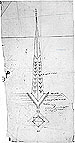 |
Edward C. Waller Stable & Poultry House, River Forest, IL (1901 -
S.066). Detail of the Spire "Ventilator" for the Mr. Edward C. Waller
Poultry House. Designed by Frank Lloyd Wright in 1901. Wright does not
specify materials for finishing this spire, but on the stables he
specified copper and shingles. Hand written top left: "0108.09." Hand
written to the right of the spire: "These pieces to be bent out." Hand
written at the base of the spire: "Ridge of roof. This flange to be
fitted to shingles. Elevation. 2 vents for Mr. Waller's Poultry House at
River Forest. Frank Lloyd Wright Architect. Oak Park, IL." Courtesy of
the Frank Lloyd Wight Foundation. 5.5 x 10 B&W photograph. |
0049.25.0521 |
|
1902 |
Circa 1902
 |
Dana-Thomas Residence (1902 -
S.072) Circa 1902. Study for the presentation drawing of the Studio. Hand
written on drawing, bottom right corner: "Study for Dana Studio, 1900, Frank
Lloyd Wright." Cut-away view of the two-story vaulted studio. Stairs lead up
to the studio, windows in the far wall are broken by ribbed beams and trim,
and an arched beam. The fireplace is under the balcony on the right.
Published in "Frank Lloyd
Wright's Dana House," Hoffmann, 1996, p.92. Original 10 x 8 B&W
photograph. |
0052.07.0514 |
Circa 1902
 |
Dana-Thomas Residence (1902 -
S.072) Circa 1902. Preliminary Dining Room presentation drawing. Watercolor
on paper. Cut-away view of the vaulted dining room, complete with ribbed
trim, furniture, hanging lamps, sculpture, carpet and wallpaper. Published
in "Frank Lloyd Wright's Dana
House," Hoffmann, 1996, p.23. Original 7.5 x 9.25 B&W photograph.
|
0052.06.0514 |
1902/2023
 |
Susan L. Dana Residence, Springfield,
Illinois, Tall-back Chair, 1902/2023 (1902 - S.072). Tall-back chair from
the Susan L. Dana Residence, designed by Frank Lloyd Wright in 1902. Wright
not only designed the house but also meticulously crafted all its
furnishings, ensuring a complete and harmonious design throughout. His
attention to detail and commitment to creating a unified aesthetic resulted
in a living space that seamlessly blends architecture and interior design
into a singular, cohesive vision.
This chair was sold at Toomey & Co. on March 2, 2023, Price realized
$107,100. Produced in oak and leather. The chair measured 51.25" High x
17.75" Wide x 18.5" Deep. Courtesy of Toomey & Co. 8 x 10 Color photograph. |
0052.43.1225 |
1902
 |
Mrs. George E. Gerts Summer Cottage,
Whitehall, Michigan, Floor Plan 1902 (1902 - S.077). Floor plan for the Mrs.
George E. Gerts Summer Cottage. The cottage is very small, 1,026 square
feet, not including the two porches. The house is divided in half, with each
side mirroring itself. The entrance is from the small porch, not facing the
lake. Each side has a portion of the porch, with stairs, a 9' x 9' kitchen
and a 6' x 6' servants bedroom. There is not a second bedroom or even a
single bathroom. The living room is both private with a portion shared. The
fireplace is very unique. It is a double fireplace, triangular in shape. The
porch facing the lake is share by both sides. A roof covered half the large
porch, and it was not enclosed. The exterior is finished in horizontal board
and batten. The cottage is laid out using a three-foot grid system. Text top
right: "Mrs. G. E. Gerts Summer Cottage. White Lake, Michigan. Frank Lloyd
Wright, Architect. Oak Park." Text bottom left: "0202.01." Text bottom
right: "1." Courtesy of the Avery Library Archive, Columbia University. 8 x
10 B&W photograph. |
0052.23.0822 |
1902
 |
Mrs. George E. Gerts Summer Cottage,
Whitehall, Michigan, Elevations 1902 (1902 - S.077). North, South and East
Elevations of the Mrs. George E. Gerts Summer Cottage. The North Elevation
faces the lake and a bridge spans Birch Brook. Windows and doors run from
corner to corner. The South Elevations has a small porch and two entrances,
one for each side of the double house. The East Elevation shows the entrance
on the left, bridge on the right, and windows that covers two-thirds of the
main portion of the house. The cottage is very small, 1,026 square feet, not
including the two porches. A roof covered half the large porch, and it was
not enclosed. The exterior is finished in horizontal board and batten. The
cottage is laid out using a three-foot grid system. Text bottom left:
"0202.02." Text bottom right: "2." Courtesy of the Avery Library Archive,
Columbia University. 8 x 10 B&W photograph. |
0052.24.0822 |
1902
 |
Mrs. George E. Gerts Summer Cottage,
Whitehall, Michigan, Sections and Details 1902 (1902 - S.077). Transverse
Section, Details and Longitudinal Section for the Mrs. George E. Gerts
Summer Cottage. Transverse Section illustrated the two fireplaces and the
living rooms. Longitudinal Section illustrated the entrance on the left and
the bridge on the right. A roof covers half the large porch, and it was not
enclosed. The exterior is finished in horizontal board and batten. Text
bottom right: "Boards and Battens same as those on side, sprung on soffit of
arch, lengthwise of span. Text bottom left: "0202.03." Text bottom right: "3." Courtesy of the Avery Library Archive, Columbia University. 8 x 10 B&W
photograph. |
0052.25.0822 |
1902
 |
George E. Gerts Circa 1902 (1902 -
S.077). Portrait of George E. Gerts, Chicago. Caption: "Born in Portland,
Me., in 1827. Came to Chgo. in 1S50, establishing himself in the business of
a brush manufacturer, and located on Wells St., now Fifth Ave. ; the
business was conducted under the name of Geo. E. Gerts, afterward Gerts &
Loder; afterward it became Geo. E. Gerts & Co., and subsequently Gerts,
Lumbard A Co." Published in "Men In Illinois," 1902. Published by Halliday
Witherspoon, Chicago. 5 x 7 B&W photograph. |
0052.26.0822 |
1902
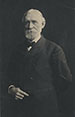 |
Harry C.
Goodrich Residence, Oak Park, Illinois, Portrait, Circa 1902 (1896 -
S.042). Portrait of Harry C. Goodrich. Frank Lloyd Wright designed a house
for Goodrich in 1895. Harry Clinton Goodrich was born on March 22, 1832,
died in 1926 at the age of 94. He was married to Louisa M. Fowler on March
22, 1855. They had 11 children. The oldest was Adelaide Eunice Goodrich,
born in 1856. She became a famous actress. The Adelaide Eunice Goodrich
Collection of documents is located at the University of Chicago Library.
Harry C Goodrich also had a son by the same name, Harry C. Goodrich, who was
born on September 2, 1871. Harry C. Goodrich (Sr.) had a brother, Herman
Barnum Goodrich, who was also an inventor. Herman B. Goodrich married Emily
C. Dunkllee on November 8, 1855. They had seven children, one of which was
named Harry Clinton Goodrich, born on January 27, 1866. Text hand written on
verso: "Harry Clinton Goodrich. #45." Courtesy of the University of Chicago
Library. 6.5 x 10 B&W photograph. |
0052.31.0323 |
1902
 |
1) A. W. Hebert Residence Remodel, Evanston,
Illinois, East Elevation 1902 (1902 - S.089). East elevation (front) of the
A. W. Hebert Residence Remodel. FLLW #0112.07. The remodeling was designed
by Frank Lloyd Wright in 1902. Almost all of the changes designed by Frank
Lloyd Wright were lost when the house was restored after a fire in 1959.
Comparing Wright's plans to the house as it looks today, you would be hard
pressed to make a connection without knowing the history of the house. Fire
damage to the plans themselves add intrigue to the legacy of the Wright
design for the Hebert Residence. 10 x 8 Color photograph. |
0052.28.0223 |
1902
 |
2) A. W. Hebert Residence Remodel, Evanston,
Illinois, North Elevation 1902 (1902 - S.089). North elevation (right side)
of the A. W. Hebert Residence Remodel. FLLW #0112.09. The remodeling was
designed by Frank Lloyd Wright in 1902. Almost all of the changes designed
by Frank Lloyd Wright were lost when the house was restored after a fire in
1959. Comparing Wright's plans to the house as it looks today, you would be
hard pressed to make a connection without knowing the history of the house.
Fire damage to the plans themselves add intrigue to the legacy of the Wright
design for the Hebert Residence. 10 x 8 B&W photograph. |
0052.29.0223 |
1902
 |
3) A. W. Hebert Residence Remodel, Evanston,
Illinois, Perspective 1902 (1902 - S.089). Perspective view of the A. W.
Hebert Residence Remodel. FLLW #0112.05. The remodeling was designed by
Frank Lloyd Wright in 1902. Almost all of the changes designed by Frank
Lloyd Wright were lost when the house was restored after a fire in 1959.
Comparing Wright's plans to the house as it looks today, you would be hard
pressed to make a connection without knowing the history of the house. Fire
damage to the plans themselves add intrigue to the legacy of the Wright
design for the Hebert Residence. 10 x 8 B&W photograph. |
0052.30.0223 |
1902
 |
Arthur Heurtley Cottage Remodeling,
Les Cheneaux, Marquette Island, Michigan, Alteration Plan 1902 (1902 -
S.075). Alteration Plan for the Arthur Heurtley Cottage. Frank Lloyd Wright
may have designed the original plans for the cottage, but plans could not be
found. The renovation included alterations to the bedrooms and bath on the
first floor, and reconfiguring the basement to include a dining room,
kitchen and servant's quarters. Plans appear to indicate that the "basement" was built into the slope. He also designed a fireplace and sideboard for the
dining room. Original work is indicated in red, new changes indicated in
black. Drawings include, Plan of Alteration in First Floor, Plan of
Alteration in Basement, West Elevation, South Elevation, Sideboards, Dining
Room Fireplace. He also specified maple floor throughout the basement.
Written on the plans: "Maple Floor Throughout. Note - Interior Finish to
Correspond with Finish of First Floor." Text bottom right: "Alteration
Summer Cottage Of Mr. Arthur Heurtley, Les Cheneaux Club, Marquette Island,
Michigan. Frank Lloyd Wright - Architect, Oak Park, Illinois. New Work
Indicated Thus ------------- (black line). Old Work Indicated Thus
------------- (red
line)." Hand written center left: "0214.01." Courtesy of the Frank
Lloyd Wright Archives, Avery Library. 10 x 6 Color and 10 x 5.5 B&W
photograph. (S#0052.32 : 1&2) |
0052.32.0523 (1&2) |
1902
 |
1) Francis W. and Mary Little
Residence I, Peoria, Illinois, Ground and First Floor Plan 1902, (FLLW
#0009.23) (1902 - S.070). House and Stable ground and first floor plan for
the Francis W. and Mary Little Residence I. Designed by Frank Lloyd Wright
in 1902. Francis Little was an attorney and owner of a utility company in
Peoria, Illinois. He hired his friend, Frank Lloyd Wright to design his home
in Peoria. He retained Wright again that year to add a Stable to the home.
In 1908 they hired Wright to build a second home in Minnesota , "Northome".
The Little Residence was included in Frank Lloyd Wright’s Ausgefuhrte Bauten
portfolios. Plate XXVIII (28).
Perspective and floor plan for the Little Residence. The description reads:
"Residence of F. W. Little, Peoria, Ill. 1900. A residence of cream -colored
brick. The plan is as the residence was finally built. The exterior sketch,
the original scheme."
This illustration is very similar to the illustration published in the 1910
portfolio, with minor changes and text in English. The left is the first
floor for the house, the right is the first floor of the stable. The house
has a compact cruciform floor plan. The living room is on left side,
reception and kitchen in the center and the dining room is on the right side...
Continue... |
0052.35.0824 |
1902
 |
2) Francis W. and Mary Little
Residence I, Peoria, Illinois, Second Floor Plan 1902, (1902 - S.070).
Second floor plan for the Francis W. and Mary Little Residence I, a portion
of the Ausgefuhrte Bauten Plate XXVIII (28). Designed by Frank Lloyd Wright
in 1902. Francis Little was an attorney and owner of a utility company in
Peoria, Illinois. He hired his friend, Frank Lloyd Wright to design his home
in Peoria. He retained Wright again that year to add a Stable to the home.
In 1908 they hired Wright to build a second home in Minnesota , "Northome".
The Little Residence was included in Frank Lloyd Wright’s Ausgefuhrte Bauten
portfolios. Plate XXVIII (28).
Perspective and floor plan for the Little Residence. The description reads:
"Residence of F. W. Little, Peoria, Ill. 1900. A residence of cream -colored
brick. The plan is as the residence was finally built. The exterior sketch,
the original scheme."
This illustration a portion of the Ausgefuhrte Bauten Plate XXVIII (28)
published in 1910. There are five bedrooms upstairs, three bath, and three
balconies. 8.25 x 7.75 Color photograph. |
0052.36.0824 |
1902
 |
3) Francis W. and Mary Little
Residence I, Peoria, Illinois, Stable First and Second Floor Plan 1902,
(FLLW #0009.15) (1902 - S.070). First and second floor plan for the Francis
W. and Mary Little Residence I Stable. Designed by Frank Lloyd Wright in
1902. Francis Little was an attorney and owner of a utility company in
Peoria, Illinois. He hired his friend, Frank Lloyd Wright to design his home
in Peoria. He retained Wright again that year to add a Stable to the home.
In 1908 they hired Wright to build a second home in Minnesota , "Northome".
The Little Residence was included in Frank Lloyd Wright’s Ausgefuhrte Bauten
portfolios. Plate XXVIII (28). Perspective and floor plan for the Little
Residence. The description reads: "Residence of F. W. Little, Peoria, Ill.
1900. A residence of cream -colored brick. The plan is as the residence was
finally built. The exterior sketch, the original scheme."
The stable has a carriage room, stalls for horses and a cow, and a bathroom.
The upstairs has a “man’s room” and the hay loft. Courtesy of the Frank
Lloyd Wright Archives, Avery Library. 10 x 7.25 Color photograph. |
0052.37.0824 |
1902
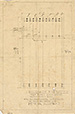 |
Francis W. and Mary Little Residence
I, Peoria, Illinois, Window Plan 1902, (FLLW #0009.21) (1902 - S.070).
Window plan for the Francis W. and Mary Little Residence I, designed by
Frank Lloyd Wright in 1902. Francis Little was an attorney and owner of a
utility company in Peoria, Illinois. He hired his friend, Frank Lloyd Wright
to design his home in Peoria. He retained Wright again that year to add a
Stable to the home. In 1908 they sold the home and moved to Minnesota where
they hired Wright to build a second home, "Northome".
The top one-third of the window holds the most detail. Detailed glass also
runs on either side, and along the bottom of the window. The upper and lower
portions of the window are bridged together by vertical cames. Julie Sloan
called this a “Bamboo-Curtain pattern,” Light Screens, 2001. Other examples
include the Davenport (1901), Henderson (1901), Fricke (1901), Cheney
(1903), Brown (1905) and the Martin Gardener’s Cottage (1905). Most of the
windows in the house included clear glass, with opaque, white and gold
accents. The windows in the stable used clear glass.
As in many of
Wright’s other houses, he created a different design...
Continue... |
0052.34.0824 |
1902
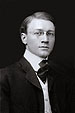 |
Frederick Carlton Robie 1902
Wedding photograph. Frederick was born on August 14, 1879 in Chicago,
Illinois. His father was Fred C Robie. He entered Purdue University in
September 1895 while he was only 16. He left in February 1899, before
graduating to work for his father. He met Lora Hieronymus at a dance at the
University of Chicago. Frederick and Lora continued their relationship, and
on June 30, 1902 they were married. Their first child Fred Robie Jr. was
born in February 19, 1907. They had a second child, a daughter by the name
of Lorraine. They purchased the lot at 5757 Woodlawn on April 8, 1908 for
$13,500. They contacted Wright in 1908 and by March 1909 plans were
complete. Construction was complete, and they moved in during the early part
of 1910. Frederick worked for his father, and when he past away on July 18,
1909, the businesses had to be sold to pay back the debts his father had
incurred. Lora Robie moved out of the home in April 1911, and took both
children with her. Frederick sold the house in December 1911 to David Lee
Taylor, president of the advertising agency Taylor-Critchfield Co. Frederick
and Lora were divorced in March, 1912. David Lee Taylor past away in October
1912. His wife sold the house in November 1912 to Marshall Dodge and Isadora
Wilber. They had two daughters, Marcia and Jeannette...
Continue... |
0052.04.0212 |
1902
 |
Lora Hieronymus Robie 1902
wedding photograph. Photographed by Kessberger & George. Lora Hieronymus was
born on May 14, 1878 in Peoria, Illinois. Her father was Benjamin R.
Hieronymus. She began attending the University of Chicago in 1896 and met
Frederick Robie at a dance at the University. She graduated in June of 1900
and returned to Springfield where her family now lived and taught ninth
grade at the Lawrence School. The Lawrence School was named after Rheuna D
Lawrence, president of the board, after his death in 1901. He was the father
of Susan Lawrence Dana (1902 - S.072). Frederick and Lora continued
their relationship, and on June 30, 1902 they were married. Their first
child Fred Robie Jr. was born in February 19, 1907. Their daughter Lorraine
was born on December 2, 1909. Financial struggles took its toll, Lora Robie
moved out of the home in April 1911, and took both children with her. She
headed back home to Springfield Illinois and took up teaching to support her
children. She filed for divorce in January 1912, claiming infidelity, and
was granted a divorce in March, 1912. She became the dean of girls at
Springfield High School in the 1920s, then opened a bookstore in 1927. She
even broadcast a weekly book review on the radio. She became the manager of
the book department at Myers Brothers Department Store...
Continue... |
0052.05.0212 |
|
1903 |
1903
 |
George Barton Residence, Buffalo, New York, Window Plan 1903 (1903 -
S.103). Window plan for the George Barton Residence, designed by Frank
Lloyd Wright in 1903. This single plan for the George Barton House
appears to be the only plan that survived, and is located in the Frank
Lloyd Wright Archives in the Avery Library, Columbia University. Hand
written on plan: “Green Yellow; Iridecent; Green; Gold; W. Opal
(erased); $1.50 per foot, Giannini & Hilgart; 2' 4" x 3'; Full Size
Detail of of Glass, Residence.” The final windows were produced in
green, gold and amber irodized glass, which is very similar to the Susan
Dana House. Courtesy of the Frank Lloyd Wright Archives, Avery Library.
8 x 10 Color photograph. |
0054.19.1124 |
1903
 |
William G. Fricke Home, 1903 (1901 S.058). Viewed from the Northwest,
photographed during the winter. This may be one of the earliest views of
the Fricke Residence. The street has not yet been paved but sidewalks
have been installed. Landscaping and other homes are sparse. There does
not appear to be any window plantings. "Hitching Posts" near the
entrance are not visible. William G. Fricke was a partner in Weber,
Costello, Fricke, a Chicago firm which manufactured and sold school
supplies nationwide. Fricke commissioned Wright in 1901 to design his
home. He lived in the home for five years until it was purchased by Emma
Martin purchased the home in 1906-7. Patrick F. Cannon suggests that
"Fricke sold the house because of Financial difficulties. According to
divorce records. William Frick left for work on August 10, 1909, and
never returned..." Hometown Architect, 2006. Courtesy of the Historical
Society of Oak Park and River Forest. Image partially restored by
Douglas M. Steiner. (Dated by the Historical Society.) 8 x 8 B&W
photograph. |
0054.11.1116 |
C 1903
 |
Warren R. Hickox Residence, Kankakee, Illinois, C 1903 (1900 - S.056).
View of the Warren R. Hickox Residence from the Southeast. This appears
to be photographed just a couple years after
S#49.39,
S#49.40 and S#49.41.
Bushes and the small tree have been planted. Designed by Frank Lloyd
Wright in 1900. Both the Hickox and Bradley houses are considered
Wright’s first prairie styled houses. Although the Hickox is smaller
than the Bradley, it has many of the same characteristics. Broad
overhanging eaves, gabled roof, upturned flanges, stucco and wood trim,
dominate horizontal lines, and horizontal bands of leaded glass windows.
The angles in the windows mimic the angles of the roof line. The terrace
is on the far left. The Library/music room is on the left, reception
hall and entrance on the right, and covered front porch of the far
right. Photographed by Henry Fuermann and Sons. Text lower left: “2827.”
Published in the July, 1905 Architectural Record. Courtesy of the Art
Institute of Chicago. 10 x 6 B&W photograph. |
0054.16.1223 |
1903
 |
Joseph J. Walser Residence, Chicago, Illinois,
Elevations and Wall Plans, Sheet 4, 1903 (1903 - S.091). East and West
Elevations and Wall Plans for the Joseph J. Walser Residence,
(FLLW#0306.05). Designed by Frank Lloyd Wright in 1903. The building
permit was issued in May, 1903 and completed and occupied by the end of
the year.
Although there are slight differences, the Walser is very similar in
design to the Barton, De Rhodes and Horner houses. The Living Room faces
the street, the dining room is at the back of the house. Constructed of
stucco and wood trim. The interior and exterior art glass was removed
and funds used to save the home from destruction.
Text: “West Elevationm, East Elevation.” Hand written lower left:
“0306.05.” Courtesy of the Frank Lloyd Wright Archives, Avery Library,
Columbia University. Three 10 x 8 B&W Photograph.
|
0054.20.1224 (A-C) |
1903
 |
Joseph J. Walser Residence, Chicago, Illinois,
Elevations Plans, Sheet 5, 1903 (1903 - S.091). North and South
Elevation Plans for the Joseph J. Walser Residence, (FLLW#0306.06).
Designed by Frank Lloyd Wright in 1903. The building permit was issued
in May, 1903 and completed and occupied by the end of the year.
Although
there are slight differences, the Walser is very similar in design to
the Barton, De Rhodes and Horner houses. The Living Room faces the
street, the dining room is at the back of the house. Constructed of
stucco and wood trim. The interior and exterior art glass was removed
and funds used to save the home from destruction.
Text: “North Elevation, South Elevation.” Hand written lower left:
“0306.06.” Courtesy of the Frank Lloyd Wright Archives, Avery Library,
Columbia University. Three 10 x 8 B&W Photograph.
|
0054.21.1224 (A-C) |
1903
 |
Joseph J. Walser Residence, Chicago, Illinois,
First Floor Plan, Sheet 2, 1903 (1903 - S.091). First Floor Plan for the
Joseph J. Walser Residence, (FLLW#0306.03). Designed by Frank Lloyd
Wright in 1903. The building permit was issued in May, 1903 and
completed and occupied by the end of the year.
Although
there are slight differences, the Walser is very similar in design to
the Barton, De Rhodes and Horner houses. The Living Room faces the
street, the dining room is at the back of the house. Constructed of
stucco and wood trim. The interior and exterior art glass was removed
and funds used to save the home from destruction.
From Central Avenue, the sidewalk on the left leads to the front stairs.
Turning 90 degrees, the stairs lead to the landing by the front door.
Straight ahead leads to the front terrace, turning left 90 degrees...
Continue...
 |
0054.22.1224 (A-b) |
1903
 |
Joseph J. Walser Residence, Chicago, Illinois,
Second Floor Plan, Sheet 3, 1903 (1903 - S.091). Second Floor Plan for
the Joseph J. Walser Residence, (FLLW#0306.04). Designed by Frank Lloyd
Wright in 1903. The building permit was issued in May, 1903 and
completed and occupied by the end of the year.
Although
there are slight differences, the Walser is very similar in design to
the Barton, De Rhodes and Horner houses. The Living Room faces the
street, the dining room is at the back of the house. Constructed of
stucco and wood trim. The interior and exterior art glass was removed
and funds used to save the home from destruction.
The second floor has five bedrooms and a bath. Courtesy of the Frank
Lloyd Wright Archives, Avery Library, Columbia University. 10 x 8 B&W
Photograph. |
0054.23.1224 |
1903
 |
Joseph J. Walser Residence, Chicago, Illinois,
Millwork Details, Sheet 6, 1903 (1903 - S.091). Millwork Details Plan
for the Joseph J. Walser Residence, (FLLW#0306.07). Designed by Frank
Lloyd Wright in 1903. The building permit was issued in May, 1903 and
completed and occupied by the end of the year.
Although
there are slight differences, the Walser is very similar in design to
the Barton, De Rhodes and Horner houses. The Living Room faces the
street, the dining room is at the back of the house. Constructed of
stucco and wood trim. The interior and exterior art glass was removed
and funds used to save the home from destruction.
Details include: General Trim; North Side of Dining and Living Rooms;
Cases in Kitchen; East Side of Hall and Reception Room; Jambs and Doors;
Typical Wardrobes; North Side of Chamber 4; Wardrobe...
Continue...
|
0054.24.1224 (A-D) |
1903
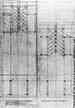 |
Joseph J. Walser Residence, Chicago, Illinois, Art
Glass Plan, 1903 (1903 - S.091). Sideboard and Bookcase Plan for the
Joseph J. Walser Residence, (FLLW#0306.01). Designed by Frank Lloyd
Wright in 1903. The building permit was issued in May, 1903 and
completed and occupied by the end of the year.
Although
there are slight differences, the Walser is very similar in design to
the Barton, De Rhodes and Horner houses. The Living Room faces the
street, the dining room is at the back of the house. Constructed of
stucco and wood trim. The interior and exterior art glass was removed
and funds used to save the home from destruction.
Text in drawing: “White”; “Gold”; “Green”; “Yellow”. Text bottom left:
“Full Size Detail of Glass in Sideboard. House of J. J. Walser Jr. Frank
Lloyd Wright Arch. Oak Park Ill.” Text lower right: “Full Size Detail of
Glass in Bookcase.” Hand written lower left: “0306.01.” Courtesy of the
Frank Lloyd Wright Archives, Avery Library, Columbia University. 8 x 10
B&W Photograph. |
0054.25.1224 |
1903
 |
Wright at 36. Circa 1903. Portrait of Wright slightly facing to the
right, resting his head on his hand. May have been photographed at the
same one dated 1905 (Wright at 38), but his hair
does not have the touch of gray. Published in "Frank
Lloyd Wright" Thomas, 1997, page 6 and dated 1903. 4 x 5 Print, High res
digital image. |
0054.02.0609 |
|
1904 |
1904
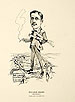 |
William Adams
Illustration 1904 (1900 - S.048). Caricature illustration of William
Adams. William Adams was a successful contractor in the Chicago area.
Adam's first collaboration with Frank Lloyd Wright was on Wright's
Winslow Stable. Two other major collaborations were the Heller
Residences (1896 - S.038) built in 1897 and Husser (1899 - S.046). Frank
Lloyd Wright also designed the home for Adams. Text in illustration:
"William Adams, President, William Adams Co." "Wm. Adams Contract,
Chicago." Signed: "Kettner." Illustrated by Magnus G. Kettner, a
cartoonist for the Western Newspaper Union. 6.5 x 10.5 Color photograph
of illustration published in 1904. |
0055.19.1119 |
1904
 |
Charles W. Barnes Residence, McCook,
Nebraska, Project (1904 - FLLW #0513). While researching the
Joseph Walser windows, we happened to stumble upon drawings
for the Charles W. Barnes Residence again, and were struck
by the similarity of the design between the two houses. The
Walser Residence, Chicago, was designed
in 1903 (FLLW #0305) while the Charles Barnes was designed
in 1904 (FLLW #0513). A third would be the
Barton Residence, Buffalo, also
designed in 1903 (FLLW #0301). While the floor plans are
similar in all three, the similarities between the Walser
and Barnes are striking.
Charles Barnes was born in 1860, and married Rose L. Lee in
1895. He was the publisher of the McCook Times-Democrat and
the McCook... Continue...
|
0055.36.0125 (1-6) |
1904
 |
George
Barton Residence, Buffalo, New York, 1904 (1903 - S.103). View from the
Southeast, of the George Barton House under construction. Designed by
Frank Lloyd Wright in 1903. The grounds have not yet been landscaped,
nor has the large urn been placed, near the entrance to the house. The
Darwin Martin Complex can be seen
in the background, under construction. The Bartons may have moved into
the house. Flowers can bee seen in the front window.
From Summit
Avenue, the sidewalk leads to the front stairs. Turning 90 degrees, the
stairs lead up to the front terrace. 90 degrees once again, and the
front door leads you into the entry hall. Once in the entry hall,
turning left leads out to the porch, and right to the dining, living and
library. Past the stairs, which leads to the second level, is the
kitchen. Upstairs are four bedrooms and a bath. This photograph is dated
September 25, 1904. Courtesy of the University at Buffalo, Darwin Martin
Collection. 10 x 8 B&W photograph. |
0055.35.1124 |
1904
 |
William G.
Fricke Home, Circa 1904 (1901 S.058). Viewed from the Northwest,
photographed during the spring or fall. The street has not yet been
paved but sidewalks have been installed. Landscaping and other homes are
sparse. Window plantings are visible. "Hitching Posts" near the entrance
have been installed. Like the
Rollin Furbeck Residence
(1897), it includes elements of Wright's transitional period. Corners
are turned at a 45 degree angle, it includes a massive central tower,
there are rectangular square windows with columns and it is more
vertical than Wright's prairie styled horizontal designs. It is also a
three story home. The Living and Dining Rooms, Kitchen, Hall and
Reception Room are on the first level. The Bedrooms are on the second
level. Courtesy of the Frank Lloyd Wright Preservation Trust.(The
Preservation Trust dates the image circa 1902-1907, but the streets are
paved in the 1905 photograph published in the Inland Architect and News
Record - Volume XLVI No. 1 1905, August 1905) 10 x 7.5 B&W photograph. |
0055.10.1116 |
1904
 |
Larkin
Administration Building, Buffalo, New York, 1904 (1903 - S.093). Design
for the Larkin Administration Building Telephone Operator's Station FLLW
#0403.110. Frank Lloyd Wright's designs for the Larkin Administration
building were completed in 1904. The finished building was ready for
occupancy in August 1906. In the main lobby of the Larkin Administration
Building, behind the semi-circular Telephone Operator's Station is an
elaborately designed light fixture. Hung below, but part of the fixture
is an "LCO" monogram
designed by Frank Lloyd Wright. Text: "Larkin Office Building, Buffalo,
N.Y. Detail of Telephone Operators Station, Etc. Frank Lloyd Wright,
Architect, Oak Park, Illinois." Courtesy of the Frank Lloyd Wright
Archives, Avery Library. 10 x 6.75 B&W photograph. |
0055.27.0721 |
1904
 |
Larkin
Administration Building, Buffalo, New York, 1904 (1903 - S.093). Detail
of the design for the Larkin Administration Building Telephone
Operator's Station FLLW #0403.110. Frank Lloyd Wright's designs for the
Larkin Administration building were completed in 1904. The finished
building was ready for occupancy in August 1906. In the main lobby of
the Larkin Administration Building, behind the semi-circular Telephone
Operator's Station is an elaborately designed light fixture. Hung below,
but part of the fixture is an
"LCO" monogram
designed by Frank Lloyd Wright. Text: "Larkin Office Building, Buffalo,
N.Y. Detail of Telephone Operators Station, Etc. Frank Lloyd Wright,
Architect, Oak Park, Illinois." Courtesy of the Frank Lloyd Wright
Archives, Avery Library. 10 x 8 B&W photograph. |
0055.28.0721 |
1904
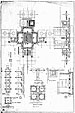 |
Larkin
Administration Building, Buffalo, New York, 1904 (1903 - S.093). Design
for the Larkin Administration Building Light Fixtures FLLW #0403.115.
Frank Lloyd Wright's designs for the Larkin Administration building were
completed in 1904. The finished building was ready for occupancy in
August 1906. In the main lobby of the Larkin Administration Building,
behind the semi-circular Telephone Operator's Station is an elaborately
designed light fixture. Hung below, but part of the fixture is an
"LCO" monogram
designed by Frank Lloyd Wright. Text: "Fixture (K); Fixture (Q); Fixture
(2); (K); Sheet 4." Courtesy of the Frank Lloyd Wright Archives, Avery
Library. 10 x 7 B&W photograph. |
0055.29.0721 |
1904
 |
Larkin
Administration Building, Buffalo, New York, 1904 (1903 - S.093). Detail
of the design for the Larkin Administration Building Light Fixture 2,
Side Elevation. FLLW #0403.115. Frank Lloyd Wright's designs for the
Larkin Administration building were completed in 1904. The finished
building was ready for occupancy in August 1906. In the main lobby of
the Larkin Administration Building, behind the semi-circular Telephone
Operator's Station is an elaborately designed light fixture. Hung below,
but part of the fixture is an
"LCO" monogram
designed by Frank Lloyd Wright. Text: "Fixture (2) Side Elevation."
Courtesy of the Frank Lloyd Wright Archives, Avery Library. 10 x 8 B&W
photograph. |
0055.30.0721 |
1904
 |
Larkin Company
Workmen's Row Housing Project 1904. Frank Lloyd Wright Foundation Number
0408. Glass slide of Larkin Company Workmen's Row Housing floor plan.
Designed by Frank Lloyd Wright as low-cost rental housing, each brick
row house was a laid out as a duplex. The main level included the Living
Room and Kitchen. The Living Room was approximately 10' 9" by 11'. The
Kitchen was approximately 12' 4" by 14' 6", which may indicate that the
kitchen which included the fireplace was where the "Living" took place.
The second floor included three bedrooms and one bath. The Basement was
for laundry and utilities. The project was never completed, and in 1910
Wright resurrected it and included it in "Ausgefuhrte Bauten und
Entwurfe von Frank Lloyd Wright, " the Wasmuth Portfolio, Tafel XL, and
titled it "Workmen's Cottages for Mr. E. C. Waller, Chicago, Ill." Label
on face: "Wright, Frank Lloyd, 1867-1959, 1904. Plans for Larkin Co.
Workmen's Row Houses, Buffalo, New York. (35448). 44453. Art Dept. Smith
College." Original 3.25 x 4 B&W glass slide. |
0055.11.0518 |
1904
 |
Larkin Company
Workmen's Row Housing Project 1904. Frank Lloyd Wright Foundation Number
0408. Designed by Frank Lloyd Wright as low-cost rental housing, each
brick row house was a laid out as a duplex. The main level included the
Living Room and Kitchen. The Living Room was approximately 10' 9" by
11'. The Kitchen was approximately 12' 4" by 14' 6", which may indicate
that the kitchen which included the fireplace was where the "Living"
took place. The second floor included three bedrooms and one bath. The
Basement was for laundry and utilities. The project was never completed,
and in 1910 Wright resurrected it and included it in "Ausgefuhrte Bauten
und Entwurfe von Frank Lloyd Wright, " the Wasmuth Portfolio, Tafel XL,
and titled it "Workmen's Cottages for Mr. E. C. Waller, Chicago, Ill."
Label on face: "Wright, Frank Lloyd, 1867-1959, 1904. Plans for Larkin
Co. Workmen's Row Houses, Buffalo, New York. (35448). 44453. Art Dept.
Smith College." Two 8 x 10 Color photographs. (S#55.12 A&B) |
0055.12.0518 |
1904
 |
Larkin Company
Workmen's Row Housing Project 1904. Frank Lloyd Wright Foundation Number
0408. Perspective Drawing. Designed by Frank Lloyd Wright as low-cost
rental housing, each brick row house was a laid out as a duplex. Each
consisted of two floors plus a basement. Constructed of brick. The main
level included the Living Room and Kitchen. The Kitchen included the
fireplace. The second floor included three bedrooms and one bath. The
Basement was for laundry and utilities. The project was never completed,
and in 1910 Wright resurrected it and included it in "Ausgefuhrte Bauten
und Entwurfe von Frank Lloyd Wright, " the Wasmuth Portfolio, Tafel XL,
and titled it "Workmen's Cottages for Mr. E. C. Waller, Chicago, Ill."
Courtesy of the Frank Lloyd Wright Foundation. 8 x 10 Color photographs. |
0055.13.0518 |
1904
 |
Larkin Company
Workmen's Row Housing Project 1904. Frank Lloyd Wright Foundation Number
0408. Floor Plan, Basement Plan (left, First Floor Plan (center), Second
Floor Plan (right). Designed by Frank Lloyd Wright as low-cost rental
housing, each brick row house was a laid out as a duplex. Each consisted
of two floors plus a basement. The main level included the Living Room
and Kitchen. The Kitchen included the fireplace. The second floor
included three bedrooms and one bath. The Basement was for laundry and
utilities. The project was never completed, and in 1910 Wright
resurrected it and included it in "Ausgefuhrte Bauten und Entwurfe von
Frank Lloyd Wright, " the Wasmuth Portfolio, Tafel XL, and titled it
"Workmen's Cottages for Mr. E. C. Waller, Chicago, Ill." Courtesy of the
Frank Lloyd Wright Foundation. 8 x 10 Color photographs. |
0055.14.0518 |
1904
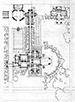 |
Darwin D. Martin Residence Ground Plan, 1904, Buffalo, New York (1904 -
S.100). Ground and floor plan for the Darwin Martin House. Published in
Ausgeführte Bauten und Entwurfe von Frank Lloyd Wright. 1910. "Ground
plan of the D. D. Martin. Reference to the general plan of the Martin
house will show certain freestanding groups of piers. In the central
chamber formed by the piers the radiators are located, and the lighting
fixtures are concentrated upon the peers themselves. Bookcases, swinging
out ward, are placed below between the peers: the open spaces above are
utilized as cabinets, and from these the heat passes into the rooms.
Fresh air is let into the central chamber through openings between the
piers and the bookcases. The radiators and the appurtenance systems are
thus made an artistic feature of the architecture." Ausgeführte Bauten
und Entwurfe von Frank Lloyd Wright. 1910, Plate XXXII (32 Tissue).
The main house is on the left. The long walkway leads to the
conservatory, top center. Connected to it, and to the left is the
Carriage House. The conservatory is top center. The George Barton
Residence, is on the top right. Barton’s wife was Martin’s sister. 8 x
10 B&W photograph |
0055.37.1025 |
1904
 |
Darwin D. Martin Residence Aerial Perspective, 1904, Buffalo, New York
(1904 - S.100). Aerial perspective of the Darwin Martin House. Published
in Ausgeführte Bauten und Entwurfe von Frank Lloyd Wright. 1910.
"Dwelling of D. D. Martin, Buffalo, N.Y. The Martin house is fireproof.
The walls are of brick, floors of reinforced concrete overlaid with
ceramic mosaic: roofs tiled. The vitreous brick used in the exterior
walls is worked with bronze joints into the walls in piers of the
interior. The brick on these interior surfaces is used in a decorative
sense as a mosaic. The woodwork throughout is fumed white oak. A pergola
connects the house with the conservatory, which in turn is connected by
means of a covered way with the stable." Ausgeführte Bauten und Entwurfe
von Frank Lloyd Wright. 1910, Plate XXXII (32).
The main house is on the left. The long walkway leads to the
conservatory. Connected to it, and to the left is the Carriage House.
The George Barton Residence is to the right. Barton’s wife was Martin’s
sister. 8 x 10 B&W photograph. |
0055.38.1025 |
1904
 |
Darwin D. Martin Residence Furniture Plans, 1904, Buffalo, New York
(FLLW #0405.64) (1904 - S.100). Furniture plans designed by Frank Lloyd
Wright in 1904 for the Darwin D. Martin Residence. In 1904, Frank Lloyd
Wright designed a barrel armchair for Darwin Martin. It marked a
departure from his earlier linear Prairie-style furniture, but
maintained some details. The Frank Lloyd Wright Archives lack drawings
for this first barrel chair, but hold a clue on a rough sketch with
other furniture on FLLW Plan #0405.64.
The chairs were crafted from solid oak, the chair features a backrest
formed by vertical, slatted wooden spindles that rise from the base to
meet a solid, curved crest rail, creating its distinctive semi-circular
"barrel" shape. The seat is circular and upholstered in either fabric or
leather. The seat cushion is circular, shaped like a disk, and is
elevated above and below the seat in equal proportions. The ends of the
arms slope gently upward.
A
pair of original Martin barrel armchairs sold on June 11, 2025 at
Sotheby’s and measure 31.75" High x 22.6" Deep x 24" Deep. 10 x 6 Color
photograph. |
0055.41.0626 |
1904
 |
Darwin D. Martin Residence Bookcase Plans, 1904, Buffalo, New York (1904
- S.100). Bookcase plans designed by Frank Lloyd Wright in 1904 for the
Darwin D. Martin Residence. Among the overwhelming number of drawings
for the Darwin Martin House, are plans for a Library Bookcase, FLLW
#405.119. Within the plans for the Bookcase is a drawing for a vase.
Unless you are intentionally searching, the vase could very easily be
overlooked. The original drawing is only 9.75" x 13.5" and stained. The
base and pedestal of the vase are square. The vase is turned 45 degrees.
As the vase rises to the top, it increases in size. Just below the top,
four horizontal indents wrap around all four sides. A small “urn” sets
at the top of the vase.
Construction on the Darwin Martin
Complex began in 1904, finished in 1905, and took about 15 months to
complete. The residence included a complex of six buildings. The Martin
Residence, the George Barton House, the gardener's cottage, a
greenhouse, a two-story garage and stable, and a conservatory. Darwin
Martin was instrumental in Frank Lloyd Wright’s commission with the
Larkin Administration Building, and commissioned Wright to design
Graycliff, his summer home, in 1927...
Continue... |
0055.34.1124
(A-D) |
1904
 |
Darwin D. Martin
Residence Construction 1904 (1904 - S.100). Construction crew for the
Darwin D. Martin House in 1904. Designed by Frank Lloyd Wright in 1904.
Construction was started in 1904, finished in 1905, and took about 15
months to complete. Published in
Frank Lloyd Wright's Martin House, Quinan, 2004, p.120-121. Original 20 x 24 B&W photograph. |
0055.25.0521 |
1904
 |
Darwin D. Martin Residence Fireplace Study 1904 (S.100 - 1904). Copy photograph of
illustration published in The
Prairie School Tradition, Spencer, 1979, p.58-59. Caption: "Darwin
D. Martin Residence, Buffalo, New York. 1904. Fireplace study, pencil
and watercolor on tracing paper. Delineated by George M. Niedecken." 10
x 8 B&W photograph. See our study
of the Husser and Martin fireplaces... |
0055.15.1018 |
1904
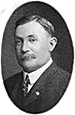 |
George W. Smith
Residence, Oak Park, Illinois, Portrait Circa 1904 (1896 - S.045).
Portrait of George W. Smith published in Dry Goods Reporter, May 7,
1904. George Smith was a buyer for Marshall Fields. By 1900, he had
already worked for the firm for over 30 years. He was also President of
the Illinois Commercial Men's Association. The Dry Goods Reporter was
published by The Dry Goods Reporter Company, Chicago, Illinois. This
photographs was published on May 7, 1904, page 21. 3.5 x 5.5 B&W
photograph |
0055.31.0623 |
C 1904
 |
Joseph J.
Walser Residence 1904 (1903 - S.091). Viewed from the street from the
East. Designed by Frank Lloyd Wright in 1903, the house sat on an
uncrowded lot, in the newly annexed Austin neighborhood. There appear to
be three photographs that were taken around the same time period and
after construction was completed, and judging the foliage on the trees,
most likely the summer of 1904. One of the three was published in the
September 1905 issue of
House Beautiful. Although there are
slight differences, the Walser is very similar in design to the
Barton, De Rhodes and
Horner houses. The Living Room faces the
street, the dining room is at the back of the house. The Entrance and
Reception Room is on the left, the Kitchen is on the right. The
Reception room and Kitchen are set back from the front of the house, and
two identical porches balanced out the front of the house. The porches
were later roofed and enclosed. 7 x 5.75 B&W photograph. |
0055.20.0720 |
C 1904
 |
Joseph J.
Walser Residence 1904 (1903 - S.091). Viewed from the street from the
Northeast. Designed by Frank Lloyd Wright in 1903, the house sat on an
uncrowded lot, in the newly annexed Austin neighborhood. There appear to
be three photographs that were taken around the same time period and
after construction was completed, and judging the foliage on the trees,
most likely the summer of 1904. One of the three was published in the
September 1905 issue of
House Beautiful. Although there are
slight differences, the Walser is very similar in design to the
Barton, De Rhodes and
Horner houses. The Living Room faces the
street, the dining room is at the back of the house. The Entrance and
Reception Room is on the left, the Kitchen is on the right. The
Reception room and Kitchen are set back from the front of the house, and
two identical porches balanced out the front of the house. The porches
were later roofed and enclosed. Published in "Frank
Lloyd Wright, Chicago," Wright, 1911, p.76. Caption: "Wohnhaus
J. J. Walser, Austin, ILL. 1904." Copy 10 x 7.5 B&W photograph. |
0055.21.0720 |
C 1904
 |
Joseph J.
Walser Residence 1904 (1903 - S.091). Viewed from the North. Designed by Frank Lloyd Wright in 1903, the house sat on an
uncrowded lot, in the newly annexed Austin neighborhood. There appear to
be three photographs that were taken around the same time period and
after construction was completed, and judging the foliage on the trees,
most likely the summer of 1904. This view was published in the September
1905 issue of House Beautiful. Although there are slight
differences, the Walser is very similar in design to the
Barton, De Rhodes and
Horner houses. The Living Room faces the
street (left), the dining room is at the back of the house. The Entrance
and Reception Room is on the left, the Kitchen is on the right. The
Kitchen is in the center foreground. Published in the September, 1905
issue of House Beautiful, p.25, in an article by Robert C.
Spencer, Jr.. Copy 7 x 5 B&W photograph. |
0055.22.1225 |
1904
 |
Frank
Wright Thomas Residence (1901 - S.067) Circa 1904. Viewed from across
the street. Taken approximately the same time as the photographed
published in Frank
Lloyd Wright Ausgefuhrte Bauten, 1911, p.28. Taken in
the winter, the one published was taken in the summer. Both are taken
from the same position and location. Note the bushes in the front of the
house, the tree trunks, and the stakes to the left side of the wide
sidewalk, next to the street and sidewalk. The electrical pole visible
in 1902 is gone. Courtesy of The National Library of Australia. 10 x 7.5
B&W photograph. |
0055.09.1116 |
1904
 |
Unity Temple,
Oak Park, Illinois Art Glass Window Design 1904 (FLLW #0611.41) (1904 -
S.096). Art Glass plan for Unity Temple. Designed by Frank Lloyd Wright
in 1904.
Reflecting on Unity
Temple, Wright said, “When I finished Unity Temple, I had it. I was
conscious of the idea. I knew I had the beginning of a great thing, a
great truth in architecture. And now architecture could be free.”
Letters to Architects, 1984, p.48.
“Frank Lloyd Wright's design for Unity Temple was radical in its
simplicity – a monolithic concrete exterior-yet sublime in its detail
and revolutionary in its use of interior space. His approach would never
again be the same, and his influence would extend around the world,
forever changing the face of architecture and design.” The Nobel Room,
Sokol, 2008, p.inside cover.
Text lower left: “0611.41.” Text lower right: “Unity Temple. Glass
Design. Frank Lloyd Wright, Arch. Oak Park, Illinois.” Courtesy of the
Frank Lloyd Wright Archives, Avery Library, Columbia University. 10 x
6.5 Color Photograph. |
0055.39.1225 |
1904
 |
Unity
Temple, Oak Park, Illinois Art Glass Window Design 1904 (FLLW #0611.93)
(1904 - S.096). Art Glass plan for Unity Temple. Designed by Frank Lloyd
Wright in 1904.
Reflecting on
Unity Temple, Wright said, “When I finished Unity Temple, I had it. I
was conscious of the idea. I knew I had the beginning of a great thing,
a great truth in architecture. And now architecture could be free.”
Letters to Architects, 1984, p.48.
“Frank Lloyd Wright's design for Unity Temple was radical in its
simplicity – a monolithic concrete exterior-yet sublime in its detail
and revolutionary in its use of interior space. His approach would never
again be the same, and his influence would extend around the world,
forever changing the face of architecture and design.” The Nobel Room,
Sokol, 2008, p.inside cover. Courtesy of the Frank Lloyd Wright
Archives, Avery Library, Columbia University. 10 x 6.5 Color Photograph. |
0055.40.1225 |
|
|
1905 |
1905
 |
Abraham Lincoln Center Circa 1905 (1903 -
S.095). Frank Lloyd Wright's first design was for his Uncle, Reverend Jenkin
Lloyd Jones, was for the All Souls' Building, 1897. The design went though
many modifications but did not proceed. In 1900, a new design, revised,
titling it the Abraham Lincoln Center. It too went through a number of
revisions. A perspective view of "The Lincoln Center" was published in The
Architectural Review, June 1900, Spencer, p.72. Floor plans for the ground
floor and Auditorium were published on page 71. A revised design for the
"Abraham Lincoln Center," Frank Lloyd Wright and Dwight Heald Perkins,
Associated Architects, was published in The Chicago Architectural Annual,
1902. Jones was still dissatisfied, and Wright resigned as architect.
Perkins also resigned. Elements of Wright's original design remained, but
the finished project lost many of Wright's ideas. What was built was a very
simplified version of Wright's design. It has been altered greatly over the
years. Photographed by the Chicago Daily News. Hand written in negative:
"Interior Lincoln Center Auditorium." Courtesy of the Chicago History
Museum. 5 x 7 B&W photograph. |
0058.29.0320 |
1905
 |
Abraham Lincoln Center Circa 1905 (1903 -
S.095). Frank Lloyd Wright's first design for his Uncle, Reverend Jenkin
Lloyd Jones, was for the All Souls' Building, 1897. The design went though
many modifications but did not proceed. In 1900, a new design, revised,
titling it the Abraham Lincoln Center. It too went through a number of
revisions. A perspective view of "The Lincoln Center" was published in The
Architectural Review, June 1900, Spencer, p.72. Floor plans for the ground
floor and Auditorium were published on page 71. A revised design for the
"Abraham Lincoln Center," Frank Lloyd Wright and Dwight Heald Perkins,
Associated Architects, was published in The Chicago Architectural Annual,
1902. Jones was still dissatisfied, and Wright resigned as architect.
Perkins also resigned. Elements of Wright's original design remained, but
the finished project lost many of Wright's ideas. What was built was a very
simplified version of Wright's design. It has been altered greatly over the
years. Published in the
Journal of the
Society of Architectural Historians, September 1991, p.256. Courtesy of
the Jenkin Lloyd Jones Collection, Meadville-Lombard Theological School
Library. 4.5 x 7 B&W photograph. |
0058.30.0320 |
1905
 |
1) Hiram Baldwin Residence, Kenilworth,
Illinois, Plot Plan 1905 (1905 - S.107). (FLLW #0502.01) Plot plan for the
Hiram Baldwin Residence, Kenilworth, Illinois. Designed in 1905 by Frank
Lloyd Wright. Text lower right: "Mr. Hiram Baldwin, Dwelling, Kenilworth,
Ill. Frank Lloyd Wright Arch. Oak Park, Illinois. Plot Plan." The living
room is semi-circular with a square roof. Like the first George Millard
House (1906) in Highland Park, the second level is cantilevered on both
ends, but is obscured on one end by the enclosure of the porch. Another
feature is the grille on the first level. Wright uses this design element on
either side of the living room, one of which conceals the entry to the
house, the entry to the porch. A third is at the back of the house. The
balustrades are massive, much more so than when Wright used the concept for
the Stephen A. Foster Cottage (1900). They appear on either side of the
living room, at the back of the house, and a fourth possibly at the garage,
but it is a solid wall today. Courtesy of the Frank Lloyd Wright Archives,
Avery Architectural and Fine Arts Library, Columbia University. 10 x 5 B&W
photograph |
0058.39.0822 |
1905
 |
2) Hiram Baldwin Residence, Kenilworth,
Illinois, First Floor Plan 1905 (1905 - S.107). (FLLW #0502.03) First floor
plan for the Hiram Baldwin Residence, Kenilworth, Illinois. Designed in 1905
by Frank Lloyd Wright. Text lower right: "First Floor Plan." The living room
is semi-circular with a square roof. Like the first George Millard House
(1906) in Highland Park, the second level is cantilevered on both ends, but
is obscured on one end by the enclosure of the porch. The balustrades are
massive, much more so than when Wright used the concept for the Stephen A.
Foster Cottage (1900). They appear on either side of the living room and at
the back of the house. Courtesy of the Frank Lloyd Wright Archives, Avery
Architectural and Fine Arts Library, Columbia University. 10 x 8 B&W
photograph. |
0058.40.0822 |
1905
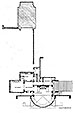 |
3) Hiram Baldwin Residence, Kenilworth,
Illinois, Adaptation of the combined Plot Plan and First Floor Plan 1905
(1905 - S.107). Adaptation of the ground and first floor plan for the Hiram
Baldwin Residence, Kenilworth, Illinois. Designed in 1905 by Frank Lloyd
Wright. We have combined the plot plan FLLW #0502.01 and the first floor
plan FLLW #0502.03. Adapted by Douglas M. Steiner. 8 x 10 B&W photograph. |
0058.41.0822 |
1905
 |
4) Hiram Baldwin Residence,
Kenilworth, Illinois, East and West Elevations 1905 (1905 - S.107). (FLLW
#0502.06) East and West elevations for the Hiram Baldwin Residence,
Kenilworth, Illinois. Designed in 1905 by Frank Lloyd Wright. Text: "East
Elevation. West Elevation." The living room is semi-circular with a square
roof. Another feature is the grille on the first level. Wright uses this
design element on either side of the living room, one of which conceals the
entry to the house. Courtesy of the Frank Lloyd Wright Archives, Avery
Architectural and Fine Arts Library, Columbia University. 10 x 7 B&W
photograph. |
0058.42.0822 |
1905
 |
1) George Barton Residence, Buffalo, New
York, 1905 (1903 - S.103). View of the George Barton House from the South.
Designed by Frank Lloyd Wright in 1903. This photographs is dated May 9,
1905. The
Darwin Martin Complex is under construction. The Barton House nears
completion. The yard has some landscaping, but the large urn has not yet
been placed. Planting have begun around the Martin House.
From Summit Avenue, the sidewalk leads to the front stairs. Turning 90
degrees, the stairs lead up to the front terrace. 90 degrees once again, and
the front door leads you into the entry hall. Once in the entry hall,
turning left leads out to the porch, and right to the dining, living and
library. Past the stairs, which leads to the second level, is the kitchen.
Upstairs are four bedrooms and a bath. Courtesy of the University at
Buffalo, Darwin Martin Collection. 10 x 8 B&W photograph. |
0058.72.1124 |
1905
 |
2) George Barton Residence, Buffalo, New
York, 1905 (1903 - S.103). View of the George Barton House from the
Southeast. Designed by Frank Lloyd Wright in 1903. This photographs is dated
September 1, 1905. Landscaping has been completed. The large urn is in
place. A vase of flowers sits on the front porch ledge. The Pergola,
Conservatory and two-story Garage and Stable can be seen in the background.
The bird-houses have been installed above the pergola (far left) and the
conservatory. Courtesy of the University at Buffalo, Darwin Martin
Collection. 10 x 8 B&W photograph. |
0058.73.1124 |
1905
 |
3) George Barton Residence, Buffalo, New
York, 1905 (1903 - S.103). View of the George Barton House from the South.
Designed by Frank Lloyd Wright in 1903. Photographed by Henry Fuermann, soon
after completion of the house. The large urn is in place close to the
entrance. From Summit Avenue, the sidewalk leads to the front stairs.
Turning 90 degrees, the stairs lead up to the front terrace. 90 degrees once
again, and the front door leads you into the entry hall. Once in the entry
hall, turning left leads out to the porch, and right to the dining, living
and library. Past the stairs, which leads to the second level, is the
kitchen. Upstairs are four bedrooms and a bath.
This photograph was taken at the same time as the photograph of the Barton
House, S#0058.75, published in Frank Lloyd
Wright Ausgefuhrte Bauten, 1911, p.54, and Frank Lloyd Wright Chicago, 1911,
p.38. 10 x 7 B&W photograph. |
0058.74.1124 |
1905
 |
4) George Barton Residence, Buffalo,
New York, 1905 (1903 - S.103). View of the George Barton House from the
East. Designed by Frank Lloyd Wright in 1903. Photographed by Henry
Fuermann, soon after completion of the house. The large urn is in place
close to the entrance. From Summit Avenue, the sidewalk leads to the front
stairs. Turning 90 degrees, the stairs lead up to the front terrace. 90
degrees once again, and the front door leads you into the entry hall. Once
in the entry hall, turning left leads out to the porch, and right to the
dining, living and library. Past the stairs, which leads to the second
level, is the kitchen. Upstairs are four bedrooms and a bath. Flowers can
bee seen in the front window.
This
photograph was taken at the same time as
S#0058.74 and is published in
Frank Lloyd Wright Ausgefuhrte
Bauten, 1911, p.54, and
Frank Lloyd Wright
Chicago, 1911, p.38. This photograph was used by Wright when he drew the
perspective for the Barton House for the Wasmuth Portfolio,
Plate XXVI (26).
10 x 7 B&W photograph. |
0058.75.1124 |
1905

 |
1&2) Charles A. Brown Residence,
Evanston, Illinois, Floor Plans 1905 (1905 - S.110). Basement, first and
second floor plans for the Charles A. Brown Residence. Designed by Frank
Lloyd Wright in 1905. Like the Davenport Residence (1901), the house is
approached on the far left side of the property. The front door faces the
street, but is enclosed and partially obscured from the street by a short
wall. Stepping into the semi-enclosed exterior space, the front door opens
into the tiled entry. On the right is a partial wall topped with square
balusters. Stairs lead up to the living room that runs the full length of
the front of the house. At the top of the stairs are built-in shelves, now
enclosed with art glass matching the exterior window design. To the right,
on the same wall, is a centrally located fireplace. On the far end of the
living room, a partial wall topped with square balusters is repeated,
creating a room withing a room. From the living room, doors open outward to
the half-walled veranda. The dining room and kitchen cover the back half of
the first floor. Upstairs there are four bedrooms and a bath. Text lower
right: "Mr. Chas. A. Brown. Dwelling North Evanston. Frank Lloyd Wright
Architect. Oak Park, Illinois. Note: Overall figures are given to inside
face of Studs. Revised Aug. 8/15 - 1905. (Sheet) 1" (FLLW #0503.01)...
Continue... |
0058.52.1123 0058.53.1123 |
1905
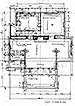 |
3) Charles A. Brown Residence, Evanston,
Illinois, First Floor Plan 1905 (1905 - S.110). First floor plan for the
Charles A. Brown Residence. Designed by Frank Lloyd Wright in 1905. Like the
Davenport Residence (1901), the house is approached on the far left side of
the property. The front door faces the street, but is enclosed and partially
obscured from the street by a short wall. Stepping into the semi-enclosed
exterior space, the front door opens into the tiled entry. On the right is a
partial wall topped with square balusters. Stairs lead up to the living room
that runs the full length of the front of the house. At the top of the
stairs are built-in shelves, now enclosed with art glass matching the
exterior window design. To the right, on the same wall, is a centrally
located fireplace. On the far end of the living room, a partial wall topped
with square balusters is repeated, creating a room withing a room. From the
living room, doors open outward to the half-walled veranda. The dining room
and kitchen cover the back half of the first floor. Upstairs there are four
bedrooms and a bath. Text lower right: “First Floor Plan” (FLLW #0503.01).
Courtesy of the Frank Lloyd Wright Foundation. 8 x 10 B&W photographs. |
0058.54.1123 |
1905
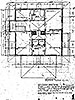 |
4) Charles A. Brown Residence, Evanston,
Illinois, Second Floor Plans 1905 (1905 - S.110). Second floor plans for the
Charles A. Brown Residence. Designed by Frank Lloyd Wright in 1905. Behind
the book shelves in the living room, stairs lead to the second level and a
wide hall. There are four bedrooms, one bath, and a balcony on either side
of the second level. Text lower right: “Second floor plan. Mr. Chas. A.
Brown. Dwelling North Evanston. Frank Lloyd Wright Architect. Oak Park,
Illinois. Note: Overall figures are given to inside face of Studs. Revised
Aug. 8/15 - 1905. (Sheet) 1” (FLLW #0503.01). Courtesy of the Frank Lloyd
Wright Foundation. 8 x 10 B&W photograph. |
0058.55.1123 |
1905
 |
Martha "Mamah"
Bouton Borthwick Cheney Circa 1905 (June 19, 1869 - August 15, 1914). She
was born in Boone, Iowa. She received a BA at the University of Michigan,
and later worked as a librarian in Port Huron, Michigan. In 1899, she
married Edwin Cheney, an electrical engineer from Oak Park, Illinois, USA.
They had two children: John (1902) and Martha (1905). Edwin commissioned
Wright to design them a home in 1903. In 1909, Mamah and Frank left their
respective spouses and traveled to Europe, settling in Italy for about a
year. Upon their return, they settled at Taliesin in Spring Green,
Wisconsin. On August 15, 1914, one of Wright's recently hired domestic
workers murdered Mamah, both her children, three of Wright's associates, and
a son of one of the associates. He set fire to one wing of Taliesin, and
murdered the seven people with an ax as they tried to escape the fire. At
the time, Wright was overseeing work on Midway Gardens in Chicago. Catherine
Wright refused to give Wright a divorce until November 13, 1922. Caption on
Verso, dated 11/15/22 (two days after divorce was granted) "Old love of
famous architect who is divorced. Photo is of Mamah Borthwick Cheney who
fled with Frank Lloyd Wright to a 'Love Hegira' in Japan, and who died in
the flames of the 'Love Bungalow' of herself...
Continue... |
0058.02.0307 |
1905
 |
Mamah Borthwick Cheney Circa 1905
(June 19, 1869 - August 15, 1914). Portrait of Mamah Borthwick Cheney. She
is facing and looking to the left. This is a close up of her head and
shoulders from S#0058.02. It
is enlargement and appears that the lace of the dress which covers her neck
is heavily airbrushed (poorly). In 1899, she married Edwin Cheney. Edwin
commissioned Wright to design them a home in 1903. In 1909, Mamah and Frank
left their respective spouses and traveled to Europe, settling in Italy for
about a year. Upon their return, they settled at Taliesin in Spring Green,
Wisconsin. On August 15, 1914, one of Wright's recently hired domestic
workers murdered Mamah, both her children, three of Wright's associates, and
a son of one of the associates. At the time, Wright was overseeing work on
Midway Gardens in Chicago. This photograph is published in
Magnificent Builders &
Their Dream Houses, Thorndike, 1978,
p.114. Photographer unknown. Credit for this photograph goes to the Chicago
Tribune. 8 x 10 B&W photograph. |
0058.44.0123 |
1905
 |
Mamah Borthwick Cheney Circa 1905 (June 19,
1869 - August 15, 1914). Portrait of Mamah Borthwick Cheney. This is a
variation of S#0058.02 and
S#0058.44. She is facing forward, looking to the
left. She appears to be wearing a different dress. In 1899, she married
Edwin Cheney. Edwin commissioned Wright to design them a home in 1903. In
1909, Mamah and Frank left their respective spouses and traveled to Europe,
settling in Italy for about a year. Upon their return, they settled at
Taliesin in Spring Green, Wisconsin. On August 15, 1914, one of Wright's
recently hired domestic workers murdered Mamah, both her children, three of
Wright's associates, and a son of one of the associates. At the time, Wright
was overseeing work on Midway Gardens in Chicago. This photograph was
published in The Detroit Tribune, August 16, 1914. Copy 8 x 10 Color
photograph of the published photograph. |
0058.45.0123 |
1905
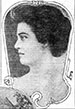 |
Mamah Borthwick Cheney Circa 1905
(June 19, 1869 - August 15, 1914). Portrait of Mamah Borthwick Cheney. This
is a variation of S#0058.02
and S#0058.44, and similar
to S#0058.45. She is facing forward, looking to the left. In 1899, she
married Edwin Cheney. Edwin commissioned Wright to design them a home in
1903. In 1909, Mamah and Frank left their respective spouses and traveled to
Europe, settling in Italy for about a year. Upon their return, they settled
at Taliesin in Spring Green, Wisconsin. On August 15, 1914, one of Wright's
recently hired domestic workers murdered Mamah, both her children, three of
Wright's associates, and a son of one of the associates. At the time, Wright
was overseeing work on Midway Gardens in Chicago. This photograph was
published in the Chicago Examiner, December 24, 1911. p.4. Copy 6.5 x 9
Color photograph of the published photograph. |
0058.46.0123 |
1905
 |
Cinema San Diego Project, San Diego,
California (1905 - FLLW #0517). Photograph of original drawing in the Frank
Lloyd Wright Archives. Perspective drawing of the Cinema's street elevation.
Hand written text: "C.1905." Lower left: "0517.01." But there seems to be
uncertainty as to the actual date of this project. The illustration hint at
Midway Gardens (1913). Not only do the triangles and squares in the facade
hint at Midway Gardens, but so do the spheres. This illustration is
published in
Frank Lloyd
Wright Monograph 1902-1906, Pfeiffer, 1987, p.183,
and Wright, 1885-1916,
Pfeiffer, 2011, p.505. What adds to the confusion is a second rendering of
the Cinema by Louis Rasmussen (1859 - after 1930). Rasmussen regularly
assisted Adler and Sullivan, and worked with Frank Lloyd Wright on many
occasions. He rendered the Abraham Lincoln Center, published in The
Architectural Review, June 1900, p.72. In 1905, he illustrated a perspective
of the Frank L. Smith Bank (1905). According to
Van Zanten, he also illustrated other projects for Wright during that time
period including the San Diego Cinema. Marion Mahony Reconsidered,
Van Zanten, 2011, p.54. Rasmussen's illustration of the Cinema is similar,
but with changes. The triangles along the top of the facade are a little
more subtle, and the squares just...
Continue... |
0058.27.1219 |
1905
 |
Cinema San Diego Project, San Diego,
California (1905 - FLLW #0517). Photograph of original drawing in the Frank
Lloyd Wright Archives. Floor plan, Front Elevation and Stage. Top
illustration: Stage and "Screen." Center illustration: Floor Plan. Lower
illustration: Front Elevation. Text lower left: "0517.03." Text hand written
lower right: "Cinema Study." Published in
Frank Lloyd
Wright Monograph 1902-1906, Pfeiffer, 1987, p.183.
Original 8 x 10 B&W photograph. |
0058.28.1219 |
1905
 |
E. Arthur Davenport Residence, River Forest,
Illinois, Circa 1905 (1901 - S.068). View of the Davenport Residence from
the street. A young boy pulling a wagon has paused to look up at the house.
This photograph is widely regarded as the earliest photograph of the
Davenport, after completion of construction. Judging the size of the bushes
in front of the house, that were mostlikely planted after completion of the
house, this photograph was most likely taken around 1905. The lower portion
of the exterior of the house is board and batten construction, the upper,
lighter portion with cream colored plaster. As originally designed in
A Small House With
Lots of Room In It (1901) the
Bradley (1900) and Davenport
houses, the projecting hip roof which runs from the peak past the front of
the house, is a prominent feature of the house. The roof has broad
overhangs. The house is approaches on the far left side of the property. It
runs past the porch and living room. During the 1931 renovation, the front
porch was removed, the living room's bay window facing the street was
replaced with a rectangular addition, and the roof which ran from the peak
past the front of the house was altered dramatically. The front door faces
the street, but is enclosed and obscured from the street by a partial wall
topped...
Continue... |
0058.51.1023 |
1905
 |
E-Z Polish Factory, Chicago, Illinois, Elevation 1905 (1905 - S.114). Front
elevation for the Martin & Martin E-Z Polish Factory. The building was
constructed of reinforces concrete faced with brick. Rows of large
horizontal windows were broken by vertical brick piers projecting out from
the exterior surface of the brick wall. These were capped by limestone or
concrete that ran the full length of the building. The entrance was reached
between two smaller rectangular sections of the building that were
perpendicular to the main structure. These were reached only by a bridge
from the main building. A large planting was in the center of the courtyard
that lead to the entrance. Just past the planting was the entrance. The
lower doors, the employee entrance lead to into the basement. On either side
of the lower doors, were brick piers with large concrete vases. On either
side of the employee entrance, stairs lead up to the visitor’s entrance on
the main floor. To the outside of the entrance, on either side, light
flooded the two stairways with tall vertical windows.
Although this plan remained a project and was never built, what survived was
the monogram that Frank Lloyd Wright designed for the building. The new
letterhead using the monograph first appeared in 1904...
Continue... |
0058.23.0219 |
1905
 |
E-Z Polish Factory Ground and Floor Plan
Circa 1905 (1905 - S.114). Drawing of the ground and floor plan for the
Martin & Martin E-Z Polish Factory. The building was constructed of
reinforces concrete faced with brick. Rows of large horizontal windows were
broken by vertical brick piers projecting out from the exterior surface of
the brick wall. These were capped by limestone or concrete that ran the full
length of the building. The entrance was reached between two smaller
rectangular sections of the building that were perpendicular to the main
structure. These were reached only by a bridge from the main building. A
large planting was in the center of the courtyard that lead to the entrance.
Just past the planting was the entrance. The lower doors, the employee
entrance lead to into the basement. On either side of the lower doors, were
brick piers with large concrete vases. On either side of the employee
entrance, stairs lead up to the visitor's entrance on the main floor. To the
outside of the entrance, on either side, light flooded the two stairways
with tall vertical windows. Text on lower right: "E-Z Stove Polish Factory.
Martin and Martin, Chicago. Frank Lloyd Wright Architect. Chicago. First
Floor Plan. Scale One Quarter Inch Equals One Foot." Published in
Frank Lloyd
Wright Monograph 1902-1906...
Continue... |
0058.24.0219 |
1905 (2011)
 |
E-Z Polish Factory Axonometric Drawing of
Ground and Floor Plan Circa 1905 (2011) (1905 - S.114). Axonometric drawing
of the ground and floor plan for the Martin & Martin E-Z Polish Factory. The
building was constructed of reinforces concrete faced with brick. Rows of
large horizontal windows were broken by vertical brick piers projecting out
from the exterior surface of the brick wall. These were capped by limestone
or concrete that ran the full length of the building. The entrance was
reached between two smaller rectangular sections of the building that were
perpendicular to the main structure. These were reached only by a bridge
from the main building. A large planting was in the center of the courtyard
that lead to the entrance. Just past the planting was the entrance. The
lower doors, the employee entrance lead to into the basement. On either side
of the lower doors, were brick piers with large concrete vases. On either
side of the employee entrance, stairs lead up to the visitor's entrance on
the main floor. To the outside of the entrance, on either side, light
flooded the two stairways with tall vertical windows. Created by Ryan
Zegarelli in 2011. Text on lower right: "E-Z Stove Polish Factory. Martin
and Martin, Chicago, Illinois. Frank Lloyd Wright - Architect." Courtesy of
the University of Buffalo. 8 x 8.4 B&W Photograph. |
0058.25.0219 |
C
1905
 |
William G. Fricke Home, C 1905 (1901
S.058). Viewed from the Southwest, photographed during the winter. Like the
Thomas Residence,
also 1901 and in Oak Park, it is an all-stucco exterior. But unlike the
Thomas Residence which is considered Frank Lloyd Wright's first fully
developed prairie styled house in Oak Park, it includes elements of Wright's
transitional designs. Like the
Rollin Furbeck Residence (1897),
it includes elements of Wright's transitional period. Corners are turned at
a 45 degree angle, it includes a massive central tower, there are
rectangular square windows with columns and it is more vertical than
Wright's prairie styled horizontal designs. It is also a three story home.
The Living and Dining Rooms, Kitchen, Hall and Reception Room are on the
first level. The Bedrooms are on the second level. Landscaping is sparse and
thin. Plantings missing from window sills. The Pavilion on the right was
eventually demolished and lot sold to make room for a brick house. Courtesy
of the Art Institute of Chicago. 10 x 4.25 B&W photograph. |
0058.18.1116 |
1905

|
1) Mrs. Thomas Gale Summer Cottages, Whitehall, Michigan, First
Floor Plan 1905 (1909 - S.088.1-3).
First floor plan for three Mrs.
Thomas Gale Summer Cottages. FLLW Foundation #521.01. Designed
in 1905 by Frank Lloyd Wright. The Gale family were early
clients of Frank Lloyd Wright. Brothers Thomas Gale Residence,
Oak Park (1892 S.016), Walter Gale Residence, Oak Park (1893 -
S.020), Thomas Gale Summer Cottage, Whitehall, Michigan (1897 -
S.088), Mrs. Thomas Gale Three Summer Cottages (1909 - S.088 :
1-3), and the Mrs. Thomas Gale Residence, Oak Park (1909 -
S.098). The three rental
cottages used the same floor plans. These cottages were designed
as summer cottages, and were not originally occupied year round.
Originally dated 1905, the Frank Lloyd Wright Foundation updated
the cottages to 1909 after additional records were found. This
is also an early use of the unit system which Frank Lloyd Wright
consistently used in his later designs. The front of the
cottages faced the lake, so the main entrance was at the back of the cottage
and entered into the kitchen. To the right was a maid's room. Straight ahead
was the living room with a centrally located fireplace. To the right of the
fireplace, stairs led to the second level. From the living room doors opend
to a porch... Continue... |
0058.47.0723 |
1905
 |
2) Mrs. Thomas Gale Summer Cottages, Whitehall, Michigan, Second
Floor Plan 1905 (1909 - S.088.1-3).
Second floor plan for three Mrs.
Thomas Gale Summer Cottages. FLLW Foundation #521.05. Designed
in 1905 by Frank Lloyd Wright. The Gale family were early
clients of Frank Lloyd Wright. Brothers Thomas Gale Residence,
Oak Park (1892 S.016), Walter Gale Residence, Oak Park (1893 -
S.020), Thomas Gale Summer Cottage, Whitehall, Michigan (1897 -
S.088), Mrs. Thomas Gale Three Summer Cottages (1909 - S.088 :
1-3), and the Mrs. Thomas Gale Residence, Oak Park (1909 -
S.098). The three rental
cottages used the same floor plans. These cottages were designed
as summer cottages, and were not originally occupied year round.
Originally dated 1905, the Frank Lloyd Wright Foundation updated
the cottages to 1909 after additional records were found. This
is also an early use of the unit system which Frank Lloyd Wright
consistently used in his later designs. The front of the cottages faced the lake, so the main entrance
was at the back of the cottage and entered into the kitchen. To
the right was a maid's room. Straight ahead was the living room
with a centrally located fireplace. To the right of the
fireplace, stairs led to the second level. From the living room
doors... Continue... |
0058.48.0723 |
1905
 |
3) Mrs. Thomas Gale Summer Cottages, Whitehall, Michigan, Front
Elevation1905 (1909 - S.088.1-3).
Front elevation for three Mrs.
Thomas Gale Summer Cottages. FLLW Foundation #521.02. Designed
in 1905 by Frank Lloyd Wright. The Gale family were early
clients of Frank Lloyd Wright. Brothers Thomas Gale Residence,
Oak Park (1892 S.016), Walter Gale Residence, Oak Park (1893 -
S.020), Thomas Gale Summer Cottage, Whitehall, Michigan (1897 -
S.088), Mrs. Thomas Gale Three Summer Cottages (1909 - S.088 :
1-3), and the Mrs. Thomas Gale Residence, Oak Park (1909 -
S.098). The three rental
cottages used the same floor plans. These cottages were designed
as summer cottages, and were not originally occupied year round.
Originally dated 1905, the Frank Lloyd Wright Foundation updated
the cottages to 1909 after additional records were found. This
is also an early use of the unit system which Frank Lloyd Wright
consistently used in his later designs. The front of the cottages faced the lake, so the main entrance
was at the back of the cottage and entered into the kitchen.
Horizontal bans of windows dominated the first and second floors
of the front elevation. Two rectangular short piers,
approximately 2.5' x 5', possibly planter boxes, projected from
the front elevation on either...
Continue... |
0058.49.0723 |
1905
 |
4) Mrs. Thomas Gale Summer Cottages,
Whitehall, Michigan, Side Elevation1905 (1909 - S.088.1-3).
Side elevation for three Mrs. Thomas Gale
Summer Cottages. FLLW Foundation #521.03. Designed in 1905 by
Frank Lloyd Wright. The Gale family were early clients of Frank
Lloyd Wright. Brothers Thomas Gale Residence, Oak Park (1892
S.016), Walter Gale Residence, Oak Park (1893 - S.020), Thomas
Gale Summer Cottage, Whitehall, Michigan (1897 - S.088), Mrs.
Thomas Gale Three Summer Cottages (1909 - S.088 : 1-3), and the
Mrs. Thomas Gale Residence, Oak Park (1909 - S.098). The three rental cottages used the same floor plans. These
cottages were designed as summer cottages, and were not
originally occupied year round. Originally dated 1905, the Frank
Lloyd Wright Foundation updated the cottages to 1909 after
additional records were found. This is also an early use of the
unit system which Frank Lloyd Wright consistently used in his
later designs. The front
of the cottages faced the lake, so the main entrance was at the
back of the cottage and entered into the kitchen. Doors from the
livinbg room opened to a 9' x 21' covered porch with slate
floors. Two rectangular short piers, approximately 2.5' x 5',
possibly planter boxes, projected from the front elevation on
either corner. The lower...
Continue... |
0058.50.0723 |
1905
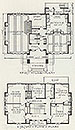 |
Walter Gerts Residence, River Forest,
Illinois, First and Second Floor Plan 1905 (1911 - S.177). Original First
and Second floor plans for the Walter Gerts Residence by Charles E. White,
Jr. in 1905. When it suffered and extensive fire and in 1911, they asked
Frank Lloyd Wright to remodel the house. Wright moved the stairs from the
center of the house to the back as well as moving interior walls. Wright
also specified art-glass windows, interior furnishings, a living room
ceiling fixture and interior glass doors. 5 x 8.5 B&W photograph. |
0058.43.0922 |
C 1905-08
 |
Isidore Heller Residence,
Chicago, Circa 1905-08 (1896 - S.038). Appears to have been taken after
plate 43, published in "In The Nature of Material", Hitchcock, 1942, and at
the same time as a photograph published in the November 1908 issue of House
Beautiful. It appears to have been photographed just after completion of the
home, with a few minor details not finished. Photographed during the winter,
there are no vines on the front of the home, like those in the AB 1911 image
(circa 1910).The three trees on the left, and one on the right are seen in
AB 1911 photograph. The exterior light fixture to the right of the entrance
seen in 1913 has not been installed. Although the gutters have been
installed, the down spout on the east side of the Southeast corner seen in
AB 1911, are missing, but the house numbers have been installed. The vase
sits on a low pedestal, just behind the bushes, centered in the entrance
sidewalk. Courtesy of the City of Chicago. 10 x 7.6 B&W photograph.
See our Wright Study on the Heller Residence. |
0058.09.0514 |
C 1905
 |
1)
Warren R. Hickox Residence, Kankakee, Illinois, C 1905 (1900 - S.056). View
of the Warren R. Hickox Residence from the East. This appears to be
photographed just a couple years after S#54.16. Bushes and the small tree
have matured. Designed by Frank Lloyd Wright in 1900. Both the Hickox and
Bradley houses are considered Wright’s first prairie styled houses. Although
the Hickox is smaller than the Bradley, it has many of the same
characteristics. Broad overhanging eaves, gabled roo7yf, upturned flanges,
stucco and wood trim, dominate horizontal lines, and horizontal bands of
leaded glass windows. The angles in the windows mimic the angles of the roof
line. The terrace is on the far left. The Library/music room is on the left,
reception hall and entrance on the right, and covered front porch of the far
right. Published in The Architectural Annual, 1906. Copy 10 x 6 B&W
photograph. |
0058.58.1223 |
C 1905
 |
2) Warren R. Hickox Residence, Kankakee, Illinois, C 1905 (1900 - S.056).
View of the Warren R. Hickox Residence from the Southeast. This appears to
be photographed at the same time as S#58.58.
Bushes and the small tree are similar and the upper left window is open on
both. Designed by Frank Lloyd Wright in 1900. Both the Hickox and Bradley
houses are considered Wright’s first prairie styled houses. Although the
Hickox is smaller than the Bradley, it has many of the same characteristics.
Broad overhanging eaves, gabled roof, upturned flanges, stucco and wood
trim, dominate horizontal lines, and horizontal bands of leaded glass
windows. The angles in the windows mimic the angles of the roof line. The
terrace is on the left. The dining room is iun the background on the left.
The living room is in the center, the Library/music room is on the right.
Published in the Cyclopedia of
Architecture, 1907, Volume VI. Copy 10 x 6.5 B&W photograph. |
0058.59.1223 |
C 1905-06
 |
Larkin Administration Building
(1903 - S.093) circa 1905-6. According to Jack Quinan, Frank Lloyd Wright's
designs for the Larkin Administration building were completed in 1904. The
finished building was ready for occupancy in August 1906 "Frank
Lloyd Wright's Larkin Building, Myth and Fact", 1989, p. xiii.
Photographed after the completion of the exterior. It became the focal point
of the Larkin Company. The building was constructed of dark red brick,
utilizing pink tinted mortar. Photographed by Edward Van Altena. 8 x 10 B&W
photograph. |
0058.10.0514 |
C 1905-06
 |
Larkin Administration Building (1903 -
S.093) circa 1905-6. Copy of the photograph published in "Frank
Lloyd Wright Ausgefuhrte Bauten" 1911, p.131. Frank Lloyd Wright's
designs for the Larkin Administration building were completed in 1904. The
finished building was ready for occupancy in August 1906. Photographed after
the completion of the exterior about the same time as
S#58.10. The building
was constructed of dark red brick, utilizing pink tinted mortar. Also
published in "Frank
Lloyd Wright's Larkin Building, Myth and Fact" Quinan, 1987,
p.31. Original 16 x 20 B&W photograph. |
0058.19.0218 |
C 1905-06
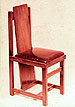 |
Larkin Company Side Chair Circa 1905-6 (1903
- S.093). View of a Larkin Company Side Chair. Constructed of wood and
leather. Photograph not dated. Designed by Frank Lloyd Wright in 1903, the
building was completed in 1906. Text on sleeve: "Wright, F. L. - Larkin
Building. 8-2. Larkin Building. Full view, wood and leather side chair.
Buffalo, NY, USA, 1904-06. Wright, Frank Lloyd. U of Virginia FAIC."
Acquired from the archives of the University of Virginia. 35mm Color slide,
sandwiched between glass, plastic mount. |
0058.32.0420 |
C 1905-06
 |
Larkin Company Side Chair Circa 1905-6 (1903
- S.093). Two views of the Larkin Company Side Chair, back and side.
Constructed of wood and leather. Photograph not dated. Designed by Frank
Lloyd Wright in 1903, the building was completed in 1906. Text on sleeve:
"Wright, F. L. - Larkin Building. 8-1. Larkin Building. Full view, wood and
leather side chair. Buffalo, NY, USA, 1904-06. Wright, Frank Lloyd. U of
Virginia FAIC." Acquired from the archives of the University of Virginia.
35mm Color slide, sandwiched between glass, plastic mount. |
0058.33.0420 |
C 1905-06
 |
Larkin Company Office Arm Chair Circa 1905-6
(1903 - S.093). View of a Larkin Company Office Arm Chair. Constructed of
metal, wood and leather with casters. Photograph not dated. Designed by
Frank Lloyd Wright in 1903, the building was completed in 1906. Text on
sleeve: "Wright, F. L. - Larkin Building. 8-3. Larkin Building. Full view,
wheeled desk chair with arms. Buffalo, NY, USA, 1904-06. Wright, Frank
Lloyd. U of Virginia FAIC." Acquired from the archives of the University of
Virginia. 35mm Color slide, sandwiched between glass, plastic mount. |
0058.34.0420 |
C 1905
 |
1) Francis W. and Mary Little
Residence I, Peoria, Illinois, Street View Circa 1905 (1902 - S.070). View
of the Francis W. and Mary Little Residence I from the Southeast. Designed
by Frank Lloyd Wright in 1902. Francis Little was an attorney and owner of a
utility company in Peoria, Illinois. He hired his friend, Frank Lloyd Wright
to design his home in Peoria. He retained Wright again that year to add a
Stable to the home. In 1908 they hired Wright to build a second home in
Minnesota , "Northome".
The Little Residence was included in Frank Lloyd Wright’s Ausgefuhrte Bauten
portfolios. Plate XXVIII (28). Perspective and floor plan for the Little
Residence. The description reads: "Residence of F. W. Little, Peoria, Ill.
1900. A residence of cream -colored brick. The plan is as the residence was
finally built. The exterior sketch, the original scheme."
This photograph was published in Frank Lloyd Wright, Ausgeführte Bauten
(Executed Buildings), published by Ernst Wasmuth A.-G., Berlin, 1911, p.30.
The photograph was taken after the house was complete, and most likely
before Wright left for Europe in 1909.
The stable can be seen in the background on the
left. The living room...
Continue... |
0058.65.0824 |
C 1905
 |
2) Francis W. and Mary Little
Residence I, Peoria, Illinois, Street View Circa 1905 (1902 - S.070). View
of the Francis W. and Mary Little Residence I from the Southeast. Designed
by Frank Lloyd Wright in 1902. Francis Little was an attorney and owner of a
utility company in Peoria, Illinois. He hired his friend, Frank Lloyd Wright
to design his home in Peoria. He retained Wright again that year to add a
Stable to the home. In 1908 they hired Wright to build a second home in
Minnesota , "Northome".
The Little Residence was included in Frank Lloyd Wright’s Ausgefuhrte Bauten
portfolios. Plate XXVIII (28). Perspective and floor plan for the Little
Residence. The description reads: "Residence of F. W. Little, Peoria, Ill.
1900. A residence of cream -colored brick. The plan is as the residence was
finally built. The exterior sketch, the original scheme."
Similar to S#58.65 which was published in Frank Lloyd Wright, Ausgeführte
Bauten (Executed Buildings), published by Ernst Wasmuth A.-G., Berlin, 1911,
p.30. The photograph was taken after the house was complete, and most likely
before Wright left for Europe in 1909.
The stable can be
seen in the background on the left. The living room...
Continue... |
0058.66.0824 |
C 1905
 |
3) Francis W. and Mary Little
Residence I, Peoria, Illinois, Street View Circa 1905 (1902 - S.070). View
of the Francis W. and Mary Little Residence I from the Northeast. Designed
by Frank Lloyd Wright in 1902. Francis Little was an attorney and owner of a
utility company in Peoria, Illinois. He hired his friend, Frank Lloyd Wright
to design his home in Peoria. He retained Wright again that year to add a
Stable to the home. In 1908 they hired Wright to build a second home in
Minnesota , "Northome".
The Little Residence was included in Frank Lloyd Wright’s Ausgefuhrte Bauten
portfolios. Plate XXVIII (28). Perspective and floor plan for the Little
Residence. The description reads: "Residence of F. W. Little, Peoria, Ill.
1900. A residence of cream -colored brick. The plan is as the residence was
finally built. The exterior sketch, the original scheme."
This photograph was published in Frank Lloyd Wright, Ausgeführte Bauten
(Executed Buildings), published by Ernst Wasmuth A.-G., Berlin, 1911, p.31.
The photograph was taken after the house was complete, and most likely
before Wright left for Europe in 1909.
The living room
on the left, the entrance and covered porch are in the center...
Continue... |
0058.67.0824 |
C 1905
 |
4) Francis W. and Mary Little
Residence I, Peoria, Illinois, Street View Circa 1905 (1902 - S.070). View
of the Francis W. and Mary Little Residence I from the Northeast. Designed
by Frank Lloyd Wright in 1902. Francis Little was an attorney and owner of a
utility company in Peoria, Illinois. He hired his friend, Frank Lloyd Wright
to design his home in Peoria. He retained Wright again that year to add a
Stable to the home. In 1908 they hired Wright to build a second home in
Minnesota , "Northome".
The Little Residence was included in Frank Lloyd Wright’s Ausgefuhrte Bauten
portfolios. Plate XXVIII (28). Perspective and floor plan for the Little
Residence. The description reads: "Residence of F. W. Little, Peoria, Ill.
1900. A residence of cream -colored brick. The plan is as the residence was
finally built. The exterior sketch, the original scheme."
This photograph was published in Sonderheft, Frank Lloyd Wright, Chicago,
published by Ernst Wasmuth A.-G., Berlin, 1911, p.16. The photograph was
taken after the house was complete, and most likely before Wright left for
Europe in 1909.
The living room on the left, the entrance and covered porch are in the
center and...
Continue... |
0058.68.0824 |
1905/2025
 |
Darwin D. Martin Residence Barrel
Armchairs, Buffalo, New York, Circa 1905/2025 (S.100 - 1904). Two barrel
armchairs from the Darwin Martin Residence, designed by Frank Lloyd Wright
in 1904, executed by Matthews Brothers Furniture Company for the Darwin D.
Martin House. Crafted from solid oak, fifteen spindles across the back that
rise from the moulded horseshoe base to meet a solid curved crest rail. The
seat is circular and upholstered in fabric. The seat cushion is circular,
shaped like a disk, and is elevated above and below the seat in equal
proportions. The ends of the arms slope gently upward. These two chairs were
sold at Christie’s on June 10, 1989. Price realized for both $232,200.
These two chairs
were resold at Sotheby’s on June 11, 2025, and are listed as two of the
original six chairs commissioned for the Darwin D. Martin Residence. The
chair sizes were listed as 31.75" High x 23" Wide x 24" Deep. Courtesy of
Sotheby’s, New York. 10 x 8 Color photograph. |
0058.80.0626 |
C 1905
 |
Frank Wright Thomas Residence (1901 -
S.067) Circa 1905. Viewed from across the street. Taken shortly after the
image from 1904, during the summer. Taken around the same time as the
photograph published in
The Sketch Book,
September 1905. The front bushes are fuller, the branch hanging over the
front yard from the tree on the right has broken off. There is a horse
hitching pole in the foreground. There is a horse drawn cart to the far
right. The ivy growing on the front of the house to the left of the entrance
has grown substantially. Courtesy of The National Library of Australia. 10 x
7.5 B&W photograph. |
0058.17.1116 |
1905
 |
Ward W. Willits Dining Room,
Highland Park, Illinois (1901 - S.054) Circa 1905. Wright designed dining
room table and chairs. Three styles of chairs are visible, low and high back
chairs, and a third with a raised seat, possibly for young children. But the
raised seat version may actually be the low back chair setting on a base.
The Willits had four children. Ward W. Willits was the president of the
Adams and Westlake Company, a brass and bronze foundry. Orlando Giannini, an
artist who designed art glass and murals for Wright, also worked for Adams
and Westlake. In 1905, Willits and his wife accompanied Frank and Catherine
Wright on their first trip to Japan. Courtesy Ryerson & Burnham Archives,
Art Institute of Chicago. Original 10 x 8 B&W print. |
0058.06.1013 |
1905
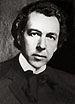 |
Wright at 38. Circa 1905. Wright
slightly facing to the right. This portrait has been dated circa 1926, which
would place Wright at 59. A more accurate date would be circa 1905. A very
similar portrait is published in "Frank Lloyd Wright
Collected Writings", Volume 1, Pfeiffer, page 2. 5 x 7 Print, High res
digital image. |
0058.03.0609 |
C
1905
 |
Frank Lloyd Wright Home & Studio, Oak Park,
Illinois, Circa 1905 (1895 - S.002-4). Frank Lloyd Wright purchased the lot
in Oak Park in May 1889, drawings for the home are dated 1889. Construction
did not begin until late August and was probably finished by the end of 1889
or the early part of 1890. Text on sleeve: "Wright, F. L. Wright Home &
Studio. 5-35. Wright Home & Studio. Int., studio reception hall. Oak Park,
IL. USA. 1889-1909. Wright, Frank Lloyd. U of Virginia FAIC." Acquired from
the archives of the University of Virginia. 35mm Color slide, sandwiched
between glass, plastic mount. |
0058.35.0720 |
|
1906 |
1906
 |
Charles A. Brown Residence, Evanston,
Illinois, Perspective 1906 (1905 - S.110). Perspective view of the Brown
Residence under construction, viewed from the North. Designed by Frank Lloyd
Wright in 1905. The front door faces the street, but is enclosed and
partially obscured from the street by a short wall. The exterior walls of
the house are board and batten, and extend up to the sills of the second
floor windows. The horizontal band of windows and stucco surrounds all four
side and extends to the roof line. The sills match the light color of the
stucco. The windows are trimmed in wood, and trim is also used to as a
design element between windows. A striking feature of the house is the roof
that is cantilevered over the veranda. Published in
Frank Lloyd Wright,
Complete Works 1885-1916, Pfeiffer, 2011. Courtesy of the Frank Lloyd Wright
Foundation. 10 x 8 B&W photographs. |
0064.51.1123 |
1906
 |
Stephen A. Foster, 1906.
Foster Cottage & Stable, West Pullman, Chicago, Illinois (1900 - S.049-050).
News article reprint, Chicago Tribune, September 22, 1906, P.7.
Candidate
for Municipal Judge. Stephen A. Foster.
Stephen A. Foster, who has been
nominated by the republicans as a candidate for Municipal court judge, is a
comparatively young man. He was born in Vermont in 1806, was graduated from
Tufts college In 1887, being the valedictorian of his class, and afterwards
studied law at Harvard. While at Harvard he was an editor of the Law Review
and was a classmate of Judges Honore and Carpenter of the local bench.
Mr. Foster practiced law In Boston from 1891 to 1806 and then came to
Chicago, where he became a law partner of Charles H. Aldrich, and since the
dissolution of the firm of Aldrich, Reed, Foster & Allen has been associated
with Frank F. Reed.
Mr. Foster Is an assistant attorney for the sanitary
district. He was the secretary of the Calumet Canal association, which was
instrumental in bringing the "Calumet district" into the sanitary district
proper. In 1899 Mr. Foster marred Almeda Hodges and they live at 12147
Harvard avenue. 3.25 x 10 B&W photograph. |
0064.36.0622 |
1906
 |
1) Grace
Fuller House, Glencoe, Illinois (1906 - S.123). Two perspective views
for the Grace Fuller House, with and without the covered terrace. In the
top perspective, stairs on either side lead up to the semicircular
terrace. The entrance is centered and is covered with a cantilevered
roof. In the lower perspective the stairs leading up to the entrance is
on the left. The cantilevered cover has been removed. Frank Lloyd Wright
designed the Grace Fuller House
in 1906. Eight original drawings are housed in the
Frank Lloyd Wright Archives at the Columbia University Avery Library.
Hand written to the right of the upper illustration: "This one." Text
hand written lower left: "0603.01." FLLW Foundation #0603.001. Courtesy
of the Frank Lloyd Wright Archives at the Columbia University Avery
Library. 8 x 8.75 B&W photograph.
|
0064.33.0221
(1-8) |
1906
 |
1) A. W.
Gridley Residence, Batavia, Illinois, Plan 1906 (1906 - S.121). First
floor plan for the Gridley Residence. Designed by Frank Lloyd Wright in
1906. Copy of plan published in
In The Nature of Materials,
Hitchcock, 1942, Plate 127. Text on sleeve: "Wright, F. L. - Gridley Ho.
1-1. Gridley House. Plan, ground floor. Batavia, IL, USA. 1906. Wright,
Frank Lloyd. U of Virginia FAIC." Acquired from the archives of the
University of Virginia. 35mm Color slide, sandwiched between glass,
plastic mount. |
0064.28.0720 |
1906
 |
2) A. W.
Gridley Residence, Batavia, Illinois, Plan 1906 (1906 - S.121). Second
floor plan for the Gridley Residence. Designed by Frank Lloyd Wright in
1906. Copy of plan published in
In The Nature of Materials,
Hitchcock, 1942, Plate 127. Text on sleeve: "Wright, F. L. - Gridley Ho.
1-2. Gridley House. Plan, second floor. Batavia, IL, USA. 1906. Wright,
Frank Lloyd. U of Virginia FAIC." Acquired from the archives of the
University of Virginia. 35mm Color slide, sandwiched between glass,
plastic mount. |
0064.29.0720 |
Circa 1906
 |
William R Heath Residence (1904 - S.105) Buffalo, NY, circa 1906. Viewed
from the Northwest. One of Wright's larger prairie styled homes. Main
entry on the far left, children's entry seen in the center. The covered
Porch and Living Room are on the far left, the Maid's bedrooms are on
the right. Bedrooms are on the second level. Heath was an attorney for
the Larkin Company and was married to Mary, the sister of one of the
company's cofounders Elbert Hubbard. Darwin Martin, a longtime friend of
Wright's, began working for the Larkin Company in 1878. He was
instrumental in the selection of Wright for the design the
Administration Building for the
Larkin Company (S.093) in 1903. The following year, 1904,
Darwin Martin (S.100) hired
Wright to design a home in Buffalo NY. Wright next designed a home for
Martin's sister and her husband, George and Delta Barton (S.103) on an
adjacent lot. That same year, Wright designed a home for the Larkin
Company's attorney, William Heath. Original 10 x 7.2 B&W photograph. |
0064.06.0712 |
Circa 1906
 |
William R Heath Residence (1904 - S.105) Buffalo, NY, circa 1906. Viewed
from the Northwest. One of Wright's larger prairie styled homes. Main
entry on the far left, children's entry seen in the center. The covered
Porch and Living Room are on the far left, the Maid's bedrooms are on
the far right. Bedrooms are on the second level. Heath was an attorney
for the Larkin Company and was married to Mary, the sister of one of the
company's cofounders Elbert Hubbard. Darwin Martin, a longtime friend of
Wright's, began working for the Larkin Company in 1878. He was
instrumental in the selection of Wright for the design the
Administration Building for the
Larkin Company (S.093) in 1903. The following year, 1904,
Darwin Martin (S.100) hired
Wright to design a home in Buffalo NY. Wright next designed a home for
Martin's sister and her husband, George and Delta Barton (S.103) on an
adjacent lot. That same year, Wright designed a home for the Larkin
Company's attorney, William Heath. Original 10 x 7.5 B&W photograph. |
0064.07.0712 |
Circa 1906
 |
William R Heath Residence (1904 - S.105) Buffalo, NY, circa 1906. View
of the Living Room fireplace which covers the North wall. The massive
sandstone mantel reads "The reality of the house is order. The blessing
of the house is contentment. The glory of the house is hospitality. The
crown of the house is Godliness." Sandstone cubes balances the fireplace
opening. A pair of art glass light fixtures are positioned symmetrically
from the ceiling on either side of the fireplace. On the far right is an
example of an art glass wall sconce, used earlier in the Dana Residence
(1902 - S.072) and the George Barton Residence (1903 - S.103). Original
10 x 7.6 B&W photograph. |
0064.08.0712 |
Circa 1906
 |
Hillside Home School II circa 1906 (1902 -
S.069). View from the South. Ellen (Nell) and Jane Lloyd Jones, Frank Lloyd
Wright's aunts, formed the Hillside Home School in 1887. Wright designed
Hillside Home School I in 1892 (1897 - S.001). As the school grew, so did
the need for more space. Wright designed Hillside Home School II in 1902,
which was completed in 1903. (Plate X, Ausgefuhrte Bauten.) The building was
constructed of light rose colored sandstone, heavy oak beams and red roof
tiles. The gymnasium/theatre was on the left, two floors of classrooms and
offices in the center, and a three story assembly hall on the right. The
windows were diamond patterned leaded glass. Hillside Home School closed in
1915, and the building fell into disrepair. When Wright began the Taliesin
Fellowship in 1932, it became part of the Taliesin Fellowship complex. He
began restoring and remodeling the building. Image is from a real photo
postcard, enhanced and enlarged. 8 x 5 B&W photograph.
(See progression of the Hillside
Home School / Taliesin Complex) |
0094.43.0215 |
1906
 |
P. D. Hoyt Residence, Geneva, Illinois, Perspective
1906 (1906 - S.120). Perspective view of the of Front Elevation. Designed by
Frank Lloyd Wright in 1906. The Hoyt House is similar in design to the Hunt
and Stockman houses. In some respects a simplification of the design used in
Wright's "Fireproof"
House. Square in its footprint, it is constructed of stucco with wood trim.
The entrance is in the center of the front elevation and opens into the
living room. Unusual for Wright because he preferred concealing the
entrance. It appears very symmetrical in design. Another design element
unique to the Hoyt House is the letter "H" monogram repeated at the top
portion of every window. Wright emphasizes the vertical appearance with wood
strips that extend from the first to the second floors, and wrap around the
four corners. A trellis-arbor above the front door surrounds the entrance
with vegetation. Published in
Wright 1885-1916,
Pfeiffer, 2011, p.266. Also published in
Frank Lloyd Wright
Monogram 1902-1906, Pfeiffer, 1989,
p.221. FLLW Foundation #0605.001. 8.5 x 8 Color photograph. Courtesy of the
Frank Lloyd Wright Foundation. |
0064.32.0121 |
1906
 |
1) A. P. Johnson Residence, Delavan Lake, Wisconsin, Floor Plans (1906
- S.087). First and second floor plans for the A.P. Johnson Residence.
Designed by Frank Lloyd Wright in 1906. FLLW Foundation #0508.01. The house
is two-stories with covered porches on either side forming a cruciform. An
open porch runs the full length of this of the house, connecting both
porches, with stairs in the center leading to the lawn facing the lake. Four
pilasters project from the surface of the house and frame the first floor
windows. The pilasters are rectangular. The long side of the two outer
pilasters face outward while the short side of the two inner pilasters face
outward. The pilasters project through the first floor roof line to the sill
line of the second floor, and are capped by a horizontal row of windows.
Text bottom right: "Mr. A. P. Johnson. Residence at Lake Delavan. Frank
Lloyd Wright Architect. Oak Park, Illinois." Courtesy of the Frank Lloyd
Wright Archives, Avery Library. 10 x 5.5 B&W photograph. |
0064.44.0323 |
1906
 |
2) A. P. Johnson Residence, Delavan Lake, Wisconsin, Foundation Plan
(1906 - S.087). Foundation plan for the A.P. Johnson Residence. Designed by
Frank Lloyd Wright in 1906. FLLW Foundation #0508.03. Below the stairs that
lead to the second floor, stairs lead down to the cellar which is 14' 4" x
18' 6." Text lower right: "Foundation Plan." Hand written text: "Johnson
House, Lake Delavan." Courtesy of the Frank Lloyd Wright Archives, Avery
Library. 10 x 5.5 B&W photograph. |
0064.45.0323 |
1906
 |
3) A. P. Johnson Residence, Delavan Lake, Wisconsin, Front and Rear
Elevations (1906 - S.087). Front and Rear elevation for the A.P. Johnson
Residence. Designed by Frank Lloyd Wright in 1906. FLLW Foundation #0508.04.
The house is designed so that the side facing the driveway is the back of
the house, and the side facing the lake is the front of the house. The house
is two-stories with covered porches on either side forming a cruciform. An
open porch runs the full length of this of the house, connecting both
porches, with stairs in the center leading to the lawn facing the lake. Four
pilasters project from the surface of the house and frame the first floor
windows. The pilasters are rectangular. The long side of the two outer
pilasters face outward while the short side of the two inner pilasters face
outward. The pilasters on the front of the house project through the first
floor roof line to the sill line of the second floor, and are capped by a
horizontal row of windows. Text: "Front Elevation. Rear Elevation." Courtesy
of the Frank Lloyd Wright Archives, Avery Library. 10 x 5.5 B&W photograph. |
0064.46.0323 |
1906
 |
4) A. P. Johnson Residence, Delavan Lake, Wisconsin, Side Elevation and
Cross Section (1906 - S.087). Side elevation, cross section and details for
the A.P. Johnson Residence. Designed by Frank Lloyd Wright in 1906. FLLW
Foundation #0508.05. The house is two-stories with covered porches on either
side forming a cruciform. Text: "Side Elevation. Cross Section." Courtesy of
the Frank Lloyd Wright Archives, Avery Library. 10 x 5.5 B&W photograph. |
0064.47.0323 |
1906
 |
A. P. Johnson Residence, Delavan Lake, Wisconsin,
First Floor Plan (1906 - S.087). First floor plan for the A.P. Johnson
Residence. Designed by Frank Lloyd Wright in 1906. Adapted from the original
floor plan by Douglas M. Steiner. As you approach the back of the house from
the drive, it is symmetrical in appearance. Four pilasters project from the
surface of the house and frame the first floor windows. The pilasters are
rectangular. The long side of the two outer pilasters face outward while the
short side of the two inner pilasters face outward. The pilasters rise up to
the sill line of the second floor, and are capped by a horizontal row of
windows. Stairs on either end of the back elevation each lead to a porch,
each with an entrance to the house. The right stairs lead to a semi-enclosed
porch, the same width as the kitchen. Vertical spindles enclose the window
openings. A door leads into the kitchen. The left stairs lead to a small
porch with a door that leads to the entrance hall. In the hall are stairs
leading to the second level. There are five bedrooms and a bath upstairs.
The kitchen is to the right behind the stairway. Straight ahead is the
living room. The hall opens up to an expansive living room which runs the
full width of the front of house and is approximately 16' by 24'. Doors on
either end of the living room...
Continue... |
0064.48.0323 |
1906
 |
Ladies' Home Journal houses. "A
Fireproof House for $5000." 1906 (FLLW #0614) (Project). Perspective
view of the Living Room for the Ladies' Home Journal houses' Fireproof
House. Frank Lloyd Wright designed the house in 1906 and it was published in
April 1907. There are 11 drawings in the Frank Lloyd Wright Archives, Avery
Library, Columbia University. Four of which were published in in the Ladies’
Home Journal. Although this house was never built, Wright utilized the
concept in a number of other designs that were completed. He also published
the drawings again in the Ausgefuhrte Bauten folios, 1910, Tafel XIV (14)
and XIVa (14a).
This living room has all the ear-marks of a Wright designed prairie styled
living room. Furniture, fireplace, Japanese Print, and even a “Skyscraper”
vase.
It is interesting to note that S. C. Johnson & Son used this illustration in
an ad in The American Architect, July 26, 1914. Courtesy of the Frank Lloyd
Wright Archives, Avery Library. 10 x 4 Color photograph. |
0064.59.1225 |
C 1906-07
 |
Larkin Administration Building
(1903 - S.093) circa 1906-07. Designed by Wright in 1903, completed in 1906.
Photographed after completion circa 1906-07, but before the installation of
the wall-mounted lanterns mounted on either side of the relief. The building
became the focal point of the Larkin Company. The building was constructed
of dark red brick, utilizing pink tinted mortar. The entrance of the
building was flanked by a waterfall-like fountain that ran into a pool.
Above the fountains was a bas-relief by Richard Bock, who also designed the
globes at the top of the central exterior piers of the building. Of note are
the two holes drilled near the top in the border of the relief on the left
and right sides. Two Wright designed wall-mounted lanterns were seen in
later photographs. The globes were removed by 1941 due to structural
problems associated with their weight. Photographed by Henry Fuermann. 10 x
8 B&W photograph. |
0080.13.0712 |
C 1906-07
 |
Larkin Administration Building
(1903 - S.093) circa 1906-07. A) Detail of the entrance. The entrance piers
are dwarfed by the size of the building. Pedestrians give a size perspective
to the piers and fence. Designed by Wright in 1903, the building was
completed and occupied in August, 1906. Photographed after completion circa
1906-07, by Henry Fuermann. 10 x 8 B&W photograph. |
0080.13.0712 A |
C 1906-07
 |
Larkin Administration Building
(1903 - S.093) circa 1906-07. B) Detail of the pier and column capitals.
Richard Bock created the globe sculptures as well as the decorative column
capitals seen between the two globes. Designed by Wright in 1903, the
building was completed and occupied in August, 1906. The globes were removed
by 1941 due to structural problems associated with their weight.
Photographed after completion circa 1906-07, by Henry Fuermann. 10 x 8 B&W
photograph. |
0080.13.0712 B |
C 1906-07
 |
Larkin Administration Building
(1903 - S.093) circa 1906-07. C) Detail of the bas-relief waterfall-like
fountain carved by Richard Bock. The fountain flowed into a pool. The women
to the left give a size perspective to the sculpture and pool. Note the two
holes drilled near the top in the border of the relief on the left and right
sides. Two Wright designed wall-mounted lanterns were seen in later
photographs. Designed by Wright in 1903, the building was completed in 1906.
Photographed after completion circa 1906-7 by Henry Fuermann, but before the
installation of the wall-mounted lanterns mounted on either side of the
relief. 8 x 10 B&W photograph. |
0080.13.0712 C |
C 1906-07
 |
Larkin Administration Building exterior, circa 1906-7(1903 - S.093).
Designed by Wright in 1903, completed in 1906. Photographed after
completion circa 1906-7, but before the installation of the plaques
mounted on the entrance piers on the far left. The building was
constructed of dark red brick, utilizing pink tinted mortar. The
entrance of the building was flanked by a waterfall-like fountain that
ran into a pool. Above the fountains was a bas-relief by Richard Bock,
who also designed the globes at the top of the central exterior piers of
the building. This image has a dot pattern which indicated it is a copy
photograph of a printed photograph. Possibly a copy published in "Frank
Lloyd Wright Ausgefuhrte Bauten", Wright 1911, p.131. Label pasted to
verso: "The Museum of Modern Art. Wright, Frank Lloyd. The Larkin
Building, Buffalo, New York, 1904. Exterior View.) Original 8 x 10 B&W
photograph. |
0080.29.0216 |
C 1906-07
 |
Larkin Administration Building Interior, circa 1906-7 (1903 - S.093).
View of the interior Central Hall from the ground floor. Designed by FL
Wright in 1903, photographed after the completed in 1906. The building
was constructed of dark red brick, utilizing pink tinted mortar. Similar
view published in "Frank
Lloyd Wright Ausgefuhrte Bauten", Wright 1911,
p.130, but photographed from the opposite end of the Hall. The
inscription at the far end on the fifth floor reads: "Ask and it Shall
Be Given You, Seek and Ye Shall Find Knock, and it Shall Be Opened unto
You." The inscription from the image on page 130 reads: "All Things
Whatsoever Ye, Would That Men Should Do, to You Do Ye Even So to Them."
Both quotes are from Matthew 7. "On the magnesite panels between the
capitals surmounting the columns that form the central sky-lighted court
in our new Administration Building, inscribed in gold letters, are two
quotations from the Sermon on the Mount, and forty-two words. The
passages from the Bible are on the large panels at the ends of the
court..." The Larkin Idea, May 1907, pp.1-2. Label pasted to
verso: "The Museum of Modern Art. Wright, Frank Lloyd. The Larkin
Building, Buffalo, New York, 1904. Exterior View.) Original 8 x 10 B&W
photograph. |
0080.30.0216 |
C 1906-07
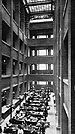 |
Larkin Administration Building (1903 - S.093) circa 1906-7. View of the
interior Central Hall from the second level. Designed by Wright in 1903,
the building was completed in 1906. Published in "Frank
Lloyd Wright Ausgefuhrte Bauten" Wright, 1911, p.130, and "Frank
Lloyd Wright, Chicago" Wright, 1911, p.110. 6 x 10 B&W photograph.
|
0080.24.0115 |
1906
 |
George
Millard Residence (I), Highland Park, Illinois, Perspective 1906 (1906 -
S.126). (FLLW #0606.01) Perspective presentation drawing of the George
Millard Residence. Designed by Frank Lloyd Wright in 1906. The house is
surrounded by woods. The approach to the house is an arched bridge over
a ravine on the right. A low wall, the height of the terrace wall,
extends past the bridge to the edge of the illustration. It also extends
a short distance on the left side of the house. The entrance is on the
left, the covered terrace is in the center foreground. The second floor
is cantilevered on either end. This drawing was dramatic enough that
Bruce Brooks Pfeiffer decided to give it a two-page spread in
Frank Lloyd Wright, Complete
Works 1885-1916, 2011, p.268-269. Courtesy of the Frank Lloyd Wright
Archives, Avery Library, Columbia University. 10 x 4 Color photograph, |
0064.37.0622 |
1906
 |
1) George
Millard Residence (I), Highland Park, Illinois, South Elevation 1906
(1906 - S.126). (FLLW #0606.05) The South elevation of the George
Millard Residence. Designed by Frank Lloyd Wright in 1906. The entrance
is on the left, the covered terrace to the right of center. Both the
East and West ends of the second floor were cantilevered. Text top
right: "4." Text bottom left: "0606.05." Courtesy of the Frank Lloyd
Wright Archives, Avery Library, Columbia University. 10 x 5 B&W
photograph, |
0064.38.0622 |
1906
 |
2) George
Millard Residence (I), Highland Park, Illinois, West and East Elevation
1906 (1906 - S.126). (FLLW #0606.06) The West (left) and East (right)
elevation of the George Millard Residence. Designed by Frank Lloyd
Wright in 1906. Left: The back of the house is on the left, the dining
room in the center, the entrance to the right, and the covered terrace
is on the right. Right: The covered terrace is on the left, the living
room is in the center, tghe back of the house is on the right. Text top
right: "5." Text bottom left: "0606.06." Courtesy of the Frank Lloyd
Wright Archives, Avery Library, Columbia University. 10 x 5 B&W
photograph, |
0064.39.0622 |
1906
 |
3) George
Millard Residence (I), Highland Park, Illinois, North Elevation 1906
(1906 - S.126). (FLLW #0606.07) The North elevation of the George
Millard Residence. Designed by Frank Lloyd Wright in 1906. This is a
view of the back of the house. The back entrance is in the center, the
dining room is on th right. . Both the East and West ends of the second
floor were cantilevered. Text top right: "6." Text bottom left: "0606.07." Courtesy of the Frank Lloyd Wright Archives, Avery Library,
Columbia University. 10 x 5 B&W photograph, |
0064.40.0622 |
1906
 |
Mrs. William H.
Pettit Memorial Chapel, Belvidere, Illinois, Perspective 1906 (1906 -
S.116). Perspective view of the Pettit Memorial Chapel. Designed by
Frank Lloyd Wright in 1906. Published in Ausgefuhrte Bauten und Entwurfe
von Frank Lloyd Wright, 1910, Tafel XLI (41). It is very symmetrical in
design. The floor plan is T-shaped. It consists of one large room
(Chapel) with a fireplace, and doors on either side that opens out to a
large covered porch that wraps around one end of the Chapel. "A small
inexpensive burial chapel at Belvidere, Illinois. A simple, not
unhomelike room for services, with shelter at rear and sides to
accommodate people waiting for cars. A memorial tablet and modest
fountain characterize it as a memorial to Mr. Pettit." FLLW #0619.002.
Courtesy of the Frank Lloyd Wright Archives, Avery Library, Columbia
University. 10 x 7 B&W photograph. |
0064.41.1022 |
1906
 |
Mrs. William H.
Pettit Memorial Chapel, Belvidere, Illinois, Floor Plan 1906 (1906 -
S.116). Floor plan for the Pettit Memorial Chapel. Designed by Frank
Lloyd Wright in 1906. It is very symmetrical in design. The floor plan
is T-shaped. It consists of one large room (Chapel) with a fireplace,
and doors on either side that opens out to a large covered porch that
wraps around one end of the Chapel. There are three sets of stairs, one
on either side of the Chapel, and one on the opposite side in the
center. There are built in planter on each end of the porch.
Doors on either side of the center stairs lead down to a storage room
for wood, and a bathroom. The main level is raised off the ground. FLLW
#0619.008. Courtesy of the Frank Lloyd Wright Archives, Avery Library,
Columbia University. 10 x 7 B&W photograph. |
0064.42.1022 |
1906
 |
Mrs. William H.
Pettit Memorial Chapel, Belvidere, Illinois, Floor Plan 1906 (1906 -
S.116). Floor plan for the Pettit Memorial Chapel adapted from the
original design. Designed by Frank Lloyd Wright in 1906. It is very
symmetrical in design. The floor plan is T-shaped. It consists of one
large room (Chapel) with a fireplace, and doors on either side that
opens out to a large covered porch that wraps around one end of the
Chapel. There are three sets of stairs, one on either side of the
Chapel, and one on the opposite side in the center. There are with a
built in planter on each end of the porch. Doors on either side of the
center stairs lead down to a storage room for wood, and a bathroom. The
main level is raised off the ground. FLLW #0619.008. Adapted by Douglas
M. Steiner. 10 x 7 B&W photograph. |
0064.43.1022 |
1906
 |
River Forest
Tennis Club, Floor Plan 1906 (1906 - S.119). Designed by Frank Lloyd
Wright in 1906. When the River Forest Tennis Club caught fire and burned
in 1906, Wright was tapped to redesign their building. The Tennis Club
was 204 feet long. There were two covered Porte Cochere (Carriage
Entryways), and three Fireplaces. The left side included a Women's
Locker Room and Kitchen. The right included the Men's Locker Room. The
Fireplace Nook and Alcoves on either side included built-in seating.
Doors opened outward from the expansive interior, in essence, removing
the wall which lead to an open Terrace which ran nearly the full length
of the building. Wright designed each end by rotating a square 90
degrees. On either side of the Men's and Women's Locker rooms was a
elongated row of Balustrated windows, or as Wright specified, 4"x4"
Vertical Spindles with glass between. This allowed natural light in,
while providing a measure of privacy. Original floor plan copyright
1958, "Frank Lloyd Wright To 1910" Manson, page 171. Modified by Douglas
M. Steiner from original drawings, copyright 2010. Original 8 x 10 B&W
photograph. |
0064.35.0421 |
1906
 |
Robie House,
Chicago, Illinois 1906 (1906 - S.127). Floor plan for the first, second
and third floors. Designed by Frank Lloyd Wright in 1906. Text on
sleeve: "Wright, Frank Lloyd (1869-1959). Robie House, Chicago, IL,
1906. Floor Plan. Am. Arch." Acquired from the archives of the
University of Virginia. 35mm Color slide, sandwiched between glass,
plastic mount. |
0064.30.0920 |
1906
 |
Robie
House, Chicago, Illinois 1906 (1906 - S.127). Perspective drawing of the
Robie House. Designed by Frank Lloyd Wright in 1906. This illustration
was published in
Modern Architecture,
Wright, 1931, p.64 and dated 1906. Published on the cover of
The
Prairie House, 1990 Calendar,
Pomegranate. Text on sleeve: "Wright, Frank Lloyd (1869-1959). Robie
House, Chicago, IL, 1906. Perspective. American Architecture." Acquired
from the archives of the University of Virginia. 35mm Color slide,
sandwiched between glass, plastic mount. |
0064.31.0920 |
|
1907 |
1907
 |
Art Institute of Chicago. Exhibition of Frank Lloyd
Wright's work at the Art Institute of Chicago, 1907. Wright's work was
featured at the Twentieth Annual Exhibition of the Chicago Architectural
Club, at the Galleries of the Art Institute of Chicago during the month of
April 1907. The exhibition included Wright's drawings, models, art glass
windows, furniture, light fixtures and Wright-designed objects. Photographed
by Henry Fuermann and Sons. 8 x 9.5 B&W photograph. |
0080.25.0115 |
1907
 |
1) Avery Coonley Residence, Riverside,
Illinois, Site Plan, 1907 (FLLW #0803.18) (1907 - S.135). Site plan for the
Avery Coonley Residence and estate. Designed by Frank Lloyd Wright in 1907.
According to Dean Eastman, the block that the Coonley Residence was built
on, was a tract of land comprised nine lots which covered about 5 acres. The
whole block was purchased by the Coonley’s in 1906. By 1912 they had
purchased an additional nine adjacent lots which brought the total area to
about 10 acres. Frank Lloyd Wright’s Coonley
House, 2012, p.40-42. The plan covered the entire block and included the
residence and pool, stable, gardener’s cottage and gardens. It is
interesting to note that the landscaping plan extend North between the river
and Bloomingbank Road. Not only does the landscaping extend, but so does the
walkway. As you follow the sidewalk from the house to Bloomingbank Road,
just before you reach the street as you walk North, the sidewalk splits, and
extends all the way to the river bank. There appears to be a small structure
and a dock. On the South side of the property, a pergola extends from the
gardener’s cottage to two tennis courts on the West end of the property.
Text top right: “Mr. Avery Coonley Dwelling, Riverside, Illinois. Frank...
Continue... |
0080.72.0425 |
1907
 |
2) Avery Coonley Residence, Riverside,
Illinois, Site Plan, 1907 (FLLW #0803.19) (1907 - S.135). Site plan for the
Avery Coonley Residence and estate. Designed by Frank Lloyd Wright in 1907.
According to Dean Eastman, the block that the Coonley Residence was built
on, was a tract of land comprised nine lots which covered about 5 acres. The
whole block was purchased by the Coonley’s in 1906. By 1912 they had
purchased an additional nine adjacent lots which brought the total area to
about 10 acres. Frank Lloyd Wright’s Coonley
House, 2012, p.40-42. The plan covered the entire block and included the
residence and pool, stable, gardener’s cottage and gardens. It is
interesting to note that the landscaping plan extend North between the river
and Bloomingbank Road. Not only does the landscaping extend, but so does the
walkway. As you follow the sidewalk from the house to Bloomingbank Road,
just before you reach the street as you walk North, the sidewalk splits, and
extends all the way to the river bank. There appears to be a small structure
and a dock. On the South side of the property, a walkway extends from the
gardener’s cottage to two tennis courts and a structure on the West end of
the property. Text top right: “Mr. Avery Coonley Dwelling, Riverside,
Illinois. Frank...
Continue... |
0080.73.0425 |
1907
 |
3) Avery Coonley Residence, Riverside,
Illinois, Site Plan, 1907 (FLLW #0803.20) (1907 - S.135 ). Site plan for the
Avery Coonley Residence and estate. Designed by Frank Lloyd Wright in 1907.
According to Dean Eastman, the block that the Coonley Residence was built
on, was a tract of land comprised nine lots which covered about 5 acres. The
whole block was purchased by the Coonley’s in 1906. By 1912 they had
purchased an additional nine adjacent lots which brought the total area to
about 10 acres. Frank Lloyd Wright’s Coonley
House, 2012, p.40-42. The plan covered the entire block and included the
residence and pool, stable, gardener’s cottage and gardens. On the South
side of the property, a pergola extends from the gardener’s cottage to two
tennis courts on the West end of the property. It is interesting to note
that on the north end of the property there was an “old House” located on
the proiperty.
Text bottom right: “Mr. And Mrs. Avery Coonley, Riverside, Illinois. Plot of
Grounds. Frank Lloyd Wright Architect. Oak Park, Illinois.” Hand written
lower left: “0803.20.” Courtesy of the Frank Lloyd Wright Archives, Avery
Library, Columbia University. (FLLW #0803.20) 10 x 8 Color photograph.
|
0080.74.0425 |
1907
 |
4) Avery Coonley Residence, Riverside,
Illinois, Site Plan, 1907 (FLLW #0803.21) (1907 - S.135). Site plan for the
Avery Coonley Residence and estate. Designed by Frank Lloyd Wright in 1907.
According to Dean Eastman, the block that the Coonley Residence was built
on, was a tract of land comprised nine lots which covered about 5 acres. The
whole block was purchased by the Coonley’s in 1906. By 1912 they had
purchased an additional nine adjacent lots which brought the total area to
about 10 acres. Frank Lloyd Wright’s Coonley House, 2012, p.40-42. The plan
covered the entire block and included the residence and pool, stable,
gardener’s cottage and gardens. The driveway extends the full width of the
block. On either side of the guest wing the drive branches toward the
stable. The North side drives through the stable and the South side drives
between the stable and the Gardener’s Cottage. It is interesting to note
that the landscaping plan extend North between the river and Bloomingbank
Road. Not only does the landscaping extend, but so does the walkway. As you
follow the sidewalk from the house to Bloomingbank Road, just before you
reach the street as you walk North, the sidewalk splits, and extends all the
way to the river bank. There appears to be a small structure...
Continue... |
0080.75.0425 |
1907
 |
Avery Coonley Residence, Riverside,
Illinois, First Floor Plan, 1907 (FLLW #0803.83) (1907 - S.135). First floor
plan for the Avery Coonley Residence. Designed by Frank Lloyd Wright in
1907. The upper level, the “first floor” is the living space: living and
dining rooms, kitchen, bedrooms, guest rooms and servants quarters. The
concept, the living space on the second level is similar to the Robie House
designed only one year earlier, in 1906. What Wright labeled on the plans as
the “Basement” is actually the ground floor. The drive began at Bloomingbank
Road, past the full length of the house, which is 180 feet long, and exited
onto Scottswood Road. It flowed under two wings, the servants quarters, and
the guest wing. The space under the two wings form porte cocheres. The main
entrance is under the first wing and leads to the entrance hall on the
ground floor. Stairs leading to the first floor, the living space is on the
left. Past the stairs on the ground level is the playroom, which is directly
below the living room. An addition, just past the first wing was built on
the drive, now forming a courtyard. Lower text: “First Floor Plan.” Hand
written lower left: “0803.83.” Courtesy of the Frank Lloyd Wright Archives,
Avery Library, Columbia University. (FLLW #0803.83) 10 x 7.5 Color
photograph. |
0080.69.0425 |
1907
 |
Coonley Residence, Riverside,
Illinois, Ground Floor Plan, 1907 (FLLW #0803.82) (1907 - S.135). Ground
floor plan for the Avery Coonley Residence. Designed by Frank Lloyd Wright
in 1907. The main entrance on the ground floor is under the first wing and
leads to the entrance hall. Stairs leading to the first floor, the living
space is on the left. Past the stairs on the ground level is the playroom,
which is directly below the living room. The ground floor is used for
storage and work spaces. The upper level, the “first floor” is the living
space: living and dining rooms, kitchen, bedrooms, guest rooms and servants
quarters. The concept, the living space on the second level is similar to
the Robie House designed only one year earlier, in 1906. What Wright labeled
on the plans as the “Basement” is actually the ground floor. The drive began
at Bloomingbank Road, past the full length of the house, which is 180 feet
long, and exited onto Scottswood Road. It flowed under two wings, the
servants quarters, and the guest wing. The space under the two wings form
porte cocheres. An addition, just past the first wing was built on the
drive, now forming a courtyard. Lower text: “Basement Plan.” Hand written
lower left: “0803.83.” Courtesy of the Frank Lloyd Wright Archives, Avery
Library, Columbia University. (FLLW #0803.82) 10 x 7.5 Color photograph.
|
0080.70.0425 |
1907
 |
1) Avery Coonley Residence, Riverside,
Illinois, Typical Window Plan, 1907 (FLLW #0803.59) (1907 - S.135 ). Typical
window design plan for the Avery Coonley Residence. Designed in 1907 by
Frank Lloyd Wright. Many of the windows in the residence came in pairs with
the design facing each other creating a symmetry, mirroring the design in
each window.
“As the main geometric element, the windows of the main house employ the
strong, independent square first seen in the W. A. Glasner house and the
Unity Temple clerestories. More important, with the windows of the Coonley
house, Wright cautiously approached asymmetrical design by halving the
composition vertically and shifting the vertical axis to the jamb, as he had
done previously in the Susan Lawrence Dana and Darwin D. Martin houses on a
smaller scale (discussed below). This vertical axis seems both strong yet
delicate with its heavily outlined squares of white glass and small, lightly
outlined squares of yellow, balanced on a thin vertical line. Setting these
windows or doors in pairs reestablishes their symmetry...”
Light Screens, Frank Lloyd Wright,
Sloan, 2001, p.188.
Text hand-written on the right: “Typical Window Design. Mr. Avery Coonley.”
Hand written...
Continue... |
0080.77.0525 |
1907
 |
2) Avery Coonley Residence, Riverside,
Illinois, Window Design Plan, 1907 (FLLW #0803.60) (1907 - S.135 ). Typical
window plan for a three window set for the Avery Coonley Residence. Designed
in 1907 by Frank Lloyd Wright. Many of the windows in the residence came in
pairs with the design facing each other creating a symmetry, mirroring the
design in each window. In many of Wright’s designs, windows and doors opened
outward. This created an issue with exterior flower boxes. Opening outward
would interfere with plantings. Wright devised a plan for windows adjacent
to exterior flower boxes. He added a windows below the pair. The lower
window was stationary and continued the glass design from above. This
allowed the upper pair to open outward without disturbing the contents of
the flower box. These were prominent in the dining room as well as others
windows that were adjacent to exterior built-in flower boxes.
“As the main
geometric element, the windows of the main house employ the strong,
independent square first seen in the W. A. Glasner house and the Unity
Temple clerestories. More important, with the windows of the Coonley house,
Wright cautiously approached asymmetrical design by halving the composition
vertically and shifting the vertical axis to the jamb...
Continue... |
0080.78.0525 |
1907
 |
3) Avery Coonley Residence, Riverside,
Illinois, Elevations, 1907 (FLLW #0803.86) (1907 - S.135 ). East, North and
South elevations for the Avery Coonley Residence. Designed in 1907 by Frank
Lloyd Wright. After locating the original plan for the Coonley three-widow
set (S#0080.78), the question arose, “Did Wright intend these sets for other
rooms in the house?” The East, North and South Elevation Plan answered the
question. Besides the dining room , we were able to locate other locations:
A) The East end of the Servants wing. B) Dining Room. C) Master Bedroom.
There was a flower box on the West end of the master bedroom dressing room,
and the three window set may have been placed there.
Text: “East
Elevation. North Elevation. South Elevation.” Hand written lower left:
“0803.86.” Courtesy of the Frank Lloyd Wright Archives, Avery Library,
Columbia University. (FLLW #0803.86) 10 x 8 Color photograph. |
0080.79.0525 |
C 1907
 |
E. A. Cummings Real Estate
Office, circa 1907 (1905 - S.112). Designed by Frank Lloyd Wright in 1905,
little is know about the building, and few photographs exist. Broad
overhanging eaves surrounds the building. Two pedestals on either side of
the entrance hold large prairie styled concrete vases that appear to be
round at the top, with four square legs setting on a square base. Two high
walls float out from the front corners with the ends attached to pedestal
setting on a large base. A decorative pole rests on top of the pedestal.
Text on the left wall: "River Forest Land..." Right: "We Welcome all who
would a home acquire." Edmund Augustus Cummings was born in Lowell, Mass on
Nov. 29, 1842. When he was a boy, his family moved to Elgin, Ill. He
enlisted as a soldier in the war in 1860 at 18 years of age and served with
General Grant. After the war, he moved to Chicago in 1864, working in the
insurance and real estate business. He married Ellen M. Merrill in Chicago
on Sept. 11 1867. In 1869 he formed the firm of E.A. Cummings & Co. He was
very successful in the real estate business, considered one of the most
successful at the time, creating as many as 250 subdivisions. He was one of
the organizers of the Chicago Real Estate Board and was for a time president
of the board. He was a founder and director of the... Continue...
|
0080.26.0215 |
C
1907
 |
1) Colonel George Fabyan Residence First
Floor Plan 1907, Fabyan Villa, Geneva, Illinois (1907 - S.129). Floor plan
for the first floor of the Fabyan Residence. Designed by Frank Lloyd Wright
in 1907. Text: "First Floor Plan, For Mrs. Fabyan, Geneva, Ill. Alterations
and Addition. Frank Lloyd Wright, Architect. Oak Park, Illinois. March 25,
'07." It is interesting to note that this first plan is for Mrs. Fabyan.
Possibly because the addition of a bedroom on the South side was for Mrs.
Fabyan. Text bottom left: "0703.01." Courtesy of the Frank Lloyd Wright
Archives, Avery Library. 10 x 8 B&W photograph. |
0080.48.1021 |
C
1907
 |
1C) Colonel George
Fabyan Residence Color First Floor Plan 1907, Fabyan Villa, Geneva, Illinois
(1907 - S.129). Color floor plan for the first floor of the Fabyan
Residence. Designed by Frank Lloyd Wright in 1907. Text: "First Floor Plan,
For Mrs. Fabyan, Geneva, Ill. Alterations and Addition. Frank Lloyd Wright,
Architect. Oak Park, Illinois. March 25, '07." It is interesting to note
that this first plan is for Mrs. Fabyan. Possibly because the addition of a
bedroom on the South side was for Mrs. Fabyan. Courtesy of the Frank Lloyd
Wright Foundation. Published in
Frank Lloyd Wright, Complete Works
1885-1916, Pfeiffer, 2011. 10 x 8 Color
photograph. |
0080.49.1021 |
C
1907
 |
2) Colonel George Fabyan Residence Second
Floor Plan 1907, Fabyan Villa, Geneva, Illinois (1907 - S.129). Floor plan
for the second floor of the Fabyan Residence. Designed by Frank Lloyd Wright
in 1907. Text: "Second Floor Plan. Col. Fabyan," Possibly titled for Col.
Fabyan because the second floor bedroom was for Mr. Fabyan. Three of the
rooms are listed as "Old Room,' with one "New Room" which was part of the
addition. Text bottom left: "0703.03." Courtesy of the Frank Lloyd Wright
Archives, Avery Library. 10 x 8 B&W photograph. |
0080.50.1021 |
C
1907
 |
2C) Colonel George Fabyan Residence Color
Second Floor Plan 1907, Fabyan Villa, Geneva, Illinois (1907 - S.129). Color
Floor plan for the second floor of the Fabyan Residence. Designed by Frank
Lloyd Wright in 1907. Text: "Second Floor Plan. Col. Fabyan," Possibly
titled for Col. Fabyan because the second floor bedroom was for Mr. Fabyan.
Three of the rooms are listed as "Old Room,' with one "New Room" which was
part of the addition. Text bottom left: "0703.03."
Courtesy of the Frank Lloyd Wright Foundation. Published in
Frank Lloyd
Wright, Complete Works 1885-1916,
Pfeiffer, 2011. 10 x 8 Color photograph. |
0080.51.1021 |
C
1907
 |
3) Colonel George Fabyan Residence Basement
Plan 1907, Fabyan Villa, Geneva, Illinois (1907 - S.129). Floor plan for the
Basement of the Fabyan Residence. Designed by Frank Lloyd Wright in 1907.
Text: "Mr. Geo. Fabyan Dwelling. Revised Plan of Basement. Frank Lloyd
Wright, Architect. Oak Park, Illinois." Text bottom left: "0703.02."
Courtesy of the Frank Lloyd Wright Archives, Avery Library. 10 x 8 B&W
photograph. |
0080.52.1021 |
C
1907
 |
4) Colonel George Fabyan Residence Design
for the Window Seats 1907, Fabyan Villa, Geneva, Illinois (1907 - S.129).
Design for the Window Seats for the Fabyan Residence. Designed by Frank
Lloyd Wright in 1907. Text: "Mr. George Fabyan, Detail of Window Seats.
Frank Lloyd Wright, Architect. Oak Park, Illinois." Caption center left:
"Elevation of Window Seat. One like this in Bed Room #2 & Bed Room #3."
Caption center right: "Elevation of Window Seat. One in Bed Room #2 & Bed
Room #3." Text bottom left: "0703.04." Courtesy of the Frank Lloyd Wright
Archives, Avery Library. 10 x 8 B&W photograph. |
0080.53.1021 |
1907
 |
Avery Coonley Residence, Riverside,
Illinois, Dressing Table, Bedroom #1 (FLLW #0803.51) (1907 - S.135). Front
and side view of the dressing table and side view of the chair. Designed
by Frank Lloyd Wright in 1907, the chair was executed in 1908. We could not
find examples of this table, but many examples the the chair. In 1989,
Cassina produced a low back that matched this drawing but called it a dining
room chair. The Cassina: 609 Coonley, 1. Was designed with a handhold below
the crest rail. There is a space at the base of the back of the chair that
mirrors the Handhold at the top. Eight shorter spindles run parallel to a
long and larger spindle on either side. Horizontal trim runs along the base
of the seat and runs along the front, sides and back. Like the crest tail
that curves out at the top, the base of the legs curve outward also. Forward
in the front, backwards in the back. There is a matching chair in a
photograph from 1911, Wright's Home and Studio (S#0104.15). In a bedroom for
Wright's daughter Catherine, there is a Japanese Print Table, designed by
Wright in 1898, used as a desk. In front of desk is a low back chair that
matches this Coonley low back chair. Wright also designed a low bak chair
for William E. Martin Residence, Oak Park, Illinois (1902 - S.061)...
Continue... |
0080.57.0323 |
C
1907
 |
William G. Fricke Home, C 1907 (1901 S.058).
Viewed from the North, photographed during the late Spring or late fall.
Curbs have been installed on the streets, but it appears that they have not
been paved yet. Short "hitching posts" are visible. Frank Lloyd Wright
designed a two-story garage for Emma Martin, and were dated March 15, 1907.
It appears that the Garage is under construction on the far left.
Landscaping on the far right is maturing. Like the Thomas Residence,
also 1901 and in Oak Park, it is an all-stucco exterior. But unlike the
Thomas Residence which is considered Frank Lloyd Wright's first fully
developed prairie styled house in Oak Park, it includes elements of Wright's
transitional designs. Like the
Rollin Furbeck Residence (1897),
it includes elements of Wright's transitional period. Corners are turned at
a 45 degree angle, it includes a massive central tower, there are
rectangular square windows with columns and it is more vertical than
Wright's prairie styled horizontal designs. It is also a three story home.
The covered Porch is on the far left followed by the Kitchen, Reception and
Entryways. The Living Room is on the far right. The Bedrooms are on the
second level, with a Balcony on the right, above the main Entrance.
Published in the Architectural Record, March 1908;
Frank
Lloyd Wright... Continue...
|
0080.31.1116 |
C
1907
 |
William G. Fricke Home, C 1907 (1901
S.058). Viewed from the West, photographed during the winter. The bushes on
the far let have reached the height of the wall surrounding the Entrance.
Photographed from Fair Oaks Avenue, which is it's street address, and
although the front door faces this direction, Wright turned the home so that
the Entrance to the home is from Iowa Street. Like the Thomas Residence,
also 1901 and in Oak Park, it is an all-stucco exterior. But unlike the
Thomas Residence which is considered Frank Lloyd Wright's first fully
developed prairie styled house in Oak Park, it includes elements of Wright's
transitional designs. Like the
Rollin Furbeck Residence (1897),
it includes elements of Wright's transitional period. Corners are turned at
a 45 degree angle, it includes a massive central tower, there are
rectangular square windows with columns and it is more vertical than
Wright's prairie styled horizontal designs. It is also a three story home.
Where the Rollin columns were round, these are closer to the appearance of
the square Thomas columns. The Entrance, along with the triangular bay
windows enclosing the Reception room is on the left. The Living Room is
toward the center, the Pavilion, which was later demolished to make room for
another home is on the right. The Bedrooms are on... Continue...
|
0080.32.1116 |
C
1907
 |
William G. Fricke Home, C 1907 (1901
S.058). Viewed from the Southwest, photographed during the winter. The
bushes on the far let have reached the height of the wall surrounding the
Entrance. The Garage can be seen in the background on the far right. Like
the Thomas Residence,
also 1901 and in Oak Park, it is an all-stucco exterior. But unlike the
Thomas Residence which is considered Frank Lloyd Wright's first fully
developed prairie styled house in Oak Park, it includes elements of Wright's
transitional designs. Like the
Rollin Furbeck Residence (1897),
it includes elements of Wright's transitional period. Corners are turned at
a 45 degree angle, it includes a massive central tower, there are
rectangular square windows with columns and it is more vertical than
Wright's prairie styled horizontal designs. It is also a three story home.
Where the Rollin columns were round, these are closer to the appearance of
the square Thomas columns. The Living Room is on the left, the Pavilion,
which was later demolished to make room for another home is on the right.
The Bedrooms are on the second level, with a Balcony on the left, above the
Living Room. Published in the Architectural Record, March 1908 and
Frank
Lloyd Wright, Chicago, Wright, 1911, p.63.
Photographed by Edward Van Altena. 10 x 6.5 B&W photograph. |
0080.33.1116 |
C
1907
 |
William G. Fricke Home, C 1907 (1901
S.058). Viewed from the Southeast, photographed during the winter. Although
more vertical than his later prairie houses, Frank Lloyd Wright did include
a dominate horizontal line that incorporates the second story window sills
and completely encircles the house, an element of his Prairie styled homes.
Like the Thomas Residence, also 1901
and in Oak Park, it is an all-stucco exterior. But unlike the Thomas
Residence which is considered Frank Lloyd Wright's first fully developed
prairie styled house in Oak Park, it includes elements of Wright's
transitional designs. Like the
Rollin Furbeck Residence (1897),
it includes elements of Wright's transitional period. Broad overhanging
eves, corners are turned at a 45 degree angle, it includes a massive central
tower, there are rectangular square windows with columns and it is more
vertical than Wright's prairie styled horizontal designs. It is also a three
story home. Where the Rollin columns were round, these are closer to the
appearance of the square Thomas columns. The pavilion, in the foreground on
the left, which was later demolished to make room for another home, was
reached by the outer stairs on the East (right) side, and a doorway and
covered passage on the South side of the house. The Living Room is in the
background... Continue...
|
0080.34.1116 |
C
1907
 |
Mrs. George E. Gerts Summer Cottage,
Whitehall, Michigan, Circa 1907 (1902 - S.077). View of the Mrs. George E.
Gerts Summer Cottage from the Northeast. Designed by Frank Lloyd Wright in
1902. First published in the March, 1908, Architectural Record. Wright
captioned it "Summer Cottage" Mrs. Geo. E. Gerts." Summer leaves date the
photograph prior to the fall of 1907. By 1907, an elongated addition appears
to be at the "front" of the house, either an addition or separate building.
The bridged porch can be seen in the foreground. Also published in
Frank Lloyd
Wright, Ausgefuhrte Bauten, 1911. Wright captions the
photograph "Doppelsommerlandhaus Geo E. Gets, Birch Brook, Mich." (Twin
Summer Cottage Geo E. Gets, Birch Brook, Mich.). It was also published in
Frank
Lloyd Wright, Chicago, 1911, and is titled "Doppel
sommerlandhaus Geo E. Gerts, Birch Brook, Mich." (Double Summer Cottage Geo
E. Gerts, Birch Brook, Mich.). 8 x 10 B&W copy photograph. |
0080.55.0822 |
1907
 |
Larkin Administration Building, Buffalo, New
York, 1907 (1903 - S.093). Copy 35mm slide of visiting women having lunch in
the Administration Building Cafe after a tour of the Larkin Factories.
Designed by Frank Lloyd Wright in 1903. Very low quality slide that appears
to be a copy of a printed photograph. This image was published in
The
Larkin Idea, December 1907, p.3. Acquired from the estate of an
art collector in Miami, Florida. Stamped on plastic sleeve: “LinDia. Made in
Switzerland.” Original 35mm B&W slide, sandwiched between glass, plastic
mount. 8 x 10 B&W Photograph. |
0080.81.0625 |
1907
 |
Larkin Administration Building, Buffalo, New
York, 1907 (1903 - S.093). Copy 35mm slide of the classroom on the fourth
floor of the Administration Building Annex. Designed by Frank Lloyd Wright
in 1903. Very low quality slide that appears to be a copy of a printed
photograph. A similar image was published in
Frank Lloyd Wright’s
Larkin Building, Myth and Fact, Quinan, 1987/89, p.80.Acquired from the
estate of an art collector in Miami, Florida. Stamped on plastic sleeve:
“LinDia. Made in Switzerland.” Original 35mm B&W slide, sandwiched between
glass, plastic mount. 8 x 10 B&W Photograph. |
0080.82.0625 |
1907
 |
Larkin Administration Building,
Buffalo, New York, 1907 (1903 - S.093). Copy 35mm slide of gentleman at the
Frank Lloyd Wright designed Larkin desk and chair in the Larkin
Administration Building. Designed by Frank Lloyd Wright in 1903. He is busy
recording with a graphophone. A graphophone is a sound recording and
playback device that uses wax cylinders to record and reproduce audio. It
was developed by Alexander Graham Bell in the 1880s.
Very low quality slide that appears to be a copy of a printed photograph.
Acquired from the estate of an art collector in Miami, Florida. Stamped on
plastic sleeve: “LinDia. Made in Switzerland.” Original 35mm B&W slide,
sandwiched between glass, plastic mount. 8 x 9 B&W Photograph. |
0080.83.0625 |
1907
 |
Larkin Jamestown Exposition
Pavilion, 1907 (1907 - S.132). View of entrance. The exhibition room is on
the left, the lecture room is to the right. Text on exterior wall: "Larkin
Co. Factory to Family. Soaps and Toilet Articles, Food Products, and
Premiums." "Larkin Co. at Jamestown Ter-Centennial. Along with the many
beautiful structures that will soon be completed on the grounds of the great
Jamestown Exhibition is the private building of Larkin Co. In this building
there will be an interesting display of the Larkin Products and Premiums...
The Larkin Building is intended for the entertainment and comfort of the
hosts of our friends and customers that will attend the exhibition. ...the
object of the Jamestown Exhibition is primarily to celebrate the three
hundredth anniversary of the first English settlement on the American
continent..." From The
Larkin Idea, March, 1907, Larkin Co., Buffalo, NY. 10 x 5 B&W
photograph. |
0080.22.0115 |
1907
 |
Larkin Jamestown Exposition
Pavilion Interior, 1907 (1907 - S.132). The exhibition room viewed from the
lecture room. In the background are six sets of large windows with pairs of
smaller panes on either side. The window design is reminiscent of Pebbles &
Balch Store Remodeling,(1907 - S.131) and the Beachy Residence Remodel (1906
- S.117). "Larkin Co. at Jamestown Ter-Centennial. Along with the many
beautiful structures that will soon be completed on the grounds of the great
Jamestown Exhibition is the private building of Larkin Co. In this building
there will be an interesting display of the Larkin Products and Premiums...
The Larkin Building is intended for the entertainment and comfort of the
hosts of our friends and customers that will attend the exhibition. ...the
object of the Jamestown Exhibition is primarily to celebrate the three
hundredth anniversary of the first English settlement on the American
continent..." From The
Larkin Idea, March, 1907, Larkin Co., Buffalo, NY. 10 x 5.6 B&W
photograph. |
0080.23.0115 |
1907
 |
William Storrs MacHarg (McHarg) House,
Chicago, Illinois, Circa 1907 (Not Dated) (1891 - S.10). Real photo postcard
of the MacHarg Residence viewed from the Northeast. To date, this is only
the second photograph of the MacHarg House known to exist. It was discovered
by Greg Brewer while researching the house for an article he published. It
was designed by Frank Lloyd Wright in 1891 while working for Louis Sullivan.
Many of the residential designs that came to Adler and Sullivan, were turned
over to Wright. But Grant Manson believes that this was one of the first
“Bootlegged” houses, designed by Wright during that period. Demolished
around 1926.
According to Greg
Brewer, “Childs was a prolific photographer of Chicago neighborhoods in the
early years of the twentieth century. It is estimated that the C.R. Childs
Company produced between twenty-five and forty thousand real-photo postcard
views of Illinois towns and cities and various locations in Indiana,
Michigan, Wisconsin, and Iowa. The Chicago History Museum has nearly ten
thousand C.R. Childs images in its collection, but the postcard showing the
BerryMacHarg house is not among them. Ths image... was discovered in the
personal collection of LeRoy Blommaert, a resident historian...
Continue... |
0080.63.0524 |
C
1907
 |
Municipal Boathouse, Lake Mendota,
Madison, Wisconsin, Circa 1907 (1893 - S.022). The Municipal Boathouse was
built at the foot of North Carroll Street on Lake Mendota. View of the
University Crew on the lake in front of the Municipal Boathouse. The
Municipal Boathouse was designed by Frank Lloyd Wright in 1893. He was 26
year old at the time and a draftsman for the architectural firm of Adler and
Sullivan. The boat house for Lake Mendota was completed by the Spring of
1894. Text: "University Crew, Madison, Wis."ť Photographic copy of a postcard
published circa 1907. Not dated, but we have a copy of this postcard
postmarked December 1908. 10 x 6.5 B&W Photograph. |
0080.60.0823 |
1907
 |
Pebbles and Balch Remodeling Drawings 1907
(1907 - S.131). Copy photograph of Frank Lloyd Wrights original designs for
the Pebbles and Balch Store Remodeling. Frank Lloyd Wright designed the
Pebbles and Balch Store Remodeling in 1907. Text bottom right: "Remodeling
Store Front for Pebbles and Balch, Oak Park, Ill. Frank Lloyd Wright Arch't."
Top left: Front Elevation. Center: Floor Plan. Top right: Longitudinal
Section Looking Toward West. Center Right: Cross Section Looking Toward
South. Published in "Frank Lloyd Wright, Complete Works 1885-1916",
Pfeiffer, 2011, p.301. Courtesy of The Frank Lloyd Wright Foundation. 10 x
4.75 Color photograph. |
0080.41.0519 |
1907
 |
Pebbles and Balch Store Remodeling
(1907 - S.131). This exterior photograph was taken just after completion of
the remodel and was acquired by Grant Manson. The exterior was first
published in "In The Nature of Materials: 1887 - 1941", Hitchcock, 1942.
Hitchcock indicated "Photo courtesy of Grant C Manson". Manson could not
have taken them in 1907-08, he would have been only three to four years old
at the time. He published this photograph in "Frank Lloyd Wright to 1910",
1958. In Manson's Illustration Credits, he indicates that "Another source of
illustrations of erected buildings of the Oak Park Period are the remaining
photographs of the set made around 1910 by Henry Fuermann of Chicago...",
but is not specific as to the origin of the image. The clerestory windows
with wood muntins (thin bands of wood), are similar to the earlier Peter
Beachy Residence Remodel (S.117) and the Frederick D. Nichols Residence
(S.118), both in 1906. Wright designed the large show window as an enclosed
display area, blocking exterior activity, giving privacy to clients shopping
inside. Wright compensated for the blocked daylight by an unobstructed band
of clerestory windows. Of interest are the two exterior light fixtures. They
are very similar to the fixtures... Continue... For more information see
our Wright Study on Pebbles and Balch Remodel. |
0080.11.1011 |
1907
 |
Pebbles and Balch Store Remodeling
(1907 - S.131). This interior photograph was taken just after completion of
the remodel and was acquired by Grant Manson. The interior photograph was
first published in "Frank Lloyd Wright to 1910", 1958. In Manson's
Illustration Credits, he indicates that "Another source of illustrations of
erected buildings of the Oak Park Period are the remaining photographs of
the set made around 1910 by Henry Fuermann of Chicago...", but is not
specific as to the origin of the image. Wright designed the large show
window as an enclosed display area, blocking exterior activity, giving
privacy to clients shopping inside. Wright compensated for the blocked
daylight by an unobstructed band of clerestory windows. The interior
reflected Wright's prairie style. Bands of horizontal trim, natural wood and
warm earth tones and stained glass lighting fixtures. The interior glass
fixture seems to be a scaled down, less complex fixture than the Browne's
Bookstore (S.141) fixture. All the wood cabinetry was designed by Wright.
There were wood framed cabinets with glass doors for displaying decorative
objects to entice any homeowner in Oak Park. Being a "paper-hanger's" shop,
Wright also designed some of the cabinetry to hold and display rolls of
wallpaper... Continue... For more information see
our Wright Study on Pebbles and Balch Remodel. |
0080.12.1011 |
1907
 |
Andrew Porter Residence, Tanyderi, Spring
Green, Wisconsin Perspective 1907 (1907 - S.134). Presentation drawing of
the Andrew Porter House designed by Frank Lloyd Wright in 1907 for his
sister and brother-in-law Jane and Andrew T. Porter. He designed the house
when Andrew Porter became headmaster of Hillside Home School. The Porter
Residence preceded Taliesin by six years and was built on one of the higher
hills at Taliesin, just beneath Romeo and Juliet. The home's floor plan is
based on Wright's "Fireproof House for $5,000"
published in Ladies Home Journal in 1907. It is square with an extension off
the front, enclosing the stairway, and creating a balcony above it on the
second floor. One of twelve drawings in the Frank Lloyd Wright Foundation
Archives at the Avery Library, Columbia University. Text bottom left: "0709.09." Frank Lloyd Wright Foundation #0709.09. Courtesy of the Frank
Lloyd Wright Foundation Archives, Avery Library, Columbia University. 10 x
8" B&W photograph. |
0080.56.0123 |
C
1907
 |
River Forest Tennis Club, Membership
Card, Circa 1907 (1906 - S.119). The River Forest Tennis Club was designed
by Frank Lloyd Wright in 1906. When the River Forest Tennis Club caught fire
and burned in 1906, Wright was tapped to redesign their building. This may
be one of the earliest photographs of the Tennis Club. Plans published in
Frank Lloyd Wright
Monograph 1902-1906, Pfeiffer, 1989,
p.184, and
Frank Lloyd Wright 1885-1916,
Pfeiffer, 2011, p.272, are dated August 7th, 1906. Taking into consideration
construction schedules, and the foliage in this photograph, it was most
likely photographed in 1907. Wright designed the Logo seen on either side of
the photograph. Courtesy of Wisconsin Historical Society. 8 x 4.75 B&W
photograph. |
0080.47.0421 |
1907
 |
Unity Temple, Oak Park, Illinois, Under
Construction 1907 (1904 - S.096). View of Unity Temple under construction,
from the Northeast, early 1907. This view is the exterior of Unity Temple's
main sanctuary. Designed by Frank Lloyd Wright in 1904. The walls were
executed in poured concrete. Wood bracing holds the forms in place until the
concrete sets. The roof has not yet been poured, but the upper columns on
the left have been completed. The street is made of brick. Published in
Unity Temple, Frank Lloyd Wright, McCarter, 1997, p.13.
This photograph may be be flipped horizontally. Similar view published in
Inland Architect & News Record - Volume LII December 1908. Original 24 x 20
B&W photograph. Gold Nielsen frame: 24.25 x 20.25. |
0080.66.1024 |
1907
 |
Burton J. Westcott Residence, Springfield,
Ohio, Presentation Drawing Circa 1907 (1907 - S.099) (FLLW #0712.54). Aerial
perspective drawing of the Westcott Residence. Designed by Frank Lloyd
Wright in 1907, completed in 1909-11. This is possible one of the earliest
presentation drawing of the Westcott Residence. Very similar to Ausgefuhrte
Bauten Tafel LIII (Plate 53). This rendering is missing the large urns as
well as the stairs on either side of the front of the pool, that are visible
in the 1910 Ausgefuhrte Bauten illustration. Frank Lloyd Wright described
the Westcott house, “Plastered walls, tile roof, cement base courses and
groundwork. House of the large living-room type: the necessary privacy for
various functions obtained by screens, contrived as bookcases, and seats
beside the central fireplace. In front a tiled terrace, to be covered with
awning in summer, and a lily pool, flanked with large cast concrete bases.
The grounds are terraced above the street." Published in the
March
1908 issue of Architectural Record, p.218.
Caption: “House For Mr. B. J. Westcott. Springield, Ohio. A simple treatment
of the same problem as the Coonley house at Riverside, III. Living room at
center; dining room on one side and sleeping rooms on the other; service
wing extending from the rear of the living room.” Courtesy of the Frank
Lloyd Wright Archives, Avery Library. 10 x 6.25 B&W photograph. |
0080.61.0324 |
1907
 |
Burton J. Westcott Residence,
Springfield, Ohio, Front Elevation 1907 (1907 - S.099) (FLLW #0712.07).
Front elevation of the Westcott Residence with Urns. Designed by Frank Lloyd
Wright in 1907, completed in 1909-11. Hand written lower right: “Burton
Westcott House. Springfield, Ohio, 1907.” Hand written lower left:
“0712.07.” Frank Lloyd Wright described the Westcott house, “Plastered
walls, tile roof, cement base courses and groundwork. House of the large
living-room type: the necessary privacy for various functions obtained by
screens, contrived as bookcases, and seats beside the central fireplace. In
front a tiled terrace, to be covered with awning in summer, and a lily pool,
flanked with large cast concrete bases. The grounds are terraced above the
street." Published in the
March
1908 issue of Architectural Record, p.218.
Caption: “House For Mr. B. J. Westcott. Springield, Ohio. A simple treatment
of the same problem as the Coonley house at Riverside, III. Living room at
center; dining room on one side and sleeping rooms on the other; service
wing extending from the rear of the living room.” Courtesy of the Frank
Lloyd Wright Archives, Avery Library. 10 x 4 B&W photograph. |
0080.62.0324 |
1907-1908
 |
Catherine Tobin Wright. Circa
1907-1908. Catherine and her youngest child Robert Llewellyn Wright
(1903-1985) age 4-5. Catherine Tobin Wright in a dress designed by Frank
Lloyd Wright. See similar photograph without Robert in "The decorative
designs of Frank Lloyd Wright", Hanks, page 25. (Note: Robert Llewellyn
Wright was born on November 15, 1903 in Oak Park, IL, and passed away on
February 22, 1986 in West Bethesda, MD. He married Elizabeth Bryant Kehler
on July 29, 1933. He was buried in Unity Chapel Cemetery, Spring Green, WI.)
Courtesy of the Smithsonian Institute, Mrs. Robert L. Wright collection.
Published in "Frank
Lloyd Wright A
Biography", Secrest, 1992, page 191, dated 1907. 5 x 6.5 Print. High res digital image. |
0080.07.0609 |
|
1908 |
1908
 |
Edmund D. Brigham Residence Ground and
Garage Plan, Glencoe, Illinois 1908 (1908 - S.184). Designed by Frank Lloyd
Wright in 1908, construction began in 1908 and completed in 1909. In 1907,
Frank Lloyd Wright proposed a concrete house in the April issue of
The Ladies
Home Journal in his article "A
Fireproof House for $5,000." One year later Wright designed the Brigham
House as a reinforced board-formed concrete house. Text on plan, bottom
left: "Plan of Grounds." Bottom right: "Mr. E. D. Brigham Dwelling. Glencoe,
Illinois. Frank Lloyd Wright Architect, Oak Park, Ill. Plan of Garage." Hand
written bottom left corner: "1503.05." Courtesy of the Columbia University,
Avery Library. 8 x 9.5 B&W photograph. |
0085.43.1119 |
1908
 |
Edmund D. Brigham Residence First
Floor Plan, Glencoe, Illinois 1908 (1908 - S.184). Designed by Frank Lloyd
Wright in 1908, construction began in 1908 and completed in 1909. In 1907,
Frank Lloyd Wright proposed a concrete house in the April issue of
The Ladies
Home Journal in his article "A
Fireproof House for $5,000." One year later Wright designed the Brigham
House as a reinforced board-formed concrete house. Text on plan, bottom
right: "Mr. E. D. Brigham Dwelling. Glencoe, Illinois. Frank Lloyd Wright
Architect, Oak Park, Ill. First Floor Plan." Hand written bottom left
corner: "1503.03." Courtesy of the Columbia University, Avery Library. 8 x
9.5 B&W photograph. |
0085.44.1119 |
1908
 |
Edmund D. Brigham Residence First
Floor Plan, Glencoe, Illinois 1908 (1908 - S.184). Designed by Frank Lloyd
Wright in 1908, construction began in 1908 and completed in 1909. In 1907,
Frank Lloyd Wright proposed a concrete house in the April issue of
The Ladies
Home Journal in his article "A
Fireproof House for $5,000." One year later Wright designed the Brigham
House as a reinforced board-formed concrete house. Text on plan, bottom
right: "First Floor Plan." Hand written bottom left corner: "1503.02." Hand
written bottom right: "For contractor to build for himself. FLLW." "Brigham
house On Sheridan Road." Courtesy of the Columbia University, Avery Library.
8 x 9.5 B&W photograph. |
0085.45.1119 |
1908
 |
Edmund D. Brigham Residence Second
Floor Plan, Glencoe, Illinois 1908 (1908 - S.184). Designed by Frank Lloyd
Wright in 1908, construction began in 1908 and completed in 1909. In 1907,
Frank Lloyd Wright proposed a concrete house in the April issue of
The Ladies
Home Journal in his article "A
Fireproof House for $5,000." One year later Wright designed the Brigham
House as a reinforced board-formed concrete house. Text on plan, bottom
right: "Mr. E. D. Brigham Dwelling. Glencoe, Illinois. Frank Lloyd Wright
Architect, Oak Park, Ill. Second Floor Plan." Hand written bottom left
corner: "1503.04." Courtesy of the Columbia University, Avery Library. 8 x
9.5 B&W photograph. |
0085.46.1119 |
1908
 |
Edmund D. Brigham Residence Stable
Plan, Glencoe, Illinois 1908 (1908 - S.184). Designed by Frank Lloyd Wright
in 1908, construction began in 1908 and completed in 1909. In 1907, Frank
Lloyd Wright proposed a concrete house in the April issue of
The Ladies
Home Journal in his article "A
Fireproof House for $5,000." One year later Wright designed the Brigham
House as a reinforced board-formed concrete house. Text on plan, bottom
right: "Mr. E. D. Brigham. Stable. Frank Lloyd Wright Arch, Oak Park,
Illinois." Hand written: "Revised May 11 - 08." Hand written bottom left
corner: "0811.01." Published in "Frank
Lloyd Wright, Complete Works 1885-1916," Pfeiffer, 2011, p.308. Courtesy
of the Frank Lloyd Wright Foundation. Copy 10 x 5.5 color photograph. |
0085.47.1119 |
C 1908
 |
Lucius M. Boomer, Circa 1908,
was born in New York on August 22, 1878, and passed away on June 26, 1947 in
Norway. His parents were Lucius S. Boomer and Berthaldine Sterling Boomer.
Owned or managed a number of hotels with industrialist Thomas Coleman
DuPont. Courtesy of the State Archives of Florida. 6 x 9 B&W photograph.
For more information on the Boomer
Residence see our Wright Study. |
0085.33.1014 |
1908
 |
Browne's Bookstore (1907 -
S.141) Exterior Entrance Circa 1908. Exterior view of entry from hallway.
Glass, envelopes the entryway. Two doors allow customers to enter. "Browne's
Bookstore" is on the glass above the left door. Two Copper Weed Holders are
seen inside display case. Storrer dates Bookstore as 1908. But November 1907
issue of The Dial announced that "Browne's Bookstore... is now open".
Photographed by Henry Fuermann and Sons. 8 x 8 Print. High res digital
image.
For more information see
our Wright Study on Browne's Bookstore. |
0085.09.0311 |
1908
 |
Browne's Bookstore (1907 -
S.141) Interior Entrance Circa 1908. The cashier's station is conveniently
situated between the two entry doors. Wright designed every fixture and
every piece of furniture. "Browne's Bookstore" is on the glass above the
right door. Storrer dates Bookstore as 1908. But November 1907 issue of The
Dial announced that "Browne's Bookstore... is now open". Photographed by
Henry Fuermann and Sons. 8 x 10 Print. High res digital image.
For more information see
our Wright Study on Browne's Bookstore. |
0085.10.0311 |
1908
 |
Browne's Bookstore (1907 -
S.141) Front Cove Circa 1908. View of front Cove. Browne sought to combine
the best features of a well-equipped bookstore with those of a choice home
library. Built-in seating, high-backed chairs and tables, stained glass
windows and light fixtures, and a view of Lake Michigan from these seventh
floor windows. Wall and ceiling trimmings were of quartered oak throughout.
Storrer dates Bookstore as 1908. But November 1907 issue of The Dial
announced that "Browne's Bookstore... is now open". Photographed by Henry
Fuermann and Sons. 7 x 10 Print. High res digital image.
For more information see
our Wright Study on Browne's Bookstore. |
0085.11.0311 |
1908
 |
Browne's Bookstore (1907 -
S.141) Viewed From Front to Back Circa 1908. Alcoves were arranged along the
left side; each alcove had chairs, a table and reading light. The shelves
extend only part way up the walls, giving the effect of a home library. By a
unique system of shelf-lighting, the title of every volume from top shelf to
bottom were easily be read, while at the same time the lights were hidden
from the eye. Every fixture and every piece of furniture was specially
designed by Wright and manufactured to order. The cases, tables, chairs, and
wall trimmings were of quartered oak throughout. Wright also lowered the
ceiling in the main room. Storrer dates Bookstore as 1908. But November 1907
issue of The Dial announced that "Browne's Bookstore... is now open".
Photographed by Henry Fuermann and Sons. 8 x 9 Print. High res digital
image.
For more information see
our Wright Study on Browne's Bookstore. |
0085.12.0311 |
1908
 |
Browne's Bookstore (1907 -
S.141) Viewed From Entry to Back Circa 1908. View from entry to back.
Alcoves were arranged along the left side; each alcove had chairs, a table
and reading light. The shelves extend only part way up the walls, giving the
effect of a home library. By a unique system of shelf-lighting, the title of
every volume from top shelf to bottom were easily be read, while at the same
time the lights were hidden from the eye. Set between every tier of shelves,
at right angles to the wall are long library tables, with dependent reading
lamps and high-backed chairs. The cases, tables, chairs, and wall trimmings
were of quartered oak throughout. Wright also lowered the ceiling in the
main room. Wright adorned the top of a book shelf with his familiar Winged
Victory Statue and quotations on the wall. Moving from one room to the next,
Wright would often lower the ceiling, giving the effect of immensity as you
moved into the next room. Wright dropped the ceiling in the space between
the two rooms, while continuing the ceiling above. Storrer dates Bookstore
as 1908. But November 1907 issue of The Dial announced that "Browne's
Bookstore... is now open". Photographed by Henry Fuermann and Sons. 8 x 10
Print. High res digital image.
For more information see
our Wright Study on Browne's Bookstore. |
0085.13.0311 |
1908
 |
Browne's Bookstore (1907 -
S.141) View of Cove Circa 1908. Each Cove included a built in table, four
high-backed chairs and a reading light. The shelves extend only part way up
the walls, giving the effect of a home library. By a unique system of
shelf-lighting, the title of every volume from top shelf to bottom could
easily be read, while at the same time the lights were hidden from the eye
(PW). The book tier on the left shows the design of the lighting system just
above the top shelf. Not only were the upper shelves recessed, but the lower
shelves were slightly slanted, angling the books upward. Storrer dates
Bookstore as 1908. But November 1907 issue of The Dial announced that
"Browne's Bookstore... is now open". Photographed by Henry Fuermann and
Sons. Original 8 x 9.8 B&W photograph.
For more information see
our Wright Study on Browne's Bookstore. |
0085.27.0712 |
1908
 |
Browne's Bookstore (1907 -
S.141) View Toward Fireplace Circa 1908. The smaller room contains no
shelving other than on either side of the fireplace, and is arranged with
cases and tables for the display of fine bindings and special editions. A
large fireplace and comfortable easy-chairs give this the appearance of an
attractive living-room. Every fixture and every piece of furniture in both
rooms has been specially designed and manufactured to order. Photographed by
Henry Fuermann and Sons. 8 x 10 Print. High res digital image.
For more information see
our Wright Study on Browne's Bookstore. |
0085.14.0311 |
1908
 |
Dana-Thomas Residence Circa 1908 (1902 - S.072). Deigned
by Frank Lloyd Wright in 1902 for Susan Lawrence Dana, it was completed
in 1904. Single photograph with three images on it. 1) Portrait of Frank
Lloyd Wright slightly facing to the right. Hair has just a touch of
gray. Caption: "Top Left: Frank Lloyd Wright, Dana Thomas House
architect. Photo taken during House construction (sic)." 2) Susan
Lawrence Dana, looking slightly to the right. Caption: "Top Right: Susan
Lawrence Dana, circa 1910. She hired Wright to design a house suitable
for entertaining." 3) View of the entrance to the Dana House. Caption:
"Right: Dana-Thomas House entrance shortly after construction was
completed." Published in Frank
Lloyd Wright, Ausgefuhrte Bauten, Wright, 1911, p.35. Text:
Photos Courtesy of Illinois State History Library. Original 8 x 10 B&W
photograph.
|
0085.49.0720 |
Circa 1908
 |
William G.
Fricke Home, C 1908 (1901 S.058). Viewed from the Northwest,
photographed during the Summer. Landscape is mature and in full bloom.
Curbs have been installed, but the street in the foreground appears to
be dirt. Like the Thomas Residence,
also 1901 and in Oak Park, it is an all-stucco exterior. But unlike the
Thomas Residence which is considered Frank Lloyd Wright's first fully
developed prairie styled house in Oak Park, it includes elements of
Wright's transitional designs. Like the
Rollin Furbeck Residence (1897),
it includes elements of Wright's transitional period. Broad overhanging
eves, corners are turned at a 45 degree angle, it includes a massive
central tower, there are rectangular square windows with columns and it
is more vertical than Wright's prairie styled horizontal designs. It is
also a three story home. Where the Rollin columns were round, these are
closer to the appearance of the square Thomas columns. The Garage (1907)
is visible on the far left. The covered porch and Kitchen are on the
left. The Entrance and triangular bay window in the center, and the
Living Room is on the right. Bedrooms are on the second level. Courtesy
of the Art Institute of Chicago. Photographed by J. W. Taylor. 10 x 7.75
B&W photograph. |
0085.35.1116 |
Circa 1908
 |
William G.
Fricke Home, C 1908 (1901 S.058). Viewed from the West, photographed
during the Summer. Landscape is mature and in full bloom. Curbs have
been installed, but the street appears to be dirt. Like the Thomas Residence,
also 1901 and in Oak Park, it is an all-stucco exterior. But unlike the
Thomas Residence which is considered Frank Lloyd Wright's first fully
developed prairie styled house in Oak Park, it includes elements of
Wright's transitional designs. Like the
Rollin Furbeck Residence (1897),
it includes elements of Wright's transitional period. Broad overhanging
eves, corners are turned at a 45 degree angle, it includes a massive
central tower, there are rectangular square windows with columns and it
is more vertical than Wright's prairie styled horizontal designs. It is
also a three story home. Where the Rollin columns were round, these are
closer to the appearance of the square Thomas columns. The Entrance,
with the triangular bay windows enclosing the Reception room is on the
left. The Living Room is in the center, the Pavilion, which was later
demolished to make room for another home is on the right. The Bedrooms
are on the second level, with a Balcony on the left, above the main
Entrance. Published in Frank
Lloyd Wright Ausgefuhrte Bauten, 1911, p.72. 10 x
7 B&W photograph. |
0085.36.1116 |
Circa 1908
 |
Hillside Home School II circa 1908 (1902 - S.069). View from the
Southwest. Three students can be seen in front of the building. Ellen
(Nell) and Jane Lloyd Jones, Frank Lloyd Wright's aunts, formed the
Hillside Home School in 1887 and ran it until 1915 when it closed. The
private school accepted students between the ages of seven and
seventeen. It espoused non-conventional teaching methods, and was the
first coeducational school in the nation. After attending the University
of Wisconsin, Madison, Wright headed for Chicago in 1887 and accepted a
position as draftsman in the architectural firm of Joseph Lyman Silsbee.
That year, his Aunt's drafted him to design a school building for them,
Hillside Home School I, a large Shingle styled building, reflected the
designs of his mentor Silsbee, and in the style of his first project,
Unity Chapel, in Spring Green. As the school grew, so did the need for
more space. Wright designed Hillside Home School II in 1902, which was
completed in 1903. (Plate X, Ausgefuhrte Bauten.) It eventually became
part of the Taliesin Fellowship complex. When Wright began the Taliesin
Fellowship in 1932, he began restoring and remodeling the building.
Courtesy of the Wisconsin Historical Society. 7 x 4 B&W photograph.
(See progression of the Hillside
Home School / Taliesin Complex) |
0085.29.1213 |
1908
 |
Joseph & Helen Husser Residence
(1899 - S.046). Purcell Exterior Image #1, 1908. Viewed from the Southwest.
Photographed from the driveway of the Southern end of the Entrance Pergola,
circa 1908. The Pergola leads into the lower level of the Stair Bay. The
entrance to the home is through the lower level of the Stair Bay. The
Bedrooms are located on the Second (top) level. The Sullivanesque frieze
wraps horizontally under the eves. The top half of the frieze extends out
approximately six to twelve inches. The arches were also of a Sullivanesque
design. The Husser residence was a blend of Wright's Prairie style and the
last usage of Sullivanesque details by Wright. The openings of the Covered
Porch were enclosed. Wright placed large vases on either side of the
entrance to the covered Pergola. William Gray Purcell (1880 - 1965) was born
and raised in Oak Park. He attended Cornell University and in 1903
apprenticed with Louis Sullivan. According to the Archives, Purcell visited
and photographed the Husser Residence in 1908. Courtesy of the William Gray
Purcell Papers, Correspondence file: Frank Lloyd Wright, Northwest
Architectural Archives, University of Minnesota Libraries, Minneapolis, MN.
4x5 B&W Photograph from original digital scan.
See our Wright Study on the Husser
Residence. |
0085.22.0312 |
1908
 |
Joseph & Helen Husser Residence
(1899 - S.046). Purcell Exterior Image #2, 1908. Viewed from the South.
Circa 1908. Lower level: On the left is the Driveway. From the street, the
Drive leads to the Porte Cochere which Wright designed into the lower level
of the Stair Bay. The Driveway leads through the lower level of the Stair
Bay to the Stable. Just to the right of the Drive is the covered Entrance
Pergola. Both the Drive and the Entrance Pergola lead to the Entrance and
the Lower Hall. First and Second Level: The Stair Bay can be seen above the
Porte Cochere. Bedrooms are located on the Second (top) level above the main
part of the house. William Gray Purcell (1880 - 1965) was born and raised in
Oak Park. He attended Cornell University and in 1903 apprenticed with Louis
Sullivan. According to the Archives, Purcell visited and photographed the
Husser Residence in 1908. Courtesy of the William Gray Purcell Papers,
Correspondence file: Frank Lloyd Wright, Northwest Architectural Archives,
University of Minnesota Libraries, Minneapolis, MN. 4x5 B&W Photograph from
original digital scan.
See our Wright Study on the Husser
Residence. |
0085.23.0312 |
1908
 |
Joseph & Helen Husser Residence
(1899 - S.046). Purcell Exterior Image #3, 1908. Viewed from the Southeast.
Circa 1908. Lower level: Wright designed the Lower level as a basement,
although it was at ground level. This allowed the First floor (second level)
a better view of Lake Michigan. The Lower Level housed the utilities,
heating, laundry, servant's and butler's rooms, children's playroom and
entry hall. The Children's Playroom was mostly located below the Living
Room. To the left of the Dining Room Bay is the entry to the back of the
Entrance Hall. Double stairways gave access to the main level and lead to an
Entrance Hall or "foyer" situated between the Dining and Living Rooms on the
First level. First and Second Level: The Covered Porch on the far left. The
Living Room is just to the right. The Dining Room Bay is on the right.
Between the Living and Dining Rooms is the Entrance Hall or "foyer".
Bedrooms are located on the Second (top) level. William Gray Purcell (1880 -
1965) was born and raised in Oak Park. He attended Cornell University and in
1903 apprenticed with Louis Sullivan. According to the Archives, Purcell
visited and photographed the Husser Residence in 1908. Courtesy of the
William Gray Purcell Papers, Correspondence file: Frank Lloyd Wright,
Northwest... Continue...
See our Wright Study on the Husser
Residence. |
0085.24.0312 |
1908
 |
Joseph & Helen Husser Residence
(1899 - S.046). Purcell Interior Image #1 (#4), 1908. Robert C. Spencer, Jr.
describes the home in the June 1900 issue of
The Architectural Review.
He wrote, "...the Husser home, whose interior walls are of a dull yellow
brick engaged with deep toned and unvarnished wood with inlaid lines of
tawny gold mosaic..." As you pass through the archway on the left, there are
double sets of leaded glass cabinet doors on either side. A stairway leads
down to the Lower Hall and Entrance. In the center, wood spindles create a
partition, blocking the view of the stairs that lead down to the Lower Hall
and Entrance. The built-in Sideboard is just to the right of the spindles.
Six upper leaded glass doors are bordered on either side by a leaded glass
light fixture atop a pedestal and larger wooden column with a carved
capital. The triple-row checkerboard pattern is carved into the horizontal
shelf set between the upper and lower Sideboard doors. The Kitchen is
accessed to the left of the Fireplace. The Dining Room Fireplace is on the
right. William Gray Purcell (1880 - 1965) was born and raised in Oak Park.
He attended Cornell University and in 1903 apprenticed with Louis Sullivan.
According to the Archives, Purcell visited and photographed the... Continue...
See our Wright Study on the Husser
Residence. |
0085.25.0312 |
1908
 |
Joseph & Helen Husser Residence
(1899 - S.046). Purcell Interior Image #2 (#5), 1908. Robert C. Spencer, Jr.
describes the home in the June 1900 issue of The Architectural Review. He
wrote, "...the Husser home, whose interior walls are of a dull yellow brick
engaged with deep toned and unvarnished wood with inlaid lines of tawny gold
mosaic..." Standing in the Dining Room Bay, the Living Room is to the far
left. The entry to the Kitchen is through the doorway just to the left of
the Fireplace. Two matching vertical panels adorn either side of the
fireplace. A Built-in cabinet sets off the Dining Room Bay and encompasses a
single hanging leaded glass light fixture. Wright would have envisioned a
planter or sculpture atop the cabinet. The checkerboard pattern is carved
into the cabinet's top. A Dining Room Bay window and Built-in seating is to
the right. William Gray Purcell (1880 - 1965) was born and raised in Oak
Park. He attended Cornell University and in 1903 apprenticed with Louis
Sullivan. According to the Archives, Purcell visited and photographed the
Husser Residence in 1908. Courtesy of the William Gray Purcell Papers,
Correspondence file: Frank Lloyd Wright, Northwest Architectural Archives,
University of Minnesota Libraries, Minneapolis, MN. 4x5 B&W Photograph from
original digital scan.
See our Wright Study on the Husser
Residence. |
0085.26.0312 |
1908
 |
Japanese Print Exhibition
at The Art Institute of Chicago. Wright loaned over two hundred prints to an
extensive exhibition of Japanese Colour Prints from March 5-25, 1908, at The
Art Institute of Chicago, titled
A Loan Exhibition of Japanese
Colour Prints. The committee in charge, and major contributors, were
Clarence Buckingham, Frederick W. Gookin, J. Clarence Webster and Frank
Lloyd Wright. It was the largest exhibit of Ukiyo-e prints ever displayed in
America. Wright designed the exhibition installation for the Art Institute.
Wright's display consisted of a long horizontal panel suspended above the
ground, held up on each end by a pair of vertical pedestals. Included with
the designs for the exhibition was a Japanese Print Easel or Stand. Courtesy
of The Art Institute of Chicago. 10 x 6.5 B&W print. For more information
see our
Wright Study on the Japanese
Print Stand. |
0085.16.1211 |
1908
 |
Japanese Print Exhibition
at The Art Institute of Chicago. Wright loaned over two hundred prints to an
extensive exhibition of Japanese Colour Prints from March 5-25, 1908, at The
Art Institute of Chicago, titled
A Loan Exhibition of Japanese
Colour Prints. The committee in charge, and major contributors, were
Clarence Buckingham, Frederick W. Gookin, J. Clarence Webster and Frank
Lloyd Wright. It was the largest exhibit of Ukiyo-e prints ever displayed in
America. Wright designed the exhibition installation for the Art Institute.
Included with the designs for the exhibition was a Japanese Print Easel or
Stand. The print was held in a tall vertical frame that intersected the
base, and floated above the surface it was placed on. The low base was
designed to hold a small vase for flower arrangements or other decorative
items. The overall design was very consistent with Wright's prairie style.
Although very vertical in appearance, this first Print Stand appears to be
about three feet in height and was designed to be placed off the ground at
eye level. Courtesy of The Art Institute of Chicago. 7.25 x 9 B&W print.
For
more information see our
Wright Study on the Japanese
Print Stand. |
0085.17.1211 |
Circa 1908
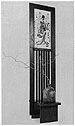 |
Japanese Print Exhibition
at The Art Institute of Chicago. Wright loaned over two hundred prints to an
extensive exhibition of Japanese Colour Prints from March 5-25, 1908, at The
Art Institute of Chicago, titled
A Loan Exhibition of Japanese
Colour Prints. The committee in charge, and major contributors, were
Clarence Buckingham, Frederick W. Gookin, J. Clarence Webster and Frank
Lloyd Wright. It was the largest exhibit of Ukiyo-e prints ever displayed in
America. Wright designed the exhibition installation for the Art Institute.
Included with the designs for the exhibition was a Japanese Print Easel or
Stand. The print was held in a tall vertical frame that intersected the
base, and floated above the surface it was placed on. The low base was
designed to hold a small vase for flower arrangements or other decorative
items. The overall design was very consistent with Wright's prairie style.
Although very vertical in appearance, this first Print Stand appears to be
about three feet in height and was designed to be placed off the ground at
eye level. 5.75 x 9.75 B&W print. For more information see our
Wright Study on the Japanese
Print Stand. |
0085.18.1211 |
1908
 |
Darwin D. Martin Residence Reception Room,
Buffalo, New York, Circa 1908 (S.100 - 1904). Designed by Frank Lloyd Wright
in 1904. Two barrel armchairs are seen on the left and right. Crafted from
solid oak, the chair features a backrest formed by vertical, slatted wooden
spindles that rise from the base to meet a solid, curved crest rail,
creating its distinctive semi-circular "barrel" shape. The seat is circular
and upholstered in either fabric or leather. The seat cushion is circular,
shaped like a disk, and is elevated above and below the seat in equal
proportions. The ends of the arms slope gently upward.
This photograph was published in the March 1908 issue of Architectural
Record. Also published in Frank Lloyd Wright Ausgefuhrte Bauten, Wright,
1911, p.51, and in Frank Lloyd Wright Chicago, Wright, 1911, p.34. Also
published in FLW’s Martin House, Quinian, 2004, p.166-167. Photographed by
Henry Fuermann. 10 x 8 B&W photograph. |
0085.67.0626 |
1908
 |
Darwin D. Martin Residence Living Room,
Buffalo, New York, Circa 1908 (S.100 - 1904). Designed by Frank Lloyd Wright
in 1904. Two barrel armchairs are seen on the left and right. Crafted from
solid oak, the chair features a backrest formed by vertical, slatted wooden
spindles that rise from the base to meet a solid, curved crest rail,
creating its distinctive semi-circular "barrel" shape. The seat is circular
and upholstered in either fabric or leather. The seat cushion is circular,
shaped like a disk, and is elevated above and below the seat in equal
proportions. The ends of the arms slope gently upward.
This photograph was published in Frank Lloyd Wright Ausgefuhrte Bauten,
Wright, 1911, p.53, and in Frank Lloyd Wright’s Martin House, Quinian, 2004,
p.137. Photographed by Henry Fuermann. 10 x 8 B&W photograph. |
0085.68.0626 |
Circa
1908
 |
Darwin D. Martin Residence Fireplace
Circa 1908 (S.100 - 1904). Frank
Lloyd Wright designed the Martin Residence in 1904. This photograph
was first published in the March 1908 issue of
Architectural Record. Of the
Husser fireplace mosaic, Spencer wrote, "Mr. Wright as architect, Miss Ostertag as artist, and Mr. Giannini as craftsman and burner of remarkable
enamels, have cooperated to show what may be conceived and executed here
above and beyond precedent."
Architectural Review, June 1900, Robert C.
Spencer, Jr. At the same time, Pattison wrote of the same fireplace, "Frank
Lloyd Wright, architect, is responsible for the creation of the innovation,
and Orlando Giannnini invented the new glass work... The motive use by Miss
Ostertag is based on the study of the wisteria vine in blossom." The
Art-Interchange, June 1900, James William Pattison. The three collaborated
again on the... Continue...
See our study of the Husser and Martin
fireplaces...
|
0085.41.1018 (A-C) |
1908/1905
 |
Darwin D. Martin
Gardener’s Cottage, Buffalo, New York, Floor Plans 1905/1908 (FLLW #0530.01)
(1905 - S.090). Sheet 1: Basement, First and Second Floor plans for the
Darwin Martin Gardener’s Cottage. Designed originally by Frank Lloyd Wright
in November 29, 1905, plans were revised in May 1908.
The Darwin D. Martin Complex consisted of the Residence, Pergola,
Conservatory and Carriage House (1904), the Gardener’s Cottage (1905) and
the George Barton Residence (1903). In 1927, twenty-three years after, Frank
Lloyd Wright designed a smaller complex, the Isabel & Darwin Martin Summer
Residence, Graycliff (S.225-226).
Text lower left:
“0530.01.” Text lower right: “Gardener's Cottage. D. D. Martin, Buffalo, New
York. Frank Lloyd Wright Architect. Oak Park, Illinois. Nov.29-1905. Revised
May 1908.” Courtesy of the Frank Lloyd Wright Archives, Avery Library,
Columbia University. 10 x 8 Color photograph. |
0085.65.1125 |
1908/1905
 |
Darwin D.
Martin Gardener’s Cottage, Buffalo, New York, Elevations 1905/1908 (FLLW
#0530.02) (1905 - S.090). Sheet 2: South, West, Noth and East Elevations for
the Darwin Martin Gardener’s Cottage. Designed originally by Frank Lloyd
Wright in 1905, plans may have been revised in 1908.
The Darwin D. Martin Complex consisted of the Residence, Pergola,
Conservatory and Carriage House (1904), the Gardener’s Cottage (1905) and
the George Barton Residence (1903). In 1927, twenty-three years after, Frank
Lloyd Wright designed a smaller complex, the Isabel & Darwin Martin Summer
Residence, Graycliff (S.225-226).
Text lower left:
“0530.02.” Text lower right: “2.” Courtesy of the Frank Lloyd Wright
Archives, Avery Library, Columbia University. 10 x 8 Color photograph.
|
0085.66.1125 |
1908
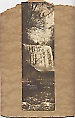 |
Photo of
Minnehaha Falls. F.L. Wright Photo, St. Paul. Copyright 1908.
Not a Frank Lloyd Wright photograph. |
1908.00.1201 |
1908
 |
Ingwald Moe
Residence, Gary, Indiana, Map 1908 (1909 - FLLW #0531). The Sanborn Fire
Insurance Map for the City of Gary, Indiana, published in December, 1908
shows a vacant lot on the Northeast corner of 7th and Van Buren Street. The
Moe House was built on the Southwest corner of Block 53. Sanborn Maps
published in January 1911 includes the footprint of a two-story house with a
one-story partially covered porch. Published December, 1908 by the Sanborn
Map Company, New York. Sheet 1 of 12 sheets. By comparing the map published
in December, 1908 to the map published in January 1911, it confirms that the
Ingwald Moe house was constructed during 1909-1910. The Inwald Moe House was
designed by Frank Lloyd Wright in 1905/1908-9, and most likely plans from
the Evanston Model Housing Project. Courtesy of the Library of Congress. 8 x
9.5 Color photograph. |
0085.56.1123 |
1908
 |
Ingwald Moe
Residence, Gary, Indiana, Map 1908 (1909 - FLLW #0531). The Sanborn Fire
Insurance Map for the City of Gary, Indiana, published in December, 1908
shows a vacant lot on the Northeast corner of 7th and Van Buren Street. The
Moe House was built on the Southwest corner of Block 53. Sanborn Maps
published in January 1911 includes the footprint of a two-story house with a
one-story partially covered porch. Published December, 1908 by the Sanborn
Map Company, New York. Sheet 5 of 12 sheets. By comparing the map published
in December, 1908 to the map published in January 1911, it confirms that the
Ingwald Moe house was constructed during 1909-1910. The Inwald Moe House was
designed by Frank Lloyd Wright in 1905/1908-9, and most likely plans from
the Evanston Model Housing Project. Courtesy of the Library of Congress. 8 x
9.5 Color photograph. |
0085.57.1123 |
Circa 1908
 |
Robie House, Dining Room, Dining
Table and Six Chairs (1906 S.127) Circa 1908. Label pasted to verso: "Frank
Lloyd Wright, Interior view of Dining Room - 1908. Title: Dining table & six
side chairs in interior of the Frederick C. Robie House, Chicago. Medium:
Oak. Exhibition: The Arts & Crafts
Movement in America 1876-1916. Date of Exhibition: Feb 24 - April
22, 1973. Lender's name as it should appear: Lent by the university of
Chicago." Published in the Chicago Tribune February 18, 1973 and October 12,
1986. Originally published in "Frank
Lloyd Wright Ausgefuhrte Bauten", Wright, 1911. Possibly
photographed by Henry Fuermann & Sons. Acquired from the archives of the
Chicago Tribune. Original 10 x 8 B&W photograph. |
0085.19.1211 |
Circa
1908
 |
Robie House, Chicago, Illinois, Circa 1908
(1906 - S.127). Robie House, Dining Room, Dining Table and Six Chairs.
Designed by Frank Lloyd Wright in 1906. Text on sleeve: "Wright, F. L. -
Robie House, 5-13. Robie House. Int., dining room. Chicago, IL., USA.
1908-9. Wright, Frank Lloyd. U of Virginia FAIC." Acquired from the archives
of the University of Virginia. 35mm Color slide, sandwiched between glass,
plastic mount. |
0085.50.0720 |
Circa 1908
 |
Unity Temple (1904 - S.096), Oak
Park Circa 1908. Unity Temple during construction, nearing completion.
Construction material along Lake Street. Viewed from the Southwest, Unity
Temple is on the left, Unity House is on the right, and the Entrance is in
the center. Lake Street is on the left, North Kenilworth Avenue in the
foreground. Courtesy of the Frank Lloyd Wright Preservation Trust. Original
10 x 6.7 B&W photograph. |
0085.21.0112 |
1908
 |
Unity Temple (1904 - S.096), Oak
Park 1908. Unity Temple after completion of construction. Viewed from the
Northwest, Unity Temple is on the left, Unity House is on the right, and the
Entrance is in the center. Lake Street is on the left, North Kenilworth
Avenue in the foreground. Courtesy of the Art Institute of Chicago. 10 x 8
B&W photograph. |
0085.32.0914 |
C
1908
 |
Unity Temple, Oak Park Circa 1908 (1904 -
S.096). Copy of the photograph published in
Frank
Lloyd Wright Ausgefuhrte Bauten, 1911, p.11. Viewed from the Northeast,
the exterior of Unity Temple's main sanctuary. Lake Street is in the
foreground, North Kenilworth Avenue is on the right. Lake Street is made of
brick. The pedestal on the far left has been constructed, but the large urn
has not yet been placed on top. Original 16 x 20 B&W photograph. |
0085.39.0218 |
1908
 |
Burton J.
Westcott Residence, Springfield, Ohio, Circa 1908 (1907 - S.099).
Perspective view of the Westcott Residence from the Southeast. Designed
by Frank Lloyd Wright in 1907. Westcott purchased the lot in July, 1907.
“On October 7, 1907, The Springfield Gazette reported: “The foundation
is being laid for a new residence for Burton J. Westcott at the corner
of High Street and Greenmount Avenue.” Frank Lloyd Wright’s Westcott
House in Springfield, Siek, Ohio History, Summer 1978, p.282. Siek
indicated that the Westcotts moved into their house in 1909, but was not
completed until 1911. Taken near the completion of the home. The large
exterior vases on the terrace have not been installed nor the awnings
over the veranda. The second floor "Veranda" (balcony) has not been
enclosed. The home to the West (left), 1330 E. High Street has not been
constructed. It is visible in the photograph dated circa 1912
(S#0114.06). There are three trees in the front of the house, and in
1912, the two larger threes have been removed, and the center tree has
matured. Courtesy of the Clark County Historical Society, which dates
this image 1908. 10 x 4 B&W photograph. |
0085.59.0324 |
1908
 |
Wright at 41.
Circa 1908. Portrait of Wright slightly facing to the right. Hair has
just a touch of gray. May have been photographed at the same one dated
1905 (Wright at 38).
Published in
Frank
Lloyd Wright Collected Writings
Volume 1, Pfeiffer, page 2. Also published in
Frank
Lloyd Wright Monograph 1907-1913
(3), Pfeiffer, 1991, page v, and dated 1908 by Bruce Brooks Pfeiffer.
Many
Masks Gill, 1987, page 180. 7 x 8.2 B&W
photograph, |
0064.02.0609 |
1908
 |
Wright at 41.
Circa 1908. Portrait of Wright facing to the right, looking at the
camera. Very similar to
S#64.02, but his head is turned a little more to the right, and
sitting up a little straighter. Hair has just a touch of gray. Hand
written on face: "Frank Lloyd Wright." Hand Written on verso: "Frank at
time he met Mamah Borthwick Cheney - his first soul mate - who was
murdered. Frank Lloyd Wright." Edwin Cheney commissioned Wright to
design them a home in 1903. In 1909, Mamah and Wright left their
respective spouses and traveled to Europe, settling in Italy for about a
year. Upon their return, they settled at Taliesin in Spring Green,
Wisconsin. On August 15, 1914, one of Wright's recently hired domestic
workers murdered Mamah, both her children, three of Wright's associates,
and a son of one of the associates. May have been photographed at the
same one dated
1905. Stamped on verso: "Filed Jun 21
1932." Original 8 x 10 B&W photograph. |
0085.38.0218 |
|
1909 |
1909
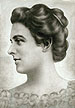 |
Mamah Borthwick
Cheney, Circa 1909 (June 19, 1869 - August 15, 1914). Mrs. E. H. (Mamah
Borthwick) Cheney. Chicago Tribune Photograph. Published in the Chicago
Tribune on August 6, 1911 at the time of her divorce and in 1914 at the time
of her death. Courtesy of the Wisconsin Historical Society. Published in
Frank
Lloyd Wright A
Biography, Secrest,1992, page 196. Caption: "The only known
photograph of Mamah Borthwick Cheney, published in the Chicago Tribune at
the time of her murder, in 1914." 4.25 x 6 Print, High res digital image. |
0085.05.0509 |
C
1909
 |
William Storrs MacHarg (McHarg) House,
Chicago, Illinois, Circa 1909 (Not Dated) (1891 - S.10). View of the MacHarg
Residence from the street. Designed by Frank Lloyd Wright in 1891 while
working for Louis Sullivan. Many of the residential designs that came to
Adler and Sullivan, were turned over to Wright. But Grant Manson believes
that this was one of the first "Bootlegged" houses, designed by Wright
during that period. Demolished around 1926. Very few photographs exist of
the MacHarg Residence, and this may be the only image to exist. According to
The American Architect and Building News, April 1893, MacHarg was the Chief
Engineer in Chicago for water, sewage and fire-protection, and oversaw much
of the related construction in Chicago. He was also part of the management
team for the Chicago World's Columbian Exposition in 1893. There was another
connection between MacHarg and Wright. In 1894 Frank Lloyd Wright designed a
house for William Winslow (S.024). In 1895 Wright designed the Francisco
Terrace (S.030) and Waller (S.031) Apartments for Edward Waller. In 1895
Wright worked with Winslow and Chauncey Williams, two of his clients, and
designed the title page for The Eve of St.
Agnes. Beginning in 1896, Wright worked with Winslow designing and
publishing... Continue...
|
0086.28.0620 |
1909
 |
Ingwald Moe Residence,
Gary, Indiana, Perspective Drawing 1909 (1909 - FLLW #0531). Perspective
presentation drawing of the Moe Residence by Marion Mahony. Designed by
Frank Lloyd Wright in 1905/1908-9, and most likely plans from the Evanston
Model Housing Project. The exterior walls of the house are covered in
plaster and extends up to the roof line. When this drawing was rediscovered,
it was initially credited to be the Charles Brown House because of the
similarity. It was nearly a complete match. Christopher Meyers writes: “In
the summer of 1996, I had the pleasure to confirm a perspective drawing from
the business portfolio of Marion Mahony as the Moe residence... The drawing
was originally accredited to be the Charles Brown House. Mahony's
perspective denotes a stucco structure on a large corner lot. The Charles
Brown House is not on a corner lot rather it is located mid-block and
possesses a wooden board and batten first floor. Rather Mahony's rendering
illustrates the Moe residence, on the corner of 7th and Van Buren,
possessing a hipped roof, broad projecting eaves, inset banding, double hung
art glass windows, a front veranda with a cantilevered roof, and as being
amply landscaped...” Christopher Meyers continues, “669 Van Buren is a
precise realization... Continue...
|
0086.34.1123 |
1909
 |
Scoville Park Fountain, Oak Park
(1903 S.094) 1909. Published in the Chicago Daily News in 1909. Taken by a
Chicago Daily News photographer. Erected by the Oak Park Horse Show
Association. Dedicated and presented to the Village July 24, 1909.
Photographed and first published after the presentation. Note height of
horse trough. Plants growing on top. Wrought iron fence beyond fountain.
Home is visible in the background. 8.25 x 6 Print. High res digital image. |
0086.04.0310 |
1909
 |
Oscar Steffens Residence, Chicago, Illinois,
First Floor Plan, 1909 (1909 - S.153). Floor plan for the first level of the
Steffens Residence. Designed by Frank Lloyd Wright in 1909. The Living Room
windows were originally designed to run from floor to ceiling, but
alterations created a bay, with the top lining up with the base of the upper
clerestory windows. Spindled screens on either side of the Living Room added
a measure of privacy. The exterior balcony lowered the ceiling on either
side, creating a space with a space. With built-in seating, this feature is
reminiscent of the Usonian Living Rooms Wright designed decades later. From
the corner of Sheridan and Rogers, the entrance to the home was hidden. Upon
entering the home when you turned left (North) and walked past the Living
Room and centralized Fireplace, a double set of doors lead out to an
enclosed covered porch, with a built-in Planter. The stairs across from the
Entrance lead to the second floor. To the right (South) was the Dining Room.
A spindled screens enclosed the stairway, adding a sense of privacy. As you
pass through the Dining Room, you enter the Kitchen. Passing through the
Kitchen allowed access to the utility rooms and the enclosed rear Porch.
Stairs lead down to an enclosed Rear Porch, and additional stairs to the
Utility... Continue... |
0086.37.1225 |
1909
 |
Oscar Steffens Residence, Chicago,
Illinois, Second Floor Plan, 1909 (1909 - S.153). Floor plan for the second
level of the Steffens Residence. Designed by Frank Lloyd Wright in 1909. As
you reach the top of the stairs, turn left and you enter the Balcony which
overlooks the Living Room. On either side of the balcony, doors lead out to
an exterior Balcony with built-in planters. Bedrooms and the Bath were
reached by turning right at the top of the stairs. A row of art glass
clerestory windows were recessed just beneath the roof line. Courtesy of
"Frank Lloyd Wright, Ausgeführte Bauten (Executed Buildings)", 1911.
Modified by Douglas M. Steiner. 8 x 10 B&W photograph. |
0086.38.1225 |
1909


 |
Oscar Steffens Residence, Chicago,
Illinois, West Elevation / Windows, 1909 (1909 - S.153). Detail of Sheet 4,
West Elevation 1963. Lower Level: The covered Porch is on the far left, the
Living Room in the center, the entrance just to the right, and the Dining
Room is on the far right. Upper Level: The Master Bedroom is on the far
left, the upper portion of the Living Room is in the center, with an
exterior balcony on either side. A set of doors on either side lead from the
interior Balcony to the exterior Balcony. The Bedrooms are on the far right.
The Living Room windows were originally designed to run from floor to
ceiling (see below), but alterations created a bay, with the top lining up
with the base of the upper clerestory windows. Other alterations included
reducing the number of windows on the upper level and narrowing the
fireplace chimney.
Addition of living room windows. Salvaged windows, saved from destruction
and vandalism have survived and maintained by collectors. We inserted
examples of the living room and celestory windows. Modified and recreated by
Douglas M. Steiner. 8 x 10 B&W photograph. |
0086.39.1225 |
1909
 |
George C. Stewart Residence First
Floor Plan, Montecito, California, 1909 (1909 - S.160). Photograph of
original drawing in the Frank Lloyd Wright Archives. Designed by Frank Lloyd
Wright in 1909 and built in 1910. It was Wright's first house and the only
Prairie styled house built in California. FLLW Foundation #0907. Text on
face: "Summer Cottage For Mr. George C. Stewart, Santa Barbara, California.
Frank Lloyd Wright Architect. Oak Park, Illinois. First Floor Plan." In
1910, Frank Lloyd Wright included the Stewart Residence in his Ausgefuhrte
Bauten und Entwurfe von Frank Lloyd Wright,
Plate XLIIIa. Published in
Wright,
1885-1916, Pfeiffer, 2011, p.368. Also
published in
Frank Lloyd Wright
Monograph 1907-1913, Pfeiffer, 1991,
p.112. Original 8 x 10 B&W photograph. |
0086.25.1219 |
1909
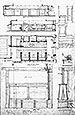 |
Thurber Art Galleries Elevations and Plans
1909 (1909 - S.154). Elevations, plan and details of the furniture for the
Thurber Art Galleries designed by Frank Lloyd Wright in 1909. Top left:
"Elevation of South Wall of East Room. Elevation of North Wall." Top right:
"Chair. Bench Stool. Bench." Center: "Plan of East Room." Text center right:
"Thurber's Art Galleries. Fine Arts Building, Chicago. Frank Lloyd Wright,
Architect. Oak Park, Illinois., June 23, 09." Bottom left and right: "Elevation. Detail of Stall. Elevation and Stall." Frank Lloyd Wright
Foundation #0911.001. Courtesy of the Frank Lloyd Wright Archives, Avery
Architectural Library. 8 x 10 B&W photograph. |
0086.32.0622 |
C 1909
 |
Thurber Art Galleries (1909 -
S.154), circa 1909. View of the smaller Viewing Gallery looking toward the
Southwest. The woodwork was of fumed oak, with bronze worked into the grain
and inlaid with a line of white holly. The floors were designed especially
to reflect the light, composed of white magnasite. Around the edge of the
floor was a band of dull yellow-toned magnasite, bringing the golden wall
color down into the floor. The two colors were divided by a narrow strip of
inlaid brass. The walls of both galleries were covered with cork gilded in a
low-toned bronze dadoed by a higher-keyed gilded rough plaster. Each gallery
had a skylight, composed of oblong pieces of dull grayed white glass, with
smaller oblong pieces of rich yellow and a few small squares of black, set
in brass leadings of various widths, and were different in each gallery. The
furniture was designed by Wright. Photographed by Published in
"International Studio", February, 1910. 10 x 7.4 B&W Print.
For more information see
our Wright Study on the Thurber Art Galleries. |
0086.05.0911 |
C 1909
 |
Thurber Art Galleries (1909 -
S.154), circa 1909. View of the built-in portfolio booths in the larger
Print and Reproduction Gallery. They were seven and one-half feet high and
included viewing spaces, desks that fold up and down, drawer spaces, and
innovative viewing portfolio screens that slid up and down within the wall
on the right. There were no fixtures of any sort. Electric lights were
concealed in the portfolio booths, so that the source of light was hidden
and diffused. The furniture was designed by Wright. Published in
"International Studio", February, 1910. 10 x 7.6 B&W Print.
For more information see
our Wright Study on the Thurber Art Galleries. |
0086.06.0911 |
1909
 |
Edward C. Waller Bathing Pavilion,
Charlevoix, Michigan, Elevation and Plan 1909 (1909 - S.166). Side and Front
Elevations, Floor Plan. Windows run the entire periphery of the pavilion.
Designed by Frank Lloyd Wright in 1909. Text center left: "Mr. E. C. Waller.
Bathing Pavilion. Charlevoix, Mich. Frank Lloyd Wright, Architect. Oak Park,
Illinois. June 10, 1909." Hand written lower left: "0916.01." Edward C.
Waller was a successful Chicago Businessman, real estate developer and an
early client and patron of Frank Lloyd Wright. One of his projects was a
2,000 acre parcel of land on Lake Michigan, just north of Charlevoix, and
ran half way Petosky. Immediately North of Charlevoix there is still a Road
named Waller that runs a little over half a mile. In 1902 Wright created two
designs for a large summer house on the property (FLLW #0212 and #0310).
Neither was built. In 1909 Wright designed a Bathing (swimming) Pavilion on
the property. Located on the beach, it provided a large common area with
fireplace, separate bath/changing room and lounge for men and women. Behind
the fireplace was a kitchen. The front of the building had a large veranda,
balance on either side by large concrete urns. It was demolished in 1922-23
by fire. Courtesy of the Frank Lloyd Wight Foundation. 10 x 6.75 B&W
photograph. |
0086.30.0521 |
1909
 |
Edward C. Waller Bathing Pavilion,
Charlevoix, Michigan, Elevation and partial Plan 1909 (1909 - S.166). Side
and Front Elevations, partial Floor Plan. Windows run the entire periphery
of the pavilion. Designed by Frank Lloyd Wright in 1909. This plan appears
to have enlarged the building. Stairs and a doorway were added on both
sides, leading to the common area. The veranda also appears to be enlarged.
Wright may have presented both versions at the same time. Comparing the
plans to the photograph, it appears this is the plan that was chosen. Text
center left: "Mr. E. C. Waller. Bathing Pavilion. Charlevoix, Mich. Frank
Lloyd Wright, Architect. Oak Park, Illinois. June 10, 1909." Edward C.
Waller was a successful Chicago Businessman, real estate developer and an
early client and patron of Frank Lloyd Wright. One of his projects was a
2,000 acre parcel of land on Lake Michigan, just north of Charlevoix, and
ran half way Petosky. Immediately North of Charlevoix there is still a Road
named Waller that runs a little over half a mile. In 1902 Wright created two
designs for a large summer house on the property (FLLW #0212 and #0310).
Neither was built. In 1909 Wright designed a Bathing (swimming) Pavilion on
the property. Located on the beach, it provided a large common area with
fireplace, separate bath/changing room and lounge for men and women. Behind
the fireplace was a kitchen. The front of the building had a large veranda,
balance on either side by large concrete urns. It was demolished in 1922-23
by fire. Courtesy of the Frank Lloyd Wight Foundation. 10 x 6.75 B&W
photograph. |
0086.31.0521 |
C
1909
 |
Chauncey L. Williams Residence, River
Forest, Illinois, Circa 1909 (1895 - S.033). In 1895 Chauncey Williams hired
Frank Lloyd Wright to design a home for him in Oak Park (now River Forest).
Chauncey L. Williams Residence viewed from the East. The octagonal Library
is on the left, entrance is in Viewed from the South. Copy phonograph of
image published in "Frank Lloyd Wright
Ausgefuhrte Bauten," Wright, 1911, p.22. Photographed after the dormers
which were remodeled in 1900. Other changes made since 1895, down spouts
have been added, as well as the diamond shaped vents in the brick just below
the Living Room windows as well as a fourth next to the down spout on the
right. The massive brick chimneys slice into the roof line. As the chimney
extends down it cuts through the roof and ties into the Roman brick that
runs beneath the window sills. The brick also extends past the rear of the
house forming a terrace. The wall of the terrace is patterned by rows of
matching diamond shapes. 10 x 6.75 B&W photograph. |
0086.21.1019 |
|
|
1910 |
1910
 |
Ausgefuhrte Bauten und Entwurfe von
Frank Lloyd Wright, Tafel XL (40). "Workmen's
Cottages for Mr. E, C. Waller, Chicago, Ill.
Suurban Cottage for Miss Grace Fuller, Glencoe, Ill." The Larkin Company
Workmen's Row Housing Project, 1904, was designed by Frank Lloyd Wright as
low-cost rental housing, each brick row house was a laid out as a duplex.
The project was never completed, and in 1910 Wright resurrected it and
included it in "Ausgefuhrte
Bauten und Entwurfe von
Frank Lloyd Wright, " the Wasmuth Portfolio, Tafel XL, and titled it "Workmen's Cottages for
Mr. E. C. Waller, Chicago, Ill." Frank Lloyd Wright Foundation Number 0408.
8 x 10 Color photograph. |
0087.40.0518 |
1910
 |
Frank J. Baker Residence, Wilmette,
Illinois Circa 1910 (1909/1920 - S.151). View of the South elevation from
across the street. The Living Room is on the left, the Entrance is to the
right of the Living Room. The Dining Room is in the center. The covered
Porch is to the right. It is not enclosed, and the Southeast corner of the
roof is cantilevered. The garage can be seen in the background on the right.
Curbs and sidewalks have been installed. The street is constructed of brick.
Designed by Frank Lloyd Wright in 1909, it is somewhat similar in style to
the Roberts (1908 - S.150) and Davidson (1908 - S.149) Residences, the
Living Room stands a story and a half. A long covered porch is on either end
of the house. Wright's first design for the Baker Residence in 1908 was very
similar to the Beachy Residence. In 1908, Wright also designed a similar
house for William Norman Guthrie, which was never realized. Wright modified
the Guthrie design in 1909 and it became the second design proposal for the
Baker Residence . Although built as the Baker Residence, Wright included it
in the Wasmuth Portfolio, Ausgefuhrte Bauten
und Entwurfe von Frank Lloyd Wright, Tafel LXI (61),
"Perspective view of the dwelling for William Norman Guthrie." Text bottom
left: "3495." Published in
Frank Lloyd Wright Ausgefuhrte
Bauten, Wright, 1911, p.96, and
Frank Lloyd Wright,
Chicago, Wright, 1911, p.83.
Photographed by Henry Fuermann. Courtesy of The Art Institute of Chicago. 10
x 8 B&W photograph. |
0094.70.0120 |
1910
 |
Frank J. Baker Residence, Wilmette,
Illinois Circa 1910 (1909/1920 - S.151). View of the East elevation. The
Covered Porch is on the left. The Kitchen is in the center. The Bedrooms are
on the upper level. Designed by Frank Lloyd Wright in 1909, it is somewhat
similar in style to the Roberts (1908 - S.150) and Davidson (1908 - S.149)
Residences, the Living Room stands a story and a half. A long covered porch
is on either end of the house. Wright's first design for the Baker Residence
in 1908 was very similar to the Beachy Residence. In 1908, Wright also
designed a similar house for William Norman Guthrie, which was never
realized. Wright modified the Guthrie design in 1909 and it became the
second design proposal for the Baker Residence . Although built as the Baker
Residence, Wright included it in the Wasmuth Portfolio, Ausgefuhrte Bauten
und Entwurfe von Frank Lloyd Wright, Tafel LXI (61),
"Perspective view of the dwelling for William Norman Guthrie." Text bottom
left: "3497." Photographed by Henry Fuermann. Courtesy of The Art Institute
of Chicago. 10 x 8 B&W photograph. |
0094.71.0120 |
1910
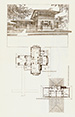 |
George Barton Residence, Buffalo, New
York, Wasmuth Portfolio, Plate 26, 1910 (1903 - S.103). Perspective, first
and second floor plans published in the Ausgefuhrte
Bauten, 1910,
Plate XXVI (26),
“Masonry dwelling for Mr. Martin, Buffalo, N.Y. Adjoining the
Darwin D. Martin residence. A building
in the larger Martin group, occupied as a separate residence. A type of
floor plan originated in the Walser house at Austin. The main floor is one
large room, with entrance and porch at one side, and stair and kitchen on
the other.“ Designed by Frank Lloyd Wright in 1903.
From Summit Avenue, the sidewalk leads to the front stairs. Turning 90
degrees, the stairs lead up to the front terrace. 90 degrees once again, and
the front door leads you into the entry hall. Once in the entry hall,
turning left leads out to the porch, and right to the dining, living and
library. Past the stairs, which leads to the second level, is the kitchen.
Upstairs are four bedrooms and a bath. 6.75 x 10 Color photograph.
|
0094.112.1124
(A-D) |
1910
 |
George Barton Residence, Buffalo, New
York, First Floor Plan 1910 (1903 - S.103). Copy of the first floor plan
published in the Ausgefuhrte
Bauten, 1910, Plate XXVI (26), "Masonry dwelling for Mr. Martin,
Buffalo, N.Y. Adjoining the Martin residence." Frank Lloyd Wright designed
the Barton Residence in 1903. Text on sleeve: "A-20-Wr-92-1. Wright. Barton
House. Plan: First floor." Acquired from the archives of the University of
Virginia. 35mm Color slide, sandwiched between glass, plastic mount.
|
0094.85.0720 0094.86.0720 0094.87.0720 |
Circa 1910
 |
Peter A. Beachy Residence, Oak
Park (1906 - S.117) Circa 1910. View of the exterior front looking East.
Frank Lloyd Wright remodeled the James Fargo House to create the Prairie
styled Beachy Residence. Little remains of the original structure. The
Entrance is on the left side of the home. The Living Room is in the
foreground on the first level. The master Bedroom is directly above the
Living Room. Built-in planters are to the left and right of the front.
Photographed between 1906 and 1916 by J. W. Taylor. Original 10 x 8 B&W
Photograph. Acquired from The Art Institute of Chicago, Ryerson & Burnham
Archives. |
0094.29.0613 |
C 1910
 |
George Blossom Residence, Chicago Circa 1910
(1892 - S.014). View looking North. The Blossom Residence was designed in
1892, while he was still working for Sullivan, thus one of his "bootleg"
designs. Colonial Revival in design, the floor plan is nearly symmetrical. A
short wall, set between two sets of stairs, borders the sidewalk on the
South side. Semi-circular urns are set on both corners of the terrace. Curbs
have been installed, but the road still appears to be dirt. Courtesy of The
Art Institute of Chicago. 10 x 7.25 B&W photograph. |
0094.50.0517 |
C 1910
 |
George Blossom Residence, Chicago, Illinois,
Circa 1910 (1892 - S.014). View looking North. The Blossom Residence was
designed in 1892, while he was still working for Sullivan, thus one of his
"bootleg" designs. Colonial Revival in design, the floor plan is nearly
symmetrical. A short wall, set between two sets of stairs, borders the
sidewalk on the South side. Semi-circular urns are set on both corners of
the terrace. Curbs have been installed, but the road still appears to be
dirt. Photographed before dormer was added. Text on sleeve: "A-20-Wr-100-4.
Wright. Blossom House. Ext: Orig. side vw." Acquired from the archives of
the University of Virginia. 35mm Color slide, sandwiched between glass,
plastic mount. |
0094.88.0720 |
C 1910
 |
Charles A. Brown Residence, Evanston,
Illinois, Perspective Circa 1910 (1905 - S.110). Perspective view of the
Brown Residence viewed from the North. Designed by Frank Lloyd Wright in
1905. The front door faces the street, but is enclosed and partially
obscured from the street by a short wall. The exterior walls of the house
are board and batten, and extend up to the sills of the second floor
windows. The horizontal band of windows and stucco surrounds all four side
and extends to the roof line. The sills match the light color of the stucco.
The windows are trimmed in wood, and trim is also used to as a design
element between windows. A striking feature of the house is the roof that is
cantilevered over the veranda. Published in the October, 1913 issue of
House Beautiful,
p.134, and in Modern American Homes,
von Holst, 1913, plate 90. 7 x 5 B&W photographs. |
0094.103.1113 |
C 1910
 |
James Charnley Bungalow, Ocean
Springs, Mississippi, Circa 1910 (1890 - S.007). View of one of the Charnley
Bungalow from the Southwest. James Charnley was a wealthy lumber baron who
was a personal friend of Louis Sullivan. Frank Lloyd Wright was the chief
draftsman at the time for the architectural firm of Adler and Sullivan.
Designed in 1890 by Frank Lloyd Wright. In his autobiography, Wright wrote:
"With Silsbee, I had gained considerable light on the practical needs of the
American dwelling. Adler and Sullivan refused to build residences during all
the time I was with them. The few that were imperative, owing to social
obligations to important clients, fell to my lot out of office hours. They
would, of course, check up on them in good time. Sullivan's own home on Lake
Avenue (now demolished) was one of these, as were his southern house at
Ocean Springs and the house next door for the Charnleys. The city house on
Astor Street for the Charnleys, like the others, I did at home evenings and
Sundays in the nice studio draughting room upstairs at the front of the
little Forest Avenue home... In this Charnley city-house on Astor Street I
first sensed the definitely decorative value of the plain surface, that is
to say, of the flat plane as such. The drawings for the Charnley house...
Continue...
|
0094.101.0623 |
1910
 |
City National Bank and Park Inn Hotel,
Mason City, Iowa, Ground and Floor Plan 1910 (1909 - S.155-156). Set of 8 -
35mm slides. 1) Copy photograph of the Ground and Floor plan for the City
National Bank and the Park Inn published in
Ausgefuhrte
Bauten Plate IL (49T). Designed by Frank Lloyd Wright in 1909. Text on
sleeve: "Wright, F. L. - City National Bank, 1-1. City National Bank
Building and Hotel. Plan, ground floor of bank and hotel. Mason City, IA,
USA, 1909. Wright, Frank Lloyd. U of Virginia FAIC." Acquired from the
archives of the University of Virginia. 35mm Color slide, sandwiched between
glass, plastic mount.
|
0094.75.0510 - 0094.82.0510 |
1910/2025
 |
Avery Coonley Residence, Riverside,
Illinois, Adaptation from Ausgeführte
Bauten First Floor Plan. Plate LVIa (56a), 1910/2025 (1907 - S.135).
Adaptation of the first floor plan of the Coonley Residence published in the
Ausgeführte Bauten und Entwurfe von Frank Lloyd Wright, 1910. What Wright
labeled on the Coonley plans as the “Basement” was actually the ground
floor. The drive began at Bloomingbank Road, past the full length of the
house, which is 180 feet long, and exited onto Scottswood Road. It flowed
under two wings, the servants quarters, and the guest wing. The space under
the two wings form porte cocheres. The main entrance is under the first wing
and leads to the entrance hall on the ground floor. Stairs leading to the
first floor, the living space is on the left. Past the stairs on the ground
level is the playroom, which is directly below the living room. An addition,
just past the first wing was built on the drive, now forming a courtyard.
The upper level, the first floor is the living space: living and dining
rooms, kitchen, bedrooms, guest rooms and servants quarters. The concept,
the living space on the second level is similar to the Robie House designed
only one year earlier, in 1906. Adaptation by Douglas M. Steiner, 2025. 10 x
7.5 B&W photograph. |
0094.116.0425 |
C
1910
 |
1) Avery Coonley Residence, Riverside,
Illinois, Circa 1910 (1907 - S.135). View of the main entrance of the Coonley
Residence from the Northeast. Designed by Frank Lloyd Wright in 1907. The
main level is acturally the second floor. The Servant’s wing is on the left.
The dining room is on the right. The house is approached from the North,
down a long drive which is on the far right. Like many of Wright’s homes,
the main entrance is hidden from view. This is no exception. The drive runs
parallel to the right (East) elevation, through the porte cochere, seen in
the center. The five lower windows in the center flood the entrance hall on
the ground floor. It is interesting to note that there are no windows
perforating the patterned northern wall of the servant’s wing on the left.
Many windows were later added.
This was one of
seven photographs of the Coonley House published in
Architectural Record,
October. 1911. Caption: “Side Elevation - Residence of Avery Coonley, Esq.
Riverside, Ill. Frank Lloyd Wright, Architect.” Copy 10 x 7 B&W photograph,
courtesy of Architectural Record. |
0094.117.0425 |
C 1910
 |
2) Avery
Coonley Residence, Riverside, Illinois, Circa 1910 (1907 - S.135). West
elevation viewed from the Northwest. Designed by Frank Lloyd Wright in
1907. The Coonley’s daughter Elizabeth is standing by a tree. The Dining
Room is on the left, the pool is to the far right. The children’s
playroom is on the first level in the center. The main level was raised
to the upper level. The Living Room is in the center above the
children’s playroom. “The Coonley house is one of the great masterpiece
of all time. In it the architect has been given full reign to produce a
work in which every facet came from his own imagination, and produced a
unity we rarely see in the world of architecture.” Bruce Brooks
Pfeiffer,
Frank
Lloyd Wright Monograph 1907-1913,
1987/1991, p.2. Published in
Frank
Lloyd Wright Ausgefuhrte Bauten, Wright, 1911, p.119. Text lower
left: “77.”
Mounted to gray
board. Label pasted to board: “182, R52453, B13C, 41. Riverside,
Illinois. Coonley House. 1907-1908. Architect: Frank Lloyd Wright (1969-
). Label pasted to verso: Gift of the Carnegie Corporation.”
Photographed by Clarence Fuermann, The Chicago Architectural
Photographing Co. Acquired from the archives of the University of
Minnesota. Original 9 x 6.5 B&W Photograph. |
0085.48.0420 |
C 1910
 |
3) Avery Coonley
Residence, Riverside, Illinois, Circa 1910 (1907 - S.135). View of the West
elevation pool and terrace. Designed by Frank Lloyd Wright in 1907. The
dining room is to the far left. The living room and playroom beneath it are
in the center, the bedrooms are to the right. Avery and Queene Ferry Coonley
are on the right. Their daughter Elizabeth is playing by the pool in the
center. The upper level, the first floor is the living space: living and
dining rooms, kitchen, bedrooms, guest rooms and servants quarters. The
concept, the living space on the second level, is similar to the Robie House
designed only one year earlier, in 1906. Text lower left: “76.”
“The Coonley house is one of the great masterpiece of all time. In it the
architect has been given full reign to produce a work in which every facet
came from his own imagination, and produced a unity we rarely see in the
world of architecture.” Bruce Brooks Pfeiffer, Frank Lloyd Wright Monograph
1907-1913, 1987/1991, p.2. Label pasted to verso: “Photographed by Clarence
Fuermann, The Chicago Architectural Photographing Co.” Published in Frank
Lloyd Wright Ausgefuhrte Bauten, Wright, 1911, p.119. Original 10 x 8
B&W photograph. |
0085.20.0112 |
C 1910
 |
4) Avery
Coonley Residence, Riverside, Illinois, Circa 1910 (1907 - S.135). View
of the West elevation, pool and terrace. Designed by Frank Lloyd Wright
in 1907. The dining room is on the left. The living room and playroom
beneath it are in the center, the bedrooms are to the far right. The
upper level, the first floor is the living space: living and dining
rooms, kitchen, bedrooms, guest rooms and servants quarters. The
concept, the living space on the second level, is similar to the Robie
House designed only one year earlier, in 1906. Photographed at the same
time as
S#85.20.
“The Coonley house
is one of the great masterpiece of all time. In it the architect has
been given full reign to produce a work in which every facet came from
his own imagination, and produced a unity we rarely see in the world of
architecture.” Bruce Brooks Pfeiffer,
Frank
Lloyd Wright Monograph 1907-1913,
1987/1991, p.2. Photograph by Henry Fuermann. Published in
Frank
Lloyd Wright Ausgefuhrte Bautenn, Wright, 1911, p.117. Copy of the
photograph published in Frank
Lloyd Wright Ausgefuhrte Bauten, 1911, p.117. Also published in
House and Garden, October 1910,
p.231, which may have been the first time photographs of the Coonley
House were published. Photographed by Clarence Fuermann, The Chicago
Architectural Photographing Co. Original 16 x 20 B&W photograph. |
0085.40.0218 |
C 1910
 |
5) Avery Coonley Residence, Riverside,
Illinois, Circa 1910 (1907 - S.135). Detailed view of the West elevation,
terrace, looking toward the entrance to the interior corridor. Designed by
Frank Lloyd Wright in 1907. The living room and playroom beneath it are on
the left, the bedrooms are to the right. The upper level, the first floor is
the living space: living and dining rooms, kitchen, bedrooms, guest rooms
and servants quarters. The concept, the living space on the second level, is
similar to the Robie House designed only one year earlier, in 1906. Text
lower left: “6639.”
“The Coonley house is one of the great masterpiece of all time. In it the
architect has been given full reign to produce a work in which every facet
came from his own imagination, and produced a unity we rarely see in the
world of architecture.” Bruce Brooks Pfeiffer,
Frank
Lloyd Wright Monograph 1907-1913,
1987/1991, p.2. Photographed by Henry Fuermann. Published in Frank
Lloyd Wright Ausgefuhrte Bauten, Wright, 1911, p.122. Also
published in the
Architectural Record,
October. 1911, p.335. 8 x 10 B&W photograph. |
0094.118.0425 |
C 1910
 |
6) Avery Coonley Residence, Riverside,
Illinois, Circa 1910 (1907 - S.135). View of the West elevation master
bedroom dressing room. Designed by Frank Lloyd Wright in 1907. There are two
bedrooms to the left, the master bedroom and terrace are on the right. The
upper level, the first floor is the living space: living and dining rooms,
kitchen, bedrooms, guest rooms and servants quarters. The concept, the
living space on the second level, is similar to the Robie House designed
only one year earlier, in 1906. Text lower left: “88.”
“The Coonley house is one of the great masterpiece of all time. In it the
architect has been given full reign to produce a work in which every facet
came from his own imagination, and produced a unity we rarely see in the
world of architecture.” Bruce Brooks Pfeiffer,
Frank
Lloyd Wright Monograph 1907-1913.
1987/1991, p.2. Photographed by Henry Fuermann. Published in Frank
Lloyd Wright Ausgefuhrte Bauten, Wright, 1911, p.121. Also
published in the
Architectural Record,
October. 1911, p.334. 8 x 10 B&W photograph. |
0094.119.0425 |
C 1910
 |
7) Avery Coonley Residence, Riverside,
Illinois, Circa 1910 (1907 - S.135). View from the Southwest of the South
elevation. The master bedroom dressing room is on the left, The master
bedroom and terrace is in the center, the Guest wing is in the background on
the right. Designed by Frank Lloyd Wright in 1907. The upper level, the
first floor is the living space: living and dining rooms, kitchen, bedrooms,
guest rooms and servants quarters. The concept, the living space on the
second level, is similar to the Robie House designed only one year earlier,
in 1906. Text lower left: “85.”
“The Coonley
house is one of the great masterpiece of all time. In it the architect has
been given full reign to produce a work in which every facet came from his
own imagination, and produced a unity we rarely see in the world of
architecture.” Bruce Brooks Pfeiffer,
Frank
Lloyd Wright Monograph 1907-1913,
1987/1991, p.2. Photographed by Henry Fuermann. Published in Frank
Lloyd Wright Ausgefuhrte Bauten, Wright, 1911, p.124. Also
published in the
Architectural Record,
October. 1911, p.332. 8 x 10 B&W photograph. |
0094.120.0425 |
C 1910
 |
8) Avery Coonley Residence, Riverside,
Illinois, Circa 1910 (1907 - S.135). View of the South elevation guest room
wing. There are two guest bedrooms on the main (upper) level. The drive
began at Bloomingbank Road, at the far end, past the full length of the
house, which is 180 feet long, and exited onto Scottswood Road, behind the
camera. It flows under two wings, the servants quarters at the far end, and
the guest wing in the foreground. The space under the two wings form porte
cocheres. The main entrance is under the wing in the background. Designed by
Frank Lloyd Wright in 1907. Text lower left: “3252.”
“The Coonley house is one of the great masterpiece of all time. In it the
architect has been given full reign to produce a work in which every facet
came from his own imagination, and produced a unity we rarely see in the
world of architecture.” Bruce Brooks Pfeiffer,
Frank
Lloyd Wright Monograph 1907-1913,
1987/1991, p.2. Photographed by Henry Fuermann. 8 x 10 B&W photograph. |
0094.121.0425 |
C 1910
 |
9) Avery Coonley Residence, Riverside,
Illinois, Circa 1910 (1907 - S.135). View of the main house on the left, and
the servant’s wing in the background. Designed by Frank Lloyd Wright in
1907. The main entrance on the ground floor is under the first wing, to the
left of the pedestal and vase, and leads to the entrance hall. Stairs
leading to the first floor, the living space is on the left. Past the stairs
on the ground level is the playroom, which is directly below the living
room. The ground floor is used for storage and work spaces. The upper level,
the “first floor” is the living space: living and dining rooms, kitchen,
bedrooms, guest rooms and servants quarters. The concept, the living space
on the second level is similar to the Robie House designed only one year
earlier, in 1906.
The drive began at Bloomingbank Road, at the far end, past the full length
of the house, which is 180 feet long, and exited onto Scottswood Road,
behind the camera. It flows under both wings. The space under the two wings
form porte cocheres. Text lower left: “3447.”
“The Coonley
house is one of the great masterpiece of all time. In it the architect has
been given full reign to produce a work in which every facet came from his
own imagination, and produced a unity we rarely see in the world of
architecture.” Bruce Brooks Pfeiffer,
Frank
Lloyd Wright Monograph 1907-1913.
1987/1991, p.2. Photographed by Henry Fuermann. 10 x 8 B&W photograph. |
0094.122.0425 |
C 1910
 |
10) Avery Coonley Residence,
Riverside, Illinois, Circa 1910 (1907 - S.135). View of the guest wing
looking South from the main entrance. Designed by Frank Lloyd Wright in
1907. There are two rooms in guest wing. The drive began at Bloomingbank
Road, behind the camera, past the full length of the house, which is 180
feet long, and exited onto Scottswood Road, at the far end. It flows under
both wings. The space under the two wings form porte cocheres.
“The Coonley house is one of the great masterpiece of all time. In it the
architect has been given full reign to produce a work in which every facet
came from his own imagination, and produced a unity we rarely see in the
world of architecture.” Bruce Brooks Pfeiffer,
Frank
Lloyd Wright Monograph 1907-19133,
1987/1991, p.2. Photographed by Henry Fuermann. Published in Frank
Lloyd Wright Ausgefuhrte Bauten, Wright, 1911, p.123. 10 x 7.5
B&W photograph. |
0094.123.0425 |
C 1910
 |
11) Avery Coonley Residence,
Riverside, Illinois, Circa 1910 (1907 - S.135). View of the South elevation
master bedroom, terrace and guest room wing from the Southeast. The master
bedroom and terrace are on the left, the guest wing is on the right.
Designed by Frank Lloyd Wright in 1907. Today, the master bedroom terrace
has been enclosed and enlarged. The lower level of the guest wing has been
enlarged and converted to a two car garage. Text lower left: “6630.”
“The Coonley house is one of the great masterpiece of all time. In it the
architect has been given full reign to produce a work in which every facet
came from his own imagination, and produced a unity we rarely see in the
world of architecture.” Bruce Brooks Pfeiffer,
Frank
Lloyd Wright Monograph 1907-1913,
1987/1991, p.2. Photographed by Henry Fuermann. Published in Frank
Lloyd Wright Ausgefuhrte Bauten, Wright, 1911, p.120. Also
published in
House and Garden, October 1910,
p.230, which may have been the first time photographs of the Coonley House
were published. 10 x 8 B&W photograph. |
0094.124.0425 |
C 1910
 |
12) Avery Coonley Residence,
Riverside, Illinois, Circa 1910 (1907 - S.135). View of the guest wing, East
elevation and servant’s wing from the Southeast. The guest wing is in the
foreground on the left, the East elevation can be seen in the center. The
chimney in the background is the living room’s. The servant’s wing is on the
far right. Designed by Frank Lloyd Wright in 1907. The ground floor is used
for storage and work spaces. The upper level, the “first floor” is the
living space: living and dining rooms, kitchen, bedrooms, guest rooms and
servants quarters. The concept, the living space on the second level is
similar to the Robie House designed only one year earlier, in 1906.
“The Coonley house is one of the great masterpiece of all time. In it the
architect has been given full reign to produce a work in which every facet
came from his own imagination, and produced a unity we rarely see in the
world of architecture.” Bruce Brooks Pfeiffer,
Frank
Lloyd Wright Monograph 1907-1913,
1987/1991, p.2. Photographed by Henry Fuermann. Published in
Frank
Lloyd Wright Ausgefuhrte Bauten, Wright, 1911, p.123. Also
published in
Architectural Record,
October. 1911, p.336. 10 x 8 B&W photograph. |
0094.125.0425 |
C 1910
 |
13) Avery Coonley Residence,
Riverside, Illinois, Circa 1910 (1907 - S.135). View of the guest wing, East
elevation and servant’s wing from the Northeast. The guest wing is on the
far left, the East elevation is in the center. The servant’s wing is on in
the foreground on the right. The garden is in the foreground. Designed by
Frank Lloyd Wright in 1907. The ground floor is used for storage and work
spaces. The upper level, the “first floor” is the living space: living and
dining rooms, kitchen, bedrooms, guest rooms and servants quarters. The
concept, the living space on the second level is similar to the Robie House
designed only one year earlier, in 1906.
“The Coonley
house is one of the great masterpiece of all time. In it the architect has
been given full reign to produce a work in which every facet came from his
own imagination, and produced a unity we rarely see in the world of
architecture.” Bruce Brooks Pfeiffer,
Frank
Lloyd Wright Monograph 1907-1913,
1987/1991, p.2. Photographed by Henry Fuermann. 10 x 8 B&W photograph. |
0094.127.0425 |
1910
 |
Coonley Living Room (1907 -
S.135) Circa 1910. View of the right side. Copper Urn on the right.
Photographed by Henry Fuermann. 8 x 5.5 Print. High res digital image.
For more information see
our Wright Study on Browne's Bookstore. |
0094.09.0311 |
1910
 |
Coonley Living Room Circa 1910 (1907 -
S.135). View of the right side of the Living Room. Very similar to the view in Frank
Lloyd Wright Ausgefuhrte Bauten, Wright, 1911, p.124. A Wright designed Copper Urn
is on the right. This print was used by The University Prints. Cambridge,
Mass., for publishing "A Special
Study Set of Fine Art Reproductions" 1961, plate 81. Acquired from the
archives of The University Prints. Cambridge, Mass. Photographed by Henry
Fuermann. 8 x 5.5 Print. Original 10 x 4 B&W photograph. |
0094.53.0118 |
1910
 |
Coonley Living Room (1907 -
S.135) Circa 1910. View of the left side. Copper Urn on the left.
Photographed by Henry Fuermann. 8.5 x 6.5 Print. High res digital image.
For more information see
our Wright Study on Browne's Bookstore. |
0094.10.0311 |
1910
 |
Coonley Living Room Hall (1907 -
S.135) Circa 1910. Hallway viewed from Living Room. Photographed by Henry
Fuermann. 10 x 7.5 Print. High res digital image.
For more information see
our Wright Study on Browne's Bookstore. |
0094.11.0311 |
C 1910
 |
Coonley
Residence Living Room Hall Circa 1910 (1907 - S.135). Copy of the
photograph published in "Frank
Lloyd Wright Ausgefuhrte Bauten" p.125. Hallway viewed from Living Room.
One of two Wright designed Urns can be seen in the center. Photographed
by Henry Fuermann. Original 16 x 20 B&W photograph. |
0094.54.0218 |
C 1910
 |
Coonley Living Room Hall (1907 -
S.135) Circa 1910. Hallway looking toward Living Room. Two Urns were placed
symmetrically in the Living Room. Wright used this same symmetry in the
Waller Dining Room and possibly his own Dining Room. Photographed by Henry
Fuermann. 10 x 7.5 Print. High res digital image.
For more information see
our Wright Study on Browne's Bookstore. |
0094.12.0311 |
C
1910
 |
Avery Coonley Residence, Riverside,
IL, Living Room Hall Circa 1910 (1907 - S.135). View of the Living Room
Hall, from the Dining Room toward the Living Room. Two copper urns were
placed symmetrically in the Living Room, one can be seen on the left, the
other in the background in the center. Designed by Frank Lloyd Wright in
1907. A very similar view was illustrated in the
Ausgefuhrte
Bauten in 1910, Plate LVIa (56a), and
the same similar view was published in both
Frank Lloyd Wright Ausgefuhrte
Bauten, 1911, p.121, and Frank Lloyd
Wright Chicago, 1911, p.99. Stamped on verso: "Chicago Architectural Photo
Co.," and "Photographic Archive, Art History Department, University of
Minnesota." Hand written on verso: "F. L. Wright. The Avery Coonley House
(Gallery). Riverside, Illinois 1908." Photographed by the Chicago
Architectural Photographing Company, Chicago. Acquired from the archives of
the University of Minnesota. Original 10 x 8 B&W photograph. |
0094.72.0420 |
Circa 1910
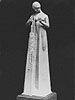 |
Dana-Thomas Residence (1902 -
S.072). Flower in the Crannied Wall Sculpture Circa 1910. The Dana-Thomas
House was designed by Frank Lloyd Wright in 1902 for Susan Lawrence Dana.
The back of the sculpture is inscribed with the following poem by Alfred
Lord Tennyson. "Flower in the crannied wall. I pluck you out of the
crannies. I hold you here, root and all, in my hand. Little flower" but if I
could understand. What you are, root and all, and all in all. I should know
what God and man is." Photographed by Frederick O. Bemm, who was a staff
photographer for the Art Institute of Chicago and later owned and operated a
studio. Original 5 x 6.5 B&W photograph. |
0094.28.0513 |
1910
 |
Grace Fuller House, Glencoe, Illinois (1906
- S.123). Tafel XL (40), Ausgefuhrte Bauten und Entwurfe von Frank Lloyd
Wright. Perspective, Ground and Floor Plans for the: "Workmen's Cottages for
Mr. E. C. Waller, Chicago, Ill. Suburban cottage for Miss Grace Fuller,
Glencoe, Ill." Published in 1910 by Ernst Wasmuth A.-G., Berlin. In 1910,
Frank Lloyd Wright published the Ausgefuhrte Bauten portfolio, Tafel (Plate)
XL which included The Workmen's Cottages for Mr. E. C. Waller, and a
Suburban Cottage for Miss Grace Fuller, Glencoe, Illinois. It included a
perspective of the Fuller House as well as the floors plans for the first
and second levels. There was no descriptive text for the Fuller house in the
introduction. Wright did not indicate if the house was ever built. 10 x 6.5
Color photograph. |
0087.40.0221 |
1910 / 1934
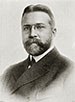 |
Arthur Heurtley Cottage Remodeling,
Les Cheneaux, Marquette Island, Michigan, Portrait Circa 1910 (undated)
(1902 - S.075). Portrait of Arthur Heurtley, facing slightly to the left,
looking straight ahead. Obituary for Arthur Heurtley, published in The Oak
Leaves, Oak Park, Illinois, September 20, 1934. Arthur Heurtley, one of Oak
Park's most prominent citizens until after the World War, died on Tuesday at
his country place near Muscatine, Ia., aged seventy-three years. Funeral
services will take place at Muscatine this afternoon (Thursday) and
interment will be at Chippiannock, Rock Island. Mr. Heurtley was
distinguished both in business and in movements for cultivation of arts,
especially music. He was among the first to employ the art of Frank Lloyd
Wright and the "Heurtley House" at 310 Forest, designed by Mr. Wright has
been pictured in architectural publications in Europe and Asia and has had a
wide influence on design.
In the
garden of this house is the oldest inhabitant of Oak Park, a great oak tree,
said to have lived a thousand years.
Mr. Heurtley became secretary of the
Northern Trust company in 1889 when it was organized and served in that
capacity until 1920 when he retired. He was born in Boston and came to
Chicago in 1881... Continue... |
0094.99.0523 |
C
1910
 |
P. D. Hoyt Residence, Geneva, Illinois,
South Elevation Circa 1910 (1906 - S.120). View of the Hoyt Residence from
the South. Designed by Frank Lloyd Wright in 1906. The Hoyt House is similar
in design to the Hunt and Stockman houses. In some respects a simplification
of the design used in Wright's "Fireproof"
House. Square in its footprint, it is constructed of stucco with wood trim.
The entrance is in the center of the front elevation and opens into the
living room. Unusual for Wright because he preferred concealing the
entrance. It appears very symmetrical in design. Another design element
unique to the Hoyt House is the letter "H" monogram repeated at the top
portion of every window. Wright emphasizes the vertical appearance with wood
strips that extend from the first to the second floors, and wrap around the
four corners. A trellis-arbor above the front door surrounds the entrance
with vegetation. The trellis was removed in 1917, but is still visible in
the photograph. Photographer unknown. Published in
Wright
1885-1916, Pfeiffer, 2011, p.266. Courtesy of the
Frank Lloyd Wright Foundation. 9 x 7.75 Color photograph. |
0094.89.0121 |
Circa 1910
 |
1) Stephen Hunt Residence I, LaGrange,
Illinois, Ground Plan 1910 (1907 - S.138). Copy of the ground plan published
in the Ausgefuhrte Bauten, 1910,
Plate XIVa (14a), Concrete house originally designed for Ladies' Home
Journal. The Hunt Residence is the best example of "A Fireproof House for
$5,000." Frank Lloyd Wright designed the Hunt Residence in 1907. Text on
sleeve: "Wright, F. L. - Hunt House I, 1-1. Stephen Hunt House I. Plan,
ground floor. La Grange, IL., USA. 1907. Wright, Frank Lloyd. U of Virginia
FAIC." Acquired from the archives of the University of Virginia. 35mm Color
slide, sandwiched between glass, plastic mount. |
0094.83.0720 |
Circa 1910
 |
2) Stephen Hunt Residence I, LaGrange,
Illinois, Upper Floor Plan 1910 (1907 - S.138). Copy of the upper floor plan
published in the Ausgefuhrte Bauten,
1910, Plate XIVa (14a), Concrete house originally designed for Ladies' Home
Journal. The Hunt Residence is the best example of "A Fireproof House for
$5,000." Frank Lloyd Wright designed the Hunt Residence in 1907. Text on
sleeve: "Wright, F. L. - Hunt House I, 1-2. Stephen Hunt House I. Plan,
upper floor. La Grange, IL., USA. 1907. Wright, Frank Lloyd. U of Virginia
FAIC." Acquired from the archives of the University of Virginia. 35mm Color
slide, sandwiched between glass, plastic mount. |
0094.84.0720 |
Circa 1910
 |
Joseph & Helen Husser Residence Circa 1910
(1899 - S.046). Photographic postcard of Buena Avenue East from Clarendon
Street. Although the Husser Residence is barely visible, hidden behind
vegetation, it does give an additional view of the house in proximity to the
lake. In Wright's drawings, he showed the lake in close proximity to the
house. Text written along the bottom "15067. Buena Ave. E. from Clarendon,
Chicago." Thank you Anthony Thompson for bringing this image to our
attention. 8 x 5 B&W photograph. |
0094.60.0419 |
Circa 1910
 |
Hillside Home School II circa 1910 (1902 - S.069). View from the
Southwest. A bridge is seen in the foreground. Ellen (Nell) and Jane
Lloyd Jones, Frank Lloyd Wright's aunts, formed the Hillside Home School
in 1887 and ran it until 1915 when it closed. The private school
accepted students between the ages of seven and seventeen. It espoused
non-conventional teaching methods, and was the first coeducational
school in the nation. After attending the University of Wisconsin,
Madison, Wright headed for Chicago in 1887 and accepted a position as
draftsman in the architectural firm of Joseph Lyman Silsbee. That year,
his Aunt's drafted him to design a school building for them, Hillside
Home School I, a large Shingle styled building, reflected the designs of
his mentor Silsbee, and in the style of his first project, Unity Chapel,
in Spring Green. As the school grew, so did the need for more space.
Wright designed Hillside Home School II in 1902, which was completed in
1903. (Plate X, Ausgefuhrte Bauten.) It eventually became part of the
Taliesin Fellowship complex. When Wright began the Taliesin Fellowship
in 1932, he began restoring and remodeling the building. Courtesy of the
Wisconsin Historical Society. 7 x 5 B&W photograph.
(See progression of the Hillside
Home School / Taliesin Complex) |
0094.36.1213 |
1910
 |
Hillside Home School II Floor Plan 1910 (1902 -
S.069). Photograph of Plate X (tissue), "Hillside Home School, Lloyd Jones
Sisters, Hillside Wisconsin. Floor Plan on the Main Floor." From the
Ausgefuhrte Bauten und Entwurfe von Frank Lloyd Wright. "Studies and
Executed Buildings". Published by Ernst Wasmuth A.-G., Berlin, 1910. Ellen
(Nell) and Jane Lloyd Jones, Frank Lloyd Wright's aunts, formed the Hillside
Home School in 1887. Wright designed Hillside Home School I in 1892 (1897 -
S.001). As the school grew, so did the need for more space. Wright designed
Hillside Home School II in 1902, which was completed in 1903. The building
was constructed of light rose colored sandstone, heavy oak beams and red
roof tiles. The gymnasium/theatre was on the left, two floors of classrooms
and offices in the center, and a three story assembly hall on the right.
Hillside Home School closed in 1915. When Wright began the Taliesin
Fellowship in 1932, it became part of the Taliesin Fellowship complex. 10 x
6 Color photograph.
(See progression of the Hillside
Home School / Taliesin Complex) |
0094.44.0215 |
1910
 |
Hillside Home School II Bird's-Eye View, 1910
(1902 - S.069). Photograph of Plate X, "Hillside Home School, Lloyd Jones
Sisters, Hillside Wisconsin, Bird's-Eye View." From the Ausgefuhrte Bauten
und Entwurfe von Frank Lloyd Wright. "Studies and Executed Buildings".
Published by Ernst Wasmuth A.-G., Berlin, 1910. Ellen (Nell) and Jane Lloyd
Jones, Frank Lloyd Wright's aunts, formed the Hillside Home School in 1887.
Wright designed Hillside Home School I in 1892 (1897 - S.001). As the school
grew, so did the need for more space. Wright designed Hillside Home School
II in 1902, which was completed in 1903. The building was constructed of
light rose colored sandstone, heavy oak beams and red roof tiles. The
gymnasium/theatre was on the left, two floors of classrooms and offices in
the center, and a three story assembly hall on the right. Hillside Home
School closed in 1915. When Wright began the Taliesin Fellowship in 1932, it
became part of the Taliesin Fellowship complex. 10 x 6 Color photograph.
(See progression of the Hillside
Home School / Taliesin Complex) |
0094.45.0215 |
Circa 1910
 |
Samuel & Lena Horner Residence
(1908 - S.142). Front exterior viewed from the street, looking South circa
1910. As you entered the sidewalk on the left, you passed the Garden Wall
with it's pedestal that begged for a urn. A large prairie styled Robie House
urn would have fit perfectly. Turning right into the Garden, you entered the
home through the art glass front door. The Reception Room is on the left.
Five wide stairs lead up to the balance of the first level. The Living Room
is in the center foreground with art glass doors that exit out to an
enclosed Terrace. The Stairway landing and Kitchen overlooked the
symmetrical Garden and Garden Wall on the right. Upper level. As you reached
the top of the stairs, the Bedrooms and the Bath were reached by turning
left. The Balcony on the east (left) was reached through the two smaller
Bedrooms in the center of the upper level. A row of art glass windows were
just beneath the roof line of the Master Bedroom in the center. Turning
right at the top of the stairs lead to the exterior balcony over the
Kitchen. Both Balconies had built-in Planters on either end. The low pitch
of the roof almost gives the appearance of being flat like the Gale
Residence. Most likely photographed by Henry Fuermann. Original 10 x 8 B&W
photograph.
|
0094.24.0612 |
Circa 1910
 |
Samuel & Lena Horner Residence
(1908 - S.142). Back exterior viewed from the back yard, looking North circa
1910. The Kitchen and back Entrance is on the left. The Dining Room is in
the center foreground with art glass doors that exit out to the Terrace. On
the right side stairs lead down to the back yard. From the Living and Dining
Room, five wide stairs lead down to the Reception Room on the right. Note:
the house across the street seen on the left still exists. Upper level. A
door at the top of the stairs leads out to the Balcony over the Kitchen on
the left. Bedrooms and the Bath are in the center, The Balcony over the
Kitchen on the east (right) was reached through the two smaller Bedrooms in
the center of the upper level. A row of art glass windows were just beneath
the roof line of the large Bedroom in the center. Both Balconies had
built-in Planters on either end. The low pitch of the roof almost gives the
appearance of being flat like the Gale Residence. Most likely photographed
by Henry Fuermann. Original 9.7 x 8 B&W photograph. |
0094.25.0612 |
Circa 1910
 |
Samuel & Lena Horner Residence
(1908 - S.142). View of the Living Room from the Reception Room circa 1910.
As you opened the art glass front door, you entered the Reception Room.
Wright chose wood and stucco for the exterior of the home. Behind the camera
to the left were built-in seats. Above the coat closet and front door to the
right, were a pair of clerestory art glass windows. On either side of the
five wide stairs were built-in oak book cases, which opened up in the front
and back. At the top of the stairs the Dining Room was to the left. Entering
the hall straight ahead, enclosed by a pair of vertical spindled screens,
you could turn left to go to the Kitchen, or take the stairs to the right to
reach the second level. The Living Room on the right. The large, prairie
styled Fireplace was located in the Living Room to the right, covered most
of the west wall. Photographed by Henry Fuermann. Original 10 x 8 B&W
photograph. |
0094.26.0612 |
C 1910
 |
Samuel & Lena Horner Residence
circa 1910 (1908 - S.142). View of the Living Room from the Reception Room
circa 1910. As you opened the art glass front door, you entered the
Reception Room. Wright chose wood and stucco for the exterior of the home.
Behind the camera to the left were built-in seats. Above the coat closet and
front door to the right, were a pair of clerestory art glass windows. On
either side of the five wide stairs were built-in oak book cases, which
opened up in the front and back. At the top of the stairs the Dining Room
was to the left. Entering the hall straight ahead, enclosed by a pair of
vertical spindled screens, you could turn left to go to the Kitchen, or take
the stairs to the right to reach the second level. The Living Room on the
right. The large, prairie styled Fireplace was located in the Living Room to
the right, covered most of the west wall. Clipping pasted to verso: "One of
the early tri-levels, Wright's Horner house was built in 1908. Indirect
lighting is beamed out from cornices near ceiling. This house also bears
another Wright imprint, the free-flowing rooms not blocked off by solid
partitions." Stamped on clipping: "Mar 27 1957." Photographed by Henry
Fuermann. 10 x 8 B&W photograph. |
0094.42.0115 |
Circa 1910
 |
Samuel & Lena Horner Residence
(1908 - S.142). View of the Living Room from the Dining Room circa 1910. Art
glass doors in the Living Room on the left, opened out to an enclosed
Terrace. The west (left) wall of the Living Room was covered by the
fireplace. The east (right) wall of the Living Room included three "high
windows" that fell in line with the two in the Reception Room. On either
side of the wide stairs were built-in oak book cases, which opened up in the
front and back. Photographed by Henry Fuermann. Original 10 x 8 B&W
photograph. |
0094.27.0612 |
Circa 1910
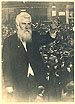 |
Jenkin Lloyd Jones Circa 1910. Jones
(November 14, 1843-September 12, 1918) appears to be standing above the
crowd, his left hand is raised as he addresses the crowd. The entrance to an
unidentified auditorium is in the background. Hand written on verso: "Jenkin
Lloyd Jones. (Quelling a mob at Auditorium, Chicago." Etched in the
negative, bottom right hand corner: "1P-10-3-10." Jones was the uncle of
architect Frank Lloyd Wright, He became a Unitarian minister in Chicago. He
became Missionary Secretary of the Western Unitarian Conference and editor
of the liberal religious weekly, Unity. In 1889 Jones became a strong
supporter of the Hull House Settlement that had been established by Jane
Addams and Ellen Starr in the run-down Nineteenth Ward of Chicago. An
opponent of child labour and supporter of the early trade union movement,
gave lectures at Hull House to recently arrived immigrants from Europe. He
was the author of numerous works. Although Jones was the most powerful
western figure in the denomination, he encountered friction from the
American Unitarian Association (AUA) because of his independent course and
friction within the WUC because of his theological radicalism. In 1882 Jones
reorganized the Fourth Unitarian Society in Chicago...
Continue... |
0094.61.0819 |
C 1910
 |
Larkin Administration Building. Buffalo, New York, Circa 1910-1920 (Not
Dated) (1903 - S.093) / Frank L. Smith Bank
Barrel Chair (1905 - S.111). Larkin Administration Building Library and
Frank L. Smith Bank Barrel Chair. The Library was located on the fourth
floor of the Annex. Thanks to Thomas Heinz’s sharp eye, he noticed a Frank
L. Smith Bank Barrel Chair in the library. The Larkin Side Chairs seen in
this photograph were also found in the restaurant on the fifth floor. There
is no indication as to the relationship of the Smith Barrel Chair and the
Larkin Building. Wright designed the Larkin Building in 1903, the Larkin
Administration building was completed in 1904, and the finished building was
ready for occupancy in August 1906. Construction of the Larkin Building and
the Smith Bank overlapped, and one might speculate that Wright sent John
Larkin and Darwin Martin a sample of the Smith chair as an option? Wright
designed his first barrel chair for the Darwin D. Martin residence in 1904.
But it is only a speculation. Published in
Frank Lloyd Wright’s
Larkin Building, Quinan, 1987, p.81. Courtesy of Jack Quinan. 10 x 6 B&W
copy photograph. See Additional
information on the Smith Bank Barrel Chair... |
0094.111.0824 |
1910
 |
1) George Millard Residence (I), Highland
Park, Illinois, Ground Plan 1910 (1906 - S.126). Detail of the ground and
first floor plan of the George Millard Residence, Ausgefuhrte Bauten und
Entwurfe von Frank Lloyd Wright. Tafel XLIV (44). The dining room is on the
left, to its right is the entrance, hall and kitchen, in the center is the
terrace, living room, stairwell, and the servant's room. On the exterior to
the far right, under the cover of the cantilevered bedroom, it almost
appears that Wright may have added built-in exterior seating. German text
replaced with English text by Douglas M. Steiner. 8 x 10 Color photograph. |
0094.96.0622 |
1910
 |
2) George Millard Residence (I),
Highland Park, Illinois, Second Floor Plan 1910 (1906 - S.126). Detail of
the second floor plan of the George Millard Residence, Ausgefuhrte Bauten
und Entwurfe von Frank Lloyd Wright. Tafel XLIV (44). The second floor
included four bedrooms and two bath. One of the rooms was labeled sewing,
and the master bedroom had a fireplace. German text replaced with English
text by Douglas M. Steiner. 10 x 8 Color photograph. |
0094.97.0622 |
1910
 |
George Millard Residence (I), Highland Park,
Illinois, Viewed from the South, Circa 1910 (1906 - S.126). View of the
George Millard house from the South. Designed by Frank Lloyd Wright in 1906.
Both the East and West ends of the second floor were cantilevered. Although
it is difficult to see through the woods, the West end (right) was
cantilevered. By 1935-1945 when Gilman Lane photographed the house, the
space under the West cantilever was fully enclosed, and windows added. It
remains that way as of this date. Copy photograph published in both Frank
Lloyd Wright Ausgefuhrte Bauten (1911) p.65 and Sonderheft: Frank
Lloyd Wright Chicago (1911), p.56. 10 x 8 B&W photograph. |
0094.98.0622 |
1910
 |
New York City Exhibition 1910 (1910 -
S.163). Copy of photograph published in "Frank
Lloyd Wright Ausgefuhrte Bauten," Wright, 1911, p.111. The exhibition
was held in Madison Square Garden, December 14 - 20, 1910. An announcement
was published in the Universal Portland Cement Monthly Bulletin - December,
1910, p.3: "We will be represented at the New York Show by four exhibits.
The main exhibit will be located in spaces 229 and 230, where a display of
ornamental concrete will be made, illustrating the possibilities in the
decoration of concrete surfaces by means of inlaid colored glass and tile.
It has been designed by Mr. Frank Lloyd Wright, the well known architect of
Chicago. Mr. Wright has given much study to the subject of reinforced
concrete design, with special reference to residence architecture and
interior decoration. The striking originality of his work has attracted wide
attention, and examples may be seen in many localities." Courtesy of the
Frank Lloyd Wright Foundation. 10 x 6.75 B&W photograph. |
0094.66.1119 |
Circa 1910
 |
Isabel Roberts Residence Living
Room (1908 - S.150) circa 1910. Isabel Roberts was Frank Lloyd Wright's
secretary, bookkeeper and office manager in his Oak Park studio. View of the
two story Living Room toward the fireplace, from the west. The Dining Room
is to the left, screened porch to the right. Open balcony is in the
background above. Two Wright designed side chairs are visible, One in the
doorway on the left, and in front of the book shelf on the right. An arm
chair is just to the right of the fireplace. A Wright designed desk is to
the right. Of interest is the unidentified side chair on the left. Possibly
a Wright design, but not confirmed. A second is in the background on the
right. Published in "Frank
Lloyd Wright Chicago" (Sonderheft), 1911, p.59. Photographed by
Henry Fuermann. Original 10 x 8 B&W photograph. |
0094.30.1013 |
Circa 1910
 |
Isabel Roberts Residence Living
Room (1908 - S.150) circa 1910. Isabel Roberts was Frank Lloyd Wright's
secretary, bookkeeper and office manager in his Oak Park studio. View of the
Living Room fireplace looking north toward the dining room. An arm chair is
just to the left. The Dining Room is to the through the door in the center.
A side chair can be seen to the right of the doorway. Published in "Frank
Lloyd Wright Ausgefuhrte Bauten", 1911, p.67, and "Frank
Lloyd Wright Chicago" (Sonderheft), 1911, p.60. Photographed by
Henry Fuermann. Original 10 x 8 B&W photograph. |
0094.31.1013 |
1910
 |
River Forest Tennis Club,
Tafel 42, Wasmuth
Portfolio 1910 (1906 - S.119). Designed by Frank Lloyd Wright in 1906. In
1910 Frank Lloyd Wright produced the "Ausgefuhrte Bauten und Entwurfe von
Frank Lloyd Wright," published by Ernst Wasmuth, in Berlin. Perspective and
floor plan. Description: "Plate 42. River Forest Tennis Club, River Forest,
Illinois. 1906. A simple wooden building set up on posts, built to house the
River Forest Tennis Club. Located and planned to afford an outlook over the
tennis courts and a good dancing floor, with comfortable ingle nooks. The
walls are of wide boards laid on horizontally, joints covered with battens."
There are three fireplaces. The left side included a Women's Locker Room and
Kitchen. The right included the Men's Locker Room. The Fireplace Nook and
Alcoves on either side included built-in seating. Doors opened outward from
the expansive interior, in essence, removing the wall which lead to an open
Terrace which ran nearly the full length of the building. Wright designed
each end by rotating a square 90 degrees. 10 x 6.25 Color photograph. |
0087.42.0421 |
C 1910
 |
River Forest Tennis Club circa 1910. View
looking out at the tennis courts. Photographed by H. Fuermann & Co.
Published in Frank
Lloyd Wright Ausgefuhrte Bauten, 1911, page 97, by Ernst Wasmuth
A.-G., Berlin. Also published in
Frank
Lloyd Wright Chicago. Wasmuth A.-G., Berlin, 1911, p.77.
This photograph shows the building as Frank Lloyd Wright designed it, in its
original location before it was moved in 1920. On the roof, above the stairs
that lead up to the Terrace, there appear to be two poles, left and right,
with banners on each. The Terrace runs from one end to the other, about
two-thirds of the length. Frank Lloyd Wright described it as, "A simple
wooden building set up on posts, built to house the River Forest Tennis
Club. Located and planned to afford an outlook over the tennis courts and a
good dancing floor, with comfortable ingle nooks. The walls are of wide
boards laid on horizontally, joints covered with battens." 10 x 6.25 B&W
copy photograph. |
0094.90.0421 |
1910
 |
Robie House Viewed from the Southeast 1910
(1906 - S.127). Note the wall and gates toward the right which leads into
the courtyard. The wall was lowered and the gates were removed at a later
date, but have now been restored. The wall is lowered in photographs from
the 1950s through the 1990s. Published in "Frank Lloyd Wright Robie House",
title pages and p.20. Photographed by Henry Fruemann. "AR-20. Frank Lloyd
Wright. Robie House. Chicago, Illinois. 1909." Original 10 x 8 B&W
photograph. |
0094.48.0117 |
1910
 |
Robie House Entrance Hall, Lower
Level (1906 - S.127) 1910. Looking Southeast. A Wright designed
high back
chair and entry table are on the left. Oak with leather upholstered seat and
back. The back legs have square feet and caps. Laid across the Wright
designed entry table is a runner designed by Wright with the pattern from
the leaded glass windows. The carpets were also designed by Wright. The
leaded glass doors in the center lead to the Playroom. The stairs lead up to
the main level. Photographed by Henry Fuermann & Sons. Courtesy of the
Frank Lloyd Wright
Foundation. Original 10 x 8 B&W photograph. Wright
Chairs. |
0094.32.1013 |
1910
 |
Robie House Living Room (1906 -
S.127) 1910. Looking West. The Robies were moved into the home by May 1910.
This was photographed after the completion of construction and furnishing
the home. Four distinct chairs are visible in this photograph. A) An
armchair on the left; B) A matching armchair rocker; C) A side chair behind
the rocker; D) An upholstered armchair on the right, very similar to an
upholstered armchair in the May house photographed circa 1910 (see "Frank
Lloyd Wright and George Mann Niedecken", 1999, p. 38). Wright designed
some of the Robie House furniture, some was in conjunction with George Mann
Niedecken, and some may have been designed by Niedecken for the Robie House.
A double pedestal lamp sets on the table to the left. The left half of this
photograph was published in "Frank
Lloyd Wright Ausgefuhrte Bauten",
1911, p. 114, and "Frank
Lloyd Wright Chicago" (Sonderheft), 1911, p. 96. Courtesy of
the Frank Lloyd Wright Foundation. Original 10 x 8 B&W photograph.
Wright
Chairs. |
0094.33.1013 |
1910
 |
Edward C. Waller Bathing Pavilion,
Charlevoix, Michigan Circa 1910 - Not Dated (1909 - S.166). View of the side
of the Pavilion. The front is on the left, back is to the right. Windows run
the entire periphery of the pavilion. Designed by Frank Lloyd Wright in
1909. Edward C. Waller was a successful Chicago Businessman, real estate
developer and an early client and patron of Frank Lloyd Wright. One of his
projects was a 2,000 acre parcel of land on Lake Michigan, just north of
Charlevoix, and ran half way Petosky. Immediately North of Charlevoix there
is still a Road named Waller that runs a little over half a mile. In 1902
Wright created two designs for a large summer house on the property (FLLW
#0212 and #0310). Neither was built. In 1909 Wright designed a Bathing
(swimming) Pavilion on the property. Located on the beach, it provided a
large common area with fireplace, separate bath/changing room and lounge for
men and women. Behind the fireplace was a kitchen. The front of the building
had a large veranda, balance on either side by large concrete urns. This
photograph appears to be the only one that has survived. It was demolished
in 1922-23 by fire. 10 x 6.5 B&W photograph. |
0094.92.0521 |
1910
 |
Wright's Oak Park Playroom (1895
S.003) C1910. Photographed by Henry Fuermann & Sons. Published in "In The
Nature of Material" Hitchcock, 1942, Plate 16, credited to Fuermann; also
published in "Frank Lloyd Wright to 1910" Manson, 1958, page 47, credited to Fuermann and
dated 1910. Caption on verso: "Abundant use of wood and stone in living room
of Wright's own Oak Park home, built in 1895, sowed seeds for natural
building materials often seen in today's homes. Wall mural over fireplace
recalls popularity of this type of interior decorating treatment today.
Hanging lamps over chairs near fireplace may be forerunners of today's
pulley lights. Chicago Architectural Photography Co. Photo. (Stamped) Mar
27, 1957. " Noted changes from photograph published in House Beautiful,
February 1897: Built-in window seats on left and right are removed; Windows
on left cover have been sealed off; Four light fixtures have been added; Two
leaded glass cabinets have been added.4 on either side of fireplace.
Original 10 x 8 B&W Print. Acquired from the archives of the Chicago Sun
Times. |
0094.06.0310 |
1910
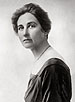 |
Mamah Borthwick
Cheney. Circa 1910-1914. She appears to be just a little older in this
photograph than in the other two available photographs. Note: she was 45 at
the time of her death (1914). She would have been 41 years old in 1910.
Published in "Many
Masks" Gill, 1987, page
207. 4.75 x 6.5 Print, High res digital image. |
0094.05.0609 |
Circa 1910
 |
Oscar Steffens Residence (1909 -
S.153) Circa 1910. Viewed from the Northwest, from Rogers Avenue. The
covered Porch is on the left, Living Room in the center, and Dining Room on
the far right. The entrance is on the right side of the Living Room. The
Bedrooms are on the second level, seen above and behind the covered Porch
and Living Room. Photographed by Henry Fuermann. Published in "Frank
Lloyd Wright Ausgefuhrte Bauten",
1911. Original 8.5 x 6.5 B&W print.
For more information see
our Wright Study on the Oscar Steffens Residence. |
0094.22.0412 |
Circa 1910
 |
Oscar Steffens Residence (1909 -
S.153) Circa 1910. Viewed from the West, from the corner of Sheridan Road
and Rogers Avenue. The covered Porch is on the left, Living Room in the
center, and Dining Room on the far right. The entrance is on the right side
of the Living Room. The Bedrooms are on the second level, seen above and
behind the covered Porch and Living Room. Most likely photographed by Henry
Fuermann at the same time and S#94.22. Published in
"Frank Lloyd Wright,
Chicago", (Sonderheft) 1911. Original 8.1 x 5.75 B&W print.
For more information see
our Wright Study on the Oscar Steffens Residence. |
0094.23.0412 |
Circa
1910
 |
Albert W. Sullivan Residence, Chicago,
Illinois, Circa 1910 (1892 - S.019). View of the front of the Albert
Sullivan Residence. Designed in 1892 while Frank Lloyd Wright worked for
Louis Sullivan. Albert Sullivan , Louis" brother, commissioned him to design
a house for their mother. She past away before it was completed and Louis
Sullivan moved into the house when it was completed, and lived there until
1896. Albert and his family then took up residence there until 1914. The
house was a collaboration between Sullivan and Wright, but most scholars
credit Wright with the design and Sullivan with the floral designs. Sullivan
was busy on commercial commissions and delegated residential to Wright. The
house was demolished in 1970. Photographed by A. H. Hall between 1892 -
1910. Courtesy of The Art Institute of Chicago. 8 x 10 B&W photograph. |
0094.102.0823 |
Circa
1910
 |
Frank Wright Thomas Residence (1901 - S.067)
Circa 1910. Viewed from across the street. The Frank Thomas Residence is
considered to be Frank Lloyd Wright's first fully developed prairie styled
house in Oak Park. It is also the first house in Oak Park to be completely
designed in Stucco. Upon entering the archway, stairs lead up to the Terrace
and main living quarters on the second level. The Living Room is to the
left, Dining Room on the right. The Kitchen is strait ahead. A back stairway
leads to the bedrooms on the third floor. The ground floor was for the house
staff. Some of the design features included beaded molding and exquisite
leaded glass windows. Photographed by Henry Fuermann. Courtesy of The Art
Institute of Chicago. Published in "Frank
Lloyd Wright," Hitchcock, 1928. 10 x 7.75 B&W photograph. |
0094.47.1116 |
Circa
1910
 |
1) Thurber Art Galleries circa 1910 (1909 -
S.154). Exterior hallway view of entrance to the Thurber Art Galleries
designed by Frank Lloyd Wright in 1909. Located on the fifth floor of the
Annex Building, which is adjacent to the Fine Arts Building on the North
side, facing Michigan Avenue. Where the Fine Arts Building has ten floors,
the Annex has five. Glass, an element Wright brilliantly utilized in his
designs, engulfed the Entryway of the Thurber Art Galleries. Single stained
glass panels adorned either side of the double glass doors in the entrance.
A single circular piece of glass topped the Entrance. Wright used dull
grayed white glass, rich yellow and a few small squares of black. All were
set in brass leadings of various widths. Copy photograph published in
The
Book of The Fine Arts Building, 1911/2008, page 19. 4 x 5 B&W photograph. |
0094.95.0522 |
Circa 1910
 |
Thurber Art Galleries (1909 -
S.154), circa 1910. View of the smaller Viewing Gallery looking East toward
Lake Michigan. The floors were designed especially to reflect the light,
composed of white magnasite. Around the edge of the floor was a band of dull
yellow-toned magnasite, bringing the golden wall color down into the floor.
The two colors were divided by a narrow strip of inlaid brass. The walls of
both galleries were covered with cork gilded in a low-toned bronze dadoed by
a higher-keyed gilded rough plaster. Each gallery had a skylight, composed
of oblong pieces of dull grayed white glass, with smaller oblong pieces of
rich yellow and a few small squares of black, set in brass leadings of
various widths, and were different in each gallery. The furniture was
designed by Wright. Published in "International Studio", April, 1911. 10 x
7.2 B&W Print.
For more information see
our Wright Study on the Thurber Art Galleries. |
0094.17.0911 |
Circa 1910
 |
Thurber Art Galleries (1909 -
S.154), circa 1910. View of the larger Print and Reproduction Gallery
looking East toward Lake Michigan. Wright "carefully considers every detail
of room size and height, the lighting by day and night, placing of doors and
windows, the breaking up of the wall surfaces, the design and use of each
piece of furniture..." (I.S.) The built-in portfolio booths were seven and
one-half feet high and include portfolio screens, drawer space, tables,
desks and seats. There were no fixtures of any sort. Electric lights were
placed above the skylights and concealed in the portfolio booths, so that
the source of light was hidden, diffused and softened "as to have the effect
of daylight". Each gallery had a skylight, composed of oblong pieces of dull
grayed white glass, with smaller oblong pieces of rich yellow and a few
small squares of black, set in brass leadings of various widths. The
furniture was designed by Wright. Photographed by Henry Fuermann and
Company. Published in "Frank
Lloyd Wright Ausgefuhrte Bauten", 1911. 10 x
7.4 B&W Print.
For more information see
our Wright Study on the Thurber Art Galleries. |
0094.18.0911 |
Circa 1910
 |
Thurber Art Galleries (1909 -
S.154), circa 1910. View of the larger Print and Reproduction Gallery
looking West. Wright "carefully considers every detail of room size and
height, the lighting by day and night, placing of doors and windows, the
breaking up of the wall surfaces, the design and use of each piece of
furniture..." (I.S.) The built-in portfolio booths were seven and one-half
feet high and include portfolio screens, drawer space, tables, desks and
seats. There were no fixtures of any sort. There were electric lights placed
above the skylights and concealed in the portfolio booths, so that the
source of light was hidden, diffused and softened. This larger gallery had
two skylights, composed of oblong pieces of dull grayed white glass, with
smaller oblong pieces of rich yellow and a few small squares of black, set
in brass leadings of various widths. The furniture was designed by Wright.
Photographed by Henry Fuermann and Company. Published in "Frank
Lloyd Wright Ausgefuhrte Bauten", 1911. 10 x 6.5 B&W Print.
For more information see
our Wright Study on the Thurber Art Galleries. |
0094.19.0911 |
Circa 1910
 |
Ward W. Willits, Highland Park,
Illinois, Circa 1910 (1901 - S.054). Viewed from the South. Frank Lloyd
Wright designed the Willits House in 1901, one of his first Prairie styled
houses. Ward W. Willits was the president of the Adams and Westlake Company,
a brass and bronze foundry. Orlando Giannini, an artist who designed art
glass and murals for Wright, also worked for Adams and Westlake. In 1905,
Willits and his wife accompanied Frank and Catherine Wright on their first
trip to Japan. Etched in negative, bottom left hand corner: "2767."
Published in
Frank Lloyd Wright,
Chicago, Wright, 1911, p.50.
Photographed by Henry Fuermann. Courtesy Art Institute of Chicago. 10 x 4.75
B&W print. |
0094.69.1219 |
Circa 1910
|
Ward W. Willits Residence, Highland
Park, Illinois, Circa 1910 (1901 - S.054). Viewed from the South.
Photographed circa 1910. Copy photograph of Ward Willits House published in
Frank Lloyd Wright:
The Early Work, Wright, 1968, p.57.
Frank Lloyd Wright designed the Willits House in 1901, one of his first
Prairie styled houses. Ward W. Willits was the president of the Adams and
Westlake Company, a brass and bronze foundry. Orlando Giannini, an artist
who designed art glass and murals for Wright, also worked for Adams and
Westlake. In 1905, Willits and his wife accompanied Frank and Catherine
Wright on their first trip to Japan. Printed on verso: "Copy of Willits
Houase on page 57 of Frank Lloyd Wright: The Early Work." Clipping pasted to
verso: "The Willits House, shown in an old photo, is a mature example of a
prairie house designed by Frank Lloyd Wright." Stamped on verso: "Aug 10
1982, The Houston Post Co." Also "Photo (copy photo) by Craig Hartley."
Clipping pasted to verso: "The future of this Frank Lloyd Wright
architectural masterpiece in Chicago is in question." First published in Frank
Lloyd Wright Ausgefuhrte Bauten, Wright, 1911, p.57. Also
published in
Frank Lloyd Wright,
Chicago, Wright, 1911, p.47. Acquired from the archives of the
Houston Post. 10 x 8 B&W photograph. |
0094.94.0322 |
|
1911 |
1911
 |
Herbert Angster Residence, Lake Bluff,
Illinois, Perspective View 1911 (1911 - S.169). Designed by Frank Lloyd
Wright at Taliesin (Hillside), in 1911 after his return from Europe
(FLLW#1101.01). Perspective view of the Herbert Angster Residence viewed
from the West. The kitchen is in the background on the far left. The
entrance can be seen left of center in the two-story section of the house
tucked behind the concrete urn. The covered porch in the foreground to the
right is off the master bedroom. A built-in flower box sets between the two
columns supporting the roof. The living room is to the right. Text lower
left: "Mr. Herbert Angster Residence. Frank Lloyd Wright, Architect."
Courtesy of the Frank Lloyd Wright Foundation Archives, Avery Library,
Columbia University. 10 x 7 B&W photograph.
|
0104.31.0923 |
1911
 |
Sherman M. Booth
Residence Scheme I, Glencoe, Illinois, Perspective 1911 (1911 - FLLW#1118).
Perspective No, 1.
View of the Booth Residence, Scheme I, from across
the ravine. Frank Lloyd Wright Foundation #1118.01. Designed in 1911, this
was Frank Lloyd Wright’s first design for Sherman Booth. Scheme I was a
magnificent estate on fifteen acres. It has been compared to the Coonley and
Martin Residences, and the unrealized McCormick residence. Wright excelled
when the topography was challenging, and he took full advantage of it’s
unique characteristics. “Although the most striking feature of the design is
undoubtedly the treatment of the ravine, Wright has treated the access and
approach to it in much the same manner as he did the waterfall at
Fallingwater. It is done with intricate subtlety. Crossing the bridge, one
gets only a glimpse of the glen, but once inside the house the beauty of the
ravine and its natural landscape is revealed as part of the interior of the
house itself. The entrance to the house is likewise treated as a series of
approaches, not as a sudden confrontation.”
Treasures of Taliesin,
Pfeiffer, 1985, p.18-19. The design remained a project, and as Pfeiffer puts
it, “for reasons that are lost in time.” Courtesy of the Frank Lloyd Wright
Foundation. 7 x 10 Color photograph. |
0104.44.0524 |
1911
 |
Sherman M. Booth Residence Scheme I,
Glencoe, Illinois, Perspective 1911 (1911 - FLLW#1118).
Perspective No,
2.
View of the Booth Residence,
Scheme I, from across the ravine. Frank Lloyd Wright Foundation #1118.04.
Designed in 1911, this was Frank Lloyd Wright’s first design for Sherman
Booth. Scheme I was a magnificent estate on fifteen acres. It has been
compared to the Coonley and Martin Residences, and the unrealized McCormick
residence. Wright excelled when the topography was challenging, and he took
full advantage of it’s unique characteristics. “Although the most striking
feature of the design is undoubtedly the treatment of the ravine, Wright has
treated the access and approach to it in much the same manner as he did the
waterfall at Fallingwater. It is done with intricate subtlety. Crossing the
bridge, one gets only a glimpse of the glen, but once inside the house the
beauty of the ravine and its natural landscape is revealed as part of the
interior of the house itself. The entrance to the house is likewise treated
as a series of approaches, not as a sudden confrontation.”
Treasures of Taliesin,
Pfeiffer, 1985, p.18-19. The design remained a project, and as Pfeiffer puts
it, “for reasons that are lost in time.” Courtesy of the Frank Lloyd Wright
Foundation. 8 x 10 Color photograph. |
0104.45.0524 |
1911
 |
Sherman M. Booth Summer Cottage, Glencoe,
Illinois, Floor Plan 1911 (1911 - S.178). Floor plan for the Booth Summer
Cottage. Designed by Frank Lloyd Wright in 1911, on a 3' grid. The house is
42' x 21', 882 square feet. With the enclosed veranda, 51' x 21', 1071
square feet. The house included a living room and kitchen, maid's room for
their nanny, a nursery for their children, a dressing room, one bathroom and
an enclosed veranda. There is a continuous band of windows across the front
of the house. What is curiously missing is a master bedroom. Text lower
left: "Floor Plan. Notes: All window mullions as detailed. Elsewhere the
walls are made up of 4 x 4's spaced 3' 0" apart." Text bottom right:
"Sherman Booth Summer Cottage." Courtesy of the Frank Lloyd Wright
Foundation. 10 x 5.5 Color photograph. |
0104.25.0121 |
1911
 |
Glencoe Park Architectural Features For Sherman Booth
1911 (1911 - FLLW #1120). Glencoe Park Architectural Features designed by
Frank Lloyd Wright in 1911. Frank Lloyd Wright Foundation #1120.04. Frank
Lloyd Wright designed a number of projects for Sherman Book. Besides the
architectural features that were completed, the Ravine Bluffs Development
Bridge and Concrete Street Lamp (1915 - F.1505, S.186) and the Ravine Bluffs
Development Sculptures (3) (1915 - S.185 1-3), he designed architectural
features for the unrealized Glencoe Park.
One of the
features of Wrights design for the Sherman Booth Residence, Scheme I, was a
bridge across the ravine. There also appeared to be an elaborate entrance to
the property. The entrance appears to include architectural designed
elements. These Glencoe Park architectural features may give a glimpse of
what was planned for the entrance. Text lower left: “Curb and Gateway -
Lanterns. Corner Glencoe Parkway 1911.” Courtesy of the Frank Lloyd Wright
Foundation. 10 x 6.5 B&W photograph. |
0104.46.0524 |
1911/2001
 |
Avery Coonley Residence, Riverside, Illinois, HABS
Site Plan, 1911/2001 (1907 - S.135). HABS Site plan for the Avery Coonley
estate comparing 1911 to 2001. Designed by Frank Lloyd Wright in 1907. The
plan covered the entire block and included the residence and pool, stable,
gardener’s cottage and gardens. By 2001, the master bedroom terrace, on the
West end of the residence was expanded and enclosed. The structure that
connected the gardener’s cottage and the stable was removed, which separated
the two structures.
According to Eastman, from 1951 to 1957, the Coonley estate was divided into
four residences. The main residence was split in two, the stable and the
Gardener’s Cottage. Five additional houses were built on Block II, including
348 Coonley Road on the Northeast corner of the property.
Frank Lloyd Wright’s Coonley House,
2012, p.226-227.
Historic American Buildings Survey, IL-1100, Sheet 2 of 17. Avery Coonley
House, Riverside. The School of the Art Institute of Chicago. Drawn by K.
Szulga. Courtesy of The Library of Congress. 10 x 8 B&W photograph. |
0104.51.0425 |
1911/2001
 |
Avery Coonley Residence, Riverside, Illinois, HABS
Window Plans, 1911/2001 (1907 - S.135 ). HABS window plans for the Avery
Coonley estate comparing 1911 to 2001. Designed by Frank Lloyd Wright in
1907. There are four window p[lans: Butler’s pantry window (2); Dining room
window; Living room window.
Many of the windows in the residence came in pairs with the design facing
each other creating a symmetry, mirroring the design in each window. In many
of Wright’s designs, windows and doors opened outward. This created an issue
with exterior flower boxes. Opening outward would interfere with plantings.
Wright devised a plan for windows adjacent to exterior flower boxes. The
dining room window is a perfect example. He added a windows below the pair.
The lower window was stationary and continued the glass design from above.
This allowed the upper pair to open outward without disturbing the contents
of the flower box. These were prominent in the dining room as well as others
windows that were adjacent to exterior built-in flower boxes.
Besides the
dining room , we were able to locate other locations: A) The East end...
Continue... |
0104.55.0525 |
1911
 |
Avery Coonley Stable/Coach House, Riverside, IL, Floor Plan,
1911 (FLLW# 1103.21) (1911 - S.137).
Floor Plan for the Coonley
Stable/Coach House. The Coach House, originally called the
Stable, and the Gardener’s Cottage were independent buildings,
but designed as a unit and connected by the roof.
In 1910
when Frank Lloyd Wright published the Ausgeführte Bauten
portfolios, four plates illustrated the Coonley Residence.
Wright described the ground plan, Plate 57:A one-story house
designed for the Prairie, with the basement entirely above
ground, similar to Thomas, Heurtley and Tomek houses... Stable
and gardener's cottage are grouped together and informally
connected by a covered way, which terminates in the gardener's
veranda. An arbor crosses the garden to the rear, terminating in
the service entrance. The stables, stable yards and gardens are
enclosed by plastered walls.” Ausgefuhrte Bauten Booklet,
Wright, Description Plate LVII (57).
The Coach House
is a long building, nearly 115 feet. The final plans dated December 5, 1911
included a one room living space with a bath and separate entrance, work
room, horse stalls and harness room, carriage...
Continue... |
0104.56.0625 |
1911
 |
Avery Coonley Stable/Coach House, Riverside, IL,
North, South Elevations, 1911 (FLLW# 1103.22) (1911 - S.137). North and
South elevations for the Coonley Stable/Coach House. The Coach House,
originally called the Stable, and the Gardener’s Cottage were independent
buildings, but designed as a unit and connected by the roof.
In 1910 when
Frank Lloyd Wright published the Ausgeführte Bauten portfolios, four plates
illustrated the Coonley Residence. Wright described the ground plan, Plate
57:A one-story house designed for the Prairie, with the basement entirely
above ground, similar to Thomas, Heurtley and Tomek houses... Stable and
gardener's cottage are grouped together and informally connected by a
covered way, which terminates in the gardener's veranda. An arbor crosses
the garden to the rear, terminating in the service entrance. The stables,
stable yards and gardens are enclosed by plastered walls.” Ausgefuhrte
Bauten Booklet, Wright, Description Plate LVII (57).
The Coach House is a long building, nearly 115 feet.
The final floor plans dated December 5, 1911 included a one room living
space with a bath and separate entrance, work room, horse stalls and harness
room, carriage room...
Continue... |
0104.57.0625 |
1911
 |
1) Avery Coonley Gardener’s Cottage, Riverside, IL, First
Floor and Basement Plan 1911 (FLLW# 1103.15) (1911 - S.136). First floor and
basement plan for the Coonley Gardener’s Cottage. The Gardener’s Cottage was
800 square feet and consisted of a living room, kitchen, two bedrooms and a
bath. There was a long covered veranda off the South end, which was later
enclosed and a large covered porch off the North side of the cottage.
Exterior stairs led to the basement that was used for the furnace and
storage. Wright designed the art glass windows specifically for the cottage.
The Coonley
estate covered a whole city block which was comprised of nine lots covering
about 5 acres. The whole block was purchased by the Coonley’s in 1906. The
plan which covered the entire block and included the residence and pool,
stable, gardener’s cottage and gardens. Although the stable and gardener’s
cottage were planned at the start, the design for both were not completed
until 1911. They were clustered with the residence, but not attached. The
design for the two blended with the main residence. Although the two
buildings were connected by a roof, they were two separate structures. This
allowed...
Continue... |
0104.52.0425 |
1911
 |
2) Avery Coonley Gardener’s Cottage, Riverside, IL,
East and West Elevations, 1911 (FLLW# 1103.16) (1911 - S.136). East and West
elevations for the Coonley Gardener’s Cottage. The Gardener’s Cottage was
800 square feet and consisted of a living room, kitchen, two bedrooms and a
bath. There was a long covered veranda off the South end, which was later
enclosed and a large covered porch off the North side of the cottage.
Exterior stairs led to the basement that was used for the furnace and
storage. Wright designed the art glass windows specifically for the cottage.
The Coonley
estate covered a whole city block which was comprised of nine lots covering
about 5 acres. The whole block was purchased by the Coonley’s in 1906. The
plan which covered the entire block and included the residence and pool,
stable, gardener’s cottage and gardens. Although the stable and gardener’s
cottage were planned at the start, the design for both were not completed
until 1911. They were clustered with the residence, but not attached. The
design for the two blended with the main residence. Although the two
buildings were connected by a roof, they were two separate structures...
Continue... |
0104.53.0425 |
1911
 |
3) Avery Coonley Gardener’s Cottage, Riverside, IL,
North and South Elevations, Section , 1911 (FLLW# 1103.18) (1911 - S.136).
North and South elevations for the Coonley Gardener’s Cottage and a section
of the Stable. Note: Incorrectly identified as the East and West
Elevations. The Gardener’s Cottage was 800 square feet and
consisted of a living room, kitchen, two bedrooms and a bath. There was a
long covered veranda off the South end, which was later enclosed and a large
covered porch off the North side of the cottage. Exterior stairs led to the
basement that was used for the furnace and storage. Wright designed the art
glass windows specifically for the cottage.
The Coonley estate covered a whole city block which was comprised of nine
lots covering about 5 acres. The whole block was purchased by the Coonley’s
in 1906. The plan which covered the entire block and included the residence
and pool, stable, gardener’s cottage and gardens. Although the stable and
gardener’s cottage were planned at the start, the design for both were not
completed until 1911. They were clustered with the residence, but not
attached. The design for the two blended with the main residence. Although
the two buildings were connected by a roof, they were two separate
structures...
Continue... |
0104.54.0425 |
1911
 |
Walter Gerts Residence Remodeling, River Forest,
Illinois, First and Second Floor Plan 1911 (1911 - S.177). First and Second
floor plans for the remodel of the Walter Gerts Residence. Plans also
include the staircase, interior glass doors and the sideboard. The Walter
Gerts Residence was designed by Charles E. White, Jr., in 1905. It suffered
and extensive fire and in 1911, they asked Frank Lloyd Wright to remodel the
house. From the plans it appears that Wright moved the stairs from the
center of the house to the back as well as moving interior walls. Wright
also specified art-glass windows, interior furnishings, a living room
ceiling fixture and interior glass doors. The art-glass windows were never
executed. Sheet 1. Text
upper right: "Walter S. Gerts. Alterations of Dwelling. River Forest,
Illinois. Frank Lloyd Wright, Architect, Oak Park, Illinois. Specifications:
Contractor shall take the building in its present condition, replace all
charred and damaged woodwork, furnish new materials and for all work
necessary to make same correspond to these drawings and details according to
the specifications. New work to correspond in every detail to old work.
Floors, woodwork, walls and ceilings, where damaged, shall be replaced or
made good. New floor should be laid through out first story, except the
kitchen...
Continue... |
0104.28.0922 |
1911
 |
Walter Gerts Residence Remodeling, River Forest,
Illinois, Elevations and Plans 1911 (1911 - S.177). Four elevations,
basement plan, windows and light fixture for the remodel of the Walter Gerts
Residence. The Walter Gerts Residence was designed by Charles E. White, Jr.,
in 1905. It suffered and extensive fire and in 1911, they asked Frank Lloyd
Wright to remodel the house. From the plans it appears that Wright moved the
stairs from the center of the house to the back as well as moving interior
walls. Wright also specified art-glass windows, interior furnishings, a
living room ceiling fixture and interior glass doors. The art-glass windows
were never executed.
Sheet
2. Text hand written lower left: "1114.02." Courtesy of the Avery Library,
Columbia University. 10 x 4 B&W photograph. |
0104.29.0922 |
1911
 |
Ingwald Moe
Residence, Gary, Indiana, Map 1911 (1909 - FLLW #0531). The Sanborn Fire
Insurance Map for the City of Gary, Indiana, published in January, 1911
shows a house on the Northeast corner of 7th and Van Buren Street. The Moe
House was built on the Southwest corner of Block 53. Sanborn Maps published
in January 1911 includes the footprint of a two-story house with a one-story
partially covered porch. The roof was slate or tin and indicates framed
construction, plastered finish. A one-story plastered Auto House was built
on the Northeast corner of the lot. The property was a corner lot that
combined three lots. Published Janury, 1911 by the Sanborn Map Company, New
York. Sheet 1 of 34 sheets. By comparing the map published in December, 1908
to the map published in January 1911, it confirms that the Ingwald Moe house
was constructed during 1909-1910. The Inwald Moe House was designed by Frank
Lloyd Wright in 1905/1908-9, and most likely plans from the Evanston Model
Housing Project. Courtesy of the Library of Congress. 8 x 9.5 Color
photograph. |
0104.40.1123 |
1911
 |
Ingwald Moe
Residence, Gary, Indiana, Map 1911 (1909 - FLLW #0531). The Sanborn Fire
Insurance Map for the City of Gary, Indiana, published in January, 1911
shows a house on the Northeast corner of 7th and Van Buren Street. The Moe
House was built on the Southwest corner of Block 53. Sanborn Maps published
in January 1911 includes the footprint of a two-story house with a one-story
partially covered porch. The roof was slate or tin and indicates framed
construction, plastered finish. A one-story plastered Auto House was built
on the Northeast corner of the lot. The property was a corner lot that
combined three lots. Published Janury, 1911 by the Sanborn Map Company, New
York. Sheet 4 of 34 sheets. By comparing the map published in December, 1908
to the map published in January 1911, it confirms that the Ingwald Moe house
was constructed during 1909-1910. The Inwald Moe House was designed by Frank
Lloyd Wright in 1905/1908-9, and most likely plans from the Evanston Model
Housing Project. Courtesy of the Library of Congress. 8 x 9.5 Color
photograph. |
0104.41.1123 |
1911
 |
Wright's Oak Park Home and
Studio (1895 S.003) 1911. "In December of 1911 he left Oak Park and moved to
Spring Green... There he built Taliesin 1 for his new life with Mamah
Cheney. Before leaving Oak Park, Wright extensively remodeled the home and
studio. The studio was converted to a dwelling for his wife and four
children still living at home. The home was converted into a rental unit to
provide income for Catherine. This wall was constructed to add privacy to
the garden and 'Library'. "The
Plan for Restoration" 1978, pages38-40. Stamped on verso: "Dec 2 -
1911". Photographed by "Bu... & At..., Press Photographers, Chicago."
Clipping on verso: "Although Frank Lloyd Wright's home in Oak Park today
serves as a museum, it was built in 1889 for about $6,000. In 1911, workers
built the brick fence that assures privacy." 10 x 8 Print, High res image.
From the archives of the Chicago Sun Times. |
0104.07.0410 |
Circa 1911
 |
Wright's Oak Park Home (1895 -
S.002-4) Dining Room Circa 1911. Dining Room looking south. In 1911, Frank
Lloyd Wright converted the home into a rental property. He added two
cantilevered lights on the bay end of the Dining Room. "In December of 1911
he left Oak Park and moved to Spring Green... There he built Taliesin I for
his new life with Mamah Cheney. Before
leaving Oak Park, Wright extensively remodeled the home and studio. The
studio was converted to a dwelling for his wife and four children still
living at home. The home was converted into a rental unit to provide income
for Catherine. "The
Plan for Restoration" 1978, pages38-40. Most likely photographed
after restoration, before Wright left Oak Park. Photographed by Henry
Fuermann. Original 10 x 7.75 B&W photograph. |
0104.19.0814 |
1911
 |
Wright's Oak Park Home and Studio, Bedroom for
Mrs. Wright. (1895 - S.003) 1911. "In December of 1911 Wright left Oak Park
and moved to Spring Green... There he built Taliesin I for his new life with
Mamah Cheney. Before leaving Oak Park, Wright extensively remodeled the home
and studio. The studio was converted to a dwelling for his wife and four
children still living at home. The home was converted into a rental unit to
provide income for Catherine." "The
Plan for Restoration" 1978, pages 38-40. In 1911, Wright's original
two-story drafting room was converted to a living room on the first floor,
and four bedrooms for his children on the second. His office which was
adjacent to the drafting room on the first floor was converted to a dining
room, and a second level was added above it creating a bedroom for Mrs.
Wright. The fireplace was added, tying it into the original drafting room
chimney. The windows on the left look out over Chicago Avenue. A Wright
designed slant-back chair is visible against the wall under the windows. A
stubbed wall is visible on the far right. To it's right, two steps lead down
to a landing and out to the hallway. Courtesy Frank Lloyd Wright Preservation Trust, Oak
Park. Original 10 x 8 B&W photograph. Wright Chairs. |
0104.14.1013 |
1911
 |
Wright's Oak Park Home and Studio, Bedroom for
Children. (1895 - S.003) 1911. "In December of 1911 Wright left Oak Park and
moved to Spring Green... There he built Taliesin I for his new life with
Mamah Cheney. Before leaving Oak Park, Wright extensively remodeled the home
and studio. The studio was converted to a dwelling for his wife and four
children still living at home. The home was converted into a rental unit to
provide income for Catherine." "The
Plan for Restoration" 1978, pages 38-40. In 1911, Wright's original
two-story drafting room was converted to a living room on the first floor,
and four bedrooms for his children on the second. This was Catherine's
Bedroom, the northeast bedroom, looking northeast. Three pieces of furniture
are visible. A) Left: Slant back side chair. Wright designed them for his
home in Oak Park, 1904. Front and back legs are straight. The back legs have
feet, the top is capped. Oak, leather upholstered seat, 40.25 (H) x 15 (W) x
18.75 (D). B) Japanese Print Table, designed by Wright in 1898. Used in
Catherine's room as a desk. 48.5 (H) x 44 (W) x 26.25 (D). C) In front of
desk: Low back chair. Designed by Wright circa 1908. Very similar to the
Isabel Roberts Side Chair (1908), but shorter. The main difference is an
additional horizontal trim along the base of the seat which runs along...
Continue... |
0104.15.1013 |
C 1911-25
 |
Frank Lloyd Wright's Oak Park Home and Studio Master (North)
Bedroom (1889 - S.002) Circa 1911-1925. Looking North after 1911 renovation
by Wright. The Master Bedroom looking North, shows the vault ceiling and
mural painted by Orlando Giannini. "In December of 1911 he (Wright) left Oak
Park and moved to Spring Green... There he built Taliesin I for his new life
with Mamah Cheney. Before leaving Oak Park, Wright extensively remodeled the
home and studio. The studio was converted to a dwelling for his wife and
four children still living at home. The home was converted into a rental
unit to provide income for Catherine..." "The
Plan for Restoration" 1978, pages 38-40. This could explain the
single beds and sealed doors to the balcony. Photographed by Henry Fuermann
and Sons Photographic Company. The Frank Lloyd Wright Preservation Trust
dates this photograph circa 1911-1925. The Art Institute of Chicago, Ryerson
& Burnham Archives, dates this photograph circa 1890-1910 and acquired their
copy of the photograph in 1933. Clipping pasted to the verso: "What seems to
be an Indian brave commands the space above rectangular bedroom windows",
stamped "May 11, 86". Second clipping pasted to verso: "A bedroom in his Oak
Park home: elegance even in the most modest spaces", stamped "Feb 9, 92"...
Continue... |
0104.13.1211 |
C
1911-25
 |
Frank Lloyd Wright's Oak Park Home and Studio Master
(North) Bedroom (1889 - S.002) Circa 1911-1925. Looking North after 1911
renovation by Frank Lloyd Wright. The Master Bedroom looking North, shows
the vault ceiling and mural painted by Orlando Giannini. "In December of
1911 he (Wright) left Oak Park and moved to Spring Green... There he built
Taliesin I for his new life with Mamah Cheney. Before leaving Oak Park,
Wright extensively remodeled the home and studio. The studio was converted
to a dwelling for his wife and four children still living at home. The home
was converted into a rental unit to provide income for Catherine..." "The
Plan for Restoration" 1978, pages38-40. This could explain
the single beds and sealed doors to the balcony. Photographed by Henry
Fuermann and Sons Photographic Company. The
Frank Lloyd Wright
Preservation Trust dates this photograph circa 1911-1925. The Art Institute
of Chicago, Ryerson & Burnham Archives, dates this photograph circa
1890-1910 and acquired their copy of the photograph in 1933. Mounted to gray
board. Label pasted to board: : "West 20, US Arch. Wright, Frank L. Oak
Park, Ill. F.L. Wright Res. 1889. Interior." Acquired from the Wayne Andrews
estate. Original 9 x 8 B&W photograph. |
0104.22.0220 |
C 1911-12
 |
Taliesin I Entrance Gate circa 1911-12 (1911 -
S.172). Taliesin I was designed by Frank Lloyd Wright in 1911, it was
partially destroyed by fire on August 15, 1914. Three stone masons working
on the entrance gate to Taliesin. Wright wrote, "Country masons laid all the
stone with the quarry for a pattern and the architect for teacher. They
learned to lay the walls in the long, thin, flat ledges natural to it,
natural edges out. As often as they laid a stone they would stand back to
judge the effect. They were soon as interested as sculptures fashioning a
statue..." "An Autobiography"
Wright, 1932, p.174. Photographed by Taylor Woolley, a draftsman who lived
and worked at Taliesin from September 1911 though the Spring of 1912. His
photographs are an invaluable record of the birthing of Taliesin I. 10 x 7
B&W photograph. |
0104.20.0215 |
1911
 |
(Side Note) Hoquiam Library, Hoquiam, Washington. After living in the State of Washington for over 30 years, I was surprised
to find such a fine example of a prairie style building right here in my
back yard. I was even more surprised when I discovered it was built in
1911. Originally funded by the Andrew Carnegie Foundation, (funding
secured in 1910), it's on the National Register of Historic Places and is
known as a rare example of the Prairie Style of Architecture found in the
Pacific Northwest. The original building was designed by the
architectural firm of Claude & Starck, Madison, Wisconsin. Louis
Claude was a former associate and lifelong friend of architects Louis
Sullivan and Frank Lloyd Wright. Claude & Starck's work reflects this
influence. This firm was selected by Miss Macpherson, the first
Librarian. She had previously worked in the Evansville, Wisc. Library
which was also designed by them. After additional research I was
surprised to five additional libraries from the same design. The
library was formally dedicated on August 25, 1911. In 1991, the
building was enlarged and remodeled by Tonkin/Koch Architects of Seattle. They did an excellent job of duplicating and blending the with original
design. The original frieze mold was still available through a
University of Minnesota Library which houses the... Continue... |
2007.03.0207 |
|
1912 |
1912
 |
Sherman M. Booth Residence Scheme I, Glencoe, Illinois, Planting Plan 1912
(1911 - FLLW #1118). Landscaping plans for the grounds of the Booth
Residence, Scheme I, designed by Jens Jensen. Frank Lloyd Wright Foundation
#1118.14. Designed in 1911, Scheme I was Frank Lloyd Wright’s first design
for Sherman Booth. Frank Lloyd Wrtight called on Jen Jensen to design the
landscaping plans for the Booth Estate. The design was quite extensive. One
of the main elements was the garden. It was divided into three sections, two
for vegitables and one for floweres. A grape arbor ran the full length of
the gardens, and the were bordered in hedges. To the West of the entrance to
the garden was the Stable and Garage (Gardener’s Cottage). Further west was
a tennis court, and to the South end of the garedns was a natural;ly formed
swimming pool. To the North of the Gardens was the residence.
Besides the bridge across the ravine, there appears to be an elaborate
entrance to the property. The entrance appears to include architectural
designed elements, much like Wright’s plans for the Gateway to the Glencoe
Park (FLLW #1120.04). An interesting side note. The plans include the Stable
and Garage, which the Foundation... Continue... |
0114.44.0524 |
1912
 |
Sherman Booth Stable and Garage Main Floor Plan and Details, Sheet 2 (1912 -
FLLW #1211). Floor plan and details for the Sherman Booth Stable and Garage.
Designed by Frank Lloyd Wright in 1912. Frank Lloyd Wright Foundation
#1211.03. The garage and stables were actually two separate building set at
right angles to each other, but not touching. The smaller of the two
buildings was the stable with stalls for one cow, two horses, and a carriage
room. The garage was actually a small, 730 square foot house with two large
garage bays. The garage bays opened on both sides so you could drive in and
drive out. It was finished in a light stucco finish with wood trim and a red
tile roof. The plans in the Frank Lloyd Wright archives are dated February
7, 1912... Continue...
|
0114.45.0524 0114.46.0524 0114.47.0524 |
1912
 |
City National Bank, Mason City, Iowa 1912 (1909 - S.155). View of the City
National Bank from the Northeast. The Park Inn Hotel can be seen in the
background to the right. Frank Lloyd Wright was commissioned by attorneys,
James E.E. Markley and James E. Blythe to design a building for their bank.
Markley made Wright's acquaintance while visiting his daughter during her
stay at the Hillside Home School, in Spring Green, Wisconsin. Wright was
commissioned to design both the City National Bank and Park Inn Hotel in
early 1909 and construction began April 1, 1909. Construction was completed
in August 1910. Original 8 x 10 B&W photograph. |
0114.28.0519 |
1912
 |
Avery Coonley Playhouse, Riverside, Illinois, Perspective 1912 (FLLW
#1201.04) (1912 - S.174) . Perspective illustration of the Avery Coonley
Playhouse. Designed by Frank Lloyd Wright in 1912. Possibly Frank Lloyd
Wright’s most famous triptych dominates the front elevation of the
playhouse. Hand written text lower left: “1201.04.”
When Frank Lloyd Wright was published in seven issues of
Wendingen Volume II No. 3-9, October 1925 -
April 1926, he felt the Playhouse important enough to include two plans, a
perspective illustration, and four photographs, p.28-33. Courtesy of the
Frank Lloyd Wright Archives, Avery Library, Columbia University. (FLLW
#1201.04) 10 x 7 B&W photograph. |
0114.54.0625 |
1912
 |
Avery Coonley Playhouse, Riverside, Illinois, Floor Plan 1912 (FLLW
#1201.14) (1912 - S.174) . Floor plan for the Avery Coonley Playhouse.
Designed by Frank Lloyd Wright in 1912. The plan included the main assembly
area, a stage with a fireplace and a dressing room behind it, a kitchen and
workshop. Lower text: “Mrs. Avery Coonley, Riverside, Illinois. Little
Playhouse and Workshops. Sheet No. 2. Frank Lloyd Wright, Architect.”
When Frank Lloyd Wright was published in seven issues of
Wendingen Volume II No. 3-9,
October 1925 - April 1926, he felt the Playhouse important enough to include
two plans, a perspective illustration, and four photographs, p.28-33.
Courtesy of the Frank Lloyd Wright Archives, Avery Library, Columbia
University. (FLLW #1201.14) 8 x 10 B&W photograph. |
0114.50.0625 |
1912
 |
Avery Coonley Playhouse, Riverside, Illinois, Floor Plan 1912 (FLLW
#1201.23) (1912 - S.174) . Floor plan for the Avery Coonley Playhouse.
Designed by Frank Lloyd Wright in 1912. The plan included the main assembly
area, a stage with a fireplace and a dressing room behind it, a kitchen and
workshop. When Frank Lloyd Wright was published in seven issues of
Wendingen Volume II No. 3-9,
October 1925 - April 1926, he felt the Playhouse important enough to include
two plans, a perspective illustration, and four photographs, p.28-33.
Courtesy of the Frank Lloyd Wright Archives, Avery Library, Columbia
University. (FLLW #1201.23) 8 x 10 B&W photograph. |
0114.51.0625 |
1912
 |
Avery Coonley Playhouse, Riverside, Illinois, Elevations 1912 (FLLW
#1201.16) (1912 - S.174) . Front and rear elevations for the Avery Coonley
Playhouse. Designed by Frank Lloyd Wright in 1912. A row of windows on
either side dominates the rear elevation. Possibly Frank Lloyd Wright’s most
famous triptych dominates the front elevation of the playhouse. Lower text:
“Mrs. Avery Coonley, Riverside, Illinois. Little Playhouse and Workshops.
Sheet No. 4. Frank Lloyd Wright, Architect.”
When Frank Lloyd Wright was published in seven issues of
Wendingen Volume II No. 3-9,
October 1925 - April 1926, he felt the Playhouse important enough to include
two plans, a perspective illustration, and four photographs, p.28-33.
Courtesy of the Frank Lloyd Wright Archives, Avery Library, Columbia
University. (FLLW #1201.16) 8 x 10 B&W photograph. |
0114.53.0623 |
1912
 |
Avery Coonley Playhouse, Riverside, Illinois, Elevations 1912 (FLLW
#1201.17) (1912 - S.174) . Two side elevations for the Avery Coonley
Playhouse. Designed by Frank Lloyd Wright in 1912. A row of clerestory
windows dominate both sides of the elevations. Lower text: “Mrs. Avery
Coonley, Riverside, Illinois. Little Playhouse and Workshops. Sheet No. 5.
Frank Lloyd Wright, Architect.”
When Frank Lloyd Wright was published in seven issues of
Wendingen Volume II No. 3-9,
October 1925 - April 1926, he felt the Playhouse important enough to include
two plans, a perspective illustration, and four photographs, p.28-33.
Courtesy of the Frank Lloyd Wright Archives, Avery Library, Columbia
University. (FLLW #1201.17) 8 x 10 B&W photograph. |
0114.52.0625 |
1912
 |
Francis W. Little Residence II, Northome, Deephaven, Minnesota, Ground &
Floor Plan 1912 (1912 - S.173). Ground and floor plan for the Little
Residence II, designed by Frank Lloyd Wright in 1912. The Bedroom wing is on
the left, which includes three bedrooms, two bath and the library. Stairs
lead down to the dining room which is on the lower level. The living room
and billiards is in the center, and the screened pavilion is on the right.
Mr. Little past away in 1923. Mrs. Little gave the summer home to their
daughter Eleanor and her husband, Raymond Stevenson. By the late 1960s, the
Stevensons could not keep up with the challenges of the home. In 1972, after
efforts were exhausted to preserve the Little House on its site, interior
rooms were saved. The Metropolitan purchased the house in 1972, installing
the Living Room, selling other portions of the home to other museums. The
Allentown Art Museum installed the Library. The Minneapolis Institute of Art
installed remnants of other rooms. The Domino’s Center for Architecture and
Design purchased the Bedroom Wing and displayed portions of it.
Text lower left: "1304.50.” Courtesy of the Frank Lloyd Wright Archives,
Avery Library. 10 x 7.5 Color photograph. |
0114.48.0924 |
1912
 |
Darwin D. Martin Residence Library, Buffalo, New York, 1912 (S.100 - 1904).
Designed by Frank Lloyd Wright in 1904. Darwin R. Martin is in the library,
seated in a barrel chair reading. The chair features a backrest formed by
vertical, slatted wooden spindles that rise from the base to meet a solid,
curved crest rail, creating its distinctive semi-circular "barrel" shape.
The seat is circular and upholstered in either fabric or leather. The seat
cushion is circular, shaped like a disk, and is elevated above and below the
seat in equal proportions. The ends of the arms slope gently upward. This
photograph was published in Historic Furnishings Report Volume II, 2008,
p.40. Courtesy of the Darwin D. Martin House. 6 x 8 B&W photograph. |
0114.57.0726 |
1912
 |
Press Building for San Francisco Call, Project, San Francisco, California,
Perspective 1912 (1913 - FLLW #1207). Photograph of original drawing in the
Frank Lloyd Wright Archives. Perspective drawing of the Press Building for
the San Francisco newspaper, the Call Bulletin was the first tall building
designed by Frank Lloyd Wright. It was actually designed as two connected
buildings, one half the size of the other. In 1914, a model of the building
was exhibited at "The Work of Frank Lloyd Wright," with the Chicago
Architectural Club at the Art Institute of Chicago. The model included only
the taller portion of the building. Hand written in center left: "Call Bldg
S. F. Globe Bldg with Albright of L.A. FLW." Hand written lower right:
"Skyscraper for ... San Francisco. C. 1912." lower left: "1207.07." Two
similar original 8 x 10 B&W photographs. |
0114.30.1219 0114.31.1219 |
1912
 |
Press Building for San Francisco Call, Project, San
Francisco, California, Floor Plan 1912 (1913 - FLLW #1207). Photograph of
original drawing in the Frank Lloyd Wright Archives. Floor Plan of the Press
Building for the San Francisco newspaper, the Call Bulletin, which was the
first tall building designed by Frank Lloyd Wright. It was actually designed
as two connected buildings, one, half the size of the other. In 1914, a
model of the building was exhibited at "The Work of Frank Lloyd Wright,"
with the Chicago Architectural Club at the Art Institute of Chicago. The
model included only the taller portion of the building. Hand written: "Plan
of Main Floor. (Design) For Reinforced Concrete Skyscraper. Slab
Construction. Frank Lloyd Wright, Architect." Bottom left hand corner:
"1207.09."Published in
Frank Lloyd Wright
Monograph 1907-1913, Pfeiffer, 1991, p.230. Original 8 x 10 B&W
photographs. |
0114.32.1219 |
C 1912
 |
Robie House exterior viewed from the Southwest.
(1906 S.127) Circa 1912. Heavily airbrushed photograph, home on far left in
background removed as well as tree trunks in foreground. Published on the
cover of "Frank Lloyd Wright
Robie House". Pipes and wire fence are visible along the West porch.
Photographed by Clarence Fuermann. According to the Frank Lloyd Wright
Preservation Trust, the date of view is circa 1912. Original 10 x 8 silver
gelatin B&W photograph. Acquired from Kelmscott Gallery. |
0114.09.0612 |
C
1912
 |
Robie House, Chicago, Illinois, Circa 1912 (1906 - S.127). View of the Robie
House from the Southwest. Photographed by Clarence Fuermann. According to
the Frank Lloyd Wright Preservation Trust, the date of view is circa 1912.
Designed by Frank Lloyd Wright in 1906. Text on sleeve: "Wright, Frank Lloyd
(1869-1959). Robie House, 1909. American Architecture. Chicago, Illinois."
Acquired from the archives of the University of Virginia. 35mm Color slide,
sandwiched between glass, plastic mount. |
0114.35.0920 |
1912
 |
Taliesin I, Spring Green, 1912 (1911 - S.172). View of Frank Lloyd Wright's
Living quarters from the West. The fore court is in the foreground. The
carriage approach to Taliesin I was from the South (right), through the
porte-cochere seen in the center. Taliesin I was designed by Wright in 1911,
it was partially destroyed by fire on August 15, 1914. Published in "Taliesin
1911-1914", Menocal, 1992, p.129. Also published in the "Journal
of Organic Architecture," O'Mallery; Smith; Kalec, p.30. Photographed by
Henry Fuermann in the Summer of 1912. Clipping pasted to verso: "A vista at
the first Taliesin." Stamped on clipping: "Su May 23 1965." Hand written on
verso: "Taliesin I." Original 10 x 8 B&W photograph. |
0114.29.0619 |
1912
 |
Burton J. Westcott Residence (1907
- S.099),
circa 1912. Designed by Frank Lloyd Wright in 1907, completed 1909-1911. View of the South and East side and the garage. Hand written on
verso: "By Frank Lloyd Wright. Westcott House, Springfield, Ohio, 1912. 1340
E. High Street. Present owner Roscoe Pierce, who bought house in 1927." In
dating this photograph the date written on the back (1912), presents a few
questions. A brief history: When Burton Westcott's father passed away in
1907, he inherited the Westcott Carriage Co. located in Richmond, Ohio. He
converted the company to the Westcott Motor Car Co. and produced the first
two-seater (seen on the far right) in 1909. By 1911 they were producing a
larger sedan, seen to the left of the two-seater. Around 1915, Burton moved
the company from Richmond to Springfield, about 190 miles to the west.
Westcott would have been driving the latest models of his vehicles, but it
is difficult to date the vehicles in the photograph. Production continued
until 1925, so this photograph would have been taken between 1910-1925, so
most likely 1912 is correct. The Oak Park Public Library attributes this
photograph to Grant Manson. Manson was born in 1904. That would have place
Manson at 8 years old. So most likely Manson acquired the photograph but did
not take it... Continue... |
0114.06.1011 |
1912
 |
Burton J. Westcott Residence (1907
- S.099),
circa 1912. Designed by Frank Lloyd Wright in 1907, completed 1909-1911. Viewed from the South. Dining Room on the left, Living Room in
the center, Sitting Room on the far right, first floor. Photographed at the
same time as S#114.06. Noted that the second floor "Veranda" (balcony) has
been enclosed, which was not originally intended by Wright. Acquired from
the Art Institute of Chicago. Original 4.75 x 2.75 B&W Print. |
0114.07.1011 |
C
1912
 |
Ward W. Willits Residence, Highland Park, Illinois, Circa 1912 (1901 -
S.054). Viewed from the South. Photographed circa 1912. Copy photograph of
the Ward Willits House. Text on face: "Willits House, Highland Park,
Illinois. "ËśThe house on the prairie a well developed type by 1901." "ťThis
photograph was taken shortly after the photograph published in Frank Lloyd
Wright, Chicago, Wright, 1911, p.50. Changes include removal of trees very
close to the house. Remaining trees are nearly identical in their growth. It
is nearly identical to a photograph published in "The Work of the American
Architect Frank Lloyd Wright," 1925, p.55. Frank Lloyd Wright designed
the Willits House in 1901, one of his first Prairie styled houses. Ward W.
Willits was the president of the Adams and Westlake Company, a brass and
bronze foundry. Orlando Giannini, an artist who designed art glass and
murals for Wright, also worked for Adams and Westlake. In 1905, Willits and
his wife accompanied Frank and Catherine Wright on their first trip to
Japan. Stamped on verso: "Date Used, May 22 1977." Original 7.5 x 4.5 B&W
photograph. |
0114.39.0323 |
|
1913 |
1913
 |
Sherman M. Booth Summer Cottage, Glencoe, Illinois, Exterior view 1913 (1911
- S.178). View of the Booth Summer Cottage shortly after construction was
completed. Designed by Frank Lloyd Wright in 1911. The house is 882 square
feet, with the enclosed veranda, 1071 square feet. The house included a
living room and kitchen, maid's room for their nanny, a nursery for their
children, a dressing room, one bathroom and an enclosed veranda. What is
curiously missing is a master bedroom. There is a continuous band of windows
across the front of the house. The enclosed veranda is on the right. It
appears that the veranda windows (screens?) have been covered. Booth's two
sons, Knox and Sherman Booth III are pictured with Thorun their nanny.
Courtesy of the Glencoe Historical Society. 10 x 8 B&W photograph.
(S#120.22) |
0120.22.0121 |
1913
 |
Sherman M. Booth Summer Cottage, Glencoe, Illinois, Exterior view 1913 (1911
- S.178). View of the Booth Summer Cottage shortly after construction was
completed. Designed by Frank Lloyd Wright in 1911. The house is 882 square
feet, with the enclosed veranda, 1071 square feet. The house included a
living room and kitchen, maid's room for their nanny, a nursery for their
children, a dressing room, one bathroom and an enclosed veranda. What is
curiously missing is a master bedroom. There is a continuous band of windows
across the front of the house. The enclosed veranda is on the right. Booth's
two sons, Knox and Sherman Booth III are pictured with Thorun their nanny.
Courtesy of the Glencoe Historical Society. 8 x 8 B&W photograph. |
0120.23.0121 |
1913
 |
Avery Coonley Playhouse, Riverside, Illinois, Exterior Circa 1913 (1912 -
S.174). Perspective view of the front elevation of the Avery Coonley
Playhouse from the South. Mrs. Avery (Queene Ferry) Coonley, a believer in
early childhood education, attempted to enroll her daughter in Kindergarten.
She was denied entrance because her daughter was not yet five. In 1906, Mrs.
Coonley formed the Cottage School in Riverside, Illinois, a private
independent school. Designed by Frank Lloyd Wright in 1912 to accommodate
the growth of the Cottage School. Possibly Frank Lloyd Wright’s most famous
triptych dominates the front elevation of the playhouse.
Copy photograph of the Coonley Playhouse published in Wendingen Volume II
No. 4, November, 1925, p.31. Also published in In
The Nature of Material, Hitchcock, 1942, Plate 185.
Photographed by Henry Feurmann. 10 x 8 B&W photograph. |
0120.34.0625 |
Circa 1913
 |
Isidore Heller Residence Entrance, Chicago,
Circa 1913 (1896 - S.038). View from the Southeast of the entrance. The
large limestone columns on either side of the entrance are octagonal in
shape, with ornamental Sullivanesque capitals. The columns support three
square frieze panels with a quatrefoil design. The entrance is framed with a
billet molding. The Art Institute of Chicago dates this photograph before
1914. Ida Heller, Isidore Heller's wife, past away in 1909. Isidore Heller
lived in the home a few more years, but sold it and moved in 1913. Not
confirmed, but the gentleman in the photograph could be Isidore Heller.
(Note lamp to the right of the entrance. Changed in later images.) Courtesy
of The Art Institute of Chicago. 6 x 10 B&W photograph.
See our Wright Study on the Heller Residence. |
0120.15.0514 |
C
1913
 |
Francis W. Little Residence II, Northome, Wayzata, Minn. Exterior View 1913
(1912 - S.173). Mrs. Little seated on the stairs leading to the Entrance of
the second Little residence. Viewed from the Southeast. The bedroom wing is
on the far left, the Living Room is in the background on the right. Designed
by Frank Lloyd Wright in 1912. Text on sleeve: "Wright, F. L. - Little, F
Ho2, 4-1. Francis W. Little House II. Ext., front entrance. Deephaven, MN,
USA., 1912-13, 1972. Wright, Frank Lloyd. U of Virginia FAIC." Acquired from
the archives of the University of Virginia. 35mm Color slide, sandwiched
between glass, plastic mount. |
0114.33.0420 |
C
1913
 |
Francis W. Little Residence II, Northome, Wayzata, Minn. Exterior View Circa
1915 (1912 - S.173). Exterior view of the second Little residence shortly
after completion. Viewed from the lake side. The Bedroom Wing is on the
left, the dining room is below. The Living Room on the right, and the
Screened Pavilion is on the far right. Designed by Frank Lloyd Wright in
1912. Two copies: A) Text on sleeve: “Wright, F. L. - Little, F Ho2, 4-3.
Francis W. Little House II. Ext., view from lake (sic). Deephaven, MN, USA.,
1912-13, 1972. Wright, Frank Lloyd. U of Virginia FAIC.” Acquired from the
archives of the University of Virginia. A) 35mm Color slide, sandwiched
between glass, plastic mount. B) 10 x 8 B&W photograph. |
0114.34.0420 (A&B) |
1913
 |
Francis W. Little House Living Room 1913.
"200B. Francis W. Little House, 'Northome' R.F.D. 3, Wayzata, Minn. 1913 -
Living Room." Photographic copy of Plate 200b, "In
The Nature of Material" Hitchcock, 1942. Verso label:
"The Living
Room from the Francis Little House, Wayzata, Minn. 1912-1914. Designed
by Frank Lloyd Wright. The Metropolitan Museum of Art. The Emily C. Chadbourne
Bequest. Photo by Hollis, courtesy Henry-Russell Hitchcock." 8 x
10 silver gelatin photo. |
0120.03.0207 |
1913
 |
Francis W. Little House Living Room, 1913. Photographic copy of Plate 200b,
"In
The Nature of Material" Hitchcock, 1942. Clipping pasted to
verso: "At home. Frank Lloyd Wright's majestic living room for the F. W.
Little house in Wayzata, Minnesota, (1912-1915) is to be rebuilt in the
enlarged American wing of the Metropolitan Museum of Art, New York. The
Kansas City Star. Sunday, May 21, 1972." Stamped on clipping: "May 21,
1972." Acquired from the archives from the Kansas City Star. Original 7 x
5.5 B&W photograph. |
0120.19.1217 |
1913
 |
1) Midway Garden, Chicago, Illinois, Table Setting Illustration 1913
(FLLW#1401.06) (1913 - S.180). Illustration for the Midway Garden table
setting, including table, lamp and vase, linens, china and fruit bowl. There
are three side chairs and one tall back arm chair. Designed by Frank Lloyd
Wright in 1913, Midway Gardens was built in 1914 and demolished in 1929.
Midway Gardens covered a city block and included the exterior summer garden
with performance stage and an interior Winter Garden for year round
entertainment. Wright designed the complete structure: furnishings,
furniture, sculptures, murals, windows, dinnerware, monogram, a complete
work of art. Hand written lower left: “1401.06.” 8 x 9.5 B&W photograph.
Courtesy of the Frank Lloyd Wright Archives, Avery Library, Columbia
University. |
0120.35.1025 |
1913
 |
2) Midway Garden, Chicago, Illinois, Study Illustration for Table Setting
and Chair 1913 (FLLW#1401.17) (1913 - S.180). Study illustration for the
Midway Garden table setting, including decorative pole, table, chairs, vase,
linens and beer stein. There are three chairs at the table, a front and side
view to the right. Designed by Frank Lloyd Wright in 1913, Midway Gardens
was built in 1914 and demolished in 1929.
Midway Gardens covered a city block and included the exterior summer garden
with performance stage and an interior Winter Garden for year round
entertainment. Wright designed the complete structure: furnishings,
furniture, sculptures, murals, windows, dinnerware, monogram, a complete
work of art. Hand written at the top: “Studies Midway Garden Furniture
1913.” 8 x 9.5 B&W photograph. Courtesy of the Frank Lloyd Wright Archives,
Avery Library, Columbia University. |
0120.36.1025 |
1913
 |
3) Midway Garden, Chicago, Illinois, Interior Furniture 1913 (FLLW#1401.20)
(1913 - S.180). Illustration for the Midway Garden table setting and chair
design, including the table, lamp and vase, linens, china and fruit bowl.
There are two side chairs and one tall back chair at the table. To the left
is a front view of the chair. On the right side are designs for the Midway
Gardens Monogram, China plate and the cup and saucer. Designed by Frank
Lloyd Wright in 1913, Midway Gardens was built in 1914 and demolished in
1929.
Midway Gardens covered a city
block and included the exterior summer garden with performance stage and an
interior Winter Garden for year round entertainment. Wright designed the
complete structure: furnishings, furniture, sculptures, murals, windows,
dinnerware, monogram, a complete work of art. Lower text: “Midway Garden,
Interior Furniture, Frank Lloyd Wright, Architect.” Hand written lower left:
“1401.20.” Hand written lower right: “1913.” FLLW#1401.18 is nearly an exact
copy of the illustration. 10 x 8 B&W photograph. Courtesy of the Frank Lloyd
Wright Archives, Avery Library, Columbia University. |
0120.37.1025 |
1913
 |
4) Midway Garden, Chicago, Illinois, Chinaware Study 1913
(FLLW#1401.83) (1913 - S.180). Illustration for the Midway Garden china and
table setting. This includes, left: Midway Garden monogram, plate, cup and
saucer. Top: Cup and saucer, chinaware designs. Center: Small red-square
pattern, chinaware, hexagonal cup and saucer, coffee pot, dish. Designed by
Frank Lloyd Wright in 1913, Midway Gardens was built in 1914 and demolished
in 1929.
Midway Gardens covered a
city block and included the exterior summer garden with performance stage
and an interior Winter Garden for year round entertainment. Wright designed
the complete structure: furnishings, furniture, sculptures, murals, windows,
dinnerware, monogram, a complete work of art. Hand written lower left:
“1401.83.” 6.5 x 10 B&W photograph. Courtesy of the Frank Lloyd Wright
Archives, Avery Library, Columbia University |
0120.38.1025 |
1913
 |
5) Midway Garden, Chicago, Illinois, Interior View 1913
(FLLW#1401.179) (1913 - S.180). Interior illustration of Midway Gardens with
three table settings. These table and chair settings were never produced for
Midway Gardens, but were executed in 1986 by Cassina. Each table is covered
with a linen tablecloth. Setting on the table in the background on the left
is a lamp, vase, round plate and two beer steins, which are very similar to
the beer stein used by Midway Gardens. Setting on the background table on
the right is lamp, vase and fruit bowl. Designed by Frank Lloyd Wright in
1913, Midway Gardens was built in 1914 and demolished in 1929.
Midway Gardens covered a city block and included the exterior summer garden
with performance stage and an interior Winter Garden for year round
entertainment. Wright designed the complete structure: furnishings,
furniture, sculptures, murals, windows, dinnerware, monogram, a complete
work of art. This illustration was published in
Frank Lloyd Wright, A Testament,
Wright, 1957, p.117. 8 x 10 B&W photograph. Courtesy of the Frank Lloyd
Wright Archives, Avery Library, Columbia University. |
0120.39.1025 |
1913
 |
Midway Garden, Chicago, Illinois, Winter
Garden Sculpture Drawing 1913 (FLLW#1401.213) (1913 - S.180). Drawing for the Winter Garden Sculpture. Designed by Frank Lloyd
Wright in 1913, the sculptures were executed by Alfonso Iannelli. Midway
Gardens was built in 1914 and demolished in 1929. Two fountains were located
in the Winter Garden, one at either end of the promenade. As you enter
Midway Gardens through the Belvedere, stairs lead down to the Promenade.
This fountain was originally located in the center of the stairs. The
promenade lead to the Winter Garden Restaurant. In 1953, Iannelli wrote an
essay for his unpublished book. "My last problems were two fountains at the
entry of the dining room which was worked out by John (Lloyd Wright) and me
on the Cube theme "children sprites playing over and around the Cube" a
playful garland of planes winding over and around, protruding and receding
into the mass. Mr. Wright made some suggestions as it was being carried
out."
Alfanso Iannelli,
Jameson, 2013, p.80-81. Hand Written lower left: "0107.01." It was later
renumbered "1401.213." Text lower right: "Front Elevation." Courtesy of the
Frank Lloyd Wright Archives, Avery Library. 10 x 6.75 B&W photograph.
|
0120.27.0122 |
|
1914 |
C 1914
 |
Harry S. Adams Residence (1913 -
S.179) Circa 1914. Wright's first proposal was more extensive than the
finished project, and was dated September 4, 1912. Wright's second proposal
was dated May 31, 1913. Both were rejected as too elaborate, and the third
scaled down proposal was one of Wright's last prairie homes to be completed.
710 Augusta Blvd., Oak Park. Viewed from across the street. Photographed by
Henry Fuermann. Original 10 x 6.75 B&W photograph. |
0124.16.0112 |
C 1914
 |
Herbert Angster Residence, Lake Bluff,
Illinois, Circa 1914 (1911 - S.169). Perspective view of the Herbert Angster
Residence from the Southwest. Only one photograph of the Angster House has
survived to date, a perspective view seen from the Southwest. It is in the
Lake Bluff History Museum and was published in the Independence Day, July
4th, 1914 booklet. The covered porch and master bedroom are on the left. An
entry to the living-dining room is in the center. The living room is to the
right. A built-in flower box is on the left side of the living room. Lake
Michigan can bearly be seen in the background on the far right. The guest
bedroom is on the second floor. Hitchcock noted in In The Nature of
Materials, 1942, "The Angster house, like many of the houses of this decade,
is so set among trees it cannot be adequately photographed." Courtesy of the
Lake Bluff History Museum, Lake Bluff, Illinois. 10 x 5 B&W photograph |
0124.56.0923 |
C 1914-15
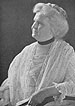 |
Mrs. Lydia Avery Coonley Ward.
The Mother of Wright client Avery Coonley (1907 - S.135) Circa 1914-15.
Lydia Avery Coonley was born in Virginia on Jan 31, 1845 to Benjamin
Franklin and Susan Look Avery. Lydia Avery Coonley became a writer,
publishing many poems. One poem entitled "Indian Summer", was published in
the Nov 3, 1894 "The Outlook". She compiled a number of poems and published
"Singing Verses for Children". She was also the author of "Under The Pines and Other Verses",
published in 1895 by another client of Wright's, Chauncey Williams, of Way &
Williams. She also wrote and published "Washington and Lincoln". She was
active in the women's movement, and was president of the Chicago Women's
Club from 1895-1896. On March 18, 1897, Lydia Avery Coonley, a wealthy
Chicago widow, married Naturalist Henry Augustus Ward. Original 3 x 4.25 B&W
photograph. Courtesy of the New York Public Library. |
0124.15.0112 |
C 1914
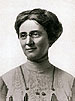 |
Grace Fuller Circa 1914 (1906 -
S.123). Frank Lloyd Wright designed the Grace Fuller House in 1906. No
evidence has been found to date that the house was ever built. According to
Karen Ettelson of the Glencoe Historical Society, Grace Fuller was a leader
of the community for quite some time before Wright prepared his 1906 designs
for her. She lived in the Thomas Allen home on the corner of Hazel Avenue
and Sheridan Road, Glencoe. Thomas Allen was the father of Grace's deceased
fiance. Grace became Mr. Allen's caregiver during the final years of his
life and when he died in 1897, he left the house and the bulk of his very
extensive estate (adjusted for inflation and estimated in current dollars to
be approximately $1.7 million) to Grace. She lived there until 1924 when she
sold the property. This photograph came from the 1914 Aurora Senior Class
Annual for Michigan State Normal College (which is now Eastern Michigan
University). At that time, Grace Fuller was Dean of Women and Head of the
Household Arts Department although she left the College shortly thereafter
in August of 1914. The Glencoe Historical Society has researched Grace
Fuller's life extensively, yet, she remains one of our greatest mysteries.
Courtesy of the Glencoe Historical Society. 8 x 10 Color photograph. |
0124.47.0221 |
C 1914
 |
Hotel Geneva, Lake Geneva,
Wisconsin, Circa 1914 (1911 - S.171). Not Dated. View of the entrance to the
Hotel Geneva. Designed by Frank Lloyd Wright in 1911. The drive appears to
be gravel. It does not appear that the area in front of the lobby has been
landscaped yet. Tall light poles is visible above large base. Smaller globes
are on the pedestals on either side of the stairs leading to the lobby. The
"Hotel Geneva" lettered across the front of the Lobby above the windows does
not yet exist. There is a horse and buggy to the far right behind the
automobile. Original 8 x 10 B&W photograph. |
0124.68.0724 |
1914
 |
Midway Garden
Sprite. Chicago Architectural Photographing Company, Chicago. Original gelatin silver photograph printed by photographer
Clarence Fuermann (1883-1983). Printed in the early 1960s from the
original negative (1913-14). Clarence Fuermann of Henry Fuermann and
Sons. The original image was published in "The Life-Work of the
American Architect Frank Lloyd
Wright" 1925, page 76,
center. 8 x 10.
For more information see
our Midway Gardens Study. |
1407.01.0406 |
Circa 1914
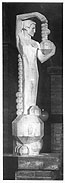 |
Midway Garden (1913 - S.180)
Male Sprite 1913-14. Male sprite holding a geometric dodecahedron, in the
Northeast corner of the Winter Garden. This sculpture appeared only once in
the Midway Gardens. In the May, 1915 issue of
"The International Studio" the
caption read "Sprites designed by Frank Lloyd Wright, executed by Alfonso Iannelli". A dispute arose between Iannelli and Wright as to who designed
the sculptures. Published in
"Life Work of the American Architect Frank Lloyd Wright", 1925, page 77.
Original 4 x 10.5 B&W photograph. Photographed by Clarence Fuermann. |
0124.17.0712 |
Circa 1914
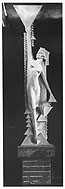 |
Midway Garden (1913 - S.180)
Female Sprite 1913-14. Female Sprite holding triangle in the Northwest
corner of the Winter Garden. This sculpture appeared only once in the Midway
Gardens. In the May, 1915 issue of "The International Studio" the caption
read "Sprites designed by Frank Lloyd Wright, executed by Alfonso Iannelli".
A dispute arose between Iannelli and Wright as to who designed the
sculptures. Published in "The International Studio", May, 1915, page LXXXI.
Original 4 x 10.5 B&W photograph. Photographed by Clarence Fuermann. |
0124.18.0712 |
Circa 1914
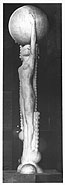 |
Midway Garden (1913 - S.180)
Female Sprite 1913-14. Female sprite holding a sphere, in the Southeast
corner of the Winter Garden. This sculpture appeared only once in the Midway
Gardens. In the May, 1915 issue of
"The International Studio" the caption
read "Sprites designed by Frank Lloyd Wright, executed by Alfonso Iannelli".
A dispute arose between Iannelli and Wright as to who designed the
sculptures. Original 4 x 10.5 B&W photograph. Photographed by Clarence Fuermann. |
0124.19.0712 |
1914
 |
Midway Gardens Summer Garden
1914. Photographed by Henry Fuermann & Sons in September 1914. The Southeast
corner of the interior, viewed from the North Terrace looking out over the
Summer Garden. The Winter Garden on the left, the South Belvedere is in the
center, and the South Arcade is on the right. Vases, Totem poles and Light
Tree are visible in the foreground. Label pasted to verso: "Photo caption:
Nostalgia buffs will get a glimpse of the past at the flower show where
'Memories of Midway Gardens' has been recreated by the Chicago School of
Architecture Foundation. This unique entertainment complex was designed by
Frank Lloyd Wright in 1914 and located near the University of Chicago. The
original Midway Gardens (pictured here) was a center for good entertainment,
food and music and was designed by Wright as a synthesis of architecture,
sculpture and painting. The mini-Midway gardens at the Flower Show was
designed by Joe Karr and Associates who designed the courtyard garden at
Glessner House, home of the Chicago School of Architecture Foundation, 1800
S. Prairie Avenue." Stamped on verso: Mar 29 1973". Acquired from the
archives of the Chicago Tribune. Original 10 x 8 B&W photograph. |
0124.14.1211 |
1914
 |
Midway Garden
Entrance (1914). Chicago Architectural Photographing Company,
photographer Clarence Fuermann (1883-1983), Chicago, (Note: "Domino's
Collection" page 152; "In The
Nature of Materials", page xvi, no. 194). Purchased from "The
Architectural Forum". Note on back indicates it was used by Arthur Drexler -
MOMA. This image published in "Frank Lloyd Wright:
Writings and Buildings"
1960, Edgar Kaufmann and Ben Raeburn, page 120. "Frank Lloyd Wright
and Midway Gardens" 1998, Paul Kruty,
page g. "Frank Lloyd Wright: Preserving an Architectural
Heritage, Domino’s Collection" David A. Hanks, page 89.
8 x 10.
For more information see
our Midway Gardens Study. |
1407.02.0706 |
1914
 |
Midway Gardens 1914.
Photographed by Henry Fuermann & Sons in 1914. Cottage Grove Avenue viewed
from the Northeast. The Winter Garden to the left side of this image, the
Tavern is on the right. Both towers are prominent above the Winter Garden.
Patterned concrete blocks, Two Queen of the Gardens and three Sprite statues
are visible. Caption on face: "The Chicago Architectural Photographing Co.
Midway Gardens, Cottage Grove Avenue at 60th Street, Chicago,
Illinois, 1914. Demolished." Stamped on verso: "Field Enterprises, Inc. Oct
1968." published in "Frank Lloyd Wright:
Writings and Buildings"
1960, Edgar Kaufmann and Ben Raeburn, page 120. "Frank Lloyd Wright
and Midway Gardens" 1998, Paul Kruty,
page g. "Frank Lloyd Wright: Preserving an Architectural
Heritage, Domino’s Collection" David A. Hanks, page 89.
Original 8 x 10
B&W photograph.
For more information see
our Midway Gardens Study. |
0124.12.0911 |
1914
 |
Midway Gardens, Chicago,
Illinois, 1914 (1913 - S.180). Set of six photographs of Midway Gardens,
held in the collection of the Oak Park Public Library. View of the North
entrance from Cottage Grove Avenue. The entrance includes three cantilevered
and trellised roof overhangs, patterned balcony concrete blocks, decorative
metal fascia cornices and two Sprites. Front doors, which open outward,
leading into the Belvedere are hidden approximately twenty-five feet within
the entrance. Designed by Frank Lloyd Wright in 1913. These photographs were
produced in the late 1970s. Hand written on verso: "Midway 41D."
Photographed by Henry Fuermann & Sons. Original 5 x 3.5 B&W photograph.
|
0124.46.0920
(1-6) |
1914
 |
Midway Gardens, Chicago, Illinois, Fuermann Photographs, 1914 (1913 -
S.180). Set of 23 historic photographs by Henry Fuermann & Sons, documenting
Midway Gardens in September 1914. Henry Fuermann & Sons photographedmany of
the buildings in the Chicago area. These Midway Gardens images photographed
in 1914 are an invaluable record of Wright's Masterpiece. The Images are the
most complete record of Midway Gardens as Wright envisioned it.
“Midway Gardens was an indoor and outdoor facility. It was comprised of a
music pavilion and stage, arcades on either side of the terraced summer
gardens, an indoor lobby, club, tavern, two belvederes, promenades...
Continue...
|
0124.84.1025 (1-23) |
1914
 |
Midway Gardens, Chicago, Illinois, Summer Garden 1914 (1913 - S.180). The
Midway Gardens Summer Garden at night, looking Southwest toward the Stage.
The South Arcade is to the left. Designed by Frank Lloyd Wright in 1913, it
was built in 1914. Midway Gardens covered a city block and included the
exterior summer garden with performance stage and an interior Winter Garden
for year round entertainment. Wright designed the complete structure:
furnishings, furniture, sculptures, murals, windows, dinnerware, monogram, a
complete work of art. Weed vases and table lamps can be seen in the
foreground. Light poles, urns and sprites can be seen in the background.
Text lower left: “Photo by J. W. Taylor, Chicago, 1914.” Photograph by J.W.
Taylor, Chicago, in 1914. This image was used in a postcard S#124.82. 10 x 8
B&W photograph. |
0124.81.0925 |
1914
 |
Study photograph of the 1914
Midway Garden real photo postcard. View of the Midway Gardens from the
Southeast. Very early nighttime photograph. Designed by Frank Lloyd Wright
in 1913. On June 27th, 1914, the Midway Gardens officially opened with the
National Symphony Orchestra. It had two excellent years as an entertainment
center providing exceptional dining, orchestra music, opera, exotic dancers
and in 1915, Anna Pavlova, the famous Russian Dancer. Although success at
first, Midway Gardens struggled financially. After only two years, on May
31, 1916, Midway Gardens was sold to the Edelweiss Brewery, turned into a
beer garden and renamed "Edelweiss Gardens." The building was demolished in
October of 1929. Very early nighttime photograph. Due to the postcard
lacking quality, we scanned the photo postcard at 600 DPI, enlarged the
image to 10 x 6.5 in order to enhance and study the details in the
photograph. Text on face: Midway Gardens, Chicago." Original postcard
published by AZO. AZO manufactured postcards between 1910 to 1930.
Original real photo postcard. 5.4 x 3.4. 10 x 6.5 Color
photograph. |
0124.50.1121 |
1914
 |
Exotic
Dancers, Midway Gardens 1914. Photographed by Collins (emboss on verso of
board). Possibly a publicity photograph or souvenir a that could be
purchased as a keepsake, 4.75 x 3.6, mounted to decorative board 6.76 x 5.8.
Photograph 4.75 x 3.6.
For more information see
our Midway Gardens Study. |
0124.03.0407 |
1914
 |
S. Mori Japanese Art Studio, Fine Arts Building,
Chicago, Illinois, Furniture Plan 1914 (FLLW#1402.01) (1914 - S.181).
Furniture plan for the S. Mori Japanese Art Studio, including chairs and two
stools. The Mori Studio, located in the Fine Arts Building, was the third
space designed by Frank Lloyd Wright. Wright first designed the space for
Browne’s Bookstore on the seventh floor in 1908 (S#141). His second design
was for the Thurber Arts Galleries, situated on the fifth floor of the annex
building, completed in 1909 (S.154). The Mori Studio, designed in 1914
(S.181), was situated on the eighth floor. Although Wright did not design a
space for himself, he did have an office from 1910-1911. The publisher,
Ralph Fletcher Seymour also had an office in the Fine Arts Building.
The text
indicated that Frank Lloyd Wright proposed producing two chairs, three short
stools and four tall stools. Text lower right: “S. Mori - Stools, Chairs.”
Text lower left: “1402.01.” 10 x 6.5 B&W photograph. Courtesy of the Frank
Lloyd Wright Archives, Avery Library, Columbia Univeresity. |
0124.86.1225 |
1914/2020

 |
S. Mori Japanese Art
Studio, Fine Arts Building, Chicago, Illinois, Stool 1914/2020 (1914 -
S.181). View of a stool designed by Frank Lloyd Wright for the S. Mori
Japanese Art Studio in 1914. The Mori Studio, located in the Fine Arts
Building, was the third space designed by Frank Lloyd Wright. Wright first
designed the space for Browne’s Bookstore on the seventh floor in 1908
(S#141). His second design was for the Thurber Arts Galleries, situated on
the fifth floor of the annex building, completed in 1909 (S.154). The Mori
Studio, designed in 1914 (S.181), was situated on the eighth floor. Although
Wright did not design a space for himself, he did have an office from
1910-1911. The publisher, Ralph Fletcher Seymour also had an office in the
Fine Arts Building. Courtesy of the Frank Lloyd Wright Foundation,
Scottsdale, AZ.
Plans in the Frank
Lloyd Wright Archives, Avery Library, indicate that Wright specified four
22" tall stools and three 17" tall stools. This is one of the 22" stools.
There is another example of a Mori stool in the Frank Lloyd Wright Home &
Studio, Oak Park, photographed in 2019 (ST#2019.64.0823-63). It appears to
be 22" Tall.
Toomey described this
as an occasional table, Frank Lloyd Wright specified this as a stool. The
Mori Studio was demolished in 1917, and photographs of the interior did not
survive. So there is no way to confirm how this stool/table was utilized.
This stool sold at Toomey & Co. on December 6, 2020, Price realized $12,500.
The stool/table measures 22" High x 19.75" Wide x 12" Deep. Produced in oak.
Courtesy of Toomey & Co. Original 8 x 10 Color photograph. |
0124.88.1225
(1-2) |
1914/2025
 |
S. Mori Japanese Art Studio,
Fine Arts Building, Chicago, Illinois, Chair 1914/2025 (1914 - S.181). View
of arm chair designed by Frank Lloyd Wright for the S. Mori Japanese Art
Studio in 1914. This chair was exhibited at the Museum of Wisconsin Art,
“Frank Lloyd Wright: Modern Chair Design,” October 4, 2025 - January 25,
2026. Museum description: “Frank Lloyd Wright: Modern Chair Design is a
visionary exhibition that reconsiders the Wisconsin-born architect’s
innovative and often overlooked contributions to furniture design. While
Wright is celebrated for his buildings and his role in shaping an American
architectural vision, he also designed more than two hundred chairs over the
course of his seventy-year career. This exhibition presents forty of
Wright’s most significant domestic pieces—several on view for the first
time—together with working sketches and archival photographs.”
The
Mori Studio, located in the Fine Arts Building, was the third space designed
by Frank Lloyd Wright. Wright first designed the space for Browne’s
Bookstore on the seventh floor in 1908 (S#141). His second design was for
the Thurber Arts Galleries, situated on the fifth floor of the annex
building, completed in 1909 (S.154). The Mori Studio, designed in 1914
(S.181)...
Continue... |
0124.87.1225 |
1914
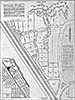 |
Ravine Bluffs Development,
Glencoe, Illinois, Ravine Bluffs Subdivision, 1914 (FLLW #1516.15). Ravine
Bluffs Subdivision was divided into 25 lots (1-17, 21-23, 2A-3A, 5A-7A). It
is bordered by the golf course on the North, Franklin Road on the East, and
the Milwaukee and Northwestern tracks on the Southwest.
In 1911,
Frank Lloyd Wright designed an estate for Sherman Booth, Scheme I. Lot 4
shows the placement of Scheme I. At that time, Booth was not planning to
subdivide the property, and in 1912, Wright had Jens Jensen created a
Planting Plan for the entire property. In 1912, Wright also designed Booth’s
Stable and Garage, completed that year. Lot 3 shows the placement of Booth’s
Stable and Garage. In 1913, Wright designed a Summer Cottage for Sherman
Booth. It was a temporary cottage, completed in 1913, and located in the
vacinity of Lot 1 & 2. After Wright’s second design for Booth was built, the
cottage was sold in 1916 and moved to the Franklin Street location where is
stood until it was moved again by the Glencoe Historical Society in July
2020. It now sits in the Park to the left of where Franklin Road and Maple
Hill road meet... Continue...
|
0124.66.0624 |
1914
 |
Marionette Theatre 1914. The
Marionette Theatre was displayed at an exhibition of Wright's work entitled "The
Work of Frank Lloyd Wright" at The Art Institute of Chicago in 1914. The
Marionette Theatre was
designed in 1908 for his son Llewellyn. The engraved masque reads, "To
Fashion Worlds in Little - Making Form As God Does One With Spirit - So God
Makes Use Of Poets", an adaptation of a passage from Richard Harvey's
"Taliesin". This quote was used three years before Wright began building
Taliesin I in 1911. Also visible in the photograph is a Coonley Playhouse
window (1912 - S.1912) and three Print Stands. The shorter version seen on
the left behind the Puppet Theater and the taller version seen on the right.
A smaller desk top Print Stand can be seen in the center. Also seen behind
the print stands center right are small models of the
Midway Gardens Sprite maquettes.
Published in Taliesin 1911-1914, Menocal, 1992, p.49. Text bottom left:
"12024." Hand written on verso: "F. L. Wright. An exhibition of his
architectural designs, Sept. 25 to Oct 12, 1930 (sic) at the Chicago Art
Institute, shown concurrently with an exhibition of Japanese prints, from
Buckingham called, By Utagaina Toyakuni." Stamped on verso: "Photographic
Archive, Art History Department, University of Minnesota." Acquired from the
achieves of the University of Minnesota. Original '7.5 x 10 B&W photograph.
For more information see our
Wright Study on the Japanese
Print Stand. |
0124.41.0420 |
1914
 |
Marionette Theatre 1914.
The
Marionette Theatre was displayed at an exhibition of Wright's work entitled
"The
Work of Frank Lloyd Wright" at The Art Institute of Chicago in 1914.
The
Marionette Theatre was designed in 1908 for his son Llewellyn. The engraved
masque reads, "To Fashion Worlds in Little - Making Form As God Does One
With Spirit - So God Makes Use Of Poets", an adaptation of a passage from
Richard Harvey's "Taliesin". This quote was used three years before Wright
began building Taliesin I in 1911. Also visible in the photograph is a
Coonley Playhouse window (1912 - S.1912) and three Print Stands. The shorter
version seen on the left behind the Puppet Theater and the taller version
seen on the right. A smaller desk top Print Stand can be seen in the center.
7.75 x 10 B&W print. Courtesy of The Frank Lloyd Wright Preservation Trust.
For more information see our
Wright Study on the Japanese
Print Stand. |
0124.13.1211 |
1914
 |
Frank Lloyd Wright at Exhibition 1914.
The
Work of Frank Lloyd Wright at The 27th Annual Exhibition of the
Chicago Architectural Club, held at the Art Institute of Chicago in the
Spring of 1914. Midway Gardens model is in the foreground on the right. The
reverse side of the Marionette Theatre, designed in 1908 for his son
Llewellyn, is in the center. There are five Print Stands visible in this
image. The two taller floor versions are seen on the far left and the right.
The shorter table top version is to the right of center. Not seen before are
the two desk top versions seen in the foreground on the left, and behind it
in the background. Drawings are on the wall in the background. Three
Midway Gardens
Sprite maquettes are visible, two on
the ledge to the left, and on in the background in the center. Published in
Wright
on Exhibit, Smith, 2017, p.38;
The Chicago
Architectural Club, Hasbrouck, 2005,
p.425. Photographed by Henry Fuermann & Sons. '7.5 x 10 B&W photograph.
(S#124.42) |
0124.42.0420 |
1914
 |
Frank Lloyd Wright at Exhibition 1914.
The
Work of Frank Lloyd Wright at The 27th Annual Exhibition of the
Chicago Architectural Club, held at the Art Institute of Chicago in the
Spring of 1914. Midway Gardens model is in the foreground. The reverse side
of the Marionette Theatre, designed in 1908 for his son Llewellyn, is to the
left. There are five Print Stands visible in this image. The two taller
floor versions are seen on the far left and the right. The shorter table top
version is in the center of the group. Not seen before are the two desk top
versions seen in the foreground on the left, and directly behind it. The
Call Building model 1 is to the right. Four
Midway Gardens Sprite maquettes are
visible, "Queen of the Gardens" and a "Sprite" are on the left, a "Triangle
Sprite" is in the center background, and a "Cube Sprite" on the right.
Drawings are on the wall in the background. Published in
Wright on Exhibit, Smith, 2017,
p.35; The Chicago Architectural Club,
Hasbrouck, 2005, p.425. Photographed by Henry Fuermann & Sons. 10 x 7.5 B&W
photograph.
|
0124.43.0520 |
1914
 |
Frank Lloyd Wright at Exhibition 1914.
The
Work of Frank Lloyd Wright at The 27th
Annual Exhibition of the Chicago Architectural Club, held at the Art
Institute of Chicago in the Spring of 1914. Midway Gardens model is in the
center. The Call Building model 1 is in the center background. The Coonley
playhouse model and window are along the wall to the right. There are four
visible Midway Gardens Sprite maquettes,
"Queen of the Gardens" and a "Sprite" are on the left, a "Sphere Sprite" is
along the wall behind the Midway Gardens model, and an "Octagonal Sprite" is
on the right. Drawings cover the walls in the background. Published in
Wright on Exhibit, Smith, 2017,
p.37; The The
Chicago Architectural Club, Hasbrouck,
2005, p.425. Photographed by Henry Fuermann & Sons. 10 x 7.75 B&W
photograph.
|
0124.44.0520 |
1914
 |
Frank Lloyd Wright at Exhibition 1914.
The
Work of Frank Lloyd Wright at The 27th
Annual Exhibition of the Chicago Architectural Club, held at the Art
Institute of Chicago in the Spring of 1914. Midway Gardens model is in the
center. The Marionette Theater and five print stands are in the center
background. The Marionette Theater was designed in 1908 for his son
Llewellyn. The Call Building model 1 is in the background to the right.
There are five visible Midway Gardens
Sprite maquettes, a "Sprite" and "Queen of the Gardens" are on the
left, a "Sprite" with baton is to the right of the plant, a Triangle Sprite"
is along the wall in the center, and an "Octagonal Sprite" is on the right.
Drawings cover the walls in the background. Published in
Wright on Exhibit, Smith, 2017,
p.34. Photographed by Henry Fuermann & Sons. 10 x 7.8 B&W photograph.
|
0124.45.0520 |
1914
 |
Taliesin I Entrance Gate circa 1914
(1911 - S.172). Picnic near Taliesin Gate. A group of unidentified picnic
goers relaxing near the gate at Taliesin. Taliesin I was designed by Frank
Lloyd Wright in 1911. The Entrance masonry was built between 1911-1912.
Taliesin was partially destroyed by fire on August 15, 1914. Group of seven
photographs pasted front and back to a scrap book page. Acquired from the
granddaughter of Emma Stephenson who lived in Mineral Point, Wisconsin, 25
miles South of Taliesin. The photograph album from which these photos were
taken begins in February of 1914.
1) Bottom Center: Group of picnicker standing at the
open entrance gate at Taliesin. Large Wright designed planter urns set atop
the walls and piers constructed of Limestone... Continue...
|
0124.28.0918 |
1914
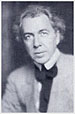 |
Wright at 47. Circa
1914. Portrait of Wright facing slightly to the left. This was taken about
the time he was completing Midway Gardens. Published in "An
Autobiography,
Frank Lloyd Wright",
page 192a. 4.6 x 7 Print, High res digital image. |
0124.09.0709 |
|
1915 |
| |
American System-Built Houses (1915-17 -
S.200-204). In a letter written by
Bruce Brooks Pfeiffer dated May 9, 1972, Pfeiffer writes, "Frank Lloyd
Wright began work, in 1911 on a scheme of precut, prefabricated housing
called the American System-Built Homes..." American System-Built Houses,
McArthur, 1985, p.13. "The drawing file for the American System-Built Houses
is the largest in the Taliesin archives, over nine hundred sheets the
greater part of which are working drawings done in ink on waxed linen
tracing cloth. Work on this particular project went on over a period of many
years, from 1911 to 1917. The size of the file bears witness to the
importance of the work, especially since
Frank Lloyd Wright believed that by means
of the machine and prefabrication, housing on a moderate scale cost could be
produced in the United States..."
Frank Lloyd Wright Monograph 4, Pfeiffer,
1985, p.92. It would appear that Pfeiffer believes that the concept was
completely Wright's. But Pfeiffer writes that in 1915, "Arthur Richards...
"then employed Wright to design a system of low-cost homes, called The
American Ready-Cut System or American System-Built Houses." Wright
1885-1916, Pfeiffer, 2011, p.483. In 1992, from January 24 - February 22,
Kelmscott Gallery, exhibited a dozen previously unpublished designs of
Frank Lloyd
Wright's American System-Built Houses. |
|
C
1915
 |
American System-Built Houses, Model
A101, Circa 1915-1917 (1915-17 - S.200-204). Photograph of the promotional
page for Model A101. In 1911, Frank Lloyd Wright began work on a concept for
precut, prefabricated housing called the American System-Built Homes. In
1915, Wright partnered with Arthur Richards and produced a line of
prefabricated homes. Promotional material was produced to facilitate the
sale of the homes. Text of face: "American Model A101. Patents Applied For.
American System-Built Houses. Designed By Frank Lloyd Wright. The Richards
Company Proprietors. Milwaukee." Original size of the flyer, 8.5 x 11. 8 x
10 color photograph courtesy of the Museum of Modern Art. |
0128.22.1216 |
C
1915
 |
American System-Built Houses, Model
A221, Circa 1915-1917 (1915-17 - S.200-204). Photograph of the promotional
page for Model A221. In 1911, Frank Lloyd Wright began work on a concept for
precut, prefabricated housing called the American System-Built Homes. In
1915, Wright partnered with Arthur Richards and produced a line of
prefabricated homes. Promotional material was produced to facilitate the
sale of the homes. Text of face: "American Model A221. Patents Applied For.
American System-Built Houses. Designed By Frank Lloyd Wright. The Richards
Company Proprietors. Milwaukee." Original size of the flyer, 8.5 x 11. 8 x
10 color photograph courtesy of the Museum of Modern Art. |
0128.23.1216 |
C
1915
 |
American System-Built Houses, Model
A231, Circa 1915-1917 (1915-17 - S.200-204). Photograph of the promotional
page for Model A231. In 1911, Frank Lloyd Wright began work on a concept for
precut, prefabricated housing called the American System-Built Homes. In
1915, Wright partnered with Arthur Richards and produced a line of
prefabricated homes. Promotional material was produced to facilitate the
sale of the homes. Text of face: "American Model A231. Patents Applied For.
American System-Built Houses. Designed By Frank Lloyd Wright. The Richards
Company Proprietors. Milwaukee." Original size of the flyer, 8.5 x 11. 8 x
10 color photograph courtesy of the Museum of Modern Art. |
0128.24.1216 |
C
1915
 |
American System-Built Houses, Model
A243, Circa 1915-1917 (1915-17 - S.200-204). Photograph of the promotional
page for Model A243. In 1911, Frank Lloyd Wright began work on a concept for
precut, prefabricated housing called the American System-Built Homes. In
1915, Wright partnered with Arthur Richards and produced a line of
prefabricated homes. Promotional material was produced to facilitate the
sale of the homes. Text of face: "American Model A243. Patents Applied For.
American System-Built Houses. Designed By Frank Lloyd Wright. The Richards
Company Proprietors. Milwaukee." Original size of the flyer, 8.5 x 11. 8 x
10 color photograph courtesy of the Museum of Modern Art. |
0128.25.1216 |
C
1915
 |
American System-Built Houses, Model B1 Floor Plan, Circa 1915-1917 (1915-17
- S.200-204). Photograph of the promotional page for Model B1 Floor Plan. In
1911, Frank Lloyd Wright began work on a concept for precut, prefabricated
housing called the American System-Built Homes. In 1915, Wright partnered
with Arthur Richards and produced a line of prefabricated homes. Promotional
material was produced to facilitate the sale of the homes. Text of face:
"American Model B1. Patents Applied For. American System-Built Houses.
Designed By Frank Lloyd Wright. The Richards Company Proprietors.
Milwaukee." Original size of the flyer, 8.5 x 11. 8 x 10 color photograph
courtesy of the Library of Congress. |
0128.46.1216 |
C
1915
 |
American System-Built Houses, Model
B11, Circa 1915-1917 (1915-17 - S.200-204). Photograph of the promotional
page for Model B11. In 1911, Frank Lloyd Wright began work on a concept for
precut, prefabricated housing called the American System-Built Homes. In
1915, Wright partnered with Arthur Richards and produced a line of
prefabricated homes. Promotional material was produced to facilitate the
sale of the homes. Text of face: "American Model B11. Patents Applied For.
American System-Built Houses. Designed By Frank Lloyd Wright. The Richards
Company Proprietors. Milwaukee." Original size of the flyer, 8.5 x 11. 8 x
10 color photograph courtesy of the Museum of Modern Art. |
0128.26.1216 |
C
1915
 |
American System-Built Houses, Model
B23, Circa 1915-1917 (1915-17 - S.200-204). Photograph of the promotional
page for Model B23. In 1911, Frank Lloyd Wright began work on a concept for
precut, prefabricated housing called the American System-Built Homes. In
1915, Wright partnered with Arthur Richards and produced a line of
prefabricated homes. Promotional material was produced to facilitate the
sale of the homes. Text of face: "American Model B23. Patents Applied For.
American System-Built Houses. Designed By Frank Lloyd Wright. The Richards
Company Proprietors. Milwaukee." Original size of the flyer, 8.5 x 11. 8 x
10 color photograph courtesy of the Museum of Modern Art. |
0128.27.1216 |
C
1915
 |
 American
System-Built Houses, Model C3, Circa 1915-1917 (1915-17 - S.200-204).
Photograph of the promotional page for Model C3. In 1911, Frank Lloyd Wright
began work on a concept for precut, prefabricated housing called the
American System-Built Homes. In 1915, Wright partnered with Arthur Richards
and produced a line of prefabricated homes. Promotional material was
produced to facilitate the sale of the homes. Text of face: "American Model
C3. Patents Applied For. American System-Built Houses. Designed By Frank
Lloyd Wright. The Richards Company Proprietors. Milwaukee." Original size of
the flyer, 8.5 x 11. 8 x 10 color photograph courtesy of the Museum of
Modern Art. Also an original 8 x 10 B&W photograph acquired from the
Kelmscott Gallery, produced for a exhibit held at the Gallery on January 24
- February 22, 1992. American
System-Built Houses, Model C3, Circa 1915-1917 (1915-17 - S.200-204).
Photograph of the promotional page for Model C3. In 1911, Frank Lloyd Wright
began work on a concept for precut, prefabricated housing called the
American System-Built Homes. In 1915, Wright partnered with Arthur Richards
and produced a line of prefabricated homes. Promotional material was
produced to facilitate the sale of the homes. Text of face: "American Model
C3. Patents Applied For. American System-Built Houses. Designed By Frank
Lloyd Wright. The Richards Company Proprietors. Milwaukee." Original size of
the flyer, 8.5 x 11. 8 x 10 color photograph courtesy of the Museum of
Modern Art. Also an original 8 x 10 B&W photograph acquired from the
Kelmscott Gallery, produced for a exhibit held at the Gallery on January 24
- February 22, 1992. |
0128.28.1216 0128.29.1216 |
C
1915
 |
 American
System-Built Houses, Model C3 Floor Plan, Circa 1915-1917 (1915-17 -
S.200-204). Photograph of the promotional page for Model C3 Floor Plan. In
1911, Frank Lloyd Wright began work on a concept for precut, prefabricated
housing called the American System-Built Homes. In 1915, Wright partnered
with Arthur Richards and produced a line of prefabricated homes. Promotional
material was produced to facilitate the sale of the homes. Text of face:
"American Model C3. Patents Applied For. American System-Built Houses.
Designed By Frank Lloyd Wright. The Richards Company Proprietors.
Milwaukee." Original size of the flyer, 8.5 x 11. 8 x 10 color photograph
courtesy of the Museum of Modern Art. Also an original 8 x 10 B&W photograph
acquired from the Kelmscott Gallery, produced for a exhibit held at the
Gallery on January 24 - February 22, 1992. American
System-Built Houses, Model C3 Floor Plan, Circa 1915-1917 (1915-17 -
S.200-204). Photograph of the promotional page for Model C3 Floor Plan. In
1911, Frank Lloyd Wright began work on a concept for precut, prefabricated
housing called the American System-Built Homes. In 1915, Wright partnered
with Arthur Richards and produced a line of prefabricated homes. Promotional
material was produced to facilitate the sale of the homes. Text of face:
"American Model C3. Patents Applied For. American System-Built Houses.
Designed By Frank Lloyd Wright. The Richards Company Proprietors.
Milwaukee." Original size of the flyer, 8.5 x 11. 8 x 10 color photograph
courtesy of the Museum of Modern Art. Also an original 8 x 10 B&W photograph
acquired from the Kelmscott Gallery, produced for a exhibit held at the
Gallery on January 24 - February 22, 1992. |
0128.30.1216 0128.31.1216 |
C
1915
 |
 American
System-Built Houses, Model C3 Interior, Circa 1915-1917 (1915-17 -
S.200-204). Photograph of the promotional page for Model C3 Interior. In
1911, Frank Lloyd Wright began work on a concept for precut, prefabricated
housing called the American System-Built Homes. In 1915, Wright partnered
with Arthur Richards and produced a line of prefabricated homes. Promotional
material was produced to facilitate the sale of the homes. Text of face:
"American Model C3. Patents Applied For. American System-Built Houses.
Designed By Frank Lloyd Wright. The Richards Company Proprietors.
Milwaukee." Original size of the flyer, 8.5 x 11. 8 x 10 color photograph
courtesy of the Museum of Modern Art. Also an original 8 x 10 B&W photograph
acquired from the Kelmscott Gallery, produced for a exhibit held at the
Gallery on January 24 - February 22, 1992. American
System-Built Houses, Model C3 Interior, Circa 1915-1917 (1915-17 -
S.200-204). Photograph of the promotional page for Model C3 Interior. In
1911, Frank Lloyd Wright began work on a concept for precut, prefabricated
housing called the American System-Built Homes. In 1915, Wright partnered
with Arthur Richards and produced a line of prefabricated homes. Promotional
material was produced to facilitate the sale of the homes. Text of face:
"American Model C3. Patents Applied For. American System-Built Houses.
Designed By Frank Lloyd Wright. The Richards Company Proprietors.
Milwaukee." Original size of the flyer, 8.5 x 11. 8 x 10 color photograph
courtesy of the Museum of Modern Art. Also an original 8 x 10 B&W photograph
acquired from the Kelmscott Gallery, produced for a exhibit held at the
Gallery on January 24 - February 22, 1992.
|
0128.32.1216 0128.47.1216 |
C
1915
 |
American System-Built Houses, Model C3 Interior, Circa
1915-1916 (1915-17 - S.200-204). Lower Photograph: Photograph of the
original perspective illustration for bungalow
Model C3 interior. In 1911,
Frank Lloyd Wright began work on a concept for precut, prefabricated housing
called the American System-Built Homes. In 1915, Wright partnered with
Arthur Richards and produced a line of prefabricated homes. Text on face:
"The Wright State. Frank Lloyd Wright in Wisconsin. September 11 - November
8, 1992. Milwaukee Art Museum... Perspective of Bungalow Living Room,
American System-Built Homes, Milwaukee, 1915-1916. Copyright 1984 The Frank
Lloyd Wright Archives." Text on face of illustration: "C3. American Model.
Frank Lloyd Wright Architect - Chicago." Text on illustration bottom right:
"Patent Applied For." Clipping pasted to verso: "Milwaukee Art Museum. The
photograph of Frank Lloyd Wright (above) in the Garden at Taliesin, Wis.,
taken Sept. 1, 1939, will be part of the museum's exhibit "Frank Lloyd
Wright in Wisconsin," Sept. 11 through Nov 8. Also on display will be a work
station (right) designed for the S. C. Johnson and Son Administration
Building in Racine." Stamped on clipping" FR Sep 4 - 1992." Upper
Photograph: S. C. Johnson Work Station, Desk and Office Chair, 1944. Text:
"Work Station (Desk and Chair), S.C. Johnson and Son Administration
Building, Racine, 1944. Courtesy S.C. Johnson and Son, Inc. Photo by P.
Richard Eells." Original 8 x 10 B&W photograph.
|
0128.66.1019 |
C
1915
 |
American System-Built Houses, Model
D1, Circa 1915-1917 (1915-17 - S.200-204). Photograph of the promotional
page for Model D1. In 1911, Frank Lloyd Wright began work on a concept for
precut, prefabricated housing called the American System-Built Homes. In
1915, Wright partnered with Arthur Richards and produced a line of
prefabricated homes. Promotional material was produced to facilitate the
sale of the homes. Text of face: "American Model D1. Patents Applied For.
American System-Built Houses. Designed By Frank Lloyd Wright. The Richards
Company Proprietors. Milwaukee." Original size of the flyer, 8.5 x 11. 8 x
10 color photograph courtesy of the Museum of Modern Art. |
0128.33.1216 |
C
1915
 |
American System-Built Houses, Model
D1 Floor Plan, Circa 1915-1917 (1915-17 - S.200-204). Photograph of the
promotional page for Model D1 Floor Plan. In 1911, Frank Lloyd Wright began
work on a concept for precut, prefabricated housing called the American
System-Built Homes. In 1915, Wright partnered with Arthur Richards and
produced a line of prefabricated homes. Promotional material was produced to
facilitate the sale of the homes. Text of face: "American Model D1. American
System-Built Houses. Designed By Frank Lloyd Wright. The Richards Company
Proprietors. Milwaukee." Original size of the flyer, 8.5 x 11. 8 x 10 color
photograph courtesy of the Museum of Modern Art. |
0128.34.1216 |
C
1915
 |
American System-Built Houses, Model
D1 Floor Plan Second Floor, Circa 1915-1917 (1915-17 - S.200-204).
Photograph of the promotional page for Model D1 Floor Plan for the Second
Floor. In 1911, Frank Lloyd Wright began work on a concept for precut,
prefabricated housing called the American System-Built Homes. In 1915,
Wright partnered with Arthur Richards and produced a line of prefabricated
homes. Promotional material was produced to facilitate the sale of the
homes. Text of face: "American Model D1. American System-Built Houses.
Designed By Frank Lloyd Wright. The Richards Company Proprietors.
Milwaukee." Original size of the flyer, 8.5 x 11. 8 x 10 color photograph
courtesy of the Museum of Modern Art. |
0128.35.1216 |
C
1915
 |
 American
System-Built Houses, Model D101, Circa 1915-1917 (1915-17 - S.200-204).
Photograph of the promotional page for Model D101. In 1911, Frank Lloyd
Wright began work on a concept for precut, prefabricated housing called the
American System-Built Homes. In 1915, Wright partnered with Arthur Richards
and produced a line of prefabricated homes. Promotional material was
produced to facilitate the sale of the homes. Text of face: "American Model
D101. Patents Applied For. American System-Built Houses. Designed By Frank
Lloyd Wright. The Richards Company Proprietors. Milwaukee." Original size of
the flyer, 8.5 x 11. 8 x 10 color photograph courtesy of the Museum of
Modern Art. Also an original 8 x 10 B&W photograph acquired from the
Kelmscott Gallery, produced for a exhibit held at the Gallery on January 24
- February 22, 1992. American
System-Built Houses, Model D101, Circa 1915-1917 (1915-17 - S.200-204).
Photograph of the promotional page for Model D101. In 1911, Frank Lloyd
Wright began work on a concept for precut, prefabricated housing called the
American System-Built Homes. In 1915, Wright partnered with Arthur Richards
and produced a line of prefabricated homes. Promotional material was
produced to facilitate the sale of the homes. Text of face: "American Model
D101. Patents Applied For. American System-Built Houses. Designed By Frank
Lloyd Wright. The Richards Company Proprietors. Milwaukee." Original size of
the flyer, 8.5 x 11. 8 x 10 color photograph courtesy of the Museum of
Modern Art. Also an original 8 x 10 B&W photograph acquired from the
Kelmscott Gallery, produced for a exhibit held at the Gallery on January 24
- February 22, 1992. |
0128.36.1216 0128.37.1216 |
C
1915
 |
 American
System-Built Houses, Model E3, Circa 1915-1917 (1915-17 - S.200-204).
Photograph of the promotional page for Model E3. In 1911, Frank Lloyd Wright
began work on a concept for precut, prefabricated housing called the
American System-Built Homes. In 1915, Wright partnered with Arthur Richards
and produced a line of prefabricated homes. Promotional material was
produced to facilitate the sale of the homes. Text of face: "American Model
E3. Patents Applied For. American System-Built Houses. Designed By Frank
Lloyd Wright. The Richards Company Proprietors. Milwaukee." Original size of
the flyer, 8.5 x 11. 8 x 10 color photograph courtesy of the Museum of
Modern Art. Also an original 8 x 10 B&W photograph produced for a exhibit
held at the Gallery on January 24 - February 22, 1992. Stamped on Verso:
"Sun Jan 19 1992". Caption pasted on verso: "A dozen previously unpublished
designs for FLW pre-fabricated houses will be shown at the Kelmscott Gallery
starting Friday." Acquired from the archives of the Associated Press.
Original 8 x 10 B&W photograph. American
System-Built Houses, Model E3, Circa 1915-1917 (1915-17 - S.200-204).
Photograph of the promotional page for Model E3. In 1911, Frank Lloyd Wright
began work on a concept for precut, prefabricated housing called the
American System-Built Homes. In 1915, Wright partnered with Arthur Richards
and produced a line of prefabricated homes. Promotional material was
produced to facilitate the sale of the homes. Text of face: "American Model
E3. Patents Applied For. American System-Built Houses. Designed By Frank
Lloyd Wright. The Richards Company Proprietors. Milwaukee." Original size of
the flyer, 8.5 x 11. 8 x 10 color photograph courtesy of the Museum of
Modern Art. Also an original 8 x 10 B&W photograph produced for a exhibit
held at the Gallery on January 24 - February 22, 1992. Stamped on Verso:
"Sun Jan 19 1992". Caption pasted on verso: "A dozen previously unpublished
designs for FLW pre-fabricated houses will be shown at the Kelmscott Gallery
starting Friday." Acquired from the archives of the Associated Press.
Original 8 x 10 B&W photograph. |
0128.38.1216 0128.39.1216 |
C
1915
 |
American System-Built Houses, Model J400 Floor Plan, Circa 1915-1917
(1915-17 - S.200-204). Photograph of the promotional page for Model J400. In
1911, Frank Lloyd Wright began work on a concept for precut, prefabricated
housing called the American System-Built Homes. In 1915, Wright partnered
with Arthur Richards and produced a line of prefabricated homes. Promotional
material was produced to facilitate the sale of the homes. Text of face:
"American Model J400. Patents Applied For. American System-Built Houses.
Designed By Frank Lloyd Wright. The Richards Company Proprietors.
Milwaukee." Original size of the flyer, 8.5 x 11. 8 x 10 color photograph
courtesy of the Museum of Modern Art. |
0128.40.1216 |
C
1915
 |
American System-Built Houses, Model J401, Circa 1915-1917 (1915-17 -
S.200-204). Photograph of the promotional page for Model J401. In
1911, Frank Lloyd Wright began work on a concept for precut, prefabricated
housing called the American System-Built Homes. In 1915, Wright partnered
with Arthur Richards and produced a line of prefabricated homes. Promotional
material was produced to facilitate the sale of the homes. Text of face:
"American Model J401. Patents Applied For. American System-Built Houses.
Designed By Frank Lloyd Wright. The Richards Company Proprietors.
Milwaukee." Original size of the flyer, 8.5 x 11. 8 x 10 color photograph
courtesy of the Museum of Modern Art. |
0128.41.1216 |
C
1915
 |
American System-Built Houses, Model J900 Floor Plan, Circa 1915-1917
(1915-17 - S.200-204). Photograph of the promotional page for Model
J900 Floor Plan. In 1911, Frank Lloyd Wright began work on a concept for
precut, prefabricated housing called the American System-Built Homes. In
1915, Wright partnered with Arthur Richards and produced a line of
prefabricated homes. Promotional material was produced to facilitate the
sale of the homes. Text of face: "American Model J900. Patents Applied For.
American System-Built Houses. Designed By Frank Lloyd Wright. The Richards
Company Proprietors. Milwaukee." Original size of the flyer, 8.5 x 11. 8 x
10 color photograph courtesy of the Museum of Modern Art. |
0128.44.1216 |
C
1915
 |
 American System-Built Houses, Model J902, Circa 1915-1917 (1915-17 -
S.200-204). Photograph of the promotional page for Model J902. In 1911,
Frank Lloyd Wright began work on a concept for precut, prefabricated housing
called the American System-Built Homes. In 1915, Wright partnered with
Arthur Richards and produced a line of prefabricated homes. Promotional
material was produced to facilitate the sale of the homes. Text of face:
"American Model J902. Patents Applied For. American System-Built Houses.
Designed By Frank Lloyd Wright. The Richards Company Proprietors.
Milwaukee." Original size of the flyer, 8.5 x 11. 8 x 10 color photograph
courtesy of the Museum of Modern Art. Also an original 8 x 10 B&W photograph
acquired from the Kelmscott Gallery, produced for a exhibit held at the
Gallery on January 24 - February 22, 1992. Label on Verso: ".Kelmscott
Gallery." American System-Built Houses, Model J902, Circa 1915-1917 (1915-17 -
S.200-204). Photograph of the promotional page for Model J902. In 1911,
Frank Lloyd Wright began work on a concept for precut, prefabricated housing
called the American System-Built Homes. In 1915, Wright partnered with
Arthur Richards and produced a line of prefabricated homes. Promotional
material was produced to facilitate the sale of the homes. Text of face:
"American Model J902. Patents Applied For. American System-Built Houses.
Designed By Frank Lloyd Wright. The Richards Company Proprietors.
Milwaukee." Original size of the flyer, 8.5 x 11. 8 x 10 color photograph
courtesy of the Museum of Modern Art. Also an original 8 x 10 B&W photograph
acquired from the Kelmscott Gallery, produced for a exhibit held at the
Gallery on January 24 - February 22, 1992. Label on Verso: ".Kelmscott
Gallery." |
0128.42.1216 0128.43.1216 |
C
1915
 |
American System-Built Houses, (Generic) Floor Plan, Circa 1915-1917 (1915-17
- S.200-204). Photograph of the promotional page of a Generic Floor Plan. In
1911, Frank Lloyd Wright began work on a concept for precut, prefabricated
housing called the American System-Built Homes. In 1915, Wright partnered
with Arthur Richards and produced a line of prefabricated homes. Promotional
material was produced to facilitate the sale of the homes. Text of face:
"American System-Built Houses. Designed By Frank Lloyd Wright. The Richards
Company Proprietors. Milwaukee." Original size of the flyer, 8.5 x 11. 8 x
10 color photograph courtesy of the Museum of Modern Art. |
0128.45.1216 |
1915
 |
Sherman Booth Residence Scheme
II, Glencoe, Illinois Ground Plan & Elevations 1915 (1915 - S.187) (1915 - FLLW #1502).
Ground plan for the Sherman Booth Residence, Scheme II. Designed by Frank
Lloyd Wright in 1915. Understanding the Sherman M. Booth Stable and Garage
is essential in the development of Scheme II. It literally became the
foundation of the house that was built. The garage and stables were actually
two separate building set at right angles to each other, but not touching.
The smaller of the two buildings was the stable. The garage was actually a
small, 730 square foot house with two large garage bays.
By the end 1914 the decision was made, and Wright
began designing plans for Scheme II early in 1915. Wright incorporated the
Stable and Garage (Gardener’s Cottage) and designed the new house around the
original two building. Written on the initial plans were “Alterations of
Gardener’s Cottage” and “Alterations of and Additions to Gardener’s
Cottage.” On this Ground Plan, FLLW#1502.02, the original two buildings are
indicated in “red” lines...
Continue...
|
0128.75.0524 0128.76.0524 0128.77.0524 |
1915
 |
Avery Coonley Playhouse, Riverside,
Illinois, Exterior Circa 1915 (1912 - S.174). Perspective view of the front
elevation of the Avery Coonley Playhouse from the South. Mrs. Avery (Queene
Ferry) Coonley, a believer in early childhood education, attempted to enroll
her daughter in Kindergarten. She was denied entrance because her daughter
was not yet five. In 1906, Mrs. Coonley formed the Cottage School in
Riverside, Illinois, a private independent school. Designed by Frank Lloyd
Wright in 1912 to accommodate the growth of the Cottage School. Possibly
Frank Lloyd Wright’s most famous triptych dominates the front elevation of
the playhouse. Photographed by Henry Feurmann. 10 x 8 B&W photograph. |
0128.88.0625 |
1915
 |
Avery
Coonley Playhouse (1912 - S.174) interior, circa 1915. View of the interior
from the South end toward the Fireplace. In 1906, Mrs. Coonley formed the
Cottage School in Riverside, Illinois, a private independent school. In
1912, Wright designed the Coonley Playhouse to accommodate the growth of the
Cottage School. The Fireplace and Stage are in the background. The Kitchen
is through the folding doors on the left. The Workshop is through the
folding doors on the right. Wright designed art glass decorate the
clerestory windows. Wright designed tables and chairs fill the Assembly
area. Photographed by Henry Feurmann. Original 10 x 7.75 B&W photograph. |
0128.13.0613 |
1915
 |
Avery Coonley Playhouse, Riverside, Illinois, interior, circa 1915 (1912 -
S.174). Interior view from the North end toward the triptych. In 1906, Mrs.
Coonley formed the Cottage School in Riverside, Illinois, a private
independent school. In 1912, Wright designed the Coonley Playhouse to
accommodate the growth of the Cottage School. The Workshop is to the left.
Wright designed art glass that decorate the clerestory windows. Wright also
designed the tables and chairs that fill the Assembly area. Photographed by
Henry Feurmann. Published in Wendingen Volume II No. 4, November, 1925,
p.33. Original 10 x 8 B&W photograph. |
0128.89.0625 |
C
1915
 |
Robert G. Emmond Residence, LaGrange, Illinois Circa 1915 (not dated) (1892
- S.015). Viewed from the Southwest. Designed and built in 1892 while Frank
Lloyd Wright still worked for Louis Sullivan, it is considered one of
Wright's "bootlegged" houses. It is similar in design to the
Thomas Gale Residence (1892 - S.016) and
the Robert Parker Residence (1892 - S.017). It is also one of Wright's
earliest designs. According to the Frank Lloyd Wright Trust, "1935 - the
terraces were enlarged and enclosed." According to Storrer, "...the Emmond
has been resurfaced with brick on the lower story; the terraces have been
enlarged and enclosed (about 1935)." The Frank Lloyd Wright Preservation
Trust dates this image 1895. The short walls that surround the front Terrace
are as originally built. An awning has been added above the front door. The
side terrace has been enlarged and covered, and the design somewhat blends
with the original design. The roof at this point is flat, and the house
today has been restore to this design. The Terrace was later enclosed, and a
pitched roof added. Courtesy of the Frank Lloyd Wright Preservation Trust.
10 x 8 B&W photograph. |
0128.65.0619 |
C
1915-1920
 |
Samuel & Lena Horner Residence
(1908 - S.142). Front exterior viewed from the street, looking South circa
1915-1920. As you entered the sidewalk on the left, you passed the Garden
Wall with it's pedestal that begged for a urn. A large prairie styled Robie
House urn would have fit perfectly. Turning right into the Garden, you
entered the home through the front door. The Reception Room is on the left.
Five wide stairs lead up to the balance of the first level. The Living Room
is in the center foreground with art glass doors that exit out to an
enclosed Terrace. The symmetrical Garden Wall on the far right. Upper level.
As you reached the top of the stairs, the Bedrooms and the Bath were reached
by turning left. The Balcony on the east (left) above the Reception Room was
reached through the two smaller Bedrooms in the center of the upper level. A
row of art glass windows were just beneath the roof line of the Master
Bedroom in the center. The Balconies had built-in Planters on either end.
The low pitch of the roof almost gives the appearance of being flat like the
Gale Residence. Photographed by Henry Fuermann. Courtesy of The Art
Institute of Chicago. Original 7 x 9 B&W photograph.
|
0128.11.0612 |
C
1915-20  |
Lake Geneva, Wisconsin. Photo Package. Package of 10 Genuine Photographs,
Lake Geneva, Wis. One photo of Hotel Geneva (1.75 x 2.75"). Grogan Photo
Systems, Inc.
|
0104.03.0602 |
C 1915-20
 |
Lake Geneva, Wisconsin. Photo Package. Package of 10 Genuine Photographs,
Lake Geneva, Wis. One photo of Hotel Geneva (1.75 x 2.75"). Grogan Photo
Systems, Inc.
|
0104.04.0307 |
1915
 |
A. D. German Warehouse, Richland Center, Wisconsin, Photograph of
Perspective Drawing 1915 (1915 - S.183).
Frank Lloyd Wright's
perspective drawing of the A. D. German Warehouse gives a clear impression
as to Wright's original intent for the building's design. With the added
details, never completed: Corner flag poles with hanging light fixtures;
Additional concrete lintel, faced with abstract patterns above the
projecting roof over the clerestory windows that ran above the entrance; A
single entrance with decorative concrete columns; And horizontal sash bars
on either end of the plate glass windows. In total, these details complete
the design which always appeared as incomplete. 9.5 x 8 Color photograph.
|
0128.48.1216 |
C 1915
 |
Portrait of Albert Delvino German, circa 1915.
Born December 18, 1875. Frank Lloyd Wright client. Photographed by Hillman, Richland Center, Wisconsin.
Courtesy of the AD German Warehouse Conservancy. 8 x 10 B&W photograph. |
0128.21.0316 |
1915
 |
Larkin Building. Darwin D. Martin's desk designed
by Frank Lloyd Wright in the Larkin Administration Building (1905) atrium, Buffalo, New York,
August 3, 1915 (Martin was CEO of Larkin). It shows Martin's desk on his
return from a family vacation to Yosemite. The "Welcome Home" flowers are in
a Rookwood(?) vase. In the early 1980s the Kelmscott Gallery acquired this
photograph from the estate of Darwin. D. Martin. It beautifully illustrates
Wright's concept of a common workspace for executives and employees. The
desk by Van Dorn Iron Works Company had "drawers of various sizes and
designed to provide space for specific forms and papers". The chair is
designed with painted steel and an oak seat. The
photograph is so clear that "Tuesday August 3" is visible on a number of
desk calendars. According to the Graycliff Conservatory, Inc., Scott
Elliott (Kelmscott Gallery) donated an impressive collection of historic
photographs of the Darwin D. Martin family, including a photo album and
journal of the Martin family's cross country trip to California including
Yosemite National Park in 1915. The Larkin
Company was a mail-order house that sold soap and other household products. The building was demolished between February and July 1950.
Published in "Frank
Lloyd Wright's Larkin Building, Myth and Fact" Quinan, 1989,
page 50.
Original silver gelatin 1915 photograph. Photographer unknown. 7.5 x 7.75. |
0128.02.0107 |
C 1915-20
 |
Pebbles and Balch
Remodeling, Oak Park, Circa 1915-20 (1907 - S.131). In the late 1800's,
brothers Alonzo and Samuel Pebbles formed a decorating and painting company
in Oak Park. In 1898, it was the oldest established business in Oak Park. In
1883 they moved the store to 144 Lake Street, which later became 1107 Lake
Street, the address that Frank Lloyd Wright remodeled. By the late 1890's it
employed more people than any other private business in Oak Park. Oscar B.
Balch moved to Oak Park in 1890, where he joined the firm of A. W. and S. E.
Pebbles. Alonzo and Samuel had a third brother who was a well know portrait
artist, Frank M. Pebbles. His son, Frank M. Jr. joined his uncle's firm in
1896. Alonzo W. Pebbles past away in 1905, leaving management to his nephew
Frank M. Pebbles Jr. Whether he purchased his two uncles interest in the
business or he and Balch made arrangements, shortly after Alonzo's death,
the name was changed to Pebbles and Balch. It was shortly after that in
1906, that Wright was approached to remodel their shop. It is not clear
which partner approached Wright, but Pebbles was the dominate partner in the
business and a member with Wright, of the Unity Church in Oak. The
partnership did not last long. In 1908, a year...
Continue... |
0128.61.0519 |
1915
 |
Chesley R. Perry Residence (1915 - S.188) and
Hollis R. Root Residence (1915 - S.189),
Glencoe, Illinois, Second Story Plan 1915. Second story plan for the Perry
and Root houses designed for Sherman Booth by Frank Lloyd Wright in 1915,
(FLLW #1516.01). The initial plan was for all the homes in Ravine Bluffs to
be designed by Wright.
A square
plan, refined from the Fireproof House Wright designed in 1907 for the April
issue of
The Ladies' Home Journal.
The first floor includes the kitchen, Dining Room and a
large Living Room, with a centrally located fireplace. The upstairs has
three bedrooms, one bath and a Sleeping porch.
Text lower left: “Second Story Plan. Roof Line For Lot #10 (Perry).” Text
top right: “2. 15 October 1915.” Text lower right: “Lot #22 (Root). Lot #10
(Perry).” The roof of the Perry is illustrated here. A gable is inserted
into a flat roof and is the most unique of the five houses. The Root is a
flat roof. One other major difference between the Perry and Root is the
entrance on the first floor. The Perry is on the “side” of the house, the
Root is on the “front...
Continue... |
0128.78.0624 |
1915
 |
Hollis R. Root Residence,
Glencoe, Illinois, Perspective 1915 (1915 - S.189). Perspective view of the
Hollis R. Root Residence. Designed by Frank Lloyd Wright in 1915, for
Sherman Booth, Wright’s attorney and close friend. The Root Residence was
one of five houses designed for the Sherman Booth's Ravine Bluffs
Development.
Wright designed five
spec houses for Booth’s Ravine Bluffs Development: Perry (1915 - S.188);
Root (1915 - S.189); Kier (1915 - S.190); Ross (1915 - S.191) and Kissam
(1915 - S.192).
A square plan, refined from the Fireproof House
Wright designed in1907 for the April issue of
The Ladies' Home Journal. The first floor includes the
kitchen, Dining Room and a large Living Room, with a centrally located
fireplace. The upstairs has three bedrooms, one bath and a Sleeping porch.
Built as a spec house, it was named for the first owner of the house, Root,
not Sherman Booth who commissioned the house. The Root House was built on
Lot #22, Ravine Bluffs. The exterior was finished in stucco and wood trim. A
basement included space for the heater, laundry and storage. The Perry and
Root are similar...
Continue... |
0128.79.0624 |
1915
 |
Hollis R. Root Residence,
Glencoe, Illinois, Elevations 1915 (1915 - S.189). Four elevations for the
Hollis R. Root Residence. Designed by Frank Lloyd Wright in 1915, for
Sherman Booth, Wright’s attorney and close friend. The Root Residence was
one of five houses designed for the Sherman Booth's Ravine Bluffs
Development.
Wright designed five
spec houses for Booth’s Ravine Bluffs Development: Perry (1915 - S.188);
Root (1915 - S.189); Kier (1915 - S.190); Ross (1915 - S.191) and Kissam
(1915 - S.192).
A square plan,
refined from the Fireproof House Wright designed in1907 for the April issue
of
The Ladies' Home Journal. The first floor includes the
kitchen, Dining Room and a large Living Room, with a centrally located
fireplace. The upstairs has three bedrooms, one bath and a Sleeping porch.
Built as a spec house, it was named for the first owner of the house, Root,
not Sherman Booth who commissioned the house. The Root House was built on
Lot #22, Ravine Bluffs. The exterior was finished in stucco and wood trim. A
basement included space for the heater, laundry and storage. The Perry and
Root are similar...
Continue... |
0128.80.0624 |
1915
 |
Oscar Steffens Residence,
Chicago, Illinois, Circa 1915-1920 (1909 - S.153). Viewed from the West,
from the corner of Sheridan Road and Rogers Avenue. The covered Porch is on
the left, Living Room in the center, and Dining Room on the far right. The
entrance is on the right side of the Living Room. The Bedrooms are on the
second level, seen above and behind the covered Porch and Living Room.
Judging from the landscape, comparing the trees in the front yard, circa
1915-1920. Published in Wendingen, Volume II No. 4, November, 1925. Also
published in The Life-Work of the American Architect Frank Lloyd Wright,
Wijdeveld; Wright, 1925-1926. Copy 9 x 7 B&W photograph. |
0128.90.1225 |
C 1915-17
 |
Taliesin II Circa 15-17 (1914 - S.182). View of Taliesin from the Southeast.
The Tower and Hill apartments are on the left, the Private Residence is to
the right. The garden can be seen at the base of the hill. Written in the
negative, bottom left hand corner "W-25." Hand written on verso: "6 3 25."
Also: "Taliesin. 5/22/32 Mag Sect. Taliesin, the magnificent home of
Frank Lloyd Wright." Very similar view, but taken
from the right, in
Frank Lloyd Wright's Taliesin and Taliesin West,
Smith, 1997, p.56. According to the Art Institute of Chicago, Ryerson and
Burnham Libraries, this was photographed by Henry-Russell Hitchcock.
Original 10 x 8 B&W photograph. |
0128.54.0218 |
1915
 |
Taliesin II Dining Room,
1915. Taken at the same time as a photograph published in
"Architectural Record",
October, 1915. This was taken after rebuilding from the fire of August 15,
1914, but before August, in time to go to production for publishing in
October, 1915. Photographed by Henry Fuermann and Sons, most likely in July
or August, 1915. Dated incorrectly, but courtesy of the Wisconsin Historical
Society. 8 x 10 B&W photograph. For more information see our
Wright Study on the Japanese
Print Stand. |
0128.09.1211 |
C 1915-17
 |
Taliesin II Sitting
Room Circa 15-17 (1914 - S.182). Rare view of the Sitting Room at Taliesin
II. When Taliesin I was built, this was the Sitting Room adjacent to two
Bedrooms on the South end of the Private Residence. See floor plan
Frank Lloyd Wright Select
Houses 2, Pfeiffer, 1996, p.28. The doorway on the far left did not
exist. The room actually ended on the left side of the fireplace and that
wall as well as the wall on the right were exterior walls. "Taliesin
1911-1914," Menocal, 1992, p.129 clearly illustrates the absence of
rooms to the South of the fireplace in 1912. Fire struck in 1914 and
destroyed the Private Residence.
Frank Lloyd Wright rebuilt, Taliesin II, extending the sitting Room
toward the South, and adding his Bedroom through the doorway on the left, as
well as a second Bedroom for Mrs. Wright. This is a view of the sitting room
at Taliesin II. See floor plan in
The Life-Work of the American
Architect Frank Lloyd Wright, 1925, p.38. Fire struck for a third time
in 1925, and Wright rebuilt again, Taliesin III. Over the years, he extended
the house behind the fireplace, added the Garden Room. The Sitting Room
became the alcove it is today, with passage to the Garden Room on either
side of the fireplace. Wright also rebuilt the fireplace. Where it serviced
just the Sitting Room, it now services this side as well as the opposite
side... |
0128.55.0218 |
1915
 |
Taliesin Hillside Home School
II, 1915 (1902 - S.069). View from the Southwest. Ellen (Nell) and Jane
Lloyd Jones, Frank Lloyd Wright's aunts, formed the Hillside Home School in
1887. Wright designed Hillside Home School I in 1892 (1897 - S.001). As the
school grew, so did the need for more space. Wright designed Hillside Home
School II in 1902, which was completed in 1903. The building was constructed
of light rose colored sandstone, heavy oak beams and red roof tiles. The
gymnasium/theatre was on the left (out of frame), two floors of classrooms
and offices in the center, and a three story assembly hall on the right. The
windows were diamond patterned leaded glass and visible in this image.
Hillside Home School closed in 1915, and the building fell into disrepair.
When Wright began the Taliesin Fellowship in 1932, it became part of the
Taliesin Fellowship complex. He began restoring and remodeling the building.
Courtesy of the Wisconsin Historical Society. 7 x 5 B&W photograph.
(See progression of the Hillside
Home School / Taliesin Complex) |
0128.18.0215 |
1915
 |
Taliesin Hillside Home School
II, 1915 (1902 - S.069). View from the Southeast. Ellen (Nell) and Jane
Lloyd Jones, Frank Lloyd Wright's aunts, formed the Hillside Home School in
1887. Wright designed Hillside Home School I in 1892 (1897 - S.001). As the
school grew, so did the need for more space. Wright designed Hillside Home
School II in 1902, which was completed in 1903. The building was constructed
of light rose colored sandstone, heavy oak beams and red roof tiles. The
gymnasium/theatre was on the left (out of frame), two floors of classrooms
and offices in the center, and a three story assembly hall on the right. The
windows were diamond patterned leaded glass and visible in this image.
Hillside Home School closed in 1915, and the building fell into disrepair.
When Wright began the Taliesin Fellowship in 1932, it became part of the
Taliesin Fellowship complex. He began restoring and remodeling the building.
Courtesy of the Wisconsin Historical Society. 7 x 5 B&W photograph.
(See progression of the Hillside
Home School / Taliesin Complex) |
0128.19.0215 |
1915
 |
Westcott Motor Sedan
circa 1915 (1907 - S.099). When Burton J. Westcott's father passed away in
1907, he inherited the Westcott Carriage Co. located in Richmond, Ohio. He
converted the company to the Westcott Motor Car Co. and produced two-seater
in 1909. By 1911 they were producing a larger sedan. Sedan facing left,
"Grand (B) Stand" can be seen in the background. Hand written on verso: "Natimal
(car) Indianapolis 1915 - Ada & Parks driving to New York." Stamped on
verso: "261C." Original 3.5 x 2.5 B&W photograph. |
0128.49.0317 |
C 1915
 |
Wright at 48. Circa
1915. Portrait of Frank Lloyd Wright facing left, looking down. This was
taken about the time Wright began working on the Imperial Hotel. May have
been taken about the same time as the
1914 image. Published in "The
Metropolitan Museum of Art" Bulletin, Fall 1982, page inside front
cover. 8 x 10 B&W Photograph. |
0128.17.0115 |
|
1916 |
1916
 |
Henry J. Allen Residence, Wichita,
Kansas Ground Plan 1916 (1916 - S.205). Ground and floor plan for the Allen
Residence, FLLW #1701.06. The house floor plan is “L” shaped, but when
including the tea house and wall on the two opposite sides, the ground plan
forms a square. The living room wing is one story, the bedroom wing is two.
As you enter the house from the Porte Cochere, the red tiles covering the
floor of the porte cochere continue into the entry hall. A fireplace warms
the entry hall. Built-in seating and shelves are to the right. Interior
brick mortar is gild. Up four stairs to the main level and the red tiles
continue in the upper hall. Stairs lead to the second floor. Straight ahead
is the dining room and the kitchen beyond. A red tile walkway continues into
the living room, extending past the doors leading to the terrace and
continuing to the far end of the living room. Red tiles flow outside and
cover the terrace surface. Both the dining room and living room have
fireplaces. They both have built-in ceiling light fixtures. The dining room
light screens are chevron-patterned. The living room’s are geometrtic in
style, utilizing squares and rectangles. The second floor included four
bedrooms, Mrs. Allen’s sitting room and Mr. Allen’s study. The outdoor
garden and pool were designed... Continue... |
0136.18.0724 |
1916
 |
Henry J. Allen Residence, Wichita,
Kansas Aerial Perspective 1916 (1916 - S.205). Aerial Perspective of the
Allen Residence, FLLW #1701.72. The house floor plan is “L” shaped, but when
including the tea house and wall on the two opposite sides, the ground plan
forms a square. The living room wing is one story, the bedroom wing is two.
The entrance hall, and a portion of the living room are tiled. The living
room opens to a terrace, pool and walled garden. The living room tile
continues out to the terrace. Text lower right: “Perspective of Dwelling For
Gov. Henry J. Allen At Wichita, Kansas. F. L. Wright Architect, Taliesin.”
Courtesy of the Frank Lloyd Wright Archives, Avery Library. 10.5 x 6 B&W
photograph. |
0136.19.0724 |
1916
 |
Henry J. Allen Residence,
Wichita, Kansas Entry Hallway 1916 (1916 - S.205). Entry Hallway for the
Allen Residence, FLLW #1701.55. As you enter the house from the Porte
Cochere, the red tiles covering the floor of the porte cochere continue into
the entry hall. A fireplace warms the entry hall. Built-in seating and
shelves are to the right. Interior brick mortar is gild. Up four stairs to
the main level and the red tiles continue in the upper hall. Stairs lead to
the second floor. Straight ahead is the dining room and the kitchen beyond.
A red tile walkway continues into the living room, extending past the doors
leading to the terrace and continuing to the far end of the living room. Red
tiles flow outside and cover the terrace surface. Courtesy of the Frank
Lloyd Wright Archives, Avery Library. 10.5 x 6.5 B&W photograph. |
0136.20.0724 |
1916
 |
Hotel Geneva Circa 1916 (1911 -
S.171). Not Dated. View of the entrance to the Hotel Geneva. Designed by
Frank Lloyd Wright in 1911. Drive is gravel. Landscaping is flourishing.
"Hotel Geneva" lettered across the front of the Lobby above the windows.
Globes have been added to the pedestals on either side of the stairs leading
to the lobby. Original 3.25 x 2.25 B&W photograph. |
0136.14.0721 |
1916
 |
Midway Gardens,
Chicago, Illinois, 1916 (1913 - S.180). View of the Midway Gardens, now
called the “Edelweiss Gardens” from the Northeast. Designed by Frank Lloyd
Wright in 1913. On June 27th, 1914, the Midway Gardens officially opened
with the National Symphony Orchestra. It had two excellent years as an
entertainment center providing exceptional dining, orchestra music, opera,
exotic dancers and in 1915, Anna Pavlova, the famous Russian Dancer.
Although success at first, Midway Gardens struggled financially. After only
two years, on May 31, 1916, Midway Gardens was sold to the Edelweiss
Brewery, turned into a beer garden and renamed "Edelweiss Gardens."
Ownership continued to change hands and on August 31, 1921 the property was
sold to owners of the E. C. Dietrich Midway Automobile Tire and Supply
Company and became the "Midway Dancing Gardens". The building was demolished
in October of 1929.
Spheres have been added to the tops of the towers. A large “Edelweiss
Gardens” sign with lights has been added above the Belvedere (the large two
story portion of the building to the right of center in the photograph).
There is a second sign above the entrance, just tpo the right of the corder,
that appears to read “Edelweiss Gardens...
Continue... |
0136.22.0924 (1-2) |
1916
 |
Robie House Entrance Hall, Lower
Level (1906 - S.127) 1916. Looking Southeast. A Wright designed entry table
is on the left, a high back
chair is on the right. Laid across the
Wright designed entry table is a runner designed by Wright with the pattern
from the leaded glass windows. A Winged Victory Statue, a Wright favorite,
sits atop the runner. The leaded glass doors in the center lead to the
Playroom. The stairs lead up to the main level. The Oak straight back chair
seat and back is upholstered with leather. The back legs have square feet
and caps. The carpets were also designed by Wright. Courtesy of the Frank
Lloyd Wright
Foundation. Original 10 x 8 B&W photograph. Wright
Chairs. |
0132.16.1015 |
1916
 |
Robie House, Wilbers seated in Living
Room (1906 - S.127) 1916. Seated on the left, Mrs. Isadora Wilber and
Jeannette, seated on the right, Mr. Marshall D. Wilber. Stamped on
Verso: Feb 1963, Field Enterprises, Inc. Hand written: "Frank Lloyd
Wright. Mr. & Mrs. Marshall D. Wilber and daughter Jeannette (age
10). The second (third) owners of Robie House. Photo taken 1916."
Robie sold the house in December 1911 to David Lee Taylor. Taylor
died in October, 1912 and his wide sold the Robie House to Marshall
Dodge Wilber in November 1912. "...the Wilbers loved the place
and preserved everything as it was originally built. Commenting on
the occasion when he accompanied the older Wright to dinner, he
continued: "The old brown-stained furniture and woodwork was cleaned
and polished. The soft autumn shade on the sand-finished wall panels
had been maintained. The special light fixtures and leaded glass
windows were clear and bright.. After we left, Dad said to me: 'You
see John, that's an example of a house that has character, it grows
more valuable as it grows older."' John Lloyd Wright, biography page
148. Wilber sold the house to the Chicago Theological Seminary on
June 9, 1926. Published in "Frank Lloyd Wright's Robie House",
Hoffmann 1984, page 65. 7.25 x 5.75 Print, High res image. From the
archives of the Chicago Daily News. |
0132.08.0410 |
1916
 |
Robie House, Wilbers seated in Living
Room (1906 - S.127) 1916. Stamped on Verso: Feb 1963, Field
Enterprises, inc. Hand written: "Frank Lloyd Wright. Mr. & Mrs.
Marshall D. Wilber and daughter Jeannette, age 10. 2nd (3rd) owners
of Robie House - 1916." Robie sold the house in December 1911 to
David Lee Taylor. Taylor died in October, 1912 and his wide sold the
Robie House to Marshall Dodge Wilber in November 1912. "...the
Wilbers loved the place and preserved everything as it was
originally built. Commenting on the occasion when he accompanied the
older Wright to dinner, he continued: "The old brown-stained
furniture and woodwork was cleaned and polished. The soft autumn
shade on the sand-finished wall panels had been maintained. The
special light fixtures and leaded glass windows were clear and
bright.. After we left, Dad said to me: 'You see John, that's an
example of a house that has character, it grows more valuable as it
grows older."' John Lloyd Wright, biography page 148. Wilber sold
the house to the Chicago Theological Seminary on June 9, 1926.
Acquired from the archives of the Chicago Daily News. Original 10 x
8 silver gelatin photograph. Published in "Frank Lloyd Wright's Robie House",
Hoffmann 1984, page 71. |
0132.05.0310 |
1916
 |
Robie House, Mrs. Wilber poses in the
Living Room (1906 - S.127) 1916. Hand written on verso: "Mrs. Marshall
D. Wilber, wife of second (third) owner of Robie House, shown in
house in 1916." Stamped on verso: "Sun Times, Jan 5 1963". Clipping
on verso: "In 1916, the wife of the second owner of Robie House,
Mrs. Marshall D. Wilber, posed in the home's living room." 5.75 x
7.25 Print, High res image. From the archives of the Chicago Sun
Times. |
0132.09.0410 |
1916
 |
Robie House. View from the Dining Room and
South Aisle, toward the Living Room, 1916. Original Dining Room Table.
Published in "Frank Lloyd Wright's Robie House",
Hoffmann 1984, page 74, "The Robie House of Frank Lloyd Wright", Connors 1984, page 31.
Photographed by Clarence Fuermann. 1) Photograph printed circa mid 1960s on
Agfa paper. Verso: "The Office of Public Relations, The University of
Chicago". Original silver gelatin photograph. 10 x 8. 2) Original
silver gelatin photograph. 10 x 8. Acquired from Kelmscott Gallery. Two
copies. |
0132.04.0707 0132.13.0612 |
1916
 |
Robie House, Dining Room (1906 - S.127)
1916. Stamped on Verso: Feb 1963, Field Enterprises, Inc. Published
in "Frank Lloyd Wright's Robie House",
Hoffmann 1984, page 71, "The Robie House of Frank Lloyd Wright", Connors 1984, page 33. Original
10 x 8 silver gelatin photograph. Acquired from the archives of the
Chicago Daily News. |
0132.06.0310 |
1916
 |
Robie House Dining Room (1906 - S.127). View of
the Dining Room looking Southeast, 1916. Built-in cabinetry on the left,
dining table and chairs on the right. The Kitchen is through the doorway on
the left. The dining alcove can be seen in the background. This photograph
was taken at the same time as S#132.06.
Stamped on verso: "Feb 4, 1963". Published in "Frank Lloyd Wright's Robie House",
Hoffmann 1984, page 77. Acquired from the archives of the Chicago Tribune.
Original B&W 10 x 8 silver gelatin photograph. |
0132.12.1211 |
1916
 |
Robie House, Jeannette Wilber standing
in Hall (1906 - S.127) 1916. Stamped on Verso: Feb 1963, Field
Enterprises, Inc. Hand written: "Frank Lloyd Wright Robie House.
Mrs. Jeannette Wilber Scofield shown in Robie House, 5757 S.
Woodlawn, at age of 10, as Jeannette Wilber, photo made in 1916."
Published in "Frank Lloyd Wright's Robie House", Hoffmann 1984, page
62. 7.25 x 5.75 Print, High Res image. From the archives of the
Chicago Daily News. |
0132.07.0410 |
1916
 |
Robie House, Hallway, main level
(1906 S.127) 1916. Looking west, built-ins are to the left and right. The
Living Room is in the background through the opening. The Guest Room is on
the right. Three side chairs are visible in this photograph as well as
others dated 1910 and 1916. Courtesy of the Frank Lloyd Wright Foundation.
Original 10 x 8 B&W photograph. Wright
Chairs. |
0132.18.1013 |
1916
 |
Robie House, Jeannette in Rumpus Room
(1906 - S.127) 1916. Caption on Verso: "Early-Day Rumpus Room. Among
dozens of innovations introduced by Frank Lloyd Wright is his Robie
House, which he completed in Chicago in 1909 was this ground level
family room, forerunner of today's rumpus room. Playing with doll
house (left) is Jeanette Wilber, whose family was third to occupy
dwelling. Now Mrs. Jeanette Wilber Scofield, of Riverdale,
California., she remembers it as a 'beautiful house.' Associated
Press Photo, 2/6/63." Stamped on verso: "Feb 8 - 1963". Published in
"Frank Lloyd Wright's Robie House", Hoffmann 1984, page 56.
Original 9 x 7 Print. Acquired from the archives of the Associated
Press. |
0132.10.0511 |
1916
 |
Robie House, Jeannette Wilber in Bedroom
(1906 - S.127) 1916. Jeanette Wilber's family was the third to occupy
the Robie House. Stamped on verso: "Feb 4 1963". Published
in "Frank Lloyd Wright's Robie House",
Hoffmann 1984, page 87. Acquired from the
archived of the Chicago Tribune. Original 10 x 8 B&W Print. |
0132.11.0811 |
1916
 |
Robie House Guest Bedroom (1906 - S.127)
1916. The Guest Bedroom is on the main level, north side of the
home. The image is looking West, the Living Room windows can be seen
through the windows on the left. A Wright designed
slant back chair can be seen is on
the left, a matching slant back rocker
is in the center. Two pieces of the Wright designed bedroom
furniture are visible, the bed, bottom left, and the dresser on the
right. The detail of the dresser and bed frame match the details of
the chair in the 1910 and 1916 entryway photographs. The Side Chair
in the foreground on the right has been identified as a Wright
design by the Frank Lloyd Wright Preservation Trust. Donald Hoffman
also identifies it as a Wright design on page 81 "Frank Lloyd Wright's Robie House",
and is visible on page 65, top (1910) which was also published in "Frank
Lloyd Wright Ausgefuhrte Bauten" 1911, and page 63 (1916). The small
table in the background on the left is not a Wright design. Courtesy
of the Frank Lloyd Wright Foundation. Original 10 x 7.75 B&W
photograph. Wright
Chairs. |
0132.17.1013 |
|
1917 |
1917
 |
Henry J. Allen drawings for Dining Room
Table and chairs 1917 (1916 - S.205). "Furniture Details - Henry J.
Allen Residence. Frank Lloyd Wright Architect." Plan for Dining Room
Table: 8' 0" x 3' 6". Plan for Chair 18" x 18". Allen was a Governor
of Kansas and editor of the Wichita Beacon. Designed in 1916, the
Allens moved into the home in 1918 and continued to live in the home
until 1947. Frank Lloyd Wright considered the Allen Residence 'among
my best,' and is considered the last of the Prairie Houses. Courtesy
of the Smithsonian's Cooper-Hewitt, National Design Museum. 10 x 8
Color photograph. |
0138.07.0314 |
1917
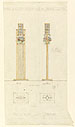 |
Henry J. Allen drawings for the Dining
Room Light Standard 1917 (1916 - S.205). "Henry J. Allen Residence.
Frank Lloyd. Dining Room Light Standard " . Allen was a Governor of
Kansas and editor of the Wichita Beacon. Designed in 1916, the
Allens moved into the home in 1918 and continued to live in the home
until 1947. Frank Lloyd Wright considered the Allen Residence 'among
my best,' and is considered the last of the Prairie Houses. Courtesy
of the Smithsonian's Cooper-Hewitt, National Design Museum. 6 x 10
Color photograph. |
0138.08.0314 |
1917
 |
Aline Barnsdall Hollyhock House, Los Angeles, Rendering Circa
1917-1919 (1917 - S.208). Photograph of original drawing in the
Frank Lloyd Wright Archives. View from the Southwest. Designed in
1917 by Frank Lloyd Wright as an appropriate style for Southern
California, Hollyhock House was built in 1920-1921. Hand written
lower left: "1705.(16?)." Published in "Frank Lloyd Wright,
Hollyhock House and Olive Hill," Smith, 1992, p.43. Original 8 x 10
B&W photograph. |
0138.29.1219 |
1917
 |
Aline Barnsdall Hollyhock House, Los Angeles, Five Elevations, Circa
1917-1920 (1917 - S.208). Photograph of original drawing in the
Frank Lloyd Wright Archives. Five elevations. Designed in 1917 by
Frank Lloyd Wright as an appropriate style for Southern California,
Hollyhock House was built in 1920-1921. Text: "Residence A.
Barnsdall, Hollywood, Cal. Frank Lloyd Wright, Architect.
Elevations." Hand written lower left: "1705.04." Published in "Frank
Lloyd Wright, Hollyhock House and Olive Hill," Smith, 1992, p.85.
Also "Frank Lloyd Wright Monograph 1914-1923," Pfeiffer, 1990,
p.144. Also "Wright 1917-1942," Pfeiffer, 2010, p.48. Original 8 x
10 B&W photograph. |
0138.30.1219 0138.31.1219 |
1917
 |
Aline Barnsdall Hollyhock House, Los Angeles,
Living Room Fireplace Relief, Circa 1917-1920 (1917 - S.208).
Photograph of original drawing in the Frank Lloyd Wright Archives.
Fireplace elevation. Designed in 1917 by Frank Lloyd Wright as an
appropriate style for Southern California, Hollyhock House was built
in 1920-1921. The Fireplace is the focal point of the Living Room.
"The bas-relief at the fireplace is composed in blocks of art-stone
and ranks among the few and great mural abstractions that Wright
deigned. Strictly geometric, monochromatic and austere in pattern,
it is at the same time rich in references..." Frank Lloyd Wright's
Hollyhock House, Hoffmann, p.61. Hand written lower left: "1705.27."
Published in "Wright 1917-1942," Pfeiffer, 2010, p.57. Original 10 x
8 B&W photograph.
|
0138.32.1219 |
1917

 |
Sherman Booth Residence Scheme II, Glencoe,
Illinois, 1917 (1915 - S.187). Ad with exterior view of the Sherman
Booth Residence from October 1917 issue of Western Architect. View
from the Southeast. Designed by Frank Lloyd Wright in 1915. An ad
for E-Cod Fabric, a plastering base. Includes a photograph of the
Sherman Booth Residence approximately one year past completion.
Note: Triangle in drive is as original plans. Garage on far left was
built as per plans. Garage has been demolished. Tall vertical roof
ventilator, designed and most likely built for the stable, is
visible above the wing to the right of the garage. It still exists
today. Flagstaff top center on roof above stairwell is in place and
appears to have a flag attached.
Caption:
“Residence for Sherman Booth, Glencoe, Illinois. Frank Lloyd Wright,
Architect. Exterior Plastered on E-Cod Fabric. Courtesy of Western
Architect. 10 x 6.5 B&W photograph. |
0138.42.0524 |
1917
 |
Imperial Hotel Model (1915 - S.194) Circa
1917. Model of the
proposed Imperial Hotel by designed by
Frank Lloyd Wright. Text of face:
"Frank Lloyd Wright, Architect.
Model of the proposed Imperial Hotel." Wright was commissioned and
began designs in 1915. Construction began in 1917 and on July 4,
1922 the first section of Wright's Imperial Hotel opened. In August
1923 the hotel was complete. Courtesy of the Library of Congress. 7
x 5 Color Photograph. See additional model
by Frank Lloyd Wright. |
0138.13.0117 |
1917
 |
Soldier's Field, Illustrated by
Charles L. Morgan, 1919. Aerial view
of Soldier's Field looking North, including the Field Museum. Lake
Michigan is to the right. Charles L. Morgan (1890-1947) had a
reputation as an excellent artist as well as being an architect.
Frank Lloyd Wright was working on the National Life Insurance
Company project in 1924-1925. Wright sought Morgan's help in
preparing a series of perspective drawings for the project. Signed
lower left: "Chas Morgan. Del." Text bottom left: Holabird & Roche -
Architects." Courtesy of the Art Institute of Chicago. 10 x 5.5
Color photograph. |
0138.24.0319 |
Circa 1917
 |
Peter C. Stohr Arcade Building, Chicago
circa 1917 (1909 - S.162). Designed in 1909, it was demolished in
1922, just 13 years after it was built. Viewed from the Northeast. A
form of the light fixture Wright designed, or what is left of it, is
visible above the Southeast corner on the roof of the first level.
Large windows at the top of the first floor allow light into the
interior and swing open at the bottom allowing air to naturally cool
the building. The second floor window design consisting of large
arched curves which were unique only in this Wright building.
Courtesy of the Chicago Historical Society. 10 x 7 B&W photograph.
For more information on the Stohr Arcade
see our right study. |
0138.09.0115 |
Circa 1917
 |
Peter C. Stohr Arcade Building, Chicago
circa 1917 (1909 - S.162). Designed in 1909, it was demolished in
1922, just 13 years after it was built. Viewed from the Northeast.
On the far left, the Southeast corner of the street level, the
mitered glass corner is visible. The second is in the center, just
to the right of the gentleman window shopping. This may be the first
example of Wright's use of mitered corners. A form of the light
fixture Wright designed is visible above the Southeast corner on the
roof of the first level. The large sets of vertical windows on the
right cover two floors. The large vertical plate glass windows are
nearly twelve feet high. Courtesy of the Krambles-Peterson Archives.
10 x 7 B&W photograph. For more
information on the Stohr Arcade see our right study. |
0138.10.0115 |
Circa 1917
 |
Taliesin II, Dining Room, circa 1917-19.
This photograph was first published in "The
Nature of Materials: 1887 - 1941, The Buildings of
Frank Lloyd
Wright"
Hitchcock, 1942, plate 177. Hitchcock mistakenly dates this
photograph at 1911 (pg xvi). One of the many items in the photograph
is an Imperial Hotel Coffee Service. Very similar to a photograph
published in
"Architectural Record",
October 1915, page 395, which was the very first published interior
of Taliesin II. Also published in
"Frank Lloyd
Wright Monograph 1907-1913 Volume 3" ill 275 and dated
1911. Photographed by Henry Fuermann. 10 x 8 B&W Photograph. For further
information see our Wright study on:
Imperial Hotel Monogram,
Japanese Print Stand. |
0138.04.1209 |
Circa
1917
 |
Taliesin II, Living
Room, circa 1917-19. Taken around the same time as a photograph of
the Dining Room published in
"Architectural Record",
October 1915, page 395, which was the very first published interior of
Taliesin II. Also published in "Wright
Studies, Taliesin 1911-1914", Menocal, 1992, page 111, and dated
circa 1915. Possibly photographed by Henry Fuermann. 10 x 7.25 B&W
Photograph. Courtesy of the Wisconsin Historical Society. For more
information see our
Wright Study on the Japanese
Print Stand. |
0138.05.1211 |
Circa
1917
 |
Taliesin II, Loggia, Circa 1917-19 (1914 - S.182). View of the Loggia.
Seating appears to be built-in. A Chinese screen is affix to the wall. Small
prairie styled table is to the left and right of the seating. A Chinese
carpet is on the floor, Japanese textile and Chinese bust are on the table.
The statue on the right is still at Taliesin today, in the Living Room.
Published in "Frank
Lloyd Wright Monograph 1914-23 (4)" Pfeiffer, 1990, p.8;
Select Houses 2, Pfeiffer, 1996,
p.43; and Taliesin and Taliesin West,
Smith, 1997, p.59. Hand written on verso: "Logia (sic) at Taliesin. 5/22/32
Mag Sect. Interior view of a corner of Taliesin.
Frank Lloyd Wright - Home of." Original 8 x 10 B&W photograph.
(S#138.20) |
0138.20.0218 |
|
1918 |
1918
 |
Henry J. Allen Residence, Wichita, Kansas, Perspective
Circa 1918 (1916 - S.205). View of the Allen Residence from the Northeast,
shortly after completion, but prior to landscaping. Designed by Frank Lloyd
Wright in 1916. The house floor plan is “L” shaped, but when including the
tea house and wall on the two opposite sides, the ground plan forms a
square. The bedroom wing on the left is two story, the living room wing on
the right is one. The entrance hall, and a portion of the living room are
tiled. The living room opens to a terrace, pool and walled garden. The
living room tile continues out to the terrace. The tea house can be seen in
the background on the right. Courtesy of The Allen House Foundation. 10 x 8
B&W photograph. |
0139.22.0724 |
1918
 |
Aline Barnsdall Theater, Los Angeles, Elevation 1918
Project (1918 - FLLW #2005). Photograph of original drawing in the Frank
Lloyd Wright Archives. Elevation for the Aline Barnsdall Theater. Aline
Barnsdall had an early interest in the theater, and moved to Chicago in
1914, formed the Players Production Company, performing in one of the
Theaters in the
Fine Arts Building,
Chicago
Frank Lloyd Wright, Hollyhock
House and Olive Hill, Smith, 1992,
p.15.) This began her connection with Frank Lloyd Wright. Although Barnsdall
did not have a specific site, she hire Wright to design a theater. Text hand
written bottom left: "... For Model. (Revision ?) of 1918.." Original 8 x 10
B&W photograph. |
0139.13.1219 |
1918
 |
Aline Barnsdall Theater, Los Angeles, 1918 Project
(1918 - FLLW #2005). Photograph of original drawing in the Frank Lloyd
Wright Archives. Longitudinal Section for the Aline Barnsdall Theater. Aline
Barnsdall had an early interest in the theater, and moved to Chicago in
1914, formed the Players Production Company, performing in one of the
Theaters in the Fine Arts Building,
Chicago Frank Lloyd
Wright, Hollyhock House and Olive Hill, Smith, 1992, p.15.) This
began her connection with Frank Lloyd Wright. Although Barnsdall did not
have a specific site, she hire Wright to design a theater. Text hand written
bottom left: "2005.34" Published in
Frank Lloyd Wright, Hollyhock
House and Olive Hill, Smith, 1992, p.31. Also published in
Frank Lloyd Wright Monograph 1914-1923, Pfeiffer, 1990, p.170.
Also published in
Wright, 1917-1942,
Pfeiffer, 2010, p.43. Original 8 x 10 B&W photograph. |
0139.14.1219 |
1918
 |
1) Aline Barnsdall Theater II, Los Angeles,
California, Model 1918 (1918 - FLLW #2005). Set of 2 - 35mm slides. Model of
the Aline Barnsdall Theater II. Designed by Frank Lloyd Wright in 1918.
Frank Lloyd Wright Project #2005. Aline Barnsdall had an early interest in
the theater, and moved to Chicago in 1914, formed the Players Production
Company, performing in one of the Theaters in the Fine Arts Building,
Chicago
Frank Lloyd Wright, Hollyhock
House and Olive Hill, Smith, 1992, p.15.) This began her connection
with Frank Lloyd Wright. Although Barnsdall did not have a specific site,
she hire Wright to design a theater. Published in
Wendingen VII No. 9, 1926, p.160. Text
on sleeve: "Wright, F. L. Barnsdall Theater II. 3-1. Barnsdall Theater II.
Model. 1918. Wright, Frank Lloyd. U of Virginia FAIC." Acquired from the
archives of the University of Virginia. 35mm Color slide, sandwiched between
glass, plastic mount. See other Wright
Models. |
0139.16.0720 |
1918
 |
2) Aline Barnsdall Theater II, Los Angeles,
California, Model 1918 (1918 - FLLW #2005). Set of 2 - 35mm slides. Model of
the Aline Barnsdall Theater II. Designed by Frank Lloyd Wright in 1918.
Frank Lloyd Wright Project #2005. Aline Barnsdall had an early interest in
the theater, and moved to Chicago in 1914, formed the Players Production
Company, performing in one of the Theaters in the Fine Arts Building,
Chicago
Frank Lloyd Wright, Hollyhock
House and Olive Hill, Smith, 1992, p.15.) This began her connection
with Frank Lloyd Wright. Although Barnsdall did not have a specific site,
she hire Wright to design a theater. Text on sleeve: "Wright, F. L.
Barnsdall Theater II. 3-2. Barnsdall Theater II. Model, view of interior
space. 1918. Wright, Frank Lloyd. U of Virginia FAIC." Acquired from the
archives of the University of Virginia. 35mm Color slide, sandwiched between
glass, plastic mount. See other Wright
Models. |
0139.17.0720 |
1918
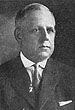 |
Edmund D. Brigham Residence, Glencoe, Illinois,
Portrait of Edmund D. Brigham,
1918 (1908 - S.184). Edmund Brigham was a prominent executive of the Chicago
& North Western Railway. In 1907, Frank Lloyd Wright proposed a concrete
house in the April issue of
The Ladies Home Journal
in his article "A Fireproof House for $5,000." Wright designed the Edmund
Brigham house in 1908, revised the stables on May 11, 1908. Construction
began later that year. Notice and portrait published in Railway Review:
"Edmund D. Brigham has been appointed manager of iron ore, coal and grain
traffic for the United States Railroad Administration, with office at
Duluth, Minn. He will, in addition, have charge of general transportation
matters throughout the Lake Superior district, and supervision over Duluth
and Superior terminals. Mr. Brigham has just completed a service of 45 years
with the Chicago & North Western Ry., having held every position in the
freight traffic department up to assist ant freight traffic manager, and
from which he now retires to devote his entire time to this important work
for the railroad administration." August 3, 1918, p.192. Edmund D. Brigham
past away on March 5, 1921, Services were held in Glencoe. 3.5 x 5 B&W copy
photograph. |
0139.12.1119 |
1918
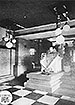 |
Midway Gardens Winter Garden Fountain,
Chicago, Illinois, Circa 1918 (1913 - S.180). Study photograph of a circa
1918 Edelweiss Gardens (Midway Garden) postcard. Designed by Frank Lloyd
Wright in 1913, the sculptures were executed by Alfonso Iannelli. Midway
Gardens was built in 1914 and demolished in 1929. Two fountains were located
in the Winter Garden, one at either end of the promenade. As you enter
Midway Gardens through the Belvedere, stairs lead down to the Promenade.
This fountain was located in the center of the stairs. The promenade lead to
the Winter Garden Restaurant. In 1953, Iannelli wrote an essay for his
unpublished book. "My last problems were two fountains at the entry of the
dining room which was worked out by John (Lloyd Wright) and me on the Cube
theme "children sprites playing over and around the Cube" a playful
garland of planes winding over and around, protruding and receding into the
mass. Mr. Wright made some suggestions as it was being carried out."
Alfanso Iannelli,
Jameson, 2013, p.80-81. This is one of only two photographs of the fountain
that has survived. In 1939, ten years after its destruction, Edgar Tafel,
one of Frank Lloyd Wright's apprentices, was supervising the construction of
the... Continue...
|
0139.18.0122
A&B
|
1918
 |
"Independence Day Dance. The Midway Garden. Music By Kelton's Music
Makers. Wed., July 3" In July of 1916 the name was changed to "Edelweiss
Gardens" but in this poster it is still called "Midway Garden". It was
referred to by "Midway Garden" (singular). 2.75 x 4.5. |
0139.03.0407 |
|
1919 |
1919
 |
Sherman Booth Residence
Scheme II, Glencoe, Illinois, 1919 (1915 - S.187). View of the Sherman Booth
Residence from the Southeast. Designed by Frank Lloyd Wright in 1915.
Triangle in drive is as original plans. Garage on far left was built as per
plans. Garage has been demolished. Tall vertical roof ventilator, designed
and most likely built for the stable, is visible above the wing to the right
of the garage. It still exists today. Flagstaff top center on roof above
stairwell is in place. Photographed by Mr. Graham Summer 1919. 10 x 7 B&W
photograph. |
0141.15.0524 |
1919
 |
Wright at 52.
Portrait of Wright facing slightly to the left. Published in
"Frank Lloyd Wright
Monograph 1914-1923 Volume 4", Pfeiffer, Futagawa, 1990, page 2.
Courtesy of the Frank Lloyd Wright Foundation. 8 x 10 Print, High res
digital image. |
0141.02.0709 |
|
|
|
|
| BACK TO TOP
1920-1929 |
|
|
|
|