|
After
living in the Seattle area for over thirty years, and
visiting Wright homes all over the country, it was time to
visit the Griggs Residence right here in my own backyard.
Over the years I had heard that the present owner preferred
privacy. Wanting to respect that, I had always pushed it
off. Armed with Storrer’s books and a letter requesting to
photograph and tour the home, I was determined to find it,
which turned out to be more difficult than I had
anticipated. It is only a few miles off of I-5, but over the
years, as lots were sold and streets developed, the address
changed. I knew I was close. I questioned one neighbor who
had lived in the area for 25 years, knew it was in the area,
but didn’t have a clue. Others responded Wright who?
After finally driving down every long driveway, Storrer’s
description rang a bell.
Chauncey’s Grandfather, Chauncey Wright
Griggs, made a fortune in real estate in St. Paul. He became
President of the St. Paul & Tacoma Lumber Company, which
owned 80,000 acres, built two large mills and employing from
five to seven thousand men in the Tacoma area. Chauncey’s
Father, Herbert Stanton Griggs, graduate from Yale, opened a
private law firm which handled the legal affairs for the
lumber company. Chauncey Levenworth Griggs was born on July
6, 1909 and pasted away on September 27, 1989. He followed
in his fathers footsteps and graduated from Yale. In 1935 at
26, he founded Ski Lifts, Inc. with a partner. They built
and installed the first rope tows west of New England at
Paradise Valley on Snoqualmie Summit (later to become Hyak),
and Mt Baker. They operated
|
|
the company for six years and
sold out in 1942 to their first employee. He then spent
the bulk of his career as a lumber industry executive.
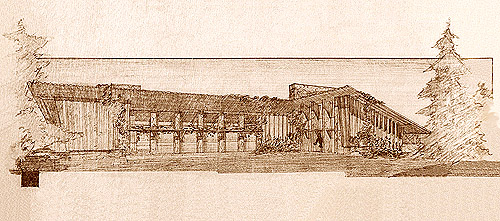
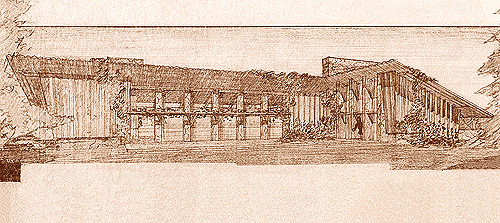
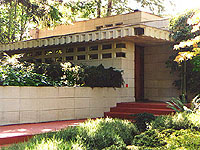
Designed in 1945, it was not completed for
another seven years. Construction was supervised by Alan
Liddle, a local architect. After descending a long drive
through a forest of massive fir trees and lush ferns, you
reach Chambers Creek and cross a bridge to reach the home.
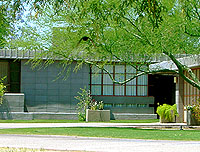
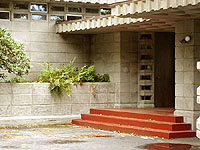
There are many classic Wright details, but it has a very
unique feel. There is the hidden entrance. Exposed rough-cut
cedar trusses, reminiscent of Taliesin’s Drafting Room.
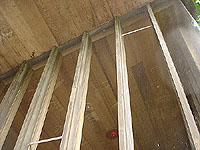
Mitered glass corners. Local cedar. Extensive floor to
ceiling glass windows with multiple glass doors that open
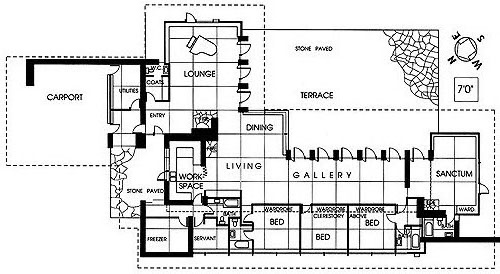
outward. It is built on a seven foot grid system rather than
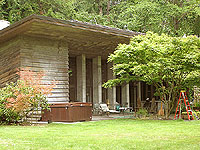
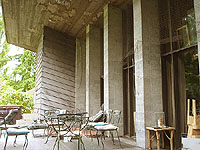
the standard four foot system. The stunning cantilevered
roof over the Gallery Terrace extends fourteen feet past the
floor to ceiling glass wall. There are double clerestory
windows, the top row lightens the Gallery, the lower row
lightens the Bedrooms. Three fireplaces, the one in the
Lounge is large enough to stand in. Everything about this
Usonian home is grand. One unique feature about this home is
the concrete block wall construction. The standard concrete
block home is constructed by staggering each row. These
blocks are stacked directly on top of each other. This is
consistent with other block homes he designed, the earlier
Textile Block homes, Florida Southern College and the later
Usonian Automatic homes. Chauncey Griggs’ son and his wife
presently live in the home. He was very gracious in allowing
me to tour the home, and photograph the outside. June
2008 |