- Wright Studies
- Lake Geneva Hotel, Lake Geneva, WI (1911) (S.171)
Not much has been written about the Lake Geneva Hotel. Lake Geneva was a popular destination attracting visitors from both Chicago and Milwaukee. One of the few hotels in Lake Geneva, The Whiting House, built in the early 1870s was destroyed by fire in1894. The lake front property sat vacant for 17 years while attempts were made to reconstruct a new motel. This was finally accomplished by Arthur L. Richards and John J. Williams.
Arthur L. Richards was a real estate developer in Milwaukee, WI. He is well known for his association with Wright and the development of the American System-Built Homes (S.200 - 204) (1915-1917). These homes are still being discovered today. John J. Williams was a businessman from Chicago. Richards and Williams formed the Artistic Building Company and developed the Lake Geneva Hotel. This was Richards first project with Wright. Designed in 1911, it opened in August 1912. Within a few years, it changed hands due to financial difficulties. In 1914 it was called The Geneva, then changed to the Hotel Geneva, and it stayed the Hotel Geneva most of its life. During its final years it was known as the Geneva Inn.
In 1917, the Hotel Geneva was advertised as "New and Modern. 70 Rooms with Bath. Dancing, Swimming and Fishing. Fish or Chicken dinners. 9 Hole Golf Course Open to the Public. A. H. Thierbach, E. T. Nussbaum Owners."
John K. Notz, Jr. writes that “in the 1920's, the Lake Geneva hotel was in its hey-day. It is said that, during the Prohibition that started in 1919 and lasted into the early 1930's, tunnels into the basements of nearby storefront buildings facilitated the movement of booze for consumption into the hotel and, when raids for Prohibition violations or gambling took place, the movement of customers out. While there are denials of that kind of activity in the local written histories such as the now defunct "Lake Geneva Magazine", such activities are more than plausible, as I have been told of biplane landings in the Winter on the frozen lake surface, for the purpose of picking up "booze" from the lake shore residences."A long-time operator-owner sold it, vacant, in 1962 but took it back in 1965. Selling it, again, in 1966. Eric Johnson of Williams Bay, WI - then an architectural student - spent a Summer vacation measuring, cataloguing and sketching all of the hotel's panels, bricks and window sills."
In the 1967 set of images by Richard Nickel, it shows that the restaurant had been operated as the Golden Orchid, Cantonese American Cuisine. But the hotel and restaurant were vacant by that time as evidenced by the photographs.
Richard Nickel also captioned image #3 as the Dining Room. This may be due to the assumed use at the time this photograph was taken. As you can see from the image, this area was converted to a dining area. In Monograph V3 p189, Pfeiffer, and in Lost Wright p119 Lind, both describe this area as the Dining Room. This can not be the Dining Room, but the Lobby. The Lobby is the only room that has a row of lower windows. The original drawings indicate columns in the middle of the Dining Room. The drawings also indicate a square in the center of the Lobby area in relationship to the placement of the skylight.
Ownership continued to change over the years, the building deteriorated, it became vacant and in 1970 after a fire, it was demolished.
Wright’s other collaborations with Richards included: Remodeling of the Hotel Madison, Madison, Project 1911 (V3 p192); Office Building and Shop, Milwaukee, Project 1913 (V3 p236); Chinese Restaurant, Milwaukee, Project 1913 (V3 p237).
There were many classic Prairie styled Wright details. The basic materials were wood and stucco. Strong horizontal lines, low-pitched roof, broad overhanging eaves, horizontal rows upon rows of leaded glass windows, leaded glass light fixtures and doors, vases, and decorative poles, the prominent centrally located fireplace and chimney, terraces and porches. There was a beautiful art glass skylight ceiling in the lobby. The lobby included built-in seating, a large semicircular fireplace with a semicircular metal sculpture and fireplace andirons. September 2008Text by Douglas Steiner, Copyright 2008.
Whiting
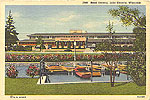
The Whiting House, built in the early 1870s was destroyed by fire in 1894. This is the original property where the Hotel Geneva was built. Boat landing with Whiting House in background. Shows original lagoon in front of the Whiting House. Postcard printed in Germany and published by James Leonard Publishing, Lake Geneva, Wis. See additional information about the Whiting House.
Original aerial view drawing drawing. "Frank Lloyd Wright Monograph 1907-1913", Vol. 3, Pfeiffer, Futagawa, Yukio, 1991, page 189-191.
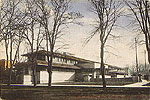
Postcard using Wright's original drawing. Published by Acmegraph Co., Chicago, IL Early drawings included a proposed three story section on the East end, which was never built.
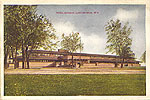
"The Geneva," Lake Geneva, Wis. This may be one of the earliest images of the Hotel Geneva. Published by V. O. Hammon Co., Chicago, IL. Circa 1912. The History of the Hotel Geneva viewed through Post Cards.
Drawing submitted by Wright and published in the Architectural Record, June 1913, p572.
Also published in the the Architectural Record, June 1913, p573. Wright’s other collaborations with Richards included: Remodeling of the Hotel Madison, Madison, Project 1911 (V3 p192).
Morrison
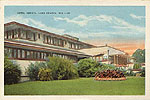
Hotel Geneva 1915. From “Lake Geneva”, Published by Morrison and Rogers, Lake Geneva, Wis.
Copyright 1915, by C. MacKay Morrison. (See Ceramic Plate)
“The Frank Lloyd Wright Companion”, Storrer, William Allin, 1993, page 172.
Images from the Eric Milton Nicholls Collection, circa 1925
These images are from the Eric Milton Nicholls Collection and may be some of the earliest documented photographs of the Hotel Geneva, including an excellent
photograph of the "light pole" and possibly one of the only photographs of the East end of the building. The NLA dates these images circa 1925.
Courtesy of the National Library of Australia. Text by Douglas M. Steiner, Copyright 2008
Images By Gilman Lane, Circa 1935-1945
Little can be found about Gilman Lane. He photographed buildings in the Chicago area including many of Wright’s work. His photographs were given to the Oak Park Public Library after his death in 1961. These Lane images were photographed 1935-1945.
They are important because they give a picture of the Hotel Geneva in a more original state before changes were made. Gilman Lane images courtesy of the Oak Park Public Library, Gilman Lane Collection.
Gilman Lane images courtesy of the Oak Park Public Library, Gilman Lane Collection. Text by Douglas M. Steiner, Copyright 2008
Images By Richard Nickel, 1967
This set of six images were photographed by Richard Nickel in 1967, for the Historic American Building Survey (HABS). Nickel (1928-1972) was killed in April 1972, when a stairwell in the Chicago Stock Exchange building collapsed on him. HABS began in 1933 and has been administered jointly by the Library of
Congress and the National Park Service. The Library of Congress has digitized photographs, drawings and other data from the project. A number of HABS photographs were taken by Chicago photographer and preservationist Richard Nickel. This collection of six photographs are available from the The Library of Congress.
This collection of six photographs are available from the The Library of Congress. Text by Douglas M. Steiner, Copyright 2008
The Hotel Geneva Decorative “Light Pole” & The Darwin D. Martin “Birdhouse” (S.100) (1904)
One of the small details of the Martin complex is the “Birdhouse” Wright designed. Although this Hotel Geneva element is not a “Birdhouse”, the design is very similar. It is most likely to constructed of wood and leaded glass. Early images show the vertical pole to be 4.5 to 5 times the height of the decorative “light pole” base. Original aerial view drawing shows the decorative “Light Pole” setting on a much larger pedestal. It also
showed a vase setting on a pedestal at each corner of the Lobby. The “globe” light fixtures do not exist in earlier images. The decorative “light pole” base was built into the vase pedestal. It may have been a decorative light fixture to light the stairs at night. These images of the Hotel Geneva are from a Real Photo Post Card Published by L. L. Cook Co., Milwaukee.
Text by Douglas M. Steiner, Copyright 2008
The History of the Hotel Geneva viewed through Post Cards. Dating images of the Hotel Geneva.
There are very few photographs of the Hotel Geneva, so postcards become a good record.
Lake Geneva Hotel Light Fixtures
Lake Geneva Hotel Art Glass Windows
©Copyright 2008