|
|
|
Paul and Ida Trier
Residence, Johnston, Iowa (1956 - S.398) |
|
|
|
|
|
|
Introduction
Original Drawing
Floor Plan
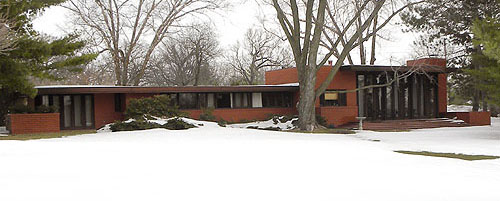
Exterior Photographs 2010
Interior Photographs (2010)
NY Usonian
Exhibition House
Light Screens Usonian
Automatic Homes
Related Usonian
Items
Bibliography Wright
Studies |
|
|
|
|
|
|
 |
Date:
1958-59
Title:
Paul and Ida Trier
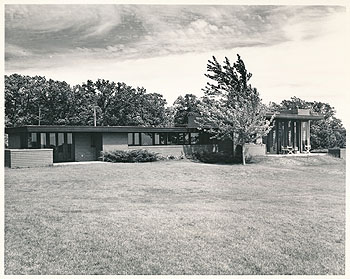
Residence, Johnston, Iowa, 1958-59 (1956 - S.398).
Description:
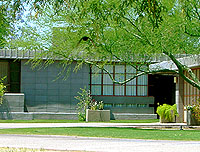
Viewed from the
Southwest. Designed by Frank Lloyd Wright in 1956. The Trier
Residence is based on the Usonian Exhibition House that was
built in 1953 on the site of The Guggenheim Museum. The Trier
Residence was the second home to utilize this floor plan. The
first being the Feiman Residence
(S.371). The Trier's original floor plan created approximately
1740 square feet of living space, not including the Work Shop.
The Living Room occupied thirty percent of the living space.
Wright's initial drawing of the home shows that he conceived
this home as a Usonian Automatic, constructed of 12 x 24"
concrete blocks. Mounted to gray board. Label pasted to board:
"West 20, US Arch. Wright, Frank Lloyd. Des Moines, IA. Dr. Paul
Trier Res. 1958-59. Side Facade. Andrews Photo 2751."
Photographed by
Wayne Andrews.
Acquired from the archives of the University of Minnesota.
Size:
Original 10 x 8 B&W Photograph.
S#:
1259.73.0420 |
|
|
|
 |
Date:
1990
Title:
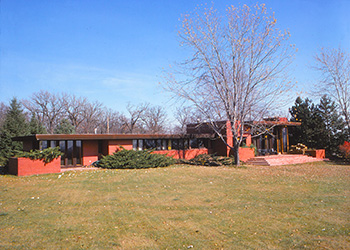
1) Paul and Ida Trier Residence, Johnston,
Iowa, Circa 1990 (Not Dated) (1956 - S.398).
Description:
Set of eight 35mm Color slides of the Trier
Residence. Exterior view of the Trier Residence from the
Southwest. Designed by Frank Lloyd Wright in 1956. The Trier
Residence is based on the Usonian Exhibition House that was
built in 1953 on the site of The Guggenheim Museum. The Trier
Residence was the second home to utilize this floor plan. The
Trier's original floor plan created approximately 1740 square
feet of living space, not including the Work Shop. Photographer
unknown.
Text on sleeve: "A-20-Wr-1431-1. Trier House. Ext: general
view."
Size:
Original 35mm slide, sandwiched between
glass, plastic mount.
ST#:
1990.201.0425-1 |
|
|
|
 |
Date:
1990
Title:
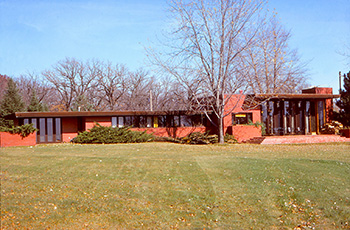
2) Paul and Ida Trier Residence, Johnston,
Iowa, Circa 1990 (Not Dated) (1956 - S.398).
Description:
Set of eight 35mm Color slides of the Trier Residence. Exterior
view of the Trier Residence from the Southwest. Designed by
Frank Lloyd Wright in 1956. The Trier Residence is based on the
Usonian Exhibition House that was built in 1953 on the site of
The Guggenheim Museum. The Trier Residence was the second home
to utilize this floor plan. The Trier's original floor plan
created approximately 1740 square feet of living space, not
including the Work Shop. Photographer unknown.
Text on sleeve: "A-20-Wr-1431-2. Trier House. Ext: general
view."
Size:
Original 35mm slide, sandwiched between
glass, plastic mount.
ST#:
1990.201.0425-2 |
|
|
|
 |
Date:
1990
Title:
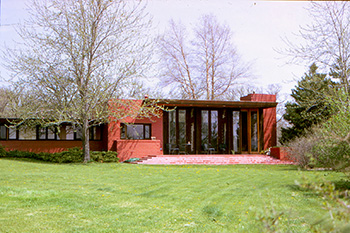
3) Paul and Ida Trier Residence, Johnston,
Iowa, Circa 1990 (Not Dated) (1956 - S.398).
Description:
Set of eight 35mm Color slides of the Trier Residence. Exterior
view of the Trier Residence from the Southwest. Designed by
Frank Lloyd Wright in 1956. The Trier Residence is based on the
Usonian Exhibition House that was built in 1953 on the site of
The Guggenheim Museum. The Trier Residence was the second home
to utilize this floor plan. The Trier's original floor plan
created approximately 1740 square feet of living space, not
including the Work Shop. Photographer unknown.
Text on sleeve: "A-20-Wr-1431-3. Trier House. Ext: general
view."
Size:
Original 35mm slide, sandwiched between
glass, plastic mount.
ST#:
1990.201.0425-3 |
|
|
|
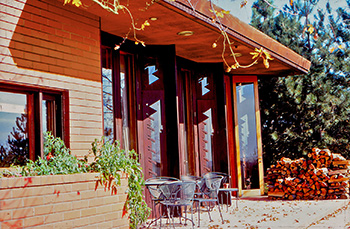 |
Date:
1990
Title:
4) Paul and Ida Trier Residence, Johnston,
Iowa, Circa 1990 (Not Dated) (1956 - S.398).
Description:
Set of eight 35mm Color slides of the Trier Residence. Exterior
view of the Trier Residence from the Southwest. Designed by
Frank Lloyd Wright in 1956. The Trier Residence is based on the
Usonian Exhibition House that was built in 1953 on the site of
The Guggenheim Museum. The Trier Residence was the second home
to utilize this floor plan. The Trier's original floor plan
created approximately 1740 square feet of living space, not
including the Work Shop. Photographer unknown.
Text on sleeve: "A-20-Wr-1431-4. Trier House. Ext: general
view."
Size:
Original 35mm slide, sandwiched between
glass, plastic mount.
ST#:
1990.201.0425-4 |
|
|
|
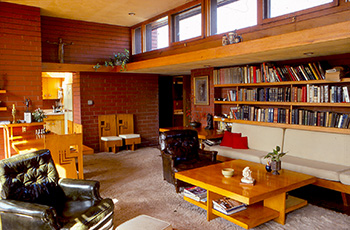 |
Date:
1990
Title:
5) Paul and Ida Trier Residence,
Johnston, Iowa, Circa 1990 (Not Dated) (1956 - S.398).
Description:
Set of eight 35mm Color slides of the Trier Residence. Interior
view of the Trier Residence living room. Designed by Frank Lloyd
Wright in 1956. The Trier Residence is based on the Usonian
Exhibition House that was built in 1953 on the site of The
Guggenheim Museum. The Trier Residence was the second home to
utilize this floor plan. The Trier's original floor plan created
approximately 1740 square feet of living space, not including
the Work Shop. The Living Room occupied thirty percent of the
living space. Photographer unknown.
Text on sleeve: "A-20-Wr-1431-5. Trier House. Int: Living area."
Size:
Original 35mm slide, sandwiched between
glass, plastic mount.
ST#:
1990.201.0425-5 |
|
|
|
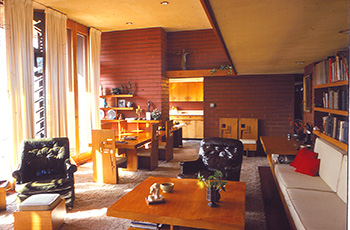 |
Date:
1990
Title:
6) Paul and Ida Trier Residence,
Johnston, Iowa, Circa 1990 (Not Dated) (1956 - S.398).
Description:
Set of eight 35mm Color slides of the Trier Residence. Interior
view of the Trier Residence living room. Designed by Frank Lloyd
Wright in 1956. The Trier Residence is based on the Usonian
Exhibition House that was built in 1953 on the site of The
Guggenheim Museum. The Trier Residence was the second home to
utilize this floor plan. The Trier's original floor plan created
approximately 1740 square feet of living space, not including
the Work Shop. The Living Room occupied thirty percent of the
living space. Photographer unknown.
Text on sleeve: "A-20-Wr-1431-6. Trier House. Int: Living area."
Size:
Original 35mm slide, sandwiched between
glass, plastic mount.
ST#:
#1990.201.0425-6 |
|
|
|
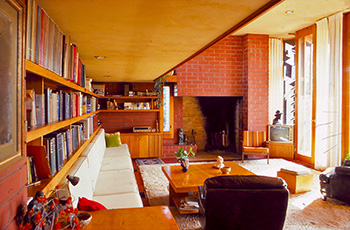 |
Date:
1990
Title:
7) Paul and Ida Trier Residence,
Johnston, Iowa, Circa 1990 (Not Dated) (1956 - S.398).
Description:
Set of eight 35mm Color slides of the Trier Residence. Interior
view of the Trier Residence living room. Designed by Frank Lloyd
Wright in 1956. The Trier Residence is based on the Usonian
Exhibition House that was built in 1953 on the site of The
Guggenheim Museum. The Trier Residence was the second home to
utilize this floor plan. The Trier's original floor plan created
approximately 1740 square feet of living space, not including
the Work Shop. The Living Room occupied thirty percent of the
living space. Photographer unknown.
Text on sleeve: "A-20-Wr-1431-7. Trier House. Int: Living area."
Size:
Original 35mm slide, sandwiched between
glass, plastic mount.
ST#:
1990.201.0425-7 |
|
|
|
 |
Date:
1990
Title:
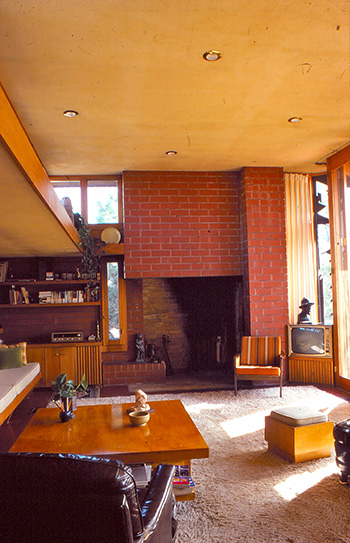
8) Paul and Ida Trier Residence,
Johnston, Iowa, Circa 1990 (Not Dated) (1956 - S.398).
Description:
Set of eight 35mm Color slides of the Trier Residence. Interior
view of the Trier Residence living room. Designed by Frank Lloyd
Wright in 1956. The Trier Residence is based on the Usonian
Exhibition House that was built in 1953 on the site of The
Guggenheim Museum. The Trier Residence was the second home to
utilize this floor plan. The Trier's original floor plan created
approximately 1740 square feet of living space, not including
the Work Shop. The Living Room occupied thirty percent of the
living space. Photographer unknown.
Text on sleeve: "A-20-Wr-1431-8. Trier House. Int: Liv. area /
fireplace."
Size:
Original 35mm slide, sandwiched between
glass, plastic mount.
ST#:
1990.201.0425-8 |
|
|
|
 |
Date: 2010
Title:
Paul and Ida Trier Residence, Johnston, Iowa, 2010 (1956 -
S.398).
Description: Set of 46 exterior and 9 interior
photographs of the Trier Residence. The average temperature in
early March hovers around freezing in central Iowa. Our stop in
Johnston, Iowa, just north of Des Moines was no different. On a
trip from Chicago to Seattle with my daughter, we had the
opportunity to visit with Ida Trier and see the home that has
been her residence for over fifty years. Icicles hung from the
eaves, creating natural designs. "I wanted a home where icicles
by invitation might beautify the eves... icicles came to hang
staccato from the eaves." wrote Frank Lloyd Wright, in his
Autobiography. We timidly knocked on the door, wanting to
photograph the exterior of the home. Ida Trier answered and
graciously invited us to view the Living Room. Images came
flooding back of my visit...
Continue...
Size:
Set of 46 exterior and
9 interior high res 10 x 13 digital
images.
ST#:
2010.43.0520 (1-55) |
|
|
|
 |
See
additional photographs... |
|
|
|
 |
See
additional photographs... |
|
|
|
|
|
|
|
|
|
|
Paul and Ida Trier
Residence, Johnston, Iowa (1956 - S.398) |
|
|
|
The average temperature in early
March hovers around freezing in central Iowa. Our stop in
Johnston, Iowa, just north of Des Moines was no different. On a trip from
Chicago to
Seattle with my daughter, we had the opportunity to visit
with Ida Trier and see the home that has been her residence
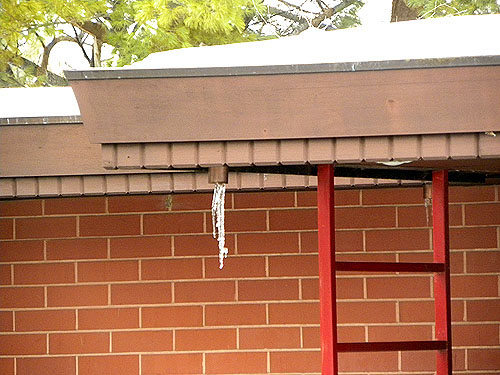
for over fifty years. Icicles hung from the eaves,
creating natural designs. "I wanted a home where icicles
by invitation might beautify the eves... icicles came to
hang staccato from the eaves." wrote Frank Lloyd Wright,
in his Autobiography.
We timidly knocked on the door, wanting to photograph the
exterior of the home. Ida Trier answered and graciously invited us to
view
the Living Room. Images came flooding back of my visit
in 1989, to the Usonian Automatic Traveling Exhibit in Bellevue,
Washington.
Our conversation drifted back to her experience with
Wright, and building their home. I asked why they
decided to hire Frank Lloyd Wright to design a home
for them. Without hesitation she answered, "My husband
Paul said we couldn't
afford a $40,000 piece of artwork, but we could afford a house
that was a piece of art." She continued, "We did out
homework. We visited all the Wright home in Iowa and Wisconsin, asking what people liked and
disliked in their Wright homes. We decided not to go with
radiant heat in the
floors."
The
Trier Residence is based
on the Usonian Exhibition House that was built in 1953 on
the site of The Guggenheim Museum.
The Trier Residence was the second home to utilize this
floor plan. The first being the Feiman Residence (S.371). The
Trier's original floor plan created approximately 1740 square feet
of living space, not including the Work Shop. The Living Room
occupied thirty percent of the living space. Wright's initial drawing
of the home shows that he conceived this home as a Usoniam Automatic,
constructed of 12 x 24" concrete blocks. She pointed
toward the Living Room wall of doors and perforated light screen window
pilasters. "The perforated triangles
were
originally designed as squares, but we couldn't afford squares."
The Triers visited Taliesin to review the working drawings of the
home. "Paul watched Wright draw the design of the
perforated
panels.
|
|
He wasn't happy with the first design, so
Wright designed a second. All panels were unique to each house,"
she explained.
The working drawings
specify the home to be constructed
of brick. The Triers elected to use brick, and
then substituted brick tile, to save construction costs.
"We chose to use brick tile because it was cheaper. A mason did all the
brick tile work," Ida said. After fifty years, the
brick tile still achieved a flawless brick appearance. The 4 x 12" size
remained consistent with Wright's original dimensions.
She reminisced about the
furniture. "Paul built all the furniture. Wright designed
the Dining Room table 3-4 inches shorter than the standard dining
room table to make the ceiling look taller," she
explained. "My son rebuilt the chairs when the originals
wore out."
She mentioned
that her sight was failing. When asked how she was able to
get around in her home, a slight smile appeared on her face
and she paused. Her face lit up, "I know every square inch of this home."
As a side note, in "Frank
Lloyd Wright Monograph 1951 -1959 ", page
230, there is a photograph that contains an
original
statue from the City National Bank Building (1909 -
S.155) in Mason City, Iowa.
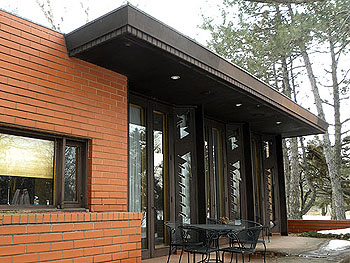
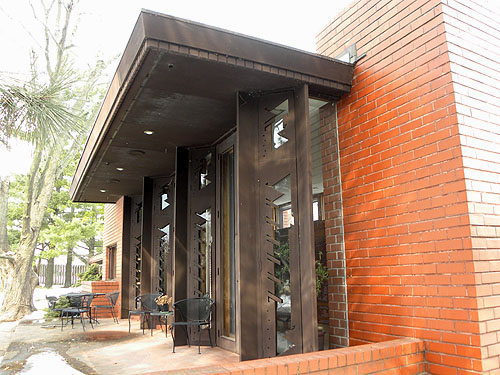
There are many classic Wright Usonian details. The cantilevered roof extends
out over the Entryway. The mortar is tinted, the vertical
joints are flush, and the horizontal joints are raked. There
are mitered glass corners, a massive fireplace, and
clerestory windows that allow natural light into the Living
Room. The Living Room's ceiling starts below seven feet and
opens up to nearly eleven feet. There are three built-in
Planters, an element that grounded Wright homes with the
environment. The roof cantilevers out over the Living Room's
Terrace. The Living Room's Southern wall of floor to ceiling
doors and unique light screen window pilasters open outward,
blending interior with exterior. Glass intersects and is
imbedded into the brick-tile wall. Windows and doors open
outward. Perforated light screen windows, run along the
length of the Gallery, allowing natural light. Quoting Paul
"A piece of Art."
March 2010.
|
|
|
|
|
|
. |
|
|
|
|
|
|
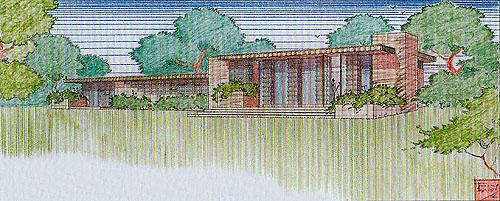
Original Drawing of the Trier Residence |
|
|
 |
|
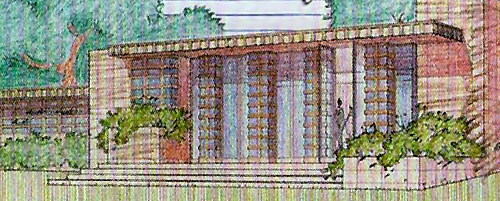
Wright initially conceived
this home as a Usoniam Automatic, constructed of 12 x
24" concrete blocks. The Triers elected to use brick, and
then substituted brick tile, to save construction costs. The
brick tile achieves a flawless brick appearance, and the 4 x 12"
size is consistent with Wright's original dimensions.
Courtesy of the Frank Lloyd Wright Foundation. |
| |
 |
|
Although the Triers elected
to use brick, the final home was built to the
original floor plan. |
| |
 |
|
Detail from
original drawing. |
| |
 |
|
Concrete block and glass columns were replaced with
unique light screen window
pilasters, the final home was built to the original floor
plan. |
| |
| |
| |
|
|
TRIER Floor Plan |
|
|
|
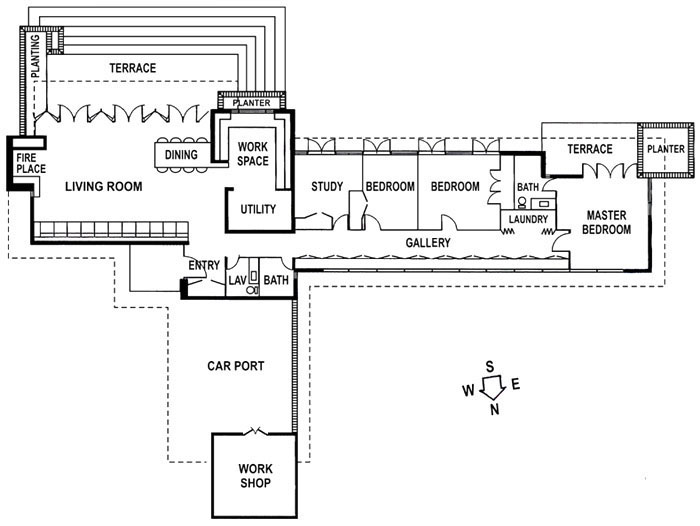
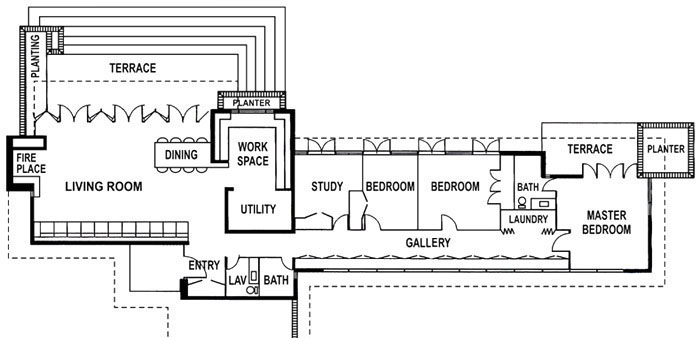
The
Trier Residence is based
on the Usonian Exhibition House
that was built in 1953 on the site of The Guggenheim Museum.
Wright's initial drawing of the home shows that he conceived
this home as a Usoniam
Automatic, constructed of 12 x 24" concrete blocks.
The working drawings specify the home to be constructed of
brick. The Triers elected to use brick, and then substituted
brick tile, to save construction costs. The 4 x 12" size
remained consistent with Wright's original dimensions. The
original floor plan, designed on a four foot square grid
system, created approximately 1740 square feet of living
space, 1884 including |
|
the Work Shop. The Living Room
occupied thirty percent of the living space. The two smaller
bedrooms were originally designed as a single "Children's"
bedroom. The Triers chose to split it into two. The smaller
at 8 x 12 and the larger at 12 x 12. The Master Bedroom was
approximately 14 x 14, not including the Master Bath.
According to Storrer,
John Ottenheimer and the Taliesin Associated Architects
completed construction after Wright's death in 1960, and
enclosed the Carport creating a Playroom for the children,
as well as additional storage. The roof was extended in
front of the Work Shop, forming the existing Car Port. |
|
|
|
|
 |
|
Floor plan Copyright 2010,
Douglas M. Steiner. |
|
|
|
|
|
|
|
EXTERIOR Photographs (2010) |
|
|
|
|
|
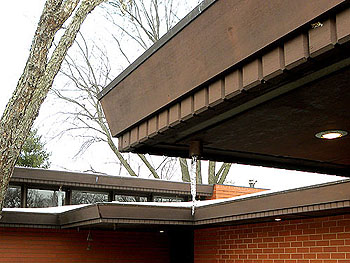
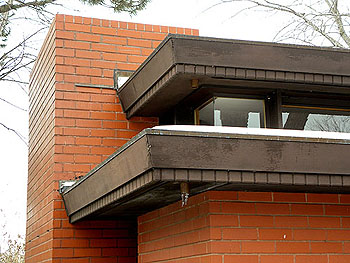
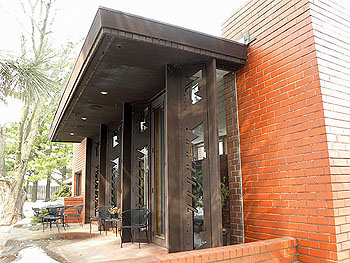
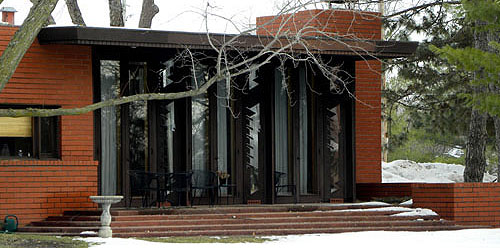
There are many classic Wright
Usonian details. The cantilevered roof extends
out over the Entryway. The mortar is tinted, the vertical
joints are flush, and the horizontal joints are raked. There
are mitered glass corners, a massive fireplace, and
clerestory windows that allow natural light into the Living
Room. The Living Room's ceiling starts below seven feet and
opens up to nearly eleven feet. There are three built-in
Planters, an element that grounded Wright homes with the
environment. The roof cantilevers out over the Living Room's
Terrace. The Living |
|
Room's Southern wall of floor to ceiling
doors and unique light screen window pilasters open outward,
blending interior with exterior. Glass intersects and is
imbedded into the brick-tile wall. Windows and doors open
outward. Perforated light screen windows, run along the
length of the Gallery, provide privacy, allowing in natural light.
Photographed by Douglas M. Steiner on March 15, 2010.
Copyright 2020. Set of 46
exterior photographs high res 10 x 13 digital images. |
|
|
|
|
|
|
 |
|
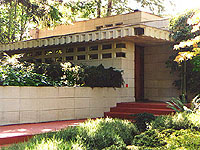
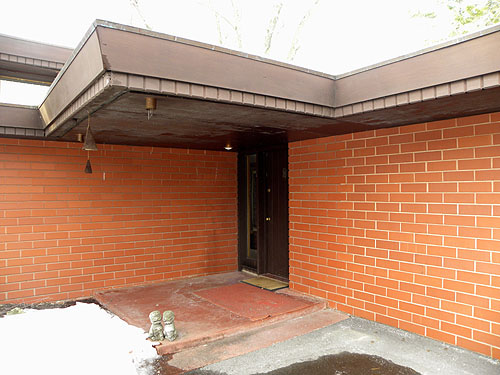
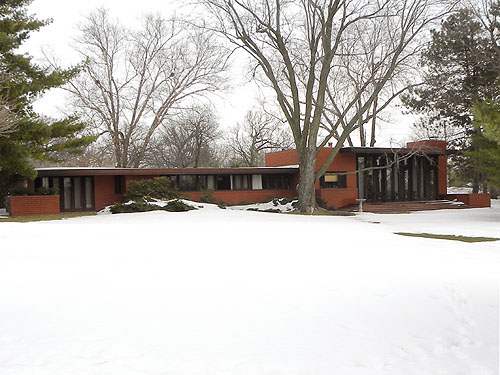
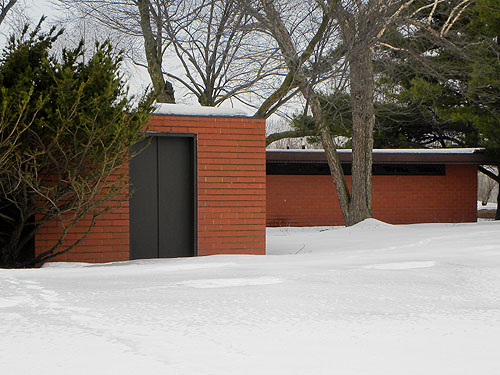
5:
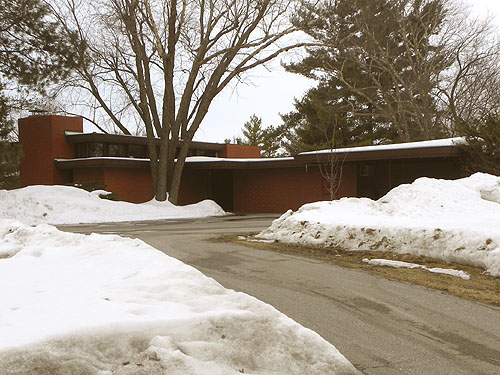
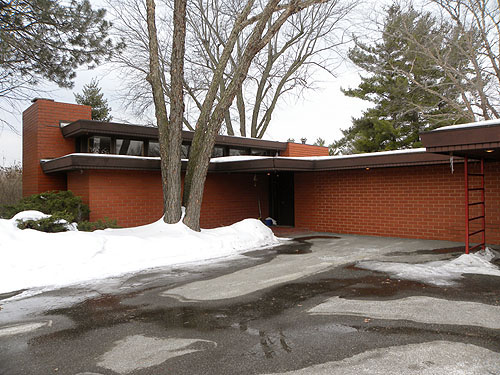
The clerestory windows of the
Living Room are seen on the left. The Entryway is in the
center. The Playroom and Carport are on the right.
(ST#2010.43.0520 -5) |
|
|
|
 |
|
6:
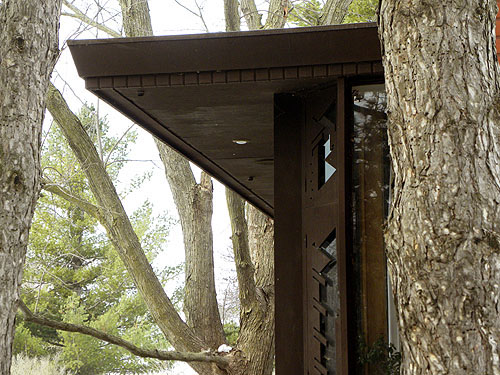
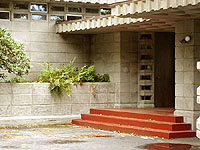
Detail of the
cantilevered roof extending over the Entryway.
(ST#2010.43.0520 -6) |
|
|
|
 |
|
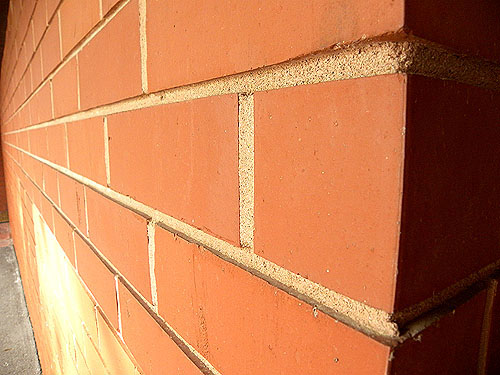
7:
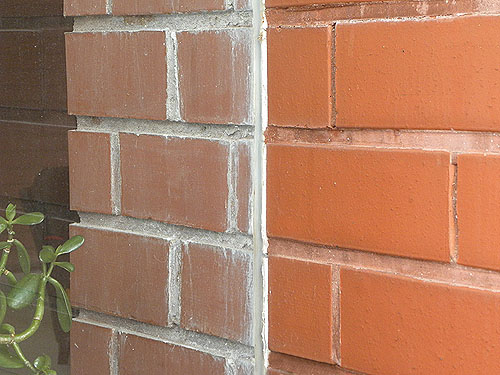
Although 4 x 12" brick tiles
were substituted for actual brick,
installation was
true to Wright's style. The mortar was tinted, the vertical
joints were flush, and the horizontal joints were raked.
(ST#2010.43.0520 -7) |
|
|
|
 |
|
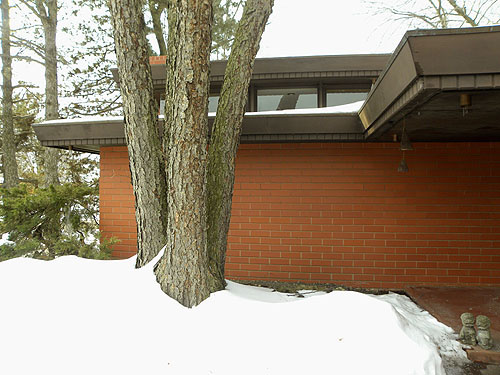
8:
View from the North of the
Living Room and clerestory windows of the Living Room. The
Entryway is to the right.
(ST#2010.43.0520 -8) |
|
|
|
 |
|
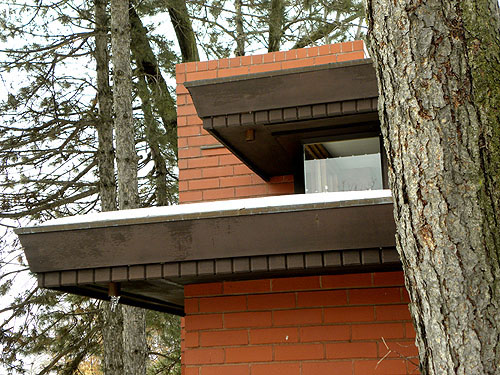
9: Detail of the
massive fireplace and clerestory windows in the background
(upper part of photograph), and exterior wall of the Living
Room (lower part of photograph).
(ST#2010.43.0520 -9) |
|
|
|
 |
|
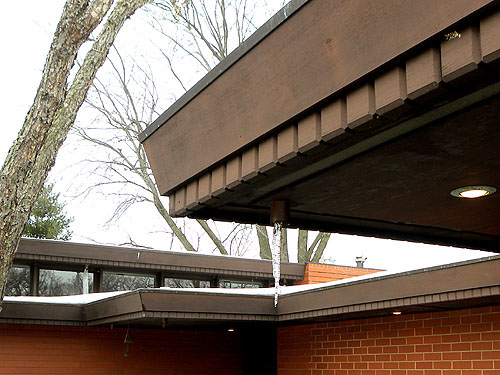
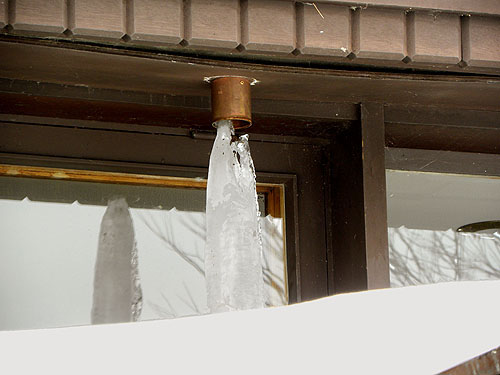
10:
Icicles add a natural design
element during winter time. "I wanted a home where icicles
by invitation might beautify the eves... icicles came to
hang staccato from the eaves." Frank Lloyd Wright,
Autobiography, 1943, p. 173.
(ST#2010.43.0520 -10) |
|
|
|
 |
|
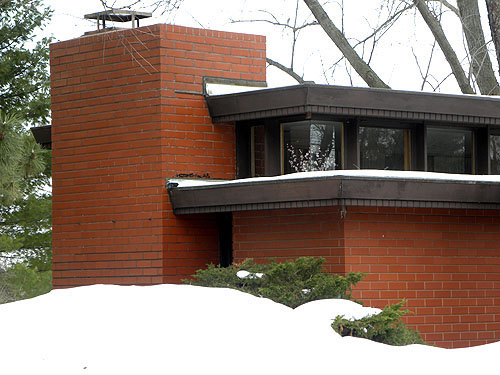
11:
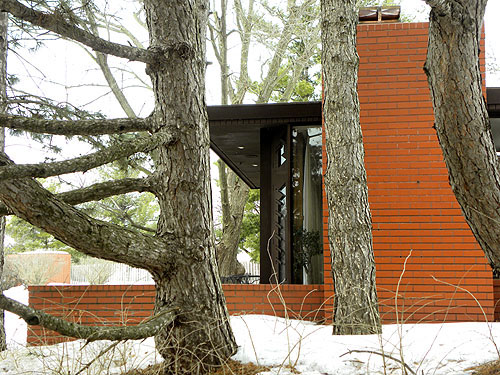
The roof intersects the
massive fireplace, clerestory windows allow natural light
into the Living Room.
(ST#2010.43.0520 -11) |
|
|
|
 |
|
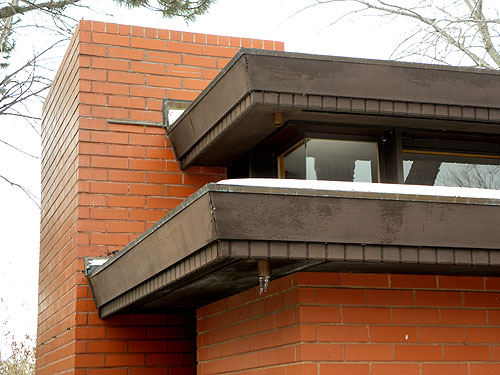
12:
Detail of the roof
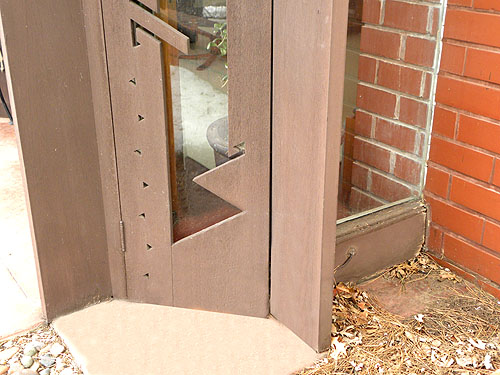
intersecting the fireplace. The mitered glass dissolves the
corner of the Living Room clerestory windows.
(ST#2010.43.0520 -12) |
|
|
|
 |
|
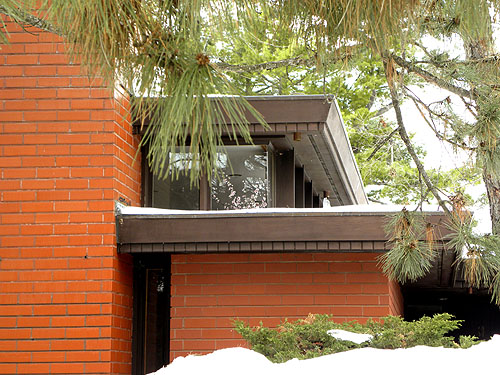
13:
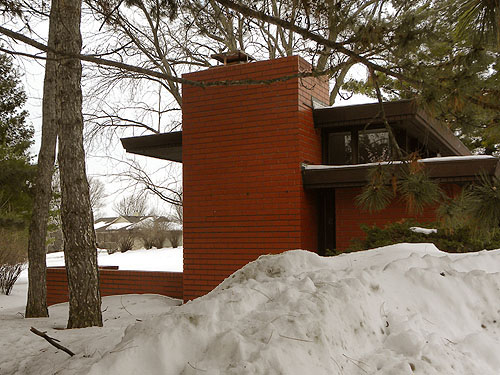
Viewed from the East. Massive
fireplace on the left, clerestory windows allow natural
light into the Living Room.
(ST#2010.43.0520 -13) |
|
|
|
 |
|
14:
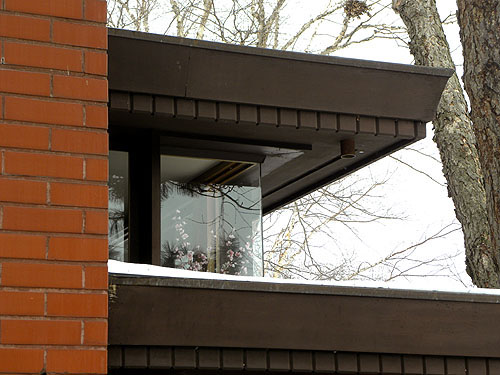
Detail of the Living
Room clerestory's mitered
glass corner window.
(ST#2010.43.0520 -14) |
|
|
|
 |
|
15:
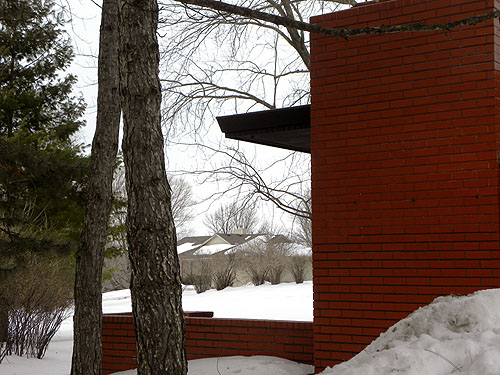
Viewed from the East. The
Living Room ceiling on the right is 6 feet 8 inches and
opens up to 10 feet 9 inches on the left.
(ST#2010.43.0520 -15) |
|
|
|
 |
|
16:
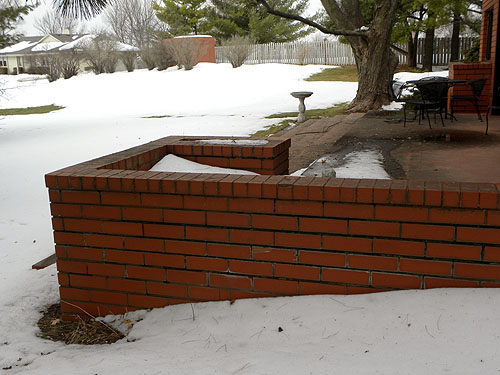
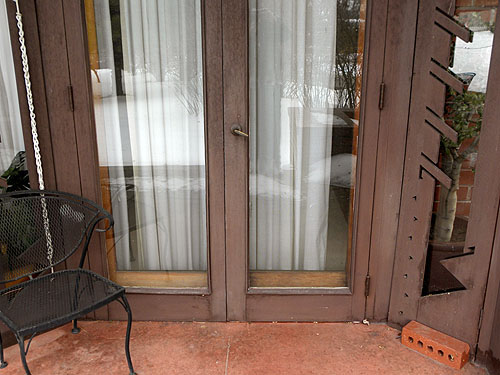
One of the home's three
built-in Planters is on the left, an element that grounded
Wright homes with the environment. The roof cantilevers out
over the Living Room's Terrace.
(ST#2010.43.0520 -16) |
|
|
 |
| 25:
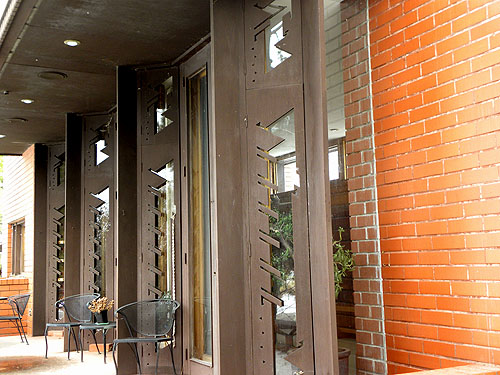
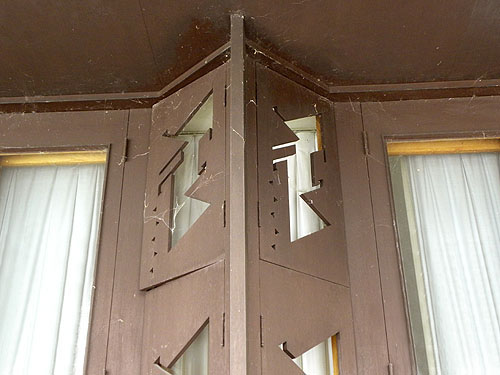
Viewed from the South. The
Living Room
floor to ceiling
doors and
unique perforated light
screen pilaster window
panels open
outward, blending interior with exterior.
(ST#2010.43.0520 -25) |
| |
 |
| 26:
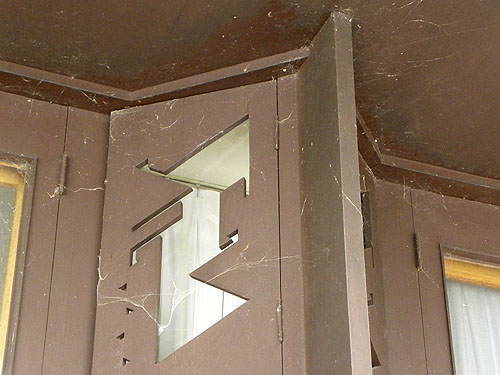
The top portion of the
pilaster window
panels open independently, allowing
ventilation into the Living Room.
(ST#2010.43.0520 -26) |
| |
 |
|
27:
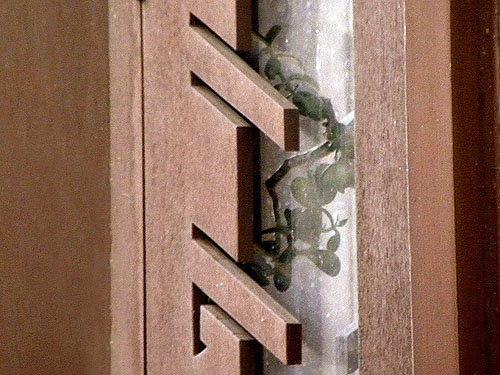
Detail of the
pilaster
construction.
(ST#2010.43.0520 -27) |
| |
 |
| 28:
Detail of the
perforated light screen windows
construction.
(ST#2010.43.0520 -28) |
| |
 |
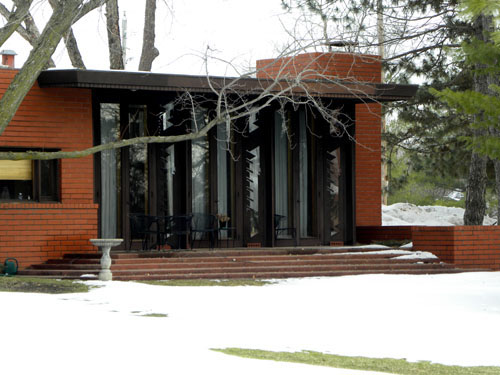
| 29:
Viewed from the Southwest, the Master Bedroom is on the
left, Bedrooms and Study in the center, Workspace and
Living Room on the right.
(ST#2010.43.0520 -29) |
| |
 |
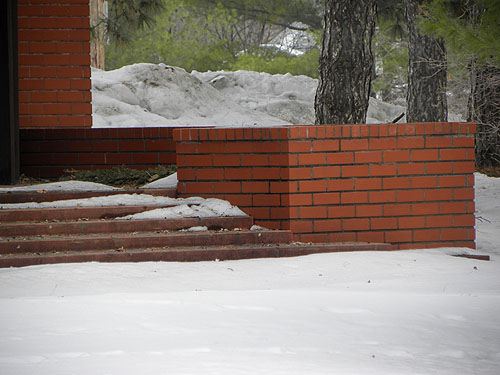
| 30:
The
Workspace is on the left, one
of the home's three built-in Planters is at window
height. The
Living Room is in the center, Planter on the right.
(ST#2010.43.0520 -30) |
| |
 |
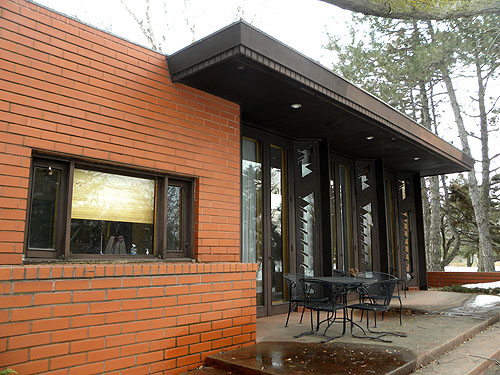
| 31:
Detail of the Planter on the right.
(ST#2010.43.0520 -31) |
| |
 |
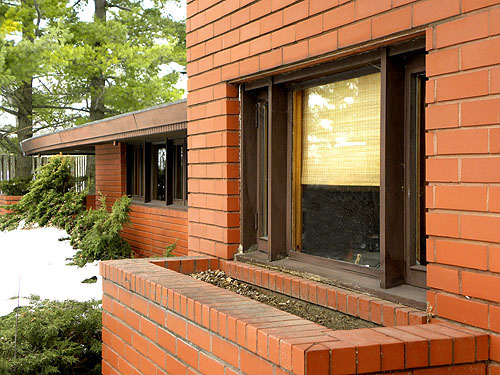
| 32:
Viewed from the West.
The
Workspace and window Planter is on the left, the Living
Room is on the right.
The roof cantilevers out over
the Living Room's Terrace.
(ST#2010.43.0520 -32) |
| |
 |
| 33:
Viewed from the East.
The roof cantilevers out over
the Master Bedroom's Terrace. The
Bedrooms and Study are to the left, Workspace and window
Planter is on the right.
(ST#2010.43.0520 -33) |
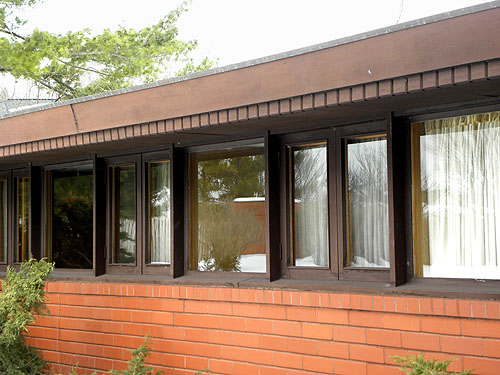
| |
 |
| 34:
Windows in the Bedrooms and Study open outward.
(ST#2010.43.0520 -34) |
| |
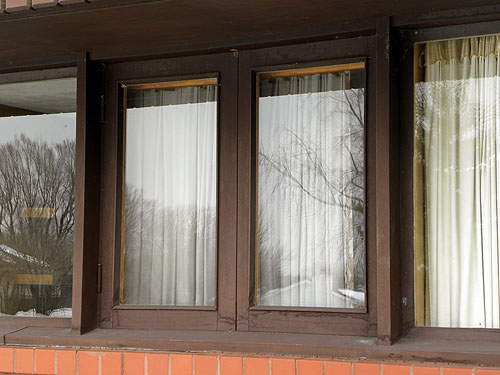 |
| 35:
Construction detail of the Bedrooms and Study windows.
(ST#2010.43.0520 -35) |
| |
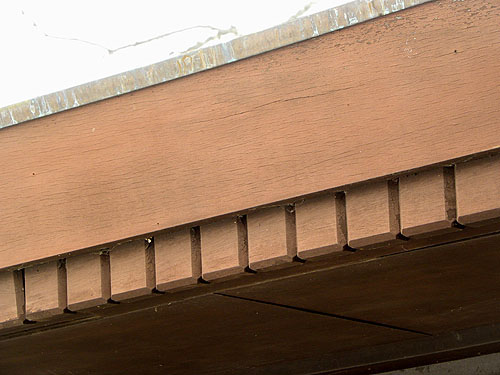 |
| 36:
Roof detail.
(ST#2010.43.0520 -36) |
| |
 |
|
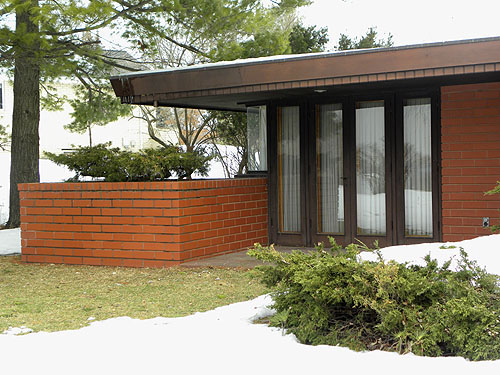
37:
A
built-in window planter is on the left, Master Bedroom
is on the right. Four floor-to-ceiling doors open
outward to a small terrace.
(ST#2010.43.0520 -37) |
| |
 |
|
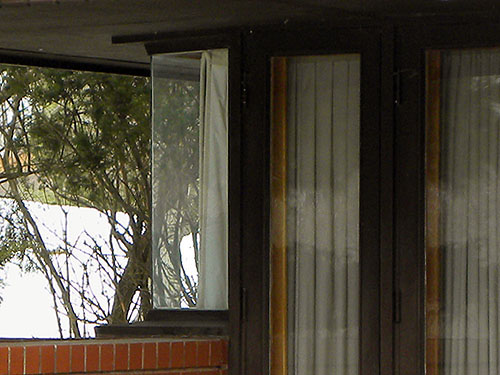
38:
Detail of the Master
Bedroom's mitered
glass corner window.
(ST#2010.43.0520 -38) |
| |
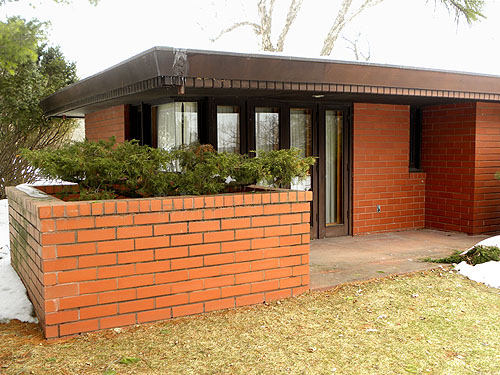 |
| 39:
Viewed from the Southwest. A
built-in window planter is on the left. The small
vertical window on the right allows light into the
Master Bath.
(ST#2010.43.0520 -39) |
| |
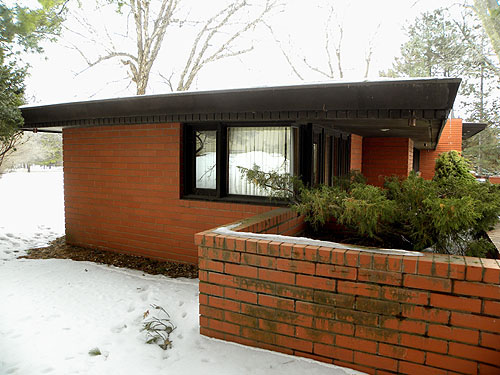 |
| 40:
Viewed from the West. The Master Bedroom is on the left,
built-in window planter is on the right.
(ST#2010.43.0520 -40) |
| |
 |
|
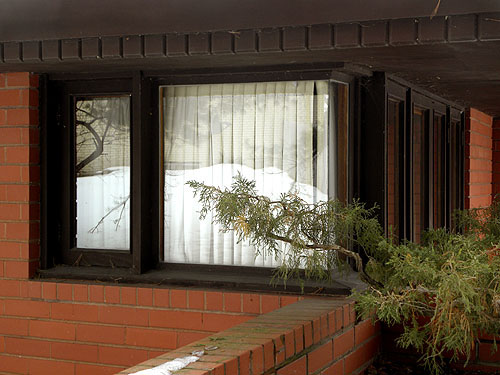
41:
Detail of the Master
Bedroom's mitered
glass corner window.
(ST#2010.43.0520 -41) |
| |
 |
|
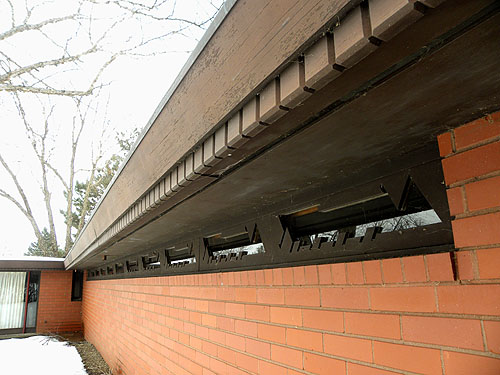
42: Viewed from the West. Originally
designed as a Carport, the enclosed playroom is on the
left. The small vertical window left of center allows
light into the Bathroom.
Perforated light screen
windows,
which run along the north side of the west
wing, provide
privacy and allow
natural light into the Gallery.
(ST#2010.43.0520 -42) |
| |
 |
|
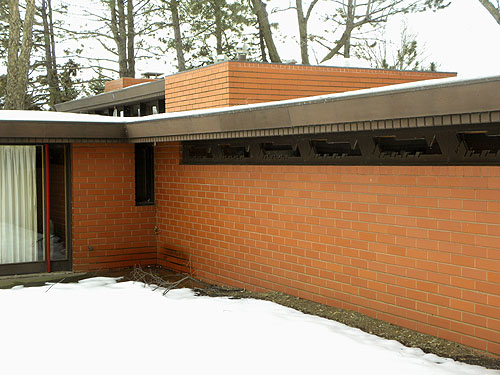
43: Viewed from the Northwest. The Living
Room's
clerestory windows can be
seen above the
playroom and Bath on the left. The height of
the Utility Room and Workspace can be seen in the center
above the roof line. The
perforated light screen
windows, allows natural light into the Gallery on the
right.
(ST#2010.43.0520 -43) |
| |
 |
|
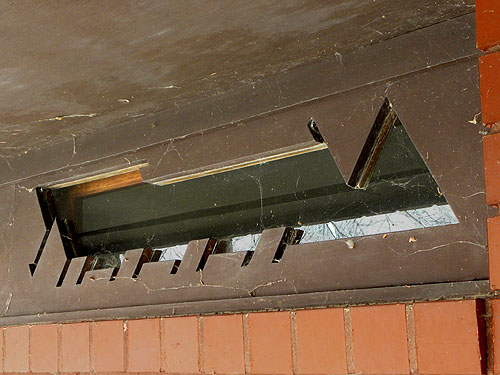
44: Detail of the
perforated light screen,
which
allows natural light into
the Gallery.
(ST#2010.43.0520 -44) |
| |
 |
|
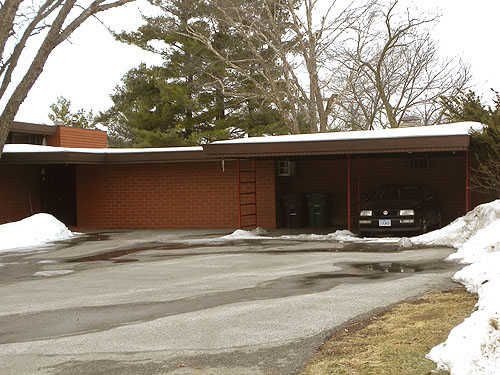
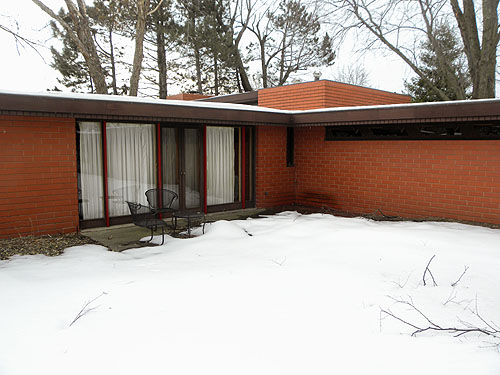
45: Viewed from the Northwest. Originally
designed as a Carport, the enclosed playroom is on the
left. The height of the Utility Room and Workspace can
be seen in the center above the roof line.
The Gallery is on the
right.
(ST#2010.43.0520 -45) |
| |
 |
|
46: Viewed from the Northeast, the Shop is
on the left, the Gallery is seen on the right.
(ST#2010.43.0520 -46) |
| |
|
Text and Photographs by Douglas M. Steiner, Copyright
2010 |
| |
| |
| |
|
|
Interior PHOTOGRAPHS (2010) |
|
|
|
|
The
Trier Residence is based
on the Usonian
Exhibition House (S.369) that was built in 1953 on the
site for The Guggenheim Museum.
The Trier Residence was the second home to utilize this
floor plan. The first being the Feiman Residence (S.371). The
Trier's original floor plan created approximately 1740 square feet
of living space, not including the Work Shop. The Living Room
occupied thirty percent of the living space.
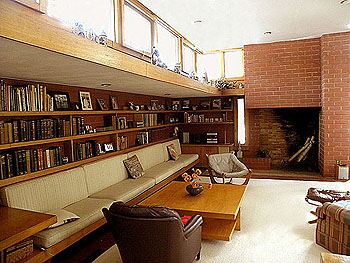
Classic Usonian
elements are prominent in the Trier Residence. Built-in
seating and shelving. The Living Room's cantilevered roof extends
out over the Terrace. The mortar is tinted, the vertical
joints are flush, and the horizontal joints are raked. There
are mitered glass corners, a massive fireplace, and
clerestory windows that allow natural light into the Living
Room. The Living Room's ceiling height starts at 6 feet 8
inches and
opens up to 10 feet 9 inches. The Living Room's Southern wall of floor to ceiling
doors and unique light screen window pilasters open outward,
blending interior with exterior. Glass intersects and is
imbedded into the brick-tile wall. Windows and doors |
|
open outward. Perforated
light screen windows run along the
length of the Gallery, allowing natural light.
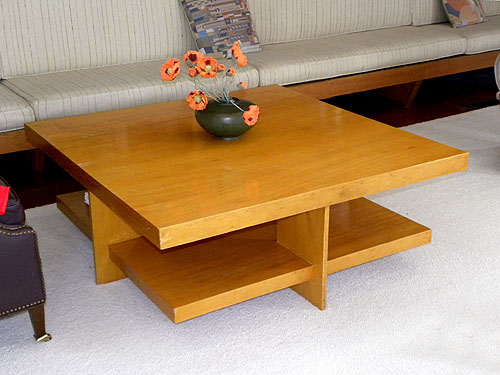
The Wright designed cantilevered coffee table is a
variation of the table first designed in 1939 for his friend
Lloyd Lewis (S.265). The original vertical legs extended out
two inches and are flush with the top of the table. This Trier version,
with its visually minimal legs, gives the appearance that
the top is floating, as apposed to being anchored to the
legs. The dining area includes built-in
shelving and dining room table. Ida reminisced about the
furniture. "Paul built all the furniture. Wright designed
the Dining Room table 3-4 inches shorter than the standard dining
room table to make the ceiling look taller". The dining room table is
anchored to the wall. Identical dining chairs were
originally designed for the Usonian
Exhibition House built in 1953 in New York, on the
grounds that were planned for, and would eventually become the
Guggenheim Museum.
Nine images photographed by Douglas M.
Steiner on March 15, 2010. Copyright 2020. Set of 14 interior photographs high res 10 x 13 digital images. |
|
|
|
|
|
 |
|
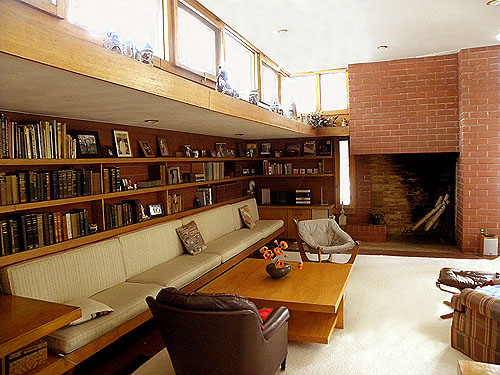
1:
Classic Usonian
elements are prominent in the Trier Residence. Built-in
seating and shelving. Clerestory windows allow natural
lighting into the Living Room. The massive fireplace
opening is 5 foot 4 inches high, 6 foot 2 inches wide.
The Living Room ceiling height is 6 feet 8 inches on the
left and opens up to 10 feet 9
inches on the right.
(ST#2010.43.0520
-47) |
|
|
|
 |
|
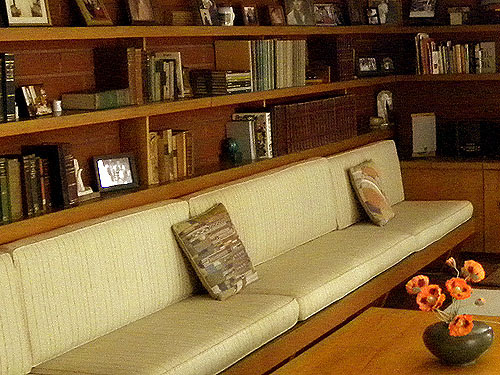
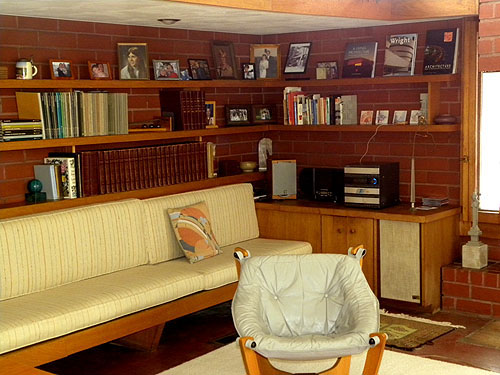
2:
Detail of the built-in
seating and shelving. "Paul built all the furniture",
said Ida.
(ST#2010.43.0520 -48) |
|
|
 |
|
3:
After fifty years, the brick tile still achieved a
flawless brick look. The 4 x 12" size remained consistent
with Wright's original dimensions.
(ST#2010.43.0520 -49) |
|
|
 |
|
4:
This Wright designed cantilevered coffee table is a
variation of the table first designed in 1939 for his friend
Lloyd Lewis (S.265) (see 4C below). The original vertical legs extended out
two inches and are flush with the top of the table. This Trier version,
with its visually minimal legs, gives the appearance that
the top is floating,
as apposed to being anchored to
the legs. Versions can be found in
many Wright designed
homes (see Blair example below)
(ST#2010.43.0520 -50) |
|
|
 |
|
5:
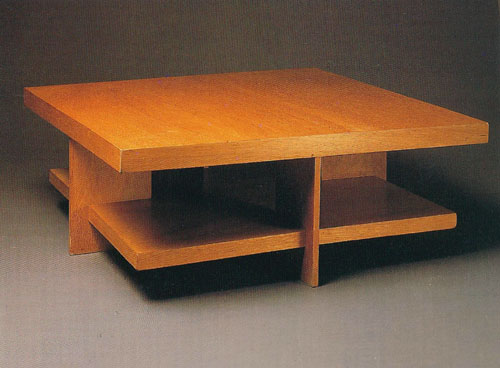
Original coffee table designed for the Paul J. Trier
Residence in 1956, was sold in New York in 1986 and became
part of the Domino's Pizza Collection. Published in
"Frank Lloyd
Wright. Preserving an Architectural Heritage", Hanks,
1989, page 112-113. Courtesy Domino's Pizza Collection.
Photographed by Gregg Campbell. |
|
Cassina |
 |
|
6:
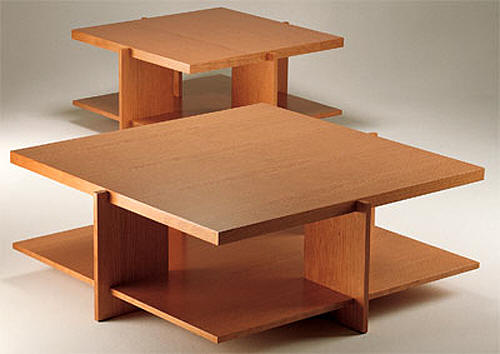
Cassina 623 Lewis Coffee Table.
As opposed to the Trier version above, this version
appears to anchor the top to
the legs.
It measures 35 1/2 x 45 1/4 x 16 1/8. |
|
Blair |
 |
|
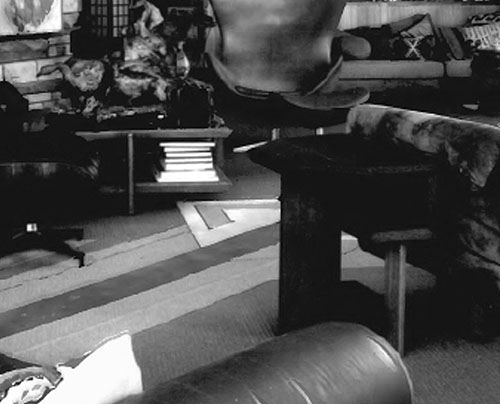
7: Detail of the
Blair (S.351) Living Room
Coffee Table.
Vertical leg extended out two inches. Horizontal
table top and shelf are equal in thickness and size, but
sides are cut inward at an angle.
(National Registry of Historic
Places, March 14, 1989, Photography by Richard Collier.) |
|
|
|
 |
|
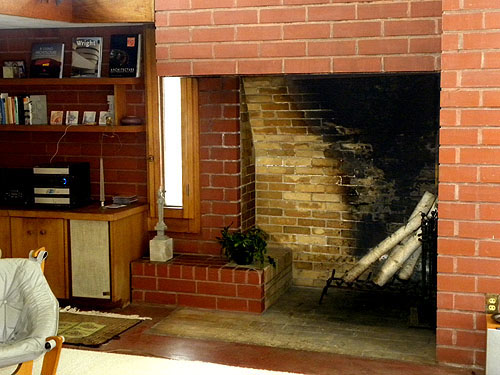
8:
The massive fireplace
opening is 5 foot 4 inches high, 6 foot 2 inches wide.
The front left corner cantilevers out into the Living Room.
(ST#2010.43.0520 -51) |
|
|
|
 |
|
9:
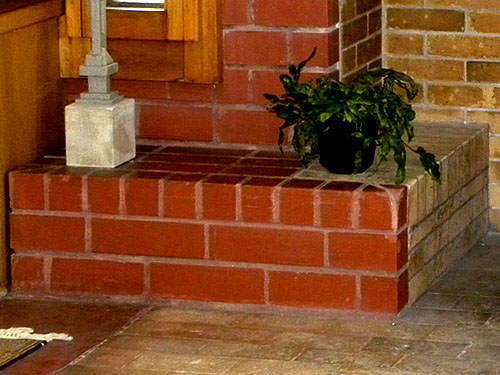
Detail of the built-in fireplace
ledge.
(ST#2010.43.0520 -52) |
|
|
|
 |
|
10:
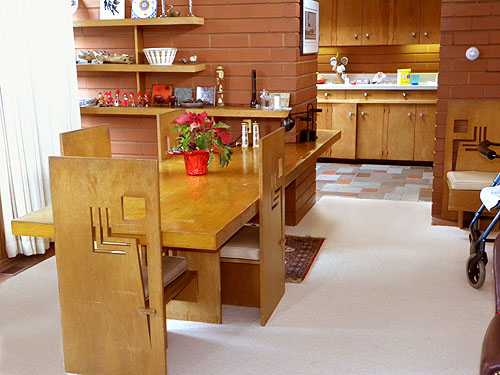
Dining area includes built-in
shelving and dining room table.
Ida reminisced about the
furniture. "Paul built all the furniture. Wright designed
the Dining Room table 3-4 inches shorter than the standard dining
room table to make the ceiling look taller".
Work Space can be seen in the
background through the opening. The Entryway is to the
right.
(ST#2010.43.0520 -53) |
|
|
|
 |
|
11:
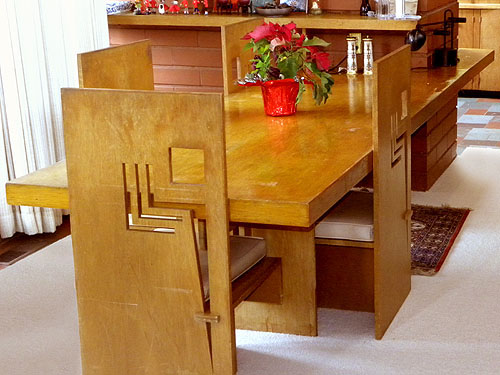
The dining room table is
anchored to the wall. Identical dining chairs were
originally designed for the Usonian
Exhibition House built in 1953 in New York, on the
grounds that were purchased for, and would eventually be the
Guggenheim Museum. See additional information about the
Usonian Exhibition House.
(ST#2010.43.0520 -54) |
|
|
|
 |
|
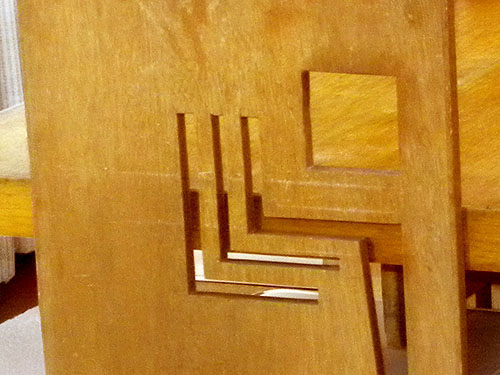
12: The perforated
geometric panel was originally constructed of laminated
birch.
(ST#2010.43.0520 -55) |
|
|
 |
|
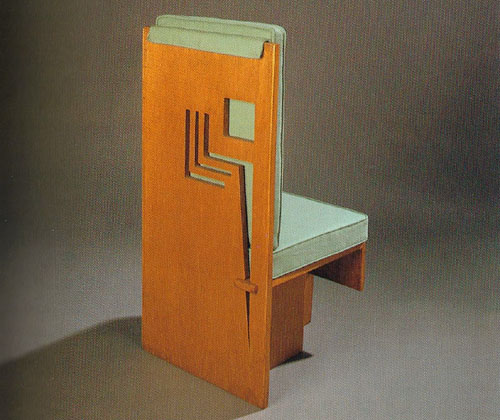
13: Original dining
chair designed for the Paul J. Trier Residence in 1956, was
sold in New York in 1986 and became part of the Domino's
Pizza Collection. Published in
"Frank Lloyd
Wright. Preserving an Architectural Heritage", Hanks,
1989, page 112-113. Courtesy Domino's Pizza Collection.
Photographed by Gregg Campbell. |
|
|
 |
|
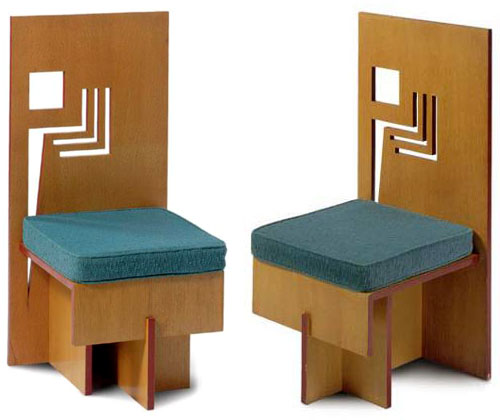
14: Usonian Exhibition Dining Chair, 1953.
Designed by
Frank Lloyd Wright for the Usonian
Exhibition House exhibited in
"Sixty Years of Living Architecture: The Work of Frank Lloyd
Wright", at The Solomon R. Guggenheim Museum exhibition
grounds, New York, 22 October - 29 November 1953. For the
retrospective of Frank Lloyd Wright's work in 1953, Wright
built a fully furnished ''Usonian House'' and pavilion in
the museum gardens. The house was described in a New York
Times article as a ''fusion of architecture and furnishings,
the blending of indoors and out.'' These two chairs were designed and built specifically for the exhibition
house. Wright later used the same model for the Trier
Residence,
Iowa, 1956. Oak plywood, 37 inches high. Manufactured by Plycraft Products.
(Sotheby's description. Sale date December 2003. Sold for
$24,000 each plus buyer's premium.) (See
Usonian
Exhibition House) |
|
|
|
Text and Photographs by Douglas M. Steiner,
unless otherwise noted, Copyright
2010 |
|
|
|
|
|
|
|
The 1953 New York
Usonian Exhibition House (S.369)
and The 1956 Trier Residence |
|
|
|
|
The
Trier Residence is based
on the Usonian
Exhibition House (S.369) that was built in 1953 on the site
for The Guggenheim Museum.
The Trier Residence was the second home to utilize this
floor plan. The first being the Feiman Residence (S.371).
Wright's initial drawing of the home shows that he conceived
the Trier Residence as a Usoniam Automatic,
constructed of 12 x 24" concrete blocks. The working drawings
specify the home to be constructed
of brick. The Triers elected to use brick, and then
substituted brick tile, to save construction costs. The 4 x
12" size remained consistent with Wright's original
dimensions. The Trier's original floor plan created approximately 1740 square feet
of living space, not including the Work Shop. The Living Room
occupied thirty percent of the living space.
The complex on the grounds that would eventually
become the Guggenheim Museum consisted of two structures.
The New York Usonian Exhibition House (S.369) and the
Pavilion (S.370), both seen on the cover of the catalog
below. "Sixty Years of Living Architecture: The Work of Frank Lloyd
Wright", was a traveling exhibition of Wright's
work, consisting of Models, photographs and original
drawings. A Preview of the exhibition was held in Philadelphia (January 1951).
The world wide tour opened in Palazzo Strozzi
Florence, Italy (June 1951). In "Sixty Years" (New
York), Wright notes that from Florence the Exhibition traveled to
"Switzerland, France, German and Holland". The Exhibition
catalogs are dated: Paris (April 1952),
Zurich (End of May 1952),
Munich (May 16 - June 15, 1952), and
Rotterdam (dated June 1, 1952). After two years in Europe
the exhibition crossed the |
|
Atlantic to Mexico
City, then to New York (1953). After an exhibition in
Los
Angeles (1954) Wright indicates
(LA)
that the Exhibition was headed to the Orient. Manila, Tokyo
and New Delhi in 1955. Note: We found no evidence that the
Orient exhibitions took place. In
"FLW, His Life, His
Work, His Words", 1966, pp. 219-220, Mrs. Wright indicates that
after the Exhibition in LA, "...it returned to Taliesin".
Also of interest is the booklet that was published for the
Exhibition held in Chicago. Included in the title of the
booklet is "Series Nine Chicago". When you count the number
of exhibitions, eliminating the Orient, Chicago is number
nine. 1) Florence 2) Switzerland 3) France
4) German 5) Holland 6) Mexico City 7) New
York 8) Los Angeles 9) Chicago. The exhibition
catalog is dated October 16, 17, 18, 1956. Mayor Daley
proclaimed October 17, Frank Lloyd Wright Day.
The New York House and Pavilion were constructed at
the same time. The exhibition was held from October 22 -
November 29, 1953. Two booklets were produced. One for the
House (below) and one for the
Exhibition. The
exhibition included a fully furnished 1,700 sq. ft. ''Usonian House''. Wright used the same
design for the dining chair in other homes including Trier
Residence. On occasion, furniture from the exhibition
are offered at auction houses.
After the exhibition in New York, the house was
auctioned off. The buyer contracted polio and was unable to
reconstruct the home. In 1984, after sitting in storage for
30 years, it was put up for auction again. Tom Monaghan won
the bid at $117,000. Plans were made to reconstruct the
home, but time had taken its toll. Parts were eventually
auctioned off again in 1992. |
| |
|
|
|
 |
|
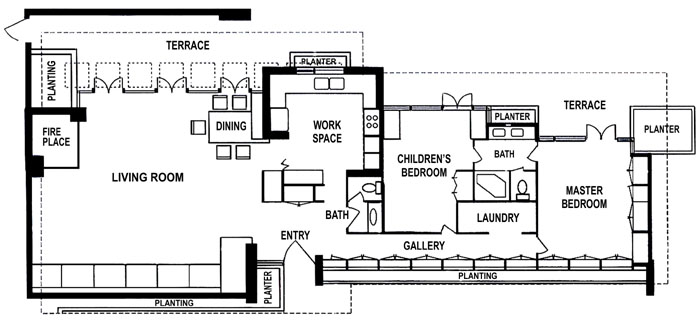
The Usonian Exhibition House
floor plan created approximately 1,700 square
feet of living space. |
|
| |
 |
|
The Trier's original floor plan
created approximately 1,740 square feet of
living space, not including the Work Shop. The
Living Room occupied thirty percent of the
living space. The Trier Residence Living Room
was reduced, and the Bedroom Wing enlarged,
allowing the addition of a Study.
(See full Floor Plan.) |
|
|
|
NY |
 |
|
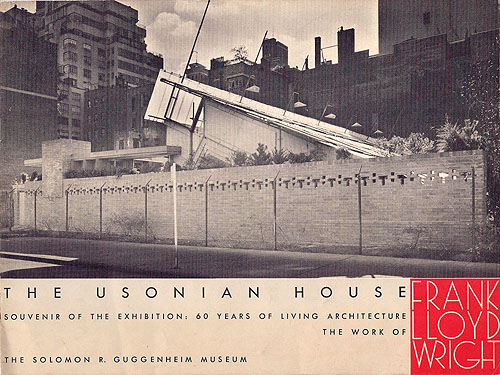
1: The complex on the grounds
that would eventually become the Guggenheim Museum consisted
of two structures. The New York Usonian Exhibition House
(left, S.369) and the Pavilion (right S.370). The New York
House and Pavilion were constructed at the same time. The
exhibition was held from October 22 - November 29, 1953. Two
booklets were produced. This one for the House (above) and one for the
Exhibition.
(Published by The Solomon R. Guggenheim Museum, New York.) |
|
|
 |
|
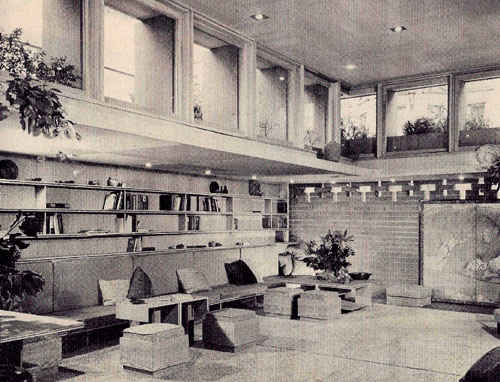
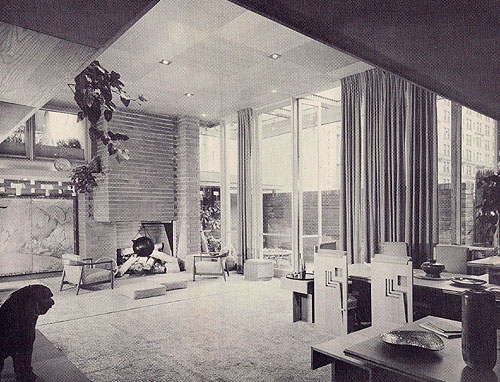
2: Classic Usonian
elements were prominent in the New York Usonian Exhibition
House. Built-in
seating and shelving. Clerestory windows allowed natural
lighting into the Living Room. The Living Room ceiling height
was approximately 7 feet on the
left and opens up to 12 feet on the right. (Photographed by
Ezra Stoller.) |
|
|
|
|
|
3:
The Trier Residence followed
the same floor plan as the Exhibition House, with minor
changes. The Living Room ceiling height was reduced from 12
feet to 10 feet 9 inches on the right. While the Fireplace
design was very similar, it was moved to the left, and the
opening was much higher. The Trier Residence Living Room was reduced,
and the Bedroom Wing enlarged,
allowing the addition of a Study. |
|
|
 |
|
4:
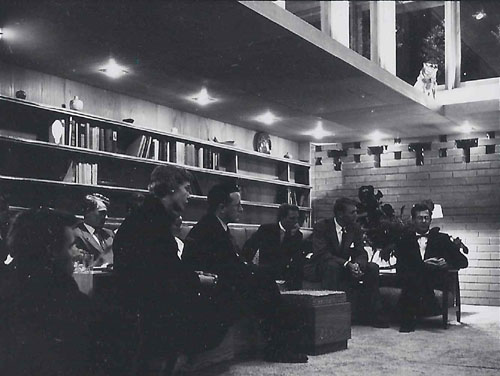
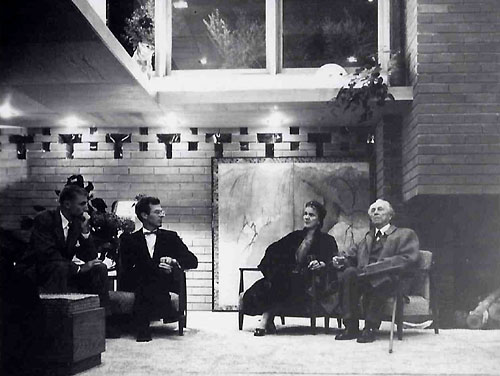
New York Usonian Exhibition House and Pavilion opening
reception, October 22,1953. See
additional photographs. (Photographed by Pedro
Guerrero.) |
|
|
 |
|
5:
New York Usonian Exhibition House and Pavilion opening
reception, October 22,1953. See
additional photographs. (Photographed by Pedro
Guerrero.) |
|
|
 |
|
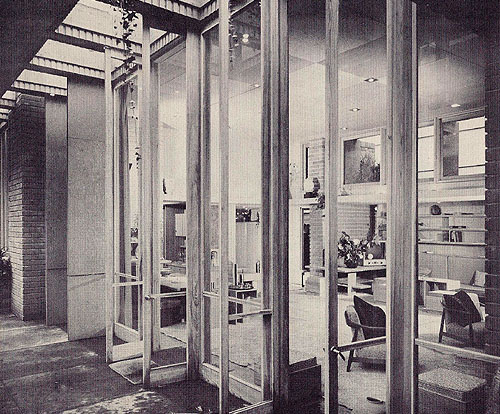
6:
The Living Room's wall of floor to ceiling doors and
windows open outward, blending interior with exterior. The
Dining area is on the right.
(Photographed by Ezra Stoller.) |
|
|
|
|
 |
|
7:
Viewed from the Terrace into the Dining area and Living
Room. Sets of 12 foot doors open outward and extend to the
full height of the Living Room. The cantilevered roof
overhang is richly patterned with ornamental dentil bands.
(Photographed by Ezra Stoller.) |
|
|
 |
|
8:
Not only do the
three sets of double floor to ceiling doors open outward but
the decorative light screen pilaster windows do as
well.
Glass intersects and is imbedded into the brick-tile wall. |
|
|
 |
|
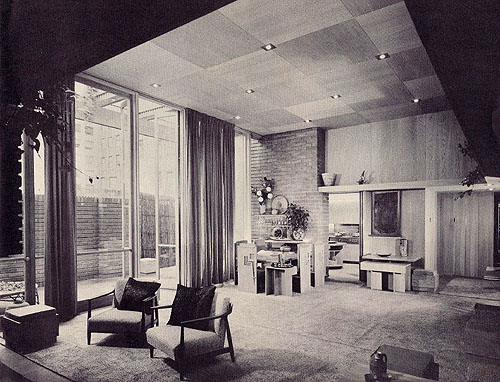
9: Fireplace is is on the far
left, Terrace, Dining area and Work Space in the center, and
Entry to the far right. The brick is a deep red, and is
complimented by a patterned ceiling of red oak plywood. The
Dining table and chairs were designed and built specifically
for this exhibition house. (Photographed by Ezra Stoller.) |
|
|
|
|
|
10:
The Trier's Dining area includes built-in
shelving and dining room table.
Ida reminisced about the
furniture. "Paul built all the furniture. Wright designed
the Dining Room table 3-4 inches shorter than the standard dining
room table to make the ceiling look taller".
Work Space can be seen in the
background through the opening. The Entryway is to the
right. |
|
|
|
|
|
11: Usonian Exhibition Dining Chair, 1953.
Designed by
Frank Lloyd Wright for the Usonian
Exhibition House exhibited in
"Sixty Years of Living Architecture: The Work of Frank Lloyd
Wright", at The Solomon R. Guggenheim Museum exhibition
grounds, New York, 22 October - 29 November 1953. For the
retrospective of Frank Lloyd Wright's work in 1953, Wright
built a fully furnished ''Usonian House'' and pavilion in
the museum gardens. The house was described in a New York
Times article as a ''fusion of architecture and furnishings,
the blending of indoors and out.'' These two chairs were designed and built specifically for the exhibition
house. Wright later used the same model for the Trier
Residence,
Iowa, 1956. Oak plywood, 37 inches high. Manufactured by Plycraft Products.
(Sotheby's description. Sale date December 2003. Sold for
$24,000 each plus buyer's premium.) |
|
|
|
|
|
12: Original dining
chair designed for the Paul J. Trier Residence in 1956, was
sold in New York in 1986 and became part of the Domino's
Pizza Collection. Published in
"Frank Lloyd
Wright. Preserving an Architectural Heritage", Hanks,
1989, page 112-113. Courtesy Domino's Pizza Collection.
(Photographed by Gregg Campbell.) |
|
|
|
Text and Photographs by Douglas M. Steiner,
unless otherwise noted, Copyright
2010 |
|
|
|
|
|
|
|
|
Light Screens |
|
|
|
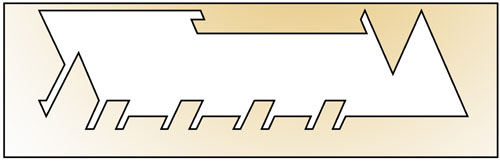
Wright's initial drawing of the
home shows that he conceived this home as a Usoniam Automatic,
constructed of 12 x 24" concrete blocks.
The Triers visited Taliesin to review the working drawings of the
home. "Paul watched Wright draw the design of the
perforated panels. He wasn't happy with the first design, so
Wright designed a second. All panels were unique to each house,"
she explained. Ida pointed
toward the Living Room wall of doors and perforated light screen window
pilasters. "The perforated triangles
were
|
|
originally designed as
squares, but we couldn't afford squares." Not only do
the three sets of double floor to ceiling doors in the
Living Room's Southern wall open outward, but the decorative light screen window
pilasters do as well, blending interior with exterior. The top portion of the
pilaster window panels open independently, allowing
ventilation into the Living Room. Perforated light screens, which run along the north side of the
bedroom
wing, provide privacy and allow
natural light into the Gallery. |
|
|
|
|
|
 |
| Perforated light screens, which run along the north side of the
bedroom
wing, provide privacy and allow
natural light into the Gallery. |
| |
|
 |
|
|
| The Living
Room's Southern wall of doors and decorative light screen window
pilasters open outward, blending interior with exterior. The top portion of the
pilaster window panels open independently, allowing
ventilation into the Living Room. |
|
|
|
|
|
|
|
|
6:
Viewed from the South. The
Living Room
floor to ceiling
doors and
unique perforated light
screen pilaster window
panels open
outward, blending interior with exterior. |
| |
|
|
| 7:
The top portion of the
pilaster window
panels open independently, allowing
ventilation into the Living Room. |
| |
|
|
|
8:
Detail of the
pilaster
construction. |
| |
|
|
|
9:
Detail of the
perforated light screen windows
construction. |
| |
|
|
| 10:
The
Workspace is on the left, one
of the home's three built-in Planters is at window
height. The
Living Room is in the center, Planter on the right. |
| |
|
|
| 11:
Viewed from the West.
The
Workspace and window Planter is on the left, the Living
Room is on the right.
The roof cantilevers out over
the Living Room's Terrace. |
| |
|
|
|
|
1: Perforated light screens, which run along the north side of the
bedroom
wing, provide privacy and allow
natural light into the Gallery. |
| |
|
|
|
|
2: Viewed from the West. Originally
designed as a Carport, the enclosed playroom is on the
left. The small vertical window left of center allows
light into the Bathroom.
Perforated light screen
windows,
which run along the north side of the west
wing, provide
privacy and allow
natural light into the Gallery. |
| |
|
|
| 3: Viewed from the Northwest. The Living
Room's
clerestory windows can be
seen above the
playroom and Bath on the left. The height of
the Utility Room and Workspace can be seen in the center
above the roof line. The
perforated light screen
windows, allows natural light into the Gallery on the
right. |
| |
|
|
|
4: Detail of the
perforated light screen,
which
allows natural light into
the Gallery. |
| |
|
|
| 5: Viewed from the Northeast, the Shop is
on the left, the Gallery is seen on the right. |
| |
|
|
Text and Illustrations by
Douglas M. Steiner, Copyright 2010 |
|
|
|
|
|
|
|
Usonian Automatic Homes (Built) |
|
|
|
|
|
|
|
|
|
|
|
Related
Items
From the
Usonian Automatic Traveling Exhibit |
|
|
|
|
| Books, Brochures,
PR, Articles |
|
|
|
|
|
|
|
|
BIBLIOGRAPHY |
|
|
|
"An Autobiography",
Wright, 1932, page 176. |
|
"Sixty Years of Living Architecture: The Work of Frank Lloyd
Wright",
Traveling Exhibition, 1951-1956. |
|
“Sixty
years of Living Architecture”,
Architectural Forum, January, 1951, pages 73-108. |
|
“Sixty years of Living Architecture”,
Architectural Forum Offset, January, 1951, pages 73-108. |
|
"Frank Lloyd
Wright:
Sixty Years of Living Architecture"
Book Review, Arch. Forum, Dec., 1952, pages 158, 166. |
|
"Frank Lloyd Wright exhibits 60
years’ work",
Architectural Forum, October, 1953, page 45. |
|
"Wright
Makes New York, Sixty Years of Living Architecture Exhibit",
Arch. Record, Oct., 1953, page 20. |
|
"Review of
Exhibit at the Guggenheim Museum, Oct 9 - Nov 15, 1953",
Art News,
October, 1953, page 44. |
|
“Sixty
Years of Living Architecture. Work of Frank Lloyd Wright".
Arch. Forum, Nov., 1953, pages 152-155. |
|
"Sixty Years
of Living Architecture", House & Home -
November, 1953, pages 118-121. |
|
"The
Natural House",
Wright, 1954, pages 115-125 |
|
"Frank
Lloyd Wright Day proclaimed in Chicago",
Architectural Forum, November 1956, page 21. |
|
"Frank Lloyd
Wright, His Life, His
Work, His Words", Wright, 1966, pp.
219-220. |
|
"Frank
Lloyd Wright 1869 - 1969", Northwest Architect,
July-August 1969, page 49. |
|
"Living with
Wright: Ida Trier, Johnston, Iowa", Midwest
Living, June 1987, Pp 101-105. |
|
"Related items from the Usonian
Automatic Traveling Exhibition" 1987 - 1990. |
|
"Frank
Lloyd Wright:
Preserving an Architectural Heritage, Domino’s Collect",
Hanks, 1989, pages 112-113. |
"Frank
Lloyd Wright Monograph 1951 -1959", Text: Pfeiffer, Bruce
Brooks;
Edited and Photographed:
Futagawa, Yukio, 1990, pages 229-230. |
| "The Frank Lloyd Wright Companion",
Storrer,
1993, page 427. |
|
"Picturing
Wright",
Guerrero, 1994, pages 136-141, 144-155. |
|
"Lost Wright", Lind,
1996, Pp 148-149, 156-159. |
|
"Frank
Lloyd Wright:
Cassina I Maestri",
1997, page 43. |
|
"Bexley Heath Ltd.: Spring 1997",
page 5. |
|
"Frank
Lloyd Wright’s
House Beautiful",
Maddex, 2000, Pages 162-163. |
|
"Interior Style & Design",
Ehrlich, 2003, pages 69, 126. |
| "Wright-Sized
Houses", Maddex, Diane, 2003, pages 50-51, 60, 134. |
|
"Frank Lloyd Wright and
the House Beautiful. Designing an American Way", Boyd;
Pfeiff, 2005, pages 66-67, 79. |
|
"Frank Lloyd Wright in New York. The
Plaza Years, 1954-1959",
Hession; Pickrel, 2007, pages 99-101. |
|
"Frank Lloyd
Wright, Complete Works 1943-1959", Pfeiffer; Gossel,
2009, page 475. |
|
"Wright Study: Usonian Automatic Homes",
Steiner, 2009 |
|
|
|
|
|
|
|
|
Additional Wright Studies |
|
|
|
SEE ADDITIONAL WRIGHT STUDIES |
|
|
|
Frank Lloyd
Wright's First Published Article (1898) |
|
|
|
Photographic Chronology of Frank Lloyd
Wright Portraits |
|
|
 |
"Frank Lloyd Wright's Nakoma
Clubhouse & Sculptures."
A
comprehensive study of Wright’s Nakoma Clubhouse
and the Nakoma
and Nakomis Sculptures. Now Available.
Limited Edition.
More
information. |
|
|
|
Text copyright
Douglas M. Steiner, Copyright 2014, 2020. |
|
|
|
|
|
|
|
|