- Wright Studies
William B. and Elizabeth Tracy Residence, Normandy Park, WA (1955) (S.389)
My first contact with the Tracys was in the late 1970's. A few years after moving to the Great Northwest in the mid-70's, I discovered that Wright had build a home in the Seattle area, the “Tracy” Home. I looked their name up in the phone book, gave them a call and much to my surprise Mrs. Tracy answered the phone. I explained how much I admired Wright’s work. She invited me to come any time and take a tour. I did.
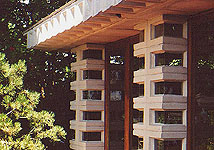
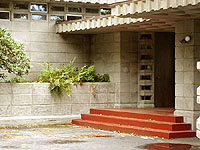
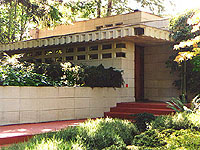
Bill was a Boeing engineer, and Elizabeth had taken art courses from Goetsch and Winckler (S.269) while at Michigan State. While only 1,200 square feet, this home is a true gem. It is located in Normandy Park, on a cliff overlooking the Puget Sound. Designed in 1955, this Usonian Automatic consists of over seventeen hundred concrete blocks. For nearly a year, Bill Tracy crafted the hundreds of blocks by hand, in eleven different block designs. The largest of the steel molds created concrete blocks measuring two feet square and weighed between 150 - 200 pounds. It is one of only a handful of Usonian Automatic homes built using concrete molded blocks (S.344,349, 386, 387, 388, 389 and 392). Others were designed using this method, but constructed of other material. If the Tracy home looks similar to the Kalil Residence (S.387), its because the same molds were used in both homes. Not only are the overhead blocks two foot square, butthe home is built on a two foot square grid system, which is consistent with the other homes built of this style. Redwood was used for paneling, built-ins, trim and the Wright design furniture. Not only did Bill create the blocks, he also built the living room seating, dining room table and chairs, as well as the shelving light boxes. Milton Stricker, who apprenticed with Wright in 1951, oversaw the construction. Their contractor Ray Brandes, built his own Usonian home in 1952. At a cost of $25,000, he finished the Tracy home in November of 1956 after four months of construction.
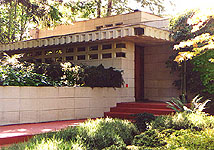
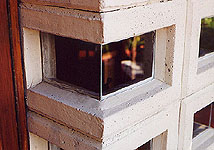
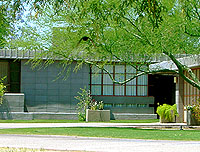
There are many classic Wright details. The basic material are concrete blocks, redwood and a red concrete floor with radiant heat, designed on a two foot grid. There are three sets of double wood framed glass doors on the West side of the Living Room that open outward and a set of corner glass doors that also open outward removing the corner. Row of vertical block columns of perforated concrete blocks and embedded mitered glass corners. There are perforated concrete block windows and clerestory windows with embedded glass. The signature red glass tile. A sunken fireplace. The hidden entrance, but this door actually opens inward. Like many of Wright’s homes, he designed the built-in seating, many of the fixtures and some of the furniture.
August 2001
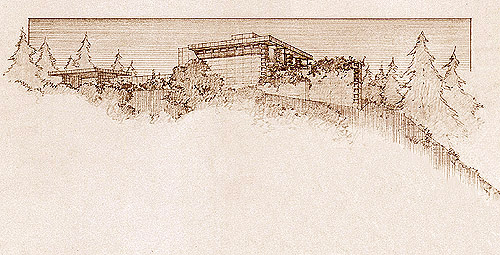
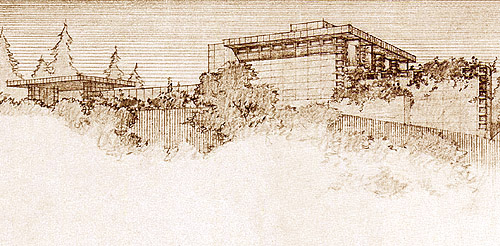
Original Drawing
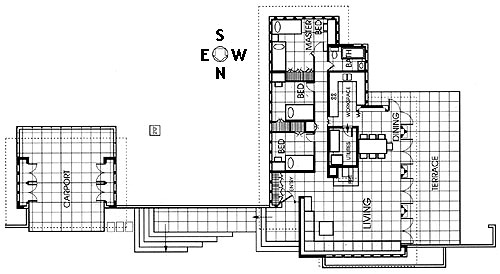
Original drawing of the Tracy Residence. Detail from original drawing.
Date: 1992
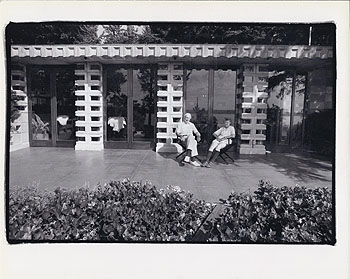
Title: William and Elizabeth Tracy Residence 1992. William and Elizabeth Tracy relaxing on their back terrace.
Description: Caption on verso: "Ron Wurzer / Seattle Times. William and Elizabeth Tracy live in one of only three dwellings in the state that was designed by the renowned architect Frank Lloyd Wright. The house, with a sound view, was designed in 1954 and the Tracy’s have been the only inhabitants." Newspaper caption attached to verso and stamped Aug 20 1992. Photograph by Ron Wurzer. Published on August 20, 1992 in the Seattle Times. Acquired from the archives of the Seattle Times.
Size: Original 10 x 8 B&W photograph.
ST#: 1992.74.1011
Photographs By Douglas Steiner, August 2001
There are many classic Wright details. The basic material are concrete blocks, redwood and a red concrete floor with radiant heat, designed on a two foot grid. There are three sets of double wood framed glass doors on the West side of the Living Room that open outward and a set of corner glass doors that also open outward removing the corner. Row of vertical block columns of perforated concrete blocks and embedded mitered glass corners. There are perforated concrete block windows and clerestory windows with embedded glass. The signature red glass tile. A sunken fireplace. The hidden entrance, but this door actually opens inward. Like many of Wright’s homes, he designed the built-in seating, many of the fixtures and some of the furniture.
Text and Photographs by Douglas M. Steiner, Copyright 2001 Floor Plan Floor plan copyright 1993, “The Frank Lloyd Wright Companion” Storrer, William Allin, page 417.
Usonian Automatic Homes (Built) Related Items From the Usonian Automatic Traveling Exhibit
Books, Brochures, PR, Articles
- Additional Wright Studies
- Adelman (S.344) Banff National Park Pavilion (S.170) Bitter Root Inn (S.145) Blair Residence (S.351) Blumberg Residence (Project)
Boomer Residence (1953 - S.361) Brandes Residence (S.350) Browne's Bookstore (S.141) Como Orchard Summer Colony (S.144)
Cooke Residence (1953) Copper Weed Urn & Weed Holder Disappearing City (1932) Elam Residence (S.336) "Eve of St. Agnes" (1896)
Feiman Residence (S.371) Frank L. Smith Bank (S.111) Gordon Residence (S.419) Griggs Residence (S.290) Hartford Resort (Project 1948)
Heller Residence (S.038) Henderson Residence (S.057) Hoffman Showroom (S.380) Horner Residence (S.142) "House Beautiful" 1896-98
Husser Residence (S.046) Imperial Hotel (S.194) Silverware and Monogram Japanese Print Stand (1908) Kalil Residence (S.387)
Lake Geneva Hotel (S.171) Lamp Cottage, Rocky Roost (S.021) Lockridge Medical Clinic (S.425) Lykes Residence (S.433)
Marden Residence (S.357) March Balloons Midway Gardens (S.180) Midway Gardens Dish (S.180) Nakoma Clubhouse
Nakoma Furniture Opus 497 Pebbles & Balch Remodel (S.131) Pilgrim Congregational Church (S.431) Loren B. Pope (S.268)
Roloson Rowhouse (S.026) Shavin Residence (S.339) Sixty Years Exhibition 1951-56 J. L. Smith Residence (1955) Steffens Residence (S.153)- Stohr Arcade (S.162) Stromquiest Residence (S.429) Sutton Residence (S.106) Teater Studio (S.352) Thurber Art Galleries (S.154)
- Tracy Residence (S.389) Trier Residence (S.398) Usonian Automatic Homes Williams (Way & Williams) (S.033)
Wyoming Valley School (S.401) Zimmerman Residence, (S.333)- Frank Lloyd Wright's First Published Article (1898)
- Photographic Chronology of Frank Lloyd Wright Portraits
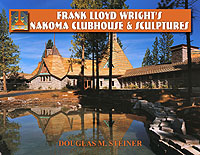
"Frank Lloyd Wright's Nakoma Clubhouse & Sculptures." A comprehensive study of Wright’s Nakoma Clubhouse and the Nakoma and Nakomis Sculptures. Now Available. Limited Edition. More information. [flw/_Private/Navbar Be-mail.htm]