SUPPORT THE
WRIGHT LIBRARY
PROCEEDS FROM EVERY SALE GOES TO SUPPORT THE WRIGHT LIBRARY.
CLICK TO ORDER.
WE PROUDLY SUPPORT THE FRANK LLOYD WRIGHT FOUNDATION

WE PROUDLY SUPPORT THE FRANK LLOYD WRIGHT BUILDING CONSERVANCY
WE PROUDLY SUPPORT FALLINGWATER
AND THE WESTERN PENNSYLVANIA CONSERVANCY

Frank L. Smith Bank, Dwight, Illinois (1905 - S.111) Introduction Small Village Bank 1901 First Design 1904 Original Smith Bank Chair (1905) Smith Bank & Larkin Building Bird's Eye
1918 1927 1928 Photograph By Gilman Lane 1935 1946 1970s Exterior Photographs 2009 Interior Photographs 2009 Furniture
Lanterns Biography Additional Biographical Information Related Books Related Images and ArticlesHistory of Dwight, From 1853 to 1894
Compiled and Published by Messrs. Dustin & Wassell, editors of Dwight Star and Herald 1894.
See Additional information...Date: 1905
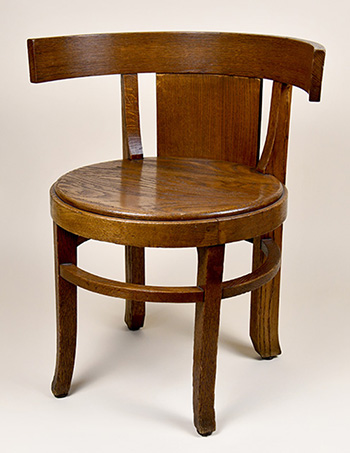
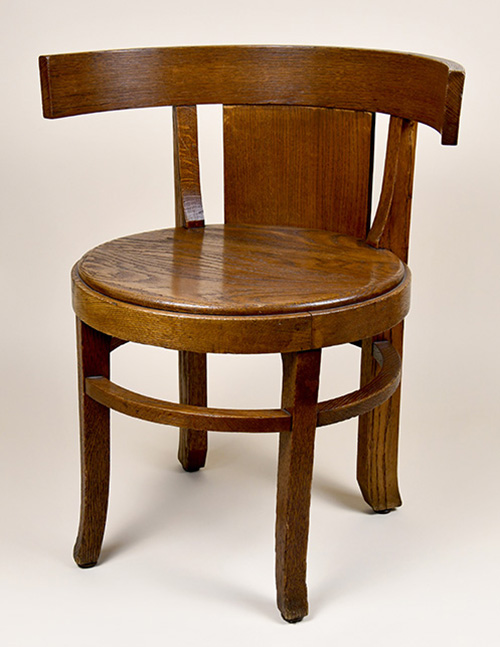
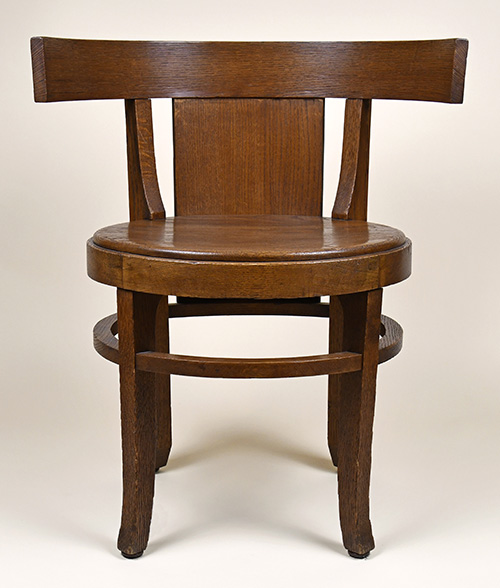
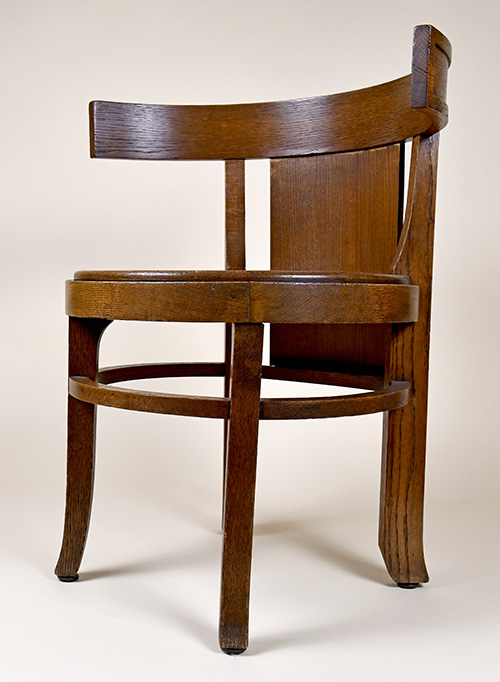
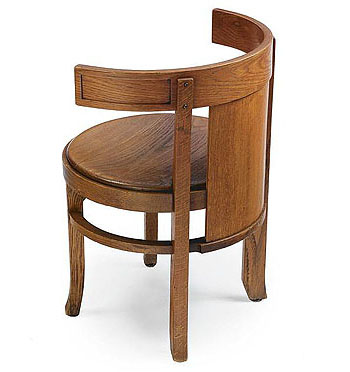
Title: Frank L. Smith Bank, Dwight, Illinois, Barrel Chair, 1905 (1905 - S.111).
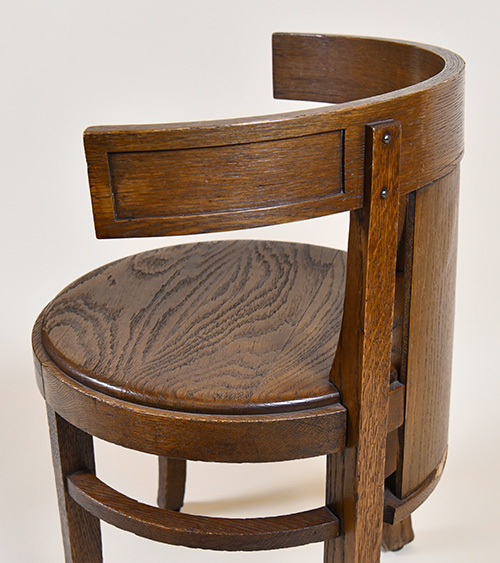
Description: Original Barrel Chair from the Frank L. Smith Bank. Designed by Frank Lloyd Wright in 1905. Smith first contacted Wright in 1904. The first designed was a three story bank, which Smith rejected. In 1905 Wright’s second design, a one and a half story structure was accepted.
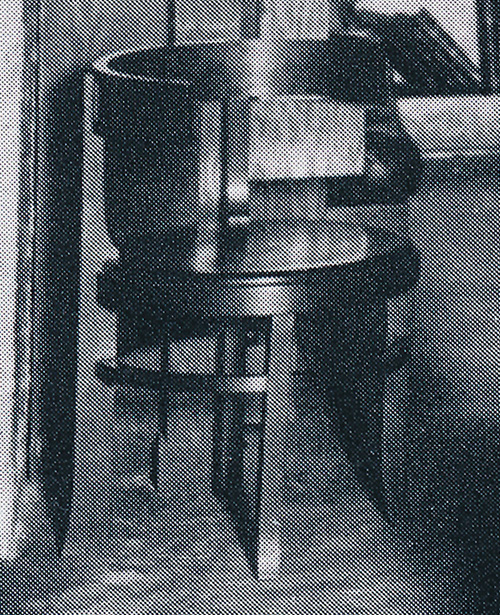
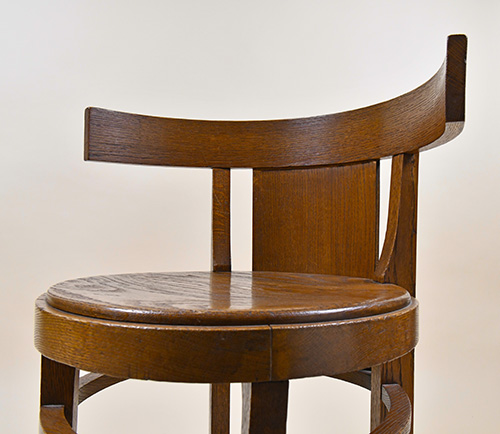
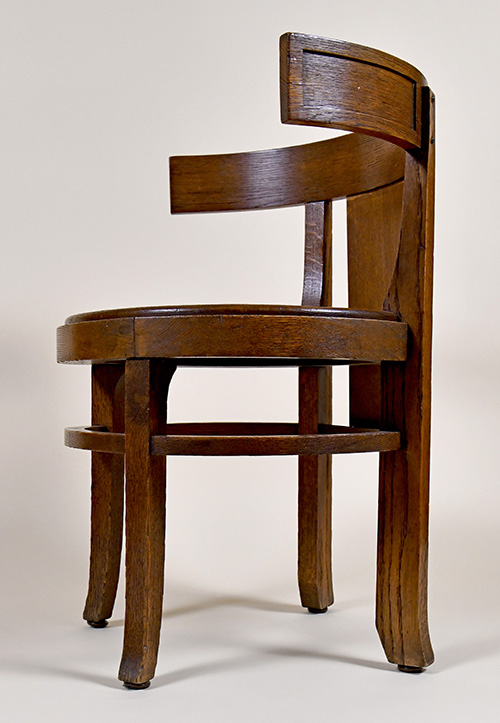
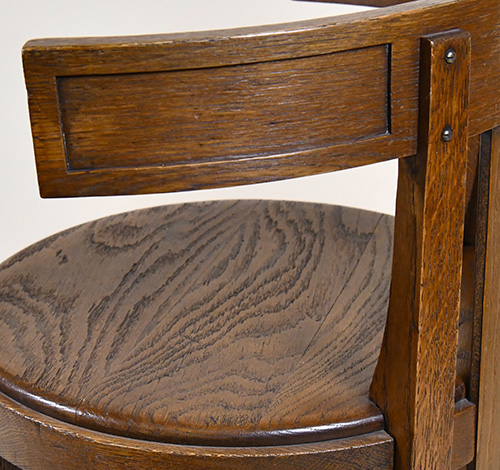
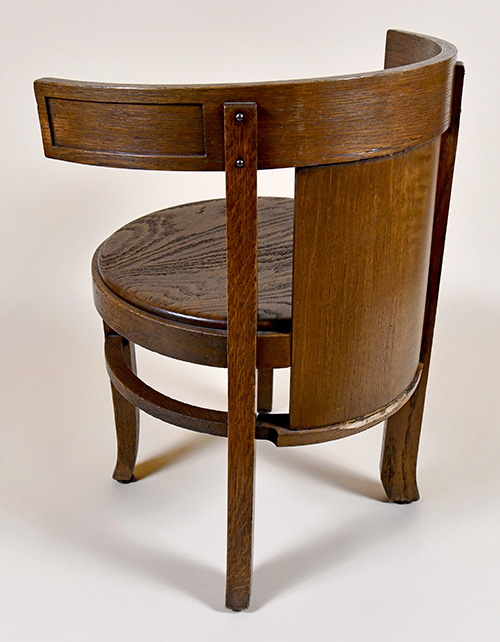
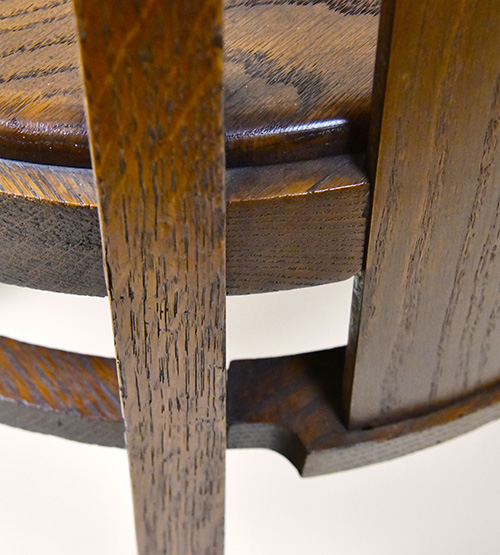
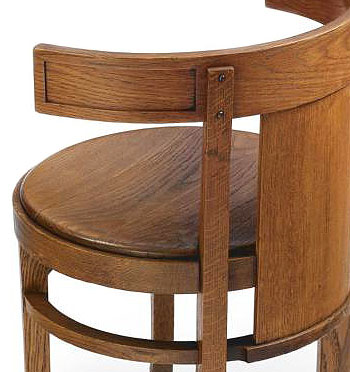
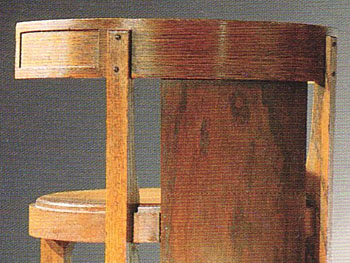
The seat is round, as are the circular stretchers below. The top rail is curved with inset panels at the ends on the back side. The ends of the top rail are cantilevered toward the front. The legs are set at forty-five degrees, pointing toward the center of the chair, and are in-line with the opposite leg, forming an exact “X”. The feet are flared at the bottom. They are the same width, 1.3125", but the depth of the back legs is greater. Front legs are 1.5" deep compared to 2.25" deep for the back. The back legs maintain that depth until they extend just past the seat where they curve to the depth of 1.125" deep. It is interesting to note that the Smith Side Chair front legs (ST#1981.108) mimic the Barrel Chair legs, set at 45 degrees, but the curved portion is inverted. The backrest, set between the back legs, runs from the stretcher to the top rail. It matches the curve of the top rail. The backrest of the side chair mimics the design of the barrel chair, but is not curved.
A Smith Barrel Chair was photographed in the Larkin Administration Building Library. Frank Lloyd Wright’s Larkin Building, Quinan, 1987, p.81.
Chairs were manufactured by the John W. Ayers, Co., Chicago. Constructed of oak. Provenance: Frank L. Smith Bank, Dwight, Illinois, Acquired from Toomey & Co. See Additional Photographs...
Size: 29 H x 23.75 W x 19.5 D
S#: 0058.64.0624Date: Circa 1908
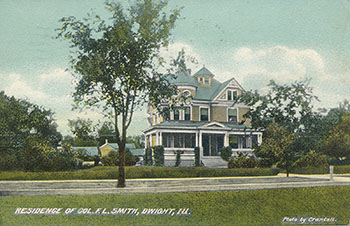
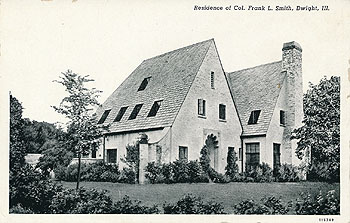
Title: Frank L. Smith Home, Dwight, Ill., Circa 1908, (Frank L. Smith Bank, Dwight, Ill (1905 - S.111).
Description: View of the home of Frank L. Smith. In 1905, Frank L. Smith commissioned Frank Lloyd Wright to design a bank in Dwight, Illinois. Test on face: “Residence of Col. F. L. Smith, Dwight Ill. Photo by Crandall." Printed using a photogravure process. Text on verso: “Post Card. This space for writing. This side is for the Address.” Vertical text on left: “The Fair Store. John Dieter, Importer and Publisher, Dwight, Ill. Made in Germany.” Bottom right: “131183.” Postmark: “Mar 31 1909.”
Size: 5.5 x 3.5
S#: 0085.58.0224The Biographical Record Of Livingston and Woodford Counties, Illinois
Published By The S. J. Clarke Publishing Company
Chicago, 1900
See Additional information...Then and Now - Being a History of Dwight, Illinois.
From 1853 to 1908
By Fred B. Hargreaves, 1908.
Originally Published at Dwight, Illinois,1908.
Photographically reproduced at Dwight, Illinois, 1999.
Transcribed from Book form to Digital, 2008, By David Weis.
Additional information...Date: 1911
Title: Frank L. Smith Bank, Dwight, Ill., 1911 (1905 - S.111)
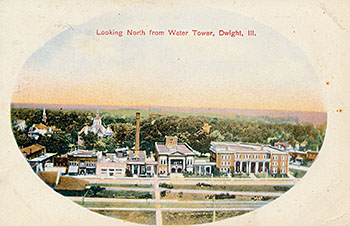
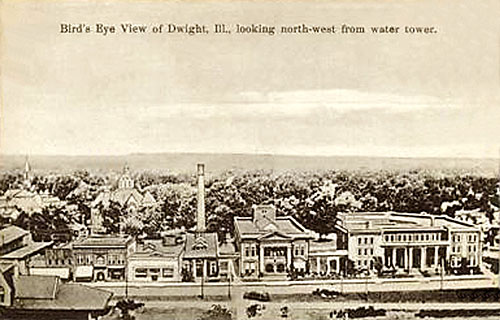
Description: Bird's Eye View of Dwight, Ill., looking north-west from water tower. Very early image of the Bank. Taken before the clock was added. In 1905, Frank L. Smith commissioned Frank Lloyd Wright to design a bank in Dwight, Illinois. Text on face: “Looking North from Water Tower, Dwight, IL.” Printed using a photogravure process. Text on verso: “Post Card. This space for writing. This side is for the Address.” Vertical text on left: “Made in Germany. The Fair Store. Jno. Dieter, Importer and Publisher, Dwight, Ill.” Postmark: “Jun 19, 1911.”
Size: 5.5 x 3.5
S#: 0104.43.0224Date: Circa 1910
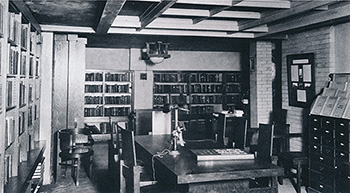
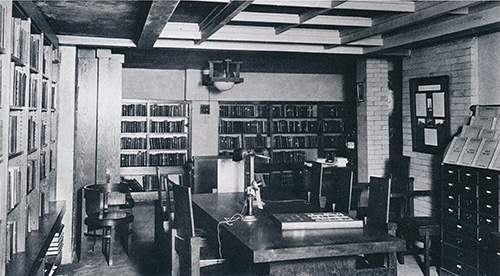
Title: Larkin Administration Building. Buffalo, New York, Circa 1910-1920 (Not Dated) (1903 - S.093) / Frank L. Smith Bank Barrel Chair (1905 - S.111).
Description: Larkin Administration Building Library and Frank L. Smith Bank Barrel Chair. The Library was located on the fourth floor of the Annex. Thanks to Thomas Heinz’s sharp eye, he noticed a Frank L. Smith Bank Barrel Chair in the library. The Larkin Side Chairs seen in this photograph were also found in the restaurant on the fifth floor. There is no indication as to the relationship of the Smith Barrel Chair and the Larkin Building. Wright designed the Larkin Building in 1903, the Larkin Administration building was completed in 1904, and the finished building was ready for occupancy in August 1906. Construction of the Larkin Building and the Smith Bank overlapped, and one might speculate that Wright sent John Larkin and Darwin Martin a sample of the Smith chair as an option? Wright designed his first barrel chair for the Darwin D. Martin residence in 1904. But it is only a speculation. Published in Frank Lloyd Wright’s Larkin Building, Quinan, 1987, p.81. Courtesy of Jack Quinan. See details of the Larking Building and the Smith Bank Chair... See Additional information on the Smith Bank Barrel Chair...
Size: 10 x 6 B&W copy photograph.
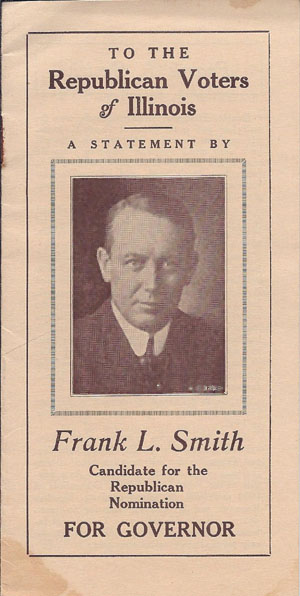
S#: 0094.111.0824Date: 1915 Title: Frank L. Smith, Candidate for Governor, 1915.
Author: Frank L. Smith
Description: "To the Republican Voters of Illinois." In March, 1915, Smith formally announced his candidacy for Governor. By mid July, 1916, two months before the primary, the race came down to Lowden, Hull and Smith. He lost in the Primary to Lowden on Sept 13, 1916. Lowden 54%, Hull 28%, Smith 18%. He whole-heartedly supported Lowden, who went on to win the election for Governor in Illinois. Smith stressed his record as a business man. "Governor is Business Manager. The governorship of Illinois is an administrative office – in fact as well as in the contemplation of the constitution. Lack of administrative efficiency there means bad government, however well-intentioned the Governor may be... The Governor is the business manager of the public at large. As a business man, I submit my candidacy to the business judgment of the voters. Frank L. Smith."
Size: 3 x 6
Pages: Pp 12
S#: 0128.16.0414
Date: 1915
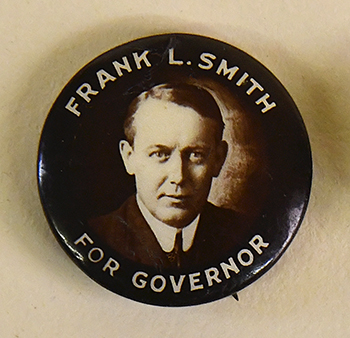
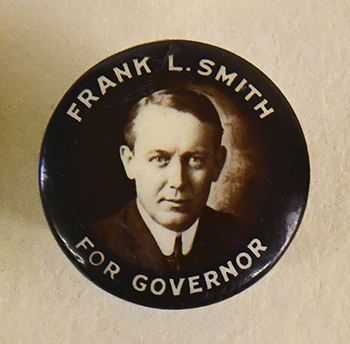
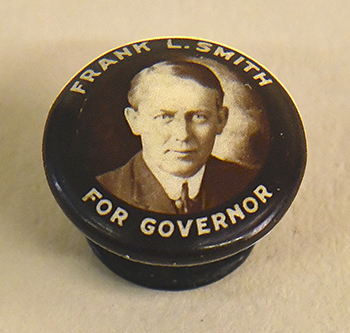
Title: Frank L. Smith For Governor Political Pin 1915 (1905 - S.111).
Description: "Frank L. Smith For Governor." Political pin for Frank L. Smith’s gubernatorial campaign. In March, 1915, Smith formally announced his candidacy for Governor. By mid July, 1916, two months before the primary, the race came down to Lowden, Hull and Smith. He lost in the Primary to Lowden on September 13, 1916. Lowden 54%, Hull 28%, Smith 18%. See Additional information...
Size: 7/8" wide.
S#: 0128.67.0621Date: 1915
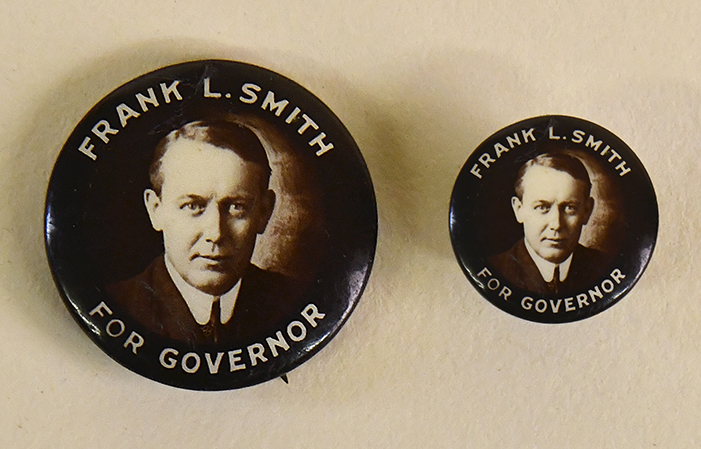
Title: Frank L. Smith For Governor Political Lapel Pin 1915 (1905 - S.111).
Description: Political pin for Frank L. Smith’s gubernatorial campaign. In March, 1915, Smith formally announced his candidacy for Governor. By mid July, 1916, two months before the primary, the race came down to Lowden, Hull and Smith. He lost in the Primary to Lowden on September 13, 1916. Lowden 54%, Hull 28%, Smith 18%. “Frank L. Smith For Governor.”
Size: Lapel pin is 1/2" wide, 5/16" deep.
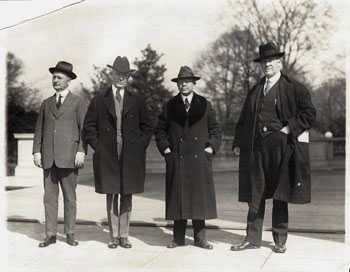
S#: 0128.91.0326Date: 1921 Title: Frank L. Smith, 1921 (second from left).
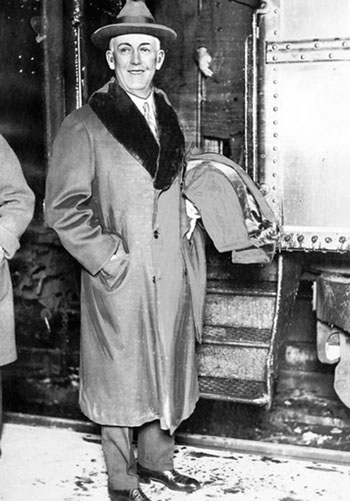
Description: Frank L. Smith with hat and overcoat looking directly at the camera. Text on verso: "Left to right: Thomas F. Smith of New York, Frank L. Smith of Ill., Addison T. Smith of Idaho, John M. Smith of Mich." Caption pasted to verso: "January 30th 1921. For the first time in many sessions the sixty-seventh Congress number in its membership only one Smith. In the present Congress there are four of whom Addison T. Smith of Idaho is the only one re-elected. Left to right: Thomas F. Smith of New York, Frank L. Smith of Ill., Addison T. Smith of Idaho, John M. Smith of Mich." Stamped on verso: "Feb 2 1921. N. E. A."
Size: Original 8.25 x 6.5 B&W photograph.
S#: 0144.04.0914
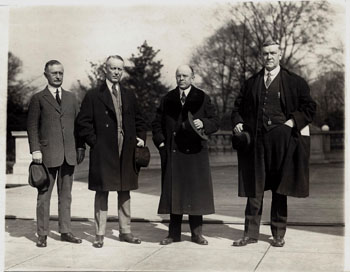
Date: 1921 Title: Frank L. Smith, 1921 (second from left).
Description: Frank L. Smith with hat in hand and wearing overcoat, looking directly at the camera. Caption pasted to verso: "For the first time in many sessions the sixty-seventh Congress number in its membership only one Smith. In the present Congress there are four of whom Addison T. Smith of Idaho is the only one re-elected. Left to right: Thomas F. Smith of New York, Frank L. Smith of Ill., Addison T. Smith of Idaho, John M. Smith of Mich." Stamped on verso: "Feb 2 1921. N. E. A."
Size: Original 8.25 x 6.5 B&W photograph.
S#: 0144.05.0914
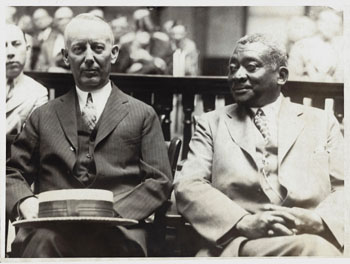
Date: 1926 Title: Frank L. Smith, 1926 (1905 - S.111).
Description: Smith (left) and Wright before investigation committee. Caption pasted to verso: "Illinois Inquiry Shows $534,388 Primary Outlay. The Senate investigation of the Illinois primary election of April 13 got underway at Chicago in order to probe the charges that an enormous slush fund was used by both men in their efforts to win the senatorial nomination of the Republican party. The photo shows Col. Frank L. Smith, the winner of the primary contest (left) and Edward H. Wright, Negro politician who were summoned as witnesses before the investigation committee." Stamped on verso: "Acme Newspictures, New York City." "Aug 4 1926. N. E. A."
Size: Original 8.5 x 6.5 B&W photograph.
S#: 0172.22.1114
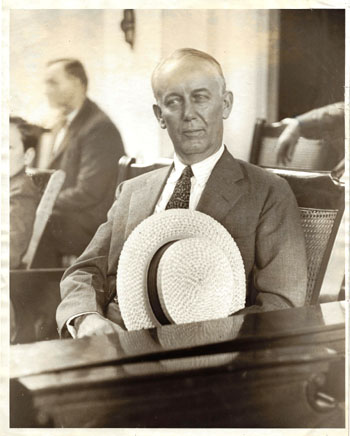
Date: 1926 Title: Frank L. Smith, 1926 (1905 - S.111).
Description: Smith is seated, looking to the let, straw hat in his lap. In August, 1926, the Senate investigated the Illinois primary election of April 13, to probe the charges that an enormous slush fund was used by Smith and Wright in their efforts to win the senatorial nomination of the Republican party. Col. Frank L. Smith won the primary contest. Stamped on verso: "Aug 14 1926. N. E. A."
Size: Original 8 x 10 B&W photograph.
S#: 0172.23.1114
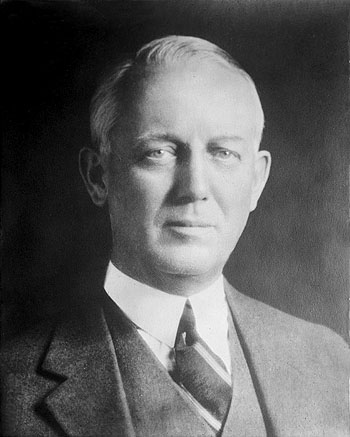
Date: Circa 1926 Title: Frank L. Smith Portrait.
Description: Looking straight into the camera, lighting from the right, wearing a suit and stripped tie. Published by the Bain News Service. Reproduced from glass negative. Possibly photographed after his senatorial election in 1926.
Size: 7.75 x 9.5 B&W photograph.
S#: 0172.15.0213
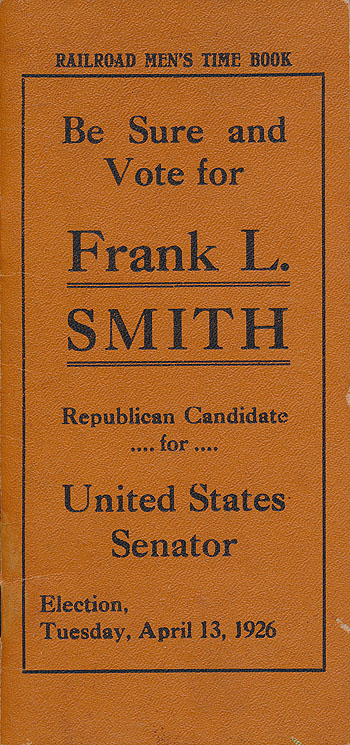
Date: 1926
Title: Frank L. Smith Campaign for Senator, 1926.
Description: Railway Men’s Time Book. "Be Sure and Vote for Frank L. Smith. Republican Candidate for United States Senator. Election, Tuesday, April 13, 1926." In 1926 Frank L. Smith ran for U.S. Senate and won the general election by 67,000 votes. On December 7, 1926, the sitting Senator, McKinley passed away, just months before his term ended on March 3, 1927. The Governor appointed Smith to fill McKinley’s vacancy, but the U.S. Senate denied his appointment. On March 4, 1927, even though elected, the Senate again refused to seat him. Pp 28.
Size: 3.25 x 7.
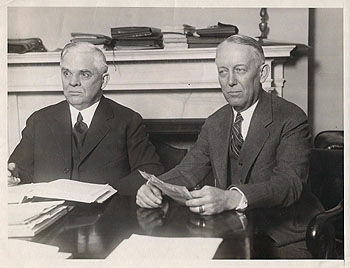
S#: 0172.52.1220Date: 1927 Title: Frank L. Smith, Dwight, Illinois, 1927 (1905 - S.111).
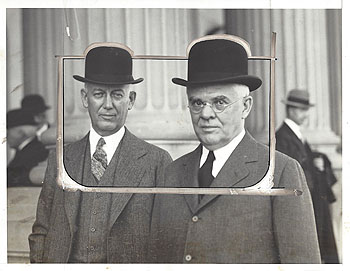
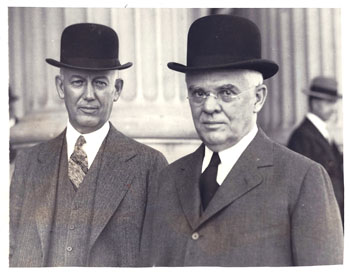
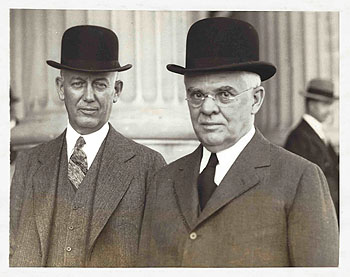
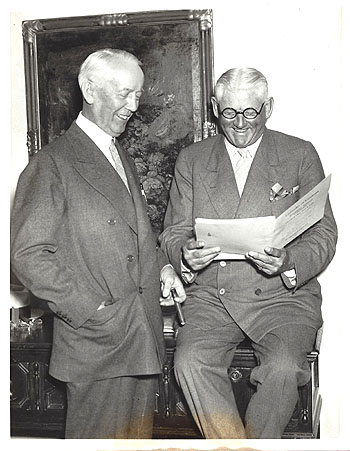
Description: Charles S. Deneen and Frank L. Smith, January 20, 1927. Stamped on verso: "Jan 20, 1927." Hand written on verso: "Frank L Smith (right) and Chas S. Deneen." After the death of incumbent Illinois Senator William McKinley, Smith was appointed to the seat in December 1926 by Illinois Governor Len Small. On Jan. 19, 1927, Smith's credentials were submitted to the senate by Senator Charles S. Deneen of Illinois. Charles Samuel Deneen (May 4, 1863 – February 5, 1940) served as Governor of Illinois from 1905 to 1913. He served as a U.S. Senator from Illinois, 1925–1931. On January 20 the senate refused to allow Smith to take his senate seat.
Size: Original 8.5 x 6.5 B&W photograph.
S#: 0198.16.0414
Date: 1927 Title: Frank L. Smith, 1927 (1905 - S.111).
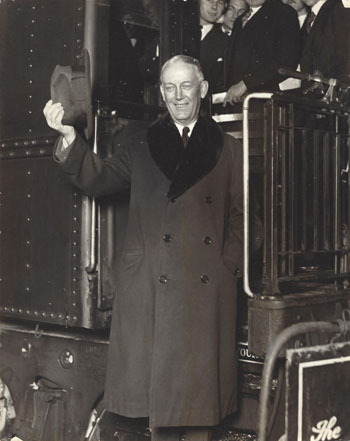
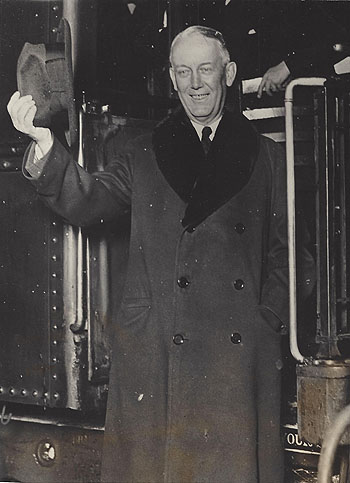
Description: Frank L. Smith standing on train stairs, holds his hat up in his right hand, January 20, 1927. Hand written on verso: "Col. Frank L. Smith." Stamped on verso: "Jan 20, 1927. N. E. A." "Photo From Jun Fujita, 12 S. Market St., % The Post, Chicago." After the death of incumbent Illinois Senator William McKinley, Smith was appointed to the seat in December 1926 by Illinois Governor Len Small. On Jan. 19, 1927, Smith's credentials were submitted to the senate by Senator Charles S. Deneen of Illinois. Charles Samuel Deneen served as Governor of Illinois from 1905 to 1913. He served as a U.S. Senator from Illinois, 1925–1931. On January 20 the senate refused to allow Smith to take his senate seat.
Size: Original 8 x 10 B&W photograph.
S#: 0198.17.1114
Date: 1927
Title: Frank L. Smith, 1927 (1905 - S.111). (Second copy of Photograph.)
Description: Frank L. Smith standing on train stairs, holds his hat up in his right hand, January 20, 1927. Stamped on verso: "Jan 20, 1927. N. E. A." "This photo is supplied by Acme Newspapers. 461 Eighth Ave., New York City." Label pasted to verso: "Leaves to Appear Before Senate Investigation. Col. Frank L. Smith, senator-elect from Illinois, shown leaving Chicago, Ill., for Washington, D.C., to appear before the Senate committee who have been investigating his credentials and have refused to allow him to be seated in the Senate."
Size: Original 6.5 x 8.5 B&W photograph.
S#: 0198.22.1216Date: 1927 Title: Frank L. Smith, Dwight, Illinois, 1927 (1905 - S.111).
Description: "Frank L. Smith returns to his hometown of Dwight, Ill. on Jan. 24, 1927, after being refused a seat in the U.S. Senate. Smith, a former congressman and chairman of the Illinois Commerce Commission, was appointed to the seat in December 1926 by then - Illinois Gov. Len Small, after the death of incumbent Sen. William McKinley. But Smith had been accused by Senate officials of accepting $125,000 in campaign money from Samuel Insull, the powerful owner several public utilities, while Smith was the chair of the ICC. Accepting such a contribution while acting as the ICC chair was a violation of Illinois law. Although he was never officially charged with a crime, the U.S. Senate voted 61-23 that Smith was not entitled to his Senate seat." Courtesy of the Chicago Tribune.
Size: 5 x 7 B&W photograph.
S#: 0198.13.1213
Date: 1927
Title: Frank L. Smith, Dwight, Illinois, 1927 (1905 - S.111).
Description: Frank L. Smith (left) and Senator Charles S. Deneen (Right). Caption pasted to verso: "Defends Smith Trying For Senate Seat – Photo Shows Senator-Elect Frank L. Smith of Illinois, (Left) with Senator Charles S. Deneen of Illinois, who is defending Smith in his fight to obtain a seat in the U.S. Senate." Frank Lloyd Wright designed the Frank L. Smith Bank in 1905. Stamped on Verso: "Dec 9 1927."
Size: Original 8.5 x 6.5 B&W photograph.
S#: 0198.19.0816Date: 1927
Title: Frank L. Smith, Dwight, Illinois, 1927 (1905 - S.111).
Description: Frank L. Smith (left) and Senator Charles S. Deneen (Right). Caption pasted to verso: "Defends Illinois Senator Elect Who is Fighting for Seat. Washington D.C. Photo Shows - Senator-elect Frank L. Smith of Illinois, left, with senator Charles S. Deneen of Illinois, who is defending Smith in his fight to obtain a seat in the U.S. Senate." Frank Lloyd Wright designed the Frank L. Smith Bank in 1905. Stamped on Verso: "Reference Dept. Oct 17 1930." "This photo is supplied by Acme Newspictures, 461 Eighth Ave. New York."
Size: Original 8.5 x 6.5 B&W photograph.
S#: 0198.20.0816Date: 1927 Title: Frank L. Smith, Dwight, Illinois, 1927 (1905 - S.111).
Description: Frank L. Smith (left) and Senator Charles S. Deneen (Right). Caption pasted to verso: "Defends Illinois Senator Elect Who is Fighting for Seat. Washington D.C. Photo Shows - Senator-elect Frank L. Smith of Illinois, left, with senator Charles S. Deneen of Illinois, who is defending Smith in his fight to obtain a seat in the U.S. Senate." Stamped on Verso: "Reference Dept. Dec 10 1927." "This photo is supplied by Acme Newspictures, 461 Eighth Ave. New York."
Size: Original 8.5 x 6.5 B&W photograph.
S#: 0198.18.1215
Date: 1927
Title: Frank L. Smith, Dwight, Illinois, 1927 (1905 - S.111).
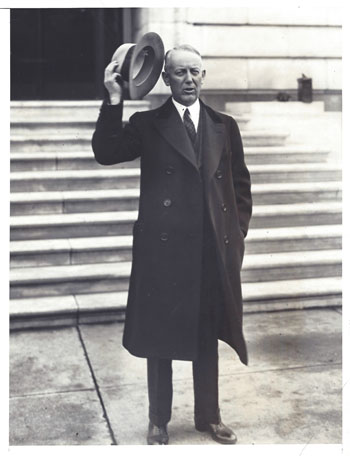
Description: Frank L. Smith standing in front of steps, facing the camera, holding his hat in his right hand. Caption pasted to verso: "Senator-elect Frank L. Smith, Illinois, photographed at the Senate office building, Washington, where he is fighting to obtain a seat in the Senate." Frank Lloyd Wright designed the Frank L. Smith Bank in 1905. Stamped on Verso: "Reference Dept. Dec 9 1927 N. E. A."
Size: Original 8.5 x 6.5 B&W photograph.
S#: 0198.21.0816Date: 1927 Title: Frank L. Smith, Dwight, Illinois, 1927 (1905 - S.111).
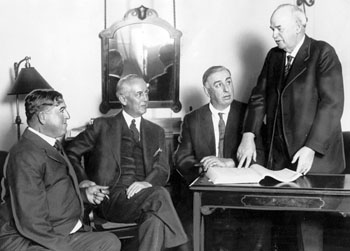
Description: "Some of the most powerful men in Illinois during the Roaring 20's meet at the Hotel Sherman on Dec. 31, 1927. Left to right: Eugene Pike, the new president of the Lincoln Park board; Sen. Elect Frank L. Smith; Chicago Mayor William "Big Bill" Thompson; and Illinois Gov. Len Small. Both Small and Smith had legal issues during their careers as public servants in Illinois. Small was indicted in 1921 on charges of embezzling up to $700,000 in public funds and conspiracy to defraud the state during Small's second term as Illinois state treasurer. But he was never convicted. Smith, a former congressman and chairman of the Illinois Commerce Commission, was appointed to the seat in December 1926 by then-Illinois Gov. Len Small, after the death of incumbent Sen. William McKinley. But Smith had been accused by Senate officials of accepting $125,000 in campaign money from Samuel Insull, the powerful owner several public utilities, while Smith was the chair of the ICC. Accepting such a contribution while acting as the ICC chair was a violation of Illinois law. Although he was never officially charged with a crime, the U.S. Senate voted 61-23 that Smith was not entitled to his Senate seat." Courtesy of the Chicago Tribune.
Size: 7 x 5 B&W photograph.
S#: 0198.14.1213
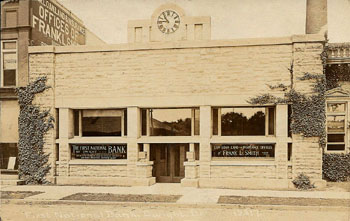
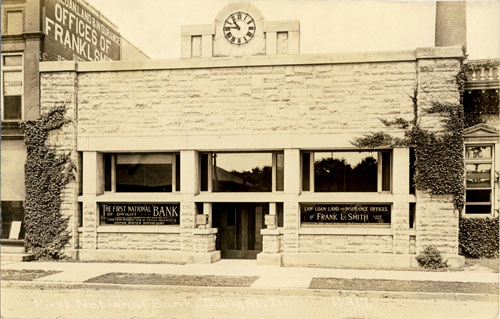
Date: 1927 Title: Frank L. Smith Bank, Dwight, Ill (1905 - S.111) circa 1927. (Real Photo Postcard.)
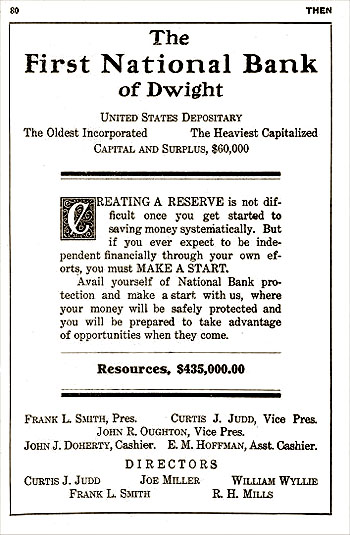
Description: Published by AZO. Lettering on left window: "The First National Bank of Dwight. Capitol and Surplus $60,000.00. 3 per cent interest paid on savings deposits. Law - Loan - Land and Insurance Offices of Frank L. Smith. Land Man. If you deal with me you get results." Hand written on negative across the bottom: "First National Bank, Dwight, Ill. 12317." On April 13, 1926, Smith runs against Senator McKinley in primary, wins election by 102,000 majority and denies McKinley re-election to U.S. Senate. Smith wins general election. November 2, Smith wins Senate election by 67,000 votes. On December 7, 1926, McKinley passed away, before his term ended on March 3, 1927. The Governor appoints Smith to fill vacancy of William B. McKinley seat, but U.S. Senate denied his appointment. On March 4, 1927, even though elected, Senate again refused to seat Smith. Hand written on verso: "Note the name on the window. This is where he does it. Nice & cool here this A.M. Home Sat." Signed: "Albert B." Postmarked Jul 22, 1927. Stamp Box on verso: AZO with two 'up' and two 'down' triangles (1910-1930).
Size: 5.4 x 3.5
S#: 0198.12.0813
Date: Circa 1927
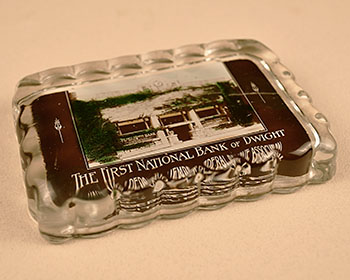
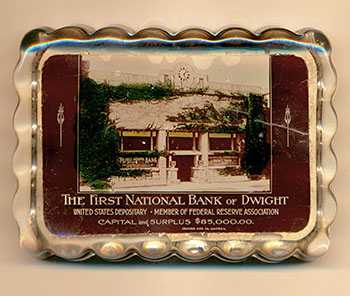
Title: Frank L. Smith Bank, Dwight, Illinois, Glass Paper Weight, Circa 1927 (1905 - S.111).
Description: Original glass paper weight from the Frank L. Smith First National Bank, Dwight, Illinois. The bank was designed by Frank Lloyd Wright in 1905. Produced by the Cruver Mfg. Co. of Chicago. Text on face: "The First National Bank of Dwight. United States Depository. Member of Federal Reserve Association. Capital and Surplus $85,000.00. Cruver Mfg. Co. Chicago." The photograph was taken from 1927-1928. The Ivy on the front of the building was just beginning to cover the left and right side of the front elevation. By 1928, the ivy nearly covered the front of the building. The time is 1:27pm. The ivy in the photograph appears to be hand tinted.
Size: 4.5 x 3.125 x .75. Weight: 14 oz.
S#: 0199.05.0321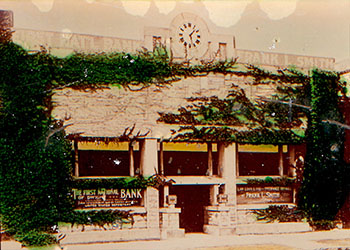
Date: 1927
Title: Residence of Frank L. Smith 1927 (1905 - S.111).
Description: In 1905, Frank L. Smith commissioned Frank Lloyd Wright to design a bank in Dwight, Illinois. Test on face: "Residence of Col. Frank L. Smith, Dwight Ill. 115749" Text on verso: Post Card. [Place One Cent Stamp Here]. Genuine Curteich-Chicago "C.T. Photo-Finish" Post Card (Reg. U.S. Pat. Off.) Note: "115749" dates this card 1927 per the Curt Teich dating chart.
Size: 5.5 x 3.5
S#: 0198.28.0918Date: 1928 Title: Frank L. Smith Bank, Dwight, Ill (1905 - S.111) circa 1928.
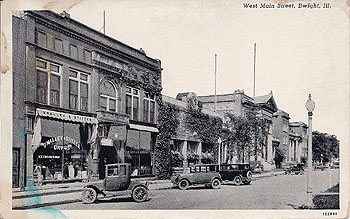
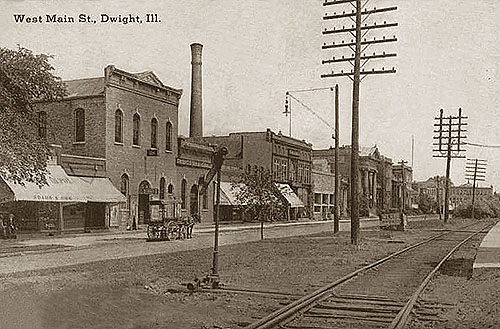
Description: Face: View of "West Main Street, Dwight. Ill." #122896 (Curteich dating system dates this card 1928). Back: "Genuine Curteich-Chicago "C.T. Photo-Finish" Post Card (Reg. U.S. Pat. Off.) On April 13, 1926, Smith runs against Senator McKinley in primary, wins election by 102,000 majority and denies McKinley re-election to U.S. Senate. Smith wins general election. November 2, Smith wins Senate election by 67,000 votes. On December 7, 1926, McKinley passed away, before his term ended on March 3, 1927. The Governor appoints Smith to fill vacancy of William B. McKinley seat, but U.S. Senate denied his appointment. On March 4, 1927, even though elected, Senate again refused to seat Smith. On February 9, 1928, Smith abandoned his effort to take his seat and resigned even though he and the Governor considered him to be the rightful senator. A special election was called to fill the vacated Senate seat, and Smith reran in the special election Primary. On April 10, 1928, Smith was defeated in the primary by Otis F. Glenn, who went on to win the general election.
Size: 5.5 x 3.5
S#: 0215.11.1113
Date: 1928 Title: Frank L. Smith Campaign for Senator.
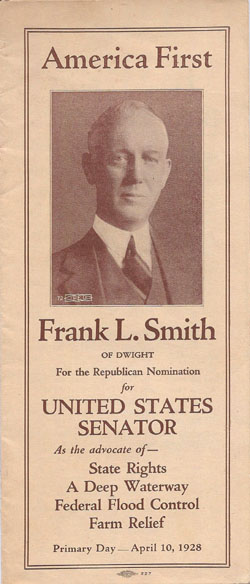
Description: "America First. Frank L. Smith of Dwight. For the Republican Nomination for United States Senator. As the advocate of - State Rights, A Deep Waterway, Federal Flood Control, Farm Relief. Primary Day - April 10, 1928... An Address to the Republican Voters of Illinois." In 1926 Smith ran for U.S. Senate and won the general election by 67,000 votes. (See Biography) On December 7, 1926, the sitting Senator, McKinley passed away, just months before his term ended on March 3, 1927. The Governor appointed Smith to fill McKinley’s vacancy, but the U.S. Senate denied his appointment. On March 4, 1927, even though elected, the Senate again refused to seat him. On February 9, 1928, Smith abandoned his effort to take his seat and resigned even though he and the Governor considered him to be the rightful senator. A special election was called to fill the vacated Senate seat, and Smith reran in the special election Primary. On March 8 his addressed the voters of Illinois and presented his defense. This brochure was a reprint of the address, a short Biography, and his platform. On April 10, 1928, Smith was defeated in the primary by Otis F. Glenn, who went on to win the general election.
Size: 3.6 x 8.5
Pages: Pp 12
S#: 0215.10.0213
Date: 1928
Title: Frank L. Smith Campaign for Senator, 1928.
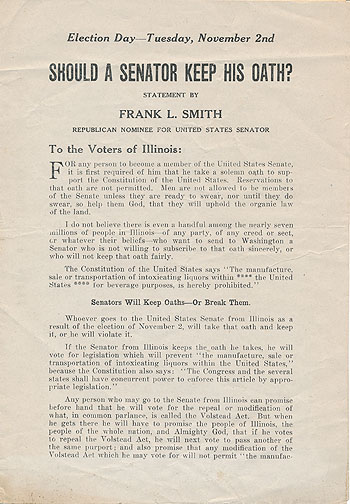
Description: "Should a senator keep his oath? Statement by Frank L Smith. Republican nominee for United States Senator. To the voters of Illinois: For any person to become a member of the United States Senate, it is first required of him that he take a solemn oath to support the Constitution of the United States. Reservations to that oath are not permitted. Men are not allowed to be members of the Senate unless they are ready to swear, nor until they do swear, so help them God, that they will uphold the organic law of the land..." Pp 4.
Size: 6.25 x 9
S#: 0215.30.0220Date: 1928
Title: Frank L. Smith, 1928 (1905 - S.111). Campaign letter from Frank L. Smith, prior to Special Election primary, April 2, 1928.
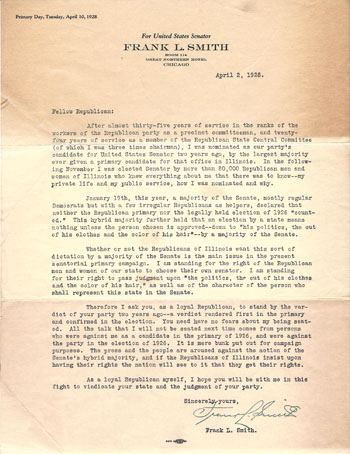
Description: "Fellow Republicans: After almost thirty-five years of service in the ranks of the workers of the Republican party as a precinct committeeman, and twenty-four years of service as a member of the Republican State Central Committee (of which I was three times chairman), I was nominated as our party’s candidate for United States Senator two years ago..." Signed "Frank L. Smith." In 1926 Smith ran for U.S. Senate and won the general election by 67,000 votes. (See Biography) On December 7, 1926, the sitting Senator, McKinley passed away, just months before his term ended on March 3, 1927. The Governor appointed Smith to fill McKinley’s vacancy, but the U.S. Senate denied his appointment. On March 4, 1927, even though elected, the Senate again refused to seat him. On February 9, 1928, Smith abandoned his effort to take his seat and resigned even though he and the Governor considered him to be the rightful senator. A special election was called to fill the vacated Senate seat, and Smith reran in the special election Primary which took place on April 10, 1928. This letter, dated April 2, 1928 was mailed one week before the primary. Smith was defeated in the primary by Otis F. Glenn, who went on to win the general election.
Size: Original 8.5 x 11 single sided letter.
S#: 0215.18.1216Date: 1931
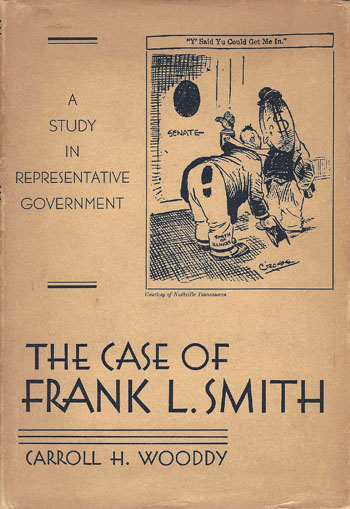
Title: The Case of Frank L. Smith, A Study in Representative (Hard Cover DJ) (Published by The University of Chicago Press, Chicago.)
Author: Wooddy, Carroll Hill
Description: The intrinsic interest attaching to the case of Frank L Smith would perhaps in itself justify an intensive exploration of its development and implications. Here, surely, is drama cast in the bold outline so characteristic of the ruggedness of American life! The cast of characters lacks neither heroes nor villains, sinister embodiments of evil nor bold champions of virtue. ...But more than this the career of this long-time participating in the political life of a great commonwealth offers opportunity for a realistic exposition of "what really happens." ... (Dust Jacket.) Original list price $3.00. (First Edition)
Size: 5.5 x 8.25
Pages: Pp 393
S#: 0300.12.0518Date: 1936
Title: Frank L. Smith, Dwight, Illinois, 1936 (1905 - S.111).
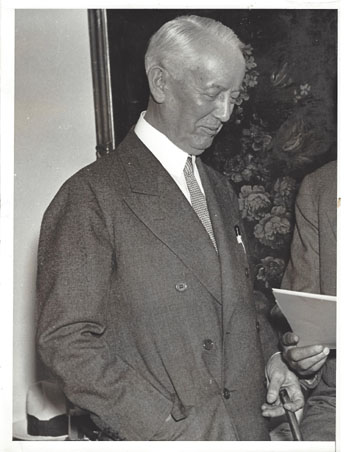
Description: Frank L. Smith, facing to the right, head lowered with a cigar in his left hand. George Getz is on the right. Label pasted to verso: "Chicago, IL. 6-2-36. Delegates Gather For Republican Convention. Cleveland, Ohio. – Frank L. Smith, at left, Republican Committeeman from Chicago and George Getz of Chicago, Treasurer Republican Committee, at Hotel in Cleveland after their arrival to attend the National Republican Convention." The 1936 Republican Presidential Convention was held in Cleveland, Ohio, from June 9 - 12, 1936. Frank L Smith was elected as the national committeeman for Illinois in 1932. The Republican Nation Committee (RNC) consisted of one member from each state to serve for four years. The Chicago Tribune reported, May 2, 1936, on the Republican state convention to be held on May 22, 1936. "There was some discussion on who would be elected national committeeman at Cleveland by the delegates to the national nominating convention due to the arrival here of Frank L. Smith of Dwight, candidate for reelection as national committeeman from Illinois. George F. Harding, one of the original sponsors of Brooks, also is a candidate... Smith was elected committeeman four years ago through the influence of Len Small, then the Republican nominee for governor." Smith was not elected as the national committeeman, but was a delegate to the convention. Stamped on verso: "International News Photos, Chicago, Illinois."
Size: Original 6.5 x 8.5 B&W photograph.
S#: 0404.29.0716Date: 1936 Title: Frank L. Smith, Dwight, Illinois, 1936 (1905 - S.111).
Description: Frank L. Smith, facing to the right, head lowered with a cigar in his left hand. The 1936 Republican Presidential Convention was held in Cleveland, Ohio, from June 9 - 12, 1936. Frank L Smith was elected as the national committeeman for Illinois in 1932. The Republican Nation Committee (RNC) consisted of one member from each state to serve for four years. The Chicago Tribune reported, May 2, 1936, on the Republican state convention to be held on May 22, 1936. "There was some discussion on who would be elected national committeeman at Cleveland by the delegates to the national nominating convention due to the arrival here of Frank L. Smith of Dwight, candidate for reelection as national committeeman from Illinois. George F. Harding, one of the original sponsors of Brooks, also is a candidate... Smith was elected committeeman four years ago through the influence of Len Small, then the Republican nominee for governor." Smith was not elected as the national committeeman, but was a delegate to the convention. Stamped on verso: "From Acme Newspictures, Inc. Cleveland Bureau, 1200 West Third St." "6 18 36. N. E. A."
Size: Original 6.5 x 8.5 B&W photograph.
S#: 0404.23.1144
DWIGHT CENTENNIAL, 1854-1954
A GREAT PAST - A GREATER FUTURE
Published in 1954
See Additional information...Date: 1957-58
Title: Frank L. Smith Bank, Dwight, IL 1957-58 (1905 - S.111).
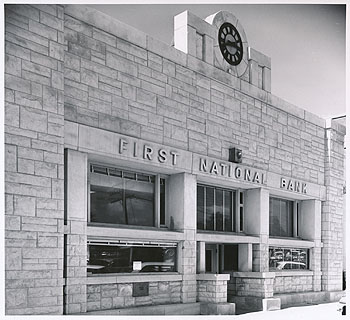
Description: View of the front elevation of the Frank L. Smith Bank. Designed by Frank Lloyd Wright in 1905. Frank L. Smith was born there on November 24, 1867, and was chairman of the board of the First National Bank of Dwight, until his death on August 30, 1950. The lanterns on either side of the entryway have been removed. A neon sign in the lower right window reads: "Frank L. Smith Agency," and "Real Estate Insurance." Note: The reflections in the windows reveal automobiles from the mid fifties. Mounted to gray board. Label pasted to board: "West 20, US Arch. Wright. Dwight, Ill. 1st National Bank, 1906. Ext. Andrew Photo #2798." Photographed by Wayne Andrews.
Size: Original 8.75 x 8 B&W Photograph.
S#: 1205.112.0220Date: 1974 Title: The Case of Frank L. Smith, A Study in Representative Government (Hard Cover) (First published in 1931 by The University of Chicago Press, Chicago. This reprint edition published by Arno Press, A New York Times Company, New York. Part of the Series "Politics and People. The Ordeal of Self-Government in America.")
Author: Wooddy, Carroll Hill
Description: Summary: Smith, Frank Leslie, a Representative and a Senator-elect from Illinois. This book describes the political career of Frank L. Smith, who refused his Senate seat in 1926 as a result of an investigation into his campaign finances. He was the Dwight village clerk in 1894; an unsuccessful candidate for lieutenant governor 1904; internal-revenue collector 1905-1906; elected as a Republican to the Sixty-sixth Congress (March 4, 1919-March 3, 1921); was not a candidate for renomination in 1920, but was an unsuccessful candidate for the Republican nomination for United States Senator; resumed his former business pursuits; chairman of the Illinois Commerce Commission 1921-1926; appointed as a Republican to the United States Senate in 1926 to fill the vacancy caused by the death of William B. McKinley in the term ending March 3, 1927; presented credentials as a Senator-designate but was not permitted to qualify, due to charges of "fraud and corruption" in his campaign; presented credentials as a Senator-elect to the United States Senate for the term beginning March 4, 1927, but again was not permitted to qualify and subsequently tendered his resignation on February 9, 1928; unsuccessful candidate for election in 1930 to the Seventy-second Congress; member of the Republican National Committee in 1932; continued in real estate and insurance business and agricultural pursuits; chairman of the board of directors if the First National Bank of Dwight, Ill.
Size: 5.5 x 8.75
Pages: Pp 393
S#: 1963.16.0815
Date: 1981 Title: Frank L. Smith Bank Side Chair, Dwight, IL, 1981 (1905 - S.111)
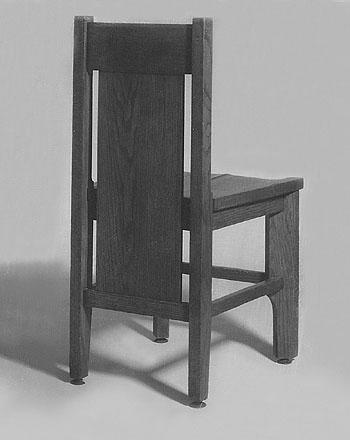
Description: Oak side chair three-quarter view, facing backward and to the right. Both front legs are turned 45 degrees and are thinner at the bottom. This photograph published in "Frank Lloyd Wright and Viollet-le-Duc", 1986, p. 54. Manufactured by John W. Ayers, Chicago. 34.5 (H) x 14 (W) x 19 (D). Acquired from Kelmscott Galleries. See Additional Frank Lloyd Wright Chairs... See Additional Smith Bank Furniture...
Size: One 4 x 5 B&W photographs.
ST#: 1981.108.0413
Date: 1981 Title: Possibly Frank L. Smith Bank Reclining Arm Chair, Dwight, IL (1905 - S.111) 1981.
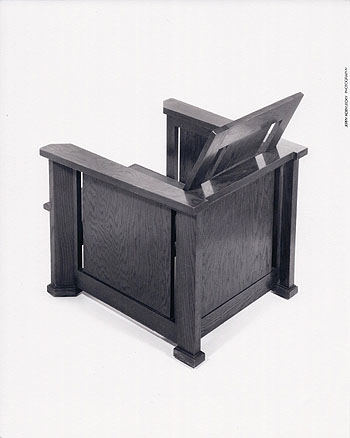
Description: Hand written on the verso: "Smith Bank?" Three-quarter view, facing backward and to the left. Very rectangular, both front legs are turned 45 degrees, much like the Frank L. Smith Bank Side Chairs. Similar to the Dana (1902), Arthur Heurtley (1902), Francis Little (1902) and Isabel Roberts (1908) reclining arm chairs. Photographed by Jerry Kobylecky. Acquired from Kelmscott Galleries. Wright Chairs.
Size: One 8 x 10 B&W photographs.
ST#: 1981.109.0413
Date: 1981 Title: Possibly Frank L. Smith Bank Reclining Arm Chair, Dwight, IL (1905 - S.111) 1981.
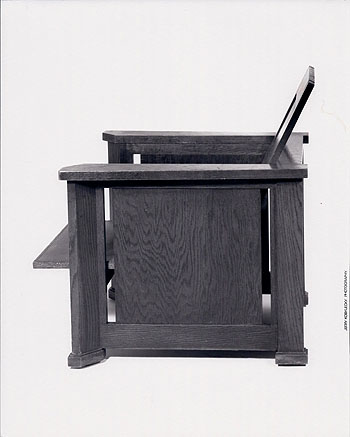
Description: Hand written on the verso: "Smith Bank?" Side view, facing left. Very rectangular, both front legs are turned 45 degrees, much like the Frank L. Smith Bank Side Chairs. Similar to the Dana (1902), Arthur Heurtley (1902), Francis Little (1902) and Isabel Roberts (1908) reclining arm chairs. Photographed by Jerry Kobylecky. Acquired from Kelmscott Galleries. Wright Chairs.
Size: One 8 x 10 B&W photographs.
ST#: 1981.110.0413
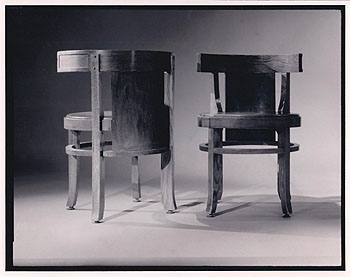
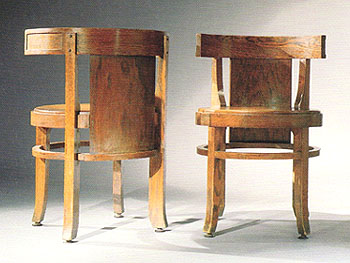
Date: 1989 Title: Frank L. Smith Bank Chairs, Dwight, IL (1905 - S.111).
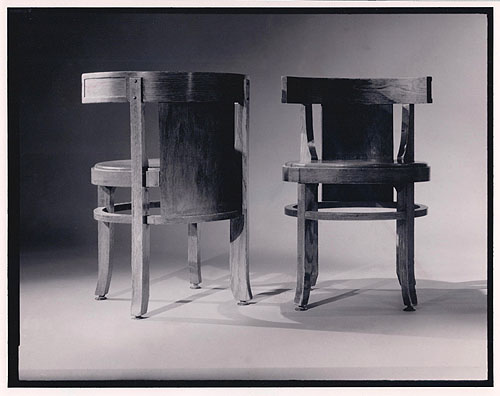
Description: Two barrel chairs designed by Frank Lloyd Wright for the Frank L. Smith Bank in 1905. The chairs were manufactured by the John W. Ayers, Co., Chicago. Caption pasted on verso: "Frank Lloyd Wright designed barrel chair, from 1906." Stamped on caption "Jan 15 ‘89". Second caption pasted on verso: "Barrel Chairs designed by Frank Lloyd Wright for a Dwight, Ill., bank in 1906 ($18,000 each), at Struve Gallery, 309 W. Superior St." Stamped on caption "Sep 17 ‘89". Stamped on verso: "Jan 18, 1989". Photographed by Struve Gallery. Acquired from the archived of the Chicago Tribune. See other examples of Wright designed furniture for the Frank L. Smith Bank. See Additional Smith Bank Furniture...
Size: Original 10 x 8 B&W Print.
ST#: 1989.74.0811
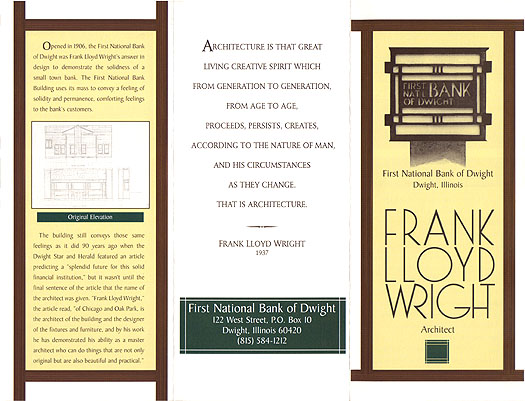
Date: 1996 Title: The First National Bank of Dwight, Dwight, Illinois.
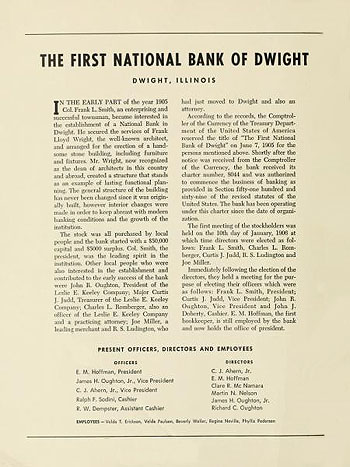
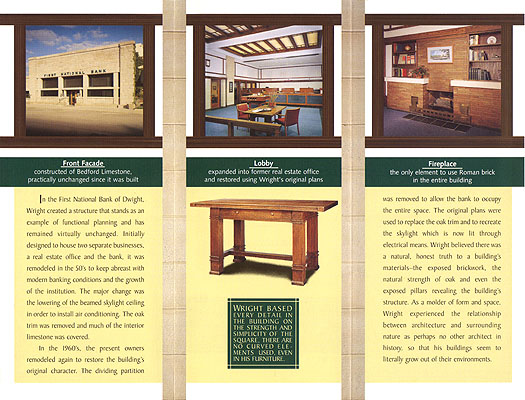
Description: Frank Lloyd Wright, Architect. (Published by The First National Bank of Dwight, Dwight, Illinois) Inside: In The First National Bank of Dwight, Wright created a structure that has stood the test of time and remains virtually unchanged. Initially designed to house two separate businesses, it was remodeled in the 1950's to keep abreast with modern banking conditions and the growth of the institution. The major change was the lowering of the beamed skylight ceiling in order to install air conditioning. The oak trim was removed and much of the interior limestone was covered.
In the 1960's, the bank was remodeled again to restore the buildings original character. The dividing partition was removed to allow the bank to occupy the entire space. The original plans were used to replace the oak trim and to recreate the skylight, which is now lit through electrical means. Wright believed there was a natural and honest truth in a building's materials, the exposed brickwork, the natural strength of oak and even the exposed pillars revealing the building's structure. As a molder of form and space, Wright experienced the relationship between architecture and surrounding nature as perhaps no other architect in history, so that his buildings seem to literally grow out of their environments.Size: 11 x 8.5
Pages: Pp 6
ST#: 1996.61.0209
Flap Back Cover Inside
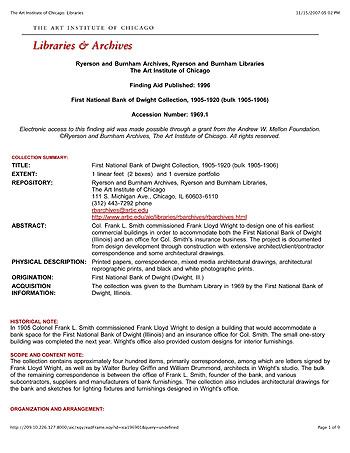
Date: 1996 Title: First National Bank of Dwight Collection 1905-1920 (Published by the Ryerson & Burnham Archives, Ryerson and Burnham Libraries, The Art Institute of Chicago, Chicago)
Author: Ryerson & Burnham Archives
Description: The collection was given to the Burnham Library in 1969 by the First National Bank of Dwight, Illinois. The collection contains approximately four hundred items.
Size: 8.5 x 11
Pages: Pp 9
ST#: 1996.60.0309
BUILD YOUR OWN ILLINOIS MAIN STREET, ILLINOIS MAIN STREET
ILLINOIS HISTORIC PRESERVATION AGENCY, Springfield, Illinois
FIRST NATIONAL BANK, DWIGHT, ILLINOIS
Drawn By MWG, March 2007
See Additional information...Date: 2009
Title: Frank L. Smith Bank, Dwight, Illinois, 2009 (1905 - S.111).
Description: Set of 13 exterior and 7 interior photographs of the Frank L. Smith Bank. Designed by Frank Lloyd Wright in 1905. On a recent trip from Chicago to Seattle with my daughter and grandchildren, we had a few minutes to stop and see the Frank L. Smith Bank, now the First National Bank in Dwight, Illinois. It is just a few minutes off the interstate and is the only bank Wright designed that is still functioning as a bank. Wright’s original 1904 design for the exterior of the bank was more elaborate and in Wright’s style than the final 1905 design. But the final design is very close to the 1901 project for “A Small Village Bank”, published in the Brickbuilder 1901 and in Ausgefuhrte Bauten und Entwürfe von Frank Lloyd Wright 1910, Tafel XII a & b. And yet even in this simple design, there are consistent Wright elements. He incorporate horizontal bands of windows, and vertical columns on either end. Most of all his... Continue...
Size: Original 23 X 15 high res digital images.
ST#: 2009.67.0824 (1-20)
See Additional Exterior Photographs...
See Additional Exterior Photographs...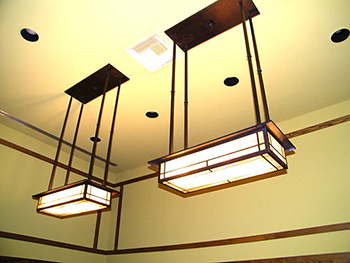
See Additional Interior Photographs...Introduction
On a recent trip from Chicago to Seattle with my daughter and grandchildren, we had a few minutes to stop and see the Frank L. Smith Bank, now the First National Bank in Dwight, Illinois. It is just a few minutes off the interstate and is the only bank Wright designed that is still functioning as a bank. Colonel Frank Leslie Smith, was a prominent citizen, entrepreneur and well-liked community leader in Dwight, Illinois. His father moved to Dwight when he was 15. Frank was born there on November 24, 1867, about five months after Wright’ birth (June 8, 1867). He went to public schools in Dwight, and at the age of seventeen taught school for one year. The next four years he worked in Dwight as a clerical for the Chicago & Alton Railroad. He moved to Chicago in 1887 and worked for the Rock Island Railroad for two years and then the P. H. Bolton & Company, until 1890, when he returned to Dwight and entered into partnership with W. H. Ketcham (possibly his cousin) in the real estate and loan business. On February, 8, 1893, he married Minnie Ahern, of Dwight. In 1895, he formed a partnership with Charles L. Romberger. Romberger & Smith was one of the largest loan and real estate businesses in central Illinois, with extensive land holdings in Illinois, Mississippi and Louisiana. In 1896 he ran for Circuit Clerk. In January, 1897, he was appointed Colonel on Governor Tanner's staff, thus gaining the title, and was involved in many political activities including President McKinley 1897 inauguration in Washington. D. C. In 1900 he declined the nomination for state senator but was unsuccessful in his bid for lieutenant governor in 1904. This loss may have influenced him to devote himself more fully to his business ventures. He contacted Wright and in 1904 was presented with the first designed for a three story bank, which Smith rejected. In 1905 Wright’s second design, a one and a half story structure was accepted. Stock in the bank was purchased by the local towns people, and the bank was chartered in June, 1905. The first stockholders meeting was held in January, 1906, and two of the directors elected were Frank L. Smith and Charles L. Romberger. Smith was elected as President. He was active in the community and formed a local baseball team. In 1913 the Dwight Country Club was formed and Smith became President. In 1914 the Women’s Club was formed and his wife became
president. He was elected to Congress in 1918 and unsuccessfully ran for other political offices. He was chairman of the board of the First National Bank of Dwight, until his death on August 30, 1950. “It is fitting that in the History of Dwight the efforts of Colonel Frank L. Smith should be given a place along with those pioneers and their successors who also devoted their best efforts to the betterment of our community.” (A real George Bailey.)
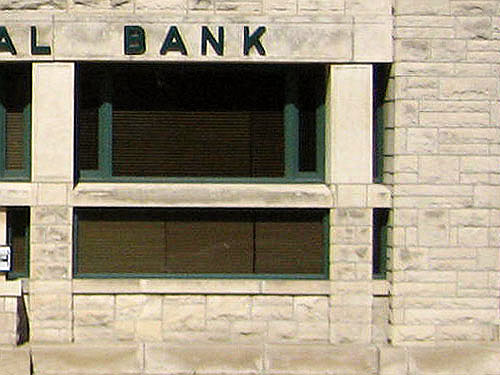
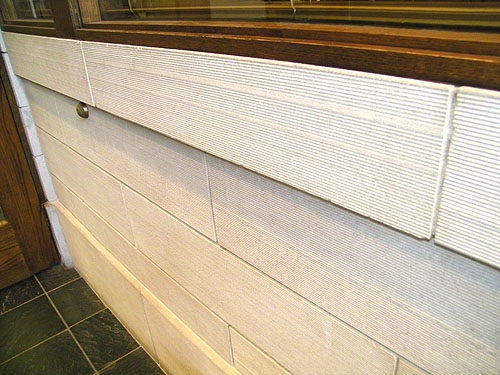
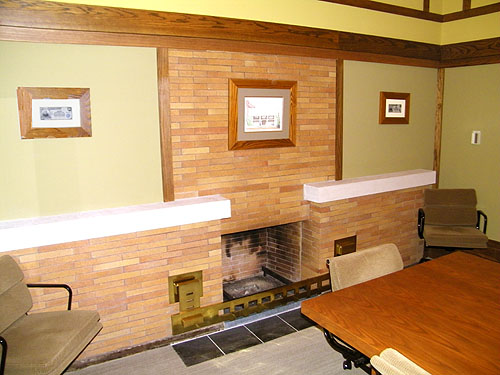
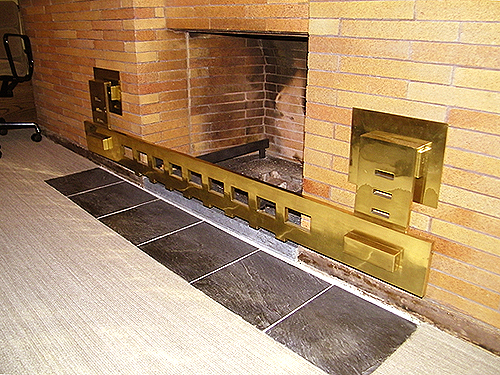
Wright’s original 1904 design for the exterior of the bank was more elaborate and in Wright’s style than the final 1905 design. But the final design is very close to the 1901 project for “A Small Village Bank”, published in the Brickbuilder 1901 and in Ausgeführte Bauten und Entwürfe von Frank Lloyd Wright 1910, Tafel XII a & b. And yet even in this simple design, there are consistent Wright elements. He incorporate horizontal bands of windows, and vertical columns on either end. Most of all his ability to work with the building’s visual perspective. When you first view the bank from a distance it appears to be a single story. But as you approach the building and the entrance becomes apparent, the building grows in size. It is reminiscent of what Wright accomplishes with hallways opening up to larger spaces. Where as the exterior may not be as “Wright” as some of his other designs, the interior is pure Wright. As you enter through the center of the building there are two lanterns atop imposing pedestals on either side of the entrance. Doors have been added to the front of the loggia where originally they were only at the end. The loggia is still wainscotted with stone, above which are plate glass windows looking into the offices on either side. There is beautiful designed prairie styled oak trim. An extensive skylights. The prairie styled fixtures and furniture were designed by Wright for the bank. One of the most unique details is the spectacular fireplace that is unique to the bank and 100% Wright.
The interior design was modified to accommodate banking, real estate and loan offices. Major changes were made in the 1950's that destroyed many of Wright’s design elements. The interior was remodeled again in the 1960's which restored much of the original character. In the early 1990's the bank was remodeled again and enlarged as seen today.
Text by Douglas Steiner, Copyright February 2009
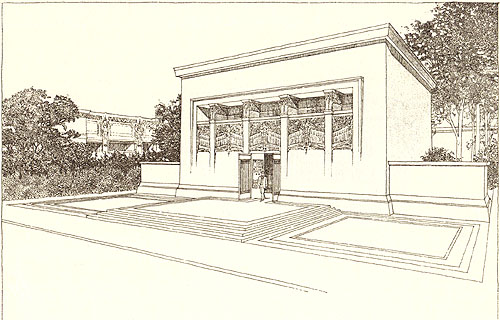
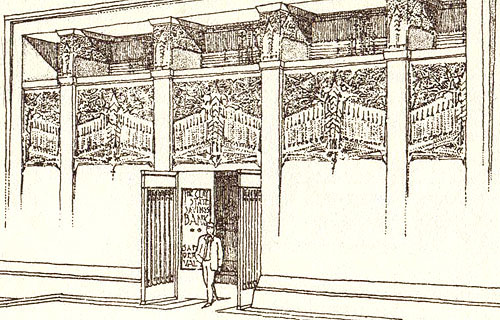
A Small Village Bank, 1901
Ausgeführte Bauten und Entwürfe von Frank Lloyd Wright, 1910
Wright designed A Small Village Bank, intended to be executed entirely of concrete, similar to the Unity Temple in Oak Park. This project was published in the Brickbuilder, August 1901. Wright also selected this project for the Ausgeführte Bauten und Entwürfe von Frank Lloyd Wright Tafel XII a & b. It was published by Ernst Wasmuth in 1910, in Berlin. Each set consisted of two portfolios and 100 separate plates (sheets). Printed in German. The complete set consisted of 72 plates numbered I through
LXIV and included eight with a or b. 28 were tissue overlays and were attached to the corresponding plates. Each set also included a 31 page introduction, consisting of unbound sheets, folded once.
In 1967 Hasbrouch reprinted the August 1901 Brickbuilder in "Architectural Essays From The Chicago School: Tallmadge, Sullivan, Jensen and Frank Lloyd Wright. From 1900 to 1909" Wright, pages 18-19.
Ausgeführte Bauten und Entwürfe von Frank Lloyd Wright (Published by Ernst Wasmuth A.-G., Berlin) Tafel XII. Detail of Tafel XII, Ausgeführte Bauten und Entwürfe von Frank Lloyd Wright.
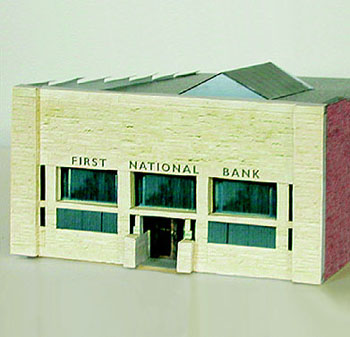
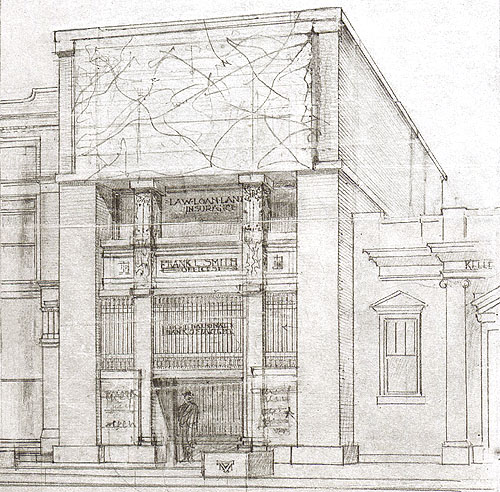
Frank L. Smith Bank, First Design, 1904
Wright's first design in 1904 was for a three story bank, which Smith rejected. It was more elaborate and more in Wright’s style than the final 1905 design. Things didn't changed much over the next 70 years. The buildings on the left and right are visible in the photograph by Gilman Lane. The building on the left was torn down to make room the the 1990's remodeling. The building on the right still exists. Frank L. Smith Bank & LARKIN ADMINISTRATION BUILDING
Larkin Administration Building. Buffalo, New York, Circa 1910-1920 (Not Dated) (1903 - S.093) / Frank L. Smith Bank Barrel Chair (1905 - S.111).
Larkin Administration Building Library and Frank L. Smith Bank Barrel Chair. The Library was located on the fourth floor of the Annex. Thanks to Thomas Heinz’s sharp eye, he noticed a Frank L. Smith Bank Barrel Chair in the library. The Larkin Side Chairs seen in this photograph were also found in the restaurant on the fifth floor. There is no indication as to the relationship of the Smith Barrel Chair and the Larkin Building. Wright designed the Larkin Building in 1903, the Larkin Administration building was completed in 1904, and the finished building was ready for occupancy in August 1906. Construction of the Larkin Building and the Smith Bank overlapped, and one might speculate that Wright sent John Larkin and Darwin Martin a sample of the Smith chair as an option? Wright designed his first barrel chair for the Darwin D. Martin residence in 1904. But it is only a speculation. Published in Frank Lloyd Wright’s Larkin Building, Quinan, 1987, p.81. (S#0094.111.0824)Frank L. Smith Bank, Bird's Eye View
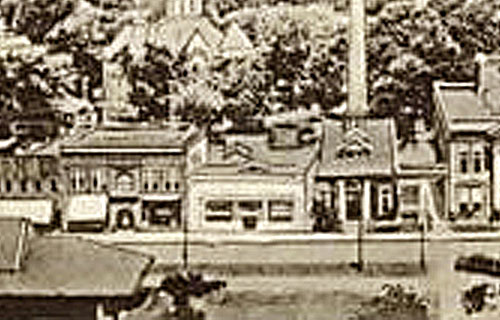
Postcard: Bird's Eye View of Dwight, Ill., looking north-west from water tower. Very early image of the Bank. Taken before the clock was added. What is visible is the skylight on the roof. Postcard: Detail of Frank L. Smith Bank. Very early image of the Bank. Taken before the clock was added. What is visible is the skylight on the roof. Frank L. Smith Bank, 1918
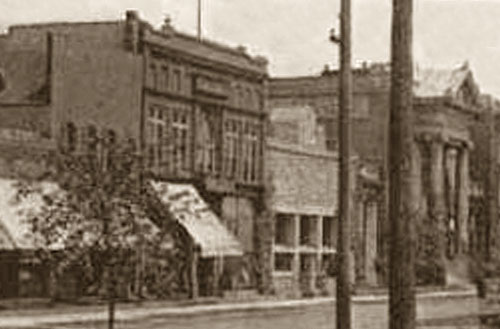
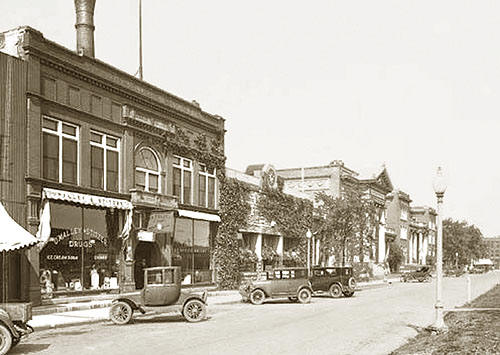
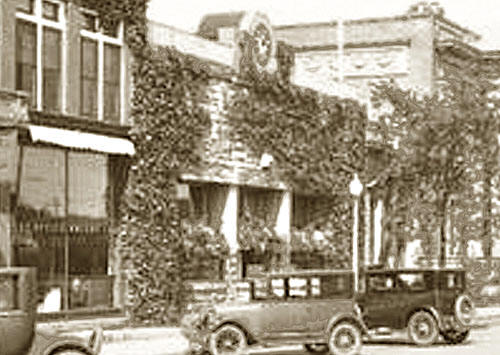
Postcard: "West Main St., Dwight, Ill." The clock is clearly visible on top of the building. A delivery horse and buggy. A couple relaxes under the awning on the far left. An interesting "lamp post" in the center of the photograph. A tree has grown up to the left of the "lamp post". Postcard: Detail of Frank L. Smith Bank. West Main St., Dwight, Ill. The clock is clearly visible on top of the building. Frank L. Smith Bank, Circa 1927
Frank L. Smith Bank postcard, circa 1927. Published by AZO. Lettering on left window: "The First National Bank of Dwight. Capitol and Surplus $60,000.00. 3 per cent interest paid on savings deposits. Law - Loan - Land and Insurance Offices of Frank L. Smith. Land Man. If you deal with me you get results." Hand written on negative across the bottom: "First National Bank, Dwight, Ill. 12317." On April 13, 1926, Smith runs against Senator McKinley in primary, wins election by 102,000 majority and denies McKinley re-election to U.S. Senate. Smith wins general election. November 2, Smith wins Senate election by 67,000 votes. On December 7, 1926, McKinley passed away, before his term ended on March 3, 1927. The Governor appoints Smith to fill vacancy of William B. McKinley seat, but U.S. Senate denied his appointment. On March 4, 1927, even though elected, Senate again refused to seat Smith. Hand written on verso: "Note the name on the window. This is where he does it. Nice & cool here this A.M. Home Sat." Signed: "Albert B." Postmarked Jul 22, 1927. Frank L. Smith Bank, 1928
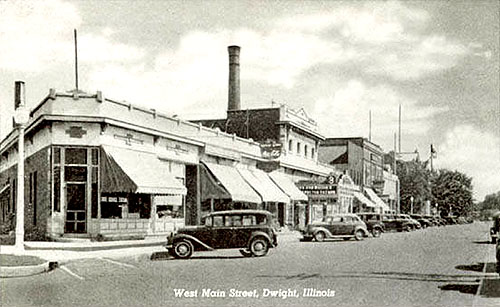
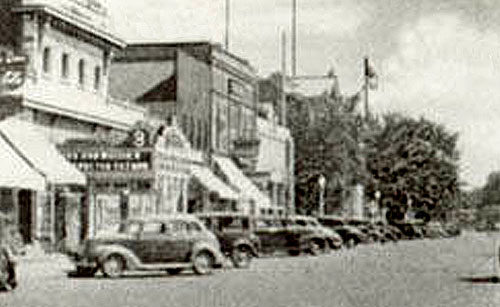
"West Main Street, Dwight, Ill." 1928 postcard, published by Curt Tech & Co., Chicago, Ill. Lamp posts have been added on either side of the street. Detail from 1928 postcard above. The clock, visible on top of the building, was not included on the original drawings. The square decoratively designed light fixtures on top of the pedestals on either side of the entrance are visible. Ivy has overtaken the face of the building. Frank L. Smith Bank, Photograph By Gilman Lane 1935-1941
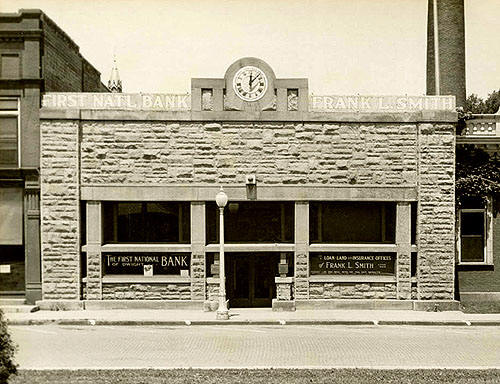
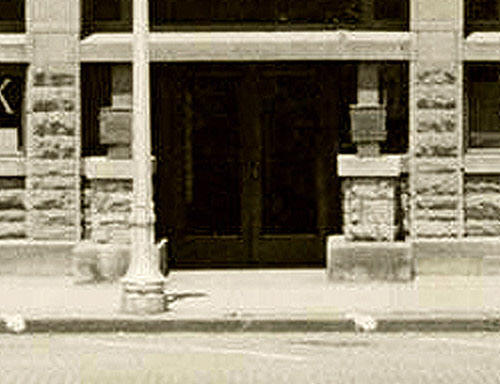
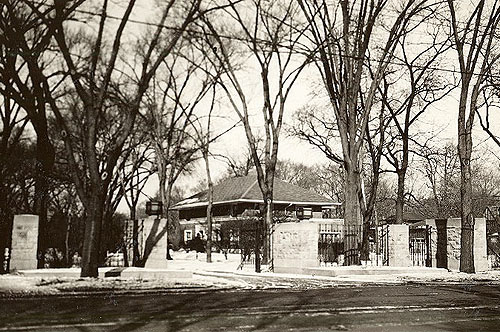
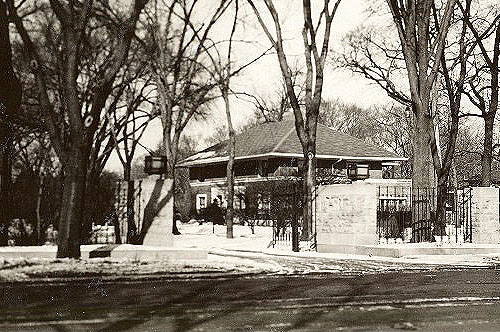
Little can be found about Gilman Lane. He photographed building in the Chicago area including many of Wright’s work. The lanterns positioned atop the pedestals at the entrance look to be plain, and do not seem to be the same lanterns that are there today (see detail below) and see additional information about the Lanterns. The street out front is made of brick. Photographed between 1935-1941. Also published in "The Nature of Materials: 1887 - 1941", Hitchcock, 1942. (Courtesy Ryerson and Burnham Libraries, The Art Institute of Chicago.) Detail from above image: The lanterns positioned atop the pedestals at the entrance look to be plain, and do not seem to be the same lanterns that are there today. See additional information about the Lanterns. Frank L. Smith Bank, 1946
"West Main Street, Dwight, Ill." 1946 postcard, published by Curt Tech & Co., Chicago, Ill. Detail from 1946 postcard above. The clock, visible on top of the building, was not included on the original drawings. Ivy has been removed. Frank L. Smith Bank, Mid 1970s
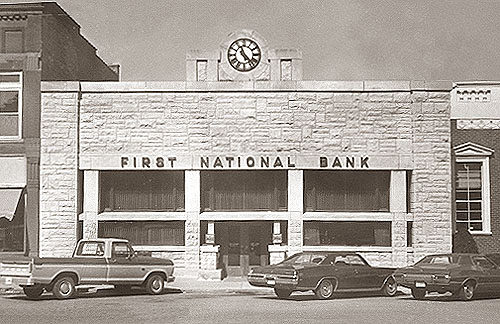
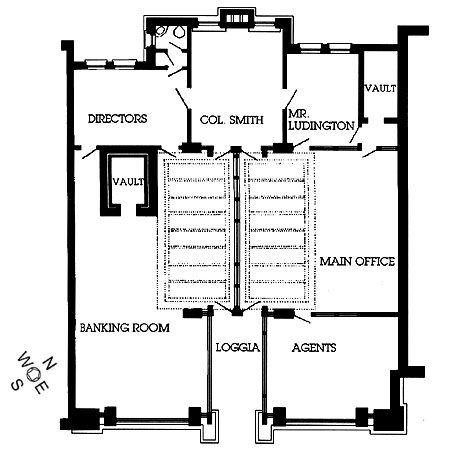
This image shows the bank as Wright designed it. The clock, visible on top of the building, was not included on the original drawings. Things haven't changed much in 70 years. The buildings on the left and right were in Wright's original 1904 drawing. The building on the left was torn down to make room the the 1990's remodeling. The building on the right still exists. Frank L. Smith Bank Floor Plan
Floor plan copyright 1993, “The Frank Lloyd Wright Companion” Storrer, William Allin, page 111. Exterior Photographs By Douglas Steiner, February 2009
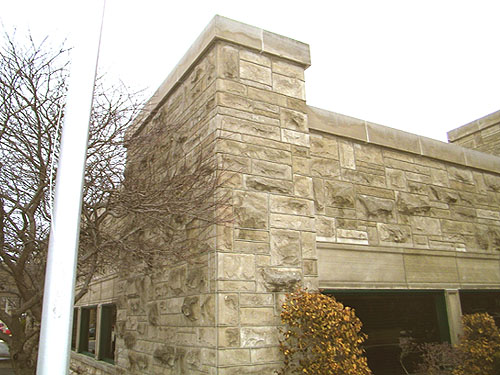
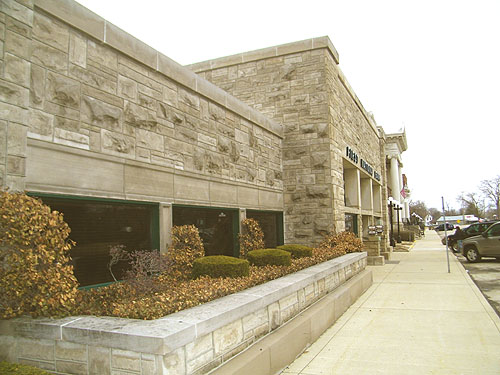
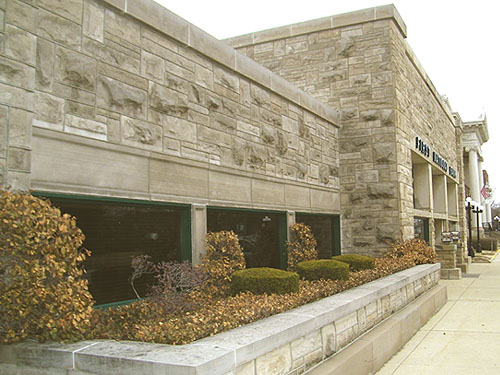
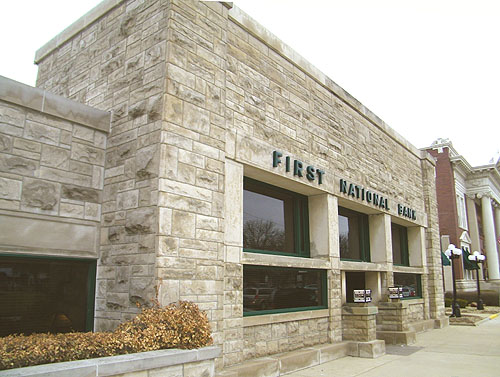
Frank L. Smith Bank, Dwight, Illinois, 2009 (1905 - S.111). Set of 13 exterior and 7 interior photographs of the Frank L. Smith Bank. Designed by Frank Lloyd Wright in 1905. On a recent trip from Chicago to Seattle with my daughter and grandchildren, we had a few minutes to stop and see the Frank L. Smith Bank, now the First National Bank in Dwight, Illinois. It is just a few minutes off the interstate and is the only bank Wright designed that is still functioning as a bank. Wright’s original 1904 design for the exterior of the bank was more elaborate and in Wright’s style than the final 1905 design. But the final design is very close to the 1901 project for “A Small Village Bank”, published in the Brickbuilder 1901 and in Ausgefuhrte Bauten und Entwürfe von Frank Lloyd Wright 1910, Tafel XII a & b. And yet even in this simple design, there are consistent Wright elements. He incorporate horizontal bands of windows, and vertical columns on either end. Most of all his ability to work with the building’s visual perspective. When you first view the bank from a distance it appears to be a single story. But as you approach the building and the entrance becomes apparent, the building grows in size. It is reminiscent of what Wright accomplishes with hallways opening up to larger spaces.
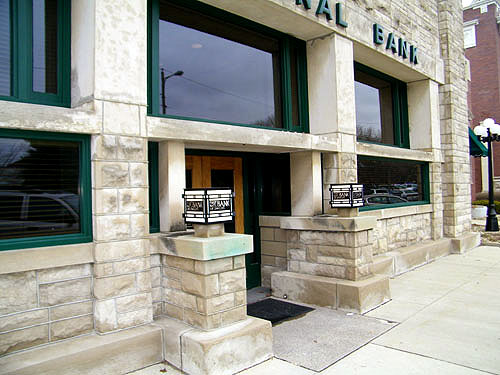
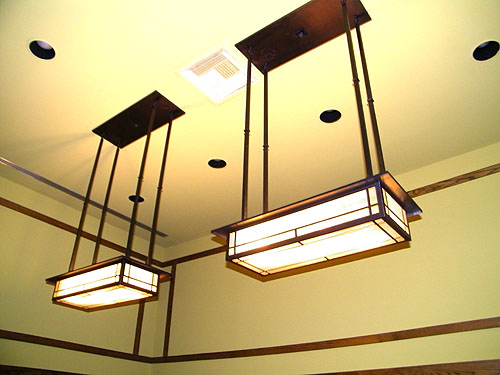
As you approach the building and the entrance becomes apparent, the building grows in size. It is reminiscent of what Wright accomplishes with hallways opening up to largerspaces. Where as the exterior may not be as “Wright” as some of his other designs, the interior is pure Wright. As you enter through the center of the building there are light fixtures atop imposing pedestals on either side of the entrance. Doors have been added to the front of the loggia where originally they were only at the end. The loggia is still wainscotted with stone, above which are plate glass windows looking into the offices on either side. There is beautiful designed prairie styled oak trim. An extensive skylights. The prairie styled fixtures and furniture were designed by Wright for the bank. One of the most unique details is the spectacular fireplace that is unique to the bank and 100% Wright. For an excellent article written just after the bank opened: First National Bank of Dwight. Published in the Dwight Star and Herald, Feb. 3, 1906. The light fixtures were manufactured by Willy H. Lau, W. H. Lau & Co., Chicago.
Set of 13 exterior and 7 interior photographs of the Frank L. Smith Bank, photographed by Douglas M. Steiner on February 27, 2009, on a road trip from Chicago to Seattle. Our intent is to record the details that create the totality of the design, creating a complete picture, as-well-as the present condition of the building. In an effort to expedite adding these photographs to this website, we have dispensed with a description for each photograph. Original 23 X 15 high res digital images. (ST#2009.67.0824 : 1-20)EXTERIOR INTERIOR
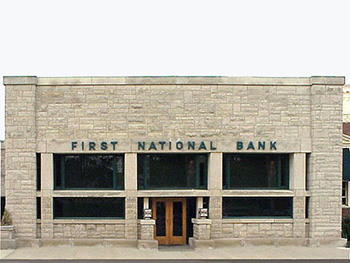
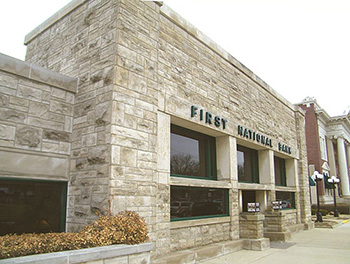
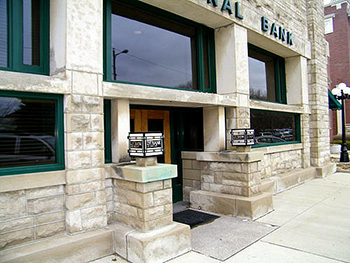
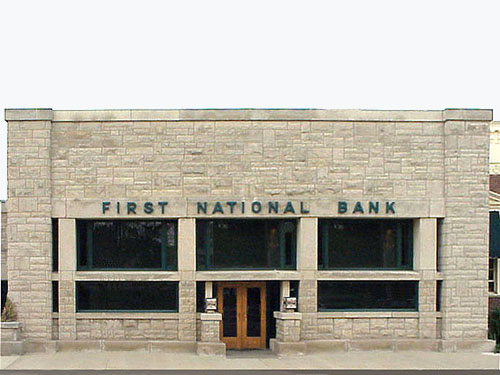
1) Viewed from the Southeast, this original section of the Bank still appears as Wright designed it. The clock that appeared at the top of the building in earlier images was removed during the early 1990 remodeling. Originally the front doors were located at the back end of the Logia which is consistent with how Wright would hide the entrance. (ST#2009.67.0824-1)
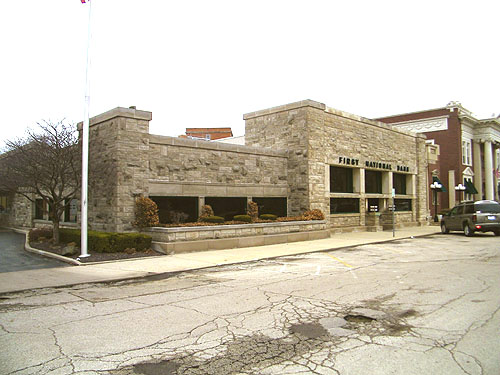
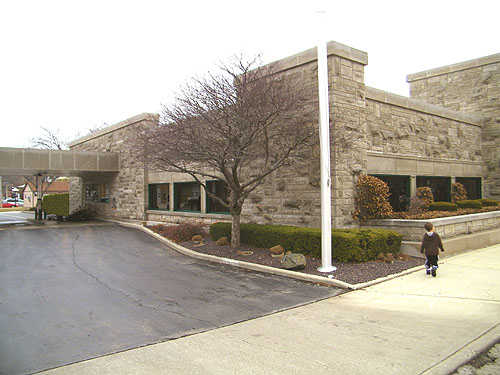
2) Viewed from the South, the addition on the left was added in the early 1990. The original section of the Bank on the right still appears as Wright designed it. The clock that appeared at the top of the building in earlier images was removed. (ST#2009.67.0824-2) 3) Viewed from the South, the addition on the left was added in the early 1990. The additional retained Wright's theme. There is a drive through on the far left. My four year old grandson admires Wright's intricate design elements. (ST#2009.67.0824-3) 4) Viewed from the South. A vertical column that appears on either end of the original structure, is repeated and takes a prominent role in the addition. (ST#2009.67.0824-4) 5) Viewed from the South. The addition retains the character and material of the original design. (ST#2009.67.0824-5) 6) Viewed from the South. The addition retains the character and material of the original design. (ST#2009.67.0824-6)
7) Viewed from the South. When you first view the bank from a distance it appears to be a single story. But as you approach the building and the entrance becomes apparent, the building grows in size. (ST#2009.67.0824-7)
8) Viewed from the South. As you approach the bank and the entrance becomes apparent, the building grows in size. (ST#2009.67.0824-8)
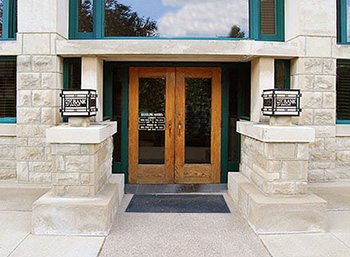
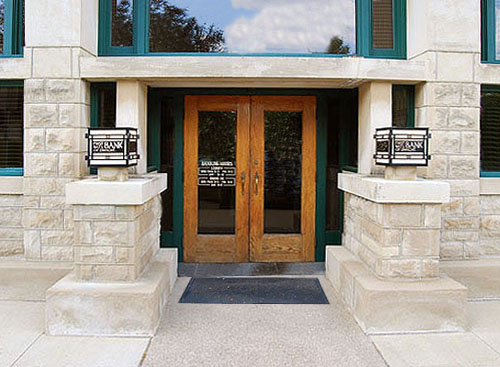
9) Viewed from the Southeast. Originally the front doors were located at the back end of the Logia which is consistent with how Wright would hide the entrance. The entrance pedestals center on the column behind it. This is very consistent with how Wright diminished the size of his hallways. As you moved through the narrow hallways, the space you moved into gave the feeling of a much larger space. (ST#2009.67.0824-9)
10) Viewed from the South. Originally the front doors were located at the back end of the Logia which is consistent with how Wright would hide the entrance. The entrance pedestals center on the column behind it. This is very consistent with how Wright diminished the size of his hallways. As you moved through the narrow hallways, the space you moved into gave the feeling of a much larger space. (ST#2009.67.0824-10)
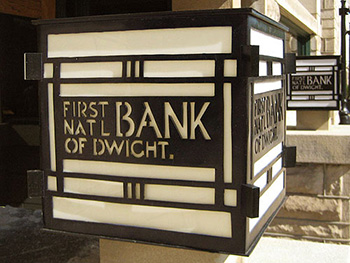
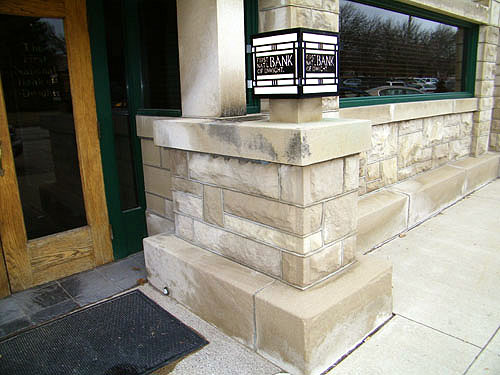
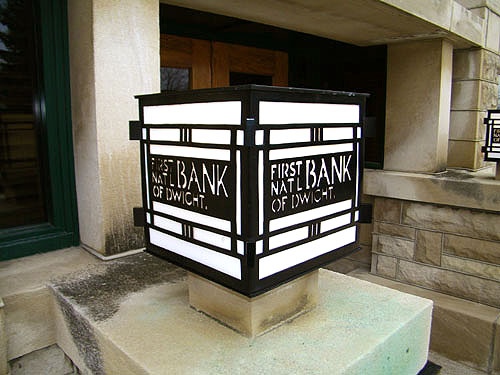
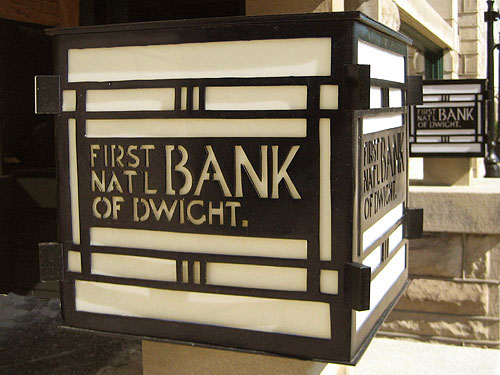
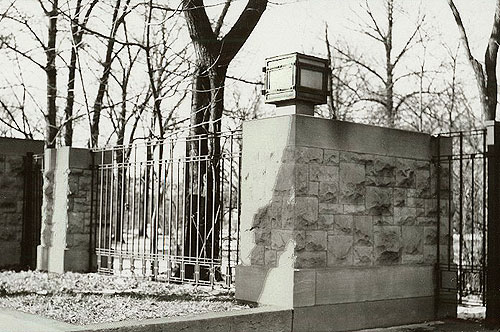
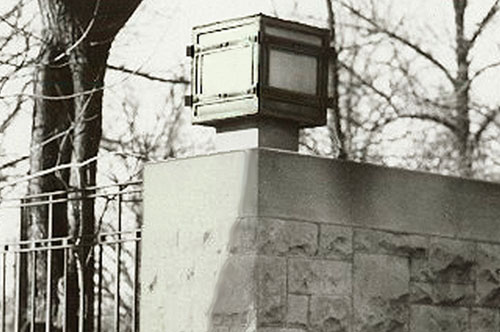
11) Viewed from the South. Detail of the lantern atop the entrance pedestals. (ST#2009.67.0824-11)
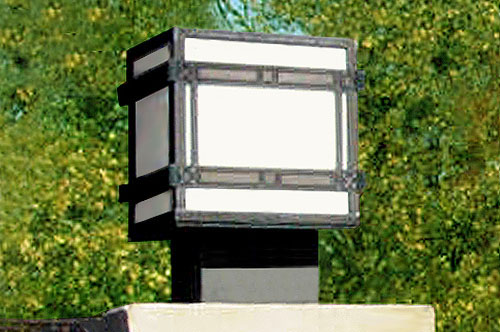
12) Detail of the lantern atop the entrance pedestals. (This image courtesy of IvoShandor, Wickimedia, and has been altered.) (ST#2009.67.0824-12)
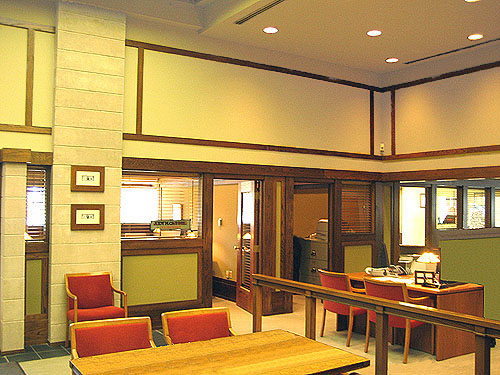
13) Detail of the narrow window on the right between the last two columns. Wright extended the horizontal row of windows from the corner column on the left to the corner column on the right. (ST#2009.67.0824-13) Interior Photographs 1) Doors have been added to the front of the loggia where originally they were only at the end. The loggia is still wainscotted with stone, above which are plate glass windows looking into the offices on either side. (ST#2009.67.0824-14)
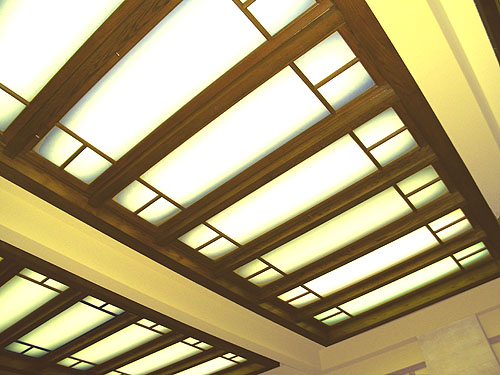
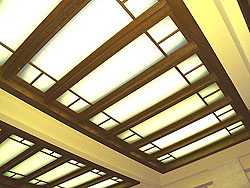
2) The extensive interior ceiling skylights were designed by Wright. (ST#2009.67.0824-15) 3) The prairie styled fixtures were designed by Wright for the bank. The beautifully designed prairie styled oak trim was restored to Wright's original specifications. (ST#2009.67.0824-16)
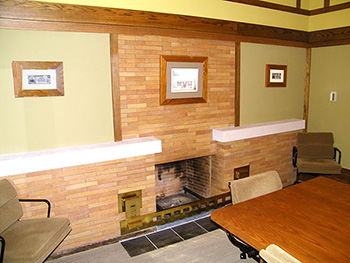
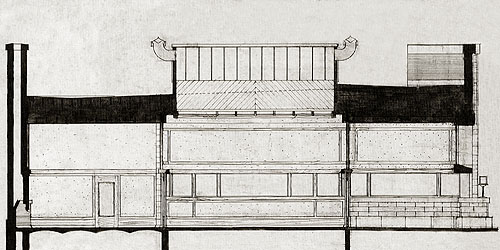
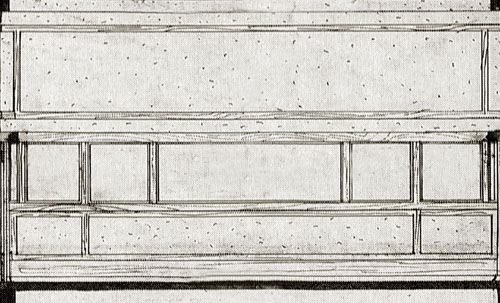
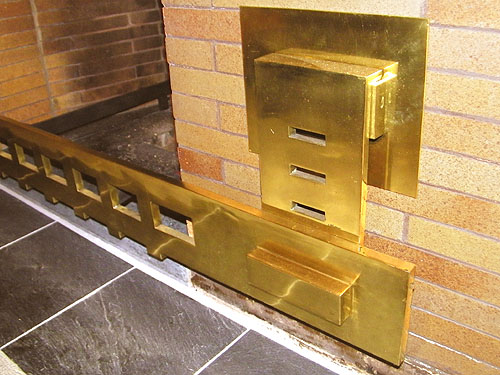
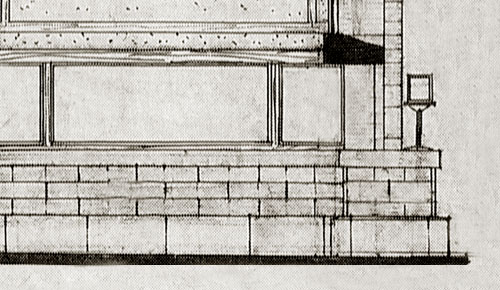
4) The beautiful designed prairie styled oak trim was painstakingly maintained in this 1990 remodel and addition. (This image courtesy of IvoShandor, Wickimedia, and has been altered.) (ST#2009.67.0824-17) Original side view drawing of the Frank L. Smith Bank, 1905. This drawing indicates Wright originally designed for the interior oak trim. Detail of original side view drawing indicates what Wright originally designed for the interior oak trim in 1905. 5) The fireplace is constructed of Roman brick and covers the entire end of Col. Smith's office. It adds a touch to the color scheme not found in the other rooms of the building. (ST#2009.67.0824-18) 6) One of the most unique details is the spectacular polished fireplace bracket that is unique to the Frank L. Smith Bank and 100% Wright. (ST#2009.67.0824-19)
7) Detail of the spectacular polished fireplace bracket that is unique to the Frank L. Smith Bank and 100% Wright. (ST#2009.67.0824-20) Frank L. Smith Bank FurniturE 1905
By 1905, Wright had completed some of his most important Prairie styled homes and buildings. The Bradley, Hickox, Willits, Henderson, Little, Dana-Thomas, Larkin, Unity Temple, and Martin, to name a few. Wright was intimately involved in some of the smallest design elements. This was true for the Frank L.
Smith Bank. In The Decorative Designs of Frank Lloyd Wright, there is a copy of an ink well Wright took the time to design and describe in detail. The fixtures, the skylight, the fireplace, an ink well and the furniture were all designed by Wright for the bank. The furniture was manufactured by John W. Ayers Co., Chicago.
BARREL CHAIR SIDE CHAIR STANDING DESK BANK TABLE OFFICE DESK ACCOUNTING / LOBBY TABLE
TELLER STOOLS
Smith Bank BARREL CHAIR 1A) Frank L. Smith Bank, Dwight, Illinois, Barrel Chair, 1905 (1905 - S.111). Original Barrel Chair from the Frank L. Smith Bank. Designed by Frank Lloyd Wright in 1905. Smith first contacted Wright in 1904. The first designed was a three story bank, which Smith rejected. In 1905 Wright’s second design, a one and a half story structure was accepted.
The seat is round, as are the circular stretchers below. The top rail is curved with inset panels at the ends on the back side. The ends of the top rail are cantilevered toward the front. The legs are set at forty-five degrees, pointing toward the center of the chair, and are in-line with the opposite leg, forming an exact “X”. The feet are flared at the bottom. They are the same width, 1.3125", but the depth of the back legs is greater. Front legs are 1.5" deep compared to 2.25" deep for the back. The back legs maintain that depth until they extend just past the seat where they curve to the depth of 1.125" deep. It is interesting to note that the Smith Side Chair front legs (ST#1981.108) mimic the Barrel Chair legs, set at 45 degrees, but the curved portion is inverted. The backrest, set between the back legs, runs from the stretcher to the top rail. It matches the curve of the top rail. The backrest of the side chair mimics the design of the barrel chair, but is not curved.
Chairs were manufactured by the John W. Ayers, Co., Chicago. Constructed of oak. (S#0058.64.0624)1B) Detail of the Frank L. Smith Bank, Dwight, Illinois, Barrel Chair, 1905 (1905 - S.111). 1C) Detail of the Frank L. Smith Bank, Dwight, Illinois, Barrel Chair, 1905 (1905 - S.111). 1D) Detail of the Frank L. Smith Bank, Dwight, Illinois, Barrel Chair, 1905 (1905 - S.111). 1E) Detail of the Frank L. Smith Bank, Dwight, Illinois, Barrel Chair, 1905 (1905 - S.111). 1F) Detail of the Frank L. Smith Bank, Dwight, Illinois, Barrel Chair, 1905 (1905 - S.111). 1G) Detail of the Frank L. Smith Bank, Dwight, Illinois, Barrel Chair, 1905 (1905 - S.111). 1H) Detail of the Frank L. Smith Bank, Dwight, Illinois, Barrel Chair, 1905 (1905 - S.111). 1I) Detail of the Frank L. Smith Bank, Dwight, Illinois, Barrel Chair, 1905 (1905 - S.111). 2) Barrel Chair designed by Wright in 1905.
This arm chair was sold at Sotheby's in December 2007. 29.125"h. Lot 369, sale price $11,875. Wright designed his first barrel chair for the Darwin D. Martin residence in 1904. These are quite different in style, and were used with the desks and conference tables in the bank and real estate offices. Composed of horizontal and vertical lines, as-well-as circles. The outside arms of the chair have a deeply carved horizontal panel that is consistent with the table top edges. Courtesy Sotheby's.3) Barrel Chair. Oak, 29h x 19.5 in diameter. Wright designed his first barrel chair for the Darwin D. Martin residence in 1904. These are quite different in style, and were used with the desks and conference tables in the bank and real estate offices. Composed of horizontal and vertical lines, as-well-as circles. The outside arms of the chair have a deeply carved horizontal panel that is consistent with the table top edges. Published in "In Pursuit of Order, Frank Lloyd Wright from 1897 to 1915" Struve Gallery, 1988. 4) Frank L. Smith Bank Chairs, Dwight, IL. Two barrel chairs designed by Frank Lloyd Wright for the Frank L. Smith Bank in 1905. The chairs were manufactured by the John W. Ayers, Co., Chicago. Caption pasted on verso: "Frank Lloyd Wright designed barrel chair, from 1906." Stamped on caption "Jan 15 ‘89". Second caption pasted on verso: "Barrel Chairs designed by Frank Lloyd Wright for a Dwight, Ill., bank in 1906 ($18,000 each), at Struve Gallery, 309 W. Superior St." Stamped on caption "Sep 17 ‘89". Stamped on verso: "Jan 18, 1989". Photographed by Struve Gallery. Smith Bank SIDE CHAIR Frank L. Smith Bank Side Chair, Dwight, IL, 1981 (1905 - S.111). Oak side chair three-quarter view, facing backward and to the right. Both front legs are turned 45 degrees and are thinner at the bottom. This photograph published in "Frank Lloyd Wright and Viollet-le-Duc", 1986, p. 54. Manufactured by John W. Ayers, Chicago. 34.5 (H) x 14 (W) x 19 (D). Acquired from Kelmscott Galleries. (ST#1981.108.0413)
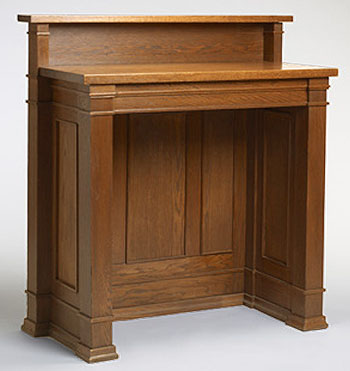
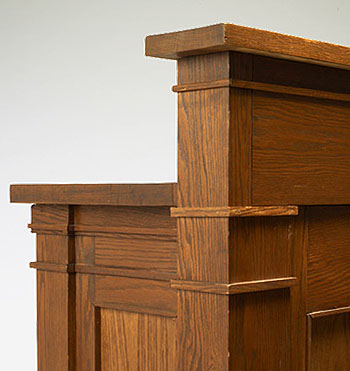
Smith Bank STANDING DESK Standing Desk designed by Wright in 1905.
This desk was one of the items at Wright Auctions in May 2008. 46"w x 22"d x 50"h. Lot 321, sale price estimated at $12,000-15,000. Item did not sell. Courtesy Wrights. There is an additional example of this desk published in "Decorative Designs", Hanks, 1979, page 38, fig. 47, and is identified as a desk from the Frank L. Smith Bank. But when it is compared with the other furniture designed by Wright for the bank, it is not consistent. The edge of the desk top does not have the deeply carved horizontal panel or groove consistent in the other table tops and chairs. It does not have the double horizontal strip of molding top and bottom. The base molding is also different. This calls into question the whether this desk was designed for the Frank L. Smith Bank.Smith Bank TABLE Table designed by Wright in 1905 (84 Inches wide).
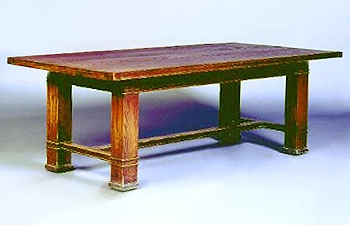
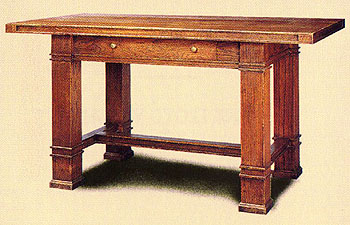
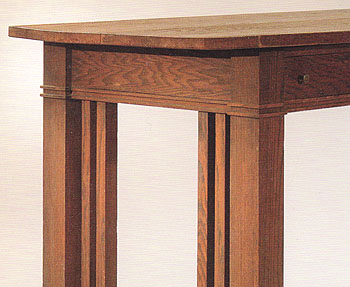
This table was sold at the Treadway-Toomey Galleries in May 1999. "The rectangular top with incised edge, supported by square legs with double molded details at top and base, 84"w x 42"d x 29"h." Lot 438, sale price $28,000. Courtesy The Treadway-Toomey Galleries.Smith Bank OFFICE DESK 1) Office Desk designed by Wright in 1905 (54 Inches wide).
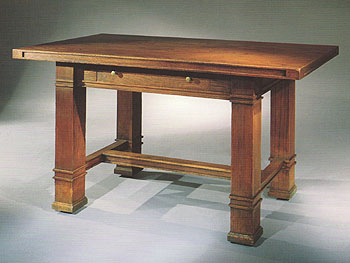
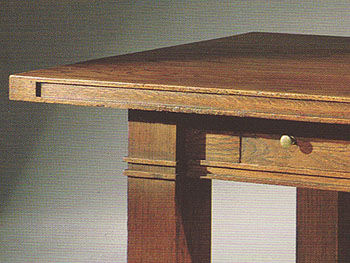
This desk is in the brochure published by The First National Bank of Dwight, Dwight, Illinois. Courtesy of The First National Bank of Dwight.2} Oak with brass drawer pulls, 54w x 27d x 28.5h. Desk for an executive of the bank. Designed with thick legs and horizontal bands. The edges of the desk top have a deeply carved horizontal panel or groove. Published in "In Pursuit of Order, Frank Lloyd Wright from 1897 to 1915" Struve Gallery, 1988. Smith Bank ACCOUNTING TABLE Accounting Table (Lobby Table) designed by Wright in 1905 (69 Inches wide).
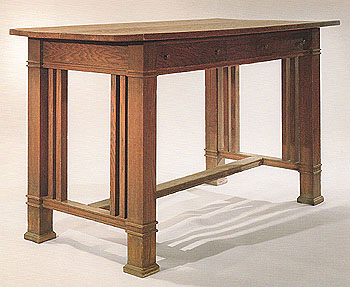
Oak with brass drawer pulls, 69w x 36d x 40.5h. Very similar in design to the other desks and tables, but much taller in height. This allowed the bookkeeper to either stand or sit on one of the stools Wright designed. But one addition that does not appear on the other tables and desks are the additional vertical spindles. It also appears that the top may not be the original top for this table. With all tables matching so closely in detail, it would seem to reason that the original top would have been more consistent. This is described here as an "Accounting Table". But is seems a more accurate description would be "Lobby Table". Clients entering the bank need a desk to stand at to fill out their deposit slips, etc. Hence a table 40.5 inches high. Published in "In Pursuit of Order, Frank Lloyd Wright from 1897 to 1915" Struve Gallery, 1988.Smith Bank TELLER STOOLS Teller Stools designed by Wright in 1905.
Stools have a rectangular top raised on square supports. 18.5"w x 12.25"d x 27"h.Frank L. Smith Bank Lanterns
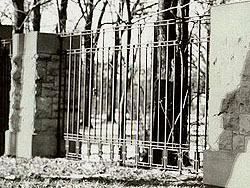
Wright always intended a lantern to sit atop the entrance pedestals. Drawings indicate what Wright originally designed for the bank in 1905. The original lanterns actually produced and placed atop the entrance pedestals were slightly different in 1906. “Correspondence and bills of sale in the Frank L. Smith Collection in The Burnham Library of The Art Institute of Chicago indicated that Lau made exterior lanterns identical to ones flanking the entrance gate of the E. C. Waller estate in River Forest, Illinois…” Hanks, page 207-208. The Waller gates were designed in 1901 (S.065). Wright would often use design elements from one building, in another. An example is the Baluster used in the Roloson Rowhouses (1894) and a similar one used in the Moore Residence (1895). Another is the same wall sconce used in the Little Residence, Peoria (1902) and in the Dana Residence (1902).
This is evident when you look closely at the Smith Lantern. In essence the original lanterns lacked the “Name Plate” centered in the existing lanterns today. When the “name plate” is removed,it is essentially the same design as the lantern at the Waller gate. Not only is the lantern consistent but also the stonework. A third similarity between the two projects is the design for the skylight and gate.
The lanterns and light fixtures were manufactured by Willy H. Lau, W. H. Lau & Co., Chicago. The lanterns were manufactured from brass. “…on February 13, 1906, Lau wrote that he had the lanterns ready but was waiting to hear from Wright regarding the finish on the brass lanterns… As regarding the finish on the brass lanterns we would prefer to have Mr. Wright determine that…” Burnham Library, Hanks, page 23.
According to Eric Stewart, a Vice President who works at the First National Bank of Dwight said, “The lanterns on the exterior were designed by Wright, but were not originally outside the bank. There are now two of the original lanterns outside and two originals inside.
Original side view drawing of the Frank L. Smith Bank, 1905. Wright always intended a lantern to sit atop the entrance pedestals. This drawing indicated what Wright originally designed for the bank. Detail of original side view drawing indicates what Wright originally designed for the bank in 1905. 1: In this early image photographed by Gilman Lane between 1935-1941, the lanterns positioned atop the pedestals at the entrance look to be plain, and do not seem to be the same lanterns that are there today (see detail below). (Courtesy Ryerson and Burnham Libraries, The Art Institute of Chicago.) 1a: Detail from above image: The lanterns positioned atop the pedestals at the entrance look to be plain, and do not seem to be the same lanterns that are there today. 2: As you approach the bank and the entrance becomes apparent, the building grows in size. The lanterns were designed by Wright for the bank.
3: The entrance pedestals center on the column behind it. This is very consistent with how Wright diminished the size of his hallways. As you moved through the narrow hallways, the space you moved into gave the feeling of a much larger space. 4: Detail of the lantern atop the entrance pedestals. When the “name plate” is removed, it is essentially the same design as the lantern for the Waller gate. 5: The Waller gates were designed in 1901. The Winslow Residence can be seen in the background. (Photographed by Grant Manson.) 5a: Detail of image #4. The Winslow Residence can be seen in the background. (Photographed by Grant Manson.) . 6: Not only are the lanterns consistent, but the stonework of the pedestals is also similar. (Photographed by Grant Manson.) Repeat of #3 for comparison of the stonework.
6a: Detail. Not only are the lanterns consistent, but the stonework of the pedestals is also similar. (Photographed by Grant Manson.)
7: The Waller Gate Lantern today. Frank L. Smith Bank Skylight and Waller Gate Not only is there a similarity between the lantern and the stonework, but there is also a similarity in the design for the skylight and gate. Basic design of the Frank L. Smith Bank skylight. Basic design for the Waller Gate. Detail of the Frank L. Smith Bank skylight. Detail of the Waller Gate. Frank L. Smith 1867-1950
Much has been recorded about Colonel Frank Leslie Smith, a prominent citizen, entrepreneur and well-liked community leader in Dwight, Illinois. His father moved to Dwight when he was 15. Frank was born there on November 24, 1867, about five months after Wright’ birth (June 8, 1867). He went to public schools in Dwight, and at the age of seventeen taught school for one year. The next four years he worked in Dwight as a clerical for the Chicago & Alton Railroad. He moved to Chicago in 1887 and worked for the Rock Island Railroad for two years and then the P. H. Bolton & Company, until 1890, when he returned to Dwight and entered into partnership with W. H. Ketcham (possibly his cousin) in the real estate and loan business. On February, 8, 1893, he married Minnie Ahern, of Dwight. In 1895, he formed a partnership with Charles L. Romberger. Romberger & Smith was one of the largest loan and real estate businesses in central Illinois, with extensive land holdings in Illinois, Mississippi and Louisiana. In 1896 he ran for Circuit Clerk. In January, 1897, he was appointed Colonel on Governor Tanner's staff, thus gaining the title, and was involved in many political activities including President McKinley 1897 inauguration in Washington. D. C. In 1900 he declined the
nomination for state senator but was unsuccessful in his bid for lieutenant governor in 1904. This loss may have influenced him to devote himself more fully to his business ventures. He contacted Wright and in 1904 was presented with the first designed for a three story bank, which Smith rejected. In 1905 Wright’s second design, a one and a half story structure was accepted. Stock in the bank was purchased by the local towns people, and the bank was chartered in June, 1905. The first stockholders meeting was held in January, 1906, and two of the directors elected were Frank L. Smith and Charles L. Romberger. Smith was elected as President. He was active in the community and formed a local baseball team. In 1913 the Dwight Country Club was formed and Smith became President. In 1914 the Women’s Club was formed and his wife became president. He was elected to Congress in 1918 and unsuccessfully ran for other political offices. He was chairman of the board of the First National Bank of Dwight, until his death on August 30, 1950. “It is fitting that in the History of Dwight the efforts of Colonel Frank L. Smith should be given a place along with those pioneers and their successors who also devoted their best efforts to the betterment of our community.” FRANK LESLIE SMITH
November 24, 1867: Born in Dwight, Ill., same year as Frank Lloyd Wright
Attended the public schools of Dwight
First job: Setting poles for the Postal Telegraph Co.
Taught school for several years, then clerked for the Chicago, Rock Island & Pacific and the Chicago & Alton Railroads
1891: Became real estate agent in farm land, Dwight, Illinois
1892: Married Erminie Ahern
1894: Dwight village clerk
1904: Organized and became President of the First National Bank of Dwight (Frank L. Smith Bank)
1904: Unsuccessful candidate for lieutenant governor
1905-1906: Internal-revenue collector
1915: March, declares candidacy for Governor.
1916: Unsuccessful run for the Governorship of Illinois
1921: Elected to Congress
1921-1926: Chairman of the Illinois Commerce Commission
1926: April 13, Smith runs against McKinley in primary, wins election by 102,000 majority and denies McKinley re-election
1926: Frank L. Smith wins general election
1926: McKinley passed away on December 7, 1926, shortly before his term ended on March 3, 1927
1926: Governor appoints Smith to fill vacancy of William B. McKinley, U.S. Senate denied appointment
1926: November 2, wins Senate election by 67,000 votes
1927: January 20, even though elected, Senate again refused to seat him
1928: February 9, Smith abandoned effort to take seat and resigned even though he and the Governor considered him to be the rightful senator
1928: Special election called to fill Senate seat vacated by Smith due to denial
1928: Frank L. Smith reruns in the special election Primary, addresses voters on March 8, presents his defense
1928: April 10, Smith is defeated in the primary by Otis F. Glenn, who went on to win the general election.
1930: Unsuccessfully ran for Congress
Continued in real estate and insurance business
Was a practical farmer, actively managed 15,000 acres of land
Chairman of the Board of Directors, First National Bank of Dwight, Ill. until his death
1950: August 30, passed away at the age of 82, interment in Oak Lawn CemeteryRelated Books Related Images and Articles
- (Note, due to the fact that the internet is constantly changing, and items that
are posted change, I have copied the text, but give all the credits available.)A) "The 'Village Bank' Series V", Wright, Published in The Brickbuilder, August 1901, pp160-161. Reprinted in "Architectural Essays From The Chicago School: Thomas Tallmadge, Louis H. Sullivan, Jens Jensen and Frank Lloyd Wright. From 1900 to 1909" Hasbrouck, 1967, Pp 18-19. B) FIRST NATIONAL BANK OF DWIGHT. Published in the Dwight Star and Herald, Feb. 3, 1906. An excellent eyewitness account describing the building in detail, just after the opening. C) Frank L. Smith Portrait. Library of Congress. Published by Bain News Service. Additional Wright Studies SEE ADDITIONAL WRIGHT STUDIES Frank Lloyd Wright's First Published Article (1898) Photographic Chronology of Frank Lloyd Wright Portraits
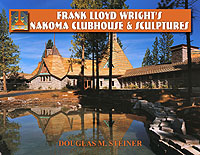
"Frank Lloyd Wright's Nakoma Clubhouse & Sculptures." A comprehensive study of Wright’s Nakoma Clubhouse and the Nakoma and Nakomis Sculptures. Now Available. Limited Edition. More information.
HOME ARTIFACTS AUDIO BOOKS PERIODICALS PHOTOS POSTCARDS POSTERS STAMPS STUDIES ASSISTING ABOUT SLIDE SHOW To donate or pass on information, comments or questions:
steinerag@msn.com
©Copyright Douglas M. Steiner, 2001, 2026