|
|
|
|
Introduction Presentation
Drawing Drawings
Window Designs
Historic Photographs
Destruction
Replaced
Track Map
Related Items
Related Books |
|
|
|
|
|
Introduction |
|
|
|
|
Little has been written, and I
have to admit, I knew nothing about the short lived Stohr
Arcade. So when I stumbled upon a photograph, I was
surprised and intrigued. I thought I was aware of most of
Wright's work.
Peter C. Stohr (1859-1912) was born in New
York City in 1959. In 1890, at the age of 31, he married
Julia A. Collins. She was born in 1862 in Toledo, Ohio, the
daughter of Jasper P. Collins and Mary A. Collins. Peter
began is career in the railway business as an office boy for
the Rock Island Railroad. In 1887, he was a General Eastern
Agent for the Minnesota and Northwestern Railroad Company
(1). By 1891, Peter was an officer for the
Chicago, St. Paul & Kansas City Railway, working as a
General Freight Agent in Chicago, Illinois (2).
In 1892, the railroad was reorganized under the name of
Chicago Great Western Railway. By 1895 he had relocated to
the St. Paul office where at the age of 36, a daughter was
born. Julia B. Stohr became a well known landscape and
portrait artist. (JB). In 1897 Peter
continued as an officer with the Chicago Great Western
Railway as a General Freight Agent in the St. Paul office
(3). From 1899 to 1904 the Stohrs lived at 502
Grand Hill, St. Paul, Minnesota
(502). By 1901
Peter had been promoted to Traffic Manager in the St. Paul
office as an officer with the Chicago Great Western Railway
(4).
In 1905 the Stohrs moved back to Chicago
when he was hired by Edward H. Harriman as an Assistant
Traffic Manager for the Southern Pacific Company, the Union
Pacific System, and Oregon Short Line Railroad
(5).
Harriman controlled the Union Pacific, the Southern Pacific,
the Saint Joseph and Grand Island, the Illinois Central, the
Central of Georgia, the Pacific Mail Steamship Company, and
the Wells Fargo Express Company, among other things. In
1906, Stohr was one of three men considered for the
promotion to Traffic Manager (Second Vice President), second
only to Mr. Harriman (6). He was not
promoted, and continued as Assistant Traffic Manager with
the Harriman organization until his death in 1912
(7).
It is hard to imagine today, the city
expanding North "toward" the corner of Wilson and
Evanston (Broadway), which is just a few blocks West
of Lincoln Park. But at the turn of the century, Wilson was
the end of the line. In 1900, the Northwestern Elevated
Railroad ended at Wilson Avenue. Farms could still be seen
from the elevated platform. The population continued to
expand North, and in 1908 the track was extended to meet the
demand. With Peter’s involvement with the railway, and
knowledge of the property involved, he saw an opportunity in
a piece of property which was most likely owned by the
railroad. In 1908 he signed a 35 year leased for the 120 by
320 foot triangular site and set out to improve the site
with stores and offices. There were many challenges, not the
least of which was the fact that a great part of the
property lay under the elevated tracks. Not much is known
about Stohr’s knowledge or relationship to Wright, but
working for one of the wealthiest businessmen in the
country, and coming in contact with men of that caliber, it
is hard to image that Wright’s name did not come up.
Like many, he may have admired Wright’s work at the time.
The Unity Temple, Oak Park, 1904. The Rookery Building,
Interior, Chicago, 1905. The Robie Residence, Chicago, 1906.
The Coonley Residence, Riverside, 1907. Browne's Bookstore,
Chicago, 1908. The City National Bank and Park Inn Hotel,
Mason City, IA 1909. These are just a few of the more
prominent buildings that Stohr might have seen and known
about.
Not only was it a
triangular piece of property, but a majority of the property
was situated under the elevated tracks. Wright |
|
had to incorporate the steel
girders from the tracks above. He took advantage of the
Southeast corner which came out from under the tracks, and
designed a three story section. The length of the building
consisted of a row of shops and offices that opened up into
a Mezzanine. Hence, the Stohr Arcade. The second floor
design, is almost reminiscent of the Gale Residence (1904,
Oak Park, S.098), and the third floor is consistent with
Wright’s Oak Park Prairie style designs. The flat roof was
reinforced concrete. The chimney extends twelve feet above
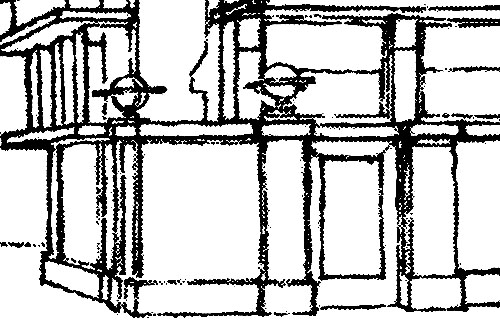
the roof line. Wright designed large geometric vases
placed atop integrated pedestals, and continuous window
boxes for planting. He also designed cube and sphere
lighting fixtures that topped integrated pedestals at the
corner entrance. There exists no photographic evidence that
the vases were ever added, but a form of the light fixtures
were installed above the Southeast corner on the roof of the
first level as designed.
There are design themes that are
reminiscent of the Robie House designed three years earlier
(S.127) (1906). The proposed vase is the same as the Robie
House vase. One design for the entrance light fixtures are a
variation of the Robie House Living Room fixtures, but
mounted at the bottom instead of the side. No
cantilevered roof, but the building is anchored to the
ground by placing it on an enlarged concrete base.
There are consistent horizontal bands, and the third floor
is offset in much the same way. There is a row of
horizontal windows directly below the roof on the third
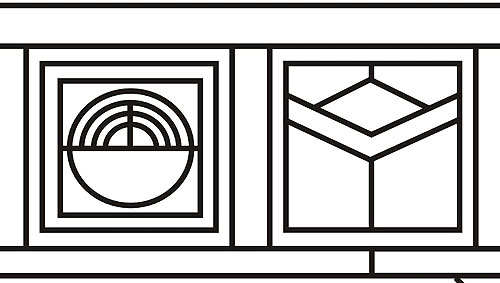
floor. And one of the proposed window concepts is an
adaptation of the geometric design of the Robie windows.
The most unique elements of this design are
the second floor windows. Like the Zimmerman Living Room
windows, this design is never used again. Although there are
a few examples of semi circular windows and many arched
doorways, the vast majority of windows were always
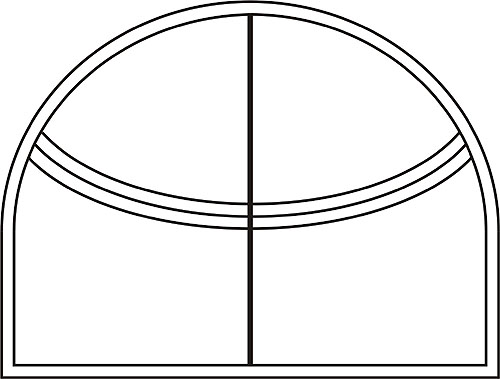
rectangular. The second floor window design consisted of
large windows topped by an arched circular curve. The glass
was divided vertically by a single mullion, and three
horizontally curved mullions. It was not until 1948 in the
Sol Friedman Residence (S.316) that he designed curved
windows. And again in 1956, a variation with the
Annunciation Greek Orthodox Church (S.399).
This may be the first example of Wright's
use of mitered corners. The street level has at lease two
visible examples. Wright designed many corner windows up to this point, but never mitered corners.
He expanded the use of mitered corners in the Freeman
Residence (S216) (1923). They became
prevalent, almost a trade mark in his later work. When
Wright left for Europe, he turned over the responsibility of
finishing the work on the Stohr Arcade on September 22, 1909
to Herman Von Holst who worked in his office
(9).
Just three years after the Stohr Arcade was
completed, obituaries reported on April 25, 1912 that after
a weeks illness Peter C. Stohr passed away in his home
(7). He was at the early age of 53. The Chicago
Blue Book of 1912 listed his address at the time as 1367 N.
State Street in Chicago (8).
During the late teens or very early 1920s,
an addition was added to the Southeast corner. The
addition can be seen in the December 1922 photographs of the
demolition. It enclosed the mitered glass corner, the
glass light fixtures and incorporated a new clock. Sadly in
1922, just 13 years after it was built, the Peter C. Stohr
Arcade Building was demolished to make way for expanded
service. It was replaced by a "White City" styled station.
Text by Douglas M. Steiner, Copyright
May 2009 |
|
|
|
|
|
|
|
|
|
Stohr Arcade Building
Presentation Drawing, 1909 |
|
|
|
|
|
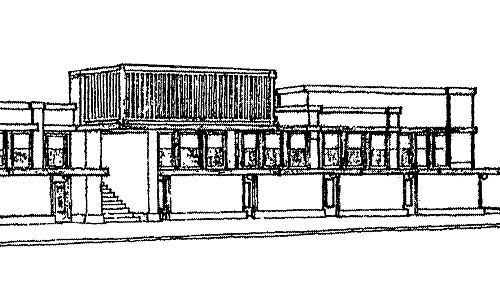
Not only was it
a triangular piece of property, but a majority of the
property was situated under the elevated tracks. Wright had
to incorporate the steel girders from the tracks above. He
took advantage of the Southeast corner which came out from
under the tracks, and designed a three story section. The
length of the building consisted of a row of shops and
offices that opened up into a Mezzanine. Hence, the Stohr
Arcade. The second floor design, is almost reminiscent of
the Gale Residence (1904, Oak Park, S.098), and the third
floor is consistent with Wright’s |
|
Oak Park Prairie style designs.
The flat roof was reinforced
concrete. The chimney extends twelve feet above the roof
line. Wright designed large geometric vases placed atop
integrated pedestals, and continuous window boxes for
planting. He also designed cube and sphere lighting fixtures
that topped integrated pedestals at the corner entrance.
There exists no photographic evidence that the vases were
ever added, but a form of the light fixtures were installed
on the Southeast corner on the roof of the first level as
designed. |
|
|
|
|
|
|
|
|
|
|
Stohr Arcade Building
Drawings, 1909 |
|
|
|
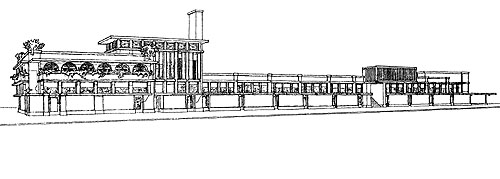
Proposed Drawing
Drawing of Completed Building |
|
|
|
The Stohr Arcade was a
beautifully designed building. There are design themes that are
reminiscent of the Robie House designed three years earlier
(S.127) (1906). The proposed vase is the same as the Robie
House vase. One design for the entrance light fixtures are a
variation of the Robie House Living Room fixtures, but
mounted at the bottom instead of the side. No
cantilevered roof, but the building is anchored to the
ground by placing it on an enlarged concrete base.
There are consistent horizontal bands, |
|
and the third floor is offset in much the same way. There is a row of
horizontal windows directly below the roof on the third
floor. And one of the proposed window concepts is an
adaptation of the geometric design of the Robie windows. The
chimney extends twelve feet above the roof line.
Illustrations were drawn from originals by Douglas M. Steiner and are a close
representation. |
|
|
|
|
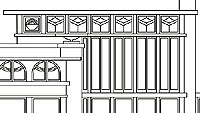
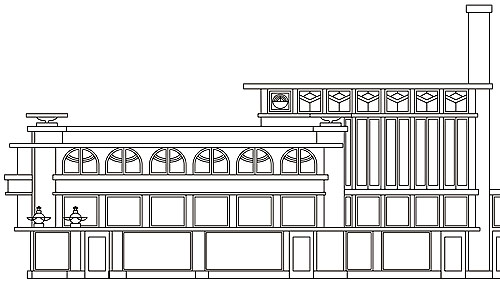
Proposed Drawings of
the Peter C. Stohr Arcade |
 |
|
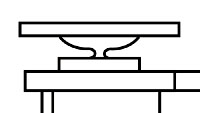
Proposed design elements:
The proposed vase for the Stohr Arcade is the same as the Robie
House vase. The building is anchored to the
ground by placing it on an enlarged concrete base. There is a row of
horizontal windows directly below the roof on the third
floor. And one of the proposed window concepts is an
adaptation of the geometric design of the Robie windows. The
chimney extends twelve feet above the roof line. |
|
|
|
|
|
See additional illustrations. |
|
|
|
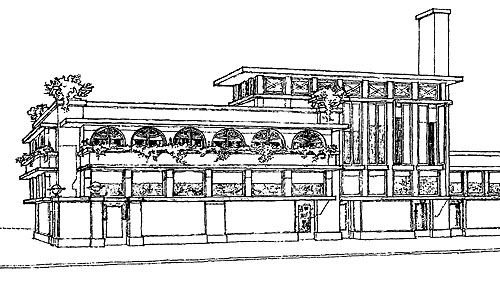
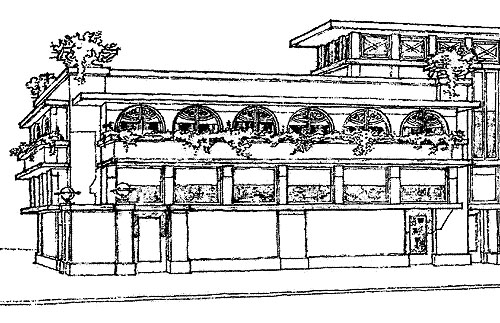
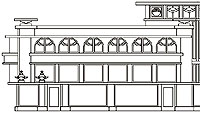
Drawings of the
Completed Peter C. Stohr Arcade |
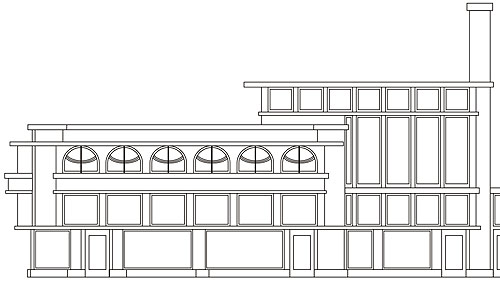 |
| Actual design
elements: There exists no photographic evidence that vases were
ever added, but a form of the light fixtures were installed on the
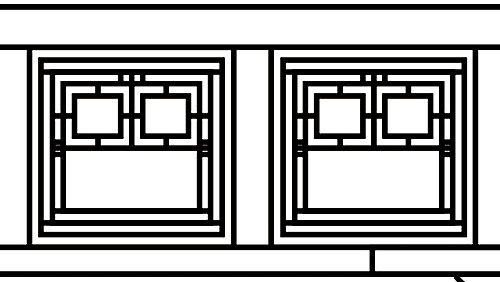
Southeast corner on the roof of the first level as designed. Most of
the decorative windows were eliminated, possibly due to cost
constraints, but the arched windows were installed.. The chimney
extends twelve feet above the roof line. |
| |
|
Illustrations were drawn from
originals by Douglas M. Steiner and are a close representation.
Copyright 2009. |
|
|
|
|
|
|
|
|
Historic Photographs
of the Stohr Arcade Building |
|
|
|
|
|
Not only was it a triangular
piece of property, but a majority of the property was
situated under the elevated tracks. Wright had to
incorporate the steel girders from the tracks above. He took
advantage of the Southeast corner which came out from under
the tracks, and designed a three story section. The length
of the building consisted of a row of shops and offices that
opened up into a Mezzanine. Hence, the Stohr Arcade. The second floor
design, is almost reminiscent of the Gale Residence (1904,
Oak Park, S.098), and the third floor is consistent with
Wright’s
|
|
Oak Park Prairie style designs.
The flat roof was reinforced concrete. The chimney
extends twelve feet above the roof line. Wright designed
large geometric vases placed atop integrated pedestals, and
continuous window boxes for planting. He also designed cube
and sphere lighting fixtures that topped integrated
pedestals at the corner entrance. There exists no
photographic evidence that the vases were ever added, but a
form of the light fixtures were installed above the
Southeast corner on the roof of the first level as designed. |
| |
|
Stohr Arcade Building Circa
1914 |
 |
|
Courtesy of the Krambles-Peterson Archives |
|
|
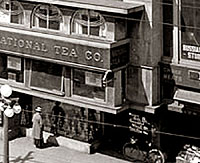
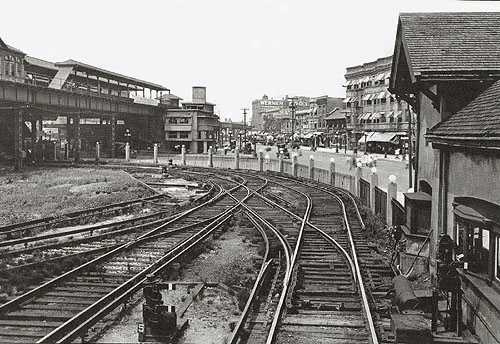
View looking North down Evanston
(Broadway). Just a few years after the building has been
completed. Wright took advantage of the Southeast corner
which came out from under the tracks, and designed a three
story section. |
| |
 |
|
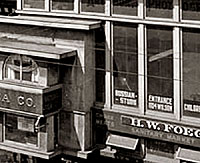
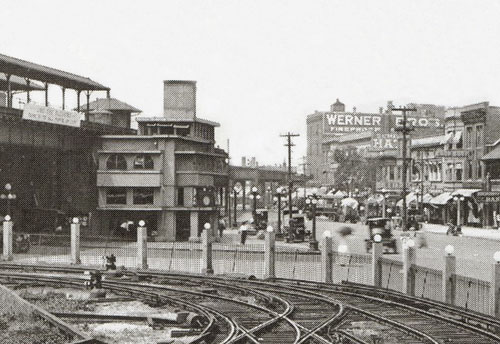
Detail of above image. View
looking North down Evanston (Broadway). Wilson Avenue runs
East and West. Just a few years after the building has
been completed. Wright took advantage of the Southeast
corner which came out from under the tracks, and designed a
three story section. |
| |
|
Stohr Arcade Building Circa
1917 |
 |
|
Courtesy of the Chicago Historical Society |
|
|
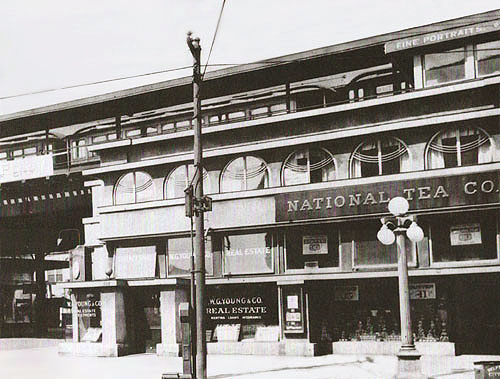
Viewed from the Northeast. A
form of the light fixture Wright designed is visible above
the Southeast corner on the roof of the first level. Large
windows at the top of the first floor allow light into the
interior and swing open at the bottom allowing air to
naturally cool the building. The second floor window design
consisting of large arched curves which were unique only in
this Wright building. |
| |
 |
|
Courtesy of the Krambles-Peterson Archives |
|
|
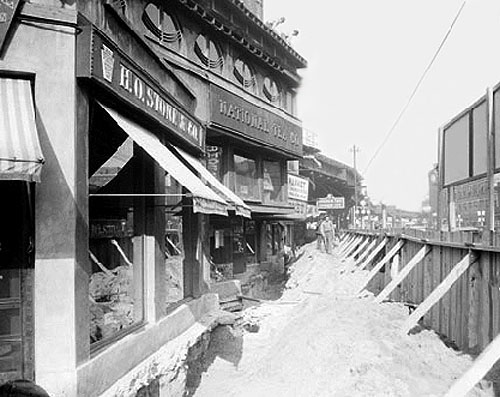
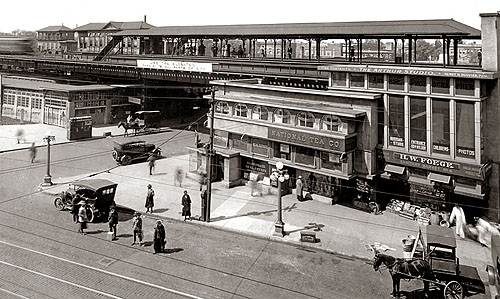
Viewed from the Northeast. On
the far left, the Southeast corner of the street level, the
mitered glass corner is visible. This may be the first
example of Wright's use of mitered corners. The street level
has at lease two visible examples. The large sets of
vertical windows on the right cover two floors. |
|
|
|
See Additional details. |
|
Text by Douglas M. Steiner, Copyright
2009 |
|
|
|
|
|
|
|
|
Destruction
of the Stohr Arcade Building
1922 |
|
|
|
|
|
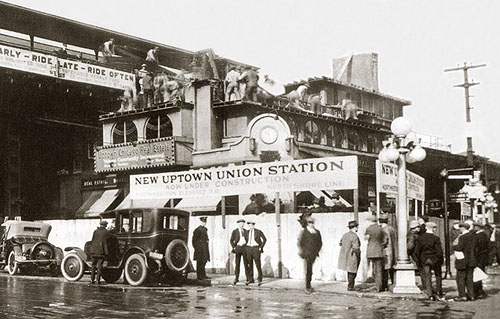
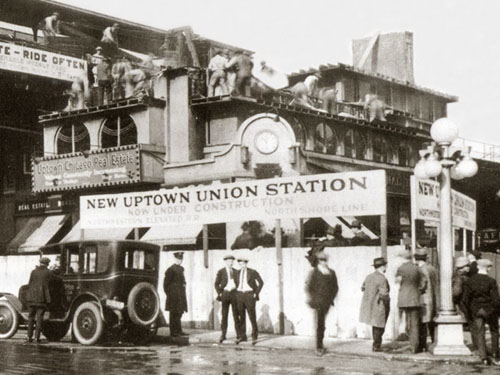
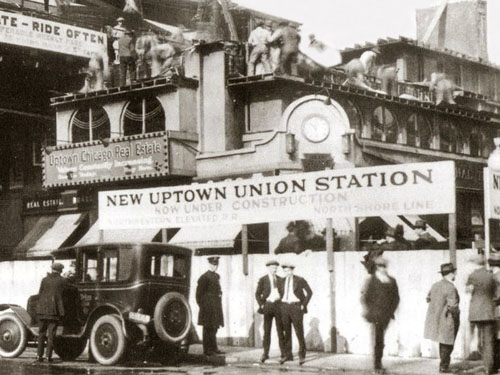
During the late teens or very
early 1920s, an addition was added to the Southeast corner.
The addition can be seen in the December 1922 photographs of
the demolition. It enclosed the mitered glass corner,
the glass light fixtures and incorporated |
|
a new clock.
Sadly in 1922, just 13 years after it was built, the Peter
C. Stohr
Arcade Building was demolished to make way for expanded
service. It was replaced by a "White City" styled station. |
|
|
The Stohr Arcade Building
Replaced 1923 |
|
|
|
|
|
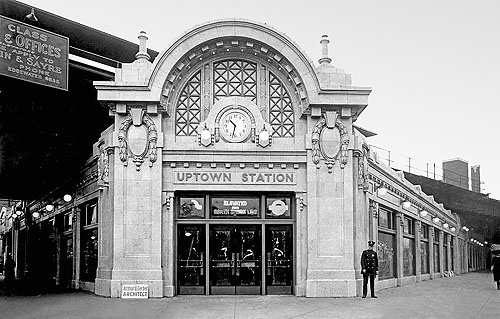
Sadly in 1922, just 13 years
after it was built, the Peter C. Stohr
Arcade Building was demolished to make way for expanded
|
|
service. It was replaced by a "White City" styled station
designed by architect Arthur U. Gerber. |
|
|
 |
|
Courtesy of the Krambles-Peterson Archives |
|
| View
looking North down Broadway. Just 13 years after it was
built, the Peter C. Stohr
Arcade Building was demolished to make way for expanded
service. It was replaced by a "White City" styled station
designed by architect Arthur U. Gerber. |
| |
| |
| |
|
|
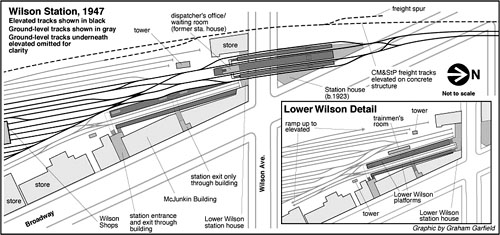
Wilson Station Track
Map 1947 |
 |
|
Courtesy of Fast & Faster |
|
|
Although this map depicts 1947, it is
a representation of where the building was located. |
|
|
|
|
|
|
|
|
Related
Items |
|
|
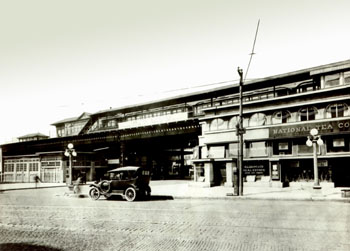 |
Date: Circa 1917
Title:
Peter C. Stohr Arcade Building, Chicago circa 1917 (1909 -
S.162).
Description:
Designed in 1909, it was demolished in 1922, just 13 years after
it was built. Viewed from the Northeast. A form of the light
fixture Wright designed, or what is left of it, is visible above
the Southeast corner on the roof of the first level. Large
windows at the top of the first floor allow light into the
interior and swing open at the bottom allowing air to naturally
cool the building. The second floor window design consisting of
large arched curves which were unique only in this Wright
building. Courtesy of the Chicago Historical Society.
Size:
10 x 7 B&W photograph.
S#: 0138.09.0115 |
|
|
|
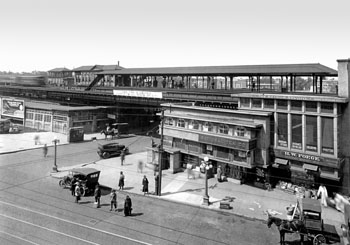 |
Date: Circa 1917
Title:
Peter C. Stohr Arcade Building, Chicago circa 1917 (1909 -
S.162).
Description:
Designed in 1909, it was demolished in 1922, just 13 years after
it was built. Viewed from the Northeast. On the far left, the
Southeast corner of the street level, the mitered glass corner
is visible. The second is in the center, just to the right of
the gentleman window shopping. This may be the first example of
Wright's use of mitered corners. A form of the light fixture
Wright designed is visible above the Southeast corner on the
roof of the first level. The large sets of vertical windows on
the right cover two floors. The large vertical plate glass
windows are nearly twelve feet high. Courtesy of the Krambles-Peterson
Archives.
Size:
10 x 7 B&W photograph.
S#: 0138.10.0115 |
|
|
|
|
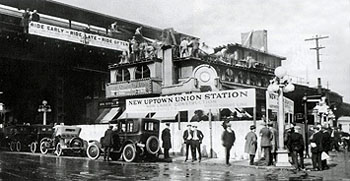 |
Date: 1922
Title:
Peter C. Stohr Arcade Building, Chicago 1922 (1909 - S.162).
Description:
Designed in 1909, it was demolished in 1922, just 13 years after
it was built. During the late teens or very early 1920s, an
addition was added to the Southeast corner. It enclosed the
mitered glass corner, the glass light fixtures and incorporated
a new clock. Courtesy of the CTA Collection.
Size:
10 x 5 B&W photograph.
S#: 0147.08.0115 |
|
|
|
|
|
|
|
|
|
|
Related Books |
|
|
| (1)
"New York Times" October
13, 1887 |
| (2)
"The 1891 Grain Dealers and Shippers Gazetteer" Chicago, St.
Paul & Kansas City Railway System, Officers: P. C. Stohr, Title:
General Freight Agt., Chicago, Ill. |
| "The Official
Railway List; a Complete Directory" Page 59, P. C.
Stohr , General Freight Agt., Chicago, Ill. |
| (3)
"Annual Report of the Railroad and Warehouse
Commissioners of the State of Missouri, 1897" Letter A) St.
Paul, Minn., March 16, 1897, P.C. Stohr, G.F.A, Letter B) March 27,
1897, P. C. Stohr, General Freight Agent. |
| "Annual Report
of the Board of Railroad Commissioners, for the Year Ending 1898",
Chicago Great Western Railway Company, Officer: P. C. Stohr,
General Freight Agent, St. Paul, Minn office. |
| (4)
"Annual Report of the Railroad and Warehouse Commission of the
State of Illinois For 1901" Page 28, 225. Chicago Great
Western Railway Company, Officer: P. C. Stohr, Traffic Manager, St.
Paul, Minn office. |
| "Report of the
Board of Railroad Commissioners, State of Kansas, for the year
ending 1902" (Same for 1903 & 1904), Page 13,
Chicago Great Western Railway Company, Officer: P. C. Stohr, Traffic
Manager, St. Paul, Minn. office. |
| (5)
"Poor's Directory of Railway Officials" Page 71, Southern
Pacific Company, Assistant Traffic Director: P.C. Stohr, Chicago,
Ill. And Page 78, Union Pacific System, Oregon Short Line RR,
Assistant Traffic Director: P.C. Stohr, Chicago, Ill. |
| (6)
"New York Times" Nov
16, 1906 (PDF) |
| "Annual Report
of the Board of Railroad Commissioners for the Year Ending 1907"
Page 209, Board of Railroad Commissioners, Officers: P.C. Stohr,
Assistant Traffic Director, Chicago, Ill. |
| "Reports of the
Railroad and Public Service Commissions of Nevada" Page 140,
Southern Pacific Company, Assistant Traffic Director: P.C. Stohr,
Chicago, Ill. |
| "Railway age
gazette" page 857. PC Stohr, Assistant Director of Traffic
of the Southern Pacific company, the Union Pacific, the Oregon Short
Line and the Oregon-Washington Railroad & Navigation Company, will
continue to have his office at Chicago, while the director of
traffic has had his office moved to New York City, as has been
announced in these columns. |
| (7)
"New York Times"
Obituary, April 26, 1912 |
| (8)
"The Chicago Blue
Book" of 1912, Page 271-272, Mr. & Mrs. Peter C. Stohr
& daughters, 1367 North State Street. |
|
"The
Nature of Materials: 1887 - 1941",
Hitchcock, 1942, page 53. |
|
"Frank Lloyd Wright
to 1910, The
First Golden Age"
Manson, 1958, pages 168-169. |
|
"Frank Lloyd Wright Monograph 1907-1913",
Vol. 3, Text: Pfeiffer, Bruce Brooks; Edited and Photographed: Futagawa,
Yukio, 1987, pages 124-125. |
| "The Frank Lloyd Wright Companion", Storrer, William Allin,
1993, page 165. |
|
"Frank Lloyd Wright
Architect", Riley, Reed, Alofsin, Cronon, Frampton,
Wright, 1994, page 163. |
|
"Lost
Wright",
Lind, 1996, page 142-143. |
| (9)
"Frank
Lloyd Wright - The Lost Years"
Alofsin, 1998, page 312. |
|
|
|
|
|
|
|
|

CLICK TO ORDER