- Wright Studies
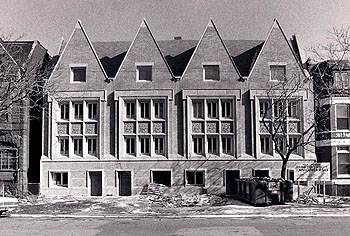
- Robert W. Roloson Rowhouses, Chicago, IL (1894) (S.026)
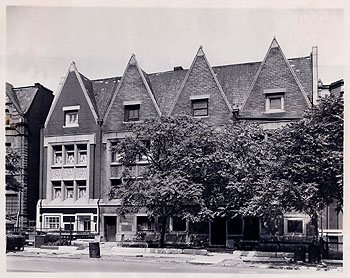
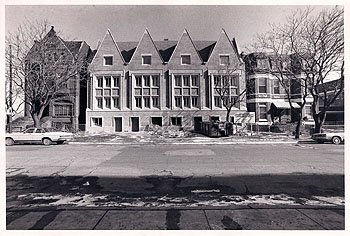
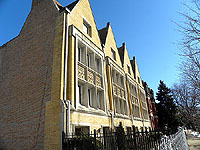
Robert W. Roloson was a successful grain merchant, a member of the Chicago Stock Exchange, and Director of the Diamond Match Company according to Eaton. When he acquired property on Calumet Avenue in 1892 he asked Wright to design the rowhouses. Robert’s son, Robert Marshall was married to Edward C. Waller Sr.’s daughter. Waller Sr. was very involved with Wright (S.030, 031, 047, 065, 066, 166), and Waller Jr's involvement included Midway Gardens (S.180). Whether Waller influence Roloson’s selection of Wright, or visa versa, Roloson was first to use Wright. In 1893 after Sullivan discovered that Wright was “bootlegging”, Wright left Sullivan’s office.
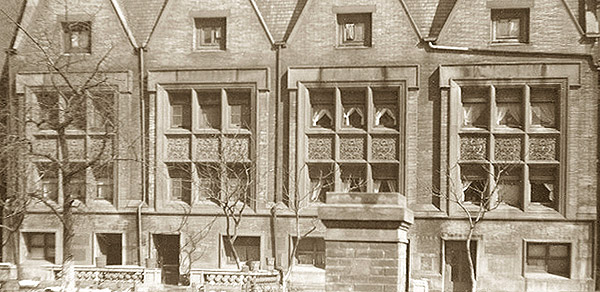
By the late 30s these houses had long been forgotten as Wright's work. They were rediscovered in 1940 when Grant Manson "happened upon them while driving along Calumet Avenue looking for some early Adler and Sullivan buildings".
But there is some confusion as to whether Wright designed and built the four homes, or simply remodeled them.
Henry-Russell Hitchcock, "In The Nature of Material" Page 108, says they were "Remodeled as apartments".
In "Frank Lloyd Wright to 1910, The First Golden Age", 1958, page 69-70, Manson wrote: ...the Roloson houses were “...an executed design...”; “The commission to design the houses...”; “The idea of erecting four identical row houses...”. He concludes “From the premise onward, however, all is Wright”.
“Robert W. Roloson Houses” 1979, page 2, Barton wrote: “In 1892, Roloson acquired a react of land on Calumet Avenue just south of 32nd Street. When, in 1894, he decided to improve this property with the addition of four single-family dwellings, he asked Frank Lloyd Wright to design them.”
"Frank Lloyd Wright Monograph 1887-1901" Vol. 1, 1991, page 55: Pfeiffer indicates that Roloson purchased a group of four row houses and commissioned Wright to remodel them.
In "The Frank Lloyd Wright Companion" 1993, page 25, Storrer wrote “Roloson purchased four rowhouses and Wright remodeled them.” I had the opportunity to contact Dr. Storrer and ask if he discovered additional information that indicated the buildings were preexisting and if Wright only remodeled them? In August of 2008, he responded, “In simple terms, no. As far as I can know, they were designed from scratch. The property Roloson wanted to improve, though I have no specific location, was apparently another property.” WA Storrer.
"Frank Lloyd Wright, American Architect for the Twentieth Century", 1993, page 36. Sommer writes "Roloson wanted to improve his property... and increase the income from it."
"Frank Lloyd Wright", 1997, page 232. McCarter indicates that this design was "for four houses remodeled for Robert Roloson..."
"Frank Lloyd Wright's Chicago", O'Gorman, 2004, page 66. "After Roloson purchased them, he asked Wright to oversee their renovation."
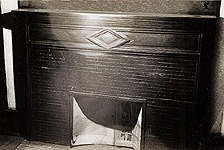
Each home was approximately 3,000 square feet. After the turn of the century, the Douglas Community began to decline and after just a few short years, the Roloson Houses were subdivided and used as apartments. Even though listed on the National Register of Historic Places in 1977 (#77000479), changing neighborhoods, neglect, misuse, and fire have greatly altered the interior.
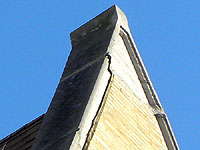
In the early 1890's Wright began experimenting with his Prairie style on the interiors of the homes he designed. 1893 Wright designed the Mendota Boathouse (S.022) his first Prairie styled structure. One year later Wright designed his first Prairie styled home, the Winslow Residence (S.024). There are many similarities between Winslow and Roloson. He even designed one option for the Roloson houses without Gables, giving Roloson a Prairie styled option (Monograph, page 56). But there are also design element similarities that are visible in some of his other work: Charnley (1891); Winslow (1894); Moore (1895); Heller (1896); and others during that time period.
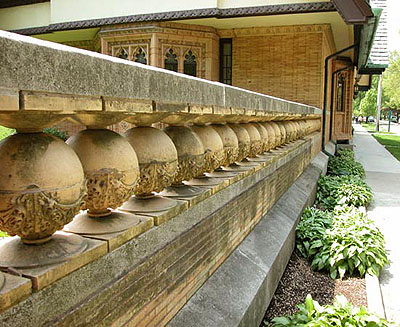
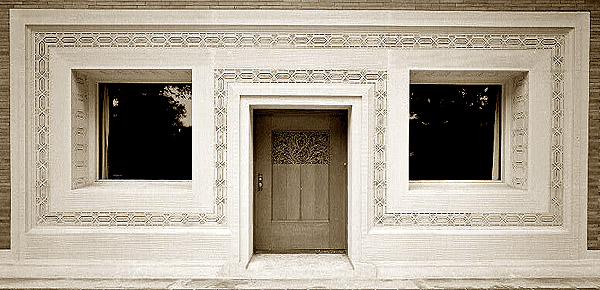
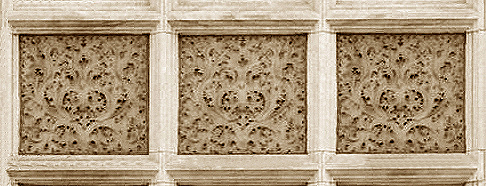
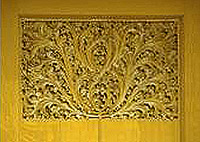
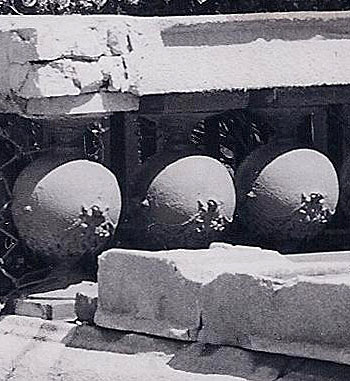
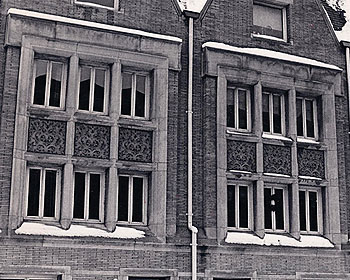
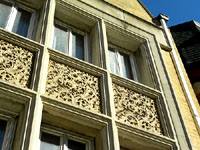
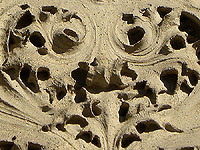
For five years (1888-93), Wright was Sullivan’s right hand. Some of the Sullivanesque details are visible in the terra-cotta spandrel between the second and third level windows and are similar to the panel in the Winslow front door (1984). The terra-cotta balusters are similar to those used in the Moore residence (1895). But there are other details that are “Wright” designs. The front doors are recessed and the limestone window casing are very consistent with the Winslow House. The interior woodwork trim and diamond patterned leaded glass windows are preludes to Wright’s Prairie styled homes.
After extensive examination, I would have to agree with Manson, Barton and Storrer’s response. There are far to many Wright details to consider this a remodel, and not a complete design.
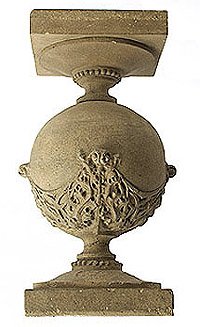
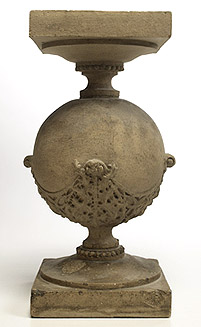
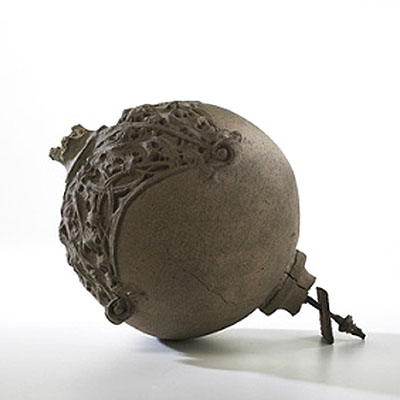
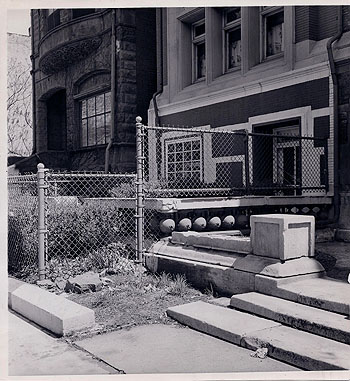
For additional information see the Roloson Baluster. Copyright August 2008ROLOSON & MOORE BALUSTERS ROLOSON & WINSLOW DESIGNS 1940 - 2010 MANSON PHOTOGRAPHS CIRCA 1940 LANE PHOTOGRAPHS CIRCA 1940-41 1961 1963 1981 1986 1987 2010 FLOOR PLAN BOOKS ARTICLES BALUSTER & PHOTOGRAPHS Roloson & Moore Balusters
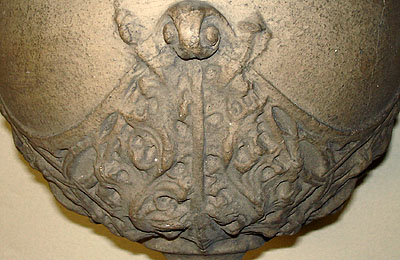
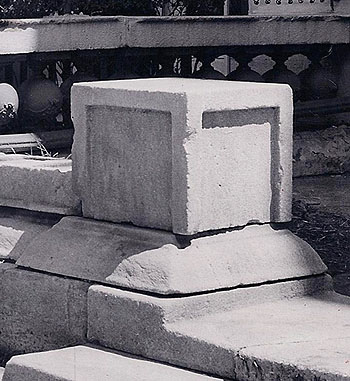
Comparing two Robert Roloson (1894) balusters on the left with the Nathan G. Moore Residence (1895) balusters on the right: A) Roloson Orbs are about 75% smaller than the Moore Orbs. B) Neck has pedestal and is much taller than Moore. C) Moore has horizontal center line.
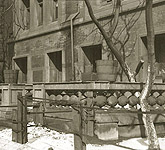
Robert Roloson Balusters Nathan G. Moore Residence Balusters Decorative Baluster from Roloson Houses
Decorative Baluster Detail Roloson & Winslow Designs
In 1894, Wright designed his first Prairie styled home, the Winslow Residence. There are many similarities between the Winslow Residence (S.024) and Roloson (S.026). He even designed one option for the Roloson houses without Gables, giving Roloson a Prairie styled option (Monograph, page 56).
Some Sullivanesque details are visible in the Roloson (1894) terra-cotta spandrel between the second and third level windows and are similar to the panel in the Winslow front door (1984).
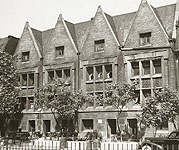
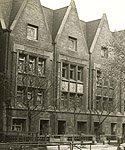
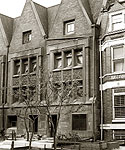
Roloson Rowhouses from 1940 - 2010 Photographs By Grant Carpenter Manson, Circa 1940
Grant Carpenter Manson (1904-1997). Architectural historian Grant Manson first met Mr. Wright in 1938. He had decided to make Wright the subject of his doctoral dissertation while at Harvard. He felt it essential to meet Wright and so in September he headed toward Spring Green from Massachusetts. Upon reaching Chicago, he placed a call to Spring Green and asked the operator “to put him through to Mr. Wright”. He heard his voice for the first time. Manson took photographs between 1937 and 1941 while researching for his doctoral dissertation titled “Frank Lloyd Wright's Work Before 1910". While a professor at the University of Pennsylvania, he elaborated his thesis and published his book “Frank Lloyd Wright to 1910: The First Golden Age" in 1958.
Upon publication, Manson hand delivered a copy of the book to Wright in New York.
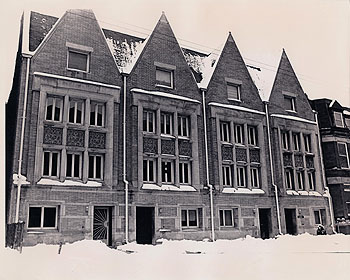
Manson “rediscovered” the Roloson Rowhouse in 1940 when he "happened upon them while driving along Calumet Avenue looking for some early Adler and Sullivan buildings". This collection of photographs are courtesy of the Oak Park Public Library, Grant Manson Collection. My assumption is that he photographed these in the winter upon discovering them, and then went back in the summer to photograph them again, or visa versa.
These images by Manson and Gilman are an invaluable record and are the most complete and only historic record of Wright's Roloson Rowhouses. Continued...
Grant Manson images courtesy of the Oak Park Public Library, Grant Manson Collection. Text by Douglas M. Steiner, Copyright 2008 Roloson Rowhouses from 1940 - 1987
Photographs By Gilman Lane, Circa 1940-01
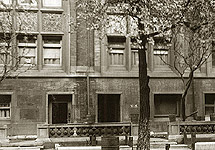
Little can be found about Gilman Lane. He photographed building in the Chicago area including many of Wright’s work. His photographs were given to the Oak Park Public Library after his death in 1961. These Lane images were photographed after the Manson images, but at the most a year or two. If you look at image #2 from both collections, you will notice that the tree
trunk painted white in the Manson image #2 has faded in the Lane #2. Other similarities include the size of the trees, the flower pots sitting on the balustrades are in the same place, the 55 gallon drums are still there. A minor change is the one house number 3215 on unit two that is visible in this set. Continued...
Gilman Lane images courtesy of the Oak Park Public Library, Gilman Lane Collection. Text by Douglas M. Steiner, Copyright 2008 Roloson Rowhouses 1961
Roloson Rowhouses 1963
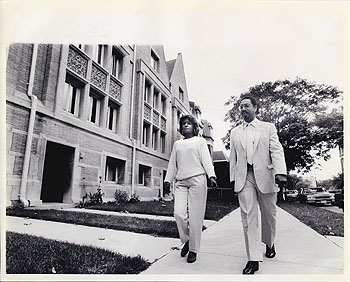
Roloson Rowhouses 1981
- Roloson Rowhouses (1981)
- Roloson Rowhouses Detail (1981)
Roloson Rowhouses 1986
Roloson Rowhouses 1987
- Roloson Rowhouses (1987)
- Roloson Rowhouses Detail (1987)
Exterior Photographs By Douglas M. Steiner, March 2010
On a rushed trip to Chicago with my daughter, five year old Grandson and three month old Grand- daughter, we had the opportunity to see the one hundred and sixteen year old Roloson Rowhouse. We flew into Midway Airport and had a few short hours before heading out. We visited the Field Museum for my Grandson and then headed for the Roloson Rowhouses.
Each home was approximately 3,000 square feet. After the turn of the century, the Douglas Community began to decline and after just a few short years, the Roloson Houses were subdividedand used as apartments. Changing neighborhoods, neglect, misuse, and fire greatly altered the interior.
By the late 30s these houses had long been forgotten as Wright's work. They were rediscovered in 1940 when Grant Manson "happened upon them while driving along Calumet Avenue looking for some early Adler and Sullivan buildings".
In 1961 as reported in the Chicago Daily News they stood "in the midst of a bad slum marked almost entirely for clearance. Will they too be cleared? Nobody knows." Continued...
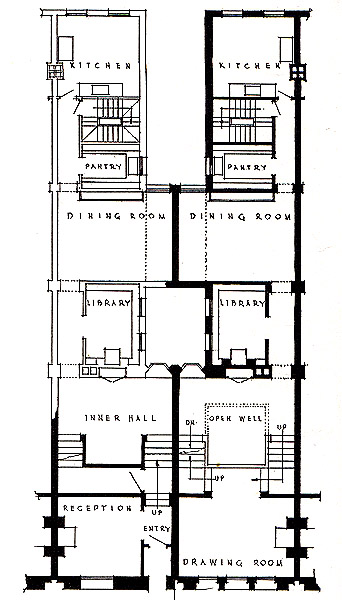
Roloson Rowhouses from 1940 - 2010 Roloson Rowhouses Balusters and Photographs Floor Plan Floor plan copyright "Frank Lloyd Wright to 1910, The First Golden Age", 1958, Manson, Grant, page 70. [flw/_Private/Navbar Be-mail.htm]