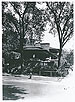
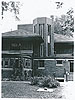
|
|
| YEAR |
DESCRIPTION |
ST# |
|
1930 |
C 1930
 |
Henry Justin Allen (1868-1950)
circa 1930 (1916 - S.205). Allen is facing slightly to the left, looking
slightly to the right. He was the 21st Governor of Kansas (1919-1923) and
U.S. Senator from Kansas (1929-31). He was involved in the newspaper
publishing business. In 1916, Allen commissioned Wright to design a home in
Wichita. A beautifully designed prairie styled home, it is the only Wright
designed home in Kansas. Hand written on face: "To Major Espy, With Regards,
Henry J. Allen." Signed: "Van Holsbeke." Original 6.5 x 8.5 B&W photograph. |
0249.44.0416 |
C
1930
 |
Hiram Baldwin Residence, Kenilworth,
Illinois, Circa 1930 (1905 - S.107). Not dated. View of the front of the
house from the West. The entrance is on the left, the semi-circular living
room is on the right. Designed in 1905 by Frank Lloyd Wright. The living
room is semi-circular with a square roof. Like the first
George Millard House
(1906) in Highland Park, the second level is cantilevered on both ends.
Another feature is the grille on the first level. Wright uses this design
element on either side of the living room, one of which conceals the entry
to the house, the entry to the porch, and also at the back of the house. The
balustrades are massive, much more so than when Wright used the concept for
the Stephen A. Foster Cottage
(1900). One unusual element designed by Frank Lloyd Wright is the decorative
motif to the right of the front door. Reflective of the art glass windows.
It also appears at the opposite end of the house. Photographed by Henry
Fuermann. Courtesy of the Art Institute of Chicago. 8 x 10 B&W photograph. |
0249.61.0722 |
Circa 1930
 |
Aline Barnsdall Hollyhock House
Terrace (1917 - S.208) Circa 1930-35. Hand written on verso: "Terrace of
California Club by Frank Lloyd Wright whose architectural exhibition is now
at Art Institute." The City of Los Angeles was approached by Aline Barnsdall
to manage part of her estate at Olive Hill as a cultural arts centre. In
1926 the City of Los Angeles agreed to manage eight acres of the Hollywood
estate. Part of the ensuing negotiations between the City and Miss Barnsdall
included a provision that the California Art Club would be granted a
fifteen-year lease on Hollyhock House. The California Art Club happily
accepted on August 31, 1927 and it remained the club's gallery and
headquarters from 1927 until 1942. For additional aerial images for dating
this photograph, see "Hollyhock
House and Olive Hill" Smith, pages 162-3 (1922) and 190-1 (1947).
Original 6.25 x 8 B&W print. |
0249.20.0310 |
C 1930
 |
1) Aline Barnsdall Residence A,
Circa 1930 (1920 - S.210). View of the North end of the West elevation. The
Living Room and Dining Room is on the first and second levels. The Dining
Room, top center, overlooks the two story Living Room. The large opening
leads to the basement and possibly a garage. The Entrance is to the far
right. Besides the main residence, Hollyhock House, the master plan also
included a Theater (project), this home, the (Theater) Director's House,
Residence A, and Residence B (demolished). Aline Barnsdall's Residence A was
designed by Frank Lloyd Wright in 1920. In 1927, Barnsdall donated an
additional 2 acres and Residence A to the City of Los Angeles, bringing the
total to 13 acres, 11 of which included Hollyhock House. (Note: Dating this
image circa 1930. The two trees on either side of the garage were just a few
feet tall in 1923.) These four photographs were A. D. White Architectural
Photograph Collection at the Cornell University Library. Andrew Dickson
White was the first President of the University. Courtesy of the Cornell
University Library. 10 x 7.75 B&W photograph. |
0249.42.1115 -1 |
C 1930
 |
2) Aline Barnsdall Residence A,
Circa 1930 (1920 - S.210). Partial view of the North end of the West
elevation. The Living and Dining Rooms are to the far left. The Dining Room
overlooks the two story Living Room. The Entrance to the home is in the
center, the Kitchen is above. (As far as dating the image, the tree to the
right of the Kitchen, which now reaches past the roof, was barely visible in
the 1923.) Besides the main residence, Hollyhock House, the master plan also
included a Theater (project), this home, the (Theater) Director's House,
Residence A, and Residence B (demolished). Aline Barnsdall's Residence A was
designed by Frank Lloyd Wright in 1920. In 1927, Barnsdall donated an
additional 2 acres and Residence A to the City of Los Angeles, bringing the
total to 13 acres, 11 of which included Hollyhock House. These four
photographs were A. D. White Architectural Photograph Collection at the
Cornell University Library. Andrew Dickson White was the first President of
the University. Courtesy of the Cornell University Library. 10 x 7.75 B&W
photograph. |
0249.42.1115 -2 |
C 1930
 |
3) Aline Barnsdall Residence A,
Circa 1930 (1920 - S.210). Partial view of the East elevation, from the
Northeast. Three Bedrooms are on the left, the two-story Living Room is on
the right. The Living room covers the whole North end of the house. Besides
the main residence, Hollyhock House, the master plan also included a Theater
(project), this home, the (Theater) Director's House, Residence A, and
Residence B (demolished). Aline Barnsdall's Residence A was designed by
Frank Lloyd Wright in 1920. In 1927, Barnsdall donated an additional 2 acres
and Residence A to the City of Los Angeles, bringing the total to 13 acres,
11 of which included Hollyhock House. These four photographs were A. D.
White Architectural Photograph Collection at the Cornell University Library.
Andrew Dickson White was the first President of the University. Courtesy of
the Cornell University Library. 10 x 7.75 B&W photograph. |
0249.42.1115 -3 |
C 1930
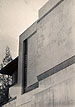 |
4) Aline Barnsdall Residence A,
Circa 1930 (1920 - S.210). Partial view of the North elevation, from the
Northwest. Five doors open outward onto a balcony on the left. Patterned
borders frame each two-story set of the windows and doors. The Living room
covers the whole North end of the house. Besides the main residence,
Hollyhock House, the master plan also included a Theater (project), this
home, the (Theater) Director's House, Residence A, and Residence B
(demolished). Aline Barnsdall's Residence A was designed by Frank Lloyd
Wright in 1920. In 1927, Barnsdall donated an additional 2 acres and
Residence A to the City of Los Angeles, bringing the total to 13 acres, 11
of which included Hollyhock House. These four photographs were A. D. White
Architectural Photograph Collection at the Cornell University Library.
Andrew Dickson White was the first President of the University. Courtesy of
the Cornell University Library. 10 x 7.75 B&W photograph. |
0249.42.1115 -4 |
1930
 |
Lucius M. Boomer, ceremonially
driving the first steel rivet of the new Waldorf Astoria, March 24, 1930
(1953 - S.261). Joining Boomer, left to right: Oscar Tschirky, Maitre de of
the new Waldorf Astoria, "Oscar of the Waldorf"; Lucius Boomer, President; Charles Hayden,
banker, Chairman of the Waldorf Astoria Board of Directors; and Augustus
Nulle, Secretary and Treasurer of the new $40,000,000 Waldorf Astoria. 9.3 x
7.5 B&W photograph.
For more information on the Boomer
Residence see our Wright Study. |
0249.40.1114 |
C 1930
 |
E. A. Cummings Real Estate
Office, circa 1930 (late 1920s - early 1930s) (1905 - S.112). Designed by
Frank Lloyd Wright in 1905, little is know about the building, and few
photographs exist. Broad overhanging eaves surrounds the building. Two
pedestals on either side of the entrance hold large prairie styled concrete
vases that appear to be round at the top, with four square legs setting on a
square base. The two high walls that floated out from the front corners with
ends attached to pedestal have been removed. Edmund Augustus Cummings was
born in Lowell, Mass on Nov. 29, 1842. When he was a boy, his family moved
to Elgin, Ill. He enlisted as a soldier in the war in 1860 at 18 years of
age and served with General Grant. After the war, he moved to Chicago in
1864, working in the insurance and real estate business. He married Ellen M.
Merrill in Chicago on Sept. 11 1867. In 1869 he formed the firm of E.A.
Cummings & Co. He was very successful in the real estate business,
considered one of the most successful at the time, creating as many as 250
subdivisions. He was one of the organizers of the Chicago Real Estate Board
and was for a time president of the board. He was a founder and director of
the Chicago Title and Trust, and vice president of the Avenue Trust and
Savings Bank. He retired after being a realtor...
Continue... |
0249.41.0215 |
C
1930
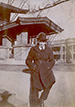 |
Dana Residence, Springfield, Illinois, Circa
1930 (Not Dated) (1902 - S.072). View of the Dana Residence entrance from
the South. An unidentified dapper young man is dressed in a top hat and
overcoat. The Dana residence was designed by Frank Lloyd Wright in 1902. The
building in the background on the right was demolished and is now a parking
lot for the Dana Residence Tours. This photograph was removed from a
scrapbook. Original 2.25 x 3.25 B&W photograph. |
0249.72.1024 |
C
1930
 |
Dr. Allison W. Harlan House, Chicago,
Illinois, Circa 1930 (1892 - S.018). View of the Harlan House from the
Southeast. Note: The Ryerson and Burnham Archives, Art Institute of Chicago,
dates this photograph from the 1940s. The lot on the left is vacant, the
apartment building on the right has been built. The balconies are intact,
and this was taken before the Gilman Land phonograph dated 1935-40 by the
same library. The balcony planters have been removed. Designed in 1892 while
Frank Lloyd Wright still worked for Louis Sullivan, it is considered one of
Wright's "bootlegged" houses. There are two cantilevered balconies, one that
runs the length of the front of the house, and a shorter balcony on the
South elevation. The face, side and possibly the base of the balcony is
covered in Sullivanesque panels, and the front balcony is topped with
planters. Just below the roof line is another simplified cut-out design,
which is repeated in the dormer above. The entrance is reached on the left
side of the house. Stairs lead up to a hall that is open on the second
floor. The Library is straight ahead, Living Room to the right, Dining and
Kitchen to the left. Five sets of floor to ceiling doors (and or windows) in
the Living Room open to an enclosed Terrace. A side entrance is seen on the
left. Over time, the front balcony was...
Continue... |
0249.55.0420 |
C
1930
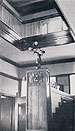 |
Dr. Allison W. Harlan House, Chicago,
Illinois, Circa 1930 (Not Dated) (1892 - S.018). View of the interior hall
of the Harlan House from the North. Published in
Frank Lloyd Wright To 1910. Caption:
"Fig. 41. Newel post and stair well in the Harlan house. The ornament carved
into the wood is Sullivanesque. The "˜lightolier" atop the newel post cannot,
needless to say , be ascribed to Wright." The Living Room is to the far
left. Stairs on the left side of the Newel post lead down to the entrance.
The door in the lower left is the interior front door. The stairs on the
right lead to the second floor. The screen behind the newel repeats the
newel design. The hall is open to the second floor. The balustrade, made up
of vertical spindles, runs around the upper level. The semi-circular window
in the stair well can be seen through the spindles. Photographer unknown.
Published in Frank Lloyd Wright To 1910, Manson, 1958, p.59. Not dated. Copy
6 x 10 B&W photograph. |
0249.56.0420 |
C
1930
 |
Dr. Allison W. Harlan House, Chicago,
Illinois, Circa 1930 (Not Dated) (1892 - S.018). View of the Southwest
corner of the Living Room. A large mirror of the South wall reflects the
fireplace on the North side of the Living Room. Harlan livid in the house
from 1892 until 1904 when he moved to New York City. According to Manson,
"because of the clients inalterable determination to have twin parlors that
the architect later bisected this large front space with an inner
partition."
Frank Lloyd Wright To 1910, 1958,
p.59. Also seen in the reflection is the partition. The stairs down to the
entrance can be seen through the doorway, as-well-as the Sullivanesque panel
that tops the wall between the two stairways. Photographer unknown. Courtesy
of Rossita Byrne Sweeney. 10 x 6.5 B&W photograph. |
0249.57.0420 |
C
1930
 |
P. D. Hoyt Residence, Geneva, Illinois, Circa
1930s (1906 - S.120). View of the Hoyt Residence from the Southeast.
Designed by Frank Lloyd Wright in 1906. Similar to
S#142.29, but photographed during the
summer. The landscaping is mature. The Hoyt House is similar in design to
the Hunt and Stockman houses. In some respects a simplification of the
design used in Wright's "Fireproof"
House. Square in its footprint, it is constructed of stucco with wood trim.
The entrance is in the center of the front elevation and opens into the
living room. Unusual for Wright because he preferred concealing the
entrance. It appears very symmetrical in design. Another design element
unique to the Hoyt House is the letter "H" monogram repeated at the top
portion of every window. Wright emphasizes the vertical appearance with wood
strips that extend from the first to the second floors, and wrap around the
four corners. The trellis-arbor originally above the front door that
surrounds the entrance was removed in 1917. It was replace by a small roof
which is visible. Photographed by Gilman Lane. Courtesy of the Oak Park
Public Library. 10 x 8 B&W photograph. |
0249.60.0121 |
Circa 1930
 |
Imperial Hotel, Circa 1930s.
Front View with reflecting pool in the foreground. Part of a set of at lease
seven images. This is image number seven. Acquired from Japan, and was part
of a scrap book. Original 3.8 x 2.7 B&W print. |
0249.22.1110 |
C
1930
 |
Francis W. Little Residence II, Northome,
Wayzata, Minn. Exterior View of Living Room Circa 1930 (1912 - S.173).
Exterior View of Living Room for the second Little residence. Viewed from
the Southwest. The Living Room is in the foreground, the Screened Pavilion
is in the background on the right. Designed by Frank Lloyd Wright in 1912.
Published in In The Nature of
Material, Hitchcock, 1942, Plate 200A. Text on sleeve: "Wright, F.
L. - Little, F Ho2, 4-2. Francis W. Little House II. Ext., view of living
room. Deephaven, MN, USA., 1912-13, 1972. Wright, Frank Lloyd. U of Virginia
FAIC." Acquired from the archives of the University of Virginia. 35mm Color
slide, sandwiched between glass, plastic mount. |
0249.58.0420 |
C
1930
 |
1) Isabel & Darwin Martin Residence
Graycliff, Derby, New York, Interior Circa 1930 (1927 - S.225-226). Interior
view of Graycliff living room with stick-and-reed armchairs, a Wright
designed end table and possibly the plant stand. The fireplace is in the
background along the Northeast end. There were three end tables visible
during our tour. One in the library and three in the living room. Designed
by Frank Lloyd Wright in 1927 for Isabelle Martin, the wife of Darwin
Martin. Graycliff was the second completed complex designed by Frank Lloyd
Wright for the Martin's. The first being the Martin House Complex in Buffalo
which included the Darwin Martin Residence (1904), the Barton Residence
(1903), and the Gardener's Cottage (1905).
Darwin Martin
communicated to Frank Lloyd Wright that this summer home was to bless his
wife, Isabel Martin. He wrote to Wright on May 5, 1926, "Your client is Mrs.
Martin... If a house is built, it is only for her pleasure and we must make
it a joy to her of the very planning and building..." On April 21, 1926,
Marting wrote to Wright again to "reduce the job to the barest simplicity...
the great desideration in floods of light and sunshine... and the appearance
of growth of the house from the soil...
Continue... |
0249.75.0925 |
C
1930
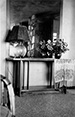 |
2) Isabel & Darwin Martin Residence
Graycliff, Derby, New York, Interior Circa 1930 (1927 - S.225-226). Interior
view of Graycliff library with a Frank Lloyd Wright designed table, setting
against the South wall. There were four of these tables visible during our
tour. One in the same place as this picture, one in the entrance hall, one
in the sun room and one in the dining room. Designed by Frank Lloyd Wright
in 1927 for Isabelle Martin, the wife of Darwin Martin. Graycliff was the
second completed complex designed by Frank Lloyd Wright for the Martin's.
The first being the Martin House Complex in Buffalo which included the
Darwin Martin Residence (1904), the Barton Residence (1903), and the
Gardener's Cottage (1905).
Darwin
Martin communicated to Frank Lloyd Wright that this summer home was to bless
his wife, Isabel Martin. He wrote to Wright on May 5, 1926, "Your client is
Mrs. Martin... If a house is built, it is only for her pleasure and we must
make it a joy to her of the very planning and building..." On April 21,
1926, Marting wrote to Wright again to "reduce the job to the barest
simplicity... the great desideration in floods of light and sunshine... and
the appearance of growth of the house from the soil...
Continue... |
0249.76.0925 |
C
1930
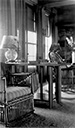 |
3) Isabel & Darwin Martin Residence
Graycliff, Derby, New York, Interior Circa 1930 (1927 - S.225-226). Interior
view of Graycliff living room with stick-and-reed armchairs and a Frank
Lloyd Wright designed table, setting on the North side of the living room.
There were four of these tables visible during our tour. One in the same
place as this picture, one in the entrance hall, one in the sun room and one
in the dining room. Designed by Frank Lloyd Wright in 1927 for Isabelle
Martin, the wife of Darwin Martin. Graycliff was the second completed
complex designed by Frank Lloyd Wright for the Martin's. The first being the
Martin House Complex in Buffalo which included the Darwin Martin Residence
(1904), the Barton Residence (1903), and the Gardener's Cottage (1905).
Darwin Martin communicated to Frank Lloyd Wright that this summer
home was to bless his wife, Isabel Martin. He wrote to Wright on May 5,
1926, "Your client is Mrs. Martin... If a house is built, it is only for her
pleasure and we must make it a joy to her of the very planning and
building..." On April 21, 1926, Marting wrote to Wright again to "reduce the
job to the barest simplicity... the great desideration in floods of light
and sunshine... and the appearance of growth of the house from the soil...
Continue... |
0249.77.0925 |
C
1930
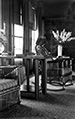 |
4) Isabel & Darwin Martin Residence
Graycliff, Derby, New York, Interior Circa 1930 (1927 - S.225-226). Interior
view of Graycliff living room with stick-and-reed armchairs and a Frank
Lloyd Wright designed table, setting on the North side of the living room.
There were four of these tables visible during our tour. One in the same
place as this picture, one in the entrance hall, one in the sun room and one
in the dining room. Designed by Frank Lloyd Wright in 1927 for Isabelle
Martin, the wife of Darwin Martin. Graycliff was the second completed
complex designed by Frank Lloyd Wright for the Martin's. The first being the
Martin House Complex in Buffalo which included the Darwin Martin Residence
(1904), the Barton Residence (1903), and the Gardener's Cottage (1905).
Darwin Martin communicated to Frank Lloyd Wright that this summer home was
to bless his wife, Isabel Martin. He wrote to Wright on May 5, 1926, "Your
client is Mrs. Martin... If a house is built, it is only for her pleasure
and we must make it a joy to her of the very planning and building..." On
April 21, 1926, Marting wrote to Wright again to "reduce the job to the
barest simplicity... the great desideration in floods of light and
sunshine... and the appearance of growth of the house from the soil...
Continue... |
0249.78.0925 |
1930
 |
Nakoma black glazed Terra-cotta
Sculpture circa 1930. Terra-cotta Nakoma and Nakomis sets were created in
1929-1930. Frank Lloyd Wright's project number for the Nakoma Sculptures was
2906, dating it as 1929. Of interest is Charles L. Morgan's involvement to
create "a few black sets" of the Nakoma and Nakomis in 1930. (Frank
Lloyd Wright and Madison, 1990, page 88). This sculpture is in the
Victoria & Albert Museum, London. Acquired from and courtesy of V&A Museum.
8 x 10 Color photograph. See our Wright study on the
Nakoma Clubhouse & Sculptures. |
0249.35.0314 |
1930
 |
Nakoma black glazed Terra-cotta
Sculpture circa 1930. Terra-cotta Nakoma and Nakomis sets were created in
1929-1930. Frank Lloyd Wright's project number for the Nakoma Sculptures was
2906, dating it as 1929. Of interest is Charles L. Morgan's involvement to
create "a few black sets" of the Nakoma and Nakomis in 1930. (Frank
Lloyd Wright and Madison, 1990, page 88). On June 9, 1999, this
sculpture were sold at Christie's Auction, "20th Century Decorative Arts".
12. in. high. Price realized $2,185 plus buyers premium. Acquired from and
courtesy of Christie's, New York. 8 x 10 Color photograph. See our Wright study on the
Nakoma Clubhouse & Sculptures. |
0249.36.0314 |
1930
 |
Elizabeth Noble Terrace Apartments, Los
Angeles, CA, First and Fourth Floor Ground Plan, 1930 (Project 1930 - FLLW
#2903). Photograph of original drawing in the Frank Lloyd Wright Archives.
First and Fourth Floor Ground Plan,1930. Designed in 1930 by Frank Lloyd
Wright for a hillside in Los Angeles. Wright incorporated terraces and
floor-to-ceiling walls of mitered glass windows. Upper plan: "1st
Terrace." Lower plan: "4th Terrace." Text:
"Terrace Apartments for Miss Elizabeth Noble, Los Angeles, California, Frank
Lloyd Wright Architect." FLLW #2903. Additional drawings in
Frank Lloyd Wright, 1917-1942,
Pfeiffer, 2010, p.203-204. Bruce Brooks Pfeiffer updated the designed date
to 1930. Original 10 x 8 B&W photograph. |
0249.53.1219 |
1930
 |
Elizabeth Noble Terrace Apartments, Los
Angeles, CA, Elevation,1930 (Project 1930 - FLLW #2903). Photograph of
original drawing in the Frank Lloyd Wright Archives. Elevation,1930.
Designed in 1930 by Frank Lloyd Wright for a hillside in Los Angeles. Wright
incorporated terraces and floor-to-ceiling walls of mitered glass windows.
FLLW #2903.10. Similar drawings in
Frank Lloyd Wright, 1917-1942,
Pfeiffer, 2010, p.204. Bruce Brooks Pfeiffer updated the designed date to
1930. Original 10 x 8 B&W photograph. |
0249.54.1219 |
Circa
1930
 |
Oscar Steffens Residence, Chicago, Illinois,
Circa 1930 (1909 - S.153). Viewed from the Northwest, across the street on
Rogers Avenue. Street lamps have been installed. Most of the mature trees
are either dead or dying. The North side of the home does not seem to be
fairing as well as the South. The stucco finish on the covered Porch is
discolored as is the upper balcony wall and soffit. A window, possibly a
storm window sets on the upper level terrace by the Northwest corner.
Photographed by Gilman Lane. Courtesy of Oak Park Public Library. 9 x 6.5
B&W photograph. |
0249.79.1225 |
Circa 1930
 |
Oscar Steffens Residence (1909 -
S.153) Circa 1930. Viewed from the West. Most of the mature trees are either
dead or dying. The South side of the home seems to be fairing better than
the South. The Living Room is on the left, the entrance in the center, and
the Dining Room is on the right. An apartment building on Eastlake Terrace
can be seen in the background on the right Photographed by
Gilman Lane.
Courtesy of Oak Park Public Library. Original 8 x 5.75 B&W print.
For more information see
our Wright Study on the Oscar Steffens Residence. |
0249.27.0512 |
1930-1935
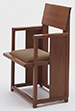 |
Taliesin III, Spring Green, Wisconsin,
Armchair Circa 1930-1935 (1925 - S.218). Taliesin armchair, designed by
Frank Lloyd Wright for Taliesin. He first conceived this chair design during
the redesign of Taliesin III in 1925. The back is slightly slanted, the
inside ends of the arms are rounded, and the inside of the feet are cut at
45 degrees. The cushion is inset in the seat. Originally it lacked the
two-thirds fill on the sides. This was possible added for stability. This
chair appeared in photographs at Taliesin in 1937, S#0429.19. Today, the
revised version is seen throughout Taliesin. Wright later adapted and
modified this design for subsequent commissions, creating several
variations. Note: MOMA dates this chair Circa 1925. Fire destroyed Taliesin
II on April 20, 2025. Taliesin III was redesigned in 1925, and the original
chair, without the partial fill on the sides was photographed in 1928. We
would date the revision of this chair closer to 1930-1935. Constructed of
pine and fabric upholstery. 32.375" High x 20.5" Wide x 17.75" Deep, Seat
Height 16". Courtesy of the Frank Lloyd Wright Foundation and The Museum of
Modern Art. 7 x 10 Color photograph. |
0249.80.0626 |
1930
 |
Wright at 63. 1930. Portrait of Frank
Lloyd Wright. Facing to the left, looking directly at the camera. Published
in 1931, Modern Architecture, Being the Kahn Lectures for 1930, Wright,
Frontispiece. Portrait published in
1932 Poster
announcing Frank Lloyd Wright's lectures on Modern Architecture at the
Albright Art Gallery. Portrait published in
Architectural Record,
September, 1936, p 179. Credit: Photograph by Price Studios. Published in
"My Father Who is on Earth",
Wright, John Lloyd, 1946, page 195, and
"Truth Against The World", Meehan, 1987, page 122.
Bottom right hand corner: "43532" etched in negative. Clipping pasted to
verso. Stamped on verso: "Mar 7 1931." Hand written on verso: "Wright, Frank
Lloyd." Original 4.5 x 5.5 B&W photograph. |
0249.52.0819 |
1930
 |
Wright at 63. Portrait of Wright
in 1930. Courtesy Library of Congress. Photographed by Price Studios. See
Architectural Record,
September, 1936, p 179. Published in
"My Father Who is on Earth",
Wright 1946, page 195, and
"Truth Against The World", Meehan, 1987, page 122. Image also used in
1932 Poster. 8 x 10
Print, High res digital image. |
0249.16.0509 |
1930
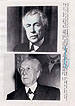 |
Wright at 63 and 83, 1930 and
1950. UPI Caption: "4/9/59 - Phoenix, Arizona: Frank Lloyd Wright, 89, dean
of American architects, died 4/9 in St. Joseph's Hospital here. Wright
underwent an operation 4/6. He is shown her in 1926 (1930) photo (top) and
1950 photo (bottom). UPI Telephoto/Files." 1930 photograph published in
"My Father Who is on Earth",
Wright 1946, page 195, and
"Truth Against The World", Meehan, 1987, page 122. Also used in the
1932 Poster.
Acquired from the archives of the Chicago Tribune. Original 7 x 9.2 B&W
Print. (1930 - S#249.21) (1950 - S#831.22) |
0249.21.0910 |
1930
 |
Wright at 63. 1930. Wright at
the Art Institute of Chicago, September 24-25, 1930. Wright is looking at a
model of the Richard Lloyd Jones Residence (S.227 - 1929). Traveling
exhibition entitled "The Show" at the Art Institute of Chicago, September 25
- October 12, 1930. "The Show" exhibited in New York City; Chicago; Eugene,
Oregon; Seattle, Washington; several European cities; and Milwaukee's Layton
Gallery. It included 600 photographs, 1,000 drawings and four models (three
of which were the Richard Lloyd Jones Residence, Gas Station and St.
Marks-in-the-Bouwerie Towers). On October 1 & 2, 1930, Wright delivered two
lectures at the Art Institute of Chicago entitled "In the Realm of Ideas"
and "To the Young Man in Architecture". These two speeches were published in
1931 as "Two Lectures on
Architecture". Clipping pasted to verso: "Back into the Public Eye -
Frank Lloyd Wright, America's most famous architect, who has been some while
in retirement, comes back into the public eye with an exhibition of his
model buildings at the Art Institute of Chicago. Herald and Examiner photo"
Stamped on clipping: "Herald & Exam. Sept 26, 1930". Published in the Herald
and Examiner, Chicago, IL. Note: Richard Lloyd Jones was Wright's Cousin.
Second clipping pasted to verso: "Berlin Academy Honors Wright...
Continue... |
0249.24.0811 |
1930
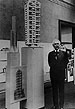 |
Wright at the Art Institute of
Chicago, September 24-25, 1930. Wright stands to the right of the St. Mark's
in-the-Bouwerie Model on exhibition at the Art Institute of Chicago, 1930.
In 1929 Frank Lloyd Wright designed a group of four towers for St.
Mark's-in-the- Bouwerie, New York City (project). The design featured an
innovative "tap root" structure, with the floors cantilevered off a vertical
core. The traveling exhibition entitled "The Show" at the Art Institute of
Chicago, September 25 - October 12, 1930. "The Show" exhibited in New York
City; Chicago; Eugene, Oregon; Seattle, Washington; several European cities;
and Milwaukee's Layton Gallery. It included 600 photographs, 1,000 drawings
and four models (three of which were the Richard Lloyd Jones Residence, the
Gas Station and St. Marks-in-the-Bouwerie Towers). To the left is the Wright
designed Skyscraper Vase. Designed and executed circa 1905, it appeared in
photographs of Wright's 1907 exhibition at the Art Institute of Chicago and
published in "The Early Work"
1968, page 101-103, and measured 22.5 x 6.125 x 3.5. 7 x 10 B&W
photograph. |
0249.37.0614 |
1930
 |
St. Mark's in-the-Bouwerie Model
on exhibition at the Art Institute of Chicago, 1930. In 1929 Frank Lloyd
Wright designed a group of four towers for St. Mark's-in-the-Bouwerie, New
York City (project). The design featured an innovative "tap root" structure,
with the floors cantilevered off a vertical core. The traveling exhibition
entitled "The Show" at the Art Institute of Chicago, September 25 - October
12, 1930. "The Show" exhibited in New York City; Chicago; Eugene, Oregon;
Seattle, Washington; several European cities; and Milwaukee's Layton
Gallery. It included 600 photographs, 1,000 drawings and four models (three
of which were the Richard Lloyd Jones Residence, the Gas Station and St.
Marks-in-the-Bouwerie Towers). To the left is the Wright designed Skyscraper
Vase. Designed and executed circa 1905, it appeared in photographs of
Wright's 1907 exhibition at the Art Institute of Chicago and published in
"The Early Work"
1968, page 101-103, and measured 22.5 x 6.125 x 3.5. Original 7 x 7.5
B&W photograph. |
0249.31.0913 |
1930
 |
Wright exhibition at the Layton
Art Gallery, Milwaukee, Wisconsin, 1930. The exhibition opened late November
1930. St. Mark's in-the-Bouwerie Model (1929 project) is proximately
featured, as is the Gas Station Model in the foreground. The Frank Lloyd
Wright Foundation dates this project 1932, but it is seen here in 1930 (see
Wright 1917-1942, Pfeiffer, pages 217-218). To the left is the Wright
designed Skyscraper Vase. Designed and executed circa 1905, it appeared in
photographs of Wright's 1907 exhibition at the Art Institute of Chicago and
published in "The Early Work"
1968, page 101-103, and measured 22.5 x 6.125 x 3.5. Behind the vase on
the left and right are the Nakomis (left) and Nakoma (right) Sculptures,
designed in 1924, photographed in 1926. While Wright is setting up the
display he is interviewed and is quoted on Nov. 20, 1930, in the Milwaukee
Journal Sentinel, "It will take Milwaukee fully a century to recover from
the influence of these buildings" (their new courthouse). A firestorm
erupted in the Milwaukee press, which increased attendance at the
exhibition. See "Layton's Legacy"
2013, pages 219-221. Original 6.25 x 8 B&W photograph. |
0249.32.0913 |
1930
 |
Wright exhibition at the Layton
Art Gallery, Milwaukee, Wisconsin, 1930. The exhibition opened late November
1930. The Richard Lloyd Jones Residence (1929 - S.227) is proximately
featured in the center. Drawings and illustrations drape the wall. The
Nakomis Model, designed in 1924, photographed in 1926, sets above the
partition to the right. On the table in the foreground are stacks of
additional drawings for the viewers to thumb through. Of interest is the
seemingly lackadaisical approach Wright took in displaying the
illustrations, many of which are considered priceless today. While Wright is
setting up the display he is interviewed and is quoted on Nov. 20, 1930, in
the Milwaukee Journal Sentinel, "It will take Milwaukee fully a century to
recover from the influence of these buildings" (their new courthouse). A
firestorm erupted in the Milwaukee press, which increased attendance at the
exhibition. See "Layton's Legacy"
2013, pages 219-221. Original 8 x 6.25 B&W photograph. |
0249.33.0913 |
|
1931 |
1931
 |
Lucius M.
Boomer, Portrait, 1931, at 53 years old (1953 - S.261). Similar image
published in "Behind the Scenes at the Waldorf-Astoria." Boomer was born in
New York on August 22, 1878, and passed away on June 26, 1947 in Norway.
Photographed by Blank & Stoller, Inc. New York. Courtesy of the Waldorf
Astoria. 7 x 9 B&W photograph.
For more information on the Boomer
Residence see our Wright Study. |
0300.09.1114 |
1931
 |
Capital Journal Building, Salem, Oregon, Project 1931 (FLLW #3101).
Perspective view of the front of the Capital Journal Building. Designed by
Frank Lloyd Wright in 1931. The Capital Journal Building was designed as a
newspaper plant. Square in size, all glass, and four stories tall. The
floors and ceiling were supported by mushroom columns, refined five years
later in the Johnson Administration Building. The third and fourth levels
are apartments. The roof of the second level is a garden terrace for the
apartments. There is a large circular ramp at the rear of the building that
services all the levels of the building. There are also two circular
stairways at the front of the building. Text on face of sleeve: "Wright,
Frank Lloyd (1867-1959). Capital Journal Project...
Continue...
|
0300.17.0323 (1-4) |
1931
 |
Capital Journal Building, Salem, Oregon, Project 1931 (FLLW #3101).
Perspective view of the front of the Capital Journal Building. Designed by
Frank Lloyd Wright in 1931. The Capital Journal Building was designed as a
newspaper plant. Square in size, all glass, and four stories tall. The
floors and ceiling were supported by mushroom columns, refined five years
later in the Johnson Administration Building. The third and fourth levels
are apartments. The roof of the second level is a garden terrace for the
apartments. There is a large circular ramp at the rear of the building that
services all the levels of the building. There are also two circular
stairways at the front of the building. Lower text: "Glass Building For The
Capital Journal, Salem, Oregon. Frank Lloyd Wright, Architect." Original 10
x 5.25 Color photograph. |
0300.18.0323 |
1931
 |
Capital Journal Building, Salem, Oregon, Project 1931 (FLLW #3101). First
Floor Plan and Section of the Capital Journal Building. Designed by Frank
Lloyd Wright in 1931. The Capital Journal Building was designed as a
newspaper plant. Square in size, all glass, and four stories tall. The
floors and ceiling were supported by mushroom columns, refined five years
later in the Johnson Administration Building. The third and fourth levels
are apartments. The roof of the second level is a garden terrace for the
apartments. There is a large circular ramp at the rear of the building that
services all the levels of the building. There are also two circular
stairways at the front of the building. Upper illustration text: "First
Floor Plan." Lower illustration text, left to right: "Section. Ramp.
Newspaper Plan. Garden Court. Apartments." Original 8 x 8.5 Color
photograph. |
0300.19.0323 |
C
1931-32
 |
Hotel Geneva 1931-32 (1911 - S.171). Two females sitting
on stairs in front lobby. Entrance is to the left and right of the lobby.
"Hotel Geneva" lettered across the front of the Lobby above the windows."
Acquired from a private scrap book, other photographs dated 1931-32.
Original 8 x 5 B&W photograph. 4.75 x 3.25. |
0300.08.0514 |
1931
 |
Vintage 4" x 3.25" Magic Lantern Slide of House On The Mesa Model and Floor
Plan 1931 (Project 1931). One photograph of the House on The Mesa Model and
a drawing of the Floor Plan. Frank Lloyd Wright
designed the House on The Mesa in 1931 for MOMA's
1932 Modern Architecture: International Exhibition. It then was incorporated
into Wright's Broadacre City as a model for upper-class housing. Label
affixed to face: "Wright, Frank Lloyd, 1867-1959. 1931. Project for "House
on The Mesa" Model exhibited at the Museum of Modern Art, N. Y., 1932 and
plan. 48261L. Art. Dept. Smith College." Acquired from the Art Department at
Smith College. Magic lantern slide 4" x 3.25", Transparency: 2.8" x 2.5" |
0300.21.1165 |
1931
 |
New Theater, Woodstock New York, 1931 (FLLW#3106.18) (Project). Perspective
elevation of A New Theater, designed by Frank Lloyd Wright in 1931 for J. P.
McEvoy, Woodstock, New York. It remained a project. In 1938 Frank Lloyd
Wright designed the Pfeiffer Chapel (S.251) at the Florida Southern College
and utilized the original Woodstock floor plan. In 1949 the "New Theatre"
(FLLW#4922) was revived again in Hartford, Connecticut, but it was never
executed. The design was revived again in 1955 and was completed as the
Dallas Theatre Center, Dallas, TX (1955 -S.395). Text lower left: “A New
Theater. Frank Lloyd Wright Architect.” Courtesy of the Frank Lloyd Wright
Foundation Archives. 10 x 4.5 Color photograph. |
0300.22.1125 |
1931
 |
Vintage 4" x 3.25" Magic Lantern Slide of the New Theater, Woodstock New
York, 1931 (FLLW#3106.18) (Project). Perspective elevation of A New Theater,
designed by Frank Lloyd Wright in 1931 for J. P. McEvoy, Woodstock, New
York. It remained a project. In 1938 Frank Lloyd Wright designed the
Pfeiffer Chapel (S.251) at the Florida Southern College and utilized the
original Woodstock floor plan. In 1949 the "New Theatre" (FLLW#4922) was
revived again in Hartford, Connecticut, but it was never executed. The
design was revived again in 1955 and was completed as the Dallas Theatre
Center, Dallas, TX (1955 -S.395). Text lower left: “A New Theater. Frank
Lloyd Wright Architect.” Label affixed to face: “Wright, Frank Lloyd,
1867-1959. 1932. Project for a New Theatre. 131264L. Art. Dept. Smith
College.” Acquired from the Art Department at Smith College. Magic lantern
slide 4" x 3.25", Transparency: 3" x 1.6" |
0300.23.1125 |
1931
 |
Wright Exhibition in Amsterdam, Holland, 1931. View of
the entrance to the First European Exhibition Of The Work Of Frank Lloyd
Wright, Architect, America, In The Sted: Museum In Amsterdam, From May 9 To
May 31. The posters in the entrance were designed by H. Th. Wijdeveld.
Wijdeveld also designed the entrance. The posters were mounted to vertical
boards, visually narrowing the eye to "Frank Lloyd Wright," and leading the
views into the exhibition. Immediately behind the receptionist is the model
of Broadacre's Gas Station. Wijdeveld was a Dutch architect and graphic
designer. He was also the editor-in-chief of the Dutch magazine Wendingen.
In 1921,
Wendingen
devoted a whole issue to the work of Frank Lloyd Wright. In 1925, Wendingen
devoted a
seven issues
to the work of Frank Lloyd Wright, and later that year, bound them in a
single issue and published
The Life-Work of the
American Architect Frank Lloyd Wright. It included
contributions by Frank Lloyd Wright, an introduction by architect H. Th.
Wijdeveld and many articles by famous European architects and American
writers. In 1931 Wijdeveld coordinated this exhibition in Amsterdam, and
designed and produced the
poster
and
invitation for the exhibition. 9.5 x 8
B&W photograph. |
0300.14.0521 |
1931
 |
Wright
Exhibition in Amsterdam, Holland, 1931. Invitation to the grand opening
on May 9 at 3:30pm, of the First European Exhibition Of The Work Of
Frank Lloyd Wright, Architect, America, In The Sted: Museum In
Amsterdam, From May 9 To May 31. The invitation was designed by H. Th.
Wijdeveld. "Amerika. Eerecomite. Uitnoodiging. De Tentoonstellingsraad
Voor Bouw En Verwante Kunsten Heeft De Eer U En Uwe Dames Uit Te
Noodigen Tot Buwoning Van De Opening Der Eerste Europeesche
Tentoonstelling Der Weren Van Den Amerikaanschen Bouwmeester Frank Lloyd
Wright. Deze Tentoonstelling Zal Worden Gehouden Gedurende De Maand Mei
In Het Sted. Museum Paulus Potterstraat Amsterdam. De Opening Zal
Geschieden Op Zaterdag 9 Mei Des Namiddags Te 3.30 Uur. De
Tentoonstellingsraad Voorz: Mr. J. F. Van Royen Secretaris B. T.
Boeyinga. Holland." (America. Honor Committee. Invitation. The
Exhibition Council For Construction And Related Arts Has The Honor To
Invite You And Your Ladies To The Opening Of The First European
Exhibition Der Weren Van Den American Architect Frank Lloyd Wright. This
Exhibition Will Be Held During The Month Of May In The Sted. Museum
Paulus Potterstraat Amsterdam. The opening will take place on Saturday 9
May in the afternoon at 3.30 pm...
Continue... |
0300.15.0521 |
1931
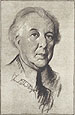 |
Wright at 64, Circa 1931.
Portrait of Frank Lloyd Wright by Samuel Johnson Woolf (1880 - 1948), drawn
from life. S. J. Woolf interviewed Wright for the January 17, 1932 issue of
the
New York Times Magazine.
Wright sat for the portrait during the interview with Woolf. Caption reads
"Drawn from life by S. J. Woolf." According to Brier Hill Galleries, "Woolf
was born in New York City into a family long active in the arts, Woolf was a
portrait artist and printmaker. He studied at the Art Students League and at
the National Academy of Design under Kenyon Cox and George deForest Brush.
He is best known for his portraits, some commissioned by Collier's magazine,
and others paired with interviews that appeared in The New York Times in the
1920s. Wolf served as an artist-correspondent during both World Wars I and
II. His work was widely exhibited and resides in the permanent collections
of numerous public and private institutions. He died at New York City." 6 x
9 B&W photograph. |
0300.10.0115 |
|
|
1932 |
1932
 |
Arizona Biltmore Circa 1932 (1927 - S.221).
Arizona Biltmore from the front entrance. Viewed from the Southeast. Sign in
the foreground on the left: "Danger. Keep Horses off the Concrete. Piestewa
Peak in the background on the right. Clipping taped to verso: "Phoenix,
Ariz. The Arizona Biltmore Hotel where the famous sportsman, William
Wrigley, Jr., passed on. 1/26/32." Wrigley past away on January 26, 1932,
and this image was used as an announcement. This would indicate that this
photograph was taken in January 1932 or earlier. Stamped on verso:
"International Newsreel, Los Angeles Calif." Original 8 x 6 B&W photograph. |
0361.04.0414 |
1932
 |
Arizona Biltmore Circa 1932 (1927 - S.221).
Arizona Biltmore from the front entrance. Viewed from the Southeast.
Piestewa Peak in the background on the right. Clipping taped to verso:
"Arizona Hotel Wrigley Owned. This hotel, the Arizona Biltmore, at Phoenix,
one of the most pretentious in the state, represents an investment of more
than three and a half million dollars by the late William Wrigley, Jr. It
caters largely to wealthy easterners who want to spend their vacations on
the desert. His winter home was on the same grounds as the hotel. 1/26/32
(West Coast)" Stamped on verso: "Associated Press Photo." "Jan 30 1932."
Original 10 x 5.75 B&W photograph. |
0361.09.0316 |
1932
 |
Arizona Biltmore, Phoenix, Arizona Circa 1932 (1927 - S.221). Arizona
Biltmore from the front entrance. Viewed from the Southeast. Piestewa Peak
in the background on the right. Signed in ink, bottom right: "McCulloch
Bros, Phoenix." Typed on verso: "Phoenix, Arizona. A view of the Arizona
Biltmore, near Phoenix, Ariz." Stamped on verso: "McCulloch Bros, Phoenix,
Arizona." Stamped on verso: "American Weekly. Editorial Department, 235 East
45th Street, New York." Acquired from the American Weekly archives. Original
10 x 8 B&W photograph. |
0361.29.0725 |
1932
 |
Broadacre City, Standardized Gas Station, Perspective,
1932, (Project FLLW #3202). Standardized Gas Station. Frank Lloyd Wright,
Architect. First designed by Frank Lloyd Wright in 1932. Original
perspective published in
Wright 1917-1942,
Pfeiffer, 2010, p.217. In 1934 it was incorporated into Broadacre City.
Published in
The Living City, Wright, 1958,
p.118-119. In 1956 it was redesigned as the Lindholm Service Station (1956 -
S. 414). Text on sleeve: "Wright, F. L. - Broadacre City - Service Station.
3-1. Overhead Service Station Project. Render ., Perspective drawing.
1924-29. Broadacre City Project. Wright, Frank Lloyd. U of Virginia FAIC."
Acquired from the archives of the University of Virginia. 35mm Color slide,
sandwiched between glass, plastic mount. |
0361.14.0420 |
1932
 |
Broadacre City, Standardized Gas Station, Ground Level
Plan, 1932, (Project FLLW #3202). Standardized Gas Station. Frank Lloyd
Wright, Architect. First designed by Frank Lloyd Wright in 1932. In 1934 it
was incorporated into Broadacre City. Published in
The Living City, Wright, 1958,
p.120. In 1956 it was redesigned as the Lindholm Service Station (1956 - S.
414). Text on sleeve: "Wright, F. L. - Broadacre City - Service Station.
1-1. Overhead Service Station Project. Plan, Ground level. 1924-29.
Broadacre City Project. Wright, Frank Lloyd. U of Virginia FAIC." Acquired
from the archives of the University of Virginia. 35mm Color slide,
sandwiched between glass, plastic mount. |
0361.15.0420 |
1932
 |
Broadacre City, Standardized Gas Station, Upper Level
Plan, 1932, (Project FLLW #3202). Standardized Gas Station. Frank Lloyd
Wright, Architect. First designed by Frank Lloyd Wright in 1932. In 1934 it
was incorporated into Broadacre City. Published in
The Living City, Wright, 1958,
p.120. In 1956 it was redesigned as the Lindholm Service Station (1956 - S.
414). Text on sleeve: "Wright, F. L. - Broadacre City - Service Station.
1-1. Overhead Service Station Project. Plan, Upper level. 1924-29. Broadacre
City Project. Wright, Frank Lloyd. U of Virginia FAIC." Acquired from the
archives of the University of Virginia. 35mm Color slide, sandwiched between
glass, plastic mount. |
0361.16.0420 |
1932
 |
Broadacre City, Unified Farm Project, Perspective,
1932, (Project FLLW #3202). The Unified Farm. Frank Lloyd Wright, Architect.
First designed as the Walter V. Davidson "The Unified Farm," Prefabricated
Farm Unit by Frank Lloyd Wright in 1932. The house and farm were designed as
a complete single unit, all under one room. Original perspective published
in
Wright 1917-1942,
Pfeiffer, 2010, p.216. In 1934 it was incorporated into Broadacre City.
Published in
The Living City,
Wright, 1958, p.61. Text on sleeve: "Wright, F. L. - Broadacre City -
Unified Farm. 1-1. Unified Farm Project. Persp. dwg. from above. 1924-29.
Broadacre City Project. Wright, Frank Lloyd. U of Virginia FAIC." Acquired
from the archives of the University of Virginia. 35mm Color slide,
sandwiched between glass, plastic mount. |
0361.12.0420 |
1932
 |
Broadacre City, Unified Farm Project, Plan, 1932,
(Project FLLW #3202). Plan for Unified Farm. Frank Lloyd Wright, Architect.
First designed as the Walter V. Davidson "The Unified Farm," Prefabricated
Farm Unit by Frank Lloyd Wright in 1932. The house and farm were designed as
a complete single unit, all under one room. Original plan published in
Wright 1917-1942,
Pfeiffer, 2010, p.216. In 1934 it was incorporated into Broadacre City.
Published in The Living City,
Wright, 1958, p.60. Text on sleeve: "Wright, F. L. - Broadacre City -
Unified Farm. 1-1. Unified Farm Project. Plan. 1924-29. Broadacre City
Project. Wright, Frank Lloyd. U of Virginia FAIC." Acquired from the
archives of the University of Virginia. 35mm Color slide, sandwiched between
glass, plastic mount. |
0361.13.0420 |
1932
 |
Broadacre City, Roadside Market, Perspective, 1932,
(Project FLLW #3202). The Roadside Market. Frank Lloyd Wright, Architect.
First designed as the Davidson Wayside Market by Frank Lloyd Wright in 1932.
Original perspective published in
Wright 1917-1942,
Pfeiffer, 2010, p.215. In 1934 it was incorporated into Broadacre City.
Published in The Living City,
Wright, 1958, p.99. Text on sleeve: "Wright, F. L. - Broadacre City -
Roadside Market. 3-1. Roadside Market Project. Render., Perspective Sketch.
1924-29. Broadacre City Project. Wright, Frank Lloyd. U of Virginia FAIC."
Acquired from the archives of the University of Virginia. 35mm Color slide,
sandwiched between glass, plastic mount. |
0361.17.0420 |
1932
 |
Broadacre City, Roadside Market, Elevation, 1932,
(Project FLLW #3202). The Roadside Market. Frank Lloyd Wright, Architect.
First designed as the Davidson Wayside Market by Frank Lloyd Wright in 1932.
Original Plan published in
Wright 1917-1942,
Pfeiffer, 2010, p.216. In 1934 it was incorporated into Broadacre City.
Published in The Living City,
Wright, 1958, p.100. Text on sleeve: "Wright, F. L. - Broadacre City -
Roadside Market. 2-2. Roadside Market Project. Elev. 1924-29. Broadacre City
Project. Wright, Frank Lloyd. U of Virginia FAIC." Acquired from the
archives of the University of Virginia. 35mm Color slide, sandwiched between
glass, plastic mount. |
0361.18.0420 |
1932
 |
Broadacre City, Roadside Market, Section, 1932,
(Project FLLW #3202). The Roadside Market. Frank Lloyd Wright, Architect.
First designed as the Davidson Wayside Market by Frank Lloyd Wright in 1932.
Original Section published in
Wright 1917-1942,
Pfeiffer, 2010, p.216. In 1934 it was incorporated into Broadacre City.
Published in The Living City,
Wright, 1958, p.100. Text on sleeve: "Wright, F. L. - Broadacre City -
Roadside Market. 2-1. Roadside Market Project. Sect. 1924-29. Broadacre City
Project. Wright, Frank Lloyd. U of Virginia FAIC." Acquired from the
archives of the University of Virginia. 35mm Color slide, sandwiched between
glass, plastic mount. |
0361.19.0420 |
1932
 |
Broadacre City, Roadside Market, Plan, 1932, (Project
FLLW #3202). The Roadside Market. Frank Lloyd Wright, Architect. First
designed as the Davidson Wayside Market by Frank Lloyd Wright in 1932.
Original Section published in
Wright 1917-1942,
Pfeiffer, 2010, p.216. In 1934 it was incorporated into Broadacre City.
Published in The Living City,
Wright, 1958, p.101. Text on sleeve: "Wright, F. L. - Broadacre City -
Roadside Market. 1-1. Roadside Market Project. Plan. 1924-29. Broadacre City
Project. Wright, Frank Lloyd. U of Virginia FAIC." Acquired from the
archives of the University of Virginia. 35mm Color slide, sandwiched between
glass, plastic mount. |
0361.20.0420 |
C 1932
 |
Larkin Building. Built 1903, Demolished 1950. I have noticed a number
of changes to the Larkin building in this later photo:
1) Globes are missing;
2) Plaques have been added at the street entrance;
3) Windows added top/side of building;
4) Fountain pool filled in;
5) Street has been widened;
6) Lights added to each side of fountain;
7) Chimney added to center column on right side at top;
8) Parking added on right side of building.
Published in "Frank
Lloyd Wright's Larkin Building, Myth and Fact" Quinan,
1989, page 120. |
0502.01.1001 |
C 1932
 |
Larkin Administration Building circa 1932 (1903 - S.093). Original Magic
Lantern Slide. Three-quarter view of the right side of the Larkin
Administration Building. Photographed about the same time as
S#502.01.
There are a number of changes since the building was originally built: 1)
Globes are missing; 2) Plaques have been added at the street entrance; 3)
Windows added top/side of building; 4) Street has been widened; 5) Parking
added on right side of building. Text on face: "University Prints Slide,
made by Max Keller, Cambridge, Mass." Hand written on face: "GM71. Buffalo,
N.Y. Larkin Building - Wright." Original 4 x 3.25 Magic Lantern Slide, and 8
x 10 B&W photograph. |
0361.11.0218 |
1932
 |
C. R. Secrest (he broke Wright's nose) and his
wife. Clipping pasted to verso: "Beaten By Students After Fight With Wright.
Following street fight in which C. R. Secrest of Madison, Wisc., is said to
have fractured the nose of Frank Lloyd Wright, world famous architect, four
students of Wright's trade and craft school at Taliesin, Wisc., drove to
Madison, entered Secrest's home, and horse-whipped him until the victim
drove them off with a butcher knife. In court the students, Karl Jansen, 25,
of Copenhagen, Denmark; Sam Ratensky, 22, New York City; Rudolph Mock, 29,
Basel, Switzerland; and William Peters, 20, Spring Green, Wisc., plead
guilty and are awaiting sentence. C. R. Secrest and his wife, who witnessed
the attack, are shown above at their home. 11-4-32." Stamped on verso "Nov 8
1932." According to Wright in "An
Autobiography", 1943, page 432-3, Wright
was struck "violently several times on the back of the head." during the
struggle he was kicked "on the bridge of the nose with his boot heel...
Blood spurted all over him. ...unknown to me, my boys (four of them) went
out after their man, got into his house... the police came and arrested the
boys and the assassin. ...they spent a couple nights in the county jail...
The boys were paying a fine of several hundred dollars. On the "˜installment...
Continue... |
0361.05.0614 |
1932
 |
Vintage 4" x 3.25" Magic Lantern Slide of the Malcolm E. Willey House Model,
Scheme I, 1932 (FLLW#3204). Model and floor plans for the Malcolm E. Willey
House, Scheme I, designed by Frank Lloyd Wright in 1932. It remained a
project, but the Willeys did build Scheme II. This Model was exhibited at
the Broadacre Exhibition held at the Industrial Arts Exhibition, New York,
held in 1935. This model may have been created at late as 1933-34. Label
affixed to face: “Wright, Frank Lloyd, 1867-1959. 1932. Project for Malcolm
E. Willey at Minneapolis, Minn., model exhibited at Museum of Modern Art,
N.Y., 1940 and plans. 48262L. Art. Dept. Smith College.” Acquired from the
Art Department at Smith College. Magic lantern slide 4" x 3.25",
Transparency: 2.5" x 2.6" |
0361.30.1125 |
1932
 |
Wright at 65. 1932. Wright in court with
apprentices. According to Wright in "An
Autobiography", 1943, page 432-3, Wright was struck "violently
several times on the back of the head." during the struggle he was kicked
"on the bridge of the nose with his boot heel... Blood spurted all over him.
...unknown to me, my boys (four of them) went out after their man, got into
his house... the police came and arrested the boys and the assassin. ...they
spent a couple nights in the county jail... The boys were paying a fine of
several hundred dollars. On the "installment plan," of course. The Taliesin
Fellowship had got off to a very bad start." According to Brendan Gill, "Many
Masks", page 332, "...his grievance against Wright was based on the
fact that Wright allegedly had long owed his wife money for domestic
service at Taliesin - by Wright's account, he was found guilty, fined, and
soon thereafter left town. Clipping pasted to verso: "Architect's students
admit whipping his foe. Rudolph Mock (left), Karl Jansen, Frank Lloyd Wright
Portrait, noted architect; Sam Ratensky, and William Peters. The four
students at Wright's trade and craft school at Taliesin, Wis., who are shown
here with the architect admitted horsewhipping C. R. Secrest of Madison,
Wis., after Secrest had broken Wright's nose in fight over debt...
Continue... |
0361.02.0811 |
|
1933 |
Circa
1933
 |
Lucius M. Boomer, Portrait,
Circa 1933 (possibly 55 years old) (1953 - S.261). By 1918, at the age of
39, Boomer was president of the Boomer-duPont Properties Corporation, owning
and managing the McAlpin and the Claridge Hotels. That year they assumed
control and management of the Waldorf-Astoria and then moved their
headquarters to the Waldorf-Astoria. In 1929, they sold the property to make
way for the Empire State Building, but maintained the name Waldorf-Astoria.
They rebuilt, and on October 31, 1931 opened the new Waldorf-Astoria.
Photographed by Fabian Bachrach. 5 x 6 B&W photograph.
For more information on the Boomer
Residence see our Wright Study. |
0370.11.1114 |
1933
 |
Lucius M. Boomer, 1933 (55 years
old). Portrait Lucius M. Boomer, looking to the left, arms crossed. In 1929,
the Waldorf Astoria was sold to make way for the Empire State Building. On
October 31, 1931 the new Waldorf-Astoria opened. Caption taped to verso:
"From Ted Saucier, The Waldorf-Astoria, New York - ELdorado 5-3000. Lucius
Boomer, President of The Waldorf-Astoria." Stamped on verso: "Mar 13 1933."
Photographed by Underwood & Underwood. Original 8 x 10 B&W photograph.
For more information on the Boomer
Residence see our Wright Study. |
0370.13.1014 |
1933
 |
Lucius M. Boomer with President
Herbert Hoover and his wife, Lou Henry Hoover at the Waldorf Astoria in 1933
(1953 - S.261). 7.75 x 10 B&W photograph.
For more information on the Boomer
Residence see our Wright Study. |
0370.12.1114 |
1933
 |
Midway Gardens Male Sprites (1913 - S.180). 1933
Press photograph. Heavily retouched photograph of page 77, from "The
Life-Work of the American Architect Frank Lloyd Wright" Wright, Frank
Lloyd, 1925. Two views of the Male Sprite holding dodecahedrons. Stamped on
verso: "Mar 14 1933." Hand written on verso: "Figures designed by Frank
Lloyd Wright for the Midway Gardens, Chicago." Original 8 x 10 B&W
photograph. |
0370.03.0713 |
1933
 |
Taliesin Fellowship Complex, 1933 (1932 - S.228). Perspective, Section and
Plan for a dormitory room at the Taliesin Fellowship Complex. Perspective
includes a drawing board and seat, hassock, bed closet and bookshelf. Of
note is a model of the Nakoma sculpture atop
the bookshelf, included in the Perspective and Section. Clipping pasted to
verso: "A drawing by Frank Lloyd Wright of the layout of one of the boys'
rooms in the dormitory at his new school, Taliesin Fellowship." Stamped on
verso: "Mar 14 1933. N.E.A." Original 7.75 x 7.5 B&W photograph. |
0370.17.0920 |
C
1933
 |
Taliesin Spring Green, Yen Liang with Lamb Circa
1933. Yen Liang was born in 1908 in Tokyo. In 1910, his family moved to
China . In 1928, he travel to the United States to study architecture. He
attended Cornell, M.I.T. and Yale, and received his degree in three years.
He enrolled in the Harvard graduate school, but after reading Frank Lloyd
Wright's "An Autobiography" he
immediately applied to the Taliesin Fellowship. In 1932 at 23, he became
Wright's first apprentice. He and Edgar Tafel became close friends. In 1934,
Liang returned to China where he became a prominent architect. "Colossus.
Last week we had, among our visitors, two professors of architectural design
from one of the leading universities of the east coast. They are typical of
teachers of design of all the instituted architectural schools. They are
graduates of some American school, were sent on bountiful scholarships to
France to study... and have returned to teach what they have just been
taught. They have had negligible contact with actual building practice..."
Liang, "Taliesin", Volume
1, No 1, 1934, pp. 12-13. Also see "Frank
Lloyd Wright, Recollections", Tafel, 1993, pp. 127-132, and "Years
with Frank Lloyd Wright" Tafel, 1979, pp 136-143. Original 7.75 x 10
B&W photograph. |
0370.14.0215 |
1933
 |
Wright at 66. Frank Lloyd Wright facing slightly
to the right, looking to the left. His left arm is raised, his had in hand.
His overcoat is draped over his right arm. He stands in front of wood file
cases. Stamped on verso: "Mar 14 1933." and "Photo by Acme Newspictures,
Inc. Chicago Bureau, Tribune Tower, Chicago, Ill. Acquired from the achieves
of the Chicago Tribune. 8 x 10 B&W photograph. |
0370.04.1213 |
|
1934 |
1934
 |
Broadacre City, Cottage For Level Ground, Perspective, Circa 1934.
Perspective view of the Typical Cottage for Level Ground, designed by Frank
Lloyd Wright. Published in The Living City,
Wright, 1958, p.62. Text on sleeve: "Wright, F. L. - Broadacre City -
Cottage. 3-1. Cottage for Level Ground (Prefabrication) model. 1924-29.
Broadacre City Project. Wright, Frank Lloyd. U of Virginia FAIC." Acquired
from the archives of the University of Virginia. 35mm Color slide,
sandwiched between glass, plastic mount. |
0376.11.0420 |
1934
 |
Broadacre City, Usonian Concrete Block House, Perspective, Circa 1934.
Perspective view of the Usonian Concrete Block House designed by Frank Lloyd
Wright. Published in The Living City,
Wright, 1958, p.70. Text on sleeve: "Wright, F. L. - Broadacre City -
Usonian House . 3-1. Usonian Concrete Block House Project. Render.,
Perspective drawing. 1924-29. Broadacre City Project. Wright, Frank Lloyd. U
of Virginia FAIC." Acquired from the archives of the University of Virginia.
35mm Color slide, sandwiched between glass, plastic mount. |
0376.07.0420 |
1934
 |
Broadacre City, Usonian Concrete Block House, Living Room Perspective, Circa
1934. Perspective view of the Usonian Concrete Block House Living Room
designed by Frank Lloyd Wright. Published in The Living City,
Wright, 1958, p.70. Text on sleeve: "Wright, F. L. - Broadacre City -
Usonian House . 3-2. Usonian Concrete Block House Project. Render., Interior
Living Room perspective drawing. 1924-29. Broadacre City Project. Wright,
Frank Lloyd. U of Virginia FAIC." Acquired from the archives of the
University of Virginia. 35mm Color slide, sandwiched between glass, plastic
mount. |
0376.08.0420 |
1934
 |
Broadacre City, Usonian Concrete Block House, Ground Plan, Circa 1934.
Ground Plan for the Usonian Concrete Block House designed by Frank Lloyd
Wright. Published in The Living City,
Wright, 1958, p.71. Text on sleeve: "Wright, F. L. - Broadacre City -
Usonian House . 1-1. Usonian Concrete Block House Project. Plan Ground
Floor. 1924-29. Broadacre City Project. Wright, Frank Lloyd. U of Virginia
FAIC." Acquired from the archives of the University of Virginia. 35mm Color
slide, sandwiched between glass, plastic mount. |
0376.09.0420 |
1934
 |
Broadacre City, Usonian Concrete Block House, Upper Level Plan, Circa 1934.
Upper Level Plan for the Usonian Concrete Block House designed by Frank
Lloyd Wright. Published in The Living City,
Wright, 1958, p.71. Text on sleeve: "Wright, F. L. - Broadacre City -
Usonian House . 1-1. Usonian Concrete Block House Project. Plan Upper Level.
1924-29. Broadacre City Project. Wright, Frank Lloyd. U of Virginia FAIC."
Acquired from the archives of the University of Virginia. 35mm Color slide,
sandwiched between glass, plastic mount. |
0376.10.0420 |
1934
 |
Larkin Administration Building, Buffalo, New York, 1934 (1903 - S.093). 35mm
slide of the Larkin Administration Building interior central court. Designed
by Frank Lloyd Wright in 1903. As business changed and mail order
diminished, less office furniture filled the central court. A grand piano
sits in the center of the court just behind the bench. Acquired from the
estate of an art collector in Miami, Florida. Stamped on sleeve: "Nov 73."
Printed on sleeve verso: "Kodachrome Transparency. Processed by Kodak."
Original 35mm B&W slide, and an 8 x 10 B&W Photograph. |
0376.22.0625 |
1934
 |
Dutch Village. Illustrated by Charles L. Morgan,
1934. Aerial perspective of the Dutch Village at the Century of Progress
International Exposition. The Century of Progress International Exposition
was a World's Fair held in Chicago, as The Chicago World's Fair, from 1933
to 1934. The Dutch Village was designed by Burnham Brothers and Hammond
Architects. Signed bottom right: "C. Morgan." Text: "Dutch Village. A
Century of Progress 1934. Burnham Brothers and Hammond Architects." Courtesy
of the Art Institute of Chicago. 10 x 7 B&W photograph. |
0376.02.0319 |
C
1934
 |
Taliesin, Spring Green, Taliesin Apprentices
circa 1934. Taliesin apprentices pushing vehicle. In 1932, Frank Lloyd
Wright formed the Taliesin Fellowship with twenty-three apprentices who came
to live, learn and work at Taliesin, in Spring Green. Published in "Taliesin,"
Wright, 1934 Volume 1, No 1., page 26. Original 7 x 5 B&W photograph. |
0370.05.0514 |
C
1934
 |
Taliesin, Spring Green, Taliesin Apprentices
circa 1934. Taliesin apprentices farming. The young girl in the foreground
could possibly be Wright's daughter Iovanna, born on December 2, 1925. She
would have been approximately eight years old in 1933. Possibly Mr. & Mrs.
Wright are in the background to the right. In 1932, Frank Lloyd Wright
formed the Taliesin Fellowship with twenty-three apprentices who came to
live, learn and work at Taliesin, in Spring Green. Original 7 x 5 B&W
photograph. |
0370.06.0514 |
C
1934
 |
Taliesin, Spring Green, Taliesin Apprentices
circa 1934. Possibly Olgivanna Lloyd Wright with apprentices sitting in the
Tea Circle. In 1932, Frank Lloyd Wright formed the Taliesin Fellowship with
twenty-three apprentices who came to live, learn and work at Taliesin, in
Spring Green. Original 7 x 5 B&W photograph. |
0370.07.0514 |
C
1934
 |
Taliesin, Spring Green, countryside circa 1934.
View of Taliesin. Taliesin can been seen on the hillside in the background.
In 1932, Frank Lloyd Wright formed the Taliesin Fellowship with twenty-three
apprentices who came to live, learn and work at Taliesin, in Spring Green.
Original 7 x 5 B&W photograph. |
0370.09.0514 |
C
1934
 |
Taliesin, Spring Green, countryside circa 1934.
Romeo and Juliet windmill and Taliesin can be seen on the hillside in the
background. A Taliesin styled short wall can be seen in the foreground. In
1932, Frank Lloyd Wright formed the Taliesin Fellowship with twenty-three
apprentices who came to live, learn and work at Taliesin, in Spring Green.
Original 7 x 5 B&W photograph. |
0370.10.0514 |
C
1934
 |
Willey Residence, Scheme II, 1934. Part of a set
of six photographs. The drawing for Willey Residence Scheme II was Wright's
Project #3401, which would indicate drawings were completed in 1934. Walls
are complete, trellis is under construction. The roof of the master bedroom
in the background is complete. Malcolm and Nancy Willey moved in to their
new house in December 1934. This image of the set of six helps date the
other five. (A thank you to Robert Barros for identifying this image.) |
0370.08.0514 |
1934
 |
Malcolm E. Willey House, Minneapolis, Minnesota, 1934 (1933 - S.229). View
of the Willey Residence from the Southwest. Designed by Frank Lloyd Wright
in 1933. It was constructed of brick with cypress trim. Located on a bluff
over looking the Mississippi River, the view was marred by the construction
of I-94 on its Southern border. This appears to be taken near the completing
of the house. Grass has not yet been planted. Stairs and the Terrace have
not yet been completed. An empty Coke bottle sits between the detached
garage and the house. The wall that runs along the East side of the property
line has not been installed. Mounted to gray board. Label pasted to board:
"182. M666. B12W. 41. Minneapolis, Minn. House of Malcolm Willey. Front
Elevation. View showing the semi detached garage at extreme left. The wall
which cuts off the view to the east has not yet been built in this view.
1934. Architect: Frank Lloyd Wright." Small label pasted to verso: "Gift of
B. Simms." Caption pasted to verso: "This house has no attic, and no
excavation excepting under the kitchen. Storage room is over the garage. In
the skylights, French doors to the terrace, and the odd triangular windows
between the eaves and the north wall, there has been an abundant use of
glass; designed to bring the outside in...
Continue... |
0376.04.0420 |
1934
 |
Malcolm E. Willey House, Minneapolis, Minnesota, 1934
(1933 - S.229). View of the Willey Residence Dining Room. Designed by Frank
Lloyd Wright in 1933. It was constructed of brick with cypress trim. Located
on a bluff over looking the Mississippi River, the view was marred by the
construction of I-94 on its Southern border. One detail that is of interest
is the brick floor. The brick floor is consistent with the construction of
the brick walls. The brick flooring continues to the exterior patios and
stairs. The
furniture and built-ins were
designed by Frank Lloyd Wright. Label pasted to board: "182. M666. B12W. 75.
Minneapolis, Minn. House of Malcolm Willey. Dining Unit in the Main Room.
Square table in center, cupboards and shelves are all designed as a part of
the house. Behind the shelves and glass partition is the kitchen. 1934.
Architect: Frank Lloyd Wright." Small label pasted to verso: "Gift of B.
Simms." Published in
In The Nature of Materials,
1942, Plate 318. Acquired from the archives of the University of Minnesota.
Original 6.5 x 4.5 B&W Photograph. |
0376.05.0420 |
1934-35
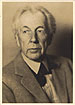 |
Wright
at 67. Frank Lloyd Wright
Portrait. Original 5 x 7 Sepia tone. Given to Lucian Schlingen
Sr. by Frank Lloyd Wright 1934-35. Purchased from Son. (Note on
back: Return to Taliesin, Spring Green, Wisconsin) |
0397.02.0606 |
|
1935 |
C 1935-40
 |
William and Jessie Adams
Residence, Chicago, Circa 1935-40 (1900 - S.048). Viewed from the Southeast.
William Adams was a successful contractor in the Chicago area. Adam's first
collaboration with Frank Lloyd Wright was on Wright's first major
commission, the Winslow Residence. Although both the Residence and Stable
were designed in 1894, it is not clear who the contractor was for the house,
but it is clear that William Adams built the Stables, his signature was on
the plans, "Frank
Lloyd Wright Preliminary Studies
1889-1916," Volume 9,
Pfeiffer, 1991, Plate 23-24. Two other major collaborations were the Heller
Residences (1896 - S.038) built in 1897 and Husser (1899 - S.046). Frank
Lloyd Wright also designed this home for Adams. Photographed by
Gilman Lane.
Etched into the negative, bottom left corner "67366." Possibly photographed
during the same time frame as his photographs of the Francisco Terrace
Apartments Circa 1935-40 (1895 - S.030) #67365. 10 x 8 B&W photograph.
Courtesy of the Art Institute of Chicago. |
0397.47.1119 |
C 1935
 |
Frederick Bagley
Residence Illustration Circa 1935-1945, Hinsdale, Illinois (1894 - S.028).
View of the Bagley Residence from the sidewalk. The gambrel , or double
sloping roof is a primary feature of this design, A covered veranda runs the
full width of the front of the house. According to Grant Manson, Bagley was
a marble merchant. "He had two Iconic colonettes in stock and wanted them
incorporated in his house. The columns of the porch were reflections in wood
of those which Wright had used, perforce, in the interior."
Frank Lloyd Wright
to 1910, 1958, p.51. Four wood columns
support the roof covering the stone veranda. Two additional sets of double
doors lead from the veranda into the living room. Photographed by
Gilman Lane. Courtesy of the Art Institute of Chicago. 10 x 8 B&W photograph. |
0397.46.0719 |
C 1935-45
 |
Hiram Baldwin Residence, Kenilworth, Illinois, Circa 1935-1945 (1905 -
S.107). View of the front of the house from the South. The entrance is on
the left, the semi-circular living room is in the center, the covered porch
is on the right. The porch appears to now be enclosed, and art glass windows
added. Designed in 1905 by Frank Lloyd Wright. The living room is
semi-circular with a square roof. Like the first
George Millard House
(1906) in Highland Park, the second level is cantilevered on both ends. Text
lower left: "67426." Photographed by
Gilman Lane. Courtesy of
the Art Institute of Chicago. 8 x 10 B&W photograph. |
0397.81.0722 |
C 1935-45
 |
1) George Barton Residence, Buffalo, New York, Circa 1935-45 (1903 - S.103).
View of the Barton Residence from the Southwest. Designed by Frank Lloyd
Wright in 1903. The back of the house is on the left, the covered porch is
in the foreground, and the front of the house facing Summit Avenue is in the
background on the far right. The landscape is mature and somewhat overgrown.
Ivy have overtaken the walls. The large tree off the corner of the porch on
the right were not in the photographs from 1905.
Darwin Martin suffered a mild stroke in 1928. George Barton passed away in
February 13, 1929. On February 14, Darwin Martin wrote to Frank Lloyd Wright
about his home and the Barton House, "We do not know what Mrs. Barton's
future plans will be. She is likely to go to Swarthmore Pa. and live with
her daughter. Mrs. Martin has said, that with strangers in the Barton house
she would willingly give up our house, as we could pay a handsome rent and
save two-thirds of the present cost of maintaining the home. It would be a
financial saving of current expenses if we gave it away..."
Frank Lloyd Wright's Martin
House, Quinan, 2004, p.201.
Inscribed in negative lower left, "67339." Photographed by
Gilman Lane between...
Continue... |
0397.87.1124 |
C 1935-45
 |
2) George Barton Residence, Buffalo, New York, Circa 1935-45 (1903 - S.103).
View of the back of the Barton Residence from the West. Designed by Frank
Lloyd Wright in 1903. The front of the house facing Summit Avenue is on the
opposite site of the house. The covered porch is on the far right side. Ivy
have overtaken the walls.
Darwin Martin suffered a mild stroke in 1928. George Barton passed away in
February 13, 1929. On February 14, Darwin Martin wrote to Frank Lloyd Wright
about his home and the Barton House, "We do not know what Mrs. Barton's
future plans will be. She is likely to go to Swarthmore Pa. and live with
her daughter. Mrs. Martin has said, that with strangers in the Barton house
she would willingly give up our house, as we could pay a handsome rent and
save two-thirds of the present cost of maintaining the home. It would be a
financial saving of current expenses if we gave it away..."
Frank Lloyd Wright's Martin
House, Quinan, 2004, p.201.
Inscribed in negative lower left, "67338." Photographed by
Gilman Lane
between 1935-1945. This photograph was taken at the same time as S#397.87.
Courtesy of the Art Institute of Chicago. Original 7 x 10 B&W photograph. |
0397.88.1124 |
C 1935-45
 |
George Blossom Residence, Chicago, Illinois, Circa
1935-1945 (1892 - S.014). View of the South elevation from the Southeast.
Copy of George Blossom Residence published in In The Nature Of
Materials, Wright, 1942, Plate 19. Frank Lloyd Wright designed
the George Blossom Residence in 1892. Photographed by
Gilman Lane between
1935-1945. Text on sleeve: "A-20-Wr-100-3. Wright. Blossom House. Ext: Side vw. (Liv. rm.)." Acquired from the archives of the University of Virginia.
35mm Color slide, sandwiched between glass, plastic mount. |
0397.63.0720 |
C 1935-45
 |
George Blossom Garage, Chicago, Circa
1935-1945 (1907 - S.133). View of the Garage from the South. At a quick
glance it almost appears as a small Prairie styled house. The George Blossom
Residence is located in the Kenwood neighborhood of Chicago. The Kenwood
neighborhood is located South of downtown Chicago, and borders the Hyde Park
neighborhood on the North. Frank Lloyd Wright designed the Blossom Residence
in 1892. One of his earliest homes, while he still worked for Louis
Sullivan. Considered one of his "bootlegged" homes, designed in the Colonial
Revival style so it would blend in. In 1906, fourteen years later, Blossom
commissioned Wright to design a barn at the back of the property, assessable
to the street (FLLW #0625). Not conforming to the Colonial Revival style,
Wright designed a two story Prairie styled barn. The ground floor included a
Carriage Room with a turntable, and a stable and a bathroom. The second
floor included a living Room, Full bathroom and a feed storage room. The
project was revised in January, 1907 (FLLW #0701). The design was updated
for use strictly as a garage for automobiles. The ground floor eliminated
the stall for the horse. The second level removed the feed storage, enlarged
the living space, added a fireplace and kitchen. Photographed by
Gilman Lane. Text bottom left "67355." Courtesy of The Art Institute of Chicago. 10
x 8 B&W photograph.
|
0397.49.0120 |
1935
 |
Broadacre City, 1935.
Model Homes. Photographed by Dan Keller, Seidman Photo Service, New
York. Caption on verso, handwritten by Frank Lloyd Wright reads "Collateral Detail Model: A Two Car House, Two Minimum Houses and a
Medium House." Verification, Kelmscott
Galleries; Leslie Hindman Auctioneers 1990, page 41 item 143; Additional
analysis "Frank
Lloyd Wright and the Living City" De Long 1998, page 29. As with
the 1938 and 1948 Architectural Forum issues which Wright designed, wrote
and coordinated, details such as captions and photo selection were handled
by Wright. Published in
Architectural Record, April 1935 page 247;
Junior Red Cross Journal, Feb 1936, page 137. Original 8 x 10 vintage silver
gelatin photograph. |
0393.02.0107 |
1935
 |
Broadacre
City, 1935. Model Bridge. Photographed by Dan Keller, Seidman Photo Service,
New York. Caption on verso, handwritten by Frank Lloyd Wright reads "Bridge Over Great Arterial Right of Way, Which Consists of Many
Lanes of Speed Traffic Above, Monorail Speed Trains In the Middle, and Truck
and Traffic on Lower Side Lanes. Within the Highway Structures are Storage
Facilities for Raw Material." Verification, Kelmscott Galleries; Leslie Hindman Auctioneers 1990, page 41
item 143; Additional analysis "Frank
Lloyd Wright and the Living City" De Long 1998, page 29. As with
the 1938 and 1948 Architectural Forum issues which Wright designed, wrote
and coordinated, details such as captions and photo selection were handled
by Wright. Published in
Architectural Record, April 1935
page 246. Original 8 x 10 vintage silver gelatin photograph. |
0393.03.0107 |
1935
 |
Broadacre City, John Howe stands
next to section of Broadacre City, circa March 1935. John Henry Howe was
born in 1913 in Evanston, Illinois. In 1932, a week after completing high
school, he left to join Frank Lloyd Wright, who was forming the Taliesin
Fellowship in Spring Green, Wisconsin. By 1937, Howe became Wright's
chief-draftsman. For more than twenty years, John Howe was known as "the
pencil in Frank Lloyd Wright's hand." How worked with Wright for 27 years.
He then continued as one of the Taliesin Associated architects for another
five years, when he left to form his own architectural firm. On January 23,
1935, the Taliesin Fellowship left en masse to start their trek to Arizona.
This was pre Taliesin West, so their destination was La Hacienda in
Chandler. "In the courtyard of our Hacienda the master and his apprentices
are working on the model of Broadacre City. The model comprising an area of
12 square feet is placed at the head of the court and around it the
apprentices have grouped their drafting tables..." Cornella Brierly,
February 24, 1935, in "At
Taliesin", Henning, 1992, p.111. Published in "At
Taliesin", p.133, caption: "Broadacre City Model, Section A... apprentice
John Howe proudly beside a finished section of the four-part,
twelve-foot-square model; La Hacienda courtyard, Chandler, AZ)...
Continue... |
0397.28.0215 |
1935
 |
Broadacre City. Frank Lloyd
Wright and apprentices working on Broadacre City model, 1935. On January 23,
1935, the Taliesin Fellowship left en masse to start their trek to Arizona.
This was pre Taliesin West, so their destination was La Hacienda in
Chandler. "In the courtyard of our Hacienda the master and his apprentices
are working on the model of Broadacre City. The model comprising an area of
12 square feet is placed at the head of the court and around it the
apprentices have grouped their drafting tables..." Cornella Brierly,
February 24, 1935, in "At
Taliesin", Henning, 1992, p.111. Published in
"Tales of Taliesin", Brierly, 1996, p.27. Left to right around the model:
Burt Goodrich, Edgar Kaufmann, Jr., Blaine Drake, Benny Dombar, Abe Dombar,
John Lautner, Jim Thomson, Edgar Tafel, Alfie Bush, Bruce Richards, Jack
Howe, Karl Monrad, Mr. Wright, Will Schwanke, Gene Masselink, Bob Bishop,
Bill Bernoudy. Broadacre was shown publically for the first time April 15 to
May 15, 1935 at the Industrial Arts Exposition in Rockefeller Center, New
York. It consisted of architectural models and a full model 12 by 12 feet in
size, of Broadacre City itself, complete with tiny forests, homes, schools,
factories, farms, and more. 10 x 6.5 B&W photograph. |
0397.29.0215 |
1935
 |
Broadacre City. Cornelia Brierly
working on Broadacre City model, 1935. On January 23, 1935, the Taliesin
Fellowship left en masse to start their trek to Arizona. This was pre
Taliesin West, so their destination was La Hacienda in Chandler. "In the
courtyard of our Hacienda the master and his apprentices are working on the
model of Broadacre City. The model comprising an area of 12 square feet is
placed at the head of the court and around it the apprentices have grouped
their drafting tables..." Cornella Brierly, February 24, 1935, in "At
Taliesin", Henning, 1992, p.111. Published in "Tales of Taliesin", Brierly,
1996, p.25. Brierly (Left), Benny Dombar (right), Will Schwanke (back).
Broadacre was shown publically for the first time April 15 to May 15, 1935
at the Industrial Arts Exposition in Rockefeller Center, New York. It
consisted of architectural models and a full model 12 by 12 feet in size, of
Broadacre City itself, complete with tiny forests, homes, schools,
factories, farms, and more. 10 x 6.5 B&W photograph. |
0397.30.0215 |
1935
 |
Broadacre City. Frederick
Langhorst working on Broadacre City model, 1935. On January 23, 1935, the
Taliesin Fellowship left en masse to start their trek to Arizona. This was
pre Taliesin West, so their destination was La Hacienda in Chandler. "In the
courtyard of our Hacienda the master and his apprentices are working on the
model of Broadacre City. The model comprising an area of 12 square feet is
placed at the head of the court and around it the apprentices have grouped
their drafting tables..." Cornella Brierly, February 24, 1935, in "At
Taliesin", Henning, 1992, p.111. Published in "At
Taliesin", p.130.
Broadacre was shown publically for the first time April 15 to May 15, 1935
at the Industrial Arts Exposition in Rockefeller Center, New York. It
consisted of architectural models and a full model 12 by 12 feet in size, of
Broadacre City itself, complete with tiny forests, homes, schools,
factories, farms, and more. 10 x 7.5 B&W photograph. |
0397.31.0215 |
1935
 |
Broadacre City. Apprentices
working on Broadacre City model in the La Hacienda courtyard, 1935. On
January 23, 1935, the Taliesin Fellowship left en masse to start their trek
to Arizona. This was pre Taliesin West, so their destination was La Hacienda
in Chandler. "In the courtyard of our Hacienda the master and his
apprentices are working on the model of Broadacre City. The model comprising
an area of 12 square feet is placed at the head of the court and around it
the apprentices have grouped their drafting tables..." Cornella Brierly,
February 24, 1935, in "At
Taliesin", Henning, 1992, p.111. Broadacre was
shown publically for the first time April 15 to May 15, 1935 at the
Industrial Arts Exposition in Rockefeller Center, New York. It consisted of
architectural models and a full model 12 by 12 feet in size, of Broadacre
City itself, complete with tiny forests, homes, schools, factories, farms,
and more. 10 x 7.5 B&W photograph. |
0397.32.0215 |
1935
 |
St. Mark's
Tower (project) 1935. Cornelia Brierly with the St. Mark's Tower model at
the Kaufmann Department Store, Pittsburgh. It became part of the Broadacre
City traveling exhibition. Brierly attended the exhibitions at the Kaufmann
Department Store and Corcoran Gallery in Washington D.C., talking with
thousands of visitors each day, explaining Wright's concepts of
decentralization. Broadacre was shown publically for the first time from
April 15 to May 15, 1935 at the Industrial Arts Exposition in Rockefeller
Center, New York. It was next exhibited in the museum of the State
Historical Library in Madison, Wisconsin. From there it went to Kaufmann's
Department Store in Pittsburg, Kaufmann being Broadacre's benefactor. It
next moved to Corcoran Gallery in Washington D.C., made possible by Mrs.
Avery Coonley. It headed back to Taliesin then was displayed at the Mineral
Point Iowa County Fair in September. Photographed by N. M. Jeannero,
Pittsburgh Post Gazette. Original 7.5 x 9.5 B&W photograph. |
0397.20.0913 |
1935
 |
Vintage 4" x 3.25" Magic Lantern Slide of Broadacre City Model and plan,
1935 (FLLW#3402). Model and partial floor plan for the Broadacre City,
designed by Frank Lloyd Wright in 1932. This Model was exhibited at the
Broadacre Exhibition held at the Industrial Arts Exhibition, New York, held
in 1935. Label affixed to face: “Wright, Frank Lloyd, 1867-1959. c.1932.
Project: Broadacre City: plan and model. 20252L. Art. Dept. Smith College.”
Acquired from the Art Department at Smith College. Magic lantern slide 4" x
3.25", Transparency: 3" x 2" |
0361.31.1125 |
1935
 |
Vintage 4" x 3.25" Magic Lantern Slide of
Broadacre City Model, 1935 (FLLW#3402). Model of Broadacre City, designed by
Frank Lloyd Wright in 1932. This Model was exhibited at the Broadacre
Exhibition held at the Industrial Arts Exhibition, New York, held in 1935.
Label affixed to face: “Wright, Frank Lloyd, 1867-1959. c.1932. Project:
Broadacre City: model. 31715L. Art. Dept. Smith College.” Acquired from the
Art Department at Smith College. Magic lantern slide 4" x 3.25",
Transparency: 3" x 2" |
0361.32.1125 |
1935
 |
Broadacre City model quarter
section, 1935. Broadacre was shown publically for the first time April 15 to
May 15, 1935 at the Industrial Arts Exposition in Rockefeller Center, New
York. It consisted of architectural models and a full model 12 by 12 feet in
size, of Broadacre City itself, complete with tiny forests, homes, schools,
factories, farms, and more. Text on the board in the background: "A New
Freedom. An acre of ground minimum for the individual. Broadacre makes no
change in existing system of land surveys. Has a single seat of government
for each county administration by radio and aerotor. Architectural features
determined by the character and typography of the region. No major or minor
axis." Courtesy of The Frank Lloyd Wright Foundation. 10 x 8 B&W photograph.
|
0397.27.1214 |
1935
 |
Broadacre City Model Detail of Stadium, 1935.
Detail of the Broadacre City Stadium within the 12 foot by 12 foot model of
Broadacre City. Broadacre was shown publically for the first time April 15
to May 15, 1935 at the Industrial Arts Exposition in Rockefeller Center, New
York. 10 x 6 B&W photograph. |
0397.39.0117 |
1935
 |
Broadacre City Model Detail of Stadium,
1935. Detail of the Broadacre City Stadium within the
12 foot by 12 foot model of
Broadacre City. Broadacre was shown publically for the first time April 15
to May 15, 1935 at the Industrial Arts Exposition in Rockefeller Center, New
York.
Published in Frank Lloyd
Wright, The Living City, Wright, 1958, p.103. 10 x 6 B&W photograph. (S#397.40) |
0397.40.0117 |
C 1935-40
 |
Dana Residence, Springfield, Illinois, Circa
1935-1940 (1902 - S.072). Set of nine photographs of the Dana Residence held
in the collection of the Oak Park Public Library. View of the Dana Residence
from the Southeast. The entrance is on the left through the arched entry.
The Living Room is on the right. Designed by Frank Lloyd Wright in 1902.
These photographs were produced in the late 1970s. Hand written on verso:
"Dana 60F." Photographed by
Gilman Lane.
Original 5 x 3.5 B&W photograph.
|
0397.65.0920 (1-9) |
C 1935
 |
Robert G. Emmond Residence, LaGrange,
Illinois Circa 1935 (1892 - S.015). Viewed from the Southwest. William
Storrer dates this image 1935. Designed and built in 1892 while Frank Lloyd
Wright still worked for Louis Sullivan, it is considered one of Wright's
"bootlegged" houses. It is similar in design to the
Thomas Gale Residence
(1892 - S.016) and the Robert Parker Residence (1892 - S.017). It is also
one of Wright's earliest designs. According to the Frank Lloyd Wright Trust,
"1935 - the terraces were enlarged and enclosed." According to Storrer,
"...the Emmond has been resurfaced with brick on the lower story; the
terraces have been enlarged and enclosed (about 1935)." The short walls that
surround the front Terrace are removed, they have since been restored to the
original design.. The side terrace has been enlarged, enclosed, and the
exterior of the first floor has been faced with brick. Leaded glass windows
have enclosed the Terrace. The roof is pitched. Courtesy William Storrer. 10
x 8 B&W photograph. |
0397.45.0619 |
C 1935-45
 |
Colonel George Fabyan Residence, Fabyan
Villa, Geneva, Illinois, Circa 1935-45 (1907 - S.129). Perspective view of
the Fabyan Villa from the Northeast. Designed by Frank Lloyd Wright in 1907.
Like the Hills (1900, 1906 - S.051) and Beachy Residence Remodeling (1906 -
S.117), Frank Lloyd Wright made dramatic changes. The Fabyan farmhouse was
originally L-shaped, the area which is now the Living Room, Dining Room and
Kitchen. Wright transformed the house by creating a cruciform design, adding
a bedroom on the South end, a Veranda on the North and South sides, a
covered porch, veranda and two bay windows on the East side. Text bottom
left: "67401." Photographed by Gilman Lane. Courtesy of the Art Institute of
Chicago. 10 x 8 B&W photograph. |
0397.74.1021 |
C 1935
 |
Francisco Terrace Apartments Circa 1935-40
(1895 - S.030). Viewed from the Southwest, the Francisco Terrace Apartments
are on the left, Waller Apartments (1895 - S.031) on the right. The
Francisco Terrace and Waller Apartments were both designed as low income
housing in 1895. Although the Francisco Terrace Apartments were designed
first, they was constructed after the Waller Apartments. The Francisco
Terrace Apartments were built adjacent to and behind the Waller Apartments,
and connected on the West side. Many architectural details found in the
Waller Apartments are also evident in the Francisco Terrace Apartments. It
consisted of forty-four units (possibly forty-five). All apartments faced
and were accessed from the inner garden courtyard except those facing the
street. Instead of hallways, Wright designed each corner of the courtyard
with a tower that enclosed stairs that opened to a wooden gallery which gave
access to the second floor units. After nearly eight decades, and years of
neglect the Francisco Terrace Apartments were demolished in March, 1974. In
1978, decorative elements were salvaged, including the Sullivanesque
terra-cotta arched entrance, and reconstructed on a smaller scale in Oak
Park, creating seventeen townhouses. Photographed by
Gilman
Lane. Etched into the negative, bottom left corner
"67365." 10 x 8 B&W photograph. |
0397.41.0119 |
C 1935
 |
Francisco Terrace Apartments,Chicago, Illinois, Circa 1935-40 (1895 - S.030).
View of the West elevation and the courtyard through the Sullivanesque
terra-cotta arched entrance. Stairs on the left lead to a small landing with
three doors. The left and right doors open to the two lower units. The
center door appears to lead up to the corner unit on the second floor. The
archway leads to the inner garden courtyard. Two newel posts were mounted to
the stairway, one on the top stair, and one on the lower. The floral pattern
that wraps around the upper portion of the post follows the floral pattern
in the archway. Designed by Frank Lloyd Wright as one of Chicago’s first low
income housing in 1895. Although the Francisco Terrace Apartments were
designed first, they was constructed after the Waller Apartments. The
Francisco Terrace Apartments were built adjacent to and behind the Waller
Apartments, and connected on the West side. Many architectural details found
in the Waller Apartments are also evident in the Francisco Terrace
Apartments. It consisted of forty-four units (possibly forty-five). All
apartments faced and were accessed from the inner garden courtyard except
those facing the street. Instead of hallways, Wright designed each corner of
the courtyard with a tower that enclosed... Continue... |
0397.42.0119 |
C 1935
 |
Francisco Terrace Apartments Circa
1935-40 (1895 - S.030). Viewed from the West of the courtyard from the
Sullivanesque terra-cotta arched entrance. Stairs on the left lead to a
small landing with three doors. The left and right doors open to the two
lower units. The center door appears to lead up to the corner unit on the
second floor. The archway leads to the inner garden courtyard. In the
September 1903, The Brickbuilder, Spencer, Robert C. Jr. wrote: "The
"˜Francisco" apartments out on the west side, widely known as " Honeymoon
Terrace," is another building designed on novel lines for collective housing
by the same architect... the great courtyard is treated as a small public
garden and on which the majority of the apartment entrances face... A
staircase at each angle gives access to a gallery extending all around the
porch from which the tenants enter their respective suites of three and four
rooms. The premises, particularly the gardens, are kept with scrupulous care
and the apartments are very popular with young married people of modest
means who have no small incumbrances." Designed by Frank Lloyd Wright as one
of Chicago's first low income housing in 1895. Although the Francisco
Terrace Apartments were designed first, they was constructed after the
Waller Apartments. The Francisco Terrace...
Continue... |
0397.43.0119 |
C 1935-45
 |
Thomas H. Gale House (1892 - S.016),
left, and Walter H. Gale House (1893 - S.020), right, Oak Park, Illinois,
Circa 1935-45. Thomas H. Gale was in the Real Estate and Mortgage business.
The Thomas Gale House was designed and built in 1892 while Frank Lloyd
Wright still worked for Louis Sullivan. It is considered one of Wright's
"bootlegged" houses. It is located about a half-block west of Frank Lloyd
Wright's Home and Studio. Queen Ann in style, it is similar in design to the Robert G. Emmond
Residence, LaGrange, Illinois (1892 - S.015) and uses the same floor plan as
the Robert Parker Residence (1892 - S.017), two houses to the East. It is
also one of Wright's earliest designs. Like the Emmond and Parker designs,
there are two octagonal bays on the outside corners, with a "library"
(living room) with fireplace in the center. The porch on the left has been
enclosed, and eventually removed to allow room for the driveway to the
garage in back. The front porch was either removed or never built as
designed. According to plans published in
Frank Lloyd Wright
Monograph 1887-1901, Pfeiffer, 1991,
p.20 (miss-labeled as the Parker House), the front porch as viewed today,
2020, has been reconstructed to reflect the original plans. (Note: Although
misidentified in Frank
Lloyd Wright Monograph 1887-1901, the...
Continue... |
0397.50.0420 |
C 1935-40
 |
Thomas P. Hardy Residence. Racine, Wisconsin
Circa 1935-1940 (1905 - S.115). Set of four photographs of the Hardy
Residence held in the collection of the Oak Park Public Library. View of the
Hardy Residence from the Northwest. Designed by Frank Lloyd Wright in 1905.
This is the street view, and although it is the front of the house, Wright
illustrated the back elevation, facing Lake Michigan, in
Plate XV, Ausgeführte Bauten
und Entwurfe von Frank Lloyd Wright. Published in
In
The Nature of Materials, Hitchcock, 1942, Plate 112. These
photographs were produced in the late 1970s. Hand written on verso: "Hardy
69A." Photographed by
Gilman
Lane. Original 5 x 3.5 B&W photograph.
|
0397.66.0920 (1-4) |
C 1935-45
 |
Dr. Allison W. Harlan House, Chicago,
Illinois, Circa 1935-45 (1892 - S.018). View of the Harlan House from the
East. Designed in 1892 while Frank Lloyd Wright still worked for Louis
Sullivan, it is considered one of Wright's "bootlegged" houses. There has
been a major revision to the cantilevered balcony. It does not run the full
length of the front of the house. The vertical posts and the cut-out trim
that ran just below the roof line and which was repeated above the windows
in the dormers has been removed. The Sullivanesque panels that covered the
face and sides of the balcony was either discarded or added under the new
balcony. Bracing was added under the new balcony. The balcony planters have
been removed. The balcony on the South elevation was removed completely, and
an addition window added between the semi-circular window and the front of
the house. An apartment building to the left has been built on the vacant
lot. A woman is standing on the Terrace. A metal fence surrounds the front
yard. The entrance is reached on the left side. Stairs lead up to a hall
that is open on the second floor. The Library is straight ahead, Living Room
to the right, Dining and Kitchen to the left. Five sets of floor to ceiling
doors (and or windows) in the Living Room open to an enclosed Terrace.
Photographed by
Gilman Lane. Text bottom left: "67352." 10 x 8 B&W
photograph. |
0397.51.0420 |
C 1935-45
 |
Arthur Heurtley Residence, Oak Park,
Illinois, Circa 1935-1945 (1902 - S.074). Photograph of the Heurtley
Residence held in the collection of the Oak Park Public Library. View of the
Heurtley Residence from the Northwest. Designed by Frank Lloyd Wright in
1902. The Heurtley Residence can be seen in the background. It is directly
across the street from the Moore Residence. The decorative wall of the Moore
Residence is on the right. This photograph was produced in the late 1970s.
Hand written on verso: "Heurtley 9A." Photographed by
Gilman
Lane. Original 5 x 3.5 B&W photograph. |
0397.67.0920 |
C 1935-45
 |
Mary and Edward R. Hills
Remodeling (1900, 1906 - S.051) Circa1935 - 1940. A Victorian home was
located one lot South of the Nathan G. Moore Home (1895 - S.034). Moore
purchased the home from Frank S. Gray in 1900 and hired Wright to remodel
the home as a wedding gift for his daughter and her husband, Mary and Edward
R. Hills. The Frank S. Gray house, built in 1883. Work did not begin until
1906, and at that time, the home was moved one lot South, enabling Moore to
expand his back yard. During the move, Wright turned the home 90 degrees.
Where the front door originally faced the street (East), it now faced North
obscured from view. A signature of Wright's. Photographed by
Gilman
Lane after the 1923
reconstruction of the Moore Residence, circa1935 - 1940. Original 10 x 8 B&W
photograph. Courtesy of The Art Institute of Chicago, Ryerson & Burnham
Archives. |
0397.14.0512 |
C 1935-1940
 |
Samuel & Lena Horner Residence
(1908 - S.142). Front exterior viewed from the street, looking Southwest
circa 1935-1940. As you entered the sidewalk on the left side of the home,
you passed the Garden Wall. Turning right into the Garden, you entered the
home through the front door into the Reception Room on the left. Five wide
stairs lead up to the balance of the first level. The Living Room Terrace in
the center foreground was enclosed with a roof and windows. Upper level. As
you reached the top of the stairs, the Bedrooms and the Bath were reached by
turning left. A row of art glass windows were just beneath the roof line of
the Master Bedroom in the center. Both Balconies had built-in Planters on
either end. The low pitch of the roof almost gives the appearance of being
flat like the Gale Residence. Photographed by
Gilman Lane. Courtesy of the
Oak Park Public Library. Original 8 x 6 B&W photograph.
|
0397.15.0612 |
C 1935-1940
 |
Samuel & Lena Horner Residence
(1908 - S.142). Front exterior viewed from the street, looking South circa
1935-1940. As you entered the sidewalk on the left side of the home, you
passed the Garden Wall. Turning right into the Garden, you entered the home
through the front door into the Reception Room on the left. Five wide stairs
lead up to the balance of the first level. The Living Room Terrace in the
center foreground was enclosed with a roof and windows. The Stairway landing
and Kitchen overlooked the symmetrical Garden and Garden Wall on the right.
Upper level. As you reached the top of the stairs, the Bedrooms and the Bath
were reached by turning left. The Balcony on the east (left) was reached
through the two smaller Bedrooms in the center of the upper level. A row of
art glass windows were just beneath the roof line of the Master Bedroom in
the center. Turning right at the top of the stairs lead to the exterior
balcony over the Kitchen. Both Balconies had built-in Planters on either
end. The low pitch of the roof almost gives the appearance of being flat
like the Gale Residence. Photographed by
Gilman Lane. Courtesy of the Oak
Park Public Library. Original 8 x 6 B&W photograph.
|
0397.16.0612 |
C 1935-1940
 |
Samuel & Lena Horner Residence
(1908 - S.142). Front exterior viewed from the street, looking Southeast
circa 1935-1940. As you entered the sidewalk on the left side of the home,
you passed the Garden Wall. Turning right into the Garden, you entered the
home through the front door into the Reception Room on the left. Five wide
stairs lead up to the balance of the first level. The Living Room Terrace in
the center foreground was enclosed with a roof and windows. The Stairway
landing and Kitchen overlooked the symmetrical Garden and Garden Wall on the
right. Upper level. As you reached the top of the stairs, the Bedrooms and
the Bath were reached by turning left. A row of art glass windows were just
beneath the roof line of the Master Bedroom in the center. Turning right at
the top of the stairs lead to the exterior balcony over the Kitchen. Both
Balconies had built-in Planters on either end. The low pitch of the roof
almost gives the appearance of being flat like the Gale Residence.
Photographed by
Gilman Lane. Courtesy of the Oak Park Public Library.
Original 8 x 6 B&W photograph.
|
0397.17.0612 |
C 1935
 |
Larkin Administration Building
circa 1935 (1903 - S.093). Three-quarter view of the left side of the Larkin
Building. From its inception, the building was the Larkin Co. Administration
building until 1939 when the building was sold to the Larkin Co Inc, and the
Larkin department store was moved into the first three floors. Photographed
by
Gilman
Lane. 8 x 10 B&W photograph.
|
0397.22.0514 |
C 1935
 |
1) Larkin Administration Building, Buffalo,
New York, Circa 1935 (1903 - S.093). Set of two photographs of the Larkin
Administration Building held in the collection of the Oak Park Public
Library. Three-quarter view of the left side of the Larkin Administration
Building. Designed by Frank Lloyd Wright in 1903. From its inception, the
building was the Larkin Co. Administration building until 1939 when the
building was sold to the Larkin Co Inc, and the Larkin department store was
moved into the first three floors. These photographs were produced in the
late 1970s. Hand written on verso: "Larkin 108E." Photographed by
Gilman
Lane. Original 5 x 3.5 B&W photograph. |
0397.68.0920 -1 |
C 1935
 |
2) Larkin Administration Building, Buffalo,
New York, Circa 1935 (1903 - S.093). Set of two photographs of the Larkin
Administration Building held in the collection of the Oak Park Public
Library. Three-quarter view of the right side of the Larkin Administration
Building. Designed by Frank Lloyd Wright in 1903. From its inception, the
building was the Larkin Co. Administration building until 1939 when the
building was sold to the Larkin Co Inc, and the Larkin department store was
moved into the first three floors. These photographs were produced in the
late 1970s. Hand written on verso: "Larkin 108C." Photographed by
Gilman
Lane. Original 5 x 3.5 B&W photograph. |
0397.68.0920 -2 |
C 1935
 |
Larkin Administration Building
circa 1935 (1903 - S.093). Three-quarter view of the left side and front of
the Larkin Building. The globe sculptures have been removed from the top of
the piers. From its inception, the building was the Larkin Co.
Administration building until 1939 when the building was sold to the Larkin
Co Inc, and the Larkin department store was moved into the first three
floors. Photographed by
Gilman
Lane. Original 4.5 x 3.5 B&W photograph. |
0397.23.0514 |
C 1935
 |
Larkin Administration Building
circa 1935 (1903 - S.093). View of the entrance and front of the Larkin
Building from the street. The cross-piece above the entrance piers reading
"Administration Building" and the two "Larkin Co." name plates did not
appear in the 1907 photographs published in the July
Inland Architect. A
lamp added to either side of the Bock fountain entrance sculpture is
visible. From its inception, the building was the Larkin Co. Administration
building until 1939 when the building was sold to the Larkin Co Inc, and the
Larkin department store was moved into the first three floors. Photographed
by
Gilman
Lane.
8 x 10 B&W photograph and original 4.5 x 3.5 B&W photograph. |
0397.24.0514 A&B |
C 1935
 |
Larkin Administration Building
circa 1935 (1903 - S.093). View of the entrance of the Larkin Building.
Lamps have been added to either side of the Bock fountain entrance
sculpture. From its inception, the building was the Larkin Co.
Administration building until 1939 when the building was sold to the Larkin
Co Inc, and the Larkin department store was moved into the first three
floors. Photographed by
Gilman
Lane. Original 4.5 x 3.5 B&W photograph.
|
0397.25.0514 |
C 1935
 |
1) Larkin Administration Building, Buffalo,
New York, 1935 (1903 - S.093). 35mm slide of the Larkin Administration
Building Eastern elevation, and a partial Northern elevation on the far
right. The right side is the back of the Larkin Building. Designed by Frank
Lloyd Wright in 1903. The Annex is in the foreground. The Chimney has been
extended above the roof line of the Annex. Acquired from the estate of an
art collector in Miami, Florida. Stamped on sleeve: "Nov 73." Printed on
sleeve verso: "Kodachrome Transparency. Processed by Kodak." Original 35mm
B&W slide, and an 8 x 10 B&W Photograph. |
0397.90.0625 |
C 1935
 |
2) Larkin Administration Building, Buffalo,
New York, 1935 (1903 - S.093). 35mm slide of the Larkin Administration
Building Entrance. Designed by Frank Lloyd Wright in 1903. By 1935, the
Administration Building was converted to the flagship department store which
originally was across the street. Railings have been added to the front
stairs and surrounding the fountain. Lamps have been added to either side of
the Bock fountain entrance sculpture. Water no longer flows into the
fountain. A display case can be seen just inside the entrance of the left.
Acquired from the estate of an art collector in Miami, Florida. Stamped on
sleeve: "Nov 73." Printed on sleeve verso: "Kodachrome Transparency.
Processed by Kodak." Original 35mm B&W slide, and an 8 x 10 B&W Photograph. |
0397.91.0625 |
C 1935
 |
3) Larkin Administration Building, Buffalo,
New York, 1935 (1903 - S.093). 35mm slide of the Larkin Administration
Building Lobby looking toward the front entrance. Designed by Frank Lloyd
Wright in 1903. By 1935, the Administration Building was converted to the
flagship department store which originally was across the street.
Photographed from the second level. The display case can be seen in the
vestibule. The lobby is now used for displaying products. The original
semi-circular front desk in the lobby can be seen in the lower right hand
corner. Acquired from the estate of an art collector in Miami, Florida.
Stamped on sleeve: "Nov 73." Printed on sleeve verso: "Kodachrome
Transparency. Processed by Kodak." Original 35mm B&W slide, and an 8 x 10
B&W Photograph. |
0397.92.0625 |
C 1935
 |
4) Larkin Administration Building,
Buffalo, New York, 1935 (1903 - S.093). 35mm slide of the Larkin
Administration Building Lobby looking toward the front entrance. Designed by
Frank Lloyd Wright in 1903. By 1935, the Administration Building was
converted to the flagship department store which originally was across the
street. Photographed from the second level. View of the light fixtures and
the piers' details in the lobby. Acquired from the estate of an art
collector in Miami, Florida. Stamped on sleeve: "Nov 73." Printed on sleeve
verso: "Kodachrome Transparency. Processed by Kodak." Original 35mm B&W
slide, and an 8 x 10 B&W Photograph. |
0397.93.0625 |
C 1935
 |
Warren McArthur Residence Circa 1935-40 (1892
- S.011). Viewed from the street. Photographed after the front porch was
chanced from a semi-circle to a covered rectangular porch. Roman brick was
used below the windowsills, with plaster used above. The entrance is on the
South side of the house, not facing the street. On three corners of the
house, an octagonal bay is cantilevered out, as is the bay of the stairway
no the North elevation. Test bottom left: "67357." Photographed by
Gilman Lane. 10 x 8 B&W photograph. |
0397.48.1219 |
C 1935
 |
1) Warren McArthur Residence, Chicago,
IL., Exterior Circa 1935-40 (1892 - S.011). Viewed from the Southeast. Copy
of photograph published in Frank
Lloyd Wright To 1910, Manson, 1958, p.55. Designed by Frank Lloyd
Wright in 1892. Text on sleeve: "Wright, F. L. - McArthur House, 4-2.
McArthur House. Ext., view from street. Chicago, IL., USA, 1892. Wright,
Frank Lloyd. U of Virginia FAIC." Acquired from the archives of the
University of Virginia. 35mm Color slide, sandwiched between glass, plastic
mount. |
0397.58.0520 |
C 1935
 |
2) Warren McArthur Residence, Chicago,
IL., Interior Circa 1935-40 (1892 - S.011). Viewed of the built-in Dining
Room sideboard. Copy of photograph published in
Frank Lloyd Wright To 1910,
Manson, 1958, p.56. Designed by Frank Lloyd Wright in 1892. Text on sleeve:
"Wright, F. L. - McArthur House, 5-1. McArthur House. Int., Buffet. Chicago,
IL., USA, 1892. Wright, Frank Lloyd. U of Virginia FAIC." Acquired from the
archives of the University of Virginia. 35mm Color slide, sandwiched between
glass, plastic mount. |
0397.59.0520 |
C 1935
 |
3) Warren McArthur Residence, Chicago,
IL., Interior Circa 1935-40 (1892 - S.011). Viewed of the Dining Room window
trim. Copy of photograph published in
Frank Lloyd Wright To 1910,
Manson, 1958, p.56. Designed by Frank Lloyd Wright in 1892. Text on sleeve:
"Wright, F. L. - McArthur House, 5-4. McArthur House. Int., detail of hall
woodwork. Chicago, IL., USA, 1892. Wright, Frank Lloyd. U of Virginia FAIC."
Acquired from the archives of the University of Virginia. 35mm Color slide,
sandwiched between glass, plastic mount. |
0397.60.0520 |
C 1935-45
 |
1) George Millard Residence (I), Highland
Park, Illinois, Perspective View, Circa 1935-1945 (1906 - S.126).
Perspective view of the George Millard house from the Southeast. Designed by
Frank Lloyd Wright in 1906. The covered terrace is on the left, the living
room is in the center on the lower level. Both the East and West ends of the
second floor were originally cantilevered. This view by Gilman Lane clearly
shows the space under the West (right) cantilever fully enclosed, and
windows added. It remains that way as of this date. Photographed by Gilman
Lane. Text lower left: "67422." Courtesy of the Art Institute of Chicago. 10
x 8 B&W photograph. |
0397.79.0622 |
C 1935-45
 |
2) George Millard Residence (I),
Highland Park, Illinois, Detail Perspective View, Circa 1935-1945 (1906 -
S.126). Detailed perspective view of the George Millard house from the
Southeast. This photograph appears to be an enlarged portion of image #67422
(S#0397.79), or taken from the same position. Designed by Frank Lloyd Wright
in 1906. The covered terrace is on the left, the living room is in the
center on the lower level. Both the East and West ends of the second floor
were originally cantilevered. This view by Gilman Lane clearly shows the
space under the West (right) cantilever fully enclosed, and windows added.
It remains that way as of this date. Photographed by Gilman Lane. Courtesy
of the Art Institute of Chicago. 10 x 8 B&W photograph. |
0397.80.0622 |
C 1935
 |
Mrs. Alice Millard Residence (La
Miniatura) Circa 1935, not dated (1923 - S.214). Designed by Frank Lloyd
Wright in 1923. The Millard Residence was Frank Lloyd Wright's first of four
textile block home in California: 2) Storer, 3) Freeman, 4) Ennis. Wright
wrote extensively about La Miniatura in
An
Autobiography. "I had used the block
in some such textured way in the Midway Gardens upper walls. If I could
eliminate the mortar joint I could make the whole fabric mechanical. I could
do away with skilled labour. I believed I could and began the experiment on
La Miniatura. A home and bookshop for Mrs. Alice Millard. Lightness and
strength! Steel the spider spinning a web within the cheap plastic material
wedded to it by pouring an inner core of cement after the blocks were set
up..." p.235. Stamped on verso: "W. Albert Martin Photographer, Pasadena,
California." Also: "Magazine of Art, New York." Hand Written on verso:
"Millard House, Pasadena, California. F. L. W. 1923." W. Albert Martin was a
California photographer active in the 1930s in the Pasadena area.
Photographed by W. Albert Martin. Original 9.75 x 7.75 B&W photograph.
Acquired from the archives of the Magazine of Art, New York. |
0397.53.0420 |
C 1935-45
 |
Robert P. Parker House, Oak Park, Illinois,
Circa 1935-1945 (1892 - S.017). View of the Parker house from the North.
Designed by Frank Lloyd Wright in 1892. The front porch is not as Wright
designed it. There does not appear to be any evidence that the porch was
ever built as designed, and it remained as is at lease until it was
photographed again in 1982. At some point it was rebuilt as it was
originally designed by Wright. Robert P. Parker was an attorney in the
Chicago area. The Chicago Legal News reported on October 18, 1884, that
Robert P. Parker and Frank A. Parker were admitted to the bar. The Parker
House is located about a half-block west of Frank Lloyd Wright's home and
Studio. Queen Ann in style, it is similar in design to the
Robert G. Emmond House, LaGrange, Illinois (1892 -
S.015) and uses the same floor plan as the
Thomas H. Gale
House (1892 - S.016). It is also one of Wright's earliest designs. Like the
Emmond and Gale designs, there are two octagonal bays on the outside
corners, with a "library" (living room) with fireplace in the center. Thomas
H. Gale was in the Real Estate and Mortgage business. According to Frances H
Steiner, Gale purchased four adjacent lots on Chicago Avenue from his father
in 1891.
Frank Lloyd Wright in
Oak Park & River Forest, 1982,
p.15... Continue... |
0397.52.0420 |
C 1935-45
 |
Mrs. William H. Pettit Memorial Chapel,
Belvidere, Illinois, Circa 1935-1945 (1906 - S.116). View of the Pettit
Memorial Chapel from the Northwest. Designed by Frank Lloyd Wright in 1906.
The chapel is to the left, the porch is to the right. It is very symmetrical
in design. The floor plan is T-shaped. It consists of one large room
(Chapel) with a fireplace, and doors on either side that opens out to a
large covered porch that wraps around one end of the Chapel. There are three
sets of stairs, one on either side of the Chapel, and one on the opposite
side in the center. There are with a built in planter on each end of the
porch. Doors on either side of the center stairs lead down to a storage room
for wood, and a bathroom. The main level is raised off the ground. Text
lower left: "67337." Photographed by
Gilman
Lane. Courtesy of the Art Institute of Chicago. 10 x 8
B&W photograph. |
0531.95.1022 |
C 1935-45
 |
Mrs. William H. Pettit Memorial Chapel,
Belvidere, Illinois, Circa 1935-1945 (1906 - S.116). View of the Pettit
Memorial Chapel from the South. Designed by Frank Lloyd Wright in 1906. The
stairs in the center lead up to the porch which extends the full lenth of
the South elevation. The two doors lead down to a storage room for wood, and
a bathroom. It is very symmetrical in design. The floor plan is T-shaped. It
consists of one large room (Chapel) with a fireplace, and doors on either
side that opens out to a large covered porch that wraps around one end of
the Chapel. There are three sets of stairs, one on either side of the
Chapel, and one on the opposite side in the center. There are with a built
in planter on each end of the porch. Doors on either side of the center
stairs lead down to a storage room for wood, and a bathroom. The main level
is raised off the ground. Text lower left: "67336." Photographed by
Gilman
Lane. Courtesy of the Art Institute of Chicago. 10 x 8
B&W photograph. |
0531.96.1022 |
C 1935-45
 |
Robie House, Chicago, Illinois, Circa
1935-1945 (1906 S.127). Set of six photographs of the Robie House, held in
the collection of the Oak Park Public Library. View from the West of the
Entrance to the Robie House. Designed by Frank Lloyd Wright in 1906. These
photographs were produced in the late 1970s. Hand written on verso: "Robie
30D." Photographed by
Gilman
Lane. Original 5 x 3.5 B&W photograph.
|
0397.69.0920
(1-3) |
C 1935-45
 |
Scoville Park Fountain, Oak Park
(1903 S.094) Circa 1935-45. Printed in 1969. Stamped on verso: "Jul 1969.
Field Enterprises, Inc." Date stamp: "May 29, '69." Photographed by
Gilman
Lane circa 1935-45. Printed in 1969 by the Chicago Daily News for an article
on the reconstruction of the Scoville Park Fountain, Oak Park. Originally
constructed in 1909, it was reconstructed 100 feet from it's original
location. The new reconstructed fountain was dedicated on June 8, 1969.
Gilman Lane's photographs were given to the Oak Park Public Library after
his death in 1961. There are two images in the OPPL collection by Lane that
appear to photographed at the same time. This one photographed from the park
side, and the second photographed from the street. The Art Institute of
Chicago has a copy of the second image and dates the image between
1935-1945. Acquired from the archives of the Chicago Daily News. Original 10
x 8 B&W print. |
0397.07.0310 |
C 1935-45
 |
Scoville Park Fountain, Oak Park
(1903 S.094) Circa 1935-45. Originally constructed in 1909. Photographed by
Gilman
Lane circa 1935-45 photographed from the street. Note changes since
the photograph in 1909. Street level is higher, decreasing the height of
horse trough. Plants still growing on top. There is a chip on the lower
right side of the fountain. Wrought iron fence beyond fountain now has hedge
on park side. Trees just beyond the fence and the power poll to the right of
the fountain are gone. 6.5 x 8.25 Print. High res digital image. |
0397.08.0310 |
|
|
Taliesin III, Spring Green circa
1935 (1925 - S.218). The Oak Park Library holds the Gilman Lane collection,
including 32 images attributed to Lane of: Hillside Home School, Tanyderi
(Porter), Romeo and Juliet Windmill, and Taliesin III. It is not clear when
Gilman Lane visited Taliesin, or how many times. They were taken before
1938, when the original windmill was covered in shingles. In 1938 it was
resurfaced in board and batten siding. This set of 14 photographs are of
Taliesin, but taken at two different times It is not clear if the pre circa
1935 were taken by Lane or in his collection. |
|
C 1935-1 A&B
 |
Taliesin III, Spring Green
entrance, circa 1935 (1925 - S.218). The "Entrance Wall" still exists, but
the road and mailbox do not. Viewed from the Northeast, looking Southwest.
To the left is the mail box. Midway Barn can be seen in the background
directly above the stone with the letters "Taliesin" carved in it. Taliesin
is out of the photograph to the right. Photographed by Gilman Lane. 8.25 x
5.5 and original 5 x 3.5 B&W photograph. |
0397.26.0514 -1 A&B |
C 1935-2 A&B
 |
Taliesin III, Spring Green Mail
Box, circa 1935 (1925 - S.218). Attached to the "Entrance Wall", constructed
of stone, wood, and appears to be stucco. The lower door is open. Viewed
from the Northeast. Photographed by
Gilman Lane. 5.5 x 8.25 and original 3.5
x 5 B&W photograph. |
0397.26.0514 -2 A&B |
C 1935-3 A&B
 |
Taliesin III, Spring Green Tower
and Hill Apartment, First view, pre 1935 (1925 - S.218). These two views (3
& 4) indicate that either Lane made two trips to Taliesin, or that this
image was in his collection. Viewed from the South toward the Tower and Hill
Apartment. "The Hill Tower was originally planned primarily as a farm unit
but was later adapted for housing and fellowship functions." "Frank
Lloyd Wright's
Taliesin," Henning, 2011, page 36. The Southwest wall of the tower is
covered with decorative horizontal boards and holes, creating a dovecote. A
large dinner bell sets in the balcony. Photographed by
Gilman Lane. 5.5 x
8.25 and original 3.5 x 5 B&W photograph. |
0397.26.0514 -3 A&B |
C 1935-4 A&B
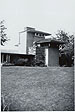 |
Taliesin III, Spring Green Tower
and Hill Apartment, second view, circa 1935 (1925 - S.218). These two views
(3 & 4) indicate that either Lane made two trips to Taliesin, or #3 was in
his collection. Viewed from the South toward the Tower and Hill Apartment.
The dovecote on the Southwest wall of the tower has been removed, and the
wall extended and enlarged out to the edge of the overhanging eave. The
large dinner bell sets in the balcony. Photographed by
Gilman Lane. 5.5 x
8.25 and original 3.5 x 5 B&W photograph. |
0397.26.0514 -4 A&B |
C 1935-5 A&B
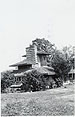 |
Taliesin, Spring Green Tower and
Hill Apartment, pre 1935 (1925 - S.218). Viewed from the West toward the
Tower and Hill Apartment. The Southwest wall of the tower is covered with
decorative horizontal boards and holes, creating a dovecote. Just beyond it
sets a large dinner bell sets in the balcony. Photographed by
Gilman Lane.
5.5 x 8.25 and original 3.5 x 5 B&W photograph. |
0397.26.0514 -5 A&B |
C 1935-6 A&B
 |
Taliesin III, Spring Green Tower
and Hill Apartment, circa 1935 (1925 - S.218). Viewed from the Southeast
toward the Tower and Hill Apartment. The Southwest wall of the tower has
been extended and enlarged out to the fascia. The large bell sets in the
balcony. A sculpture is seen on the right. Similar to the sculpture in the
Living Room seen on the cover of "Frank
Lloyd Wright Select Houses 2." Photographed by
Gilman Lane. 5.5 x 8.25 and original 3.5 x 5 B&W photograph. |
0397.26.0514 -6 A&B |
C 1935-7 A&B
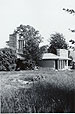 |
Taliesin III, Spring Green Tower
and Hill Apartment, circa 1935 (1925 - S.218). Viewed from the West toward
the Tower and Hill Apartment. The Southwest wall of the tower has been
extended and enlarged out to the fascia. The wing and fireplace on the
right, heading South from the tower has been added, (see #5). Photographed
by
Gilman Lane. 5.5 x 8.25 and original 3.5 x 5 B&W photograph. |
0397.26.0514 -7 A&B |
C 1935-8 A&B
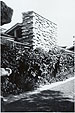 |
Taliesin III, Studio fireplace
mass, circa 1935 (1925 - S.218). Viewed from the West. For similar views see
"Frank Lloyd Wright Select Houses 2," page 60-61, 92-93, 96,100-101. Photographed by Gilman
Lane. 5.5 x 8.25 and original 3.5 x 5 B&W photograph. |
0397.26.0514 -8 A&B |
C 1935-9 A&B
 |
Taliesin III, Spring Green,
circa 1935 (1925 - S.218). View of Taliesin from the hillside. Appears to be
a sculpture in the window. 8.25 x 5.5 and original 3.5 x 5 B&W photograph. |
0397.26.0514 -9 A&B |
C 1935-10 A&B
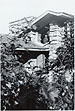 |
Taliesin III, Spring Green,
circa 1935 (1925 - S.218). Detailed view of Taliesin from the hillside.
Appears to be a sculpture in the window. 5.5 x 8.25 and original 3.5 x 5 B&W
photograph. |
0397.26.0514 -10 A&B |
C 1935-11 A&B
 |
Taliesin III, Spring Green,
circa 1935 (1925 - S.218). View of Taliesin from the hillside. 8.25 x 5.5
and original 3.5 x 5 B&W photograph. |
0397.26.0514 -11 A&B |
C 1935-12 A&B
 |
Taliesin III, Spring Green,
circa 1935 (1925 - S.218). Detailed view of Taliesin from the hillside. 8.25
x 5.5 and original 3.5 x 5 B&W photograph. |
0397.26.0514 -12 A&B |
C 1935-13 A&B
 |
Taliesin III, Spring Green,
circa 1935 (1925 - S.218). View of Taliesin. 8.25 x 5.5 and original 3.5 x 5
B&W photograph. |
0397.26.0514 -13 A&B |
C 1935-14 A&B
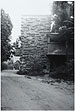 |
Taliesin III, Spring Green,
circa 1935 (1925 - S.218). Detailed view of Taliesin. 5.5 x 8.25 and original
3.5 x 5 B&W photograph. |
0397.26.0514 -14 A&B |
C 1935
 |
Taliesin, Spring Green, Romeo
and Juliet windmill Circa 1935. Designed in 1896 for Wright's two aunts
Ellen and Jane Lloyd-Jones and the Hillside Home School, it was completed in
1897. "...The reservoir finished, the Aunts intended to erect a windmill
over it. This was decided upon by a family gathering which the clan usually
held to make such decisions concerning the school or important affairs of
their own. Said Aunt Nell, managerial mind of the school: "Why not a pretty
windmill tower in keeping with our school building instead of an ugly steel
tower or, for that matter, the timber ones I have seen? I am going to ask
Frank for a design." "An Autobiography," Wright, 1932, page 130. Wright's 60
foot tall structure functioned as a windmill and a belvedere. The design
combined a diamond-shaped column wedged into an octagonal structure,
symbolizing the embrace of Shakespeare's lovers. The original windmill was
covered in shingles, and in 1938 it was resurfaced in board and batten
siding. Still covered in shingles, this photograph was taken before 1938.
Label pasted to verso: "The Museum of Modern Art. Wright, Frank Lloyd.
"Romeo and Juliet" Windmill, Spring Green, Wisconsin, Hillside, 1896."
Original 10 x 8 B&W photograph. |
0397.38.0216 |
C 1935
 |
Hillside Home School, Taliesin
Fellowship Complex Circa 1935 (1932- - S.228). View from the Southwest.
Ellen (Nell) and Jane Lloyd Jones, Frank Lloyd Wright's aunts, formed the
Hillside Home School in 1887. Wright designed Hillside Home School I in 1892
(1897 - S.001). As the school grew, so did the need for more space. Wright
designed Hillside Home School II in 1902, which was completed in 1903. The
building was constructed of light rose colored sandstone, heavy oak beams
and red roof tiles. The gymnasium/theatre was on the left, two floors of
classrooms and offices in the center, and a three story assembly hall on the
right. Hillside Home School closed in 1915, and the building fell into
disrepair. When Wright began the Taliesin Fellowship in 1932, it became part
of the Taliesin Fellowship complex. Edgar Tafel pictured the decapitated
condition in 1932, "Years
With Frank Lloyd Wright," p.29. Leaded glass windows broken and front
columns above archway demolished. He began restoring and remodeling the
building, windows have been replaced with plate glass, and lower portion of
windows in the theatre now open. Lane visited
Taliesin around 1935, and these could have been taken at this time.
10 x 7.5 B&W photograph.
(See progression of the Hillside
Home School / Taliesin Complex) |
0397.33.0215 |
C 1935
 |
Hillside Home School, Taliesin
Fellowship Complex Circa 1935 (1932- - S.228). View from the West. Ellen
(Nell) and Jane Lloyd Jones, Frank Lloyd Wright's aunts, formed the Hillside
Home School in 1887. Wright designed Hillside Home School I in 1892 (1897 -
S.001). As the school grew, so did the need for more space. Wright designed
Hillside Home School II in 1902, which was completed in 1903. The building
was constructed of light rose colored sandstone, heavy oak beams and red
roof tiles. The gymnasium/theatre was on the left, two floors of classrooms
and offices in the center, and a three story assembly hall on the right.
Hillside Home School closed in 1915, and the building fell into disrepair.
When Wright began the Taliesin Fellowship in 1932, it became part of the
Taliesin Fellowship complex. Edgar Tafel pictured the decapitated condition
in 1932, "Years
With Frank Lloyd Wright," p.29. Leaded glass windows broken and front
columns above archway demolished. He began restoring and remodeling the
building, windows have been replaced with plate glass, and lower portion of
windows in the theatre now open. Lane visited
Taliesin around 1935, and these could have been taken at this time.
10 x 7.5 B&W photograph.
(See progression of the Hillside
Home School / Taliesin Complex) |
0397.34.0215 |
C 1935-45
 |
Unity Temple, Oak Park, Illinois, Circa
1935-1945 (1904 - S.096). Photograph of Unity Temple held in the collection
of the Oak Park Public Library. View of the entrance on the West side. The
sanctuary is on the left, Unity House is to the right. The text reads "For
The Worship of God, And The Service of Man." Designed by Frank Lloyd Wright
in 1904. The walls were executed in poured concrete. This photograph was
produced in the late 1970s. Hand written on verso: "Unity 26 C."
Photographed by
Gilman Lane.
Original 5 x 3.5 B&W photograph. |
0397.70.0920 |
C 1935-40
 |
Edward C. Waller Apartments Circa 1935-40
(1895 S.031) looking East. Viewed from the Southwest, the Waller Apartments
and adjacent Francisco Terrace were both designed as low income housing in
1895. Although the Francisco Terrace Apartments were designed first, it was
constructed after the Waller Apartments. The Francisco Terrace Apartments
were built adjacent to and behind the Waller Apartments, and connected on
the West side. Many architectural details found in the Waller Apartments are
also evident in the Francisco Terrace Apartments. It consisted of five
connected buildings, with four units per building. The first and last
apartments had an arched entryway, the second, third and fourth buildings
had a limestone lintel over the entryway. A person is hanging out the window
of the first floor in the first building, and two women are standing outside
the center building and appear to be in conversation. Photographed by
Gilman Lane. Etched into the negative, bottom left corner "67362." 10 x 8 B&W
photograph. |
0397.44.0119 |
C 1935-40
 |
Edward C. Waller Stables, South Elevation,
River Forest, IL Circa 1935-1945 (1901 - S.066). South Elevation of the Mr.
Edward C. Waller Stables. Designed by Frank Lloyd Wright in 1901. On Sheet 1
of the original floor plan for the first floor, the left side was used for
Ice Storage, Cows and Tools and a Storage Area. There is a passage way
though the gates in the center. The right side held stalls for horses,
harness room, Coachman's room (office?), and a large section for carriages.
On Sheet 2, the floor plan for the second floor includes a two-bedroom,
one-bath apartment, with a living room and kitchen. About a third of it is
used for a hay loft. The two spire "ventilators" are covered in copper and
shingles. The interior of the Edward C. Waller home, was remodeled by Frank
Lloyd Wright in 1899, and demolished in 1939. All other structures on the
estate except the Waller Gates were also demolished. Text bottom left:
"67483." Photographed by Gilman Lane. Courtesy of the Art Institute of
Chicago. 10 x 8 B&W photograph. |
0397.72.0521 |
C
1935-40
 |
Edward C. Waller Poultry House, West
Elevation, River Forest, IL Circa 1935-1945 (1901 - S.066). West Elevation
of the Edward C. Waller Poultry House. Designed by Frank Lloyd Wright in
1901. The Poultry House is the smaller building on the far right and
measured 20' x 50'. It is attached to the end of an existing bard and what
appears to be a glass nursery. Like the Waller Gates, the four corners are
stone piers. Like the Stables, there are two decorative spire "ventilators."
The interior of the Edward C. Waller home, was remodeled by Frank Lloyd
Wright in 1899, and demolished in 1939. All other structures on the estate
except the Waller Gates were also demolished. Text bottom left: "67484."
Photographed by Gilman Lane. Courtesy of the Art Institute of Chicago. 10 x
8 B&W photograph. |
0397.73.0521 |
C 1935
 |
Joseph J. Walser Residence Circa 1935-1945
(1903 - S.091). Viewed from the Northeast. Designed by Frank Lloyd Wright in
1903, the house sat on an uncrowded lot, in the newly annexed Austin
neighborhood. The corner of the eve of the two-story apartment building to
the North, built circa 1925, can be seen in the upper right. The four-story
apartment building built to the South circa 1950 has not been built yet.
Although there are slight differences, the Walser is very similar in design
to the
Barton, De
Rhodes and
Horner houses. The
Living Room faces the street, the dining room is at the back of the house.
The Entrance and Reception Room is on the left, the Kitchen is on the right.
The Reception room and Kitchen are set back from the front of the house, and
two identical porches balanced out the front of the house. The porches have
been roofed and enclosed. Text bottom left: "67368." Courtesy of the Art
Institute of Chicago. 10 x 8 B&W photograph. |
0397.54.0720 |
C 1935-41
 |
Burton J. Westcott Residence
(S.099 - 1904), circa 1935-41. Designed in 1904, built in 1905 (according to
Storrer). Viewed from the Southeast. Dining Room on the left, Living Room in
the center, Sitting Room on the far right, first floor. Photographed by
Gilman
Lane. Noted that the
second floor "Veranda" (balcony) on the far right has been enclosed, which
was not originally intended by Wright. Published in "In
The Nature of Materials" Hitchcock, 1942, pl 135. Acquired from the
Art Institute of Chicago. Original 8 x 5.75 B&W Print. |
0397.09.1011 |
C 1935-41
 |
Burton J. Westcott Residence
(S.099 - 1904), circa 1935-41. Designed in 1904, built in 1905 (according to
Storrer). Viewed from the Southeast. Sitting Room on the left, Entrance to
the Home in the center, first floor. Pergola in the center between the house
and the Garage on the far right. Photographed by
Gilman
Lane.
Noted that the second floor "Veranda" (balcony) on the far left has been
enclosed, which was not originally intended by Wright. Courtesy of the OPPL.
Original 8 x 5.75 B&W Print. |
0397.10.1011 |
C 1935-41
 |
Burton J. Westcott Residence
(S.099 - 1904), circa 1935-41. Designed in 1904, built in 1905 (according to
Storrer). Viewed from the Southeast. Entrance to the Pergola is on the left,
the Pergola in the center and the Garage on the far right. Photographed by
Gilman
Lane. Courtesy of the OPPL.
Original 8 x 5.75 B&W Print. |
0397.11.1011 |
C 1935-41
 |
Burton J. Westcott Residence
(S.099 - 1904), circa 1935-41. Designed in 1904, built in 1905 (according to
Storrer). Viewed from the East. Sitting Room on the left, Entrance to the
Home in the center, first floor. Pergola is on the right. Photographed by
Gilman Lane. Acquired from the
Art Institute of Chicago. Original 8 x 6 B&W Print. |
0397.12.1011 |
C 1935-41
 |
Burton J. Westcott Residence
(S.099 - 1904), circa 1935-41. Designed in 1904, built in 1905 (according to
Storrer). Viewed from the Northeast. The Home on the left, Pergola in the
center, the Garage is on the far right. Photographed by
Gilman Lane.
Acquired from the Art Institute of Chicago. Original 8 x 6.25 B&W Print. |
0397.13.1011 |
C 1935-45
 |
William H. Winslow House, River Forest, IL,
Circa 1935-1945 (1894 - S.024 & .025). Set of three photographs of the
Winslow House, held in the collection of the Oak Park Public Library. View
of the West elevation from the street. Designed by Frank Lloyd Wright in
1894. These photographs were produced in the late 1970s. Hand written on
verso: "Winslow 1 A." Photographed by
Gilman Lane.
Original 5 x 3.5 B&W photograph.
|
0397.71.0920 (1-3) |
1935
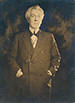 |
Wright at 68. 1935. Portrait of Frank
Lloyd Wright. Wright is facing forward, looking directly at the camera. Both
hands are in his suite jacket pockets. Eye glasses are hanging down. This
photograph appears to be taken in a studio, the background is modeled.
This portrait was published in
Time Magazine,
July 15, 1935, p.44. The photograph is credited: "Keystone." Keystone Press
Agency became one of the most respected became prominence after the World
War I and became one of leading press agencies of the era. Printed on a
thick stock stat has turned light tan with age. Original silver geletain 7 x
9.5 B&W photograph. |
0397.86.0824 |
1935
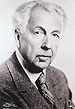 |
Wright at 68. 1935. Portrait of Frank Lloyd
Wright. Facing slightly to the right, looking straight into the camera.
Wearing a coat and tie. Photographed by Don Keller, Phoenix Ariz. Text
bottom left: Photo by Don Keller, Phoenix Ariz, 4-5-35." Published in
American Architect, May 1935, p.55.
Original 6 x 9 B&W
photograph.
|
0397.06.0921 |
1935
 |
Harrison P. Young Residence
Additions and Remodel, Oak park (1895 - S.036) circa 1935. View from the
street, left and front sides. Frank Lloyd Wright remodeled the home in 1895.
It was originally built is the 1870s and designed by William E. Coman.
Wright's modifications which were pretty extensive in 1895, included moving
the house 16.5 feet further back into the lot, a new Living Room, two second
floor Bedrooms, the addition of a wide porch, and reconfiguring the house's
interior spaces. This would indicate the front of the house was an addition,
and Wright's design. Details such as semi-circular window on top, the
diamond shaped panes of leaded glass, decorative bracing above the three
upper windows and the roof overhang, the upper corner plaster panels, and
the cantilevered porch roof. Wright also designed the fireplaces in the
living room and master bedroom. The original front stairs that Wright
designed were reached at the end of the sidewalk where they paralleled the
front porch. A left turn to the top of the stairs, then a right turn brought
you up to the porch. The stairs were hidden behind the porch wall. The porch
roof cantilevers over the drive on the North (left) end. There is a
similarity to the design of the A.W. Herbert Residence remodeling, Evanston,
IL (1902 - S.089). Photographed by Gilman Lane. 8 x 10 B&W photograph. |
0397.36.0116 |
1935
 |
Harrison P. Young Residence
Additions and Remodel, Oak park (1895 - S.036) circa 1935. View from the
street, front and right sides. Frank Lloyd Wright remodeled the home in
1895. It was originally built is the 1870s and designed by William E. Coman.
Wright's modifications which were pretty extensive in 1895, included moving
the house 16.5 feet further back into the lot, a new Living Room, two second
floor Bedrooms, the addition of a wide porch, and reconfiguring the house's
interior spaces. This would indicate the front of the house was an addition,
and Wright's design. Details such as semi-circular window on top, the
diamond shaped panes of leaded glass, decorative bracing above the three
upper windows and the roof overhang, the upper corner plaster panels, and
the cantilevered porch roof. Wright also designed the fireplaces in the
living room and master bedroom. The original front stairs that Wright
designed were reached at the end of the sidewalk where they paralleled the
front porch. A left turn to the top of the stairs, then a right turn brought
you up to the porch. The stairs were hidden behind the porch wall. The porch
roof cantilevers over the drive on the North (left) end. There is a
similarity to the design of the A.W. Herbert Residence remodeling, Evanston,
IL (1902 - S.089). Photographed by Gilman Lane. 8 x 10 B&W photograph.
|
0397.37.0116 |
|
1936 |
1936
 |
"Arizona Biltmore Hotel
Phoenix." Approaching Arizona Biltmore, 1936, (Published by
Frashers, Inc., Pomona. Calif.) Frashers Fotos. 3.4 x 2.4. |
0404.11.0507 |
1936
 |
"Arizona Biltmore Hotel
Phoenix." Arizona Biltmore from Canal Bridge, 1936, (Published
by Frashers, Inc., Pomona. Calif.) Frashers Fotos. 3.4 x 2.4. |
0404.12.0507 |
Circa 30-40's
 |
Arizona Biltmore,
(Horses). 8x10 print, 22x22 Matted and framed. Framed print adorned
guest rooms. |
1940.01.0205 |
|
Circa 30-40's
 |
Arizona Biltmore,
(Pool, Cabanas and Old Ballroom). 8x10 print, 22x22 Matted and framed.
Framed print adorned guest rooms. |
1940.02.0205 |
1936
 |
At Taliesin, May 29, 1936. Photograph of an
article written by Frank Lloyd Wright on May 25, 1936. Published in The
Capital Times, Madison, Wisconsin, May 29, 1936. Randy Henning refers to the
article written by Frank Lloyd Wright, p.270, but does not include it in
At Taliesin,
Henning, 1992. At Taliesin. The silliest scares gratuitously handed out to
Americans today are the "Red Menace", ergo Russia, and the "Yellow Peril",
ergo Japan. How to be childlike does not necessarily detract from the
individual happiness and wisdom in the grown-up... but to be childish
necessarily does. When Newsprint and politicians ebb so low that these two
puppet perils are set up and puppet strings are pulled by fingers, official
or unofficial, and better to watch closely to see what
really is going on in behind the attempted distraction. Yes, we have
recently been accused of Russian Propaganda at the Taliesin Playhouse. We
sincerely are interested in the art of the cinema as we are in other arts
and to leave Russia out of our widening horizon would be like throwing
Hamlet out of Hamlet because we didn't like Hamlets... 4 x 10 B&W photograph
of an article written by Frank Lloyd Wright on May 25, 1936, published in
The Capital Times, Madison, Wisconsin, May 29, 1936.
|
0404.38.1020 |
1936
 |
At Taliesin, July 9, 1936. Photograph of an
article written by Frank Lloyd Wright, dated July 15, 1936. Published in The
Wisconsin State Journal, Madison, Wisconsin, on July 9, 1936. At Taliesin.
Some People regard Taliesin and its Fellowship as an establishment. As time
goes on the tendency grows to regard Taliesin as less and less the home of a
creative architect and more and mores some kind of education al institution.
Really it is no more like an institution than it was like one when Frank
Lloyd Wright built it as a place in which to live and work. The
apprenticeship then was never more than ten. Even with enlarged facilities
at present apprenticeship will never be more than thirty. At one time the
danger of institution loomed ahead. That was in the days when the first
Taliesin prospectus was issued. But the danger soon became apparent and the
plans of that date were discarded. Others were made intended to preserve
individuality, flexibility, and original integrity or let us say, the
integrity or originality that primarily characterized Taliesin. 2.5 x 10 B&W
photograph of an article written by Frank Lloyd Wright, published in The
Wisconsin State Journal, Madison, Wisconsin, on July 9, 1936.
|
0404.40.1020 |
1936
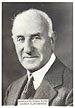 |
Solomon R.
Guggenheim, 1936 (1956 - S.400). Portrait of Solomon R. Guggenheim. Text of
face: "Associated Press Photo, Solomon R. Guggenheim." Stamped on verso:
"Solomon R Guggenheim." "Apr 27 1936." Frank Lloyd Wright was first
approached in 1943 to design a museum for Solomon R. Guggenheim's collection
of non-objective art. A model of the museum was presented to the public on
September 20,1945. But it would take another 14 years for the museum to come
to fruition. Six months after Wright's death, the museum opened on October
21, 1959. Original 5 x 7 B&W photograph. Acquired from the archives of the
Baltimore Sun. |
0404.27.0415 |
1936
 |
Paul & Jean Hanna
Residence, Honeycomb House, Stanford, California, Perspective 1936 (1936 -
S.235). FLLW #3701. Perspective of the Paul & Jean Hanna Honeycomb House.
Photograph of original drawing in the Frank Lloyd Wright Archives. Designed
by Frank Lloyd Wright in 1937, and the first house to use the hexagon as the
unit for the design. Lower left: Square box signed FLLW within. Additional
drawings in
Frank Lloyd Wright, 1917-1942,
Pfeiffer, 2010, p.270-277. Original 10 x 8 B&W photograph. |
0404.34.1219 |
1936
 |
Paul & Jean Hanna
Residence, Honeycomb House, Stanford, California, Ground Plan 1936 (1936 -
S.235). FLLW #3701. Ground Plan for the Paul & Jean Hanna Honeycomb House.
Photograph of original drawing in the Frank Lloyd Wright Archives. Designed
by Frank Lloyd Wright in 1937, and the first house to use the hexagon as the
unit for the design. Text: "Dwelling for Mr. And Mrs. Paul R. Hanna, Palo
Alto, California. Frank Lloyd Wright." Published in
Frank Lloyd Wright, 1917-1942,
Pfeiffer, 2010, p.272. Original 10 x 8 B&W photograph. |
0404.35.1219 |
1936
 |
Herbert & Katherine Jacobs
Residence I, Madison, Wisconsin 1936 (1936 - S.234). Copy 35mm slides.
Interior perspective of the Living Room and fireplace. Designed by Frank
Lloyd Wright in 1936. Text on sleeve: "A-20-Wr-93.2-5. Jacobs House 1.
Interior perspective." Published in
Frank Lloyd Wright Monograph
1924-1936, Pfeiffer, 1985, p.229. Acquired from the archives of the
University of Virginia. 35mm Color slide, sandwiched between glass, plastic
mount. |
0404.36.0720 |
1936
 |
S.C. Johnson
Building Model. 1936. Designed in 1936, the building was completed on April
22, 1939. The Research Tower was designed in 1944 and construction began in
1947. Caption on back: "Now in Wisconsin. For years Frank Lloyd Wright
designed unique buildings in many parts of the world. He planned this
factory of the Johnson & Co., Racine. It combines straight and curved lines,
built without ornamentation, yet with a trim beauty of its own." Additional
images of model in "Frank Lloyd
Wright and he Johnson Wax Building" Lipman, page 36. "At the end of
August Wright guided three of his apprentices Blaine and Hulda Drake, and
Eugene Masselink, in the construction of a large, detailed model of the
Administration Building that could be separated into two halves, allowing
one to peer into a miniature Great Workroom." Construction of the model lead
Wright to make changes to the design.
Page 37. Paul's Photos. 3702 N.
Lakewood Avenue, Chicago 13, Illinois. "GF-901". Original silver gelatin
photo. 10 x 5.8. |
0404.22.0109 |
1936
 |
Ralph Fletcher Seymour
1936. Photographed by Harold E. Way while Seymour was artist in residence at
Know College, Galesburg, Illinois. In 1937, Seymour painted Abraham Lincoln,
on stage, giving a speech at the Lincoln-Douglas debate at Knox College,
Galesburg, Illinois, October 7th 1858. The painting hangs in the college's
Old Main. He also etched "Old Main" Knox College, A commemorative etching,
to celebrate the 100th anniversary of Knox
College. Courtesy of Knox College. 8 x 9 B&W photograph. |
0404.31.0517 |
1936
 |
Frank L. Smith, Dwight, Illinois, 1936
(1905 - S.111). Frank L. Smith, facing to the right, head lowered with a
cigar in his left hand. George Getz is on the right. Label pasted to verso:
"Chicago, IL. 6-2-36. Delegates Gather For Republican Convention. Cleveland,
Ohio. - Frank L. Smith, at left, Republican Committeeman from Chicago and
George Getz of Chicago, Treasurer Republican Committee, at Hotel in
Cleveland after their arrival to attend the National Republican Convention."
The 1936 Republican Presidential Convention was held in Cleveland, Ohio,
from June 9 - 12, 1936. Frank L Smith was elected as the national
committeeman for Illinois in 1932. The Republican Nation Committee (RNC)
consisted of one member from each state to serve for four years. The Chicago
Tribune reported, May 2, 1936, on the Republican state convention to be held
on May 22, 1936. "There was some discussion on who would be elected national
committeeman at Cleveland by the delegates to the national nominating
convention due to the arrival here of Frank L. Smith of Dwight, candidate
for reelection as national committeeman from Illinois. George F. Harding,
one of the original sponsors of Brooks, also is a candidate... Smith was
elected committeeman four years ago through the... Continue...
See
Wright Study on the Frank L. Smith Bank. |
0404.29.0716 |
1936
 |
Frank L. Smith, Dwight,
Illinois, 1936 (1905 - S.111). Frank L. Smith, facing to the right, head
lowered with a cigar in his left hand. The 1936 Republican Presidential
Convention was held in Cleveland, Ohio, from June 9 - 12, 1936. Frank L Smith was elected as the national
committeeman for Illinois in 1932. The Republican Nation Committee (RNC)
consisted of one member from each state to serve for four years. The Chicago
Tribune reported, May 2, 1936, on the Republican state convention to be held
on May 22, 1936. "There was some discussion on who would be elected national
committeeman at Cleveland by the delegates to the national nominating
convention due to the arrival here of Frank L. Smith of Dwight, candidate
for reelection as national committeeman from Illinois. George F. Harding,
one of the original sponsors of Brooks, also is a candidate... Smith was
elected committeeman four years ago through the influence of Len Small, then
the Republican nominee for governor." Smith was not elected as the national
committeeman, but was a delegate to the convention. Stamped on verso: "From
Acme Newspictures, Inc. Cleveland Bureau, 1200 West Third St." "6 18 36. N.
E. A." Original 6.5 x 8.5 B&W photograph. See
Wright Study on the Frank L. Smith Bank. |
0404.23.1144 |
1936
 |
Oscar Steffens Residence, Chicago,
Illinois, Circa 1936 (1909 - S.153). Viewed from the West, looking toward
Lake Michigan which can be seen at the end of the street. The Steffens House
can be seen on the right. Designed by Frank Lloyd Wright in 1909. The
Steffens would move from their home after just three years. The home was
purchased by Otto C. Bach in August 1912. Otto Bach was the brother of
another Wright client, Emil Bach (1915 - S.193), located on the same street,
a couple miles south.
Otto C. Bach past away on October 7, 1932 at 60 years of age, after living
in his Wright designed home for twenty years. His wife Louise moved out of
home after her husbands death, but retained ownership. She rented the home,
and for the next thirty years the King's Arms Restaurant abused what once
was a beautifully designed Frank Lloyd Wright home. When Louise Bach past
away, the home went to Otto C. Bach Jr. in December 1960. He continued to
rent the property to the restaurant, but when approached by a developer, and
with no real ties to the home, sold it to O. W. Howell Enterprises in
January 1963. Three months later, and only a skeleton remaining of the home,
it was laid to rest... Continue... |
0404.51.1225 |
1936
 |
Taliesin III, Spring Green,
Enlarging Frank Lloyd Wright's Bedroom 1936 (1925 - S.218). Published in "At
Taliesin," Henning, 1992, p.197. Caption: "Last summer saw quite a bit
this seasonal growth... a sunny new bedroom, also developed from an old one,
for Mr. Wright" (Noverre Musson, "At
Taliesin," March 12, 1937). Apprentices Blaine Drake and Jim Thomson
enlarging Frank Lloyd Wright's bedroom in 1936. Photo courtesy of John H.
Howe, Architect. Original 8 x 10 B&W
photograph. |
0404.26.0215 |
1936
 |
Wright at Taliesin Spring Green,
Circa 1936. Frank Lloyd Wright operating a road grader at Taliesin, Spring
Green circa 1936. Wright is wearing a double-breasted suit, tie, hat and
work boots. Wright formed the Taliesin Fellowship in 1932 with 23
apprentices. The tractor pulling the road grader could have been operated by
one of the apprentices. In a letter to the Hanna's on June 17, 1936, Wright
wrote "...We are busy and pushing on. I got tossed [off] the road grader
making our new road to Hillside. Wrenched neck and leg-couple of ribs
knocked in-damn'D painful as I sit here writing, but worse when I try to lie
down." "Frank Lloyd Wright's Hanna
House" Hanna, 1981, p.25. One would assume that this was taken before
his painful mishap on the road grader. Published in "At
Taliesin" Henning, 1992, p.8. 8 x 8 B&W photograph. |
0404.24.0215 |
1936
 |
Wright at Taliesin Spring Green,
Circa 1936. Frank Lloyd Wright operating a road grader at Taliesin, Spring
Green circa 1936. Wright is wearing a double-breasted suit, tie, hat and
work boots. Wright formed the Taliesin Fellowship in 1932 with 23
apprentices. The tractor pulling the road grader could have been operated by
one of the apprentices. In a letter to the Hanna's on June 17, 1936, Wright
wrote "...We are busy and pushing on. I got tossed [off] the road grader
making our new road to Hillside. Wrenched neck and leg-couple of ribs
knocked in-damn'D painful as I sit here writing, but worse when I try to lie
down." "Frank Lloyd Wright's Hanna
House" Hanna, 1981, p.25. One would assume that this was taken before
his painful mishap on the road grader. 8 x 8 B&W photograph. |
0404.25.0215 |
1936
 |
Wright at 69. High res
digital 4x5 digital image, 1936. (241KB) 4 x 5. |
0404.10.0307 |
1936
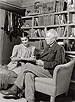 |
Wright at 69. 1936. Mr. and Mrs.
Frank Lloyd Wright. Frank Lloyd Wright and his wife Olgivanna, seated
together reading in the living room at Taliesin. Photographed by Melvin E.
Diemer. Published in "Frank Lloyd Wright
Collected Writings", Volume 4, Pfeiffer, 1994, page 121; "Frank
Lloyd Wright, His Life and His Architecture", Twombly, 1979, page 289
but dated early 1940s. 4.4 x 6 print. High res digital image. |
0404.20.0509 |
|
1937 |
1937
 |
Harold Espey "All Steel Houses,"
Los Angeles, CA, Perspective, 1937 (Project - 1937 - FLLW #3705). Photograph
of original drawing in the Frank Lloyd Wright Archives. Perspective of a
Harold Espey "All Steel House." Frank Lloyd Wright was commissioned for
design 100 steel homes on a hillside in 1937. Text: "Study for All-Steel
Houses." Additional drawings in
Frank Lloyd Wright, 1917-1942,
Pfeiffer, 2010, p.303. Original 10 x 8 B&W photograph. |
0429.45.1219 |
1937
 |
Harold Espey "All Steel Houses,"
Los Angeles, CA, Elevation, 1937 (Project - 1937 - FLLW #3705). Photograph
of original drawing in the Frank Lloyd Wright Archives. Elevation of a
Harold Espey "All Steel House." Frank Lloyd Wright was commissioned for
design 100 steel homes on a hillside in 1937. Text: "Studio Living Room.
Cantilevered mezzanine type. Sheet Metal Structure for dwelling. Unit
System...." Lower left: "3705.08." Additional drawings in
Frank Lloyd Wright,
1917-1942, Pfeiffer, 2010, p.303.
Original 10 x 8 B&W photograph. |
0429.46.1219 |
1937
 |
Harold Espey "All Steel Houses,"
Los Angeles, CA, Elevation and Floor Plans, 1937 (Project - 1937 - FLLW
#3705). Photograph of original drawing in the Frank Lloyd Wright Archives.
Elevation and three floor plans for a Harold Espey "All Steel House." Frank
Lloyd Wright was commissioned for design 100 steel homes on a hillside in
1937. Text for upper illustration: "Side." Center left Illustration: "Lower
Level." Center: "Mezzanine or Middle Level." Right: "Upper." Additional
drawings in
Frank Lloyd Wright, 1917-1942,
Pfeiffer, 2010, p.303. Original 10 x 8 B&W photograph. |
0429.47.1219 |
1937
 |
Harold Espey "All Steel Houses,"
Los Angeles, CA, Elevation and Floor Plans, 1937 (Project - 1937 - FLLW
#3705). Photograph of original drawing in the Frank Lloyd Wright Archives.
Elevation and three floor plans for a Harold Espey "All Steel House." Frank
Lloyd Wright was commissioned for design 100 steel homes on a hillside in
1937. Text for upper illustration: "Side." Center left Illustration: "Lower
Level." Center: "Mezzanine or Middle Level." Right: "Upper." Additional
drawings in
Frank Lloyd Wright, 1917-1942,
Pfeiffer, 2010, p.303. Original 10 x 8 B&W photograph. (S#429.48) Same as
47. |
0429.48.1219 |
1937
 |
Fallingwater,
Kaufmann House, Bear Run, Pennsylvania. Bill Hedrich, Hedrich-Blessing
Exterior view shows balconies cantilevered over the stream.
Photographed and printed in 1937 by Bill Hedrich of the photographic firm of
Hedrich-Blessing, Chicago. Published in: "In
the Nature of Material" Hitchcock 1942, plate 320; "The
Future of Architecture" Wright 1953, page 14; "A
Testament" Wright 1957, page 165; "Frank
Lloyd Wright, His Life, His Work, His Words" Wright 1966, page 128;
"An Autobiography" Wright
1977, page 320 plate 6; "Frank Lloyd Wright Collected Writings,
Volume 3" Pfeiffer 1993, page 281; "Frank
Lloyd Wright and the Living City" De Long 1998, page 67, 213. Original 9 x 7 vintage silver gelatin photograph. |
0429.01.1106 |
1937
 |
Fallingwater,
Kaufmann House, Bear Run, Pennsylvania. Photographed in 1937 by Bill Hedrich of the photographic firm of Hedrich-Blessing,
Chicago, printed May 12, 1944. Verso: "(This picture is for release to
papers of Sunday, May 28 and thereafter, with John Selby's New York AP
special story on Modern Architecture). House Built Over a Waterfall.
This House created by Architect Frank Lloyd Wright for Edgar Kaufmann,
Pittsburgh Department Store owner, at Bear Run, PA., is one of 47 structures
chosen by authorities at the Museum of Modern Art's new show in New York to
illustrate the best modern trends of the last 12 years. It is built
over a waterfall, anchored to the mountain with stone quarried from the
site, and cantilevered out into space so that its balconies give the
impression of flying off over the mountainside." Original 9 x 7
vintage silver gelatin photograph.
Second Print: Printed July 26, 1976. Clipping pasted to verso:
"Frank Lloyd Wright's exciting "˜Falling Water" residence at Bear Run, Pa.,
was built in 1937. Cantilevered out over a water fall, it enjoys a more
spectacular site than any of Wright's Chicago houses, many of which were
mentioned in the poll." Stamped on clipping: "Jul 26 1976". Stamped on
verso: "Hedrich Blessing, Chicago, ILL. Neg. No: 4414 D3". Original 10 x 8
B&W photograph. |
0429.06.0707 0429.10.0811 |
1937
 |
Fallingwater, Kaufman House, Bear Run, Pennsylvania (S.230 - 1935).
Photographed in 1937 by Bill Hedrich of the photographic firm of Hedrich-Blessing,
Chicago. Label pasted to verso: "The Solomon R. Guggenheim Museum. (Typed:)
1935, Edgar, J. Kaufmann House, Fallingwater." Stamped on label: "Filed Oct
30 1953." Clipping pasted to verso: "The materials of which a building is
made help to determine its form and appearance, according to Frank Lloyd
Wright. Fallingwater, built at Bear Run, Pa., in the mid-1930s, was his
first house built of reinforced concrete. Of it, he commented, "The form
took the grammar of that type of construction." The stream flows under the
special platform that Wright designed and offers and unusual rustic touch."
Stamped on clipping: "Dec 19 1954." There is a third clipping pasted to the
verso dated "Apr 9 1959," and a fourth clipping dated "Aug 8 1976."
Published in the
Architectural Forum, January, 1938, p.37-38. Original 10 x 8 B&W
photograph.
|
0429.37.0218 |
1937
 |
Fallingwater 1937 (1938 - S.231).
View of Fallingwater from the stream below Fallingwater. The living Room and
Balconies are cantilevered over the stream. Stairs lead down from the Living
Room to the stream bed. The Plunge Pool is to the right. Published in the
Architectural Forum, January 1938, p.40. Also published in
A New House on Bear Run, MOMA,
1938. Photographed in 1937 by Bill Hedrich, Hedrich-Blessing, Chicago. Hand
written on verso: "Hedrich-Blessing. Caption: Edgar J. Kaufmann Residence
"Fallingwater," Bear Run, Pa. Original 9 x 7 B&W photograph. |
0429.41.0918 |
1937
 |
Fallingwater
1937 (1938 - S.231). Set of 7 35mm B&W slides. View of Fallingwater from
below the upper falls. The Living Room and balconies are cantilevered out
over the stream. Published in the Architectural Forum, January 1938,
p.37-38. Photographed in 1937 by Bill Hedrich, Hedrich-Blessing, Chicago.
Number "11" of what appears to be part of a set of at least 19 slides
(bottom left hand corner). 35mm slide mounted in plastic sleeve and 11.5 x 8
high res B&W digital photograph.
|
0429.36.0517 (1-7) |
1937
 |
S.C. Johnson
Headquarters, preparation for the "Dendriform Column Test," 1937 (1936 -
S.237). The actual test took place on June 3-4, 1937. This would have been
taken a few days before that. Scaffolding for the test column for can be
seen in the center. Reusable metal column forms are setting to the left of
the scaffolding. Similar view published in
Frank Lloyd Wright and the Johnson
Wax Buidlings, Lipman, 1986, p.58. Original 10 x 8 B&W photograph.
|
0429.18.0215 |
1937
 |
S.C. Johnson
Headquarters "Dendriform Column Test" June 3-4, 1937 (1936 - S.237). Frank
Lloyd Wright (right) stands with Contractor Ben Wiltscheck (far left), HF
Johnson, Jr. (Center), during the testing of the dendriform column. The
Wisconsin Industrial Commission denied permission to build the columns.
According to builders a column with a nine-inch diameter at the base, could
only support a maximum column height of 6 feet 9 feet. The nine-inch
diameter of the Wright column carried a height of 21 feet 7.5 inches.
Finally it was agreed that a test column would be built, and if it carried
12 tons, construction would proceed. A full scale mockup was created to
specifications. According to The Milwaukee Journal, June 4, 1937,
"Wisconsin's internationally famous architect, Thursday (June 3) won the
first round of an encounter with the Wisconsin Industrial Commission. He
successfully loaded 24 tons of sand on the top of a test column which he
designed for the new administration building of the S. C. Johnson & Sons Wax
Co., at Racine without cracking the pillar." At twelve tons the commission
was satisfied. But Wright was not. "At 6 p. m. the structure was still
standing, and plans were made for continuing the test Friday, adding weight
until the column crashes." According to
Jonathan Lipman...
Continue... |
0429.12.0214 |
1937
 |
S.C. Johnson
Headquarters "Dendriform Column Test" June 3-4, 1937 (1936 - S.237). Frank
Lloyd Wright, HF Johnson, Jr. and Wes Peters sit on a stack of wood during
the testing of the dendriform column. The Wisconsin Industrial Commission
denied permission to build the columns. According to builders a column with
a nine-inch diameter at the base, could only support a maximum column height
of 6 feet 9 feet. The nine-inch diameter of the Wright column carried a
height of 21 feet 7.5 inches. Finally it was agreed that a test column would
be built, and if it carried 12 tons, construction would proceed. A full
scale mockup was created to specifications. According to The Milwaukee
Journal, June 4, 1937, "Wisconsin's internationally famous architect,
Thursday (June 3) won the first round of an encounter with the Wisconsin
Industrial Commission. He successfully loaded 24 tons of sand on the top of
a test column which he designed for the new administration building of the
S. C. Johnson & Sons Wax Co., at Racine without cracking the pillar." At
twelve tons the commission was satisfied. But Wright was not. "At 6 p. m.
the structure was still standing, and plans were made for continuing the
test Friday, adding weight until the column crashes." According to
Jonathan Lipman, "At thirty
tons, enjoying...
Continue... |
0429.13.0314
0429.17.0215 |
1937
 |
S.C. Johnson
Headquarters "Dendriform Column Test" June 3-4, 1937 (1936 - S.237). Frank
Lloyd Wright, HF Johnson, Jr. and Wes Peters sit on a stack of wood during
the testing of the dendriform column. The Wisconsin Industrial Commission
denied permission to build the columns. According to builders a column with
a nine-inch diameter at the base, could only support a maximum column height
of 6 feet 9 feet. The nine-inch diameter of the Wright column carried a
height of 21 feet 7.5 inches. Finally it was agreed that a test column would
be built, and if it carried 12 tons, construction would proceed. A full
scale mockup was created to specifications. According to The Milwaukee
Journal, June 4, 1937, "Wisconsin's internationally famous architect,
Thursday (June 3) won the first round of an encounter with the Wisconsin
Industrial Commission. He successfully loaded 24 tons of sand on the top of
a test column which he designed for the new administration building of the
S. C. Johnson & Sons Wax Co., at Racine without cracking the pillar." At
twelve tons the commission was satisfied. But Wright was not. "At 6 p. m.
the structure was still standing, and plans were made for continuing the
test Friday, adding weight until the column crashes." According to
Jonathan Lipman, "At thirty
tons, enjoying the...
Continue... |
0429.14.0514 |
1937
 |
S.C. Johnson
Headquarters "Dendriform Column Test" June 3-4, 1937 (1936 - S.237). Frank
Lloyd Wright and HF Johnson, Jr. On site during the testing of the
dendriform column. The Wisconsin Industrial Commission denied permission to
build the columns. According to builders a column with a nine-inch diameter
at the base, could only support a maximum column height of 6 feet 9 feet.
The nine-inch diameter of the Wright column carried a height of 21 feet 7.5
inches. Finally it was agreed that a test column would be built, and if it
carried 12 tons, construction would proceed. A full scale mockup was created
to specifications. According to The Milwaukee Journal, June 4, 1937,
"Wisconsin's internationally famous architect, Thursday (June 3) won the
first round of an encounter with the Wisconsin Industrial Commission. He
successfully loaded 24 tons of sand on the top of a test column which he
designed for the new administration building of the S. C. Johnson & Sons Wax
Co., at Racine without cracking the pillar." At twelve tons the commission
was satisfied. But Wright was not. "At 6 p. m. the structure was still
standing, and plans were made for continuing the test Friday, adding weight
until the column crashes." According to
Jonathan Lipman, "At thirty
tons, enjoying the drama, Wright...
Continue... |
0429.15.0514 |
1937/2002
 |
Herbert F. Johnson
Residence, Wingspread, Racine, Wisconsin, 1937 / 2002 (1937 - S.239). Barrel
chair for the Herbert F. Johnson, Jr. Residence Wingspread. In 1937, Frank
Lloyd Wright returned to the Martin barrel chair and adapted the design for
the Herbert Johnson Residence Wingspread. The arms in the Martin chair
flared up on the ends. For the Johnson chair, the flair was removed, the
cushion was thicker, the base was modified, the crest rail was not as
flared. Manufactured in oak and upholstery by Gillen Woodworks, Milwaukee.
This chair was offered at Wright Auctions, December 8, 2002. Price realized
$31,050. The chair size was listed as 30" High x 20.75" Wide x 19.5" Deep.
Courtesy of Wright Auctions, Chicago. 8 x 6 Color photograph. |
0429.70.0626 |
1937
 |
1) Ben Rebhuhn Residence, Great Neck Estates,
New York, Aerial Perspective 1937 (1937 - S.240). Aerial Perspective of the
Ben Rebhuhn Residence. Frank Lloyd Wright Foundation #3801.001. Designed by
Frank Lloyd Wright in 1937. The library is on the left, the living room is
in the foreground on the right. This is considered by many to be Wright's
third Usonian House. The first being Jacobs I
(1936 - S.234). The second, the
Hanna House
(1936 - S.235). The fourth being the Charles L.
Manson Residence (1938 - S.249). Where as the
Jacobs I and somewhat the Hanna are L-shaped Usonians, the Rebhuhn is a
cruciform and the Manson is generally in-line. Constructed of brick, cypress
and concrete for the floor. The house is two-story, with a second floor
balcony looking over a two-story living room. Glass is liberally used
throughout the house. Although there are no doors in the living room, the
windows are nearly two-stories tall, wrap around three sides, with mitered
glass corners. The dining room has floor to ceiling doors on the two outer
walls. The library has windows on two sides. There are three cantilevered
trellises, off the Western end of the library, the Southern end of the
living room and the Eastern end of the dining room. Courtesy of the Frank
Lloyd Wright Foundation Archives, Avery Architectural Library, Columbia
University. 10 x 8 B&W photograph. (S#429.52) |
0429.52.0522 |
1937
 |
2) Ben Rebhuhn Residence, Great Neck Estates,
New York, Perspective 1937 (1937 - S.240). Perspective of view from the
street of the Southwest elevation, of the Ben Rebhuhn Residence. Frank Lloyd
Wright Foundation #3801.003. Designed by Frank Lloyd Wright in 1937. The
bedrooms are to the left on the upper level, the living room is on the
right. This is considered by many to be Wright's third Usonian House. The
first being Jacobs I
(1936 - S.234). The second, the
Hanna House
(1936 - S.235). The fourth being the Charles L.
Manson Residence (1938 - S.249). Where as the
Jacobs I and somewhat the Hanna are L-shaped Usonians, the Rebhuhn is a
cruciform and the Manson is generally in-line. Constructed of brick, cypress
and concrete for the floor. The house is two-story, with a second floor
balcony looking over a two-story living room. Glass is liberally used
throughout the house. Although there are no doors in the living room, the
windows are nearly two-stories tall, wrap around three sides, with mitered
glass corners. The dining room has floor to ceiling doors on the two outer
walls. The library has windows on two sides. There are three cantilevered
trellises, off the Western end of the library, the Southern end of the
living room and the Eastern end of the dining room. Courtesy of the Frank
Lloyd Wright Foundation Archives, Avery Architectural Library, Columbia
University. 10 x 4.5 B&W photograph. (S#429.53) |
0429.53.0522 |
1937
 |
3) Ben Rebhuhn Residence, Great Neck Estates,
New York, Plot Plan 1937 (1937 - S.240). Early Plot Plan for the Ben Rebhuhn
Residence. Frank Lloyd Wright Foundation #3801.009. Designed by Frank Lloyd
Wright in 1937. This is considered by many to be Wright's third Usonian
House. The first being Jacobs I
(1936 - S.234). The second, the
Hanna House
(1936 - S.235). The fourth being the Charles L.
Manson Residence (1938 - S.249). Where as the
Jacobs I and somewhat the Hanna are L-shaped Usonians, the Rebhuhn is a
cruciform and the Manson is generally in-line. Constructed of brick, cypress
and concrete for the floor. The house is two-story, with a second floor
balcony looking over a two-story living room. Glass is liberally used
throughout the house. Although there are no doors in the living room, the
windows are nearly two-stories tall, wrap around three sides, with mitered
glass corners. The dining room has floor to ceiling doors on the two outer
walls. The library has windows on two sides. There are three cantilevered
trellises, off the Western end of the library, the Southern end of the
living room and the Eastern end of the dining room. Courtesy of the Frank
Lloyd Wright Foundation Archives, Avery Architectural Library, Columbia
University. 10 x 8 B&W photograph. (S#429.54) |
0429.54.0522 |
1937
 |
4) Ben Rebhuhn Residence, Great Neck Estates,
New York, Plot Plan 1937 (1937 - S.240). Revised Plot Plan for the Ben
Rebhuhn Residence. Frank Lloyd Wright Foundation #3801.021. Designed by
Frank Lloyd Wright in 1937. This is considered by many to be Wright's third
Usonian House. The first being Jacobs I
(1936 - S.234). The second, the
Hanna House
(1936 - S.235). The fourth being the Charles L.
Manson Residence (1938 - S.249). Where as the
Jacobs I and somewhat the Hanna are L-shaped Usonians, the Rebhuhn is a
cruciform and the Manson is generally in-line. Constructed of brick, cypress
and concrete for the floor. The house is two-story, with a second floor
balcony looking over a two-story living room. Glass is liberally used
throughout the house. Although there are no doors in the living room, the
windows are nearly two-stories tall, wrap around three sides, with mitered
glass corners. The dining room has floor to ceiling doors on the two outer
walls. The library has windows on two sides. There are three cantilevered
trellises, off the Western end of the library, the Southern end of the
living room and the Eastern end of the dining room. Courtesy of the Frank
Lloyd Wright Foundation Archives, Avery Architectural Library, Columbia
University. 10 x 7.25 B&W photograph. (S#429.55) |
0429.55.0522 |
1937
 |
Oscar Steffens Residence, Chicago, Illinois,
Circa 1937 (1909 - S.153). Viewed from the West, looking toward Lake
Michigan which can be seen at the end of the street. The Steffens House can
be seen on the right. Designed by Frank Lloyd Wright in 1909. The Steffens
would move from their home after just three years. The home was purchased by
Otto C. Bach in August 1912. Otto Bach was the brother of another Wright
client, Emil Bach (1915 - S.193), located on the same street, a couple miles
south.
Otto C. Bach past away on
October 7, 1932 at 60 years of age, after living in his Wright designed home
for twenty years. His wife Louise moved out of home after her husbands
death, but retained ownership. She rented the home, and for the next thirty
years the King's Arms Restaurant abused what once was a beautifully designed
Frank Lloyd Wright home. When Louise Bach past away, the home went to Otto
C. Bach Jr. in December 1960. He continued to rent the property to the
restaurant, but when approached by a developer, and with no real ties to the
home, sold it to O. W. Howell Enterprises in January 1963. Three months
later, and only a skeleton remaining of the home, it was laid to rest...
Continue... |
0429.69.1225 |
1937
 |
Taliesin III, Spring Green, Aerial View1937
(1925 - S.218). Published in the January 1938 issue of
Architectural Forum,
page 4. Caption: "Air view of Taliesin in November . . . Hillside group of
Fellowship buildings old and new are a quarter of a mile over the hill to
the South." Hand written on verso: "Feb 13 / 38, pages 4 & 5.
Frank Lloyd Wright - Home of." Clipping pasted to
verso: "Taliesin from the air spreads out on the hillside with a
serpent-like road almost surrounding it. Photo by Roy E. Peterson, Racine."
Stamped on verso: "Photography by Roy E. Peterson, Racine, Wis."
Photographed by Roy E. Peterson. Original 10 x 8 B&W photograph. |
0429.39.0218 |
1937
 |
Taliesin III, Spring Green,
viewed from the Southwest 1937 (1925 - S.218). Photographed by Hedrich-Blessing
at the time he photographed Taliesin in preparation for the January 1938
issue of the Architectural Forum.
Similar detailed view published on page 17. Note: The shrine and furniture
seen on the left side of page 17 is visible in this photograph. Large garden
visible in the foreground on the left. Earlier view published in
Monograph 1914-1923,
p.2. Courtesy Hedrich-Blessing Photographers. Original 10 x 8 B&W
photograph. |
0429.20.0215 |
1937
 |
Taliesin, Spring
Green, 1937. Verso: "South corner of dining-room at Taliesin, Looking from
the South across the top of the hill garden." "ROTO May 1, 1938." "April 2,
1954 P 36." Written in pencil: "Hedrich Blessing Studio, Courtesy The
Architectural Forum." Photographed by Hedrich Blessing Studios, taken in
preparation for the January 1938 issue of "Architectural Forum",
published on page 17. Original 8 x 10 vintage silver gelatin photograph. |
0429.09.1209 |
1937
 |
Taliesin III, Spring Green, Wisconsin, viewed from
the Northeast 1937 (1925 - S.218). Photographed by Hedrich-Blessing at the
time he photographed Taliesin in preparation for the January 1938 issue of
the Architectural Forum. The tea circle is on the left, stairs lead up to
the tower and hill apartments. A bell can be seen on the roof. The Chinese
vase was placed in the same spot in 1940 (S#0531.18).
Original 10 x 8 and 9 x 6 B&W photograph. Two copies. |
0429.63.0323 0429.65.1124 |
C 1937
 |
Taliesin III, Spring Green,
Living Room circa 1937 (1925 - S.218). "View of Living room showing
furniture as part of the building," Frank Lloyd Wright, caption page 11,
Architectural Forum, January, 1938. Note Wright designed furniture and
copper weed holder. Photographed by Hedrich-Blessing Studios, taken in
preparation for the January 1938 issue of Architectural
Forum. Similar view published in the January 1938 issue, page 11.
Published in "At
Taliesin," Henning, 1992, p.52. Courtesy Hedrich-Blessing
Photographers. Original 8 x 10 B&W
photograph. |
0429.19.0215 |
1937
 |
Taliesin III, Spring
Green, view of the Loggia 1937 (1925 - S.218). Photographed by Bill Hedrich,
Hedrich-Blessing at the time he photographed Taliesin in preparation for the
January 1938 issue of the
Architectural
Forum. Caption: "South wall of Loggia taken from under the
balcony looking away from stone fireplace on North wall, across Taliesin
farmlands to the South." Stamped on verso: "Feb 13 / 38, Pages 4 & 5.
Frank Lloyd Wright, Home
of." Clipping pasted to verso: "Through the windows of the loggia at
Taliesin, the Wright home near Spring Green, Wis., the view is south across
the rolling farmlands. - Hedrich-Blessing Studio Photo." Stamped on verso: "Hedrich-Blessing
Studio... Chicago." Published in the January 1938 issue, page 14. Original 8
x 10 B&W photograph. |
0429.38.0218 |
1937
 |
Taliesin III, Spring Green, Wisconsin, 1937 (1925 - S.218). Photograph of
Taliesin III during the winter, looking up at the private living quarters,
bedroom wing. Taliesin I was designed by Frank Lloyd Wright in 1911. After
the fire, Taliesin II was designed by Wright in 1914. Taliesin III was
designed by Wright in 1925. This photograph, captured before the Birdwalk
was constructed, was taken with a 4x5 camera using AGFA Safety Film (as
indicated by the stamp on the negative). AGFA Safety Film was introduce in
the mid-1930s. This photograph was included with a Letter of Recommendation
for Noverre Musson in 1939 (S#501.72). Original 10 x 8 B&W photograph. |
0429.68.1025 |
1937
 |
Taliesin III, Spring Green, Wisconsin, 1937 (1925 - S.218). Photograph of
Taliesin III, looking up at the private living quarters, bedroom wing.
Taliesin I was designed by Frank Lloyd Wright in 1911. After the fire,
Taliesin II was designed by Wright in 1914. Taliesin III was designed by
Wright in 1925. This photograph, captured before the Birdwalk was
constructed, was photographed by Bill Hedrich. Very similar to the postcard
S#0460.22 and photograph S#501.43. Courtesy of Chicago History Museum. 10 x
8 B&W photograph. |
0429.67.1125 |
1937
 |
Malcolm E. Willey Residence Circa 1937 (1933 - S.229).
Exterior view of from the Southeast. The carport is on the far left, Living
Room in the center, Bedrooms on the far right. Designed in 1933 by
Frank Lloyd Wright for Malcolm Willey and
completed in 1934. Willey was an administrator at the University of
Minnesota. This Usonian design was actually the second design Wright created
for the Willeys. Copy slide of photograph published in the January 1938
issue of
Architectural
Forum, p.31. Caption: "View made in early November of
Malcolm Willey House... Looking to the North, Showing glazed doors to the
living room and the wood trellis over." Also published in
The Natural House, Wright,
1954, p.76; and In The Nature of Materials, Hitchcock, 1942, plate 316.
Original 4 x 3.25 Magic Lantern Glass Slide. |
0429.43.1118 |
1937
 |
Malcolm E. Willey Residence Circa 1937 (1933 - S.229).
Interior view of Living Room Fireplace from the Southwest. The Dining Area
is to the left out of frame. The Gallery, leading to the Bedrooms is in the
center. Designed in 1933 by
Frank Lloyd Wright for Malcolm Willey and
completed in 1934. Willey was an administrator at the University of
Minnesota. This Usonian design was actually the second design Wright created
for the Willeys. Copy slide of photograph published in the January 1938
issue of
Architectural
Forum, p.30. Caption: "Red brick fireplace in living room
of Malcolm Willey House... Same alternating brick courses in floors and
walls... Iron crane and inserted red tile." Also published in
The Natural House,
Wright, 1954, p.75. Original 4 x 3.25 Magic Lantern Glass Slide. |
0429.42.1118 |
1937
 |
Wright at 70, 1937. Frank Lloyd Wright with group of
apprentices at Taliesin. Front row left to right: Benjamin Dombar, Kevin
Lynch, Frank Lloyd Wright, James Thomson, Wesley Peters and Robert Mosher.
Back row, left to right: Carey Carraway, John Lautner, John Howe, Eugene
Masselink, Blaine Drake, Ellis Jacobs, E. Brookins, Herbert Fritz, Burton
Goodrich and Edgar Tafel. According to Tafel, it was photographed by Kenn
Hedrich, Hedrich Blessing, taken during the preparation for the January
1938 issue of Architectural
Forum. Caption on Face: "Architect Frank Lloyd
Wright surrounded by apprentices in 1938. This rare photograph is one of 300
in Time Magazine's anniversary issue; "˜The Amazing 60 Years in History."
Two copies. Stamped on verso: "Nov 10 1983". Stamped on verso of second: "Jul 16 1998". Published in "Letters
to Apprentices", Wright, 1982, page 32; "Architectural
Forum", January 1938, page 3. Original 10 x 8 B&W print. |
0429.07.0511
0429.44.1118 |
1937
 |
Wright at 70, 1937. Frank Lloyd Wright with apprentices at
Taliesin. Behind Wright on the left is John Lautner. To his right is Robert
Mosher, Edgar Tafel and Wesley Peters. According to Tafel, it was
photographed by Kenn Hedrich, Hedrich Blessing, taken during the
preparation for the January 1938 issue of Architectural Forum. Similar
photograph published in "Years With Frank Lloyd Wright, Apprentice to Genius", Tafel, 1979, on the cover of the soft cover version and page
162-163. 7x 5 print. High res digital image. |
0429.08.0609 |
1937
 |
Wright at 70, 1937.
Frank Lloyd Wright with apprentices at Taliesin. Behind Wright on the left is John Lautner. To his right is Robert Mosher, Edgar Tafel and Wesley Peters.
According to Tafel, it was photographed by Kenn Hedrich, Hedrich-Blessing,
taken during the preparation for the January 1938 issue of Architectural
Forum. Similar photograph published in "Years With Frank Lloyd Wright, Apprentice to Genius",
Tafel, 1979, on the PB cover and page 162-163. Stamped on verso: "Hedrich-Blessing."
Original 8 x 10 B&W photograph. |
0429.16.0514 |
1937
 |
Wright at 70, 1937.
Frank Lloyd Wright at Taliesin Spring Green, December 1937. Wright is
standing under a tree, looking to the left of the camera. He is wearing a
cap, scarf and long coat draped over his shoulders. His cane is in his right
hand. Although not published in the issue, it was photographed by Hedrich-Blessing
during the preparation for the January 1938 issue of Architectural
Forum. Published on the cover of "Truth
Against the World," Meehan, 1992, attributed to Bill Hedrich. Very
similar pose published in "Apprentice
to Genius," Tafel, 1979, p.23, attributed to Edgar Tafel. It appears to
be taken at the same time as the Hedrich photograph. Different view but
similar photograph, also attributed to Tafel, published in "About
Wright," Tafel, 1993, p.174. Two years later, 1939, Tafel photographed
Wright in a very similar pose and outfit during a picnic at Taliesin,
publishing three photographs in "About Wright," p.192-3. A photograph very
similar to the 1939 images was published on the cover of "Frank
Lloyd Wright, Architectural Drawings and Decorative Art" 1985, and is
attributed to Tafel. 8 x 10 B&W photograph. |
0429.21.0315 |
1937
 |
Wright at 70, Circa 1937.
Portrait of Frank Lloyd Wright by Don Wallace (1891 - February 21, 1939).
Frank Lloyd wright is facing the camera and looking directly at it. He is
wearing a grey overcoat, black shirt and black pants. Around his neck is a
dark grey tie of scarf. Below his tie, a pair of glasses hung from a chain.
Around his shoulder is what appears to possibly be the belt for the
overcoat. It is made from the same material. Published in
Coronet, December, 1937, p.
172. Also published in Popular
Photography, May 1939, p.47. Caption: "Frank Lloyd Wright by Don
Wallace, 1891-1939." Footnote: "This phonograph and one of Mrs. Wallace were
Don's two favorite pictures." Also published in
Frank Lloyd
Wright, Apprentice to Genius, Tafel, 1979, Frontispiece, and attributed
to Wallace. Published on the cover of
Frank Lloyd Wright, Architectural
Drawings and Decorative Art, Hanks, 1985, but credited to Edgar Tafel.
Of note: Very similar to a photograph of Frank Lloyd Wright by
Hedrich-Blessing (S#0429.21),
same overcoat, strap around his shoulders and glasses hanging below his tie.
Wright is wearing the same outfit in the photograph "Group in the Workshop." Architectural Forum, January 1938, p.2, Hedrich-Blessing. Acquired from the
estate of Hollywood Actress Nina Lunn Black, the...
Continue... |
0429.61.0123 |
|
|
Set of 11
photographs of Frank Lloyd Wright at the offices of the Architectural Forum,
which was published by Time, Inc., New York, which also published Life
Magazine. In December 1937, Wright visited the offices in preparation for
publishing the January 1938
issue of Architectural Forum, which Frank Lloyd Wright designed and
wrote. Photographed by Peter Stackpole. Stackpole was one of the original
four staff photographers listed by Life Magazine which launched in November
1936. The other three photographers were Margaret Bourke-White, Alfred
Eisenstaedt and Thomas McAvoy. |
|
1937
 |
1) Wright at
70, 1937. Frank Lloyd Wright at the office of Architectural Forum. He is
sitting at a table, looking out the window to the right. He has a cigarette
in his right hand. Part of a set of 11 photographs of Frank Lloyd Wright at
the offices of the Architectural Forum, which was published by Time, Inc.,
New York, which also published Life Magazine. In December 1937, Wright
visited the offices in preparation for publishing the
January 1938 issue of
Architectural Forum, which Frank Lloyd Wright designed and wrote.
Photographed by Peter Stackpole. 10 x 6.5 B&W photograph. |
0429.25.0715 -1 |
1937
 |
2) Wright at
70, 1937. Frank Lloyd Wright at the office of Architectural Forum. He is
sitting at a table, looking at the camera. His head is resting on his left
hand, he has a cigarette in his right hand. In December 1937, Wright visited
the offices in preparation for publishing the
January 1938 issue of
Architectural Forum, which Frank Lloyd Wright designed and wrote. A
proof of page 8, for the January issue is directly in front of him. Page
3 is to the right. The back cover of the December 13, 1937 issue of Life
Magazine is to the far right. Part of a set of 11 photographs of Frank Lloyd
Wright at the offices of the Architectural Forum, which was published by
Time, Inc., New York, which also published Life Magazine. Photographed by
Peter Stackpole. 10 x 6.5 B&W photograph. |
0429.25.0715 -2 |
1937
 |
3) Wright at
70, 1937. Frank Lloyd Wright at the office of Architectural Forum. He is
sitting at a table, looking to the left. He has a cigarette in his mouth,
his hands are ready to strike a match. In December 1937, Wright visited the
offices in preparation for publishing the
January 1938 issue of
Architectural Forum, which Frank Lloyd Wright designed and wrote. A
proof of page 8, for the January issue is directly in front of him. Page
3 is to the right. The back cover of the December 13, 1937 issue of Life
Magazine is to the far right. Part of a set of 11 photographs of Frank Lloyd
Wright at the offices of the Architectural Forum, which was published by
Time, Inc., New York, which also published Life Magazine. Photographed by
Peter Stackpole. 10 x 6.5 B&W photograph. |
0429.25.0715 -3 |
1937
 |
4) Wright at
70, 1937. Frank Lloyd Wright at the office of Architectural Forum. He is
sitting at a table, looking straight at the camera. He has a cigarette in
his mouth, his hands are ready to strike a match. In December 1937, Wright
visited the offices in preparation for publishing the
January 1938 issue of
Architectural Forum, which Frank Lloyd Wright designed and wrote. A
proof of page 8, for the January issue is directly in front of him. Page 3 is to the right. The back cover of the December 13, 1937 issue of Life
Magazine is to the far right. This image was published on page 1 of the
January 1938 issue of Architectural Forum. Part of a set of 11 photographs
of Frank Lloyd Wright at the offices of the Architectural Forum, which was
published by Time, Inc., New York, which also published Life Magazine.
Photographed by Peter Stackpole. 10 x 6.5 B&W photograph. (S#429.25-4) |
0429.25.0715 -4 |
1937
 |
5) Wright at
70, 1937. Frank Lloyd Wright at the office of Architectural Forum. He is
sitting at a table, looking down as he lights the cigarette in his mouth. In
December 1937, Wright visited the offices in preparation for publishing the
January 1938 issue of
Architectural Forum, which Frank Lloyd Wright designed and wrote. A
proof of page 8, for the January issue is directly in front of him. Page 3
is to the right. The back cover of the December 13, 1937 issue of Life
Magazine is to the far right. Part of a set of 11 photographs of Frank Lloyd
Wright at the offices of the Architectural Forum, which was published by
Time, Inc., New York, which also published Life Magazine. Photographed by
Peter Stackpole. 10 x 6.5 B&W photograph. |
0429.25.0715 -5 |
1937
 |
6) Wright at
70, 1937. Frank Lloyd Wright at the office of Architectural Forum. He is
sitting at a table, making notes on a sheet of paper. Two editors are to
Wright's left. In December 1937, Wright visited the offices in preparation
for publishing the January
1938 issue of Architectural Forum, which Frank Lloyd Wright designed and
wrote. Page 12 is under the sheet of paper he is writing on. Page 3 is on
the left, page 8 is on the right. A lit cigarette is in his left hand. Part
of a set of 11 photographs of Frank Lloyd Wright at the offices of the
Architectural Forum, which was published by Time, Inc., New York, which also
published Life Magazine. Photographed by Peter Stackpole. 10 x 6.5 B&W
photograph. |
0429.25.0715 -6 |
1937
 |
7) Wright at
70, 1937. Frank Lloyd Wright at the office of Architectural Forum. He is
sitting at a table, confirming with one of the editors at the Architectural
Forum. In December 1937, Wright visited the offices in preparation for
publishing the January 1938
issue of Architectural Forum, which Frank Lloyd Wright designed and
wrote. A pencil is in his right hand, a lit cigarette is in his left. Part
of a set of 11 photographs of Frank Lloyd Wright at the offices of the
Architectural Forum, which was published by Time, Inc., New York, which also
published Life Magazine. Photographed by Peter Stackpole. 10 x 6.5 B&W
photograph. |
0429.25.0715 -7 |
1937
 |
8) Wright at
70, 1937. Frank Lloyd Wright at the office of Architectural Forum. He is
sitting at a table, confirming with one of the editors at the Architectural
Forum. In December 1937, Wright visited the offices in preparation for
publishing the January 1938
issue of Architectural Forum, which Frank Lloyd Wright designed and
wrote. Page 12 is next to Wright's hand, page 8 is in the foreground. Page
13 is in the center, page 3 on the far left. The back cover of the December
13, 1937 issue of Life Magazine is to the far right. Part of a set of 11
photographs of Frank Lloyd Wright at the offices of the Architectural Forum,
which was published by Time, Inc., New York, which also published Life
Magazine. Photographed by Peter Stackpole. 10 x 6.5 B&W photograph. |
0429.25.0715 -8 |
1937
 |
9) Wright at
70, 1937. Frank Lloyd Wright at the office of Architectural Forum. He is
sitting at a table, confirming with the editors at the Architectural Forum.
In December 1937, Wright visited the offices in preparation for publishing
the January 1938 issue of
Architectural Forum, which Frank Lloyd Wright designed and wrote. Part
of a set of 11 photographs of Frank Lloyd Wright at the offices of the
Architectural Forum, which was published by Time, Inc., New York, which also
published Life Magazine. Photographed by Peter Stackpole. 10 x 6.5 B&W
photograph. (S#429.25-9) |
0429.25.0715 -9 |
1937
 |
10) Wright at
70, 1937. Frank Lloyd Wright at the office of Architectural Forum. He is
sitting at a table, confirming with the editors at the Architectural Forum.
In December 1937, Wright visited the offices in preparation for publishing
the January 1938 issue of
Architectural Forum, which Frank Lloyd Wright designed and wrote. Part
of a set of 11 photographs of Frank Lloyd Wright at the offices of the
Architectural Forum, which was published by Time, Inc., New York, which also
published Life Magazine. Photographed by Peter Stackpole. 10 x 6.5 B&W
photograph. (S#429.25-10) |
0429.25.0715
-10 |
1937
 |
11) Wright at
70, 1937. Frank Lloyd Wright at the office of Architectural Forum. He is
sitting at a table, looking straight at the camera. He has a cigarette in
his left hand. In December 1937, Wright visited the offices in preparation
for publishing the January
1938 issue of Architectural Forum, which Frank Lloyd Wright designed and
wrote. A proof of page 12, for the January issue is directly in front of
him. Page 8 is to the right. The cover of the December 13, 1937 issue of
Life Magazine is to the right. Part of a set of 11 photographs of Frank
Lloyd Wright at the offices of the Architectural Forum, which was published
by Time, Inc., New York, which also published Life Magazine. Photographed by
Peter Stackpole. 10 x 6.5 B&W photograph. (S#429.25-11) |
0429.25.0715
-11 |
1937
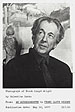 |
Wright at 70, 1937.
Portrait of Frank Lloyd Wright for cover of Time Magazine. Wright is wearing
a dark jacket, dark suit and tie. He is facing slightly to the right, but
looking toward the upper right corner. There is an illustration of
Fallingwater behind him. There is also a small Asian figurine behind him on
the left. This might indicate that it was photographed at Taliesin, Spring
Green. This photograph was published on the cover of
Time Magazine,
January 17, 1938, which would indicate that the photograph would have been
taken in the later part of 1937, so they would have it in time for the
January 1938 issue. This photograph was also used on the cover of the 1977
edition of "An Autobiography,"
Wright, Horizon Press. Text on face: "Photograph of Frank Lloyd Wright, by
Valentino Sarra. From: An Autobiography by Frank Lloyd Wright. Publication
date: May 12, 1977. $17.50." Stamped on verso: "Jun 21 1977." Photograph by
Valentino Sarra. Original 5 x 7.25 B&W photograph. |
0429.27.1015 |
|
1938 |
1938
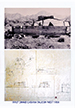 |
Apprentice Blaine & Hulda Drake's
Dwelling, Taliesin West, 1938. Blaine & Hulda Drake were both apprentice’s
to Frank Lloyd Wright starting at Taliesin East in Spring Green Wisconsin,
in the early 1930’s where they met and were married in the Wright’s living
room. When Blaine arrived at Taliesin East he had the only running car there
at the time so he became Mr. Wrights driver this included driving Fllw to
the site of what would become the Famous Falling Waters.
While they were at
Taliesin West they built the first apprentice dwelling that consisted of
more that just a tent. This print is of the dwelling taken in 1938 and the
photo of the original drawing designed by Blaine, approved and signed by Mr.
Wright, they lived in that dwelling until they left Taliesin in 1941.
Broadacre City,
1935 (0397.29). In 1935, Blaine Drake worked with Frank Lloyd Wright and
apprentices on the Broadacre City model.
S.C. Johnson
Building Model, 1936 (0404.22). "At the end of August Wright guided...
Continue... |
0460.43.0326 |
1938
 |
Florida Southern College. Wright
and Spivey visit construction site of Annie Pfeiffer Chapel (1938 - S.251),
December, 1938. Wright is looking off to the right, has a beret on his head
and holding a cane behind his back. He is wearing a suit and a scare to keep
the December chill off his neck. A pocket watch hangs on a cord around his
neck. Spivey is pointing to the right, wearing a dark suit and light top
hat. Rebar is protruding from the foundation on their right. Wright's first
visit to the Florida Southern College campus was in May, 1938. The ground
breaking ceremony was held on May 24, 1938. Wright's second visit was in
December, 1938 to oversee construction of the Chapel. Dedicated or the Annie
Pfeiffer Chapel was held on March 9, 1941. Date is verified by the Lakeland
Public Library, Dan Sanborn Collection. Possibly photographed at the same
time as the portrait of Wright
by Laura Gilpin, 1938, in which Wright is wearing the same suit and watch,
holding the same beret and cane. Photographed by Dan Sanborn. Original 8 x 10 B&W photograph. |
0460.11.0913 |
1938
 |
Florida Southern College. Wright
and Spivey visit construction site of Annie Pfeiffer Chapel (1938 - S.251),
December, 1938. Wright is leaning against the foundation, looking off to the
right and pointing with his cane. He is wearing a suit, has a beret on his
head and a scare to keep the December chill off his neck. A pocket watch
hangs on a cord around his neck. Spivey is leaning against the foundation,
looking to the right, wearing a dark suit and light top hat. Rebar is
protruding from the foundation in front of them. Wright's first visit to the
Florida Southern College campus was in May, 1938. The ground breaking
ceremony was held on May 24, 1938. Wright's second visit was in December,
1938 to oversee construction of the Chapel. Dedicated or the Annie Pfeiffer
Chapel was held on March 9, 1941. Date is verified by the Lakeland Public
Library, Dan Sanborn Collection. Possibly photographed at the same time as
the portrait of Wright by
Laura Gilpin, 1938, in which Wright is wearing the same suit and watch,
holding the same beret and cane. Photographed by Dan Sanborn. Original 8 x 10 B&W photograph. |
0460.12.0913 |
1938
 |
Florida Southern College. Wright
and Spivey visit construction site of Annie Pfeiffer Chapel (1938 - S.251),
December, 1938. Wright is leaning against a post, looking at Spivey. He is
wearing a suit, has a beret on his head and a scare to keep the December
chill off his neck. A pocket watch hangs on a cord around his neck. Spivey
has his hand extended and resting on the same post, looking at Wright. He is
wearing a dark suit and light top hat. Wright's first visit to the Florida
Southern College campus was in May, 1938. The ground breaking ceremony was
held on May 24, 1938. Wright's second visit was in December, 1938 to oversee
construction of the Chapel. Dedicated or the Annie Pfeiffer Chapel was held
on March 9, 1941. Date is verified by the Lakeland Public Library, Dan
Sanborn Collection. Possibly photographed at the same time as the
portrait of Wright by Laura
Gilpin, 1938, in which Wright is wearing the same suit and watch, holding
the same beret and cane. Photographed by Dan Sanborn. Original 8 x
10 B&W photograph. |
0460.13.0913 |
1938
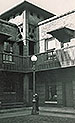 |
Francisco Terrace
Apartments 1938 (1895 - S.030). View of the inner courtyard. Designed by
Frank Lloyd Wright as one of Chicago's first low income housing in 1895.
Although the Francisco Terrace Apartments were designed first, they was
constructed after the Waller Apartments. The Francisco Terrace Apartments
were built adjacent to and behind the Waller Apartments, and connected on
the West side. Many architectural details found in the Waller Apartments are
also evident in the Francisco Terrace Apartments. It consisted of forty-four
units (possibly forty-five). All apartments faced and were accessed from the
inner garden courtyard except those facing the street. Instead of hallways,
Wright designed each corner of the courtyard with a tower that enclosed
stairs that opened to a wooden gallery which gave access to the second floor
units. "Open towers with elevated roofs are located at each corner of the
block; these contain the public stairways, and from them circulation to the
front doors of the upstairs courtyard flats is by means of an overhanging
gallery running continuously around the court. The high, close-set spindles
of the gallery railing is a typical "early Wright" touch..." Grant Manson.
Published in Frank Lloyd Wright to 1910,
Manson, 1958, p.83...
Continue... |
0460.36.0124 |
Circa 1938
 |
Hotel Geneva Entrance Circa 1938
(1911 - S.171). Lobby is in the center. Dining Room is to the left on the
first floor. "Hotel Geneva" lettered is across the front of the Lobby above
the windows, and neon lighting has been added to each letter. Decorative
light pole bases are tied into built-in pedestals with a vase. Large globe
light has been added to the patio pedestals and smaller on the corners of
the balcony. 10 x 7 B&W photograph. |
0460.15.1213 |
1938
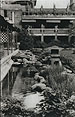 |
Imperial Hotel (1915 - S.194)
Circa 1938. View of the inner Garden Court and pool. Frank Lloyd Wright was
commissioned to design the Imperial Hotel. Construction began in 1917 and on
July 4, 1922 the first section of Wright's Imperial Hotel opened. In August
1923 the hotel was complete. On September 1, 1923 a major earthquake
destroyed Tokyo. The Dining Room Terrace can be seen on the left. The main
Dining Room, which is located just past the main Lobby as you enter from the
front, is on the left just out of the picture. Photographed by Margaret
Walbank. Original 8 x 12 B&W Print. |
0460.09.0912 |
C
1938-40
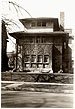 |
Isidore Heller Residence Street View, Chicago, Manson, Circa
1938-40 (1896 - S.038). Viewed from the East. Photographed during the
winter, no foliage. Ivy vines still cover front of the house. The Living
Room is on the first floor, one of five bedrooms is on the second floor. The
bedroom doors open to a balcony. The Playroom is on the third floor. The
side entrance on the North side can be seen on the far right. A short fence
can be seen along the sidewalk. It also continues toward the house on the
far left, similar to the Gilman Lane images. Appears to be photographed
within a few years of the Lane images, but less foliage. Possibly
photographed by Grant Manson. Part of the Grant Manson collection.
He took many of his
photographs between 1937 and 1941 while researching for his doctoral
dissertation titled "Frank Lloyd Wright's Work Before 1910",
1958. Courtesy of the Oak Park Public Library. 6 x 10 B&W photograph.
See our Wright Study on the Heller Residence. |
0171.21.0514 |
C
1938-40
 |
Isidore Heller Residence Street View , Chicago,
Lane Circa 1938-40 (1896 - S.038). Viewed from the Southeast. Photographed
during the summer, full foliage. Ivy vines still cover front of the house.
The Living Room is on the first floor, one of five bedrooms is on the second
floor. The bedroom doors open to a balcony. The Playroom is on the third
floor. A short fence can be seen along the sidewalk. It also continues
toward the house to the right of the stairs and walk. Appears to be
photographed within a few years of the Manson image, but more foliage.
Photographed by
Gilman Lane. Part of the Gilman Lane collection. The Art
Institute of Chicago dates similar Lane images Circa 1935-1945. Courtesy of the Oak Park Public Library. 8 x 9.5
B&W photograph. See our Wright Study on the
Heller Residence. |
0171.22.0514 |
C
1938-40
 |
Isidore Heller Residence Entrance, Chicago, Lane
Circa 1938-40 (1896 - S.038). Entrance viewed from the Southeast.
Photographed during the summer, full foliage. The large limestone columns on
either side of the entrance are octagonal in shape, with ornamental
Sullivanesque capitals. The columns support three square frieze panels with
a quatrefoil design. The entrance is framed with a billet molding. The light
fixture has been replaced with one more in sync with the design of the home.
Photographed by
Gilman Lane at the same time as other Lane images. Part of
the Gilman Lane collection. The Art Institute of Chicago dates similar Lane
images Circa 1935-1945. Courtesy of the Oak Park Public Library. 8 x 10 B&W
photograph. See our Wright Study on the Heller
Residence. |
0171.23.0514 |
C 1938-40
 |
Isidore Heller Residence, Chicago, Lane Circa
1938-40 (1896 - S.038). Viewed from the Southwest. Photographed during the
summer, full foliage. Ivy vines cover the south side of the house. The
Kitchen is on the far left. The Dining Room is in the center, the Reception
Room is on the right. The main entrance is to the far right, out of the
picture. Five bedrooms are on the second floor. Bedroom doors open to a
balcony. The Playroom is on the third floor. A short wall that runs along
the south boundary can be seen in the foreground. Appears to be photographed
within a few years of the Manson image, but more foliage. Photographed by
Gilman Lane. Part of the Gilman Lane collection. The Art Institute of
Chicago dates this Lane images circa 1935-1945. Caption on verso: "I. Heller House,
1897, 5132 Woodlawn, Frank Lloyd Wright, Architect. Imaginative articulation
of space and surface treatment, and linear trim all expressive of home,
sheltering and exciting at once." Stamped on verso: "Feb 8, 1960". The same
year Wright designed the Heller Residence, he designed the title page for "The Eve of St. Agnes".
Wright adapted the winged female figures from the title page for the Heller House Frieze. See
our Wright Study on for more information. Acquired from the archives
of the Chicago Tribune. Original 8 x 10 B&W...
Continue... |
1458.36.1211 0171.24.0514 |
1938
 |
Ralph Jester House Ground Plan, Project 1938 (1938 -
FLLW#3807). Ground Plan for the Ralph Jester House, Palos Verdes,
California. Designed by Frank Lloyd Wright in 1938 but never built. Wright
utilized the design for the Gerald Loeb Residence (1944), but it was never
built. The design was utilized again for the Dr. Paul V. Palmer Residence
(1947) in Phoenix, Arizona, but again, remained unbuilt. Bruce Brooks
Pfeiffer and his father resurrected the original Jester design and built the
home on the grounds of Taliesin West, Scottsdale, Arizona in 1974. Published
in An
American Architect, Wright, 1955, p.245.
Text on sleeve: "Wright, F. L. - Jester, Rho Project. 1-1. Ralph Jester
House Project. Plan, Ground floor. 1938. Wright, Frank Lloyd. U of Virginia
FAIC." Acquired from the archives of the University of Virginia. 35mm Color
slide, sandwiched between glass, plastic mount. |
0460.27.0420 |
1938
 |
Ralph Jester House Model, Project 1938 (1938 - FLLW#3807). Model of the
Ralph Jester House, Palos Verdes, California. Designed by Frank Lloyd Wright
in 1938 but never built. Wright utilized the design for the Gerald Loeb
Residence (1944), but it was never built. The design was utilized again for
the Dr. Paul V. Palmer Residence (1947) in Phoenix, Arizona, but again,
remained unbuilt. Bruce Brooks Pfeiffer and his father resurrected the
original Jester design and built the home on the grounds of Taliesin West,
Scottsdale, Arizona in 1974. Text on sleeve: "Wright, F. L. - Jester, Rho
Project. 3-1. Ralph Jester House Project. Model. 1938. Wright, Frank Lloyd.
U of Virginia FAIC." Acquired from the archives of the University of
Virginia. 35mm Color slide, sandwiched between glass, plastic mount. |
0460.28.0420 |
1938
 |
Ralph Jester House Model, Project 1938 (1938 - FLLW#3807). Revised model of
the Ralph Jester House, Palos Verdes, California. The model appears to have
been revised. Landscaping, and the addition of the hillside at the back of
the model. Designed by Frank Lloyd Wright in 1938 but never built. Wright
utilized the design for the Gerald Loeb Residence (1944), but it was never
built. The design was utilized again for the Dr. Paul V. Palmer Residence
(1947) in Phoenix, Arizona, but again, remained unbuilt. Bruce Brooks
Pfeiffer and his father resurrected the original Jester design and built the
home on the grounds of Taliesin West, Scottsdale, Arizona in 1974. Text on
sleeve: "Wright, F. L. - Jester, Rho Project. 3-2. Ralph Jester House
Project. Model. 1938. Wright, Frank Lloyd. U of Virginia FAIC." Acquired
from the archives of the University of Virginia. 35mm Color slide,
sandwiched between glass, plastic mount. |
0460.29.0420 |
C
1938
 |
S.C. Johnson Headquarters Great Room 1938 (1936
- S.237). Workmen working on dendriform columns in the great workroom.
Wooden forms are still in place, and it appears that the concrete has been
poured. Similar image published in
Frank Lloyd Wright and the Johnson Wax Buildings, Lipman, 1986,
pp.78-9. Original 7 x 5 B&W photograph. |
0460.17.0514 |
1938
 |
S.C. Johnson
Headquarters Great Room 1938 (1936 - S.237). Workmen installing Pyrex tubes
in great workroom. Label pasted to verso: "Title: 1938 photograph of the
workmen installing Pyrex tubes in skylights of the Johnson Wax
Administration Building Great Workroom. Date: 1938. From the exhibition:
Frank Lloyd Wright and the Johnson Wax
Buildings (1986), circulated by the Smithsonian Institute Traveling
Exhibition Service." Published in
Frank Lloyd Wright and the Johnson Wax Buildings, Lipman, 1986,
pp.78-9. Original 10 x 8 B&W photograph. |
0460.16.0514 |
C
1938-40
 |
Taliesin West, Scottsdale, Arizona 1938-40 (1937 - S.241). View of Mr.
Wright's office. Photographed during the same time period as S#531.74, Pedro
E. Guerrero. See "Pedro E. Guerrero, A Photographer's Journey," p.50-51.
Five beams holding the roof were later reduced to four. The left beam was
removed, opening up an enclosed "courtyard." Also note the slats in the roof
between the beams. Cactus are planted to the right. Mounted to gray board.
Label pasted to board: "West 20, US Arch. Wright, Frank L. Phoenix, Ariz.
Taliesin West. 1938-40. View of Wright's Office." Acquired from the archives
of the University of Minnesota. Original 10 x 8 B&W Photograph. |
0460.26.0420 |
1938
 |
Wright at 71, 1938. Frank Lloyd Wright standing
in front of a waterfall. Looking off to the right, he is wearing a
double-breasted suit and tie, and beret. Location not identified, but
possibly close to Colorado Spring, Colorado. Stamped on verso: "Shewmaker's
Camera Shop, May 12 1938, 36 N. Tejon, Colo. Springs, Colo." 2.75 x 5 B&W
photograph. |
0460.20.0115 |
1938
 |
Wright at 71. 1938. Portrait of
Wright in Taliesin studio with four apprentices (L to R) Gene Masselink, Ben Dombar, Edgar Tafel and John Howe.
Published in
"At Taliesin". Newspaper
Columns by
Frank Lloyd Wright and the Taliesin
Fellowship 1934-1937,
Henning, page 9, dated mid 30's. 7 x 5 Print, High res digital image. |
0404.21.0709 |
1938
 |
Wright at 71. 1938. Portrait of Frank Lloyd
Wright in his Taliesin, Spring Green studio. Wright is relaxed, scarf is
loosely around his neck. He is seated behind the drafting table, looking
directly at the camera. His glasses are sitting on the table. According to
AP, this photograph was taken on August 16, 1938. Original 8 x 10 B&W
photograph. |
0460.30.1121 |
1938
 |
Wright at 71, 1938. Wright spoke
at the Chicago Real Estate Board Conference in June. "If Real Estate were to
go before some bar of judgement where human values were uppermost, it would
be taken out and shot at sunrise as it stands. The good it has done is so
little as compared to the injustice and misery it has deliberately caused
for its own profit..." The whole speech is published in "Frank
Lloyd Wright Collected Writings" Wright; Pfeiffer, 1993, p.267-270.
Caption pasted to verso: "L. To R. Arthur Kruggel, President, Chicago Real
Estate Board, Frank Lloyd Wright, world-renowned architect, speakers at
Chicago Real Estate Board housing conference banquet in Palmer House June 2,
1938, attended by 1,000 realtors." Stamped on verso: "Daily Times. Jun 2
1938." 8 x 6.5 B&W photograph. |
0460.21.0115 |
1938
 |
Wright at 71, 1938 (published in
1942). Portrait of Frank Lloyd Wright by Laura Gilpin. Wright is seated in a chair
facing the camera. His right arm is resting on the back of the chair, his
finger is resting on the side of his face. He is wearing a suit and tie,
holding a cane, with a beret resting atop his knee. A pocket watch hangs
from a cord around his neck and is tucked in his breast pocket. This is
exactly the same outfit he wore when he
visited the construction
site of the Annie Pfeiffer Chapel in December, 1938. This print is a
photogravure, 5.5 x 6.5 on a page that is 6 x 8.5. Text at the bottom: "Frank
Lloyd Wright. Laura Gilpin." This is actually a page cut out of "The
Complete Photographer", September 20, 1942, page 2376c. The
caption reads: "A portrait of a great American architect, taken in 1938. The
pose is natural, as is the lighting - and the beret on the knee adds an
almost whimsical touch." Full page measures 7 x 10. |
0593.06.0913 |
|
1939 |
1939
 |
Sidney and Louise Bazett House, Hillsborough,
CA, Scheme 1, Perspective, Unrealized (1939 - FLLW #4032.001). Photograph of
original drawing in the Frank Lloyd Wright Archives. Perspective for the
Sidney and Louise Bazett House, Scheme 1, designed by Frank Lloyd Wright in
1939. This design is similar to the design for
E. A. Smith (FLLW
#3811), which is very similar to the design for the
Armstrong Tahoe Summer Colony
(1923 - FLLW #2205). Published in
Frank Lloyd Wright,
1917-1942, Pfeiffer, 2010, p.381.
Original 10 x 6.5 color photograph. |
0501.53.0621 |
1939
 |
Sidney and Louise Bazett House, Hillsborough,
CA, Scheme 1, Plot Plan, Unrealized (1939 - FLLW #4032.002). Photograph of
original drawing in the Frank Lloyd Wright Archives. Plot Plan for the
Sidney and Louise Bazett House, Scheme 1, designed by Frank Lloyd Wright in
1939. This design is similar to the design for
E. A. Smith (FLLW
#3811), which is very similar to the design for the
Armstrong Tahoe Summer Colony
(1923 - FLLW #2205). Published in
Frank Lloyd Wright,
1917-1942, Pfeiffer, 2010, p.381.
Original 10 x 7.25 color photograph. |
0501.54.0621 |
1939
 |
Sidney and Louise Bazett House, Hillsborough,
CA, Perspective Scheme 2 (1939 - S.259). FLLW #4002.001. Photograph of the
original perspective drawing of the Sidney and Louise Bazett House.
Perspective from below. Designed by Frank Lloyd Wright in 1939. The first
completed house using the hexagon "honeycomb" module was the Hanna House
(1936 - S.235). Wright also used the hexagon module in the design for
Auldbrass Plantation (1938 - S.261) and the Richardson House (1940 -
SW.282). Dated: "39." Courtesy of the Frank Lloyd Wright Foundation. 10 x
4.5 Color photograph. |
0501.56.0621 |
1939
 |
Sidney and Louise Bazett House, Hillsborough,
CA, Perspective Scheme 2 (1939 - S.259). FLLW #4002.001. Photograph of the
original perspective drawing of the Sidney and Louise Bazett House.
Perspective from below. Designed by Frank Lloyd Wright in 1939. The first
completed house using the hexagon "honeycomb" module was the Hanna House
(1936 - S.235). Wright also used the hexagon module in the design for
Auldbrass Plantation (1938 - S.261) and the Richardson House (1940 -
SW.282). Dated: "39." Courtesy of the Frank Lloyd Wright Archives, Avery
Library. 10 x 5.5 B&W photograph. |
0501.55.0621 |
1939
 |
Sidney and Louise Bazett
House, Hillsborough, CA, Perspective 1939 (1939 - S.259). FLLW #4002.001.
Photograph of original drawing in the Frank Lloyd Wright Archives.
Perspective for the Sidney and Louise Bazett House, designed by Frank Lloyd
Wright in 1939. Wright's first design for the Bazetts, scheme 1
(unrealized), FLLW #4032, is similar to the design for E. A. Smith (FLLW
#3811), which is very similar to the design for the Jessie Armstrong, Lake
Tahoe Summer Colony (1923 - FLLW #2205). This second design, realized, is
based on the honeycomb, similar to the Hanna House (1936 - S.235). Published
in
Frank Lloyd Wright,
1917-1942, Pfeiffer, 2010, p.382. Original 10 x
8 B&W photograph. |
0501.42.1219 |
1939
 |
Sidney and Louise Bazett House, Hillsborough,
CA, Plan and Two Perspectives, Scheme 2 (1939 - S.259). FLLW #4002.002.
Photograph of the original plan and perspective drawings of the Sidney and
Louise Bazett House. Top left: Perspective from below; Center: Plot plan;
Lower right: Perspective from above. Designed by Frank Lloyd Wright in 1939.
The first completed house using the hexagon "honeycomb" module was the Hanna
House (1936 - S.235). Wright also used the hexagon module in the design for
Auldbrass Plantation (1938 - S.261) and the Richardson House (1940 -
SW.282). Text: "House For Sidney and Louise Bazett, Frank Lloyd Wright
Architect." Courtesy of the Frank Lloyd Wright Archives, Avery Library. 10 x
8 B&W photograph. |
0501.57.0621 |
1939
 |
Sidney and Louise Bazett
House, Hillsborough, CA, Plan and perspectives 1939 (1939 - S.259). FLLW
#4002.002. Photograph of original drawing in the Frank Lloyd Wright Archives.
Ground Plan and two Perspectives for the Sidney and Louise Bazett House,
designed by Frank Lloyd Wright in 1939. Wright's first design for the
Bazetts, scheme 1 (unrealized), FLLW #4032, is similar to the design for E.
A. Smith (FLLW #3811), which is very similar to the design for the Jessie
Armstrong, Lake Tahoe Summer Colony (1923 - FLLW #2205). This second design,
realized, is based on the honeycomb, similar to the Hanna House (1936 -
S.235). Upper perspective is a repeat of FLLW #4002.01. The lower aerial
perspective is a portion of FLLW #4002.03. The ground and floor plan are to
the lower left. Text: "House For Sidney and Louise Bazet (sic). Frank Lloyd
Wright Architect." Published in
Frank Lloyd Wright,
1917-1942, Pfeiffer, 2010, p.382. Original 10 x
8 B&W photograph. |
0501.43.1219 |
1939
 |
Sidney and Louise Bazett House, Hillsborough,
CA, Aerial Perspectives, Scheme 2 (1939 - S.259). FLLW #4002.003. Photograph
of the original aerial perspective drawing of the Sidney and Louise Bazett
House. Designed by Frank Lloyd Wright in 1939. The first completed house
using the hexagon "honeycomb" module was the Hanna House (1936 - S.235).
Wright also used the hexagon module in the design for Auldbrass Plantation
(1938 - S.261) and the Richardson House (1940 - SW.282). Text: "Sidney
Bazett." Courtesy of the Frank Lloyd Wright Archives, Avery Library. 10 x 6
B&W photograph. |
0501.58.0621 |
1939
 |
Sidney and Louise Bazett House, Hillsborough,
CA, Plan, Scheme 2 (1939 - S.259). FLLW #4002.014. Photograph of the
original floor plan drawing of the Sidney and Louise Bazett House. Designed
by Frank Lloyd Wright in 1939. The first completed house using the hexagon
"honeycomb" module was the Hanna House (1936 - S.235). Wright also used the
hexagon module in the design for Auldbrass Plantation (1938 - S.261) and the
Richardson House (1940 - SW.282). Text: "House For Sidney And Louise Bazett."
Courtesy of the Frank Lloyd Wright Archives, Avery Library. 10 x 7 B&W
photograph. |
0501.59.0621 |
1939
 |
Sidney and Louise Bazett House, Hillsborough,
CA, Plot Plan, Scheme 2 (1939 - S.259). FLLW #4002.016. Photograph of the
original plot plan drawing of the Sidney and Louise Bazett House. Designed
by Frank Lloyd Wright in 1939. The first completed house using the hexagon
"honeycomb" module was the Hanna House (1936 - S.235). Wright also used the
hexagon module in the design for Auldbrass Plantation (1938 - S.261) and the
Richardson House (1940 - SW.282). Text: "House For Sidney And Louise Bazett."
Courtesy of the Frank Lloyd Wright Archives, Avery Library. 9 x 8 B&W
photograph. |
0501.60.0621 |
1939
 |
L. N. Bell House "Hillcrown", Los Angeles,
CA, Plan and Elevation 1939 (Project 1939 - FLLW #3908). Photograph of
original drawing in the Frank Lloyd Wright Archives. Ground Plan and
Perspective for the L. N. Bell House "Hillcrown", designed by Frank Lloyd
Wright in 1939. A variation based on a large Hexagon. The ground and floor
plan is on the left, the elevation is on the right. Text: "House For Mr. And
Mrs. Bell. Los Angeles. Frank Lloyd Wright." Additional drawings published
in
Frank Lloyd Wright,
1917-1942, Pfeiffer, 2010, p.384. Original 10 x 8 B&W photograph. |
0501.44.1219 |
1939
 |
Jorgine Boomer, 1939, with
Crowned Prince of Norway. Jorgine Slettede was born on August 18, 1887 in
Norway. In 1903, at the age of 16, she and her older sister immigrated to
the United States. She attended Columbia University in New York City.
Caption taped to verso: "From Ted Saucier, The Waldorf-Astoria, New York -
ELdorado 5-3000. New York City, April 28th/29. For immediate release,
please. H.R.H. Crown Prince Olay of Norway and Mrs. Lucius Boomer are shown
as the visiting Prince experienced his first taste of New York night life at
the Sert Room of The Waldorf-Astoria last night. (April 27th)" Stamped on
verso: "5-2 '39." Original 10 x 8 B&W photograph.
For more information on the Boomer
Residence see our Wright Study. |
0501.26.1014 |
C 1939
 |
E-Z Polish Factory Entrance Circa
1939 (1905 - S.114). Copy photograph of image published in
Many Masks
Gill, 1987, p.158. Photographed by Grant Manson, possibly shortly after his
re-discovery of the building. Manson writes, "The factory which Wright built
in 1905 for the Martin Brothers, the "E-Z" Polish plant on Chicago's West
Side...was lost to memory until 1939... and was noticed by the author from
the window of a train en route to Geneva, Illinois." Address reads "3005."
This entrance has been altered since this photograph was taken. The two
brick columns were removed and replace with glass. Text reads: "Help
Cleaners." Note: A Martin & Martin business card published in
William Everett Martin House Lesniak, 2000, p.45, reads: "E-Z Polishers" and "Help
Cleaners." Below the text is the "Martin & Martin" sign, designed by Frank
Lloyd Wright. "3005. Gold Star Press - Printers." This would also indicate
that the enhance of the East end of the building originally matched the
entrance on the West end of the building. Decorative stone has been added to
the doorway. There is also a "For Sale" sign, top left. William past way on
September 23,1938. Upon his death, Martin & Martin Co.'s management was
passed on to his son Everett (obituary). The family may have decided to put
the building up for sale after his death. 4.25 x 7.75 B&W copy photograph. |
0501.39.0319 |
1939
 |
Joseph Euchtman Residence, Baltimore, Maryland,
Ground and Floor Plan 1939 (FLLW #4005.09) (1939 - S.270). Photograph of the
ground and floor plan for the Joseph Euchtman Residence. The Joseph Euchtman
Usonian House is a long plan with the living space is on one end, with the
bedrooms on the other. The entrance, workspace and dining area are in the
center. It is 84 feet from one end to the other. The carport is turned at a
30 degree angle, intersects the house, and forms a trellis over the master
bedroom's glass doors on the East end of the house.
The Joseph Euchtman House, the companion house to the Pope house, was built
simultaneously and supervised by the same Taliesin apprentice, Gordon
Chadwick.
When we acquired a tissue fragment (S#501.65), of the original floor plan
for the Joseph Euchtman Residence. As we were searching the Frank Lloyd
Wright Archives at Avery Library, we came to sheet nine, this sheet, and
were shocked. There was a gapping hole cut out of the drawing. We had never
encountered this before. As we studied sheet #9...
Continue... |
0501.68.1125 (A-D) |
1939
 |
Joseph Euchtman Residence, Baltimore, Maryland,
Perspective 1939 (FLLW #4005.01) (1939 - S.270). Photograph of the
perspective for the Joseph Euchtman Residence. The Joseph Euchtman Usonian
House is a long plan with the living space is on one end, with the bedrooms
on the other. The entrance, workspace and dining area are in the center. It
is 84 feet from one end to the other. The carport is turned at a 30 degree
angle, intersects the house, and forms a trellis over the master bedroom's
glass doors on the East end of the house.
The Joseph
Euchtman House, the companion house to the Pope house, was built
simultaneously and supervised by the same Taliesin apprentice, Gordon
Chadwick.
Red square center right: Signed and dated: "October 26, 39." Text lower: "House For Mr. Joseph Euchtman, Baltimore, MD. Frank Lloyd Wright,
Architect." 10 x 6.5 Color photograph. |
0501.69.1125 (A-D) |
1939
 |
Joseph Euchtman Residence,
Baltimore, Maryland, Aeroshades Plan 1939 (FLLW #4005.10) (1939 - S.270).
Photograph of the Aeroshades Plan for the Joseph Euchtman Residence. The
Joseph Euchtman Usonian House is a long plan with the living space is on one
end, with the bedrooms on the other. The entrance, workspace and dining area
are in the center. It is 84 feet from one end to the other. The carport is
turned at a 30 degree angle, intersects the house, and forms a trellis over
the master bedroom's glass doors on the East end of the house.
The Joseph Euchtman House, the companion house to the Pope house, was built
simultaneously and supervised by the same Taliesin apprentice, Gordon
Chadwick.
Lower text: "Plan:
Aeroshades. House For Mr. And Mrs. Joseph Euchtman, Baltimore, MD. Frank
Lloyd Wright, Architect." There appears to be 19 Aeroshades planned,
including one to close off the kitchen. 10 x 4 Color photograph. |
0501.70.1125 |
1939
 |
Joseph Euchtman Residence,
Baltimore, Maryland, Ground and Floor Plan 1939 (FLLW #4005.12) (1939 -
S.270). Photograph of the Ground and Floor Plan for the Joseph Euchtman
Residence. The Joseph Euchtman Usonian House is a long plan with the living
space is on one end, with the bedrooms on the other. The entrance, workspace
and dining area are in the center. It is 84 feet from one end to the other.
The carport is turned at a 30 degree angle, intersects the house, and forms
a trellis over the master bedroom's glass doors on the East end of the
house.
The Joseph Euchtman House,
the companion house to the Pope house, was built simultaneously and
supervised by the same Taliesin apprentice, Gordon Chadwick.
Text lower left: "4005.12." Hand written near the bottom: "Euchtman." 10 x 4
Color photograph. |
0501.71.1125 |
1939
 |
Darwin D. Martin Residence,
Buffalo, New York, Circa 1939 (S.100 - 1904). View of the Darwin Martin
house from East on Summit Avenue. Designed by Frank Lloyd Wright in 1904. In
1942, Henry-Russel Hitchcock wrote: “The great size of the Martin house
makes possible a subtle extension of the characteristic Prairie house
composition. The fine materials inside and out have stood up well despite
the long period the house has been empty. But the planting has now
overflowed the terraced beds to which it was once confined, giving the
exterior an unkempt air. The lower photograph, which is an old one, shows
better the intended relationship between the architecture and its original
setting. The elaborated latin cross plan provides widely varied silhouettes
in perspective from different angles; thus different photographs hardly seem
of the same house.” Text amd photograph published in, In The Nature of
Materials, Plate 101. Credit, p.xiii.
In 1967 the estate was purchased by the University at Buffalo, for use as
the university president's residence. The university continued the
sub-division with the sale of The Barton House in 1967 and the gardener's
cottage soon after. From 1967 through the early 1970s, Frank Lloyd Wright
apprentice Edgar Tafel guided the partial restoration. The estate was added
to the National Register of Historic Places in 1975 and became a National
Historic Landmark in 1986.
In 1987,
Bruce Brooks Pfeiffer wrote of the Darwin Martin Residence, “The home that
Mr. Wright designed and built for him is one of the masterworks of modern
architecture. Each and every part of the whole was worked out by the
architect down to the most minute detail. The glasswork alone is among the
very best he ever did, in a category with the exquisite glass of the Susan
Lawrence Dana house in Springfield, Illinois.”
Frank Lloyd Wright, Monograph
1902-1906, 1987, p.96.
Photographed circa 1939 by Jay W. Baxstresser, Darwin Martin House: Cultural
Landscape Report, Bayer, 2015. 10 x 8 B&W photograph. |
0501.74.1225 |
1939
 |
Edgar F. Mauer House, Los
Angeles, CA, Perspective 1939 (Project 1939 - FLLW #3910). Photograph of
original drawing in the Frank Lloyd Wright Archives. Perspective of the
Edgar F. Mauer House designed by Frank Lloyd Wright in 1939. A variation
combining hexagon modules and triangles. The living Room is a large
Triangle, with two sides opening up to terraces, and the third forming the
entrance. FLLW #3910.01. Published in
Frank Lloyd Wright,
1917-1942, Pfeiffer, 2010, p.396. Original 10 x
8 B&W photograph. |
0501.45.1219 |
C 1939
 |
Rose Pauson
Residence (Shiprock) (1939 - S.250) 1939. Designed in 1939, it was completed
in 1942. It burned to the ground on April 11, 1943, blamed on tenants who
left a living room door open, causing the curtains to blow into the
fireplace and catching fire. Hand written text on face of drawing, "A desert
house just completed for the Pauson sisters, Phoenix, Arizona. Cost
$7500.00..." Original illustration published in, "Building the Pauson House," Green,
2011, pp.4, 26. Original 10 x 8 B&W photograph. |
0501.24.0514 |
1939
 |
S.C. Johnson
Headquarters. "Great Workroom". Ken Burns considered the Johnson Wax Headquarters
"the greatest room in the United States today". Herbert Johnson
addresses the employees in the Great Workroom during the 1939 profit-sharing
meeting. To his left is the company choir and to his right is the
company band. Original silver gelatin photo. Published in "Frank
Lloyd Wright and the Johnson Wax Building" Lipman 1986, page
118-119. Photographer unknown. 14 x 11. |
0501.10.0107 |
1939
 |
S.C. Johnson Headquarters 1939. Porte cochere, viewed from the east. The
loading dock is visible at the lower left. The glazed bridge from the
penthouse to the squash court is located top center. Stamped on verso: "From
Photographic Department, S.C. Johnson & Sons, Inc., Racine, Wis. Makers of
Johnson's Wax. Photograph by Roy E. Petersen." Clipping on verso: "June 8 -
1949. The Johnson Wax Co. building at Racine, Wis., designed by Wright.
Architects have called it the greatest contribution to business housing
since the advent of the skyscraper. It is built without windows and doors
(other than the main opening) and is heated through the floor and supported
by "˜golf-tee" columns, modeled on the structure of a flower." Also
published: "Oct 30, 1964. Another of Wright's masterpieces, a business
building in Racine, Wis. It has no windows and no doors except the
entrance." Published in "Frank
Lloyd Wright and the Johnson Wax Building" Lipman, 1986 page 99.
Original silver gelatin 10 x 8 photo. Acquired from the archives of the
Chicago Sun-Times. |
0798.10.0310 |
1939
 |
S.C. Johnson Headquarters 1939
(1936 - S.237). Administration building, viewed from the east. The Great
Workroom is on the left, Administration offices are on the upper level. The
carport is to the right. A similar view is published in "Frank
Lloyd Wright and the Johnson Wax Building" Lipman, p.99 (0798.10),
and in Frank Lloyd
Wright Monogram 1924-1936 V.5, Pfeiffer, p.251. Stamped on verso:
"Johnson Wax Photo, Neg #3864, S. C. Johnson & Son Inc., Racine, Wisconsin."
Original 8 x 10 B&W photograph. |
0501.27.0216 |
1939
 |
S.C. Johnson Headquarters 1939
(1936 - S.237). Recreational Terrace viewed from the South. The Great
Workroom is on right, the globe would be across the street to the left. See
Frank Lloyd Wright
Monogram 1924-1936 V.5, Pfeiffer, p.246. Stamped on verso: "Johnson
Wax Photo, Neg #3840, S. C. Johnson & Son Inc., Racine, Wisconsin." Original
10 x 8 B&W photograph. |
0501.28.0216 |
1939
 |
S.C. Johnson Headquarters
early evening, 1939
(1936 - S.237). Administration building, viewed from the Northwest. The West
side of the Administration Building early evening. The Great Workroom is to
the right, Administration offices are on the upper level. The carport is to
the left. A similar view is published in
Frank
Lloyd Wright and the Johnson Wax Building Lipman, p.98. Stamped on
verso: "Johnson Wax Photo, Neg #3993, S. C. Johnson & Son Inc., Racine,
Wisconsin." Second copy, hand written on verso: "S. C. Johnson & Son,
Inc." Stamped on verso: "Dec 19 1967." Two original 10 x 8 B&W photograph. |
0501.29.0216 0501.34.0817 |
1939
 |
S.C. Johnson Headquarters At Night, Racine,
Wisconsin Circa 1939 (Not Dated.) (1936 - S.237). Administration building,
viewed from the Northwest at night. The West side of the Administration
Building at night. Designed by Frank Lloyd Wright in 1936. The
Administration building was completed on April 22, 1939. The Great Workroom
is to the right, Administration offices are on the upper level. The carport
is to the left. Photographed in 1939. Similar to
S#501.29. Stamped on verso: "3995."
Original 8 x 10 B&W photograph. |
0501.63.0425 |
1939
 |
S.C. Johnson Headquarters Aerial View 1939
(1936 - S.237). Magic lantern glass slide of administration building, viewed
from the Northwest. Caption, Figure 17: "Aerial view of Johnson
Administration Building, 1939. The building comprises a single, large room
(right) and the carport (left). Spanning the two are at second-story theater
and third-story executive offices..."
Frank
Lloyd Wright and the Johnson Wax Building, Lipman, p.20.
Note, in the published photograph, smoke has been added to the smoke stack.
Text on face of slide: "New York State Education Department. Visual
Instruction Division." Hand written label on verso: "Wisconsin, Racine.
Office Building (Johnson Wax Co. Frank Lloyd Wright, Architect.) General
View from Roof of Factory. (1939). Original magic lantern glass slide 4 x
3.75. Image 2.75 x 2 B&W transparency. 11 x 8 High Res digital image. |
0501.41.1219 |
1939
 |
S.C. Johnson Headquarters. "Detail of The Great Workroom". Note double-wing tub
desks. Original silver gelatin photo. Photographer unknown #90018-F. S.C.
Johnson & Son Inc. Racine, Wisconsin. Similar image published in
"Frank
Lloyd Wright and the Johnson Wax Building" Lipman, 1986 page 107. |
0501.14.0907 |
1939
 |
S.C. Johnson Headquarters 1939
(1936 - S.237). Administration building Penthouse, Herbert Johnson's office
on the right. A similar view is published in "Frank
Lloyd Wright and the Johnson Wax Building" Lipman, p.113. Stamped on
verso: "15346." Original 10 x 8 B&W photograph. |
0501.30.0216 |
C
1939
 |
S.C. Johnson Headquarters Circa 1939 (1936 -
S.237). Designed by Frank Lloyd Wright in 1936. Administration building
Penthouse. View of Herbert Johnson's office, and most likely Herbert
Johnson. Clipping pasted to verso: "Offices almost entirely of glass are
used by the wax firm's executives." Hand Written on verso: "April 30 / 39.
Page 5. Racine, Wis. Johnson Wax Co." Original 10 x 8 B&W photograph. |
0501.34.0817 |
1939
 |
S.C. Johnson Headquarters.
"Private Penthouse Office". The desk engages the built-in cabinet.
Photographer unknown. Original 8 x 10 silver gelatin photo. "Photographic Department Neg. #3871 S.C. Johnson & Son Inc. Racine,
Wisconsin.". Published in "Frank
Lloyd Wright and the Johnson Wax Building", Lipman 1986, page 115. |
0501.11.0107 |
1939
 |
S.C. Johnson Headquarters
"Secretaries' Office" 1939 (1936 - S.237). Furniture was designed by Frank
Lloyd Wright in 1936. Left: three legged arm chair with wheels; Center:
desk; Right: three legged arm chair. The S.C. Johnson headquarters was
designed in 1936, completed on April 22, 1939. Label taped to verso:
"Believe it or not, Some secretaries get privacy. Frank Lloyd Wright, whose
concern over the American way of life has resulted in so many basic changes
in building, has finally got around to considering the plight of the
secretary and in the recently completed
S.C. Johnson & Sons plant at Racine, Wisconsin, saw to it that she would get
privacy, in fact as well as name, through the development of such unit
offices as the one illustrated here. During the next week, an architect's
model of this famous building will be exhibited in Chicago through the
Office Equipment Display at the Palmer House." Stamped on verso: "From
Photographic Department, S.C. Johnson & Son Inc. Racine, Wis. Makers of
Johnson's Wax. A-192." Published in "The Prairie School Tradition" Spencer,
1985 page 103. Original silver gelatin 8 x 10 B&W photo. |
0501.20.1113 |
1939
 |
S.C. Johnson Headquarters Theater 1939 (1936
- S.237). Administration building Theater, Mezzanine level. "Figure 108.
Theater, mezzanine level, 1939. The ceiling is composed of stepped
semicircles. A projection booth can be seen at right. Not visible in
photograph our sliding panels located behind rostrum that separate the
theater from the lobby and provide a projection screen." Published in
Frank
Lloyd Wright and the Johnson Wax Building, Lipman, p.111.
Stamped on verso: "Filed Dec 19 1967." Original 10 x 8 B&W photograph.
|
0501.36.0817 |
1939
 |
1) Lloyd Lewis Residence, Libertyville,
Illinois, Floor Plan 1939 (FLLW#4008.19) (1939 - S.265). First and second
floor plan of the Lloyd Lewis Residence for publication. Designed by Frank
Lloyd Wright in 1939. Wright resurrected the Willey Scheme I design, first
conceived in 1932. The long and winding drive ends on the North side of the
house. A Cherokee red sidewalk leads you around the West end of the house,
feet from the water’s edge. As you continue around the corner, the sidewalk
leads to the Loggia, situated under the living room. At the end of the
loggia is the hidden entry to the house. There is also a shortcut through
the carport. The ground level includes the carport, servants quarters, guest
bedroom, loggia and entry hall. Inside the entry hall, turning left leads
you to a guest bedroom. Turn right, up six stairs, leads to the landing and
the bedroom wing, two bedrooms each with its own bath. Continuing up stairs
to the left, leads to the main living level, living room and dining area,
workspace and sanctum (study). Hand written lower left: “4008.19.” Courtesy
of the Frank Lloyd Wright Archives, Avery Library. 10 x 7 Color photograph. |
0501.75.0326 |
1939
 |
2) Lloyd Lewis Residence, Libertyville,
Illinois, Aerial Perspective 1939 (FLLW#4008.02) (1939 - S.265). Aerial
perspective plan for the Lloyd Lewis Residence. Designed by Frank Lloyd
Wright in 1939. Wright resurrected the Willey Scheme I design, first
conceived in 1932. The house is elevated on brick piers, serving to
safeguard against potential damage from dampness or flooding. The long and
winding drive ends on the North side of the house. A Cherokee red sidewalk
leads you around the West end of the house, feet from the water’s edge. As
you continue around the corner, the sidewalk leads to the Loggia, situated
under the living room. At the end of the loggia is the hidden entry to the
house. There is also a shortcut through the carport. The ground level
includes the carport, servants quarters, guest bedroom, loggia and entry
hall. Inside the entry hall, turning left leads you to a guest bedroom. Turn
right, up six stairs, leads to the landing and the bedroom wing, two
bedrooms each with its own bath. Continuing up stairs to the left, leads to
the main living level, living room and dining area, workspace and sanctum
(study). The Farm Unit can be seen on the far right. Hand written lower
left: “4008.02.” Signed in the red box center right: “FLLW Oct 1 - 39.”
Courtesy of the Frank Lloyd Wright Archives, Avery Library. 10 x 7 Color
photograph. |
0501.76.0326 |
1939
 |
3) Lloyd Lewis Residence, Libertyville,
Illinois, Aerial Perspective 1939 (FLLW#4008.09) (1939 - S.265). Aerial
perspective plan for the Lloyd Lewis Residence. Designed by Frank Lloyd
Wright in 1939. Wright resurrected the Willey Scheme I design, first
conceived in 1932. The house is elevated on brick piers, serving to
safeguard against potential damage from dampness or flooding.
The long and winding drive ends on the North side of the house. A Cherokee
red sidewalk leads you around the West end of the house, feet from the
water’s edge. As you continue around the corner, the sidewalk leads to the
Loggia, situated under the living room. At the end of the loggia is the
hidden entry to the house. There is also a shortcut through the carport. The
ground level includes the carport, servants quarters, guest bedroom, loggia
and entry hall. Inside the entry hall, turning left leads you to a guest
bedroom. Turn right, up six stairs, leads to the landing and the bedroom
wing, two bedrooms each with its own bath. Continuing up stairs to the left,
leads to the main living level, living room and dining area, workspace and
sanctum (study). Hand written lower left: “4008.09.”Courtesy of the Frank
Lloyd Wright Archives, Avery Library. 10 x 7 Color photograph. |
0501.77.0326 |
1939
 |
4) Lloyd Lewis Residence, Libertyville,
Illinois, Interior View 1939 (FLLW#4008.04) (1939 - S.265). Interior view of
the living room, fireplace and dining area of the Lloyd Lewis Residence.
Designed by Frank Lloyd Wright in 1939. Wright resurrected the Willey Scheme
I design, first conceived in 1932. The house is elevated on brick piers,
serving to safeguard against potential damage from dampness or flooding.
Bruce Brooks Pfeiffer wrote: “Now again in 1940, as in 1900, he was building
for the prairie condition, intensified here because of the marsh and the
adjacent river. For his friend he created one of the loveliest homes he ever
designed, and both Lloyd Lewis and his wife Kathryn lived in the house in a
beautiful setting, with every detail and feature designed by their
architect-friend... the result shows such a marvelous interior harmony, and
peaceful blending with the wooded site, that the house truly became a
tribute to both of them and their friendship.” Frank Lloyd Wright Monograph,
1937-1941, 1986/1990, p.170.
Hand
written lower left: “4008.04.” Courtesy of the Frank Lloyd Wright Archives,
Avery Library. 10 x 8 Color photograph. |
0501.78.0326 |
1939
 |
5) Lloyd Lewis Residence, Libertyville,
Illinois, Detail of Section 1939 (FLLW#4008.24) (1939 - S.265). Detail
section of the dining room and the Pergforated Brick Lantern. Designed by
Frank Lloyd Wright in 1939. Wright resurrected the Willey Scheme I design,
first conceived in 1932. The house is elevated on brick piers, serving to
safeguard against potential damage from dampness or flooding.
One unique design element of the Lloyd Lewis House is the “Perforated Brick
Lantern.” Frank Lloyd Wright added this feature on the outer edge of the
carport and in the loggia, as well as in the dining area.
Bruce Brooks Pfeiffer wrote: “Now again in 1940, as in 1900, he was building
for the prairie condition, intensified here because of the marsh and the
adjacent river. For his friend he created one of the loveliest homes he ever
designed, and both Lloyd Lewis and his wife Kathryn lived in the house in a
beautiful setting, with every detail and feature designed by their
architect-friend... the result shows such a marvelous interior harmony, and
peaceful blending with the wooded site, that the house truly became a
tribute to both of them and their friendship.” Frank Lloyd Wright Monograph,
1937-1941, 1986/1990, p.170. 9 x 8 Color photograph. Courtesy of the Frank
Lloyd Wright Archives, Avery Library. |
0501.80.0326 |
1939
 |
E. A. Smith House, Piedmont Pines, CA,
Perspective 1939 (Project 1939 - FLLW #3811). Photograph of original drawing
in the Frank Lloyd Wright Archives. Perspective of the E. A. Smith House
designed by Frank Lloyd Wright in 1939. This design is very similar to the
design for the unrealized Jessie Armstrong,
Lake Tahoe Summer Colony (1923 - FLLW #2205). Wright also proposed this
design as the first unrealized design for the Sidney and Louise Bazett
House, (FLLW #4032). It is also reminiscent of the design for the
Nakoma Clubhouse. Text: "House For Mr. And Mrs.
E. A. Smith. San Francisco. Frank Lloyd Wright Architect." Note: This
appears to be a preliminary drawing for FLLW #3811.01, which changes San
Francisco to Piedmont Pines. Piedmont Pines is within the Reinhardt Redwood
Regional Park, East of Oakland California. Published in
Frank Lloyd Wright,
1917-1942, Pfeiffer, 2010, p.405. Original 10 x
8 B&W photograph. |
0501.46.1219 |
1939
 |
E. A. Smith House, Piedmont Pines, CA,
Sections 1939 (Project1939 - FLLW #3811). Photograph of original drawing in
the Frank Lloyd Wright Archives. Two Sections of the E. A. Smith House
designed by Frank Lloyd Wright in 1939. This design is very similar to the
design for the unrealized Jessie Armstrong,
Lake Tahoe Summer Colony (1923 - FLLW #2205). Wright also proposed this
design as the first unrealized design for the Sidney and Louise Bazett
House, (FLLW #4032). It is also reminiscent of the design for the Nakoma
Clubhouse. Left illustration: "Section Through Living Room." Right
illustration: "Longitudinal Section." Text: "House For Mr. And Mrs. E. A.
Smith. Piedmont Pines. Frank Lloyd Wright Architect." Piedmont Pines is
within the Reinhardt Redwood Regional Park, East of Oakland California.
Published in
Frank Lloyd Wright,
1917-1942, Pfeiffer, 2010, p.404. Original 10 x
8 B&W photograph. |
0501.47.1219 |
1939
 |
E. A. Smith House,
Piedmont Pines, CA, Plan and Elevation 1939 (Project c1939 - FLLW #3811).
Photograph of original drawing in the Frank Lloyd Wright Archives. Floor
Plan and Elevation for the E. A. Smith House designed by Frank Lloyd Wright
in 1939. This design is very similar to the design for the unrealized
Jessie Armstrong, Lake Tahoe Summer Colony
(1923 - FLLW #2205). Wright also proposed this design as the first
unrealized design for the Sidney and Louise Bazett House, (FLLW #4032). It
is also reminiscent of the design for the Nakoma Clubhouse. Top
illustration, Floor Plan, lower illustration , Elevation. Piedmont Pines is
within the Reinhardt Redwood Regional Park, East of Oakland California.
Additional illustrations published in
Frank Lloyd Wright,
1917-1942, Pfeiffer, 2010, p.404-405. Original 10 x 8
B&W photograph. |
0501.48.1219 |
1939
 |
E. A. Smith House,
Piedmont Pines, CA, Plans and Perspective 1939 (Project 1939 - FLLW #3811).
Photograph of original drawing in the Frank Lloyd Wright Archives. Two Floor
Plans and one Perspective for the E. A. Smith House designed by Frank Lloyd
Wright in 1939. This design is very similar to the design for the unrealized
Jessie Armstrong, Lake Tahoe Summer Colony
(1923 - FLLW #2205). Wright also proposed this design as the first
unrealized design for the Sidney and Louise Bazett House, (FLLW #4032). It
is also reminiscent of the design for the Nakoma Clubhouse. Top
illustrations, Floor Plans, right illustration, Perspective. Piedmont Pines
is within the Reinhardt Redwood Regional Park, East of Oakland California.
Additional illustrations published in
Frank Lloyd Wright,
1917-1942, Pfeiffer, 2010, p.404-405. Original 10 x 8
B&W photograph. |
0501.49.1219 |
1939
 |
Clarence W. Sondern Residence, Kansas City,
Missouri, Ground and Floor Plan, 1939 (1939 - S.279). Ground and floor plan
for the Clarence W. Sondern Residence. FLLW Foundation #4014.03. The Sondern
design is an "L" shaped Usonioan house. From the entry, the workspace,
Living and dining rooms are to the left. Floor to ceiling doors opebn
outward from the dining and living rooms. The bedroom wing, with two
bedrooms is to the right. A balcony is off the end of the last bedroom. A
detached shop is by the carport. Hand written lower left: "4014.03."
Courtesy of the Frank Lloyd Wright Archives, Avery Library. 10 x 8 B&W
photograph. |
0531.103.0423 |
1939
 |
Clarence W. Sondern Residence, Kansas City,
Missouri, Floor Plan, 1939 (1939 - S.279). Floor plan for the Clarence W.
Sondern Residence, adapted by Douglas M. Steiner. The Sondern design is an
"L" shaped Usonioan house. From the entry, the workspace, Living and dining
rooms are to the left. Floor to ceiling doors opebn outward from the dining
and living rooms. The bedroom wing, with two bedrooms is to the right. A
balcony is off the end of the last bedroom. A detached shop is by the
carport. Courtesy of the Frank Lloyd Wright Archives, Avery Library. 8 x 10
B&W photograph. |
0531.104.0423 |
1939
 |
George D. Sturges House, Los Angeles, CA,
Elevations 1939 (1939 - S.272). Photograph of original drawing in the Frank
Lloyd Wright Archives. Four Elevations of the George D. Sturges House
designed by Frank Lloyd Wright in 1939. A portion of the house and the
Terrace are cantilevered out over the hillside. Top left: "Southeast
Elevation." Top right: "Northeast Elevation." Lower left: "Northwest
Elevation." Lower right: "Southwest Elevation." Text: "House for Mr. And
Mrs. George D. Sturges. Los Angeles, California. Sheet No. 3. Frank Lloyd
Wright " Additional illustrations are published in
Frank Lloyd Wright,
1917-1942, Pfeiffer, 2010, p.412. Original 10 x 8 B&W
photograph. |
0501.50.1219 |
1939
 |
George D. Sturges House, Los Angeles,
CA, 1939 (1939 - S.272). Sectional view of the Sturges House. Designed by
Frank Lloyd Wright in 1939. Published in
In The Nature of Architecture,
Hitchcock, 1942, Plate 380. Text on sleeve: "Wright, F. L. - Sturges House.
2-1. Sturges House. Sect., through living room. Brentwood, CA, USA. 1939.
Wright, Frank Lloyd. U of Virginia FAIC." Acquired from the archives of the
University of Virginia. 35mm Color slide, sandwiched between glass, plastic
mount.
 |
0501.52.0920 (1-2) |
Circa 1939
 |
George D Sturges House (1939 -
S.272) circa 1939. Designed and built in 1939. Photographed shortly after
completion. A major portion of the home is cantilevered over the hillside.
Although extremely visible, the design affords it an excessive amount of
privacy. It appears windowless from the street, but the east side of the
home actually has six sets of floor to ceiling double doors that open
outward. The living room covers about half the floor space. Two bedrooms are
adjacent to the living room and share half of the floor to ceiling doors
which open to the balcony. Constructed of brick and redwood. John Lautner,
apprentice from 1933-38, handled the construction. Wright utilized this
design again in the 1952, Frank S. Sander Residence (S.354) in Stamford,
Connecticut. 4 original 2.5 x 2 B&W Proofs, 3 original B&W Negatives. |
0501.23.0401 (1-4) |
Circa 1939
 |
Suntop Homes Model Circa 1939
(1938 - S.248). Designed for Otto Mallery, Tod Company, Armore, PA. It was
originally entitled "The Ardmore Experiment" by Wright. But when Otto Tod
Mallery presents plans to the Armore neighbors, they objected to an
"Experiment" on their street. Wright retitled it The Armore "Suntop Houses".
Although delayed for a full year, designed were finally approved (Architectural
Forum, August, 1939, pp142-3). The top level is a roof deck, for
"sunning", thus the name "Suntop." Although plans were drawn for four units,
only one was built. Construction began on May 1, 1939. Each unit had a
basement utility room, carport and two story living room on the first level.
The second level had the Dining Room and kitchen, with a balcony overlooking
the living room below, Master Bedroom with outside balcony, small bedroom or
nursery and bath. The third level had two bedrooms and the Sun Terrace.
Similar view, photographed at the same time was published in the
Architectural Forum, August, 1939, pp. 142. Acquired from and courtesy of
The Art Institute of Chicago. This Suntop Homes model was displayed at
The Museum of Modern Art (MOMA),
November 12, 1940 - January 5, 1941. 10 x 8 B&W photograph. |
0501.21.0314 |
Circa 1939
 |
Suntop Homes Model Circa 1939
(1938 - S.248). Designed for Otto Mallery, Tod Company, Armore, PA. It was
originally entitled "The Ardmore Experiment" by Wright. But when Otto Tod
Mallery presents plans to the Armore neighbors, they objected to an
"Experiment" on their street. Wright retitled it The Armore "Suntop Houses".
Although delayed for a full year, designed were finally approved (Architectural
Forum, August, 1939, pp142-3). The top level is a roof deck, for
"sunning", thus the name "Suntop." Although plans were drawn for four units,
only one was built. Construction began on May 1, 1939. Each unit had a
basement utility room, carport and two story living room on the first level.
The second level had the Dining Room and kitchen, with a balcony overlooking
the living room below, Master Bedroom with outside balcony, small bedroom or
nursery and bath. The third level had two bedrooms and the Sun Terrace.
Published in the
Architectural
Forum, August, 1939, pp. 142. Acquired from and courtesy of
The Art Institute of Chicago. This Suntop Homes model was displayed at
The Museum of Modern Art (MOMA),
November 12, 1940 - January 5, 1941. 10 x 8 B&W photograph. |
0501.22.0314 |
Circa 1939
 |
Suntop Homes Model Circa 1939 (1938 - S.248).
Designed for Otto Mallery, Tod Company, Armore, PA. It was originally
entitled "The Ardmore Experiment" by Wright. But when Otto Tod Mallery
presents plans to the Armore neighbors, they objected to an "Experiment" on
their street. Wright retitled it The Armore "Suntop Houses". Although
delayed for a full year, designed were finally approved (Architectural
Forum, August, 1939, pp142-3). The top level is a roof deck, for "sunning",
thus the name "Suntop." Although plans were drawn for four units, only one
was built. Construction began on May 1, 1939. Each unit had a basement
utility room, carport and two story living room on the first level. The
second level had the Dining Room and kitchen, with a balcony overlooking the
living room below, Master Bedroom with outside balcony, small bedroom or
nursery and bath. The third level had two bedrooms and the Sun Terrace. This
Suntop Homes model was displayed at
The Museum of Modern Art
(MOMA), November 12, 1940 - January 5, 1941. Label pasted to face: "AR-20.
Wright. Suntop Apartments. 1939." Original 10 x 8 B&W photograph.
|
0501.31.0117 |
1939
 |
Wright at 72, 1939. Frank Lloyd Wright is
standing, facing the camera, a stoic expression on his face. He is wearing a
suit and ties, scarf, overcoat, a glove on his right hand, while holding a
cane. According to the St. Louis Star Times, this was photographed in
January 1939 on his visit to St. Louis. He took the opportunity on January
9, 1939 to critique the architecture of St. Louis. Original 8 x 10 B&W
photograph. |
0501.61.1121 |
1939
 |
Wright at 72, 1939. Frank Lloyd Wright in the
garden at Taliesin, September 1, 1939. Text on face: "The Wright State.
Frank Lloyd Wright in Wisconsin. September 11 - November 8, 1992. Milwaukee
Art Museum... Frank Lloyd Wright in the garden at Taliesin, September 1,
1939. Courtesy The Frank Lloyd Wright Archives." Clipping pasted to verso:
"Frank Lloyd Wright in the garden at Taliesin, Sept. 1, 1939. A photograph
from the Wright archives that is part of the current show at the Milwaukee
Art Museum, where it continues through Nov. 8." Stamped on clipping: "Su Sep
20 1992." Second clipping pasted to verso: "Frank Lloyd Wright at Taliesin,
1939: In her book about the great architect, Meryle Secrest describes Wright
as a phenomenally energetic, creative, self-absorbed man who rivaled Picasso
in his ability to reinvent his art." Stamped on clipping: "Fr Oct 2 1992."
Third clipping pasted to verso: "Frank Lloyd Wright stands in the garden at
Taliesin on Sept. 1, 1939." Stamped on clipping: "We Aug 25 1993." Original
10 x 8 B&W photograph. |
0501.40.0719 |
Circa 1939
 |
Wright at 72, Circa 1939. Frank
Lloyd Wright leaning over a desk, cigarette in his left hand, pencil in his
right. In the January 1938 issue of Architectural Record, Wright was
photographed with a cigarette in his mouth. In 1940 Yousuf Karsh
photographed Wright with a cigarette in his hand. Wright is wearing a suit
with "peaked" lapels, which he wore from the late 1920s through the early
1950s. 11 x 14 B&W photograph. |
0501.25.1014 |
|
| |
|
1920-1929
BACK TO TOP
1940-1949 |
|
|
|
|