SUPPORT THE
WRIGHT LIBRARY
PROCEEDS FROM EVERY SALE GOES TO SUPPORT THE WRIGHT LIBRARY.
CLICK TO ORDER.
WE PROUDLY SUPPORT THE FRANK LLOYD WRIGHT FOUNDATION

WE PROUDLY SUPPORT THE FRANK LLOYD WRIGHT BUILDING CONSERVANCY
WE PROUDLY SUPPORT FALLINGWATER
AND THE WESTERN PENNSYLVANIA CONSERVANCY

NATHAN G. MOORE RESIDENCE (1895/1923 - S.034)
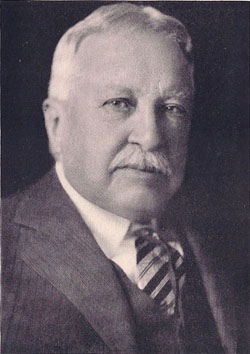
Nathan Grier Moore, musician, inventor, writer, attorney, church elder, real estate expert, was born in Cherry Tree, Pennsylvania on January 26, 1853. His parents were Rev. John and Anna Eliza (White) Moore. He graduated from Lafayette College, Easton, Pennsylvania in 1873. He moved to La Crosse and opened a music store. He became interested in the law, moved to Peoria, Illinois and was admitted to the bar in 1878. He became a partner in the law firm of James, Jack and Moore from 1978-85. While living in Peoria, he met and married Anna Walker in 1881. He also files and was granted Patent #358-469 for a type-writing machine while in Peoria. In 1885 they moved to Oak Park and he formed the partnership of Wilson and Moore with Anna’s cousin, John P. Wilson, in Chicago, Illinois. In 1988 they added an additional partner forming the firm of Wilson, Moore & McIlvaine. He argued cases before the Illinois State Supreme Court and in at least two cases (1923 and 1927) the U.S. Supreme Court. He would become regarded as Chicago’s foremost expert in real estate law.
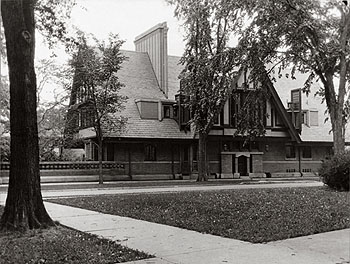
One of Frank Lloyd Wright’s early clients, Wright designed Moore’s home (S.034) in 1895. According to Wright’s "Autobiography" 1932, he wrote about Moore’s visit to his office. ‘Now we want you to build our house... but... I don’t want you to give us anything like that house you did for Winslow. I don’t want to go down backstreets to my morning train to avoid being laughed at. I would like something like this,’ he said, and laid some pictures of English half-timber work on my table... They were delighted with the house, and so was everyone but me." He recounted that he took the work because his "Three children were now running around the streets without proper shows". Pages 125-127. The Moore home would become the only English Tudor styled home he would ever design. Like Wright, he had a passion for photography, and included a dark room in his home.
A Victorian home was located one lot South of the Moore Home. He purchased the home from Frank S. Gray in 1900 and hired Wright to remodel the home as a wedding gift for his daughter and her husband, Mary and Edward R. Hills (1900, 1906 - S.051). Work did not begin until 1906, and at that time, the home was moved one lot South, enabling Moore to expand his back yard.
The May 24, 1902 issue of "The Economist", a Chicago business journal announced that "Nathan G. Moore, of the Law firm of Williams, Moore and McIlvaine, will be elected vice-president of The Federal Trust and Savings Bank, to open June 2, 1902. On January 8, 1903, he filed for and was granted Patent #729.634 for a Vehicle Wheel on June 2, 1903.
He was an very active member in the Presbyterian Church, and served as an Elder and Chairman of the music and building committees. He participated in many of the denomination’s national conventions. He was a Board Member for the Chicago Title and Trust Company of Chicago, a Director of Dolese & Shepard Co., and an associate Member of theChicago Real Estate Board. He was a Member of the Board of Trustees of Scoville Institute, and on the Board for the Oak Park High School (1906-1907).
Nathan G. Moore, published in The Theory of Evolution, 1931.
He was an accomplished writer and orator and wrotelengthy briefs as an attorney. In 1887 he and his partner John P. Wilson argued a case in the Illinois Supreme Court then published it later that year. He gave an address in 1913 entitled "Tax Evils In Illinois and their Cure" at the eighteenth Annual Meeting for the Illinois Farmer’s Institute, which was published in the annual report. In 1928 Moore wrote and published "Studies for the Adult Bible Class: Eighty-Six lessons". That same year he wrote and anonymously published the 374 page "The Theory of Evolution: an Inquiry". In 1929 he published a second edition using his name, 1931 (3rd Edition) and 1941 (4th Edition). In 1931 he published the 15 page "Winter and Spring: An Allegory". In 1934 he published the 337 page "Man and His Manor: The Past and Future of Earth and Man as Deducted from Accepted Modern Science", reprinted in 1935 and 1942 as "Man and His Manor: A History and an Outlook". "The human body must keep close to the earth, but the mind can leap in an instant a thousand years or a thousand miles. A man is strong or weak, or large or small, or gross or handsome; but these are physical, and relate to the body; the spirit is kind or unkind, harsh or tender. A man’s physical reach is a yard or two; but his memory and his aspiration are boundless and timeless. The body is visible and tangible, but the spirit can neither be seen nor touched." Page 227.
In 1922 fire gutted the home, and Wright redesigned it in 1923.
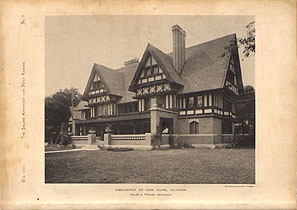
On August 16, 1946, at the age of 93, Nathan G. Moore passed away. The home was left to his children who sold it in June, 1947 to Milton G. and Mary Summerville.Date: 1898 Publication: The Inland Architect And News Record - Vol. XXXI, No.5 (Published by the Inland Architect Press)
Author: Anonymous
Description: “Residence at Oak Park, Illinois. Frank L. Wright, Architect.” Photograph of the original 1895 home before the fire that destroyed it in 1922. It was reconstructed in 1923 by Wright. IA&NR had a very small circulation at the time and these prints only appeared in a very limited number of issues that were distributed to a few prominent architects. Photogravure only, Hors-texte Plate. (Sweeney 32)
Size: 12.75 x 9
Pages: Pp 1
S#: 0032.00.0606
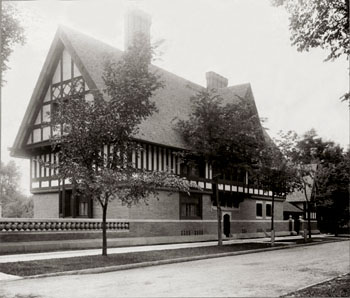
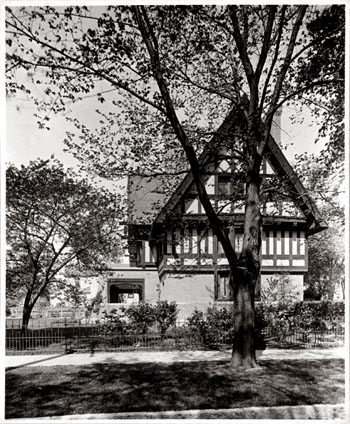
Date: Circa 1900 Title: Nathan G. Moore Residence (1895/1923 - S.034)
Description: Original 1895 structure. Originally designed in 1895, the home was destroyed by fire in 1922. It was redesigned by Wright in 1923. 333 Forest Avenue, Oak Park. Viewed from the Northeast. Superior Street is seen in the foreground. Courtesy of the Art Institute of Chicago.
Size: Original 9 x 7.75 B&W photograph.
S#: 0041.06.0112
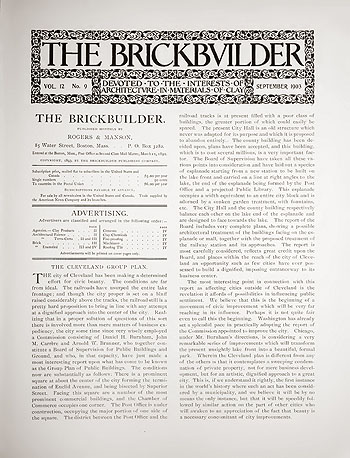
Date: 1903
Title: The Brickbuilder - September 1903 (Published monthly by Rogers & Manson Boston)
Author: Spencer, Robert C. Jr.
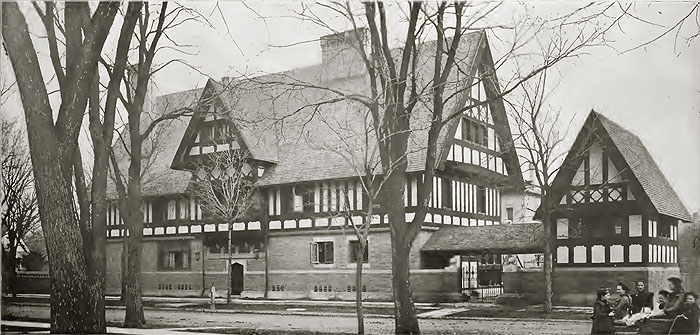
Description: "Brick Architecture in and about Chicago." An article that includes the work of Frank Lloyd Wright. It includes extensive descriptions, and images of the The Winslow Stable (1894 - S.025); Francis Apartments (1895 - S.032); Heller (2) (1896 - S.038); Husser (1899 - S.046); Charnley (1891 - S.009); Francisco Terrace (1895 - S.030); Winslow (1894 - S.024); Moore I (1895 - S.034). Very helpful in dating photographs of Wright’s early. Excerpts: The half-timbered house (Moore) in Oak Park is noteworthy for its quiet simplicity and the richness of the timber treatment in the overhanging north gable. The lower walls are of deep warm buff Roman bricks, the balustrade of the yard wall and the corbel course under the second story are of richly modeled terra-cotta. A tool house is connected to the main building in picturesque fashion. (Digital edition.) (Sweeney 54)
Size: 10 x 13
Pages: Pp 178-187
S#: 0054.00.0119
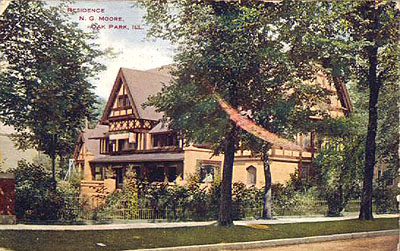
Moore Residence.Date: 1906 (Postcard) Title: Nathan G. Moore Residence
Description: “Residence N. G. Moore, Oak Park, ILL.” Published by V. O. Hammon Pub. Co., Chicago. Photograph of first design built in 1895. Redesigned after 1923 fire. No. 954. PM 6/28/07 (Have verified that No. 750 was published in 1905.)
Size: 5.4 x 3.5
S#: 0064.01.0307Date: Circa 1920 Title: Nathan G. Moore Residence (1895/1923 - S.034)
Description: Original 1895 structure. Originally designed in 1895, the home was destroyed by fire in 1922. It was redesigned by Wright in 1923. 333 Forest Avenue, Oak Park. Viewed from the East on Forest Avenue. Photographed by Henry Fuermann. Courtesy of the Art Institute of Chicago.
Size: Original 7.75 x 9.25 B&W photograph.
S#: 0142.08.0112
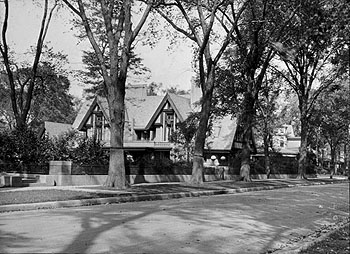
Date: Circa 1925 Title: Nathan G. Moore Residence (1895/1923 - S.034)
Description: View after reconstruction. Originally designed in 1895, the home was destroyed by fire in 1922. It was redesigned by Wright in 1923. 333 Forest Avenue, Oak Park. Viewed from the Southeast on Forest Avenue. Possibly photographed by Gilman Lane. Courtesy of the Art Institute of Chicago.
Size: Original 9 x 6.5 B&W photograph.
S#: 0171.11.0112
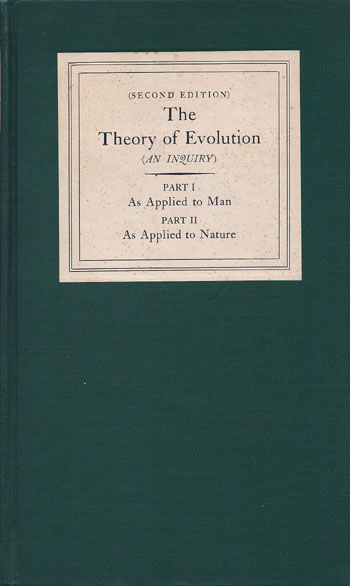
Date: 1929 Title: The Theory of Evolution (An Inquiry), From A Lawyer’s Point of View. (Hard Cover, Paper label glued to face and spine. ) (Published by The Lakeside Press: Chicago. For Private Circulation.)
Author: Moore, Nathan G.
Description: Frank Lloyd Wright designed Moore's home (S.034) in 1895 and again in 1923. The First Edition was published anonymously in 1929. This second edition using his name, was also published in 1929. Part I: As Applied to Man; Part II: As Applied to Nature; From A Lawyer’s Point of View. In his conclusion to part one, Moore argues that "The proposition of a common origin of living things is therefore completely disproved. These groups of living beings exist, and each family may be traced back to its own recognizable head, but not a common unit... It is therefore completely untenable... The theory that man descended from apes or monkeys is now definitely abandoned. (Second Edition)
Size: 5 x 8.4
Pages: Pp 374
S#: 0228.09.1211
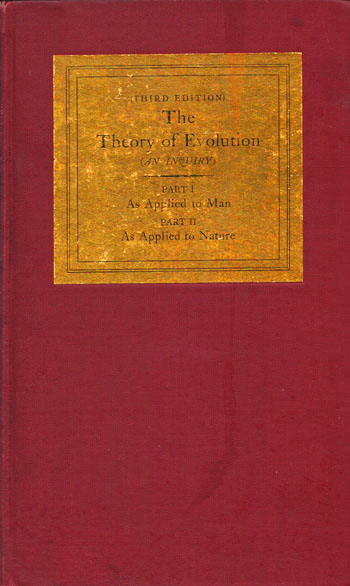
Date: 1931 Title: The Theory of Evolution (An Inquiry), From A Lawyer’s Point of View. (Hard Cover, Burgundy Cloth, Gold paper label glued to face and spine.) (Published by The Lakeside Press: Chicago. For Private Circulation.) Originally published anonymously in 1929. This third edition uses his name and includes a portrait.)
Author: Moore, Nathan G.
Description: Third edition includes a preface, dated February 1931. Part I: As Applied to Man; Part II: As Applied to Nature; From A Lawyer’s Point of View. In his conclusion to part one, Moore argues that "The proposition of a common origin of living things is therefore completely disproved. These groups of living beings exist, and each family may be traced back to its own recognizable head, but not a common unit... It is therefore completely untenable... The theory that man descended from apes or monkeys is now definitely abandoned. (Third Edition)
Size: 5 x 8.4
Pages: Pp 374
S#: 0300.06.0212
Date: Circa 1940 Title: Nathan G. Moore Residence (1895/1923 - S.034)
Description: View after reconstruction. Originally designed in 1895, the home was destroyed by fire in 1922. It was redesigned by Wright in 1923. 333 Forest Avenue, Oak Park. Viewed from the Southwest, the porch is in the foreground. Photographed by Gilman Lane. Courtesy of the Art Institute of Chicago.
Size: Original 8 x 8 B&W photograph.
S#: 0531.29.0112
Date: Circa 1940 Title: Nathan G. Moore Residence (1895/1923 - S.034)
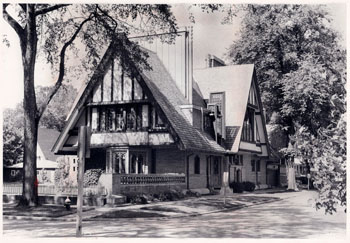
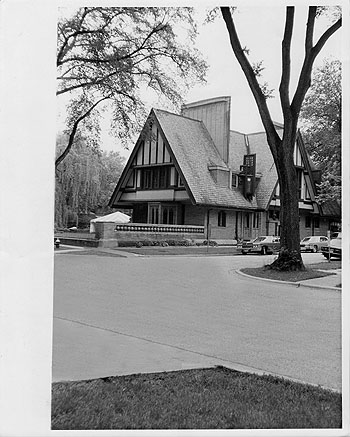
Description: View after reconstruction. Originally designed in 1895, the home was destroyed by fire in 1922. It was redesigned by Wright in 1923. 333 Forest Avenue, Oak Park. Viewed from the North, across the street on Forest Avenue. Photographed by Gilman Lane. Courtesy of the Art Institute of Chicago.
Size: Original 9 x 6.75 B&W photograph.
S#: 0531.30.0112
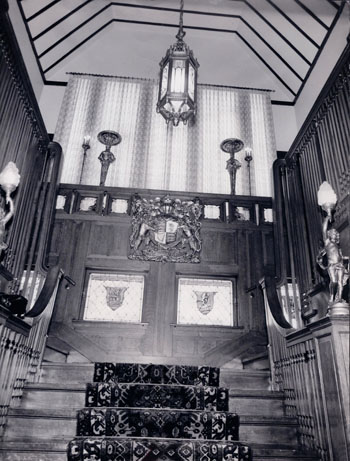
Date: 1967 Title: Nathan G. Moore Residence Stairway and balcony (1895/1923 - S.034)
Description: Originally designed in 1895, the home was destroyed by fire in 1922. It was redesigned by Wright in 1923. View of stairway and balcony. Clipping pasted to verso: "A 3-Story-High stairwell rises from what Wright called the ‘great hall’ of the house. An open mezzanine library and a third-floor balcony overlook the cathedral-like structure." Stamped on clipping: "Apr 9, 1967". See Monogram 4, pages 248-256, for additional views.
Size: Original 8.75 x 11.25 B&W photograph.
S#: 1720.13.0811
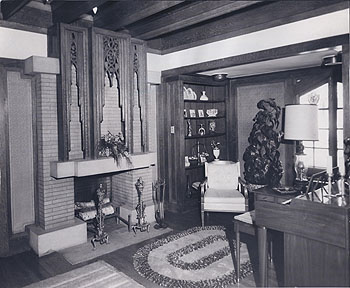
Date: 1967 Title: Nathan G. Moore Residence Fireplace (1895/1923 - S.034) 1967.
Description: Originally designed in 1895, the home was destroyed by fire in 1922. It was redesigned by Wright in 1923. View of stairway and balcony. Clipping pasted to verso: "Frank Lloyd Wright’s distinctive architectural signature is apparent in the design of the fireplace in the front living room. There are 8 fireplaces in the 22-room house, ranging in design from early American to English gothic.." Stamped on clipping: "Apr 9, 1967". See Monogram 4, pages 248-256, for additional views. Acquired from the archives of the Chicago Tribune.
Size: Original 10.25 x 8.5 B&W photograph.
S#: 1720.19.0312
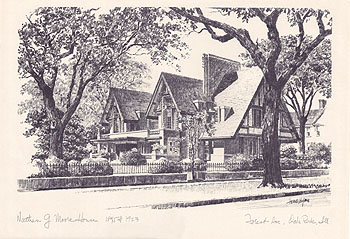
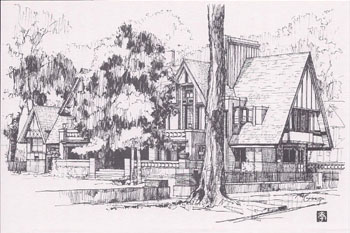
Date: Circa 1968 Title: Nathan G. Moore Residence (1895/1923 - S.34).
Artist: Hennessy, Joseph F.
Description: Illustration of residence by Joseph F. Hennessy, circa 1968. Printed on beige stock. "Nathan G. Moore House, 1995 & 1923. Forest Ave, Oak Park, Ill." Joseph F. Hennessy was born in 1917 in Pittsfield, Mass., and attended the University of Notre Dame. He was on the design team for the Prudential Building, utilizing his rendering ability. By the late 1950s, he started his own firm. His focus changed as demand for his renderings grew. His renderings of Frank Lloyd Wright structures were sold at Fallingwater and the Wright studio in Oak Park. He past away at 91, on Feb. 18, 2008.
Size: 15 x 10
S#: 1757.10.0713
Date: 1970 Title: Nathan G. Moore Residence (1923 - S.034)
Description: Label on verso: "Sun Times Photog: Dykinga. Date: July 31, 70. Location: Oak Park. Subject: Frank L. Wright Houses. Nathan G. Moore house and Stable, 333 Forest Ave." Clipping on verso: "Amid a cluster of Wright housed on Forest Av. In Oak Park stands the Nathan G. Moore house, resembling an Alpine chalet." Stamped "Sun-Times Nov 9, 1970." Acquired from the archives of the Chicago Sun-Times.
Size: Original 11 x 8.5 B&W Print.
S#: 1846.10.0310
Date: 1972 Title: Nathan G. Moore Residence (1923 - S.034)
Description: Label on verso: "Date: Jan 7 72. Location: Oak Park. Photographer: Loewe. Caption: Oak Park Village board adopted a resolution calling for an historic district to preserve examples of the so-called Prairie school of Architecture developed by Frank Lloyd Wright. 333 Forest Ave. Oak Park. Tribune photo by William Loewe." Clipping pasted to verso: "This Frank Lloyd Wright home at 333 Forest Av., Oak Park is one of 55 examples of the ‘Prairie School’ of architecture that would be preserved by the Historic Commission proposed by the Oak Park village board." Stamped on clipping: "Jan 13 1972". Acquired from the archives of the Chicago Tribune.
Size: Original 10 x 7 B&W Print.
S#: 1909.33.0112
Date: 1976 Title: Nathan G. Moore Residence (1923 - S.034)
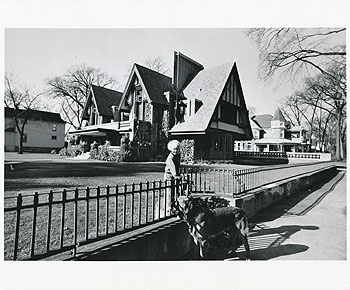
Description: Viewed from the Northeast. Forest Avenue is on the left, Superior Street is on the right. Clipping pasted to verso: "House designed by Frank Lloyd Wright at 333 Forest Av., Oak Park, one of numerous landmarks in the suburb featured in a new guidebook." Stamped on verso: "Chicago Tribune Photo by George Quinn. Printed by Robert Williams. June 25 1976". Three clippings pasted to verso dated: "Jul 1 1976, Apr 1 1977, Aug 19 1977." Acquired from the archives of the Chicago Tribune.
Size: Original 10 x 7 B&W Print.
S#: 2020.09.0112
Date: Photograph 1976 Title: Nathan G. Moore Residence (1923 - S.034)
Description: Article taped to verso (excerpt): "Wright Stamped Genius on Chicago Suburbs. ...at 333 Forest, is one of Wright’s strangest homes. Built in 1895 to satisfy a client who demanded Tudor styling, the place burned in 1922, much to Wright’s joy. He then incorporated several of his current ideas onto the Tudor shell to produce this unique and compelling home." Photo’s caption: "Built upon the shell of a mock Tudor structure, this is one of 24 buildings designed by Frank Lloyd Wright in Oak Park." Acquired from the archives of the Associated Press.
Size: Original 8 x 10 B&W Print
S#: 2020.06.0211
Date: 1980
Title: Nathan G. Moore Residence, Oak Park 1980 (1923 - S.034).
Description: View of the Moore Residence from the Southeast. Frank Lloyd Wright originally designed the Moore Residence in 1895, redesigned the Moore Residence in 1923 after a fire. Label pasted to verso: "The Nathan G. Moore Home. 333 Forest Avenue, Oak Park, Illinois. Designed by Frank Lloyd Wright in 1895 and 1923.." Stamped on verso: "PD Feb 8 ‘80.
Size: Original 10 x 8 B&W photograph.
ST#: 1980.52.0819Date: 1980
Title: Nathan G. Moore Residence, Oak Park1980 (1923 - S.034).
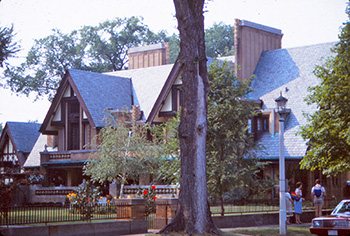
Description: 1) View of the Moore Residence from the Southeast. Frank Lloyd Wright originally designed the Moore Residence in 1895, redesigned the Moore Residence in 1923. Text stamped on sleeve: "4. Apr 80 C14."
Size: Original 35mm Ektachrome slide transparency and high res 5" x 8" digital color image.
ST#: 1980.48.0419-1Date: 1980
Title: Nathan G. Moore Residence, Oak Park1980 (1923 - S.034).
Description: 2) View of the Moore Residence from the Southeast. Frank Lloyd Wright originally designed the Moore Residence in 1895, redesigned the Moore Residence in 1923. Text stamped on sleeve: "4. May 80 C15."
Size: Original 35mm Ektachrome slide transparency and high res 5" x 8" digital color image.
ST#: 1980.48.0419-2Date: 1980
Title: Nathan G. Moore Residence, Oak Park1980 (1923 - S.034).
Description: 3) Detailed view of the Moore Residence from the Southwest. Frank Lloyd Wright originally designed the Moore Residence in 1895, redesigned the Moore Residence in 1923. Text stamped on sleeve: "6. May 80 C15."
Size: Original 35mm Ektachrome slide transparency and high res 5" x 8" digital color image.
ST#: 1980.48.0419-3Date: 1981
Title: Nathan G. Moore Residence, Oak Park, Illinois 1981 (1923 - S.034).
Description: View of the Moore Residence from the Southeast. Frank Lloyd Wright originally designed the Moore Residence in 1895, redesigned the Moore Residence in 1923 after a fire. Label pasted to verso: "Nathan Moore House, Oak Park, Ill., designed by Frank Lloyd Wright. Photo by Thomas S. England, courtesy Oak Park Tour Center." Stamped on verso: "Oct 25 1981." Photographed by Thomas S. England.
Size: Original 7 x 5 B&W photograph.
ST#: 1981.150.0520Date: Circa 1983
Title: 1) Nathan G. Moore Residence, Oak Park, Illinois Circa 1983 (1923 - S.034).
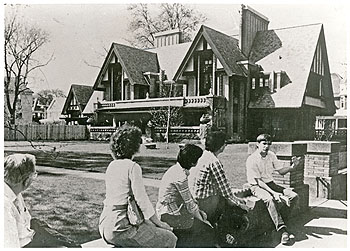
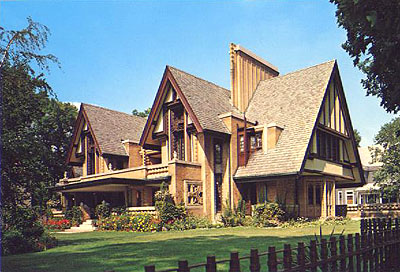
Description: iew of the Moore Residence from the Southeast. Not dated, but in a set of 20 slides of Frank Lloyd Wright houses in the Chicago area dated 1983-1985. Frank Lloyd Wright originally designed the Moore Residence in 1895, redesigned the Moore Residence in 1923 after a fire. Stamped on the sleeve: “22." Printed on sleeve verso: “Ektachrome Transparency.”
Size: Original 35mm Color slide.
ST#: 1983.68.0225-1Date: Circa 1983
Title: 2) Nathan G. Moore Residence, Oak Park, Illinois Circa 1983 (1923 - S.034).
Description: View of the Moore Residence from the Southeast. The front entrance is at the center of the house. Part of a set of 20 slides of Frank Lloyd Wright houses in the Chicago area dated 1983-1985. Frank Lloyd Wright originally designed the Moore Residence in 1895, redesigned the Moore Residence in 1923 after a fire. Stamped on the sleeve: “4. Jul 1983." Hand written on face: “Nathan Moore 1895 - 1929.” Printed on sleeve verso: “Kodachrome Slide.”
Size: Original 35mm Color slide.
ST#: 1983.68.0225-2Date: Circa 1983
Title: 3) Nathan G. Moore Residence, Oak Park, Illinois Circa 1983 (1923 - S.034).
Description: Detailed view of the Moore Residence. Part of a set of 20 slides of Frank Lloyd Wright houses in the Chicago area dated 1983-1985. Frank Lloyd Wright originally designed the Moore Residence in 1895, redesigned the Moore Residence in 1923 after a fire. Stamped on the sleeve: “35." Printed on sleeve verso: “Color Transparency.”
Size: Original 35mm Color slide.
ST#: 1983.68.0225-3Date: 1990
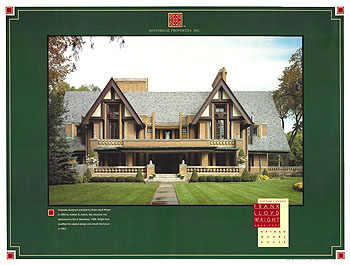
Title: Nathan Moore House, Frank Lloyd Wright Architect (Published by Historical Properties, Inc.)
Description: Nathan Moore House, Frank Lloyd Wright Architect, Oak Park, Illinois. "Originally designed and built by Frank Lloyd Wright in 1895 for Nathan G. Moore, this structure was destroyed by fire in December, 1922. Wright then modified his original design and rebuilt the house in 1923. Design: Michael Reid Design. Photo: Tony Keisman.
Size: 25 x 19
ST#: 1990.134.1117Date: Circa 1990 (Postcard) Title: “Nathan G. Moore House, Oak Park, Illinois - 1895. Reconstructed after fire - 1923. Frank Lloyd Wright, architect" (Published By H. K. Barnett, Allison Park, PA 15101) (Published exclusively for the Frank Lloyd Wright Home and Studio Foundation, 951 Chicago Avenue, Oak Park, Illinois 60302)
Description: One of the most picturesque houses in the village, the Moore House is unusual because it was one of the few major pre-Prairie style houses Wright designed in an historic style (English Tudor). According to Wright, the house was built for a man who did not want to shock his neighbors, so it does not demonstrate the level of design innovations Wright had already achieved. FLLW-7 #761424
Size: 5.8 x 4
ST#: 1990.58.0507
D) Nathan G. Moore House (#11) Date: 1992 Title: Nathan G. Moore Residence (1923 - S.034) 1992.
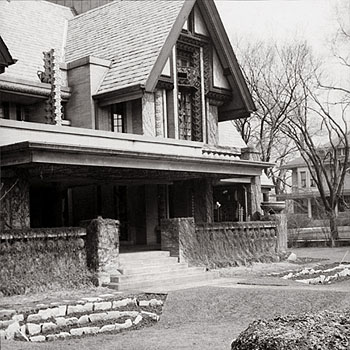
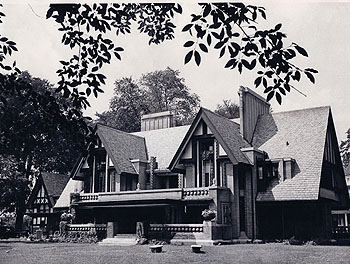
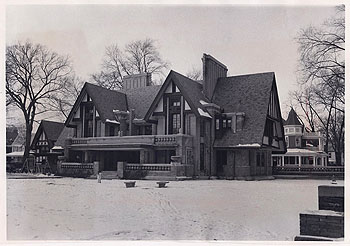
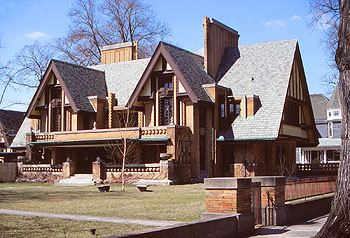
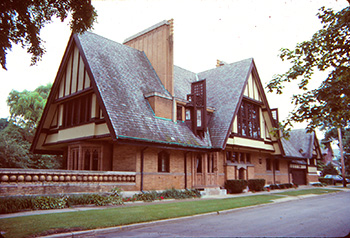
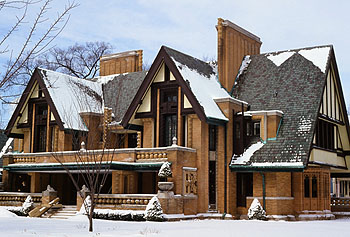
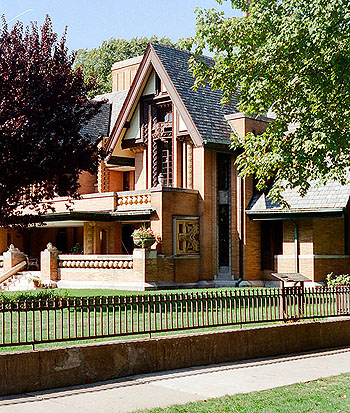
Description: Set of 4 images from a trip to Oak Park in March, 1992. Viewed from the Southeast. This is the back of the home. Originally designed in 1895, a fire gutted the house 1922. Wright redesigned it the home in 1923. It is constructed of Roman brick. This was the only home Wright designed in a Tutor style. Photographed by Douglas M. Steiner.
Size: 35mm color slide and 12 x 8" high res color digital image.
ST#: 1992.93.1015-1
Date: 1992 Title: Nathan G. Moore Residence (1923 - S.034) 1992.
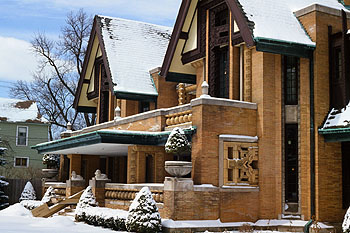
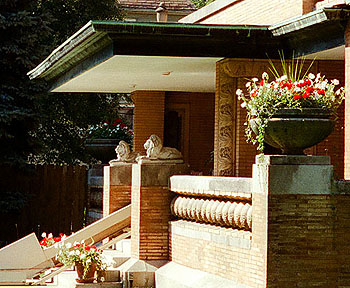
Description: Set of 4 images from a trip to Oak Park in March, 1992. Viewed from the Southeast. This is the back of the home. Originally designed in 1895, a fire gutted the house 1922. Wright redesigned it the home in 1923. It is constructed of Roman brick. The porch overhang is cantilevered out over the stairs. This was the only home Wright designed in a Tutor style. Photographed by Douglas M. Steiner.
Size: 35mm color slide and 12 x 8" high res color digital image.
ST#: 1992.93.1015-2
Date: 1992 Title: Nathan G. Moore Residence (1923 - S.034) 1992.
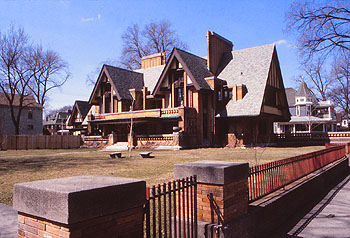
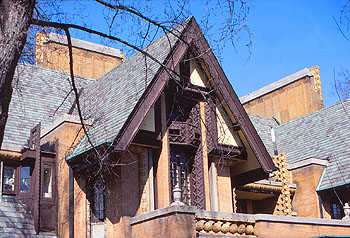
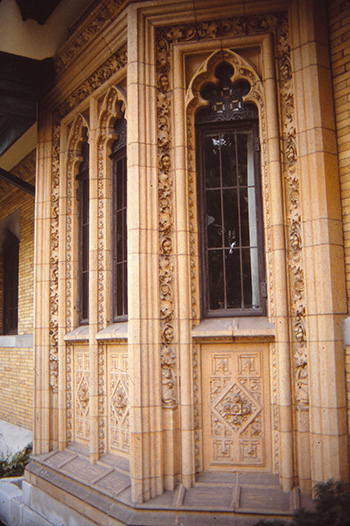
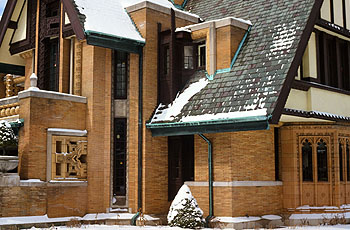
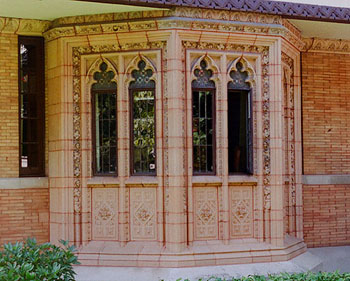
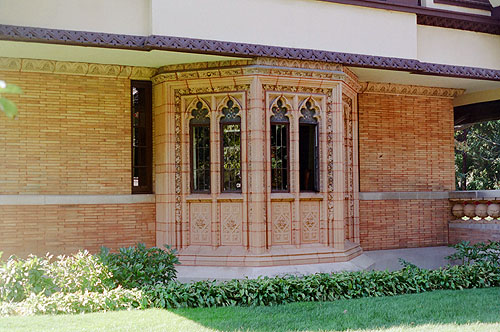
Description: Set of 4 images from a trip to Oak Park in March, 1992. Viewed of the Southeast corner of the home. Originally designed in 1895, a fire gutted the house 1922. Wright redesigned it the home in 1923. It is constructed of Roman brick. Detail of the exterior Southeast corner of the home. The Library is in the center, the Living Room is on the right. This was the only home Wright designed in a Tutor style. Photographed by Douglas M. Steiner.
Size: 35mm color slide and 12 x 8" high res color digital image.
ST#: 1992.93.1015-3
Date: 1992 Title: Nathan G. Moore Residence (1923 - S.034) 1992.
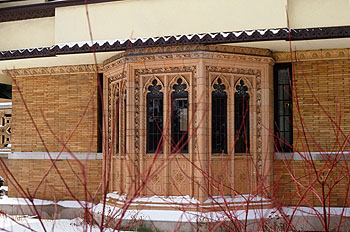
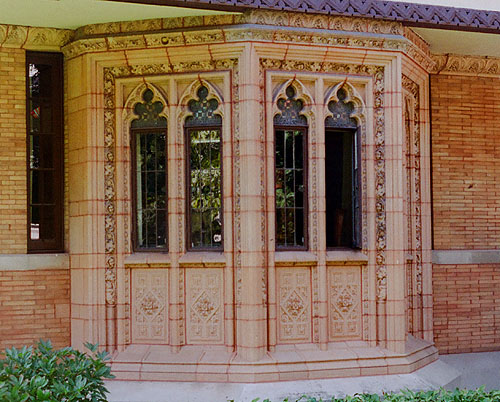
Description: Set of 4 images from a trip to Oak Park in March, 1992. Viewed from the East. Originally designed in 1895, a fire gutted the house 1922. Wright redesigned it the home in 1923. It is constructed of Roman brick. Detail of the Living bay window. This was the only home Wright designed in a Tutor style. Photographed by Douglas M. Steiner.
Size: 35mm color slide and 12 x 8" high res color digital image.
ST#: 1992.93.1015-4
Date: 2002
Title: Nathan G. Moore Residence, 2002 (1895/1923 - S.034).
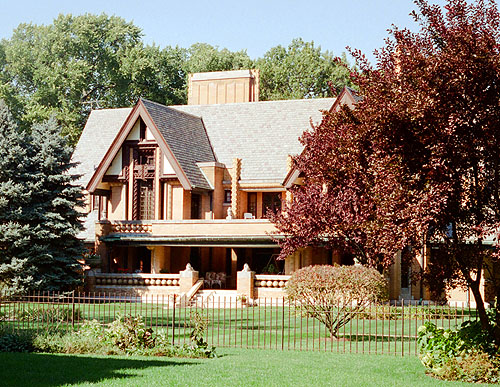
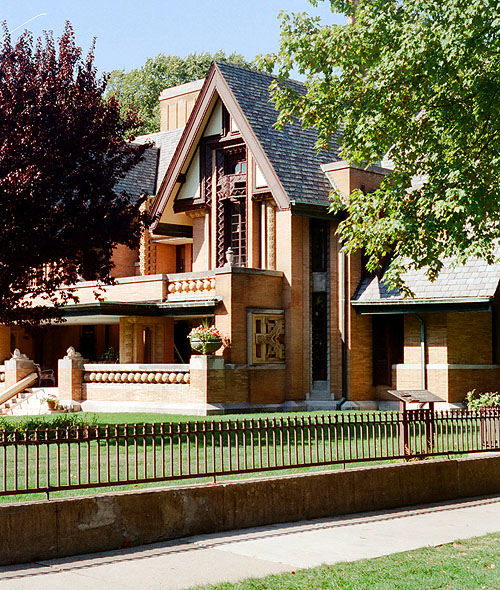
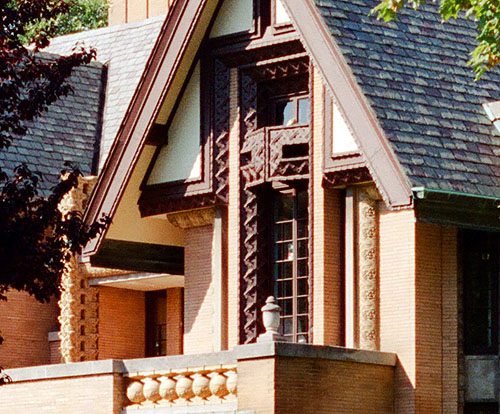
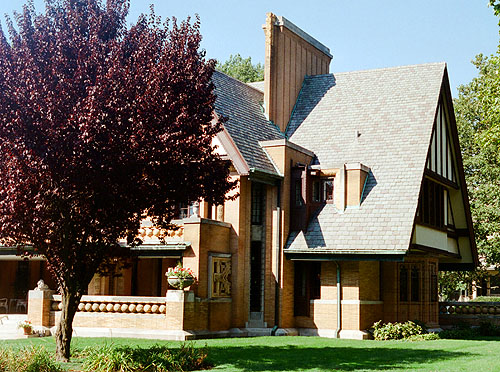
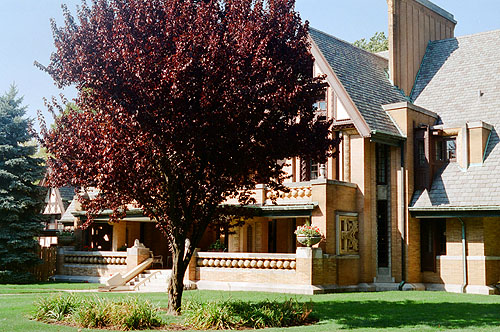
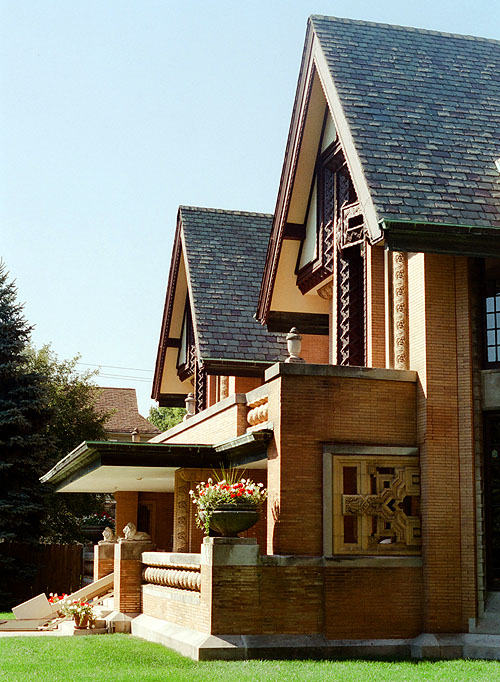
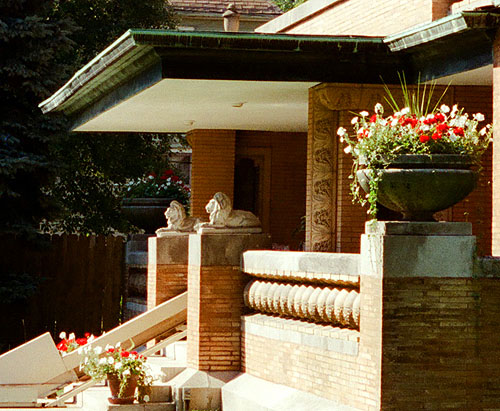
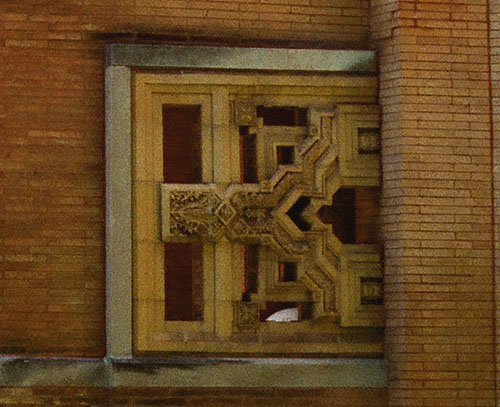
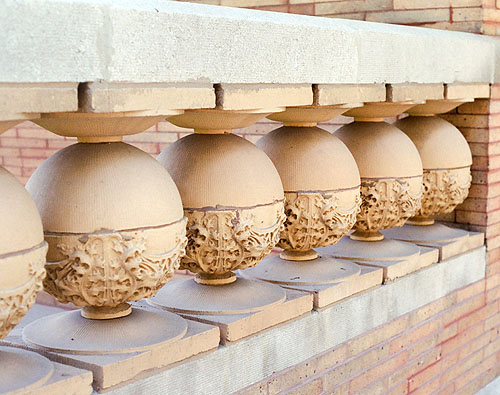
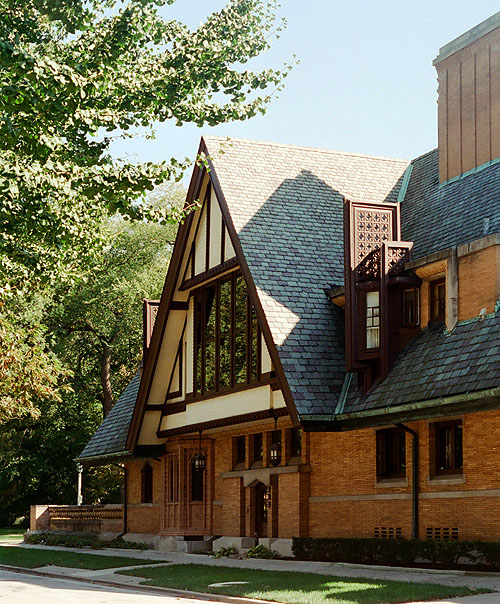
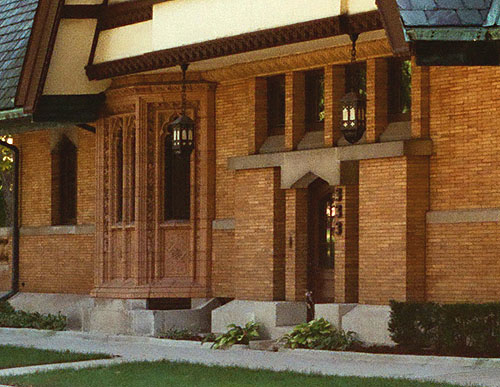
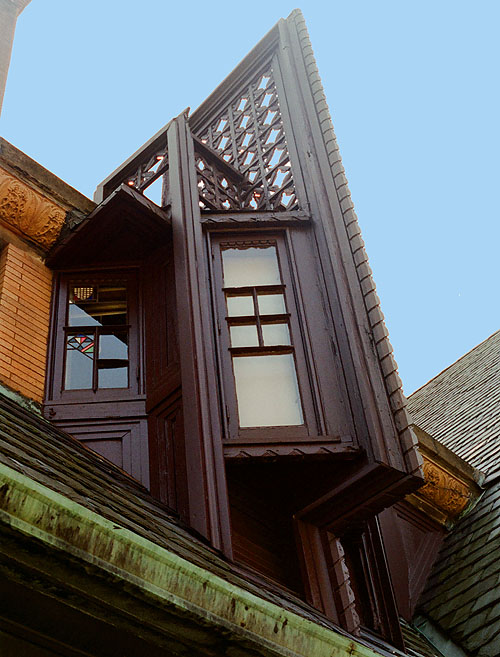
Description: One of Frank Lloyd Wright’s early clients, Wright designed Moore’s first home (S.034) in 1895, the home was destroyed by fire in 1922. It was redesigned by Wright in 1923. According to Wright’s Autobiography, 1932, he wrote about Moore’s visit to his office. ‘Now we want you to build our house... but... I don’t want you to give us anything like that house you did for Winslow. I don’t want to go down back streets to my morning train to avoid being laughed at. I would like something like this,’ he said, and laid some pictures of English half-timber work on my table... They were delighted with the house, and so was everyone but me." He recounted that he took the work because his "Three children were now running around the streets without proper shows". Pages 125-127. The Moore home would become the only English Tudor styled home he would ever design. Like Wright, he had a passion for photography, and included a dark room in his home. Constructed of Roman brick, it is embellished with Sullivanesque terra-cotta details and balusters, limestone and wood trim. The Sullivanesque balusters are similar to those of the 1894 Roloson Rowhouses. Some of the 1923 terra-cotta is reminiscent of the Imperial Hotel's carved oya. The steeply pitched slate roof forms prominent gable ends. The back of the house appears more elaborate then the front, and in the style of Wright, the main entrance is hidden in plain sight. "The most remarkable thing is that when he redesigned the house after a fire in 1922, Mr. Wright went back to extremely Sullivanesque detail in the terra-cotta and wood carving." Apprentice to Genius, Tafel, 1979, p.59. Photographed by Douglas M. Steiner in September 2002.
Size: Set of eleven 35mm slides and 14" x 9" high res digital images.
ST#: 2002.120.1216 (1-11)
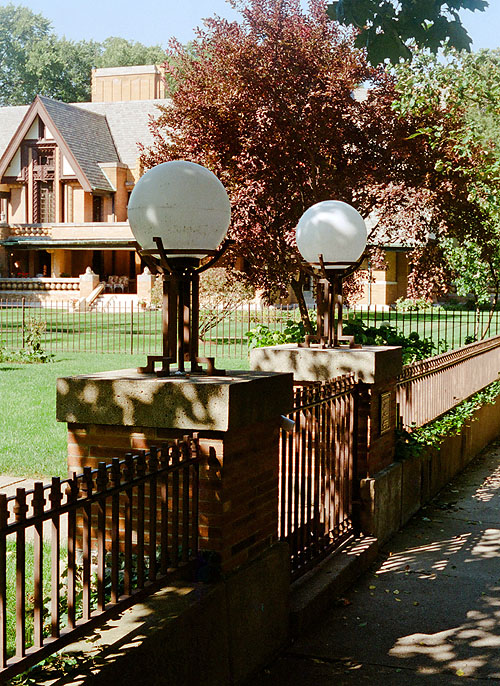
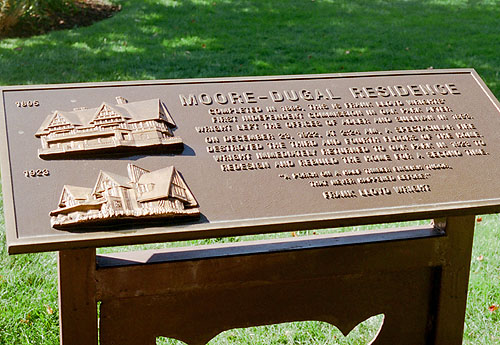
NATHAN G. MOORE RESIDENCE 2002 1) The Moore Residence viewed from the Southeast, the Moore Residence is located one block South of Frank Lloyd Wright's home in Oak Park. Photographed in front of the entrance to the Hills Residence, a home Wright designed for Moore and his daughter. One of Frank Lloyd Wright's early clients, Wright designed Moore's first home (S.034) in 1895, the home was destroyed by fire in 1922. It was redesigned by Wright in 1923. Photographed by Douglas M. Steiner in September 2002. 35mm slide and 14" x 9" high res digital image. (ST#2002.120-1) 2) The Moore Residence viewed from the Southeast, the Moore Residence is located one block South of Frank Lloyd Wright's home in Oak Park. Photographed in front of the entrance to the Hills Residence, a home Wright designed for Moore and his daughter. One of Frank Lloyd Wright's early clients, Wright designed Moore's first home (S.034) in 1895, the home was destroyed by fire in 1922. It was redesigned by Wright in 1923. Photographed by Douglas M. Steiner in September 2002. 35mm slide and 14" x 9" high res digital image. (ST#2002.120-2) 3) The Moore Residence viewed from the Southeast. One of Frank Lloyd Wright's early clients, Wright designed Moore's first home (S.034) in 1895, the home was destroyed by fire in 1922. It was redesigned by Wright in 1923. According to Wright's Autobiography, 1932, he wrote about Moore's visit to his office. "Now we want you to build our house... but... I don't want you to give us anything like that house you did for Winslow. I don't want to go down back streets to my morning train to avoid being laughed at. I would like something like this," he said, and laid some pictures of English half-timber work on my table... They were delighted with the house, and so was everyone but me." He recounted that he took the work because his "Three children were now running around the streets without proper shows". Pages 125-127. Photographed by Douglas M. Steiner in September 2002. 35mm slide and 14" x 9" high res digital image. (ST#2002.120-3) 3A) Detail of the Sullivanesque terra-cotta details and balusters, limestone and wood trim. 4) The Moore Residence plaque: Moore-Dugal Residence. Completed in 1896, this is Frank Lloyd Wrights' first independent commission in Oak Park after Wright left the offices of Adler and Sullivan in 1893. On December 23, 1922, at 2:24 am, a spectacular fire destroyed the third and fourth floors of the home. Wright immediately returned to Oak Park in 1923 to redesign and rebuild the home for a second time. "A porch on the half timber English Tudor, that never happened before." Frank Lloyd Wright. Photographed by Douglas M. Steiner in September 2002. 35mm slide and 14" x 9" high res digital image. (ST#2002.120-4) 5) The Moore Residence viewed from the Southeast. The Moore home would become the only English Tudor styled home he would ever design. Photographed by Douglas M. Steiner in September 2002. 35mm slide and 14" x 9" high res digital image. (ST#2002.120-5) 6) The Moore Residence viewed from the Southeast. Like Wright, he had a passion for photography, and included a dark room in his home. Photographed by Douglas M. Steiner in September 2002. 35mm slide and 14" x 9" high res digital image. (ST#2002.120-6) 7) The Moore Residence viewed from the East. Constructed of Roman brick, it is embellished with Sullivanesque terra-cotta details and balusters, limestone and wood trim. Photographed by Douglas M. Steiner in September 2002. 35mm slide and 14" x 9" high res digital image. (ST#2002.120-7) 7A) Detail of the back entrance. The porch overhang is cantilevered out over the stairs. 7B) Detail of the Moore Residence. Constructed of Roman brick, it is embellished with Sullivanesque terra-cotta details and balusters, limestone and wood trim. 8) The Moore Residence viewed from the East. Constructed of Roman brick, it is embellished with Sullivanesque terra-cotta details and balusters, limestone and wood trim. Some of the 1923 terra-cotta is reminiscent of the Imperial Hotel's carved oya. Photographed by Douglas M. Steiner in September 2002. 35mm slide and 14" x 9" high res digital image. (ST#2002.120-8) 8A) Detail of the Sullivanesque terra-cotta details and balusters, limestone and wood trim. 9) The Moore Residence viewed from the East. Constructed of Roman brick, it is embellished with Sullivanesque terra-cotta details and balusters, limestone and wood trim. The Sullivanesque balusters are similar to those of the 1894 Roloson Rowhouses. Photographed by Douglas M. Steiner in September 2002. 35mm slide and 14" x 9" high res digital image. (ST#2002.120-9) 10) The Moore Residence viewed from the Northwest. The steeply pitched slate roof forms prominent gable ends. The back of the house appears more elaborate then the front, and in the style of Wright, the main entrance is hidden in plain sight. "The most remarkable thing is that when he redesigned the house after a fire in 1922, Mr. Wright went back to extremely Sullivanesque detail in the terra-cotta and wood carving." Apprentice to Genius, Tafel, 1979, p.59. Photographed by Douglas M. Steiner in September 2002. 35mm slide and 14" x 9" high res digital image. (ST#2002.120-10) 10A) Detail of the front of the home, and in the style of Wright, the main entrance is hidden in plain sight. 11) The Moore Residence. The steeply pitched slate roof forms prominent gable ends. "The most remarkable thing is that when he redesigned the house after a fire in 1922, Mr. Wright went back to extremely Sullivanesque detail in the terra-cotta and wood carving." Apprentice to Genius, Tafel, 1979, p.59. Photographed by Douglas M. Steiner in September 2002. 35mm slide and 14" x 9" high res digital image. (ST#2002.120-11) FOR ADDITIONAL INFORMATION ABOUT THE MOORE RESIDENCE VISIT OUT WRIGHT STUDY ON THE ROLOSON ROWHOUSES.
HOME ARTIFACTS AUDIO BOOKS PERIODICALS PHOTOS POSTCARDS POSTERS STAMPS STUDIES ASSISTING ABOUT SLIDE SHOW To donate or pass on information, comments or questions:
steinerag@msn.com
©Copyright Douglas M. Steiner, 2001, 2025